

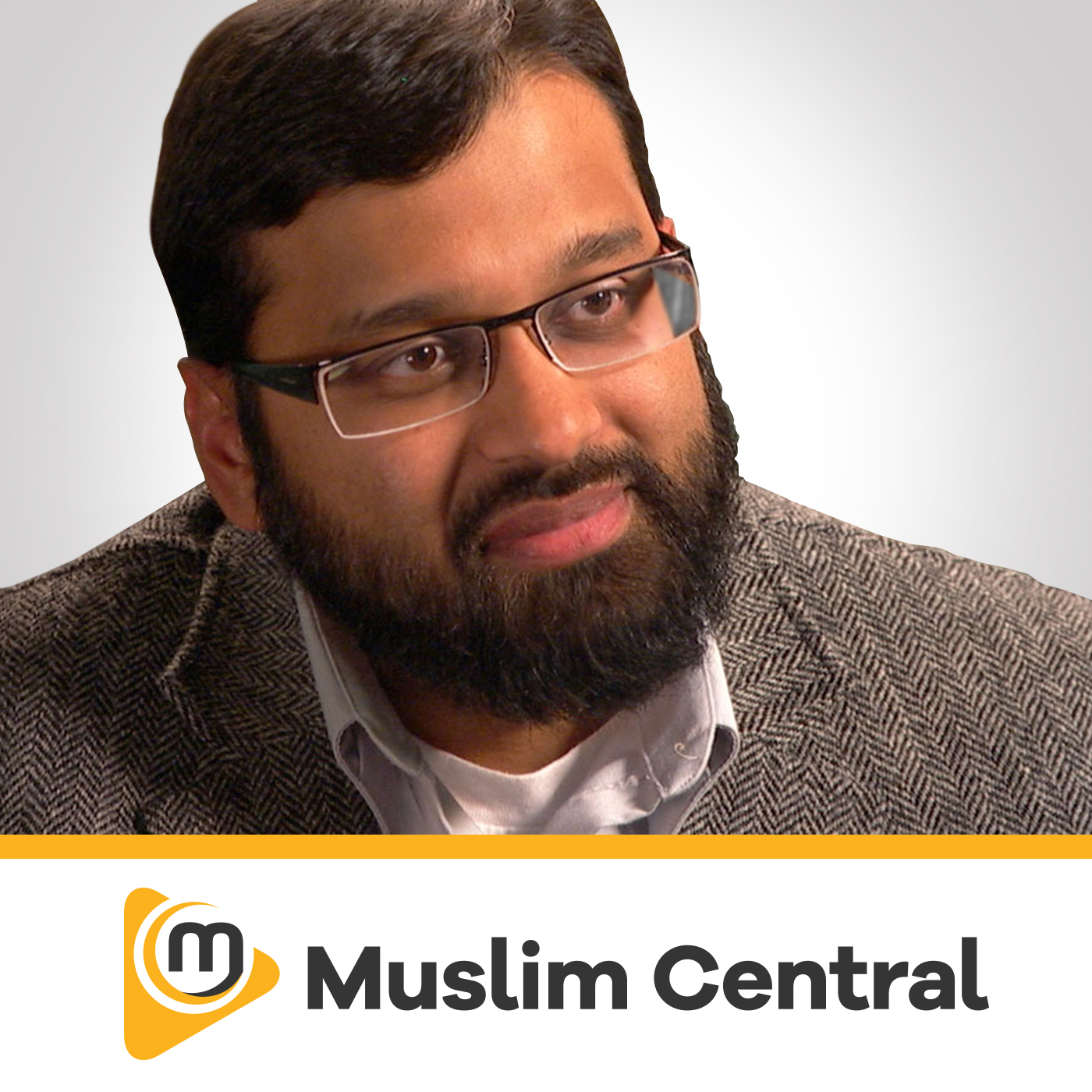
Yasir Qadhi
Muslim Central
Yasir Qadhi was born in Houston, Texas and completed his primary and secondary education in Jeddah, Saudi Arabia. He graduated with a B.Sc. in Chemical Engineering from the University of Houston, after which he was accepted as a student at the Islamic University of Madinah.
After completing a diploma in Arabic, he graduated with a B.A. from the College of Hadith and Islamic Sciences.
Thereafter, he completed a M.A. in Islamic Theology from the College of Dawah, after which he returned to America and completed his doctorate, in Religious Studies, from Yale University. Currently he is teaching at Rhodes College, in Memphis, TN.
After completing a diploma in Arabic, he graduated with a B.A. from the College of Hadith and Islamic Sciences.
Thereafter, he completed a M.A. in Islamic Theology from the College of Dawah, after which he returned to America and completed his doctorate, in Religious Studies, from Yale University. Currently he is teaching at Rhodes College, in Memphis, TN.
Episodes
Mentioned books

17 snips
Feb 6, 2019 • 1h 20min
Mothers of the Believers - Definition & Blessings of the Mothers - Part 2
Discover the revered status of the 'Mothers of the Believers' and their unique roles in Islamic tradition. Explore their characteristics and compare the esteemed virtues of figures like Khadija and Aisha. Engage in theological debates about their ranks in the afterlife and unravel the complexities of their marriages to the Prophet Muhammad. The discussion challenges traditional teachings, aiming for a more realistic portrayal of these iconic women, whose legacies continue to influence the Muslim community.
13 snips
Feb 2, 2019 • 1h 29min
Mothers of the Believers - Definition, Blessings & Rights of Ahl-al-Bayt
Dive into the revered lineage of the Prophet Muhammad's family, exploring who qualifies as Ahl al-Bayt and their esteemed roles in Islam. Discover the extraordinary status of the Prophet's wives, known as 'Mothers of the Believers,' and their profound blessings. Uncover the virtues of Hassan and Hussein, who are celebrated leaders in paradise. The podcast highlights the importance of character and deeds over mere heritage, while also addressing historical opposition faced by the Prophet's family, ensuring respect for their legacy.
Jan 1, 2019 • 27min
Why is there so much suffering in this World
Shaykh Yasir Qadhi goes into the tangent of the sad reality that encompasses the pertinent question - "Why is there so much suffering in this world?"
There are two types of calamities in this world:
The calamity of food and shelter
The calamity of war and strife
The theological wisdom behind calamities and suffering in this world are as follows:
Demonstrates Lordship - only Allah is Powerful, no one else.
Appreciation of the fact that we are the servants of Allah.
The religiosity, Iman, Taqwa, Du'a and calling to Allah that comes as a result.
Exhibition of the best Akhlaq in a person.
Allah allows others to demonstrate generosity and test those who are blessed with the worldly benefits and pleasures.
Appreciation of the blessings and ease in our daily life for which we ought to be thankful to Allah.
Blessings of Allah on the Day of Judgment due to pain in this world.
Dec 24, 2018 • 2h 10min
The Fiqh of Celebrations And Imitation - Tashabbuh
Shaykh Yasir Qadhi is about celebrations and imitating the Kuffar. Some celebrations are prohibited by the scholars because of the imitation of the Kuffar.
What does Eid mean? Shaykh Yasir answers.What is the verdict of the scholars on celebrating festivals other than the two Eids?there are two opinions.
Any festival celebrated other than Eid ul Fitr and Eid al Adha is linked to Bidah which is nonsensical.
It is imitating the Kuffar.
The Messenger of Allah ﷺ said, “Whoever imitates a people is one of them.”
Abdullaah ibn Umar RA that the Messenger of Allah ﷺ said: "Differentiate yourself from the Mushrikeen: trim the moustache and let the beard grow."
The above is one of the many Hadith that makes it clear to not imitate the Kuffar.
Sometimes Tashabbah becomes Mubah or Mustahab or even Wajib at times qs narrated by Ibn Taymiyyah in his book relating the same topic. A few examples are shared and we are able to comprehend it in a better manner.
Dec 18, 2018 • 1h 31min
Defining Bid’a: Between Blind Emotionalism & Balanced Rituals
Shaykh Yasir Qadhi acquaints us with the reality of the concept of Bid’ah or Innovation which is a branch of theology. What constitutes an innovation? What are the branches? Where and when does this occur, including the categories found within, along with the dangers related.
Linguistically, Bid'ah means to bring something unprecedented or that which has not been brought before. Islamically, it implies a new methodology or action in Islam. It is the opposite of Sunnah. Every Bid'ah is a misguidance and leads to Jahannam.
Bid'ah has the same categories as Islam such as Wajib, Mustahab, Mubah, Makrooh and Haram.
Categories of Bid'ah:
Bid'ah Filiyah (doing something more) vs Bid'ah Tarqiyyah (giving something up) - examples are stated.
Bid'ah I'tiqadiyah (Bid'ah of Aqeedah) vs Bid'ah Amaliyyah( action based Bid'ah) - illustrated via examples.
Bid'ah Kulliyyah vs Bid'ah Juziyyah.
Bid'ah Baseethah vs Bid'ah Murakkabah.
Bid'ah Haqeeqiyyah (True Bid'ah) vs Bid'ah Idhaafiyyah (adding or tweaking something more to something that is already present).
Various examples citing the Hadith are illustrated and we get numerous clarifications thus, making for a very interesting and mesmerising listen.
Nov 23, 2018 • 1h 13min
Lives of Sahaba 78 - Suhayl Ibn Amr And His Family
In this video, Shaykh Yasir Qadhi delves into the biography of Suhayl Ibn Amr and his family.
He was the Khatib or orator and one of the leaders of Makkah at the time of the advent of Islam. His two famous sons with regards to Islam are - Abdullah Ibn Suhayl and Abu Jandal Ibn Suhayl. As we shall learn, we gather his role in the refusal of protection of Prophet Muhammad ﷺ on his return from Ta'if. He was also instrumental in concluding the Treaty of Hudaybiyyah and we shall see the incidents that transpired during these events. He set the condition for the treaty to be signed from the Muslims as Muhammad ibn Abdullah as opposed to the Prophet Muhammad, which was outright rejection of the Prophethood.
He died of the Amawas plague in the 18th year of the Hijra.
Oct 28, 2018 • 1h 32min
Lives of Sahaba 77 - Abu Hurayrah pt.2
In a continuation of the previous video, Shaykh Yasir elucidates in great detail the incidents that led to the defamation of Abu Hurayrah RA and attempts to clarify the common misconceptions one may have.
Abu Hurayrah became an emissary of sorts in no time because of his utmost dedication and devotion to the Prophet ﷺ. He was given the responsibility of breaking the news to the people that no Mushrik will perform Hajj after the conquest of Mecca. He also accompanied the Prophet ﷺ pretty much everywhere he went and also participated in battles.
Once Abu Hurayrah RA asked the Prophet ﷺ: “O Messenger of Allah SAW, who will be the most fortunate of people to receive your intercession on the Day of Resurrection?” The Prophet ﷺ replied: “O Abu Hurayra, I knew, because of your love of what I say, that no one other than you would ask me of this hadith. The most fortunate of people to receive my intercession on the Day of Resurrection are those who said: La ilaha illallah purely and sincerely - with Ikhlas -from the heart.”
Abu Hurayrah RA narrates that the Messenger of Allah ﷺ said: "Whoever attributes to me something that I have not said, let him take his place in Hell.'"
Abu Hurayrah also narrated that the Prophet ﷺ said, "A believer who accompanies the Janazah of a Muslim out of sincere faith and hoping to attain Allah's reward and remains with it till the Janazah is offered and the burial ceremonies are over, he will return with a reward of two Qirats. Each Qirat is like the size of the Mount Uhud. “
His most famous students were Mohammed Ibn Sireen and Sa’d Ibn Mus'ayb RA. Such was the stature of Abu Hurayrah RA that he was the one who performed the Salat Janaza of both Aisha RA and Umme Salamah RA.
Abu Hurayrah RA mentions that were it not for the Qur’anic revelation, I would not have narrated any Hadith which is - ‘Indeed, those who conceal the clear signs and guidance that We have sent down, after We have made them clear to the people in the Book, they, such of them, are cursed by Allah and cursed by those who curse.’
He was always saddened by his mother being a mushrik and longed for her to become a Muslim but she vehemently refused. One day, she made some negative remarks about the Prophet ﷺ which saddened him greatly and he went to the Prophet ﷺ who said to him:
"What makes you cry, O Abu Hurairah?""I have not succeeded in inviting my mother to Islam and today i ask you to do dua to Allah SWT to make the heart of Abu Hurairah mother incline to Islam."Rasulullah ﷺ responded to Abu Hurairah request and did as was requested of him.
After some time, he went home and found the door closed. He heard the splashing of water and when he tried to enter his mother said, 'Stay where you are, O Abu Hurairah.' And after putting on her clothes, she said, 'Enter!' he entered and she said, 'I testify that there is no Allah but Allah and I testify that Muhammad is His Servant and His Messenger.'he then returned to Rasulullah ﷺ and said, 'I have good news, O Messenger of Allah ﷺ. Allah has responded to your prayer and guided the mother of Abu Hurairah to Islam.' "
There is none among the companions of the Prophet ﷺ who has narrated more Hadiths than Abu Hurairah RA except 'Abdullah bin Amr bin Al-'As who used to write them and Abu Hurairah never did the same - instead he memorized them - so he had more to his credit.
Oct 22, 2018 • 1h 26min
Lives of Sahaba 76 - Abu Hurayrah pt.1
In this lecture, we are transported into the life and times of one of the greatest defenders of the Sunnah - Abu Hurairah Ad Dawsi - by Shaykh Yasir Qadhi.
The lecture begins with a brief transcript of one man - Al Tufayl ibn Amr al Dawsi- who was the chieftain of a tribe named Daws (Yemen) and the reason behind this discussion is revealed in he being the one who gave da'wah to Abu Hurairah to accept Islam.
Abu Hurayrah was formerly called Abd al Shams and Abd al Raḥman ibn Ṣakhr. He was given the present name by the Prophet ﷺ in all likelihood of his extreme fondness of kittens.he was the leader of Ahle Suffah. 5700 hadith have been narrated by Abu Hurayrah which is 2 to 3 times more than what any other Sahaba might have done.
Narrated by Abu Hurayrah, "One day, my hunger became so severe that I placed a stone on my stomach. Abu Bakr passed by and I asked him about an ayah of the Book of Allah. I only asked him so that he would invite me but he did not.Then Umar ibn al Khattab passed by me and I asked him about an ayah but he also did not invite me. Then the Messenger of Allah ﷺ passed by and realized that I was hungry and said,' Abu Hurayrah!”'At your command,' I replied and followed him until we entered his house. He found a bowl of milk and asked his family:'From where did you get this?"Someone sent it to you,' they replied. He then said to me: 'O Abu Hurayrah, go to the Ahlus-Suffah and invite them.'"I did as I was told and they all drank from the milk." when they had finished, the Messenger of Allah ﷺ said to me drink! I drank and i drank till i was satiated. Then I said ‘O Messenger of Allah ﷺ, there is no way I can drink any more.’ He realised that the Messenger ﷺ was teaching him the blessings of Allah SWT.
Narrated Abu Huraira : You people say that Abu Huraira tells many narrations from the Prophet ﷺ and you also wonder why the emigrants and Ansar do not narrate from him as Abu Hurairah does. My emigrant brothers were busy in the market while I used to stick to the Prophet ﷺ content with what fills my stomach; so I used to be present when they were absent and I used to remember when they used to forget, and my Ansari brothers used to be busy with their properties and I was one of the poor men of Suffah. I used to remember the narrations when they used to forget. The Prophet ﷺ once said, "Whoever spreads his garment till I have finished my present speech and then gathers it to himself, will remember whatever I will say." So, I spread my coloured garment which I was wearing till the Messenger of Allah ﷺ had finished his saying, and then I gathered it to my chest. So, I did not forget any of that narrations.”
Tune in for the next part in this lecture and be mesmerized by the greatness of this companion and narrator of Hadith.
Oct 22, 2018 • 43min
Three Practical Steps To Maximize Your Legacy
Shaykh Yasir Qadhi gives a heartwarming lecture on the legacy we leave behind after one passes away from this life.
The only thing that can be left behind is that person's legacy that they would be remembered by. Therefore, it is absolutely essential and binding upon us to leave a good legacy behind as it would not only to be pleasing to Allah (SWT) but it could also serve as a means for us to be rewarded if that legacy is truly beneficial.
Three practical steps to maximise our legacy:
Ikhlas or Sincerity - Our Niyyah has to be to please Allah SWT and not the people of this world.
Humility - Whoever humbles himself for the sake of Allah will have his status elevated by Allah SWT. We also understand the concept of Ihsaan - giving more than what is required to give and are content with obtaining something less than that which is expected.
Sabr or Patience - consistency of performing good deeds is possible only if one inculcates and imbibes Sabr in his life. It is a necessary trait.
Oct 17, 2018 • 34min
Weathering The Storm - Standing Firm On Our Principles
Shaykh Yasir Qadhi delves deeply into the concept of standing firm on the principles of Islam - primarily, equality.
When the elite of the Quraysh requested for a change in the clause of Islam which was to get rid of Bilal RA, Ibn Masud RA, Suhaib Ibn Roomi RA and other non Arabs from the sitting in which the elites would be housed, they cited a possible chance of accepting of Islam by the elites like Mutim Ibn Adi.
A discussion ensued in Dar Al Arqam. Should a compromise be put into place for this principle clause? What was the outcome at this gathering? Listen intently to discover the happenings there.
The pomp and arrogance of the elites could not win over the heart of Prophet Muhammad ﷺ and the piety of the ordinary people. The Prophet ﷺ openly declared that His Lord, Allah SWT has said that he will be amongst the wrongdoers if he obliges to this clause thus, outright rejecting the elites.

