

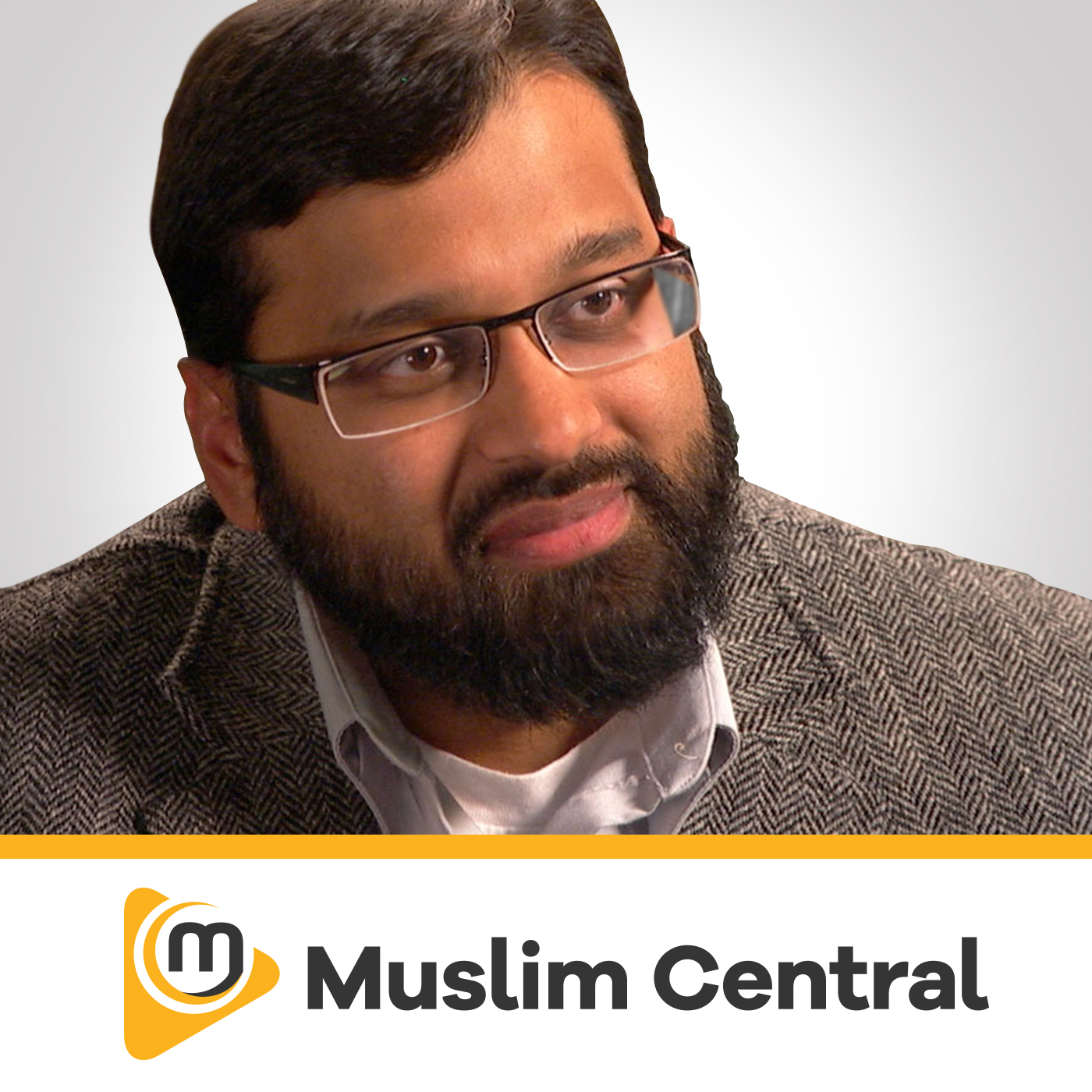
Yasir Qadhi
Muslim Central
Yasir Qadhi was born in Houston, Texas and completed his primary and secondary education in Jeddah, Saudi Arabia. He graduated with a B.Sc. in Chemical Engineering from the University of Houston, after which he was accepted as a student at the Islamic University of Madinah.
After completing a diploma in Arabic, he graduated with a B.A. from the College of Hadith and Islamic Sciences.
Thereafter, he completed a M.A. in Islamic Theology from the College of Dawah, after which he returned to America and completed his doctorate, in Religious Studies, from Yale University. Currently he is teaching at Rhodes College, in Memphis, TN.
After completing a diploma in Arabic, he graduated with a B.A. from the College of Hadith and Islamic Sciences.
Thereafter, he completed a M.A. in Islamic Theology from the College of Dawah, after which he returned to America and completed his doctorate, in Religious Studies, from Yale University. Currently he is teaching at Rhodes College, in Memphis, TN.
Episodes
Mentioned books

May 8, 2019 • 1h 38min
Ending the Moon Wars - A Case for Calculations
Shaykh Dr. Yasir Qadhi divulges in immense detail , a powerful fiqh discussion on eliminating moon sighting deviance and paving the way for a start to Ramadan and Eid based on the good old calculations.
The basis of all the assumptions should not supersede to maintain unity amongst the Muslim Ummah and avoid disputes of any sort , thus, deviating from the Sunnah.
May 7, 2019 • 16min
Quranic Duas - Ramadan Khatirahs 2019 - Episode 02 - Al-Fatihah
Shaykh Dr. Yasir Qadhi acquaints us with the most oft-repeated dua in the whole world. This dua is from Surah Al Fatihah - Ihdinas Siraatul Mustaqeem.
This dua is recited upto 30 times a day just via Salat. So imagine the reach and profundity of this verse!
Among the etiquette of dua is to praise Allah in terms of His Names and Attributes first before jumping onto your request to Allah.
Abu Huraira reported: The Prophet ﷺ said, “Allah SWT said: I have divided prayer between myself and my servant into two halves, and my servant shall have what he has asked for. When the servant says ‘all praise is due to Allah the Lord of the worlds,’ Allah says: My servant has praised me. When he says ‘the Gracious, the Merciful,’ Allah says: My servant has exalted me. When he says ‘the Master of the Day of Judgment,’ Allah says: My servant has glorified me and my servant has submitted to me. When he says ‘you alone we worship, you alone we ask for help,’ Allah says: This is between me and my servant, and my servant will have what he has asked for. When he says ‘guide us to the straight path, the path of those whom you have favored, not those who went astray,’ Allah says: This is for my servant, and my servant will have what he has asked for.”
Listen intently to this video to fully fathom the stature of Surah Al Fatihah.
May 7, 2019 • 14min
Quranic Duas - Ramadan Khatirahs 2019 - Episode 01
Shaykh Yasir acquaints us with some specific duas from the Qur'an and Sunnah. The first in this series is the dua of Adam [AS].
"قَالَا رَبَّنَا ظَلَمْنَا أَنْفُسَنَا وَإِنْ لَمْ تَغْفِرْ لَنَا وَتَرْحَمْنَا لَنَكُونَنَّ مِنَ الْخَاسِرِينَ"
They said, "Our Lord, we have wronged ourselves, and if You do not forgive us and have mercy upon us, we will surely be among the losers."
[Surah Al A'raf, 7:23]
The first act that Adam [AS] did of worship was making dua. Dua is the essence of worship. Only the true believer makes dua to Allah.
The Shaykh explicitly narrates the meaning of this dua - who we are calling, acknowledging our own shortcomings and much more.
23 snips
May 6, 2019 • 1h 19min
Mothers of the Believers - 11 - Zaynab b. Khuzayma & Umm Salama
Dive into the lives of two remarkable women in early Islamic history: Zaynab bint Khuzayma and Umm Salama. Discover Zaynab's commitment to helping the less fortunate and her unique status as the only wife for whom the Prophet ﷺ prayed. Explore Umm Salama's resilience as a widow, her impactful journeys in early Islam, and her significant role in Quranic revelations. The discussion also touches on gender equality in the Quran, highlighting Umm Salama's influential questions and insights in a male-dominated society.
18 snips
May 6, 2019 • 1h 21min
Mothers of the Believers -10 - Hafsa Bint Umar
The discussion explores the life of Hafsa Bint Umar, highlighting her early years and marriage to Khunais. Key moments from her marriage to the Prophet reveal complexities of their relationship, including a notable reconciliation after a divorce. The narrative also touches on her role in preserving the Quran and the dynamics between her and Aisha, emphasizing themes of jealousy and trust among the wives. Additionally, insights into Hafsa's teachings and significant incidents, like the divine message from Jibril, enrich our understanding of her legacy.
8 snips
May 6, 2019 • 1h 28min
Mothers of the Believers - 09 - Aisha Bint Abu Bakr RA
Explore the remarkable life of Aisha Bint Abu Bakr, the brilliant scholar and one of the most revered narrators of Hadith in Islam. Known for her keen intellect and eloquence, she recorded around 2200 authentic Hadiths. The podcast delves into her insightful contributions to Islamic jurisprudence and her role in key historical events. It also tackles contemporary debates regarding her age at marriage, providing a nuanced view of historical contexts versus modern sensibilities. Aisha's legacy as a herbal doctor and analyzer of religious texts showcases her multi-faceted impact on Islamic history.
May 6, 2019 • 4min
Achieving Taqwa Through Fasting
Shaykh Yasir Qadhi divulges details on the numerous benefits of Ramadan. Primary among these is - Taqwa - which can be attained through fasting.
In our quest to achieve Taqwa, we need to exercise patience at all stages and hope and pray that Allah will shower His infinite blessings upon us which will make it all worth it.
Apr 30, 2019 • 28min
Towards Understanding Surah Yusuf - 20
Shaykh Yasir Qadhi discusses the conclusion of Surah Yusuf and the relevance of the Surah in the context of the story. Verses 105 to 111 of Surah Yusuf are recited.
How many miracles and signs are present in front of us to ascertain the bounties given to us by Allah SWT, yet we completely ignore? Why do we do this? Not that they deny God, but they worship other than Allah SWT.
Do they feel safe and secure in this world when we hear and witness the numerous punishments of Allah SWT on a daily basis?
The followers of the Prophet ﷺ will follow the call to Allah alone with a firm knowledge.
Why are we surprised when we have Messengers coming from time to time to spread the message of Islam, the Book of Allah and the Oneness of Allah SWT?
The abode of the Hereafter is better than anything else of this temporary world.
In the stories of Surah Yusuf, there is a wisdom and a point of benefit for the one who seeks to benefit from them.these are true stories and affirm that which came before it.
The Qur'an is a guidance and a mercy for those who believe.
What are the values to be imbibed and inculcated from this magnificent story? Listen intently.
Apr 30, 2019 • 33min
Ramadan The Month of Victory
Shaykh Dr. Yasir Qadhi acquaints us with the six major battles that were won by Muslims during the month of Ramadan and the lessons we comprehend from these historical battles.
Battle of Badr - 17 Ramadan, 2 H
Conquest of Makkah - 23 Ramadan, 8H
Battle of Andalus - 28 Ramadan, 93 H
Battle under Muhammed Ibn Qasim in Sindh - 94 H
Battle of Hattin - 583 H
Battle of Ain Jaloot -25 Ramadan, 658 H
Listen intently to reiterate the comprehensive lessons that must be imbibed and inculcated amongst the Muslim Ummah.
4 snips
Apr 26, 2019 • 28min
Towards Understanding Surah Yusuf - 19
Shaykh Yasir Qadhi recites the verses 99 to 104 of Surah Yusuf which is the conclusion of the story of Yusuf AS.
The return of Yaqub AS with his family to Egypt and the reunion with his beloved son, Yusuf AS was a beautiful one. Yusuf AS hugged his parents tight and it was an emotional union and he raised his parents on to the throne of the kingdom to honour and respect them. When he did this, all of the 11 brothers and parents fell in prostration to Yusuf AS, thus, bringing his dream as a child to a full circle of interpretation as it achieves actuality.
The practice of prostration to another human being as a predominant sign of respect was only valid until the time of Prophet ﷺ. The Prophet ﷺ forbade this vehemently in his time.
Prophet Yusuf AS was full of gratitude for the fact that he could provide his family with comfort and respect. The perfection of the character of Yusuf AS comes to the fore when he avoids mentioning the sins committed by his brothers to avoid causing them distress.
Yusuf AS mentions an Attribute of Allah. Allah is Al Lateef. What does this mean?
Yusuf AS makes a powerful Dua at this juncture. What is this beautiful Dua? It is something not to be missed and makes for a very mesmerising listen.

