

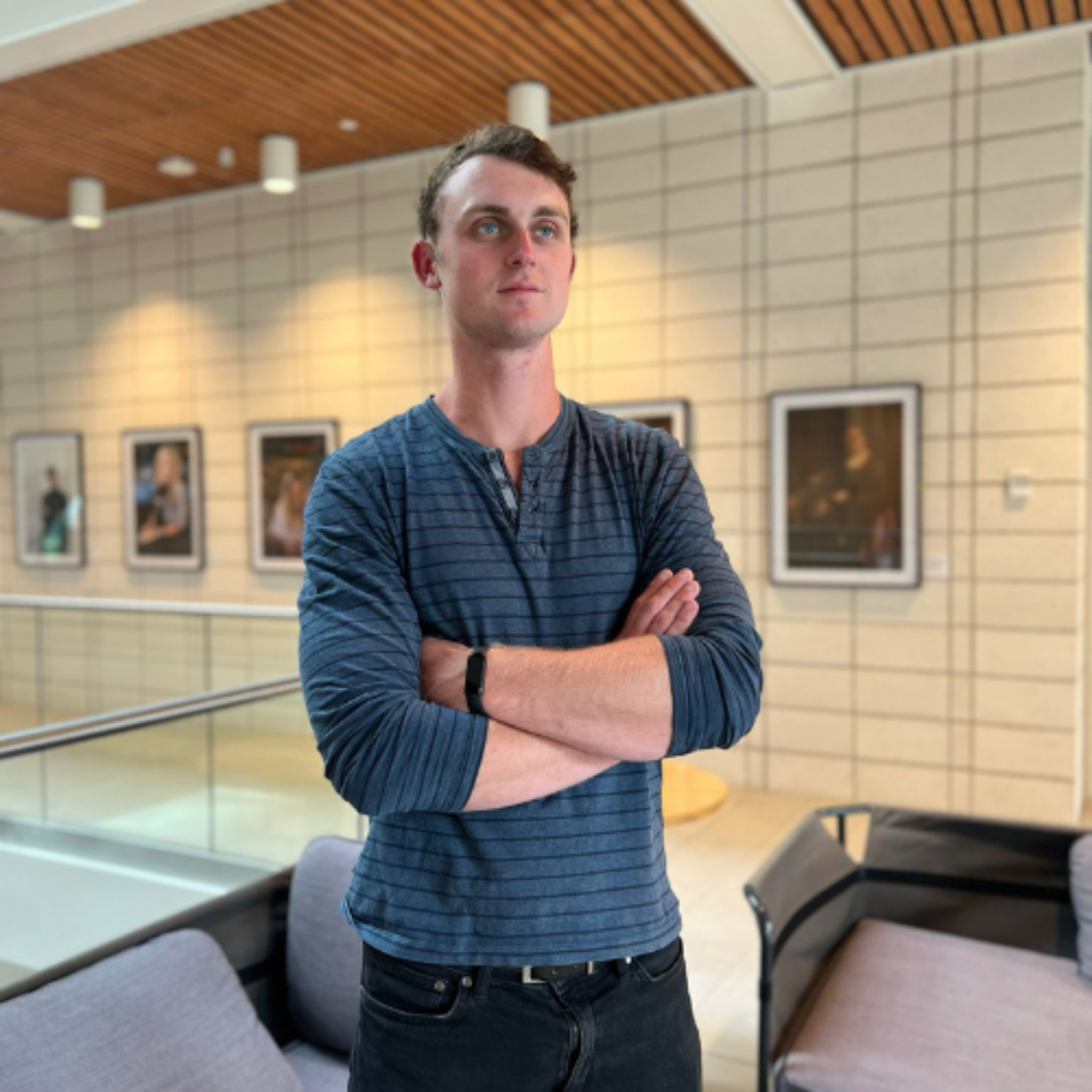
Jack Roycroft-Sherry
Jack Roycroft-Sherry
I'm Jack, an Economics and Data Science student in the beautiful town of Nottingham, England. Stick around if you like hearing from cognitive scientists, psychologists, economists and philosophers.
Episodes
Mentioned books

Nov 22, 2024 • 43min
The Mystery of Language in Humans, Animals & AI | Gašper Beguš
Gašper Beguš Is a researcher in AI, cognition and linguistics
We are far from fully understanding cognition and language. But what if
studying cognition in other animals, like whales, and even in AI—such as
how artificial "babies" learn—could help us better unravel the mystery
of cognition and language in humans?
In this podcast, expect to learn about the origins of language, whether
language is unique to humans, whether we can build AI babies that learn
like biological agents, how to interpret what is going on within AI
systems and their intelligence, the future of AI, and more...
TIMESTAMPS:
00:00 Where Does Language Come From?
03:47 Can Thought Be Separated From Language?
05:50 AI, Language & Evolution
09:43 Building Artificial Language Learners
12:39 Interpreting AI's Inner World
17:09 Inside AI's Cognition
22:13 Using AI to Understand Animal Language
27:45 What is World of Whales Like?
32:31 AI Can Have New Kinds of Intelligences
36:01 The Path Forward in AI and Language Research
Find Gasper:
-https://www.gasperbegus.com/
-X @begusgasper
Nov 22, 2024 • 59min
Will Neuroscience Ever Fully Explain The Mind? - Mazviita Chirimuuta EP 70
Mazviita is a philosopher specializing in the philosophy of mind and
neuroscience.
Some say the brain is the most complex object in the universe. If so, is
it possible for the brain and mind to be fully understood by science?
In this podcast, expect to learn about: the frontiers of neuroscience,
the distinction between mere prediction and scientific understanding,
the differences between human and artificial intelligence, the true
complexity of nature and whether it is possible to fully comprehend it,
purpose in nature, and more....
Podcast Timeline:
00:00 - When Was Neuroscience Created?
05:41 - Are There Brain Areas for Specific Tasks?
09:05 - The True Complexity of Neurons
11:04 - Are Neural Networks Enough to Model the Mind?
16:07 - Is There Understanding in Language Models?
20:30 - Brain-like AI
23:45 - Prediction vs. Scientific Understanding
31:40 - What Really Is Science?
37:04 - How Complex Is the World?
39:31 - Is the World Mechanistic?
44:48 - Cognition at Low Levels
52:10 - AI vs. Life
54:00 - Souls
Find Mazviita:
-Latest Book: "The Brain Abstracted: Simplification in the History
and Philosophy of Neuroscience", which has just won the Nayef Al-Rodhan
Book Prize from The Royal Institute of Philosophy.
Find it here:
https://mitpress.mit.edu/9780262548045/the-brain-abstracted/
-2015 Book: "Outside Color: Perceptual Science and the Puzzle of
Color in Philosophy"
Nov 8, 2024 • 47min
What We Get Wrong About Human Rationality - Hugo Mercier
Hugo Mercier is a cognitive scientist and evolutionary psychologist.
Cognitive science has revealed that human cognition is rife with biases
and what are often perceived as "flaws." But why would evolution lead to
the development of such traits? This podcast explores how these
so-called flaws may not actually be flaws at all, but rather adaptations
that serve specific purposes, whose true evolutionary functions we have
failed to see.
In this podcast, discover what we often misunderstand about cognitive
biases, what cognition actually evolved for, how the faculty of reason
and higher-order intelligence developed, the power of intuitive
reasoning, why we use all of our brain rather than just 10%, and more...
TIMESTAMPS
00:00 What We Get Wrong About Reason
03:18 Why Did Reason Evolved if Its Flawed?
07:4 Reason Evolved To Convice Others and Communicate
15:50 Reason as Distributed Cognition For Civilization
20:38 When Reasoning Goes Wrong
25:10 "Intuitive" vs "Rational" dichotomy
31:17 Its Hard to Correct Our Intuition Brain
35:48 Intuitions About Who To Trust
42:35 How Has Science Evolved?
Oct 25, 2024 • 48min
How Evolution Innovates by Exploring Genotype Space | Andreas Wagner
Andreas Wagner is a biologist studying the mechanisms of evolution.
Evolution not only generates novel innovations but does so repeatedly.
For example, the eye has evolved independently around 50 times across
different species throughout evolutionary history. How does evolution
consistently discover such innovations?
Andreas Wagner's research group explores the underlying structure of
genotype spaces to map out the possible innovations that can arise. By
examining how evolution navigates this space through genetic mutations,
they aim to understand how valuable traits emerge.
In this podcast, expect to learn whether evolution operates solely
through DNA, how evolution is being studied through lab experiments, the
mathematical structure of genotype spaces that evolution explores,
whether DNA is the only medium for evolutionary processes, and more...
Podcast Timestamps:
00:00 The Current View of How Evolution Works
04:06 How Mutations Create Variation
09:24 Male vs Female Mutation Accumulation
11:33 Evolution Before We Understood DNA
15:10 How Evolution Creates Complexity
17:58 Genotype-Phenotype Mapping
23:48 How Does Evolution Avoid Dead Ends?
28:20 How Does Evolution Explore Genotype Space to Innovate?
33:35 Scientists Exploring Genotype Space in the Lab
39:20 Why Do Genotype Spaces Exist?
Find Andreas' Books:
- Sleeping Beauties: The mystery of dormant innovations in evolution
- Arrival of the Fittest: solving evolution's greatest puzzle
Oct 9, 2024 • 48min
Negative Theology: The Hidden Nature of God & Ultimate Reality - Elliot Wolfson EP67
lliot R. Wolfson is a theologian, philosopher, and historian.
The prominent tradition in theology known as negative theology (or
apophasis) holds that one cannot speak of God directly or positively
because God is beyond all concepts and things. For example, Meister
Eckhart viewed the Christian Trinity as a path to the true Godhead
beyond. Similarly, Ibn Arabi considered Allah as a means of reaching the
truth (al-Haqq) that transcends even Allah.
In this podcast, expect to learn why this tradition emerged, how it is
has been incorpated in Christianity and Islam, why it has been
successful, as well as about dreams and mystical experiences, the nature
of the infinite, Heidegger and the unveiling of reality, and more...
Timestamps:
00:00 – Introduction to Negative Theology
03:05 – When Did This View of God Emerge?
07:50 – Why Negative Theology?
15:30 – The Emptiness of Being
17:50 – Elliot Reads Jack Some Heidegger
25:00 – The Strange Nature of Dreams
34:14 – Talmud's Interpretation of Dreams
40:00 – Negative Theology in Islam
42:50 – The Infinite
Related Books By Elliot Wolfson:
- A Dream Interpreted Within a Dream
- Heidegger and Kabbalah: Hidden Gnosis and the Path of Poiēsis
-Giving Beyond the Gift: Apophasis and Overcoming Theomania
Sep 5, 2024 • 42min
Group Consciousness, AI Consciousness, Alien Consciousness - Eric Schwitzgebel
Aug 29, 2024 • 1h 3min
Biological AI, Mortal Computation, Anthrobots & AGI | Alexander Ororbia
Alexander Ororbia is a computer scientist and neuroscientist.
AI today is built upon silicon-based computers, but what would
artificial intelligence look like if it were based on biological
materials and principles?
In this podcast, expect to learn how biological intelligence differs
from silicon-based intelligence, the concept of "mortal computers"
(computers that die), how cognition extends beyond neurons, examples of
mortal computers such as anthrobots and xenobots, and more...
00:00 Biological vs Silicon; Mortal vs Immortal
05:06 Mortal Computers vs Standard Computers
09:52 The Importance of Death in Intelligence
18:23 Embodiment and Inactivism in Biological Intelligence
26:16 Limits of Current AI
36:35 Benefits of Mortal Computers Over Standard AI
39:50 Mortal Compter Examples: Anthrobots and Xenobots
45:50 How Good are ChatGPT and LLMs? Efficiency of Mortal Computers
50:50 Will LLMs Ever Get to AGI?
Find Alexander's work:
-Mortal Computation paper: https://arxiv.org/abs/2311.09589
-Survey on brain-inspired learning: https://arxiv.org/abs/2312.09257
-Review of neuroscience machine learning: https://arxiv.org/abs/2403.18929
-Survey on predictive coding / biomimetic learning: https://arxiv.org/abs/2308.07870
Aug 27, 2024 • 23min
Synesthesia: Smelling Sounds, Tasting Colours & Other Mixed Senses
Jamie Ward is a cognitive scientist and an expert on why people's brains
and cognition differ across individuals.
Roughly 3% of the world experiences synesthesia—the mixing of senses
where you might taste words, smell colors, and other such phenomena.
In this discussion, expect to learn about the range of experiences among
synesthetes, the types of people who have synesthesia, the relationship
between psychedelics and synesthesia, why people have synesthesia, and
much more.
Timestamps:
00:00 What is Synesthesia?
01:24 The Range of Experiences
03:01 Personality Traits and Abilities
05:19 Improved Memory Among Synesthetes
07:35 Differences in Pattern Recognition
12:05 Living With Synesthesia
14:29 Synesthesia and Psychedelics
18:49 Expectations, Perception, Cognition
Aug 17, 2024 • 1h 1min
Collective Intelligence, Mathematical Agency, Economics & Cognition | Benjamin Lyons
Benjamin Lyons works on issues of collective intelligence within
economics, biology & mathematics.
We typically think that agency can only be found in brains and organisms
like us. But what if we could find agency in something as fundamental
as mathematics? Or in something as large and distributed as an economy?
In this podcast expect to learn about how agency can be seen in
mathematics, about the hidden competencies within mathematics, whether
we should be suprised by level of intelligence found in biology, the
economy as a cognitive system, and more...
Timestamps:
00:00 - Even Mathematics Has Agency
02:16 - The Role of Choice in Mathematics
05:47 - Hidden Competencies in Mathematics
09:20 - Implications for Biological Systems
34:39 - The Economy as a Collective Intelligence System
44:49 - The Role of the Price System in Collective Intelligence
48:57 - Understanding Self-Interest in Economics
51:40 - The Function of Money in the Economy
55:54 - The Importance of Mainstream Economics
01:00:31 - Closing Remarks
Find Benjamin
-Website: https://benjaminflyons.com
-Agency in Mathematics talk: https://www.youtube.com/watch?v=1tT0pFAE36c&t=231s
-Talk with Michael Levin: https://youtu.be/0Oo4ng6dWrQ?si=4fuTiAQ9vDdH9D5X
Aug 17, 2024 • 1h 3min
Science Post-Replication Crisis, Meta-science, Fraud, Misreporting | Randy Ellis
Randy Ellis is a biologist and computational biologist.
It's been a few decades since cases of fraud in psychology began
science's "replication crisis". What has happened since then? What
problems remain? And what does the future hold?
In this podcast, expect to learn about fraud in science, the
misincentives in science that lead to too many positive results, why
replication has proven difficult in science, ways science's problems
could be fixed, and more...
Timestamps:
00:00 The Replication Crisis in Science
08:08 Why Are Replication Rates So Bad?
16:13 Fraud in Science
23:32 Confirmation Bias From Scientists Meta-Science and Improving Scientific Practices
27:54 Enhancing Credibility and Reproducibility in Science
43:30 Future of Science
47:14 Problems in Clinical Trials
53:04 Problems of Citation Metrics
Find Randy:
randalljellis.github.io

