

TechSurge: Deep Tech Podcast
Celesta Capital | Deep Tech Venture Capital Firm
The TechSurge: Deep Tech VC Podcast explores the frontiers of emerging tech, geopolitics, and business, with conversations tailored for entrepreneurs, technologists, and investment professionals. Presented by Celesta Capital, and hosted by Founding Partners Nic Brathwaite, Michael Marks, and Sriram Viswanathan. Send feedback and show ideas to techsurge@celesta.vc.
Each discussion delves into the intersection of technology advancement, market dynamics, and the founder journey, offering insights into the vast opportunities and complex challenges ahead. Episode topics include AI, data center transformation, blockchain, cyber security, healthcare innovation, VC investment trends, tips for first-time founders, and more.
Tune in to hear directly from Silicon Valley leaders, daring new founders, and visionary thinkers. Past guests include investor Vinod Khosla, former PepsiCo CEO Indra Nooyi, the Global Head of McKinsey, and executive leaders from Microsoft, OpenAI, and other leading tech companies.
New episodes release every two weeks. Visit techsurgepodcast.com for more details and to sign up for our newsletter and other content!
Each discussion delves into the intersection of technology advancement, market dynamics, and the founder journey, offering insights into the vast opportunities and complex challenges ahead. Episode topics include AI, data center transformation, blockchain, cyber security, healthcare innovation, VC investment trends, tips for first-time founders, and more.
Tune in to hear directly from Silicon Valley leaders, daring new founders, and visionary thinkers. Past guests include investor Vinod Khosla, former PepsiCo CEO Indra Nooyi, the Global Head of McKinsey, and executive leaders from Microsoft, OpenAI, and other leading tech companies.
New episodes release every two weeks. Visit techsurgepodcast.com for more details and to sign up for our newsletter and other content!
Episodes
Mentioned books

Apr 7, 2026 • 51min
Pixels to Intelligence: The Next Era of Imaging
Digital imaging is so ubiquitous today that it’s easy to forget how improbable it once was. In this episode of TechSurge, guest host Nic Brathwaite sits down with Dr. Eric Fossum, inventor of the CMOS active pixel image sensor, to unpack the breakthrough that made it possible to embed cameras into billions of devices and the deeper lessons behind it.Eric explains how his work began not with consumer electronics, but with a NASA constraint: how to shrink a refrigerator-sized space camera into something small enough for spacecraft. The solution required a fundamental shift in architecture. By moving from CCD-based imaging to CMOS, where sensing and processing could happen on a single chip, he enabled a level of miniaturization and scalability that transformed cameras from standalone systems into embedded infrastructure.But the conversation goes far beyond the invention itself. Nic and Eric explore what it takes to commercialize deep technology, from the early days of Photobit to its acquisition by Micron, and the critical role ecosystems play in turning breakthroughs into global platforms. They discuss why intellectual property is less about protection and more about leverage, and why even the most important inventions require manufacturing scale, capital, and partnerships to succeed.The episode also looks forward. As AI systems increasingly rely on visual and physical data, sensors are shifting from tools designed for human perception to components optimized for machine intelligence. Eric highlights the challenges of pushing intelligence to the edge, the limitations of current architectures, and the growing importance of sensing technologies beyond traditional imaging—including molecular detection and new materials that go beyond silicon.While much of today’s investment is concentrated in models and compute, this conversation makes the case that the next wave of innovation may come from deeper layers of the stack, where machines interact directly with the physical world. The future of AI may depend not just on how systems think, but on how they see, detect, and understand their environment.If you enjoy this episode, please subscribe and leave us a review on your favorite podcast platform.Sign up for our newsletter at techsurgepodcast.com for updates on upcoming TechSurge Live Summits and future Season 2 episodes.Episode LinksConnect with Eric and learn more about his work and recognition: https://engineering.dartmouth.edu/community/faculty/eric-fossum Learn more about CMOS image sensors: https://www.spacefoundation.org/space_technology_hal/active-pixel-sensor/Timestamps02:00 From CCD to CMOS: Rethinking How Images Are Captured06:45 The NASA Problem: Shrinking a Camera for Space12:30 From Refrigerator to Coffee Cup and Beyond19:30 From Lab to Market: Founding Photobit26:00 Scaling the Technology: Micron, Manufacturing, and Cost31:00 The Role of IP in Deep Tech: Leverage vs Protection39:30 From Human Vision to Machine Perception44:30 Edge AI vs Centralized Compute: Where Intelligence Lives49:30 Beyond Imaging: Molecular Sensing and New Frontiers53:30 What Comes Next: Materials, Sensors, and the Limits of Silicon

Mar 19, 2026 • 59min
Sovereign AI Stacks: The New Strategic National Resource
As artificial intelligence becomes a strategic capability for nations as well as companies, questions of governance, safety, and geopolitical competition are moving to the forefront. In this episode of TechSurge, host Sriram Viswanathan speaks with Helen Toner, Interim Executive Director of the Center for Security and Emerging Technology (CSET) at Georgetown and a former OpenAI board member, about the rise of sovereign AI stacks and the global implications of increasingly powerful AI systems.Helen brings a rare vantage point from both inside the frontier AI ecosystem and the policy world. She reflects on lessons from her time on the OpenAI board, including the governance challenges that arise when nonprofit missions intersect with enormous commercial incentives and rapid technological progress. As AI capabilities accelerate, she argues that the industry is still grappling with deep uncertainty about how these systems work, how they will evolve, and what responsibilities companies and governments should carry.The conversation explores the idea of sovereign AI; the growing push by countries to control key layers of the AI stack, including compute infrastructure, models, and data. Helen explains why governments increasingly view AI as a strategic national resource, comparable to past transformative technologies like electricity or the internet. At the same time, she cautions that full technological independence may be unrealistic for most nations, given the complexity and global interdependence of the AI supply chain.Sriram and Helen also examine the evolving US–China AI competition, the role of export controls and semiconductor supply chains, and how different countries, from China to emerging AI hubs in the Middle East, are positioning themselves in the race to build advanced AI capabilities. Along the way, they discuss whether the industry should slow down development, how companies are experimenting with “safety frameworks” for frontier models, and why installing guardrails may be more realistic than attempting to halt progress altogether.Ultimately, Helen argues that society is entering a period of profound uncertainty. AI is transitioning from a research discipline into a foundational system that will shape economies, security, and daily life. Navigating that transition will require not just technical breakthroughs, but new approaches to governance, transparency, and global cooperation.If you enjoy this episode, please subscribe and leave us a review on your favorite podcast platform.Sign up for our newsletter at techsurgepodcast.com for updates on upcoming TechSurge Live Summits and future Season 2 episodes.--Episode LinksConnect with Helen: linkedin.com/in/helen-toner-4162439aLearn more about CSET: https://cset.georgetown.edu/--Timestamps03:00 Lessons from the OpenAI Board: Governance in the Age of Frontier AI05:00 The Big Unknowns in AI Development: Why Experts Still Disagree12:05 Public Trust and the Risk of an AI Backlash14:20 When AI Became Infrastructure: From Research Field to Societal System16:00 Is AGI a Meaningless Term Now? Rethinking the Goalposts19:05 AI’s True Scale: Internet-Level Impact or Something Bigger?23:15 Why Frontier AI Labs Struggle to Slow Down24:40 What “Sovereign AI” Actually Means for Nations28:10 Mapping the AI Stack: Chips, Cloud, Models, and Applications33:38 The US–China AI Competition: Who’s Ahead and Why39:44 China’s Progress in AI: Compute Constraints and Fast Followers44:03 US AI Policy: Export Controls, Regulation, and Federal Preemption48:40 Frontier AI Safety Frameworks: How Labs Define Dangerous Capabilities51:36 The Future of AI: Utopia, Industrialization, or Something Worse?56:04 Rapid Fire: AI Misconceptions, Governance Reforms, and Regions to Watch

Mar 5, 2026 • 58min
Governing AI Before It Outpaces Us: Safety for Critical Infrastructure
As generative AI systems move from novelty to infrastructure, questions of safety, trust, and governance are becoming urgent. In this episode of TechSurge, host Sriram Viswanathan is joined by Dr. Rumman Chowdhury, CEO of Humane Intelligence PBC and responsible AI Pioneer, about what AI safety really means and why the industry may be focusing on the wrong problems.Rumman argues that the most overlooked lever in AI development is evaluation. While companies emphasize model training and capabilities, far less attention is paid to how systems are assessed in real-world contexts, who defines “good,” what risks are measured, and how societal impacts are accounted for at scale. She distinguishes between technical assurance and broader sociotechnical risk, from misinformation and bias to over-reliance and erosion of institutional trust.Drawing on her experience at Twitter (X) and in global policy circles, Rumman highlights a fundamental governance gap: unlike finance, aviation, or healthcare, AI lacks a mature, independent ecosystem of auditors and evaluators. Today, the same companies building AI systems often define what counts as harm. She also challenges the belief that stronger guardrails alone will solve the problem, noting that cultural context, language differences, and human behavior complicate any notion of “neutral” or fully objective AI.Rather than focusing solely on speculative existential threats, Rumman urges attention to the harms already visible from AI-enabled misinformation to mental health risks and shifts in how younger generations relate to knowledge and authority. The future of AI, she suggests, will be determined not just by technological breakthroughs, but by whether we build credible systems of accountability, evaluation, and global cooperation around them.If you enjoy this episode, please subscribe and leave us a review on your favorite podcast platform.Sign up for our newsletter at techsurgepodcast.com for updates on upcoming TechSurge Live Summits and future Season 2 episodes.Episode LinksConnect with Rumman: https://www.linkedin.com/in/rummanLearn more about Humane Intelligence: https://humane-intelligence.org/Timestamps02:50 Why AI Evaluations Matter: Defining “Good” Models in Context04:25 What Is AI Safety? From Product Performance to Societal Harm11:30 Regulation Reality Check: EU AI Act, Conformance Assessments & Checklists15:25 Building the AI Evaluation Profession: Audits, Red Teaming & Legal Protections23:00 When It’s OK to Outsource Judgment and When It’s Dangerous39:38Who’s Responsible When AI Outcomes Go Wrong? 52:37 Design vs Governance: Complex Systems, System-Level Evaluation, and Regulating Horizontally44:11 AI Psychosis, Youth Harm, and What’s Already Here47:27 What Keeps Rumman Up at Night: Kids, Algorithms, and Hope from Global Governance54:00 Bringing Sci-Fi to the Real World?

Feb 19, 2026 • 1h 19min
India: The Next Tech Global Superpower?
As global supply chains fracture, AI reshapes productivity, and technology becomes a core instrument of national power, India is making an ambitious push to redefine its role in the world economy from IT services provider to deep tech superpower.In the season 2 premiere of TechSurge, host Sriram Viswanathan brings together three defining perspectives to examine how India is positioned to become a global leader in frontier technologies, and what must go right for that vision to succeed.The episode begins with S. Krishnan, Secretary at India’s Ministry of Electronics and Information Technology, who outlines how India is treating deep tech as national infrastructure. From the India Semiconductor Mission and AI compute investments to the new RDI (Research, Development & Innovation) framework, Krishnan explains how long-horizon industrial policy is being used to derisk private capital, strengthen domestic design and manufacturing, and accelerate commercialization.Next, former G20 Sherpa Amitabh Kant places India’s technology ambitions in a global context. As post-WWII institutions weaken and supply chains are redrawn, Amitabh argues that India’s decade of structural reforms, digital public infrastructure, and global partnerships has created a historic opening, if India can sustain free enterprise, execution discipline, and state-level reform.Finally, T.K. Kurien, CEO and Managing Partner of Premji Inves, brings the investor and operator lens. Kurien explores why India has excelled at services and business-model innovation but lagged in core technology creation and what it will take to build globally dominant deep tech companies. From patient capital and university-led innovation to focused national bets in AI applications, biotech, and semiconductors, he outlines the path from ambition to execution.Across policy, geopolitics, and capital, one message is clear: India’s deep tech future will not be decided by vision alone but by alignment between government direction, private risk-taking, and long-term discipline.If you enjoy this episode, please subscribe and leave us a review on your favorite podcast platform.Sign up for our newsletter at techsurgepodcast.com for updates on upcoming TechSurge Live Summits and future Season 2 episodes.Episode LinksIndia Semiconductor Mission (MeitY): https://www.meity.gov.in/India AI Mission & AI Kosh: https://indiaai.gov.in/National Research Foundation & RDI Scheme: https://anrf.gov.in/Premji Invest: https://www.premjiinvest.com/Timestamps00:00 India’s Deep Tech Inflection Point02:05 Industrial Policy as National Infrastructure06:52 Why Government Must Catalyze Product Innovation Beyond IT Services09:13 Building the Ecosystem: Talent, Research, Diaspora Return & Startup Scale13:10 India Semiconductor Mission (ISM): What’s Different This Time24:56 ISM 2.0 Plans: Fixing Design Incentives & Unlocking Risk Capital27:15 IndiaAI Mission Explained: Compute, Data (AI Kosh) & Model Development33:09 Global Order Shifts: Supply Chains, Tech Power & Introducing Amitabh Kant41:19 Alliances That Matter: China, Europe/Japan Partnerships & Why the US Is Key54:11 How Government Can Take Risk: Fund-of-Funds, R&D Incentives, and Grand Challenges57:07 Dismantle Red Tape, Build World-Class Infrastructure, 01:00:57 Why Premji Invest Focused on Growth Stage (and What Changed for Early Stage)01:03:16 India vs US Investing: Where Returns Come From and Avoiding Valuation Hype01:05:28 Building India’s Startup Ecosystem: Capital, Patience, and Core Tech vs Business Models01:13:41 Three Sectors to Bet On: AI Software/Agents, Biotech Breakthroughs, and Pragmatic Semiconductors

Feb 12, 2026 • 2min
TechSurge: Season 2 Trailer
TechSurge returns for an all-new season exploring the forces reshaping the future of deep tech, where breakthrough innovation meets real-world market dynamics. In season 2, we dive deeper into the intersection of emerging technology, market forces, and entrepreneurial discovery, featuring candid conversations with Silicon Valley leaders, visionary founders, investors, and bold builders shaping the future of deep tech. From AI and advanced computing to energy, biotech, and beyond, we explore what it really takes to turn breakthrough ideas into scalable companies. New episodes release every two weeks. Subscribe now!
Jul 1, 2025 • 26min
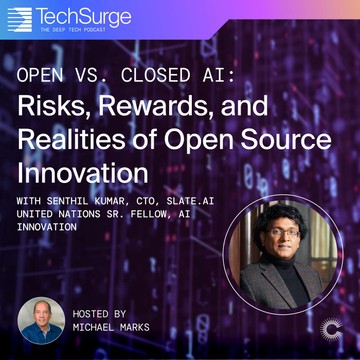
Season 1 Finale: Risks, Rewards, and Realities of Open vs. Closed AI
In TechSurge’s Season 1 Finale episode, we explore an important debate: should AI development be open source or closed? AI technology leader and UN Senior Fellow Senthil Kumar joins Michael Marks for a deep dive into one of the most consequential debates in artificial intelligence, exploring the fundamental tensions between democratizing AI access and maintaining safety controls.Sparked by DeepSeek's recent model release that delivered GPT-4 class performance at a fraction of the cost and compute, the discussion spans the economics of AI development, trust and transparency concerns, regulatory approaches across different countries, and the unique opportunities AI presents for developing nations.From Meta's shift from closed to open and OpenAI's evolution from open to closed, to practical examples of guardrails and the geopolitical implications of AI governance, this episode provides essential insights into how the future of artificial intelligence will be shaped not just by technological breakthroughs, but by the choices we make as a global community.If you enjoy this episode, please subscribe and leave us a review on your favorite podcast platform. Sign up for our newsletter at techsurgepodcast.com for updates on upcoming TechSurge Live Summits and news about Season 2 of the TechSurge podcast. Thanks for listening! Links:Slate.ai - AI-powered construction technology: https://slate.ai/World Economic Forum on open-source AI: https://www.weforum.org/stories/2025/02/open-source-ai-innovation-deepseek/EU AI Act overview: https://digital-strategy.ec.europa.eu/en/policies/european-approach-artificial-intelligence
(00:00) - The Debate on AI Development: Open vs Closed
(05:51) - Understanding Open Source vs Closed Source AI
(11:55) - The Economics of AI Models
(17:47) - Trust and Transparency in AI
(23:43) - The Future of AI Governance and Global Impact
4 snips
Jun 18, 2025 • 1h 2min
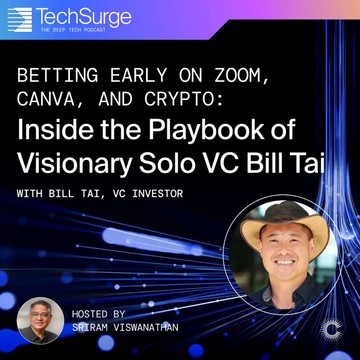
Betting Early on Zoom, Canva, and Crypto: Inside the Playbook of Visionary Solo VC Bill Tai
Legendary technologist and investor Bill Tai joins our latest episode for a wide-ranging conversation spanning decades of Silicon Valley innovation. Bill shares his remarkable journey from being employee #1 at TSMC to becoming one of the first seed investors in Zoom and Canva, and his early embrace of Bitcoin when it was priced at just 7 cents.The conversation explores Bill's unique investment philosophy shaped by mentorship from Don Valentine of Sequoia Capital, his innovative approach to building entrepreneurial communities through kiteboarding, and his insights into the intersection of AI, energy infrastructure, and cryptocurrency. Bill discusses the massive energy crisis facing AI data centers, drawing parallels to the telecom infrastructure buildout of the 1980s.From his early days as a kid reverse-engineering electronics to his current role as Chairman of Hut Eight Mining and his partnership with the Trump organization on American Bitcoin Corp, Bill provides invaluable insights into recognizing structural market changes and backing the right entrepreneurs and emerging technologies at the right time.LinksLearn more about Bill’s blockchain companies Hut Eight Mining and BITFURY - Hut 8 Corp, BITFURYBill’s original tweet from 2010 about the potential of bitcoin: https://www.instagram.com/p/Bb7QQ8GHN12/?igsh=NTc4MTIwNjQ2YQ%3D%3D Read Bill’s founding stories on Zoom and Canva: https://medium.com/@billtai/30b-stress-test-on-necker-island-814553c7f520Bill’s early memo detailing his conviction about Zoom’s technology: https://www.instagram.com/p/BwcaZjFpNrs/?igsh=NTc4MTIwNjQ2YQ== Article: Design start-up Canva raises $3 million after kitesurfing in Hawaii: https://www.smartcompany.com.au/startupsmart/design-start-up-canva-raises-3-million-after-kitesurfing-in-hawaii Canva now tops the list of most popular AI tools: https://explodingtopics.com/blog/most-popular-ai-tools Learn about TSMC's history - Taiwan SemiconductorRead the article that changed Bill’s life - Secrets of the Little Blue BoxMore fun items mentioned during the discussion2600 Hacker Quarterly: https://www.2600.com/The Cap’N Crunch whistle used by early hackers: https://www.atlasobscura.com/articles/capn-crunch-whistleThe Radio Shack 100-in-one electronics kit: https://www.rcgrabbag.com/radio-shack-100-in-1-electronic-project-kit/
(00:00) - The AI Data Center Dilemma
(00:46) - Introduction to Tech Surge Deep Tech Podcast
(01:23) - Spotlight on Bill Tai: A Legendary Technologist and Investor
(03:41) - Bill Tai's Daily Routine and Passion for Kiteboarding
(06:06) - The Birth of Ma Tai Global: A Community of Innovators
(11:44) - The Journey of Zoom: From Concept to Success
(20:07) - The Rise of Canva: From Fusion Books to a Global Powerhouse
(26:12) - Blockchain and Crypto: The Future of Decentralized Finance
(32:13) - Bitcoin Mining Industry Insights
(33:08) - The Evolution of Hut 8
(34:30) - Energy Challenges and AI Infrastructure
(35:55) - The Future of Energy and AI
(36:45) - Telecommunications and AI Parallels
(40:25) - The Role of Bitcoin in Modern Economy
(43:53) - Hut 8's Strategic Moves
(47:48) - Reflections on a Career in Tech
(57:19) - Rapid Fire Questions and Closing Thoughts
Jun 5, 2025 • 52min
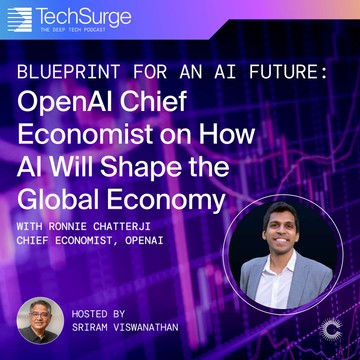
Blueprint for an AI Future: OpenAI Chief Economist on How AI Will Shape the Global Economy
Will AI displace more jobs than it creates? How can the U.S. win the AI race? How can AI benefits be evenly distributed across businesses and society?We explore these questions and more as Sriram Viswanathan sits down with Ronnie Chatterji, Chief Economist at OpenAI, for an in-depth exploration of AI's economic impact and policy implications. Ronnie brings a unique perspective, having served as an economic advisor in both the Obama and Biden administrations as a senior economist, supply chain advisor, and architect of the CHIPS Act.The conversation dives into the economic opportunities and challenges of AI adoption, from productivity gains and job market transformation to the critical need for workforce retraining and AI upskilling in schools. Ronnie also delves into America's competitive position in the global AI race, the critical need for infrastructure investment in order to continue scaling this emerging technology, and the lessons learned from implementing major industrial policy like the CHIPS Act.Links:Learn more about OpenAI's economic research and policy work - OpenAIRead OpenAI's Economic Blueprint for the US - OpenAI’s Economic BlueprintExplore the CHIPS and Science Act - CHIPS.govRonnie Chatterji's academic work at Duke University - Duke Fuqua School of Business
(00:00) - The Expanding Role of AI in Human Agency
(02:36) - Economic Implications of AI and Job Market Dynamics
(08:43) - Opportunities and Challenges in Labor with AI
(13:49) - Preparing Future Generations for an AI-Driven World
(19:15) - Ensuring Equitable Access to AI Technology
(23:07) - Infrastructure Development for AI Growth
(25:25) - Geopolitical Considerations in AI Development
(28:05) - Global Collaboration in AI Development
(31:07) - The EU's AI Regulatory Framework
(35:04) - The Chips Act: Vision and Implementation
(39:02) - AI Investment Landscape
(42:04) - Global Perspectives on AI: Insights from India and China
(45:36) - Misconceptions and Future of AI Education
May 22, 2025 • 48min
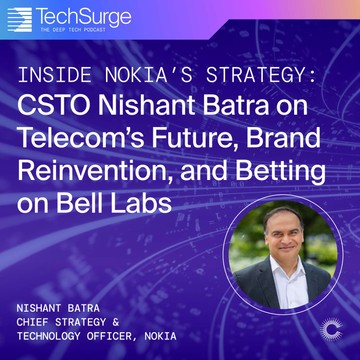
Inside Nokia’s Strategy: CSTO Nishant Batra on Telecom’s Future, Brand Reinvention, and Betting on Bell Labs
In this episode of TechSurge, host Sriram Viswanathan sits down with Nishant Batra, Chief Strategy and Technology Officer at Nokia, for a deep dive into the evolving landscape of telecom and wireless technology. Nishant shares insights into the seismic shifts transforming network infrastructure—from core networks to edge computing—and discusses how Nokia leverages artificial intelligence to optimize performance and drive innovation. The conversation also highlights Nokia's unique innovation framework, spanning its corporate venture investments, internal incubator, and expansion of the legendary Bell Labs. Today Nokia leverages Bell Labs’ groundbreaking research into emerging technology for internal innovation and new venture spinouts in collaboration with venture capital firms, including recently announced inaugural spinout startup, Astranu.Links:Discover the groundbreaking Nokia-Celesta spinout advancing healthcare imaging technology - Astranu Learn about the legendary innovation powerhouse - Nokia Bell Labs
(00:00) - The Genesis of Nokia and Bell Labs
(01:02) - Introduction to Tech Surge Deep Tech Podcast
(02:43) - Nokia's Storied History and Evolution
(03:48) - Nokia's Technological Innovations and Market Presence
(09:12) - The Impact of the iPhone and Mobile Data Tsunami
(14:52) - Understanding Open RAN, Cloud RAN, and AI RAN
(21:28) - Fragmentation and Integration in Telecom Networks
(25:09) - Market Share Analysis of Telecom Giants
(25:46) - Nokia Bell Labs: A Legacy of Innovation
(27:56) - Bell Labs' Global Impact and Future Plans
(30:33) - Commercializing Bell Labs Innovations
(37:03) - Nokia's Venture and Incubation Strategies
(44:44) - Exciting Technologies and Leadership Insights
(47:11) - Conclusion
May 8, 2025 • 40min
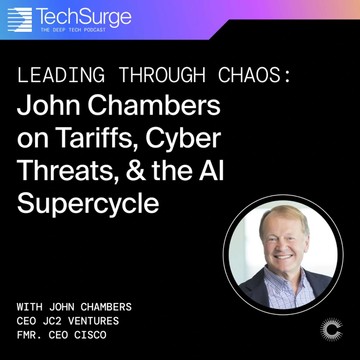
Leading Through Chaos: John Chambers on Tariffs, Cyber Threats, & the AI Supercycle
Competition, growth, tariffs, hacks, AI – what does it take to be an effective leader today? John Chambers, former CEO and Executive Chairman of Cisco and founder of JC2 Ventures, joins TechSurge host Sriram Viswanathan to share valuable wisdom on leading and growing businesses through times of significant change. As a leader who has transitioned from the c-suite to venture capital and now mentoring founders in emerging technology sectors, John has seen it all. He shares lessons from his time leading one of the world’s most influential networking companies at Cisco (the most valuable company in the world at the time), revealing what he learned while growing it from a challenger networking company into a $50 billion tech powerhouse, sharing how Cisco achieved and maintained its market leadership, particularly his bold M&A strategies. John offers hard‑won insights on navigating major technology shifts in AI, cloud, security, and more. Today’s founders and executives will find practical frameworks, real‑world war stories, and counterintuitive advice to help survive and thrive in an era of continual disruption. If you enjoy this episode, please subscribe and leave us a review on your favorite podcast platform. Sign up for our newsletter at techsurgepodcast.com for exclusive insights and updates on upcoming TechSurge Live Summits.Links:Explore John Chambers' family office and venture firm at JC2 VenturesRead John Chambers' book “Connecting the Dots” on AmazonDiscover the organization John chaired for eight years US-India Strategic Partnership ForumLearn about the company John and Sriram have invested in together at ParkourSCFind out about the deep fake detection company Pin DropLearn about the cybersecurity company Rubrik
(00:00) - Navigating the AI Revolution
(03:03) - The Genesis of JC2 Ventures
(05:45) - Investment Philosophy and Market Transitions
(09:08) - The Role of Customer Feedback in Innovation
(11:54) - Building Companies for IPO vs. Acquisition
(15:04) - The Importance of Management and Culture
(17:51) - AI's Impact on Business and Society
(20:54) - Global Economic Trends and Strategic Partnerships
(24:08) - Cybersecurity in the Age of AI
(27:00) - The Future of AI and Global Cooperation
(30:10) - Challenges and Opportunities in the Tech Landscape
(32:45) - Key Traits of Successful Tech Leaders

