

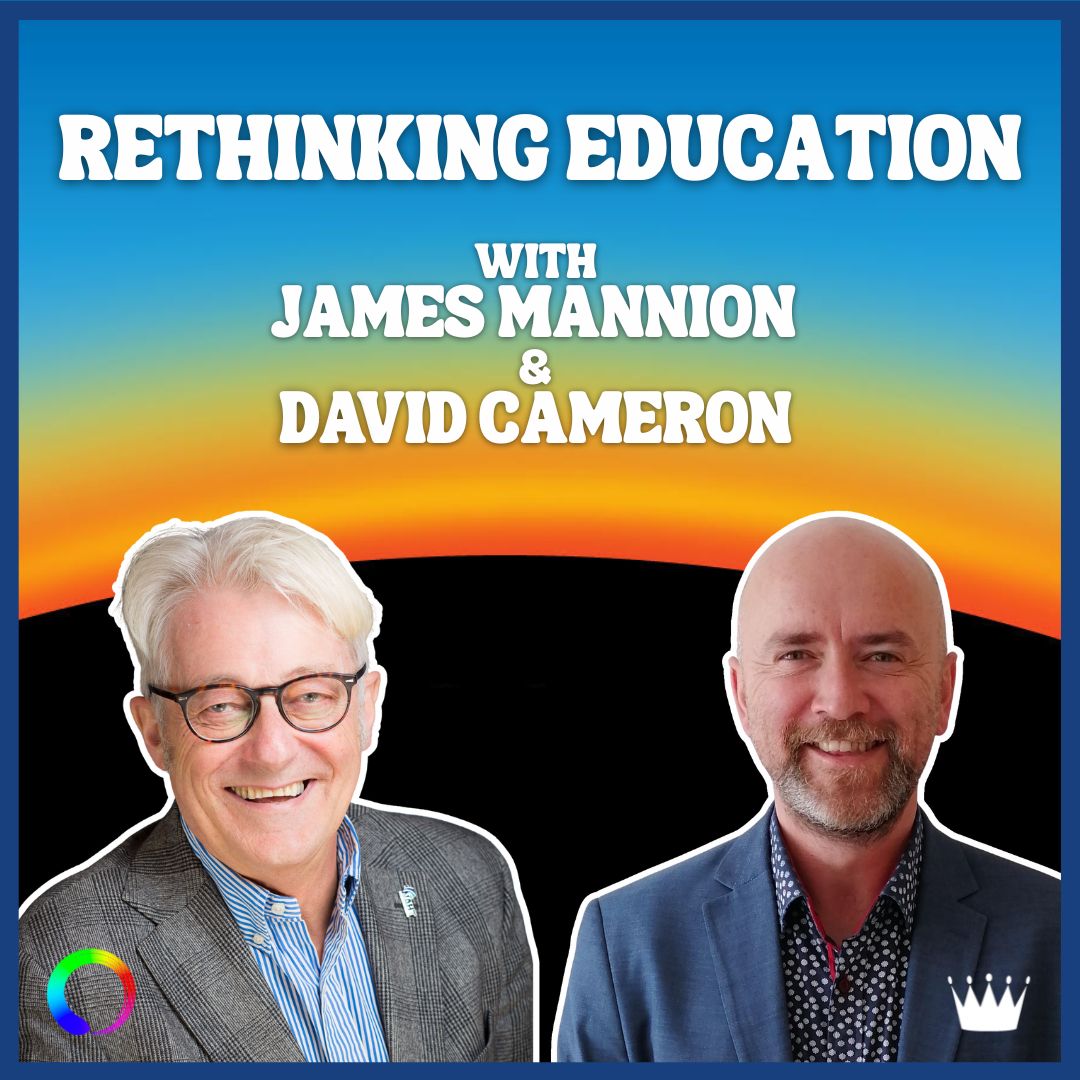
Rethinking Education
Dr James Mannion
"Civilisation is a race between education and catastrophe." (HG Wells)
In this podcast, we take Wells at his word. Hosted by Dr James Mannion and David Cameron, Rethinking Education features long-form conversations with fascinating guests about how we might create a more diverse, intelligent, responsive educational ecosystem that works for *all* young people.
If this sounds interesting to you, welcome to Rethinking Education: Education's Critical Friend: https://rethinking-ed.org/podcast
In this podcast, we take Wells at his word. Hosted by Dr James Mannion and David Cameron, Rethinking Education features long-form conversations with fascinating guests about how we might create a more diverse, intelligent, responsive educational ecosystem that works for *all* young people.
If this sounds interesting to you, welcome to Rethinking Education: Education's Critical Friend: https://rethinking-ed.org/podcast
Episodes
Mentioned books

Mar 19, 2021 • 2h 41min
S1E14: Rachel Macfarlane on Learning to Learn, Rethinking Assessment and Obstetrics for Schools
Rachel Macfarlane is the Director of Education Services at Herts for Learning, providing the strategic lead for all education services to schools across all phases. Prior to joining Herts for Learning, Rachel was the Principal of Isaac Newton Academy in Ilford, in the London borough of Redbridge. She opened this non-selective all-through academy for 4-18 year olds in 2012, the school was rated Outstanding by Ofsted when inspected in 2014, and when they received their first set of results in 2017, they went straight into the top 1% of schools in the country.
Rachel has recently written a fantastic book about how to close the disadvantage gap, called Obstetrics for Schools. Since the invention of obstetrics, the infant mortality rate has decreased by several orders of magnitude. In the book, Rachel makes a compelling case that if we can import some of this thinking into education, maybe we do the same for the disadvantage gap, and perhaps even get beyond the point where one third of young people leave school after 12 years branded a failure.
Here are a few of the really quite astonishing things people have written about Rachel’s book:
"Obstetrics for Schools takes a bleak account of poverty, disadvantage and underachievement and – using real-life case studies and data – shows that it doesn’t have to be like this. If ever there were a time to recalibrate our education system around equity, it’s now. If ever there were a book to help us to do it, it’s this one." (Geoff Barton, General Secretary, Association of School and College Leaders)
"It is a disgrace that we can accept that a third of our children will fail at school. Such a rate of attrition, and such inequity, is no longer tolerated in childbirth, and it should not be tolerated in schools. Medicine has developed robust procedures to make sure this doesn’t happen – but where are the equivalents in education? Thankfully, they are right here, in Rachel Macfarlane’s brilliant Obstetrics for Schools. Wise, passionate, compassionate and, above all, practical, this book is an intimate guide to reducing the poverty gap in education. Every head teacher, administrator and minister of education should read it and be judged on their responses to it. If this doesn’t happen, it will only show that we as a society still don’t really care, and that intellectual and ethical torpor still rule the roost." (Guy Claxton, author of The Learning Power Approach: Teaching Learners to Teach Themselves)
"Rachel Macfarlane’s book is exactly what we all need right now. The perfect antidote to COVID-19 gloom, it’s a stirring call to arms in the fight against education inequality. Rachel counters the defeatist acceptance that the education system will inevitably fail some students and, through a series of case studies, shows how it is possible to ensure that every student receives a great education. Accessible, practical and inspiring, Obstetrics for Schools is a great read for anyone who cares about education." (Lucy Heller, Chief Executive, Ark)
Here are some articles either by or about Rachel:
https://arkonline.org/blog/rachel-macfarlane-how-our-brand-new-school-went-straight-top-1
https://www.theguardian.com/teacher-network/teacher-blog/2013/jul/01/leaders-schools-g2g-g4g-talking-heads
https://www.headteacher-update.com/best-practice-article/knowledge-and-skills-how-you-can-achieve-both-in-your-school-guy-claxton-education-1/228451/
https://bigeducation.org/lfl-content/the-responsibility-of-educators-to-nurture-strong-relationships-with-learners-and-their-families/
https://www.hertsforlearning.co.uk/news/great-expectations-new-herts-learning-leadership-programme-launches-hertfordshire-schools
https://theeducation.exchange/the-role-of-the-teacher-as-facilitator-of-out-of-school-learning/
The Rethinking Education podcast is hosted and produced by Dr James Mannion. You can contact him at rethinking-ed.org/contact, or via @RethinkingJames on Twitter.

Mar 9, 2021 • 2h 57min
S1E13: Ian Gilbert on climate change, neoliberalism and making children’s brains hurt
Ian Gilbert is a globally renowned educational thinker, innovator, entrepreneur, speaker and award-winning editor and writer, who was listed by the IB magazine as one of their top 15 ‘educational visionaries’.
Ian has authored many brilliant books including the Little Book of Thunks, Independent Thinking and Why do I need a teacher when I’ve got Google? - all three of which we discuss in this conversation. He is also a skilled editor and has curated and edited many more excellent tomes, including notably The Working Class: Poverty, Education and Alternative Voices.
This is a fascinating conversation in which we discuss thunks - Ian’s brilliant invention for making children’s brains hurt; neoliberalism, the ideology that underpins so many of our educational woes; and our shared love of philosophy for children, an approach that has been in the headlines this week for all the wrong reasons. To name just a few juicy morsels.
Here are some of the books we talked about in this podcast:
The Little Book of Thunks - https://www.amazon.co.uk/gp/product/B005R25LKK/ref=dbs_a_def_rwt_hsch_vapi_tkin_p1_i0
A tin of thunks - https://www.ebay.co.uk/itm/A-Tin-of-Thunks-by-Ian-Gilbert-/164501869061?mkevt=1&mkcid=1&mkrid=710-53481-19255-0&campid=5337839255&customid=&toolid=10001
Independent thinking - https://www.amazon.co.uk/gp/product/B00GY5781Y/ref=dbs_a_def_rwt_hsch_vapi_tkin_p2_i5
Why do I need a teacher when I've got Google? - https://www.amazon.co.uk/gp/product/B00LC9DHT4/ref=dbs_a_def_rwt_hsch_vapi_tkin_p2_i3
The Working Class: Poverty, Education and Alternative Voices - https://www.amazon.co.uk/gp/product/B07BB8GP3F/ref=dbs_a_def_rwt_bibl_vppi_i2
The Rethinking Education podcast is hosted and produced by Dr James Mannion. You can contact him at rethinking-ed.org/contact, or via @RethinkingJames on Twitter.
Feb 24, 2021 • 2h 60min
S1E12: Adam Boxer on behaviour, workload and neotraditionalism
Adam Boxer is Head of Science at what he describes as a “great” secondary comprehensive school in North London, and a prolific tweeter and blogger. His blog, A Chemical Orthodoxy, recently tipped over a million readers, and considering Adam only joined the fold of bloggers fairly recently, that’s really quite impressive. As you will hear, this is the thin end of the wedge of Adam’s prodigious output, and he is a rare example of someone who has been able to have a significant impact on the school system while teaching full-time.
This, as ever, is a fascinating conversation in which we discuss neotraditionalism, practical tips on behaviour management and reducing workload, and the thin slither of Twitter beef that led to his coming on the show.
Links to interesting stuff we talked about:
Adam’s blog - A Chemical Orthodoxy: https://achemicalorthodoxy.wordpress.com/
Adam’s YouTube channel of Science videos - Boxer’s shorts: https://www.youtube.com/channel/UCBHqVPDozD6Dg3tRN1-JSgg/videos
Cog Sci Sci, the organisation Adam founded for science teachers with an interest in cognitive science: https://cogscisci.wordpress.com/resources/
Carousel Learning - a website app based on retrieval roulette: https://app.carousel-learning.com/teacher/access
Adam’s videos and blogs on behaviour: https://achemicalorthodoxy.wordpress.com/behaviour/
The Rethinking Education podcast is hosted and produced by Dr James Mannion. You can contact him at rethinking-ed.org/contact, or via @RethinkingJames on Twitter.

Feb 12, 2021 • 2h 26min
S1E11: Ross McGill on Ofsted, EduTwitter and the trouble with academies
Ross McGill really needs no introduction. Through his alter ego Teacher Toolkit, Ross is something of a publishing powerhouse, with a quarter of a million followers on Twitter - by far the biggest following of anyone in education. A teacher and school leader with decades of experience, Ross now works as a consultant and has worked in over 200 schools, colleges and universities across the UK and around the world. Ross also has one the most influential education blogs on the planet, with around 12 million hits. He has also published five books, the most recent being Mark Plan Teach 2.0.
This is a fascinating, wide-ranging conversation in which we discuss the perils of EduTwitter; the way in which teaching is becoming a much more sure-footed, evidence-informed profession; and the trouble with Ofsted, an organisation Ross refers to as the Grim Reaper.
Here's a link to the verbal feedback report and toolkit Ross developed alongside Mark Quinn at UCL Institute of Education: https://www.ucl.ac.uk/widening-participation/teachers-and-education-professionals/teacher-research-projects/verbal-feedback-project. And here's a blog by Mark Quinn outlining the key findings: https://blogs.ucl.ac.uk/ioe/tag/verbal-feedback-in-schools/.
The Rethinking Education podcast is hosted and produced by Dr James Mannion. You can contact him at rethinking-ed.org/contact, or via @RethinkingJames on Twitter.

Feb 4, 2021 • 2h 34min
S1E10: Tim Taylor on the power of the imagination
Tim Taylor is a writer and freelance teacher who works on promoting and developing innovative practices in primary schools. He is also the author of 'A Beginner's Guide to Mantle of the Expert', an approach to teaching and learning that involves engaging the children in a process of what Tim describes as ‘imaginative enquiry’. Working with Luke Abbott and others, Tim has helped grow a sizeable community of practice around the approach in recent years, and it’s well worth a visit to the Mantle of the Expert website: https://www.mantleoftheexpert.com.
This is a fascinating conversation in which we discuss some of the ludicrous educational fads and bizarre beliefs that have gripped the teaching profession in recent years; the powerful potential of mantle of the expert, of course; and the troubling fact that if you were going to change the education system, you wouldn’t want to start from here.
The Rethinking Education podcast is hosted and produced by Dr James Mannion. You can contact him at rethinking-ed.org/contact, or via @RethinkingJames on Twitter.
Jan 30, 2021 • 2h 42min
S1E9: Kate McAllister on opening her dream school
Kate McAllister is a force of nature, and a dear friend of the Rethinking Education podcast. Kate worked as a French teacher for 14 years, and has over 10 years’ experience in school leadership roles. She first worked on creating a Learning to Learn curriculum in 2005, with the aim of helping pupils develop the knowledge and skills they need to navigate the often-difficult transition from primary to secondary school. She then spent the next 15 years refining and improving both the methodology and the results, culminating in the publication of Fear is the Mind Killer: Why Learning to Learn deserves lesson time - and how to make it work for your pupils in 2020 (co-authored by James Mannion, the host of the Rethinking Education podcast). In 2015, Kate took Learning to Learn to new frontiers when she set up the School Bus Project, a charity providing mobile education for refugees. Kate crowd-funded the purchase of a double decker bus, installed solar panels on the roof and spent 6 months working in refugee camps in Calais, providing much-needed education and support for people living in displacement. Following the closure of the Calais camps, Kate set up the Human Hive, a global community of organisations and individuals working together to create a more welcoming and inclusive world. In 2020, Kate sold her house and set out to travel the world with her daughter, studying alternative education models. Finding herself in the Dominican Republic when the covid pandemic hit, Kate decided to stay and open her dream school! The Hive School is now open, and going from strength to strength...
This is a fascinating conversation that covers worldschooling - what Kate describes as her "Alice through the looking glass moment' - the importance of #WomenEd in helping her find her voice, and how she is 'rethinking education' by building her dream school!
Here are some links to interesting stuff we talked about:
WEBSITE: The Hive School, Cabrera, Dominican Republic: https://thehive.school/
MIGHTY NETWORK: The Human Hive: https://the-human-hive.mn.co/
MIGHTY NETWORK: Rethinking Education: https://rethinking-education.mn.co/
PODCAST: James Mannion and Kate McAllister on the Education Research Reading Room with Ollie Lovell: https://www.ollielovell.com/errr/james-mannion-kate-mcallister-learning-skills/
BOOK: Fear is the Mind Killer: Why Learning to Learn deserves lesson time - and how to make it work for your pupils:
https://www.amazon.co.uk/Fear-Mind-Killer-teaching-Learning/dp/1911382772
The Rethinking Education podcast is hosted and produced by Dr James Mannion. You can contact him at rethinking-ed.org/contact, or via @RethinkingJames on Twitter.

Jan 11, 2021 • 1h 33min
S1E8: Priya Lakhani on our 'inadequate' education system
Priya Lakhani, OBE, is the founder and CEO of Century Tech, an award-winning Artificial Intelligence Ed Tech company. Century is the global leader in AI-powered learning tools for schools and families, working in dozens of countries across the world. She is also the author of a book called INADEQUATE: THE SYSTEM FAILING OUR TEACHERS AND YOUR CHILDREN, recently published by John Catt. Reviewing the book, Sir Anthony Seldon wrote: “Priya Lakhani is a visionary thinker. Yesterday, her words seemed speculative. Today, they are coming into being. Tomorrow, educators, parents and politicians will be left behind if they haven’t listened to her.”
In 2008, Priya left her job as a barrister to set up a philanthropic cooking sauce company. Through its charitable foundation, Masala Masala provided millions of meals and thousands of vaccinations to the underprivileged in India and Africa, and funded several schools. A few years later, Priya pivoted again, this time setting up Century Tech. In 2018, Century won the prestigious MIT SOLVE award for Education, and in 2019 Priya was named Economic Innovator of the year by The Spectator.
Priya embodies many of the autodidactic dispositions that we want all young people to leave school with: she is a gifted communicator with a strong moral purpose, somebody who doesn’t take no for an answer and who is able to retrain and gain mastery of new knowledge and skills in a short space of time, under her own steam.
This is a fascinating conversation in which we explore why we need to embrace learning to learn; the importance of fighting for education, and not taking no for an answer; and the transformative potential of AI in education.
The Rethinking Education podcast is hosted and produced by Dr James Mannion. You can contact him at rethinking-ed.org/contact, or via @RethinkingJames on Twitter.

Jan 1, 2021 • 2h 26min
S1E7: Guy Claxton on learning to learn
Professor Guy Claxton is a hugely influential academic, thinker and author of over 30 books on learning, intelligence and creativity, including Hare Brain, Tortoise Mind, Wise Up, What’s the point of school, Intelligence in the flesh, Educating Ruby and the Learning Power Approach.
Guy’s latest book, The future of teaching and the myths that hold it back, is a blistering critique of what is increasingly a neotraditional orthodoxy. It is scheduled for release in Spring 2021, and Guy has very kindly agreed to come back on the show when the book comes out to discuss the issues he raises in detail. In this episode, we have a much more expansive conversation about education, and about our shared passion – teaching young people how to teach themselves.
Guy has an enviable knack for expressing ideas about Learning to Learn that I have thought about for years but struggled to express. To give you a flavor, I will end this introduction with a couple of short excerpts from his recent book, The Learning Powered Approach:
“Schools should be preparing kids to flourish in a complicated and demanding world. Just trying to squeeze better test scores out of them is not enough. We know that, in the long run, character counts for more than examination results. To prosper – to live good lives – today’s students will need curiosity, determination, concentration, imagination, camaraderie, thoughtfulness and self-discipline as well as literacy, numeracy, general knowledge, and the best possible grades. These attributes contribute hugely to people’s success and fulfilment in life. And we also know that they are capable of being intentionally developed – or unintentionally stifled. The desire to cultivate them has to be at the heart of every school’s endeavour.”
And here is the second excerpt, in which Guy suggests that the question of how to develop these character traits is cultural rather than curricular:
“Such dispositions cannot be ‘taught’ directly. Of course they can be made explicit and talked about, and that helps, but merely understanding the concept of ‘resilience’, say, and even being able to write an A-grade essay about it, does not by itself make you any more resilient. Character is a constellation of habits, and habits are tendencies that are built up over time. If you regularly find yourself in a culture – a family, for example – where the people you look up to continually model, value and expect politeness, honesty or curiosity, you are likely to grow towards those qualities, as a plant grows toward the sun. Such habits begin to become part of your natural way of being.”
Here are a few links to things we discuss:
BOOK: On becoming a person, by Carl Rogers: https://uk.bookshop.org/books/on-becoming-a-person/9781845290573
BOOK: What’s the point of school, by Guy Claxton: https://uk.bookshop.org/books/what-s-the-point-of-school-rediscovering-the-heart-of-education/9781851686032
VIDEO: The Scary Guy Combats Bullying on Teachers TV: https://www.youtube.com/watch?v=js8Hrqvk8QM
BOOK: Fear is the Mind Killer: Why Learning to Learn deserves lesson time - and how to make it work for your pupils, by James Mannion and Kate McAllister: https://www.amazon.co.uk/Fear-Mind-Killer-teaching-Learning/dp/1911382772
The Rethinking Education podcast is hosted and produced by Dr James Mannion. You can contact him at rethinking-ed.org/contact, or via @RethinkingJames on Twitter.

Dec 26, 2020 • 2h 28min
S1E6: Kulvarn Atwal on leading a 'thinking school'
Kulvarn Atwal is the headteacher - or rather, head learning leader - of two schools in Essex, and the author of The Thinking School. Kulvarn completed his doctorate in 2016, His thesis focuses on the factors that impact upon teacher engagement in professional learning activities, with a particular focus on action research - a topic close to my heart that we barely even touch upon in this conversation. His research draws on theories of workplace learning to provide a practical, powerful, proven framework for school improvement. His ideas are now being used by schools throughout the UK and Europe. This is a fascinating conversation in which we discuss why we should be more positive about our education system, and recognise how effective and inclusive it is; why we need to rethink how we capture and evaluate and celebrate the achievements of young people; and how to transform a school by focusing on the professional learning and development of teachers.
Links to interesting stuff we talk about:
BOOK: The Thinking School, by Kulvarn Atwal: https://uk.bookshop.org/books/the-thinking-school-developing-a-dynamic-learning-community/9781912906024
RESEARCH ARTICLE: What Makes a School a Learning Organisation?, by Kools & Stoll (2016, OECD Working Paper): https://www.oecd-ilibrary.org/docserver/5jlwm62b3bvh-en.pdf
BOOK: The Fifth Discipline, by Peter Senge: https://uk.bookshop.org/books/the-fifth-discipline-the-art-and-practice-of-the-learning-organization-second-edition/9781905211203
BOOK: Situated Learning, by Jean Lave & Etienne Wenger: https://books.google.co.uk/books?id=ZVogAwAAQBAJ
The Rethinking Education podcast is hosted and produced by Dr James Mannion. You can contact him at rethinking-ed.org/contact, or via @RethinkingJames on Twitter.

Dec 18, 2020 • 28min
S1E5: Ross McGill on chaos at the DfE
The first part of James's interview with Ross McGill, aka @TeacherToolkit.
Ross has worked in over 200 schools, colleges and universities across the UK, including schools in Belarus, Canada, Cyprus, China, Germany, Malaysia, Spain, Switzerland and the UAE. Known online as @TeacherToolkit, the ‘most followed educator on social media in the UK’, Ross has built one the most influential education websites on the planet, sharing resources with 11+ million readers across the world. He has also sold over 60,000 books, the most recent being '60-second CPD: 239 ideas for busy teachers'.
The Rethinking Education podcast is hosted and produced by Dr James Mannion. You can contact him at rethinking-ed.org/contact, or via @RethinkingJames on Twitter.

