

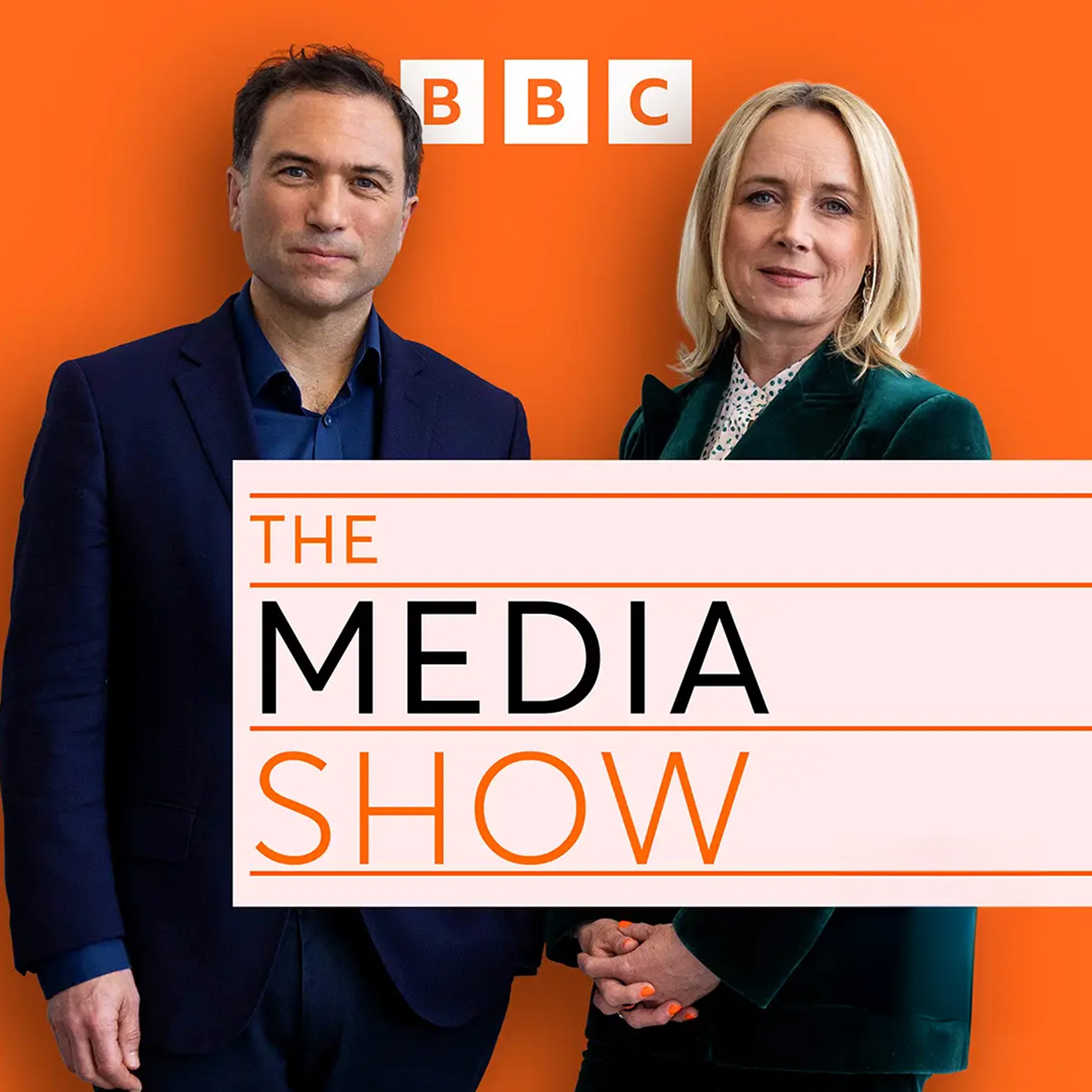
The Media Show
BBC Radio 4
Social media, anti-social media, breaking news, faking news: this is the programme about a revolution in media.
Episodes
Mentioned books

Oct 15, 2014 • 28min
Reporting the EU; TV Election Debates
Debates between UK party leaders for the upcoming general election are looming, with potential legal challenges. Media's poor coverage of the EU is highlighted despite increased attention post Eurozone crisis. Insights from industry experts on the challenges of reporting the EU and the need for more engaging coverage.
Oct 8, 2014 • 28min
Facebook's apology to drag queens; Anonymity online; Inquiry into the use of RIPA
Lil Miss Hot Mess and Misty Chance discuss Facebook's apology to drag queens. They touch on anonymity online, the challenges of maintaining digital identities, and the ethical responsibilities of media organizations. The podcast also delves into the controversial use of the Regulation of Investigative Powers Act.
Oct 1, 2014 • 28min
Sunday Mirror Sexting, Journalists' Safety, Political Interviews
Reporter Alex Wickham and political figure Louise Mensch discuss the ethics of investigative journalism and the implications of using deception. They also analyze Evan Davis's new approach on Newsnight and the challenges faced by journalists reporting from conflict zones. Expert guests explore the evolution of political interviews and the risks journalists encounter to provide objective news.
Sep 24, 2014 • 28min
Devolved powers and the BBC, Inside police custody, Phone hacking
Whilst the No Vote has halted plans for a full-blown Scottish Broadcasting Corporation, with Charter Renewal on the horizon, the pan-UK public broadcaster is unlikely to escape political pressures to decentralise more power from London. To discuss the ramifications for funding, commissioning and regulation are Tim Suter - former Ofcom and BBC executive, Glyn Mathias - Ofcom content board member for Wales and Alex Bell - a former BBC presenter and one time Head of Policy to Alex Salmond.A new Channel 4 documentary series about Luton Police Station's custody suite shows viewers how crimes like murder, child sex abuse and domestic violence are dealt with in the first few hours by police. Filmed by 60 fixed-rig cameras and 5 crews, the series provides an insight into the challenges faced by the staff and the criminal justice process. Steve Hewlett talks to Colette Paul, Chief Constable of Bedfordshire police, about the difficult decision she made to allow cameras in, and how staff reacted. Also joining Steve is Executive Producer Simon Ford about how issues of consent and legal considerations led this to be one of his toughest projects.Trinity Mirror has admitted liability and agreed to pay compensation to four individuals who sued the group for alleged hacking of voicemails. A further six claims have already been settled out of court. What this will mean for Trinity Mirror? Steve is joined by Mark Lewis, the solicitor who acted for the Dowler family and Sven Goran Eriksson.Producer: Dianne McGregor.
Sep 17, 2014 • 28min
Mike Darcey, CEO of News UK; the role of the press in Scotland; Ofcom on London Live
The media regulator Ofcom has rejected London Live's request to reduce programming commitments. After just four months on air, the local TV station asked to produce just one hour of London content during the prime time evening slot, compared to the current three. It also wanted to scrap its commitment to 10 hours of repeats every day. Steve Hewlett hears from Peter Davies, Director of Content Policy at OFCOM about why they rejected the request, and asks him what it means for the future of London Live and local TV.News UK, publishers of The Times, The Sunday Times and The Sun, has moved from its iconic home in Wapping to a new building across the Thames. It marks a new start for Rupert Murdoch's organisation, which has been plighted by controversy in recent months with the conclusion of the trial into hacking. But with more trials on the way, can staff really put the past behind them? Steve Hewlett gets a tour of the building from Chief Executive Mike Darcey on the day of the opening, and talks to him about how the business is doing, and why he's got no plans to make changes to Page 3.The Sunday Herald is still the only newspaper in Scotland to back a 'yes' vote in the referendum with the rest either sitting on the fence or backing a 'no'. With just one day to go, with both sides of the independence debate pushing for votes, we look at the role and the impact the press has played in Scotland's big decision. Steve hears from Ruth Wishart, broadcaster and columnist for the 'Herald' and 'Guardian'; Allan Rennie, Managing Editor in Chief of Media Scotland, publishers of the Daily Record and Sunday Mail, amonst others, and Greg Philo, Professor of Communications and Social Change at Glasgow University.Producer: Katy Takatsuki.
Sep 10, 2014 • 28min
Murdoch on Page 3; Protecting journalists' sources; AP uses robots
Legal expert Matthew Ryder, QC, discusses the use of RIPA to obtain journalist sources. Rupert Murdoch hints at the end of Page 3 in the Sun. Associated Press adopts robotic journalism. Radioplayer unveils hybrid car adaptor for radio.
Sep 3, 2014 • 28min
BBC on Sir Cliff coverage; Press Gazette joins IPSO; Who is Rona Fairhead?
Rona Fairhead, the former FT Group chief executive, has been announced as the Government's preferred choice as BBC Trust chair. Her nomination comes at a challenging time for the BBC, in the run up to Charter renewal and concerns over governance. Steve hears from John Gapper, former colleague, and Associate Editor of the Financial Times, about what she could bring to the role; former Culture Secretary, Tessa Jowell MP, who introduced the BBC Trust as a system of governance, and Phil Harding, former BBC news editor and Controller of Editorial Policy, about what her appointment may mean for the Trust, and the BBC.The BBC and South Yorkshire Police appeared before MPs yesterday, regarding the search of Sir Cliff Richard's home in Berkshire. The police and the BBC cooperated with each other, which ended in the BBC having cameras and a helicopter at the singer's home when the police turned up to raid it. Hundreds of people complained about the footage. However, Chairman of the Commons Home Affairs Committee, Keith Vaz said the BBC had behaved, 'perfectly properly'. Steve Hewlett is joined by the BBC's head of newsgathering, Jonathan Munro, to discuss the operational decisions the organisation made.The Independent Press Standards Organisation (IPSO) will replace the Press Complaints Commission next week. The majority of the UK's national press has elected to be subject to its regulation. The Press Gazette is the latest to sign up, and it's understood that a decision will be made by the Guardian shortly. However, there's still concern that ISPO is not independent enough. Executive Director of Hacked Off Joan Smith, Press Gazette editor Dominic Ponsford, and former Guardian editor and Observer columnist Peter Preston, join Steve.Producer: Katy Takatsuki.
Aug 27, 2014 • 28min
Jihadis on social media; Exploitation in S Yorkshire; TV debates
Social media companies have tried to stop the distribution of the video of James Foley's execution by blocking the accounts of those who shared it. The clip, posted by the group IS, sparked a debate about the ethics of sharing the content. To try and stifle the message, hashtags like #ISISmediaBlackout emerged to starve IS of coverage, and it quickly gained traction. Steve Hewlett talks to Hend Amry, the Syrian activist who instigated the hashtag, and Professor Peter Neumann, the director of the International Center for the Study of Radicalisation at King's College London, about the role social media is playing in the spread of jihadist activity.A report has found how at least 1,400 children were subjected to appalling sexual exploitation in Rotherham between 1997 and 2013. In September 2012, Andrew Norfolk, a journalist on The Times newspaper, published an investigation which revealed a confidential 2010 police report had warned thousands of such crimes were being committed in South Yorkshire each year by networks of Asian men. We speak to Andrew about the challenges he faced in covering the story. Scotland's First Minister Alex Salmond and Better Together leader Alistair Darling went head-to-head in their second televised referendum debate this week on the BBC. It's been been criticised by some for descending in to a slanging match, with poor moderation and too much audience response. Steve Hewlett talks to John Curtice, Professor of Politics at Strathclyde about whether such debates influences voting behaviour. And he discusses challenges of staging events with John Mullin, the BBC's referendum editor, and John McAndrew, who was in charge of the first ever live Sky News Leaders' debate in 2010.Producer: Katy Takatsuki.
Aug 20, 2014 • 28min
BBC on Sir Cliff; Covering the Missouri riots; Sky diversity targets
Former Editor-in-Chief of ITN discusses BBC's coverage of Sir Cliff Richard's police raid. Sky aims to increase BAME representation on screen. Challenges faced by journalists reporting on Ferguson protests in Missouri.
Aug 13, 2014 • 28min
Local TV's first casualty; Class action against Facebook; Reporting suicide
The company which was awarded the licence to run Local TV for Birmingham has gone into administration. City TV, trading as BLTV, was awarded the licence in November 2012 and was supposed to be on air by November this year. Its head, Debra Davis, told the Media Show that it's failed to find enough investment. Administrators say they now hope to find another operator. Steve McCabe Labour MP for Selly Oak tells Steve Hewlett why he thinks the licensing system set up by OFCOM isn't robust enough; Jamie Conway, CEO of Made TV, who lost out on original bid for Birmingham, explains why he still thinks local TV in the city is workable, and Bobby Hain, Director of Channels at STV Glasgow, tells Steve how they've made a go of it there. A law student in Austria, Max Schrems, has filed a class action lawsuit against Facebook. The action claims the social network has violated the privacy rights of users. More than 25.000 people from more than 100 countries have now joined the privacy law suit. Max received a stack of 1,222 pages after he was the first European to request that Facebook disclose all the information it had about him. He tells Steve his concerns.Following the death of Robin Williams, some newspapers have been criticised for publishing too much information about the incident. Joan Smith, Executive Director Hacked Off argues that much of the coverage has been sensational and a breach of the Editor's Code. Also joining Steve Hewlett is Paul Farmer, Chief Executive of the mental health charity Mind, who says he will be taking concerns to the Press Complaints Commission, and Bob Satchwell, Executive Director of the Society of Editors', a defender of the press' coverage.Producer: Katy Takatsuki.

