

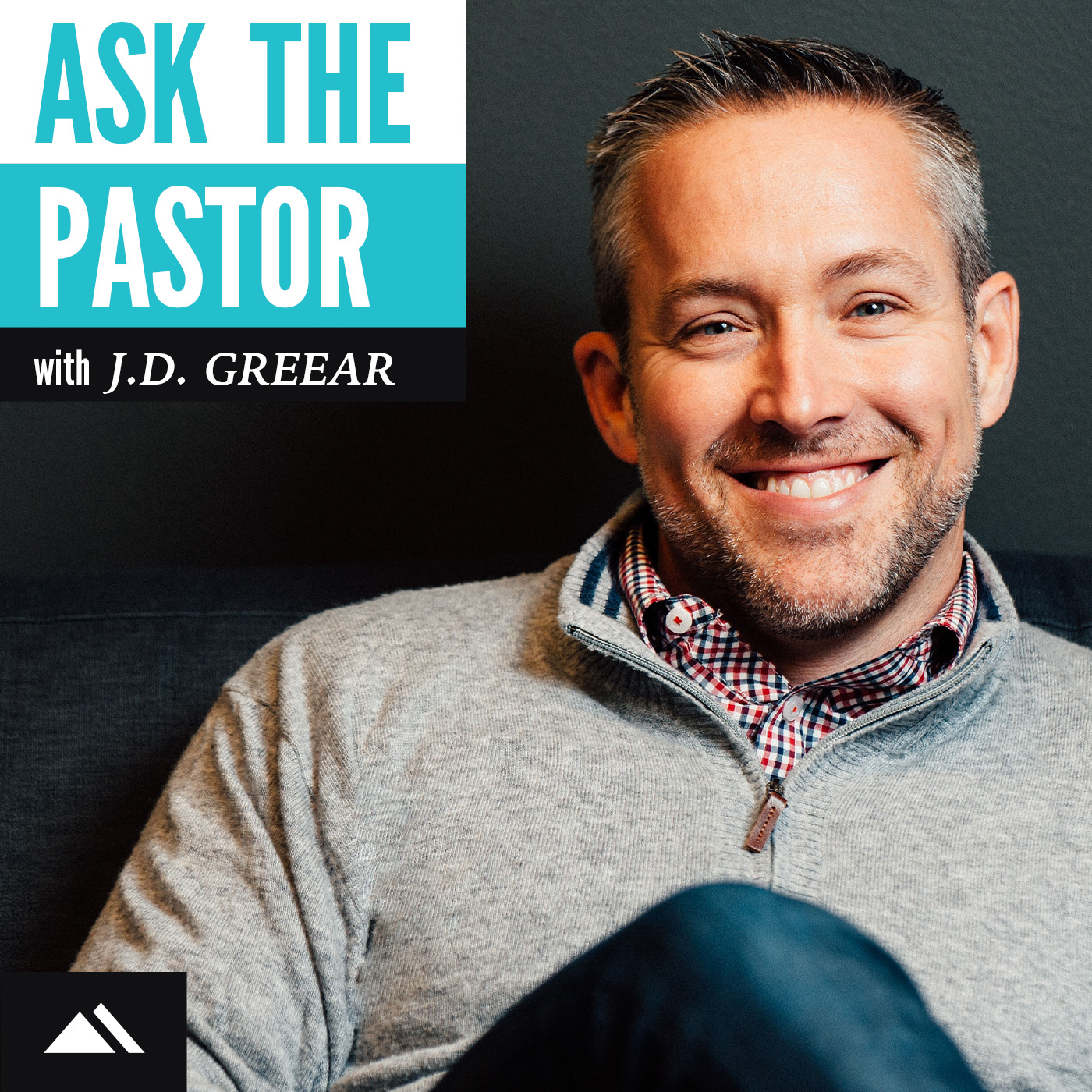
Ask the Pastor with J.D. Greear
J.D. Greear
Ask the Pastor with J.D. Greear is a weekly podcast that answers tough questions and tackles relevant issues in a way that is filled with grace, understanding, and wisdom from God’s Word. Hosted by Matt Love.
Episodes
Mentioned books

Feb 4, 2019 • 13min
How Should We Respond to a Police Shooting?
Pastor J.D. continues the discussion from Episode 19 and specifically talks about how Christians should respond to a police shooting.
A glimpse inside this episode:
When we see the broad strokes of racism in our past, we cannot avoid seeing how racism has deeply impacted social realities like families, governments, and schools. Social realities are slow to change, and while laws are good, they cannot immediately overcome generations of unjust practices.We see this reality play out when news hits of a white police officer shooting and killing a person of color.
On one side, African Americans are keenly aware of racial injustice in our history, so they sense enough of a pattern to assume injustice in this particular case. This one incident calls to mind the long period of public lynchings and other instances of racial violence. This is a valid viewpoint.
On the other side, white commentators often respond by counseling patience. The historical realities may create a disturbing pattern, but it would be unjust to assume the guilt of any individual—white or black—without letting our justice system pursue the facts.
I asked Dr. George Yancey about these situations:
“What do you do in a moment like this? It seems we’re being asked to choose between two responses, both of which are bringing in strong (and seemingly contrary) assumptions. How do we speak in a way that communicates sympathy without subverting the justice system? I don’t want to commit one injustice (depriving the police officer the presumption of innocence and due processes of law) in order to rectify another.”
Dr. Yancey responded,
“You can always—and should always—come out quickly with sympathy for the victims. After all, it is a tragedy when anyone is shot and killed. But you can go further, lamenting the fact that we still live in a racialized society whose past makes questions like this even pertinent. It should be unthinkable that ethnicity plays a role in police shootings. But it’s not. And that’s a tragedy.”
Dr. Yancey is right. If, God forbid, my white son was shot by the police, I would never ask if his death had anything to do with his skin color.
My African American friends should have that same privilege.
It’s past time we quit thinking about this as a conservative or liberal issue. The dividing line on this issue is not between Conservatives and Liberals. The dividing line runs between those who care about the problem and those who don’t.
Jan 28, 2019 • 15min
Is white privilege real?
Pastor J.D. discusses the origins of privilege, its influence in society, and the responsibility Christians have in the issue.
A glimpse inside this episode:
This term “privilege” was first developed by a white woman in the 1980’s to talk not about race but male privilege in academics. (Learned from Dr. George Yancey)
Definition: “An invisible package of unearned assets that whites can count on cashing in each day.”
Privilege is multi-dimensional. There is never one exclusive privileged class and one underprivileged class. Rather, there are various ways in which a person may be privileged or not.
For example, a white woman growing up in poverty, with an abusive father, may experience far fewer benefits of “privilege” than a black man growing up in an affluent, healthy family.
Dr. Yancey says there is tall privilege and good-looking privilege. He says that Asians are often given a “they must be smart at math privilege.”
The phrase “white privilege” indicates that—all other factors being equal—there is more social advantage in being white in the United States than in being non-white. Or, in other words, because “whiteness” is the social norm, those who are in that group have more benefits than those outside that group.
Examples:
As a white guy, if a traffic cop pulls me over, I never have to wonder if it was because of my race (Almost all POC have stories about this)
As a white guy, the same is true when I see a clerk looking at me in the store.
As a white guy, I don’t have to worry about my name causing me to be overlooked on a job or housing application. (Chris Green tells a story about assumptions being made by a lender about his income because he was black.)
We want to see all people in our society have access to the same rights and privileges. When Dr. George Yancey, an African-American sociologist from North Texas University, came to speak to our church recently, he made a really interesting comment about privilege: He said “privileges” are like “rights.” It’s not that we want to take rights from one group and give them to others, but we want to see the rights that one group enjoys extended to all. He said often, in discussing privilege (white privilege or male privilege), there’s an unspoken assumption: “Things are not equal between these two groups, and we need to make them equal by pulling the top group down.” But if we think about privilege more like rights, it changes the conversation. When I think of the privileges that I have as a white person, or as a man, what I want is to see those privileges extended to as many people as possible. I don’t want people to lose all of their rights. I want more people to have those rights!
These are just a handful of examples that show us that at least at some level, privilege exists. Another way to say it (that I’ve found helpful) is that the judicial and empowerment structures in our society, while better than in generations past, are still tilted. There is a sort of center-of-gravity toward the majority culture.
What to do about it?
There is responsibility to use that privilege to help others
Politicians are divided: some will say that because our history of exploitation and discrimination has undoubtedly contributed to creating some of these realities, that demands certain benefits and privileges be extended to the black community
Others will say that that won’t help: now that the doors of opportunity have been opened, only black people can go through them.
DESK: Diploma, employment, spouse, kids. These are things everyone can do and are proven to fight poverty.
Jan 21, 2019 • 14min
Should we stop saying, “The Bible says so …?”
Pastor J.D. shares why Christianity that is not built on “it is written” is insufficient for both personal faith and sparking a worldwide resurgence of the Christian movement.
A glimpse inside this episode:
Todd: Pastor J.D., some are saying today (Andy Stanley, for example) that because our culture no longer accepts the authority of the Bible, we should refrain from saying, “the Bible says” in our preaching. What do you think about this?
Response:
True, as a starting point. But if it doesn’t quickly translate into “thus says the Lord,” it’s not a sufficient basis for faith
A Christianity that is not built on “it is written” is insufficient for personal faith, much less sparking a worldwide resurgence of the Christian movement.
There is an advantage to thinking about this the way our overseas missionaries think and share with different cultures where the Bible doesn’t have authority.
For instance, you might say, ‘John says,” or “Paul says…”
Apostles: “It is written.” The early church had written text, so the argument that they didn’t have Scripture isn’t accurate.
2 Peter 3:16
Paul, if you are spiritual, acknowledge these commands
Matthew 7:24–27 shows us what love looks like; gives us confidence in the face of Satan
Paul/Ephesians: built on the foundation of Apostles and their writings!
Jesus with Satan! (Luke 4)
Again: A Christianity that is not built on “it is written” is insufficient for personal faith, much less sparking a worldwide resurgence of the Christian movement.
2 Timothy 3:16
Billy Graham’s most used phrase, “The Bible says…”
Jan 14, 2019 • 11min
What’s the First Step in Creating a Sending Culture in a Church?
Discover the transformative power of sending cultures in churches. Learn why sending people on short-term mission trips can ignite a passion for outreach. This discussion emphasizes that true church growth stems from multiplication, not just gathering. Through engaging stories, the hosts illustrate how mission experiences reshape perspectives and cultivate a commitment to global engagement. It all begins with fostering a yearning for mission, enabling congregants to embrace their roles in spreading the gospel.
Jan 7, 2019 • 10min
How do you guide kids who are exploring their sexual identity?
Pastor J.D. gives parents some helpful guidelines for navigating conversations about sexual identity with their kids.
A glimpse inside this episode:
This is an excellent question, and one that more and more pastors, specifically, need to be equipped to answer. I am still learning how to navigate questions like this, and I’ve been incredibly thankful for Brad Hambrick, the counseling pastor at the Summit, for teaching me how to think through this not only theologically, but also pastorally.
From the beginning of my ministry, I decided that if I could preach like anyone, I wanted to preach like a counselor.
You can check out his website for a lot more helpful resources: bradhambrick.com
Now, when talking with kids about “sexual identity,” here are a handful of ideas, most of which I’ve borrowed from Brad:
1. “The talk” is different today than it was for us growing up. By that, I mean a couple things.
First, kids aren’t just going to be curious about sex (which is pretty universal). But as our society’s views about gender identity evolve, our kids will be exposed to different ideas than perhaps we’ve ever heard.
Second, statistics tells us they will be exposed to sexual ideas way earlier than most of us were. For most of us, we need to have these discussions earlier than we’d expect.
2. When our kids bring up a potentially awkward subject, we shouldn’t over-react.
This is true whether your kid is asking about gender identity for himself, for someone else, or just out of curiosity. Your initial response to your kids signals whether you are someone they can or should approach with these questions.
3. We need to talk about sex and sexuality proactively, not just reactively.
If the only times we talk with our kids about sex is when they approach us, it will distort the biblical message about sexual ethics. Questions about sexuality and gender identity will start on the wrong foot if we let culture dictate the sorts of things our kids are asking us.
4. Be sure to ask as much as you teach.
When your kid asks you about sex—especially when they’re younger, say elementary school—the most important part of that conversation will be what you learn from them (not vice versa).
5. We want our kids to be biblically informed and personally compassionate.
We don’t have to agree with someone or understand their experience to love them. We believe that everyone is made in the image of God and deserves our honor and respect.If they’re hurting, we try to represent God’s compassion. If they’re sinning, we let them know of God’s forgiveness through the gospel. If we’re not sure, we listen and ask questions.
Dec 31, 2018 • 11min
What Are Your New Year’s Resolutions?
Pastor J.D. discusses his hopes and goals for the new year.
A glimpse inside this episode:
Each new year gives us an opportunity to refocus and recalibrate about the year ahead. A practice I’ve learned from John Piper is taking some dedicated time to pray about my calling and specifically if we’re called overseas each year.
On our staff team, each December we prepare for the next year. For example, in 2019, we’re praying for 1,000 baptisms in the coming year through our Who’s Your One? initiative. Another thing we’re focusing on is the number of people in small groups. Those are re-calibration items we’re seeking God for this year.
Personally, I have a standard set of goals each year. One is a goal for the number of books I’ll read next year, and I spend time researching what I want to read and if there is a theme. My wife and I set time each week to plan ahead for the next week. And then every three months, we set time to talk about the next six months. And so, going into 2019 we have plan for our shepherding our kids and mission trips we plan to take.
What happens when the Bible and humanity collide? Not what you’d expect. Living & Effective, a podcast collaboration between Christianity Today and the Christian Standard Bible, journeys through history, current events, theology, and the human condition to uncover surprising ways the Bible accomplishes God’s plan in the world.”
Dec 24, 2018 • 16min
Is the Old Testament Still Relevant?
Pastor J.D. speaks to the recent claim that Christians should unhitch their faith from the Old Testament and explains why doing so is unwise and untrue to the nature of Scripture.
A glimpse inside this episode:
True: Wrong use of the Old Testament has been a major obstacle to faith.
Paul in Galatians: Obligating yourself to one part obligates you to all of the law.
“Some would like to subjugate us to certain parts of the Mosaic Law. But this is not to be permitted under any circumstances. If we permit Moses to rule over us in one thing, we must obey him in all things.” -Martin Luther
Andy Stanley talks about the problem of mismatching which I agree with.
Throughout history, Christians have found two uses of Old Testament Law:
Mirror – Reveals where we are sinful
1 Corinthians 7
Galatians 3
Awakenings are always built on preaching of the 10 Commandments
Guide – After being saved, shows us how to live pleasing to God.
Jen Wilkin, “When you are an unbeliever, the Law points to your need for grace. When you are a believer, grace points to your need for the Law.”
But should we unhitch from the Old Testament altogether?
The sacrificial death of Jesus makes very little sense without the history of the sacrificial system.
Ephesians 6:1
Stanley says Jesus released into the world a new law: love
But what does love look like in action?
Jesus came to fulfill the law not abolish the law.
2 Timothy 3:16
“All Scripture (referring specifically to the Old Covenant) is breathed out by God and profitable for doctrine (understanding what love really is), for reproof (understanding what it is not), for correction and for training in righteousness (understanding how to live it out), that the man of God may be complete, not lacking in anything.”
The real problem that “de-converts” have:
Skeptics’ main objection to Christian faith, in my experience, is not why Christians today borrow from the Old Testament, but how we could ever believe God had said in it the things that he said.
Plus, they are just as skeptical of the New Testament as the Old (Hello Romans 1!).
Old Testament and how it pointed to Jesus saved my faith. Same for disciples in Luke 24
And so much more!
What happens when the Bible and humanity collide? Not what you’d expect. Living & Effective, a podcast collaboration between Christianity Today and the Christian Standard Bible, journeys through history, current events, theology, and the human condition to uncover surprising ways the Bible accomplishes God’s plan in the world.”
Dec 17, 2018 • 10min
How Do You Read a Book?
Pastor J.D. explains why it’s important to not only read but also remember what you read with some helpful tips he’s found throughout the years.
A glimpse into this episode:
A guy once told me that in 5 years you’ll be the same person except for the books you read and the people you meet.
First of all, you should be reading.
John Wesley, “Read or get out of the ministry.”
“Readers are leaders.”
But assuming you already are a reader… I talk to people all the time who read a lot but are frustrated at how little they seem to retain. They want to know the secret to reading books well.
People always see my library, which is pretty large–over a thousand books, and invariably ask me the same question, “Have you read all of these?”
I believe it really doesn’t matter how many books you’ve read if you can’t remember what’s in any of them. As Proverbs 12:27 says, “Whoever is slothful will not roast his game, but the diligent man will get precious wealth.”
Here are my two action items for you on how to read a book well:
First, take notes.
If you look into one of my books, you’ll notice that I underline passages, add stars next to others, and scribble short responses in the margins. Sometimes I’m agreeing with the author; sometimes I’m arguing; sometimes I’m making dumb jokes that only future J.D. will find funny. But I’m engaging the words, not simply looking at them.
Second, create a cheat sheet.
This is the toughest part, and it’s where most dedicated readers fall off. After the book is done, and you’ve been scribbling throughout it, create a 1-2 page cheat sheet that acts as your guide for the book. I like to use the empty pages at the front of the book for this (which, if I’m remembering correctly, is what Mortimer Adler suggested in his classic book, How to Read a Book).
Now, if you’ve ever seen one of my books, you know that my cheat sheet isn’t comprehensive (or even always legible). That’s okay: it’s not for anyone else but me. But that cheat sheet helps me remember what I liked about a book and where to find it. So at a glance, I can remember, for instance, that Tim Keller has a great evangelism analogy about a doughnut on page 46 (or whatever).
I also have a filing system by topic and book of the Bible where I catalogue a lot of the helpful things I read. And after 20 years of ministry I’ve created a rich storage of useful things that I can use later for sermons or anything else.
I keep track of all of the books that I read, but it ends up being about 65-70 books a year. I also use a service called Blinkist that gives short summaries of leadership books.
What happens when the Bible and humanity collide? Not what you’d expect. Living & Effective, a podcast collaboration between Christianity Today and the Christian Standard Bible, journeys through history, current events, theology, and the human condition to uncover surprising ways the Bible accomplishes God’s plan in the world.”
Dec 10, 2018 • 9min
Is It Okay to Teach Your Kids About Santa Claus?
Pastor J.D. discusses the difference between playing along with the idea of Santa Claus and helping kids distinguish truth from fiction.
A glimpse into this episode:
Every year my wife and I take a Santa doll and cut it into shreds and burn the remnants in front of our children’s eyes to remind them how badly that God hates lies. Then we read all the passages in the Bible about lying, and then we show them that by simply switching 2 of the letters, “Santa” becomes “Satan.”
Just kidding.
I think there is an appropriate place for fantasy in a child’s life, and I don’t mind playing “kids’ games” with my children when they are kids. So, when my kids were 4 or 5, we talked about Santa as if he was real. But all of my kids are older, now, and they realize that what we did when they were little kids was “playing a game.”
Now, I will say that things were a little different when my kids asked me directly about Santa. I’m not about lying to my kids about anything, but I didn’t want my kid being the one telling everyone in their class that their parents were liars. So when my kids asked, I tried turning the question around. “What do you think?” And then changing the subject.
My oldest, of course, had a lawyer’s mind from the time she was 3. (She’s 15 now.) So she wouldn’t let us get away with dodging the question. When she was 6 she cross-examined my wife like a grizzled court attorney, and my wife cracked. The next month we went to a local mall, and that was the first time she saw someone dressed as Santa, and she grabbed my arm and said, “Dad, Mom told me he wasn’t real, but there he is.”
Personally, I don’t think playing along with a fantasy with young kids is damaging. But trust matters, and at a certain age (say, 5 or 6), your kids will ask you directly. They’re learning to separate truth from fiction, and it’s important we reinforce that by being honest with them.
I know some families who parse this differently. One couple I know tells their kids that Santa is pretend, but that part of the game is not telling other kids that he’s pretend. Other parents just lay out from Day 1 that Santa is a fairy tale. Having parented four kids through those early years, I’m willing to show a lot of grace, because other people may have it figured out better than me. (Before I had kids, I had 4 great ideas on parenting and 0 kids. Now I have 4 kids and 0 great ideas on parenting.)
By the way, if there’s any kids listening in, this is all just a joke. Of course Santa is real.
What happens when the Bible and humanity collide? Not what you’d expect. Living & Effective, a podcast collaboration between Christianity Today and the Christian Standard Bible, journeys through history, current events, theology, and the human condition to uncover surprising ways the Bible accomplishes God’s plan in the world.”
Dec 3, 2018 • 12min
How do you prepare for sermons?
Pastor J.D. shares his process for developing his weekly sermons, from research to manuscript and everything in between.
A glimpse inside this episode:
Research
Big picture—picking the content of the entire sermon series. This happens anywhere from 3 to 6 months prior to the start of a particular series.
I consult with several key church leaders to determine what to preach. (I let a lot of people speak into my process, from the very beginning even through the weekend I’m preaching.)
We ask questions like: What parts of Scripture have we not preached recently? What is going on in our church that requires pastoral leadership? What has God been teaching me and our leaders?
Alternate between book-by-book (Old Testament and New Testament) and then occasional topical series.
Both are faithful methods.
John Stott on the preacher’s role as steward’s (cooking for the kids, etc.)
Listening to communicators and how they present the material
From research to outline
If I’m preaching through the book of Judges, I’ll read the book a dozen times. I want to get it into my blood.
My weekly pattern
Monday (initial research and rough draft)
Tuesday (fill out the draft)
Wednesday (feedback from campus pastors)
Sermon ends up being preached to the 10 people the pastor met with that week, so we want to expand that net
Thursday (flesh out the draft, incorporate changes based on feedback)
Friday (generally let it sit and not fuss with it too much)
Saturday (some last minute additions before my first sermon)
Do you preach from the outline or do you use a full manuscript?
I wouldn’t necessarily advise this for everyone, but I write out my sermon outline almost word-for-word, so that it is written down just as I would preach it.
The reason I say I wouldn’t advise this is that most people don’t write exactly how they speak. So when they try to do a full transcript, their preaching ends up sounding like someone reading a position paper. (Even though I say this to guys all the time, most people end up trying to do what I do. My advice would be: don’t.)
Of course, anyone familiar with my outlines will recognize that there are certain illustrations, stories, and points that I don’t write out completely. Many times I’ll just need a word or two (“Karate Kid”) that makes perfect sense to me but would be essentially nonsense for someone who happened to pick up a manuscript later.
What happens when the Bible and humanity collide? Not what you’d expect. Living & Effective, a podcast collaboration between Christianity Today and the Christian Standard Bible, journeys through history, current events, theology, and the human condition to uncover surprising ways the Bible accomplishes God’s plan in the world.”

