

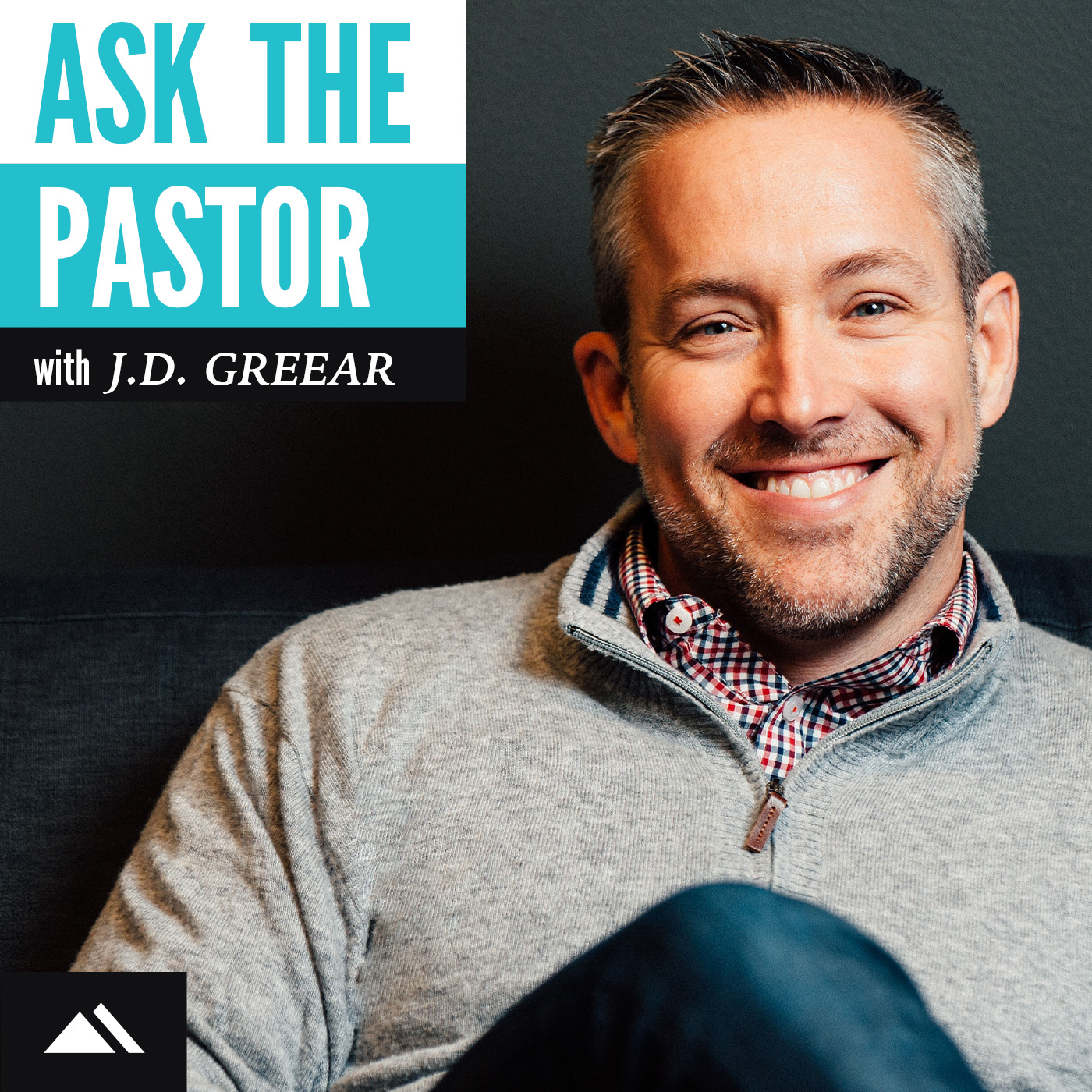
Ask the Pastor with J.D. Greear
J.D. Greear
Ask the Pastor with J.D. Greear is a weekly podcast that answers tough questions and tackles relevant issues in a way that is filled with grace, understanding, and wisdom from God’s Word. Hosted by Matt Love.
Episodes
Mentioned books

May 25, 2020 • 13min
What Are the Three Most Important Things for a New Believer to Do Immediately?
Pastor J.D. discusses the three most important things for new believers to do as they begin their relationship with Christ.
A glimpse inside this episode:
#1: Learn how to spend time with God.
There’s absolutely nothing that will benefit you more than spending time with God every single day.
Find a time that works for you, and set aside time.
Start with 10-15 minutes if you need to, but make sure you have time to read Scripture and spend time praying.
A lot of people who start well in the Christian life don’t always end well — like in the parable of the seed. The problem with the seed, though, is that it didn’t go deep enough.
I recommend reading a book of the Bible all the way through, rather than trying to read the whole thing front-to-back.
The book of Mark is a great place to start.
We advocate the “HEAR” method here at our church. Highlight, Examine, Apply, Respond.
#2: Plug into a gospel-centered local church and get involved.
You’ve gotta be known, you’ve gotta be serving… there’s just something essential about the local church.
Yes, you can get podcasts like this one and sermons online and that’s great, but good content can’t replace being a part of the church.
Even though it doesn’t technically have to be your nearest Summit Collaborative church, I am of the opinion that they’re the best… even though I may be a little biased.
Seriously though, it’s vital to get plugged into a local church that preaches the Word of God right away.
If you’re not sure where to start, ask some friends that are believers where they go.
Or, look around online, and make sure you read the “What we believe” section of the church’s website.
One of the best analogies for the body of Christ is… well, the actual body. When I have an itch on my left arm, my body sends a message to my mind which sends a message to my hand telling me to itch. It doesn’t just magically happen.
In the same way, if you’ve cut yourself off from the church, you’ve cut yourself off from one of the ways God has to meet your needs.
But do you really need the church?
#3: Get into a small group.
You need to be able to ask questions and get honest answers.
You need to be able to be honest with people about struggles and sin.
You need accountability.
And, you need people to have fun with and live life with that have the same beliefs as you.
A small group is a great connection point of connection.
Your friends are the future you. You will be the average of your 5 closest friends in 5 years.
So when you’re in a small group where people are calling out things to you and about you and preaching doctrine constantly, that’s a big step in the right direction.
You need someone to help you know God. A lot of people never take that initiative.
The sponsor for this week’s episode:
For more than 25 years, Portable Church® has helped thousands of churches launch strong and thrive in a mobile setting. They design custom solutions that fit each budget, vision, and venue. Everything you need to launch a mobile church — an inviting worship space, kids ministry areas, welcome spaces, storage cases, etc — all in a system refined to make it fast, easy & fun for the weekly volunteer teams. portablechurch.com/lifeway
May 18, 2020 • 12min
Why Are You a Southern Baptist, Anyway?
Pastor J.D. talks about the importance of doctrine, values, and mission when aligning with a denomination and shares some of his convictions.
A glimpse inside this episode:
I am Southern Baptist, not by birth but by choice.
There is no group whose doctrine, values, and mission I line up with more than Southern Baptists.
A lot of people wonder what the usefulness of denominations is, especially when they can unfortunately create a lot of divisiveness inside and outside of their membership. However, I really believe that we can do more for the kingdom of God when we work together than we could ever do alone.
First, cooperation amongst similarly-minded churches is a good thing, without question.
Second, I also believe institutions are good.
Tim Keller has a chapter in the book “Center Church” on movements, and how movements and institutions need each other. Movements are fun and exciting, and institutions can seem boring, but the two need each other.
Movements without institutions lack staying power.
Several years ago, Southern Baptists had fallen off the map in the domestic church planting game. There were a couple other groups in the U.S. had really taken off, and they had really charismatic speakers.
But one of these other groups, at the height of their popularity (hundreds of thousands of Twitter followers!), talked about their pipeline. They had fewer than 100 people in it!
Meanwhile, Southern Baptist seminaries graduate 3,500 people a year. Even if you cut that in half, or in half again, or in half AGAIN, you’d still end up with more than the pipeline of that other, “cooler” movement.
The SBC is a tool. If you have a tool and it gets dull and you can’t use it anymore, what do you do? Throw it away. But that’s not where we are with the SBC.
Sure, there are some headaches, but I believe that the ability it gives us to work together is worth it.
Unity in essential, uniformity in non-essentials. Truth trumps a faux unity.
One of the core reasons I’m a Southern Baptist is because of the doctrine. The SBC’s official statement of faith: the Baptist Faith & Message 2000. This document clearly and concisely lays out a biblical belief system that lines up very, very closely with my own. So much so, in fact, that our church has adopted it as our official statement of faith.
Narrow enough to keep us united on the essentials and broad enough for us to disagree on non-essentials.
J.D., I do have another question: why don’t you have “Baptist” in your church’s name?
Good question. We used to be, officially, Homestead Heights Baptist Church and The Summit Church was more like our “nickname.” We even used to say that!
We’re in North Carolina, but I call it the “hole” in the Bible belt… you know, the leather goes around it.
We found that some people had preconceived notions about us (some good, some bad) because of the name of our church before they even walked through the door.
For us, the name was an obstacle. I don’t advocate every church do this, and we didn’t want to lose our Baptist identity.
Our church makes it pretty clear to even the casual observer that that’s who we are, and I frequently mention it in my sermons. We make it crystal clear in our membership course.
The sponsor for this week’s episode:
For more than 25 years, Portable Church® has helped thousands of churches launch strong and thrive in a mobile setting. They design custom solutions that fit each budget, vision, and venue. Everything you need to launch a mobile church — an inviting worship space, kids ministry areas, welcome spaces, storage cases, etc — all in a system refined to make it fast, easy & fun for the weekly volunteer teams. portablechurch.com/lifeway
May 11, 2020 • 12min
Do All the Promises of God Still Apply to Me?
Pastor J.D. discusses the different types of promises we see in Scripture and how God’s promises are still true for us today.
A glimpse into this episode:
I’m for taking promises more seriously–the Bible has 3000!
In short: Yes. 2 Corinthians 1:20 says that all of the promises of God are “yes” in Christ Jesus. But not always in the same way as to Israel, so it’s important to understand what we’re reading when we read the Old Testament.
In the Bible, there are different types of promises:
First, there are unconditional promises, true about God all the time.
Nahum 1:7 says that he’s a refuge in times of trouble. Isaiah 41:10 says he will strengthen and help and uphold us — those are pretty incredible promises coming from the God of the universe.
There are national covenantal promises: promises for prosperity, to give Israel the Promised Land, to defeat their enemies, and establish a rich, prosperous kingdom, etc. to have a Jewish king on the throne.
These can still apply to us by principle: One I use: “Children mighty in the land.”
In a lot of these promises to Israel are conditional promises (like the promises with “if” statements attached to them).
First command with promise from Ten Commandments / Paul picks it up in Ephesians 6:1
“Honor your father and your mother so that you may have a long life in the land that the Lord your God is giving you.”
That’s given to Israel specially: but it still shows you something about God.
God repeatedly says that keeping his own commands equating to long life in Proverbs 3:1-2 and Deuteronomy 4:40.
It’s a principle that applies.
2 Chronicles 7:14
14 “and my people, who bear my name, humble themselves, pray and seek my face, and turn from their evil ways, then I will hear from heaven, forgive their sin, and heal their land.”
That verse was given to Israel (not America) at a specific time and place.
How is 2 Corinthians 1:20 true?
In Christ: Even the promises that are addressed to Israel apply to us, in a way, because we’re the new Israel.
Some are spiritualized in Christ: all they hoped for: a righteous, peace-ensuring Jewish king, forgiveness of sins, eternal inheritance, strength no enemy could touch–are given to us in Christ!
John Piper said about this verse: “Every sinner who comes to God in Christ, with all his needs, finds God coming to him in Christ, with all his promises. When a sinful person meets the holy God IN CHRIST, what he hears is YES.”
Everything about God’s protection, presence, working for our good, eternal rest and fulfillment–yes.
But we can still expect the break-in of God’s goodness: Psalm 27:13
13 “I am certain that I will see the Lord’s goodness in the land of the living.”
My friend Jen Wilkin gave some helpful tips on interpreting the promises of God. She said:
Don’t confuse a promise with a principle.
Don’t ignore the context of the promise.
Don’t overlook an “if” in the promise.
Don’t choose a promise selectively.
Don’t try to manipulate a promise to mean what you want it to mean.
Don’t limit a promise to your own understanding.
The sponsor for this week’s episode:
For more than 25 years, Portable Church® has helped thousands of churches launch strong and thrive in a mobile setting. They design custom solutions that fit each budget, vision, and venue. Everything you need to launch a mobile church — an inviting worship space, kids ministry areas, welcome spaces, storage cases, etc — all in a system refined to make it fast, easy & fun for the weekly volunteer teams. portablechurch.com/lifeway
May 4, 2020 • 9min
How Should We Think About Preserving Life vs. Stimulating the Economy?
Pastor J.D. explains why the seemingly obvious lives vs. livelihood answer is more complicated than we think.
A glimpse inside this episode:
When you phrase it, “Lives vs. livelihood” the answer seems obvious. But it’s more complicated than that.
To be honest, it’s really easy to say, “Let’s keep the economy closed for however long this takes,” while you’re sitting at home collecting a paycheck while there are so many people who are suddenly without an income.
But it’s not just rhetoric to point out that poverty also leads to death: poverty surges lead to increases in medical problems, other diseases, even suicide (hotlines are maxed).
According to a report in the New York Times, the World Food Program is warning that 130 million people may face starvation because the “national lockdowns and social distancing measures are drying up work and incomes” and may lead to a devastating disruption of “agricultural production and supply routes.”
22 million people here in the US are jobless because of the shutdown (and counting).
And history tells us that even with slight increases in the unemployment rate, drug overdoses rise… Just imagine what a ~15% spike will do in just a few weeks!
Furthermore, we accept that there is certain amount of collateral damage with life:
Christian ethicists throughout history have recognized that some situations require nuanced ethical reflection. For example, collateral damage has always been accepted as an unfortunate byproduct of just war—to be avoided wherever possible but sometimes necessary in pursuit of higher ends. It’s easy to make a speech about how no objective in war is worth the sacrifice of a single innocent life in war, but we know that argument hasn’t held up in history.
Or, from another angle, automobiles take untold amounts of lives each year. We can say that no amount of efficiency that the automobile brings is worth the toll in human lives cars take, but we generally accept some collateral damage as the price of freedom and progress. We also recognize how much value speed in transportation adds to life, even saving lives, etc.
Of course, I’m not saying we should throw caution to the wind, and certainly not that we should sacrifice the old or vulnerable… We’re on lockdown and plan to remain so until our officials tell us is it ok.
Wisdom is found in balancing principles. I’m not an expert who can say what the right application is–but I can advocate for the principles. Many leaders neglect one.
The sponsor for this week’s episode:
For more than 25 years, Portable Church® has helped thousands of churches launch strong and thrive in a mobile setting. They design custom solutions that fit each budget, vision, and venue. Everything you need to launch a mobile church — an inviting worship space, kids ministry areas, welcome spaces, storage cases, etc — all in a system refined to make it fast, easy & fun for the weekly volunteer teams. portablechurch.com/lifeway
Apr 27, 2020 • 10min
Is it ever right to see coronavirus as evidence of specific judgment from God?
Pastor J.D. talks about how times of suffering, like the current coronavirus pandemic, should be viewed in connection to God’s judgment.
A glimpse inside this episode:
We’ve been asking some questions that are pretty specific to our current situation with the coronavirus. Is it ever right to see coronavirus as evidence of specific judgment from God on a person or a people?
In one sense, all misery and devastation can be. You have to be very careful with this one, not all suffering, or even most suffering, is connected to a specific sin. But Scripture clearly says that sometimes God uses disease or death as a specific punishment for sin–whether of individuals or societies as a whole. Here are three quick examples:
In Acts 12, the Jewish King Herod allows himself to be called “God.” “And immediately an angel of the Lord struck him down, because he did not give God the glory, and he was eaten by worms and died.” (Acts 12:23) The autopsy revealed he had a parasite problem. Luke says it was a direct judgment by God for a specific sin. As in, “it was because he did this.”
In John 5, Jesus warned the invalid he’d healed: “See, you are well again. Stop sinning or something worse may happen to you” (John 5:14). Meaning it’s possible to commit acts of rebellion that God responds to with physical suffering.
Paul warns believers in Corinth to take their walk with God seriously because certain kinds of spiritual neglect have caused sickness: “That is why many among you are weak and sick, and a number of you have fallen asleep.” (1 Corinthians 11:30)
Paul even identifies homosexual desires as a tangible, physical punishment for sin. He may not do it by individual, but he definitely says it was a tangible judgment for exalting the Creator over the creation.
And then you have the whole book of Revelation, where various judgments are not merely the general outworkings of the curse, but specific judgments for large societies and their sins.
So, it’s clear that there are times where God uses specific sickness as judgement for sin.
But that is a level of interpretation of what God is doing and how he’s working that we should not make. So while acknowledging that that happens, it’s not wise for us to jump in and say, “Well, this is happening because of ____.”
The best example of this, of course, is Job–Job suffered and all his friends were like, “What did you do?” And Job was like, “I haven’t done anything that would single me out for judgment!” And God agreed and said that Job’s friends were wicked for saying his suffering was judgment. He calls them stupid for doing this.
I think this is especially problematic to do right now with the coronavirus. Perhaps there are some situations out there where God is judging certain people, but it’s not our place to guess.
We see now that there are some communities in our nation that are suffering more, and perhaps that’s because of unjust situations they’ve been put in. So to turn around and say, “You’re suffering because of your sins,” when in fact it’s in part because of the sins of others, is wrong.
I will say that means that when I am sick or suffering, the first question I ask should be, “Is God trying to get my attention about something?” Is he in mercy trying to wake me up? I do believe that if there is some sin that God is trying to get my attention about, he will reveal it to me quickly. So, while it is true that it does happen, and we should be aware of it, it is never on us to declare that definitively about someone else. What I’ve found is that if God is doing this, he always makes very clear to you what it’s for. He won’t hide that from you. And again, I don’t think it’s wrong to ask the question. But to say, declaratively and come to a conclusion that this is what God is doing, that’s where it becomes wrong.
In Luke 13, there’s a tower that has fallen and killed 18 people. Somebody asks Jesus, “Was this because these 18 people were more wicked than the rest?” Jesus says no, but, “…unless you repent, you will all perish.”
My assumption is not supposed to be, “What was God making that person suffer for?” Instead, we should ask what God is doing in our lives and trying to get our attention about, and recognize the reality of sin.
Sin is serious. Be afraid of it, but don’t dwell on this unless the Holy Spirit makes something plain and clear.
The sponsor for this week’s episode:
For more than 25 years, Portable Church® has helped thousands of churches launch strong and thrive in a mobile setting. They design custom solutions that fit each budget, vision, and venue. Everything you need to launch a mobile church — an inviting worship space, kids ministry areas, welcome spaces, storage cases, etc — all in a system refined to make it fast, easy & fun for the weekly volunteer teams. portablechurch.com/lifeway
Apr 20, 2020 • 13min
Is church online really church?
Pastor J.D. shares some of his thoughts about doing church online, especially in light of the current coronavirus pandemic.
A glimpse inside this episode:
J.D., most churches are now recording or live-streaming their church services so their people can watch from their homes in light of the coronavirus pandemic. What do you think about that? Is church online really church?
In some ways, you’d like to say yes, in these times, God is recognizing this as us gathering together. But it is not ideal. And this is not church in “many locations.”
I’m not onboard with those who say this is another variation of the multi-site movement.
I’m also not onboard with saying this is just the future and we need to get on board.
But don’t let perfect be the enemy of good.
The New Testament is not giving exact, prescriptive tasks very often. Instead, most of the orders it gives are ones of idealistic purity. There are even examples of irregularities in the New Testament itself:
Church without elders. It’s clear elsewhere in Scripture that churches do need elders.
Women starting missionary churches.
If gauze is the best bandage, don’t be shy about using a bandaid.
What about the ordinances? What about baptism and the Lord’s Supper?
Instinctively, my first response was “no.” Right now, The Summit Church has not gotten to a point where we’re baptizing or taking the Lord’s Supper. We don’t feel like the length of time has justified going to some of those extreme circumstances. But the longer it goes on, it makes me think there may be a point where we have to figure out non-ideal ways to participate and observe the ordinances.
Philip baptizes the Ethiopian eunuch. There wasn’t a church there. It was better for him to be baptized there than not at all.
So there may be a case where there’s something temporary that we do.
The essential elements of coming to the Lord’s table:
Togetherness
Introspection
Celebration
What about an invalid in their home? The Didache talks about that.
What about missionaries who take the Lord’s supper together, without any other believers? Obviously that’s not ideal but it is better than nothing as a temporary solution.
If someone’s going to say, “Well, it’s Tuesday and I don’t want to wait until the weekend to baptize my friend, I’m going to do it now,” that’s not a good example of utilizing a temporary solution. But in a circumstance like the one we have now, it may make sense to utilize a temporary solution.
Does it have to be bread and wine?
There are elements of bread and wine (juice) that are helpful. But if you simply don’t have it, I would say no. And you could take that further — you could say it would be best to crush the grapes yourself to see the symbolism.
If you have to get a Ritz cracker and a glass of water, that’s better than nothing.
The introspection is most important.
In some ways, doing the Lord’s table this way virtually can be more connective than in a room at church with 1500 people. That’s the ideal version, but there may also be a connection online that’s helpful.
When it comes to these ordinances, it ought to be done as an entire local church, not certain groups or people or families.
The sponsor for this week’s episode:
For more than 25 years, Portable Church® has helped thousands of churches launch strong and thrive in a mobile setting. They design custom solutions that fit each budget, vision, and venue. Everything you need to launch a mobile church — an inviting worship space, kids ministry areas, welcome spaces, storage cases, etc — all in a system refined to make it fast, easy & fun for the weekly volunteer teams. portablechurch.com/lifeway
Apr 13, 2020 • 8min
What does the cancellation of the SBC Annual Meeting mean for you?
With the cancellation of the 2020 Annual Meeting of the Southern Baptist Convention, Pastor J.D. Greear briefly answers what that means for him over the next year.
Resources:
Why canceling the 2020 SBC Annual Meeting is putting ‘Gospel Above All’
2020 SBC Annual Meeting canceled
Baptist Press COVID-19 coverage
Apr 6, 2020 • 13min
Should you send your kids to public school, private school, or home school?
Pastor J.D. talks about some key advantages and disadvantages to each type of schooling and how Scripture guides our decision-making.
A glimpse inside this episode:
My friend Joby Martin says if you want some entertainment, get a home-school mama and a public school mama together and ask what the best educational approach is and then just get some popcorn and sit back and prepare for a UFC bout.
Home-school mom be like: Sure, you can send your kid to the place where they outlaw prayer like in the times of Nebuchadnezzar and teach your kid that he came from monkeys and where he might get stabbed in the face by a gang member… that’s fine … but we love our son and want him to develop a biblical worldview so we homeschool. Statistically they are more likely to walk with Jesus if you do that, so clearly homeschooling is the godly choice.”
Public-school mom: Yeah, that’s cool. We just want our kids to have things like… social skills. We think it’s cool that Timmy can churn his own butter and make his own clothes but we want our son to know things like … math. And we think our kids need to learn how to deal with the temptation of the world and not just run from it. After all, Jesus promised he would protect us in the world, not to vacate from it—and if all the Christians flee the public school, where is that going to leave society? How can we be salt and light to the world if we vacate it? Keeping our kids in public school is an act of love for our neighbor.
First, Romans 14. Chapter 14 and the first half of 15 are one extended discussion about how to get along with people in the church who disagree with you on something you feel passionate about.
Second: We’ve done all three: private school, home school, and public school and saw advantages in each.
3 in private now, 1 in public
(Veronica says she couldn’t homeschool all 4 at once because the Bible clearly says Thou shalt not murder. And my wife would’ve killed my kids if they were home-schooled.)
Third, I’ll say: It really is ‘by kid.’
There haven’t been a lot of studies on this, but those that are out there indicate that there’s not a significant difference in homeschool and public regarding whether the child adopts the faith if the parent is involved. “The data also suggest that family climate, especially faithful religious devotion by both parents, delivered in a context of loving nurture, is far more important than where a child goes to school.”
Parental involvement is more key than school choice.
That’s similar to the studies on how much doing devotions impacts a kid. It is the quality of the relationship more than the amount of the teaching that makes the difference. Here it is: Sociologist Vern Bengston says in his book Families and Faith that studies conclusively show that the quality of the child’s relationship to the father is the single-most important factor in whether the child adopts the faith of the parents.
What are advantages to private/home schooling?
Studies show that both homeschooled kids and private school kids usually do slightly better on standardized testing than public school students.
Private school students may get more intentionally-tailored Bible teaching and Christian curriculum (takes some pressure off), and homeschool parents have all the freedom they want to disciple their kids and teach them the Bible as a part of everyday school.
Homeschooling (and private schooling to some extent) allows you the opportunity to tailor your child’s education to that child.
If in a public school, it can be difficult to control what they’re exposed to at an early age.
Public school curriculum can be notoriously harsh to Christianity–you’ve got to do due diligence. We had our older kids read apologetics books for that purpose.
What are disadvantages to private/home schooling?
Social interaction (not just a joke) if you’re not careful when homeschooling.
Church is a great place to build the kind of community that can compensate for this, by the way, along with things like sports, extracurricular clubs, etc.
Exposing them to world. We wanted to have them come home every night and process with us the hard discussions, the temptations, before college.
Missional element: be careful with this one. That’s your calling not theirs yet.
Private school is really expensive.
It’s a privileged person who even gets to ask a question like this. I understand that. Private schools are really expensive, and not only does that make it impossible for some people … it’s also something that Christians might want to consider even if they can afford it. Do you want your child to only interact with other kids who can afford that kind of school? Or do you want them to have friends from other walks of life, other socio-economic statuses?
Homeschooling can be really tough.
Sometimes it’s nice to have some help shouldering the load of teaching your kids — especially when it comes to subjects that might be out of your comfort zone (which, for me, would come embarrassingly early in the process).
Every kid is different.
The sponsor for this week’s episode:
For more than 25 years, Portable Church® has helped thousands of churches launch strong and thrive in a mobile setting. They design custom solutions that fit each budget, vision, and venue. Everything you need to launch a mobile church — an inviting worship space, kids ministry areas, welcome spaces, storage cases, etc — all in a system refined to make it fast, easy & fun for the weekly volunteer teams.
Mar 30, 2020 • 11min
What if I don’t feel like God is answering my prayers?
During this uncertain time, Pastor J.D. addresses a common question Christians have about prayer. He makes it clear that God not only hears our prayers but moves as a result.
A glimpse inside this episode:
Here are some false answers:
Maybe prayer is about changing me? Not true. Lewis. Not, ask and you’ll be changed, knock and the experience makes you different. The parables (Luke 13, Luke 18) about how God answers those who persist in prayer.
Or, people wonder, maybe it’s all predestined? AA Hodge: “Eating is the pre-ordained way God has set for living.”
What should you do?
First, Many have felt this way in history (Job; Psalms; Jeremiah in Lamentations)
God rewards persistence: in this way, it does change you.
It is good to wait on God.
You don’t know all that God is doing:
John Piper: at any given point, God is doing 10,000 things, you are aware of only three of them
Example: Tapestries at Biltmore House
None of your prayers are wasted—God uses them all.
Sometimes overruling your answer for a better one!
The Spirit intercedes for us. Revelation: God collecting these prayers at his altar.
Mar 23, 2020 • 17min
How should Christians respond to the coronavirus?
Pastor J.D. shares four main ways Christians should respond in the midst of the coronavirus pandemic.
A glimpse inside this episode:
The coronavirus is now, according to the World Health Organization, a “world pandemic.” We’ve seen some unprecedented public responses to stop the spread of the virus here in the United States—things most of us have never personally experienced.
States (like our own North Carolina) are issuing official states of emergency. In some places, the national guard has been deployed. Colleges have sent students home. Local public schools are closing, too. Every sporting event I’m aware of has been suspended indefinitely or outright canceled. And most churches, now, are not meeting.
First, a few weeks ago you quoted Matthew 24 about in the last days there being plagues, etc. Jesus told his disciples that it was not for them to know the times or the seasons, nor the day and hour of his return.
What Jesus indicates here is that God uses things like this to wake us up to the fragility of the world and to the reality of divine judgment. They are like birth pains–they can’t tell you the exact moment of new birth, but they indicate that the time is getting shorter and a new reality that is coming. As the time of judgment draws near, we can expect these things only to increase.
So, we are wise to hear in these things a divine warning God is trying to give to people on earth: The world we live in is temporary. The things we trust in won’t sustain us.
This has been humbling, hasn’t it? When I first heard about this, I thought this would go in the category of “near misses” I’ve grown accustomed to. You hear about an asteroid that comes close to earth, but it always seems to miss and life goes on. Or you hear about epidemics in other places and think, “Our medical system can keep us safe.” But think about how something that none of us can even see; something that a month ago none of us were worried about, or scarcely even aware of, has brought our nation to a screeching halt.
Even if the reality of this is not as bad as some of the worser case scenarios, the total shutdown of our country is going to have massive implications. Some are saying unemployment could get as high as 20%. How quickly and easily our whole nation has shut down shows us just how fragile we are.
So: How should we, as Christians, respond to this current crisis?
1- Heed wise counsel
This is not a time for carelessness or bravado. Nor is it a time for panic.
We all have a natural bias–some of us gravitate toward worst case scenarios and doomsday prophecies and overreact. Others tend to brush aside reports as hysteria or some kind of mainstream media political agenda. It’s probably wisest to know our bias, avoid extremes, and listen to counsel.
My encouragement to you is to avoid online extremists, particularly those that pander to your bias. We know social media isn’t helping that much. It’s ironic that in an age of unprecedented access to information that during a crisis social media does more to spread disinformation and hysteria.
Our disposition as a church, at this point, is to defer to the CDC and our government, neither getting way far ahead of them nor lagging behind. We believe this is why God gave us governing officials, and we’re going to follow them.
And let me say something to those of you who feel young and invulnerable, since I know that many of the reports we have heard have indicated that young people are not as much at risk as others. First, don’t take anything for granted. There are plenty of stories of young healthy people developing serious complications, even dying, as a result of contracting this virus.
Second, even if you are low-risk, you should take precautions for the sake of your neighbors. It’s like a friend of mine said, “I’m taking CDC instructions seriously, not because I’m afraid of getting it. I’m young, healthy, in Christ and have no fear about the future. I’m taking Covid-19 seriously because I’m afraid of distributing it.”
Or, as another Christian leader (Andy Crouch) put it, “Love, not fear, is the reason we should change our behavior.
2- In this season, move forward in faith, not backwards in fear
The early church wasn’t known for stockpiling ample food and ammunition for themselves or spreading fear on social media. Or, as I’ve heard said, Mother Teresa’s legacy built on hoarding months of supplies for herself and then berating the poor of Calcutta on why they weren’t as wise as she was.
Christian witnesses throughout history have been known for hope, faith, and self-sacrifice, imitating a Savior who ran toward tragedy, not away from it.
This is a time of great opportunity for us. Rodney Stark tells the story of how the gospel saw unprecedented expansion in a time of plagues in the 1st Century:
In AD 165, while Marcus Aurelius was emperor, a plague struck the Roman Empire, and over a 15-year period, it killed nearly 33% of the population. At this time there were 45,000 Christians in existence, just 0.08 percent of the empire. Despite their numbers, their response to this pandemic won admiration and a greater following.
Dionysius, bishop of Corinth, reported: Most of our brother Christians showed unbounded love and loyalty, never sparing themselves and thinking only of one another. Heedless of danger, they took charge of the sick, attending to their every need and ministering to them in Christ, and with them departed this life serenely happy… Many, in nursing and curing others, transferred their death to themselves and died in their stead.
This stood in stark contrast to those outside the church. Dionysius continues: “But with non-Christians everything was quite otherwise. They deserted those who began to be sick, and fled from their dearest friends. They shunned any participation or fellowship with death; which yet, with all their precautions, it was not easy for them to escape.”
Stark even points out, in evident irony, that Christian death rates in many of these plagues were substantially lower. By nearly ⅔! Why? Some analysts also say it was because of their strong sense of community, their commitment to care for each other, and their robust hope in the face of death. In their willingness to embrace death, they found life.
Andy Crouch explains this: “[If you were a first-century Roman], after you had recovered from the plague, where would you want to worship? The pagan temple whose priests and elite benefactors had fled at the first sign of trouble? Or the household of the neighbor who had brought you food and water, care and concern, at great risk to themselves?
When this plague has passed, what will our neighbors remember of us? Will they remember that the Christians took immediate, decisive action to protect the vulnerable, even at great personal and organizational cost? Will they remember that, being prepared and free from panic, the households of their Christian neighbors were able to visit the needy (while protecting them by keeping appropriate social distance!), provide for their needs, and bring hope?”
Practically:
Check on your elderly
Ask about hourly workers
Buy gift cards from service places
Support the healthcare workers you know. Pray for strength, endurance, rest, and community for those caring for the sick and vulnerable / Send a text or drop off a note of encouragement / Deliver a meal to their home or run errands for them while you are out / Offer childcare for their kids while they work and rest. (An enormous number of healthcare workers are single mothers. With numerous school closures, many of them are unable to work—and this at a time when they are needed most!)
See what ministries your church has (bunch on our home page)
3- Proclaim hope
I got this message from one of my staff members earlier this week. “While this situation is new, our calling has not changed. The gospel is still the most important message in the world, and we are still called upon to tell it. It is a gospel of love and faith, precisely what we need when society is filled with fear and uncertainty.”
In just a few weeks, we are going to celebrate a holiday that has been at the center of Christianity for 2,000 years—Easter. There was never a more hopeless time, humanly speaking, than when the Son of God was in the grave. At that point, it seemed like the end. The disciples themselves were despairing. But Easter is a reminder: He is risen! And as sure as he walked out of the grave, he promises life to those of us living in the shadow of death.
4- Use this season to develop some good habits!
Our discipleship team has prepared a small group guide called Don’t Waste Your Quarantine. Family Devotions. Reading. Structured Days.
God does some of his greatest work in secret, mundane places. We’re entering a sort of extended “Sabbath,” when most of what we would normally doing we won’t be able to do. Don’t just make it through this time. Redeem this time. Don’t waste your quarantine!
C.S. Lewis lived at a point in the 1960’s when a lot of people were genuinely afraid we were going to be destroyed by nuclear weapons, and he was once asked how one could live without fear knowing that at any minute the world could be destroyed. He said, “Well, what I know is that all of us will die eventually, and for most of us it will be sudden and for many of us it will be unpleasant. We may not know when or how death will come, but we know it will come for all of us and it’s very likely to be unexpected and unpleasant. And I know that sounds a bit morbid, but when you resolve yourself to that, you can start to use whatever amount of time you have–whether it’s 6 months or 60 years, to embrace life and capitalize on whatever opportunities God has put in front of you. Our main question should not be when and how we’ll die, but how we’ll live when we are alive.
The sponsor for this week’s episode:
For more than 25 years, Portable Church® has helped thousands of churches launch strong and thrive in a mobile setting. They design custom solutions that fit each budget, vision, and venue. Everything you need to launch a mobile church — an inviting worship space, kids ministry areas, welcome spaces, storage cases, etc — all in a system refined to make it fast, easy & fun for the weekly volunteer teams.

