

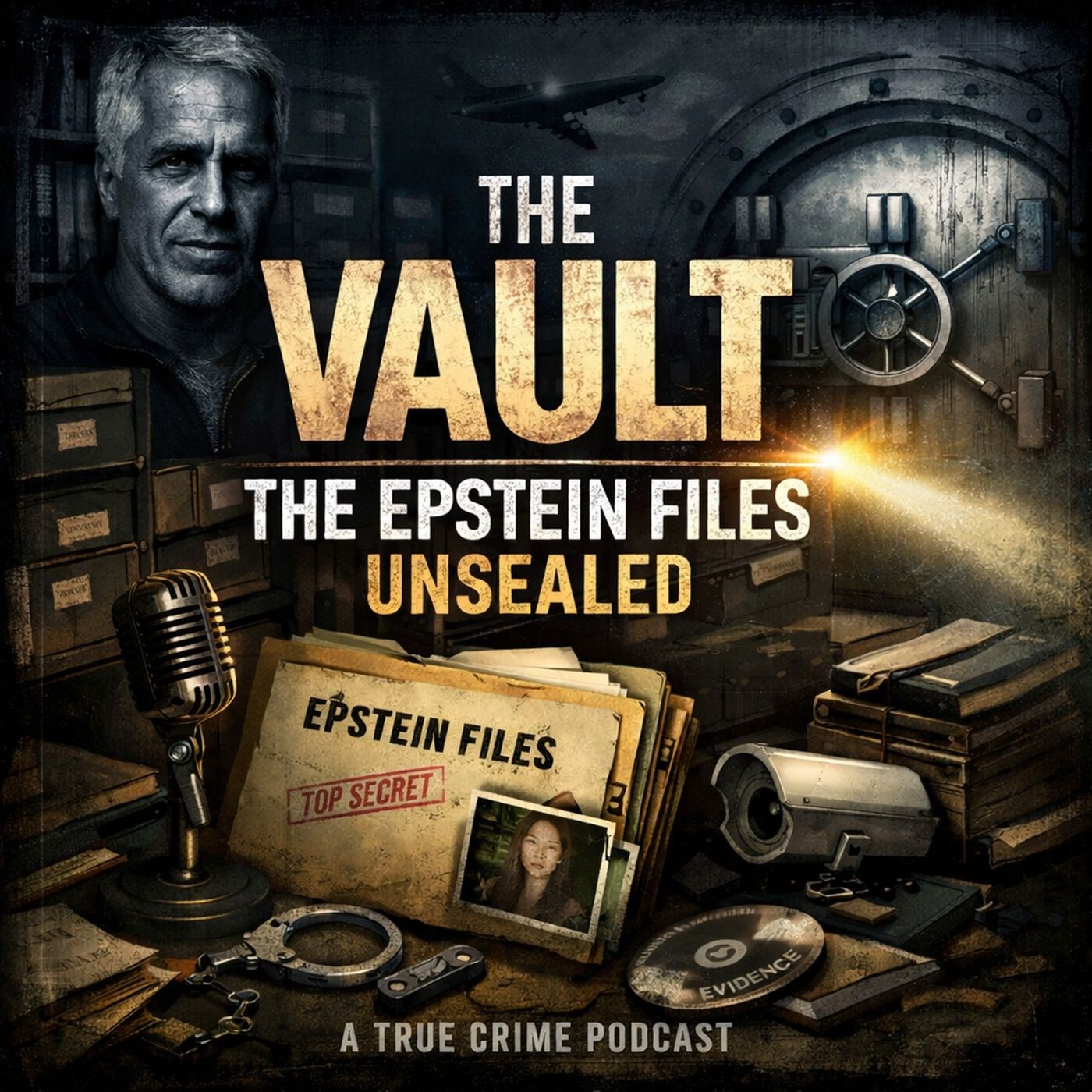
The Vault: The Epstein Files
Bobby Capucci
The Vault: The Epstein Files Unsealed is a deep-dive investigative podcast that pulls back the curtain on one of the most protected criminal networks in modern history. This series is built from the ground up on the actual paper trail—unsealed court records, depositions, exhibits, emails, and filings that were never meant to be read by the public. No pundit panels. No spin. Just the documents themselves, examined line by line, name by name, connection by connection—paired with precise, document-driven analysis that explains what the record truly shows.Each episode opens the vault on newly unsealed or long-buried Epstein files and walks listeners through what they actually reveal about power, money, influence, and the systems that failed survivors at every turn. Alongside the filings themselves, informed commentary breaks down the legal strategy, the institutional behavior, the contradictions, and the implications hiding between the lines. From judges’ orders and sealed exhibits to sworn testimony and back-channel communications, the show connects the dots the media often won’t—or can’t. Patterns emerge. Timelines collapse. Excuses fall apart.The Vault is a working archive in audio form, a living record of the Epstein case as told by the courts themselves—supplemented by rigorous analysis that provides context, challenges official narratives, and exposes where the record has been distorted, sanitized, or deliberately ignored. Every claim is grounded in filings. Every episode is anchored to the record. Listeners aren’t told what to think—they are shown what exists, what was said under oath, and what the commentary reveals about how those facts were buried, softened, or misrepresented.If you want to understand how Jeffrey Epstein was protected, who circled him, how institutions closed ranks, and why accountability keeps slipping through the cracks, The Vault: The Epstein Files Unsealed is where the record finally speaks for itself—and where the commentary ensures the documents do what no press release ever will.
Episodes
Mentioned books

Feb 22, 2026 • 17min
Palm Beach Is Ground Zero For The Jeffrey Epstein Coverup (2/22/26)
Jeffrey Epstein’s original prosecution in Florida was a catastrophic failure of justice shaped by power, wealth, and political influence. Palm Beach State Attorney Barry Krischer possessed overwhelming evidence from police investigations, yet instead of filing state charges, he deferred to federal authorities—effectively handing Epstein a lifeline. What followed was a “sweetheart” deal: a 13-month sentence in a county facility that allowed daily work-release privileges, private transport, and minimal oversight. Palm Beach Sheriff Ric Bradshaw’s office and state probation officers treated Epstein not as a felon but as a VIP, ignoring repeated violations and complaints that he continued his predatory behavior during supposed supervision. Local law enforcement who built the case were left outraged as prosecutors, probation staff, and administrators enabled a predator to operate freely under the guise of punishment.to contact me:bobbycapucci@protonmail.com
Feb 22, 2026 • 25min
Trump and Epstein: What the New York Times Revealed About Their Real Relationship (Part 3) (2/22/26)
The New York Times has reported that Donald Trump and Jeffrey Epstein shared a much closer relationship in the late 1980s through the 1990s and early 2000s than Trump has publicly acknowledged. According to the Times, Epstein described Trump as his “best friend,” and the two socialized frequently at parties, spoke often by phone, and were part of the same high-society circles, particularly bonding over women. Epstein’s former employees told the Times that Trump often discussed sex with him rather than business, and Epstein was described as Trump’s “most reliable wingman” in that era. While Trump has denied involvement in Epstein’s criminal conduct, the Times cited newly released emails and interviews suggesting Trump was aware of Epstein’s sexual abuse of girls, though no evidence has surfaced that Trump was directly involved in those crimes.The reporting also highlighted specific incidents and firsthand accounts that paint a picture of their social interactions: Epstein introduced several women to Trump, including at least one who was a minor at the time, and an email referenced Epstein “giving” Trump a 20-year-old woman. Former employees recounted Trump sending modeling cards to Epstein “like a menu,” and one woman’s story described Epstein directing her to social events where Trump was present. Although Trump and Epstein’s friendship reportedly soured by the mid-2000s, and Trump has repeatedly sought to distance himself from Epstein—saying they had a falling-out long before Epstein’s legal troubles—the Times reporting underscores a deeper and more personal connection than Trump has acknowledged.to contact me:bobbycapucci@protonmail.comsource:https://www.nytimes.com/2025/12/18/us/jeffrey-epstein-donald-trump.html
Feb 22, 2026 • 18min
Trump and Epstein: What the New York Times Revealed About Their Real Relationship (Part 2) (2/22/26)
The New York Times has reported that Donald Trump and Jeffrey Epstein shared a much closer relationship in the late 1980s through the 1990s and early 2000s than Trump has publicly acknowledged. According to the Times, Epstein described Trump as his “best friend,” and the two socialized frequently at parties, spoke often by phone, and were part of the same high-society circles, particularly bonding over women. Epstein’s former employees told the Times that Trump often discussed sex with him rather than business, and Epstein was described as Trump’s “most reliable wingman” in that era. While Trump has denied involvement in Epstein’s criminal conduct, the Times cited newly released emails and interviews suggesting Trump was aware of Epstein’s sexual abuse of girls, though no evidence has surfaced that Trump was directly involved in those crimes.The reporting also highlighted specific incidents and firsthand accounts that paint a picture of their social interactions: Epstein introduced several women to Trump, including at least one who was a minor at the time, and an email referenced Epstein “giving” Trump a 20-year-old woman. Former employees recounted Trump sending modeling cards to Epstein “like a menu,” and one woman’s story described Epstein directing her to social events where Trump was present. Although Trump and Epstein’s friendship reportedly soured by the mid-2000s, and Trump has repeatedly sought to distance himself from Epstein—saying they had a falling-out long before Epstein’s legal troubles—the Times reporting underscores a deeper and more personal connection than Trump has acknowledged.to contact me:bobbycapucci@protonmail.comsource:https://www.nytimes.com/2025/12/18/us/jeffrey-epstein-donald-trump.html
Feb 22, 2026 • 19min
Trump and Epstein: What the New York Times Revealed About Their Real Relationship (Part 1) (2/22/26)
The New York Times has reported that Donald Trump and Jeffrey Epstein shared a much closer relationship in the late 1980s through the 1990s and early 2000s than Trump has publicly acknowledged. According to the Times, Epstein described Trump as his “best friend,” and the two socialized frequently at parties, spoke often by phone, and were part of the same high-society circles, particularly bonding over women. Epstein’s former employees told the Times that Trump often discussed sex with him rather than business, and Epstein was described as Trump’s “most reliable wingman” in that era. While Trump has denied involvement in Epstein’s criminal conduct, the Times cited newly released emails and interviews suggesting Trump was aware of Epstein’s sexual abuse of girls, though no evidence has surfaced that Trump was directly involved in those crimes.The reporting also highlighted specific incidents and firsthand accounts that paint a picture of their social interactions: Epstein introduced several women to Trump, including at least one who was a minor at the time, and an email referenced Epstein “giving” Trump a 20-year-old woman. Former employees recounted Trump sending modeling cards to Epstein “like a menu,” and one woman’s story described Epstein directing her to social events where Trump was present. Although Trump and Epstein’s friendship reportedly soured by the mid-2000s, and Trump has repeatedly sought to distance himself from Epstein—saying they had a falling-out long before Epstein’s legal troubles—the Times reporting underscores a deeper and more personal connection than Trump has acknowledged.to contact me:bobbycapucci@protonmail.comsource:https://www.nytimes.com/2025/12/18/us/jeffrey-epstein-donald-trump.html
Feb 22, 2026 • 14min
Epstein Files Unsealed: Alex Acosta And His Epstein Interview With OIG Inspectors (Part 7) (2/22/26)
In his interview with the DOJ Office of the Inspector General, Alex Acosta repeatedly framed the 2007–2008 Epstein non-prosecution agreement as a constrained, pragmatic decision made under pressure rather than a deliberate act of favoritism. He told inspectors that Epstein’s defense team, stacked with politically connected and aggressive lawyers, created what he described as a credible threat of a federal indictment collapse if prosecutors pushed too hard. Acosta emphasized that his office believed securing some conviction at the state level was better than risking none at all, and he claimed he was focused on avoiding a scenario where Epstein walked entirely. Throughout the interview, Acosta leaned heavily on the idea that the deal was the product of risk assessment, limited evidence, and internal prosecutorial judgment rather than corruption or improper influence, repeatedly asserting that he acted in good faith.At the same time, the OIG interview exposed glaring gaps and evasions in Acosta’s account, particularly regarding victims’ rights and transparency. He acknowledged that victims were not informed about the existence or finalization of the NPA, but attempted to downplay this as a procedural failure rather than a substantive violation of the Crime Victims’ Rights Act. Acosta also distanced himself from the unusual secrecy of the agreement, suggesting that others in his office handled victim communications and specific drafting decisions. Most damaging, however, was his inability to offer a coherent justification for why Epstein received terms so extraordinary that they effectively shut down federal accountability altogether. The interview left the unmistakable impression of a former U.S. Attorney attempting to launder an indefensible outcome through bureaucratic language, while avoiding responsibility for a deal that insulated Epstein and his network from meaningful scrutiny for more than a decade.to contact me:bobbycapucci@protonmail.comsource:EFTA00009229.pdf
Feb 22, 2026 • 12min
Epstein Files Unsealed: Alex Acosta And His Epstein Interview With OIG Inspectors (Part 6) (2/22/26)
Alex Acosta, former U.S. Attorney and Labor Secretary, reflects on his role in the 2007–2008 Epstein non-prosecution agreement. He discusses prosecutorial decision-making under pressure and unusual internal routing of memos. The interview covers meetings with defense counsel, oversight concerns, and gaps around victim notifications and secrecy.
Feb 22, 2026 • 12min
Epstein Files Unsealed: Alex Acosta And His Epstein Interview With OIG Inspectors (Part 5) (2/21/26)
In his interview with the DOJ Office of the Inspector General, Alex Acosta repeatedly framed the 2007–2008 Epstein non-prosecution agreement as a constrained, pragmatic decision made under pressure rather than a deliberate act of favoritism. He told inspectors that Epstein’s defense team, stacked with politically connected and aggressive lawyers, created what he described as a credible threat of a federal indictment collapse if prosecutors pushed too hard. Acosta emphasized that his office believed securing some conviction at the state level was better than risking none at all, and he claimed he was focused on avoiding a scenario where Epstein walked entirely. Throughout the interview, Acosta leaned heavily on the idea that the deal was the product of risk assessment, limited evidence, and internal prosecutorial judgment rather than corruption or improper influence, repeatedly asserting that he acted in good faith.At the same time, the OIG interview exposed glaring gaps and evasions in Acosta’s account, particularly regarding victims’ rights and transparency. He acknowledged that victims were not informed about the existence or finalization of the NPA, but attempted to downplay this as a procedural failure rather than a substantive violation of the Crime Victims’ Rights Act. Acosta also distanced himself from the unusual secrecy of the agreement, suggesting that others in his office handled victim communications and specific drafting decisions. Most damaging, however, was his inability to offer a coherent justification for why Epstein received terms so extraordinary that they effectively shut down federal accountability altogether. The interview left the unmistakable impression of a former U.S. Attorney attempting to launder an indefensible outcome through bureaucratic language, while avoiding responsibility for a deal that insulated Epstein and his network from meaningful scrutiny for more than a decade.to contact me:bobbycapucci@protonmail.comsource:EFTA00009229.pdf
Feb 22, 2026 • 12min
Epstein Files Unsealed: Alex Acosta And His Epstein Interview With OIG Inspectors (Part 4) (2/21/26)
In his interview with the DOJ Office of the Inspector General, Alex Acosta repeatedly framed the 2007–2008 Epstein non-prosecution agreement as a constrained, pragmatic decision made under pressure rather than a deliberate act of favoritism. He told inspectors that Epstein’s defense team, stacked with politically connected and aggressive lawyers, created what he described as a credible threat of a federal indictment collapse if prosecutors pushed too hard. Acosta emphasized that his office believed securing some conviction at the state level was better than risking none at all, and he claimed he was focused on avoiding a scenario where Epstein walked entirely. Throughout the interview, Acosta leaned heavily on the idea that the deal was the product of risk assessment, limited evidence, and internal prosecutorial judgment rather than corruption or improper influence, repeatedly asserting that he acted in good faith.At the same time, the OIG interview exposed glaring gaps and evasions in Acosta’s account, particularly regarding victims’ rights and transparency. He acknowledged that victims were not informed about the existence or finalization of the NPA, but attempted to downplay this as a procedural failure rather than a substantive violation of the Crime Victims’ Rights Act. Acosta also distanced himself from the unusual secrecy of the agreement, suggesting that others in his office handled victim communications and specific drafting decisions. Most damaging, however, was his inability to offer a coherent justification for why Epstein received terms so extraordinary that they effectively shut down federal accountability altogether. The interview left the unmistakable impression of a former U.S. Attorney attempting to launder an indefensible outcome through bureaucratic language, while avoiding responsibility for a deal that insulated Epstein and his network from meaningful scrutiny for more than a decade.to contact me:bobbycapucci@protonmail.comsource:EFTA00009229.pdf
Feb 22, 2026 • 14min
Epstein Files Unsealed: Alex Acosta And His Epstein Interview With OIG Inspectors (Part 3) (2/21/26)
In his interview with the DOJ Office of the Inspector General, Alex Acosta repeatedly framed the 2007–2008 Epstein non-prosecution agreement as a constrained, pragmatic decision made under pressure rather than a deliberate act of favoritism. He told inspectors that Epstein’s defense team, stacked with politically connected and aggressive lawyers, created what he described as a credible threat of a federal indictment collapse if prosecutors pushed too hard. Acosta emphasized that his office believed securing some conviction at the state level was better than risking none at all, and he claimed he was focused on avoiding a scenario where Epstein walked entirely. Throughout the interview, Acosta leaned heavily on the idea that the deal was the product of risk assessment, limited evidence, and internal prosecutorial judgment rather than corruption or improper influence, repeatedly asserting that he acted in good faith.At the same time, the OIG interview exposed glaring gaps and evasions in Acosta’s account, particularly regarding victims’ rights and transparency. He acknowledged that victims were not informed about the existence or finalization of the NPA, but attempted to downplay this as a procedural failure rather than a substantive violation of the Crime Victims’ Rights Act. Acosta also distanced himself from the unusual secrecy of the agreement, suggesting that others in his office handled victim communications and specific drafting decisions. Most damaging, however, was his inability to offer a coherent justification for why Epstein received terms so extraordinary that they effectively shut down federal accountability altogether. The interview left the unmistakable impression of a former U.S. Attorney attempting to launder an indefensible outcome through bureaucratic language, while avoiding responsibility for a deal that insulated Epstein and his network from meaningful scrutiny for more than a decade.to contact me:bobbycapucci@protonmail.comsource:EFTA00009229.pdf
Feb 22, 2026 • 33min
Mega Edition: Honeypots And Kompromat: A Conversation With 'Agent X' (2/21/26)
Jeffrey Epstein’s operation bore all the hallmarks of a high-level honeypot scheme, suggesting far more than the lone actions of a wealthy manipulator. According to Agent X, a former intelligence operative, he suspects that Epstein systematically lured influential figures—politicians, CEOs, even royalty—into compromising situations that were allegedly recorded and used for blackmail or leverage. The presence of underage girls on his properties magnified the severity of potential incriminations, giving Epstein a powerful hold over his high-profile guests. Moreover, the unusually lenient legal treatment he received—particularly a Florida plea deal granting him near-total immunity—raises strong suspicions of government or intelligence involvement, possibly in exchange for Epstein providing valuable information on bigger, more strategically significant targets.Agent X also underscored the possibility that Epstein may have been “flipped” as an FBI informant, feeding them tapes or intel about the elite figures he ensnared. This scenario would explain his near-magical ability to dodge serious consequences for so long, while potentially enabling federal agencies to gather extraordinary leverage over top-level individuals. If true, Epstein’s operation would not be a mere personal blackmail ring, but a sprawling intelligence asset cultivating a vast reservoir of Kompromat for hidden patrons. In this view, the case exemplifies how institutional corruption and clandestine arrangements can permit profound abuse under the guise of exclusive wealth, while showcasing why transparency and accountability remain vital to prevent further exploitation.to contact me:bobbycapucci@protonmail.com

