

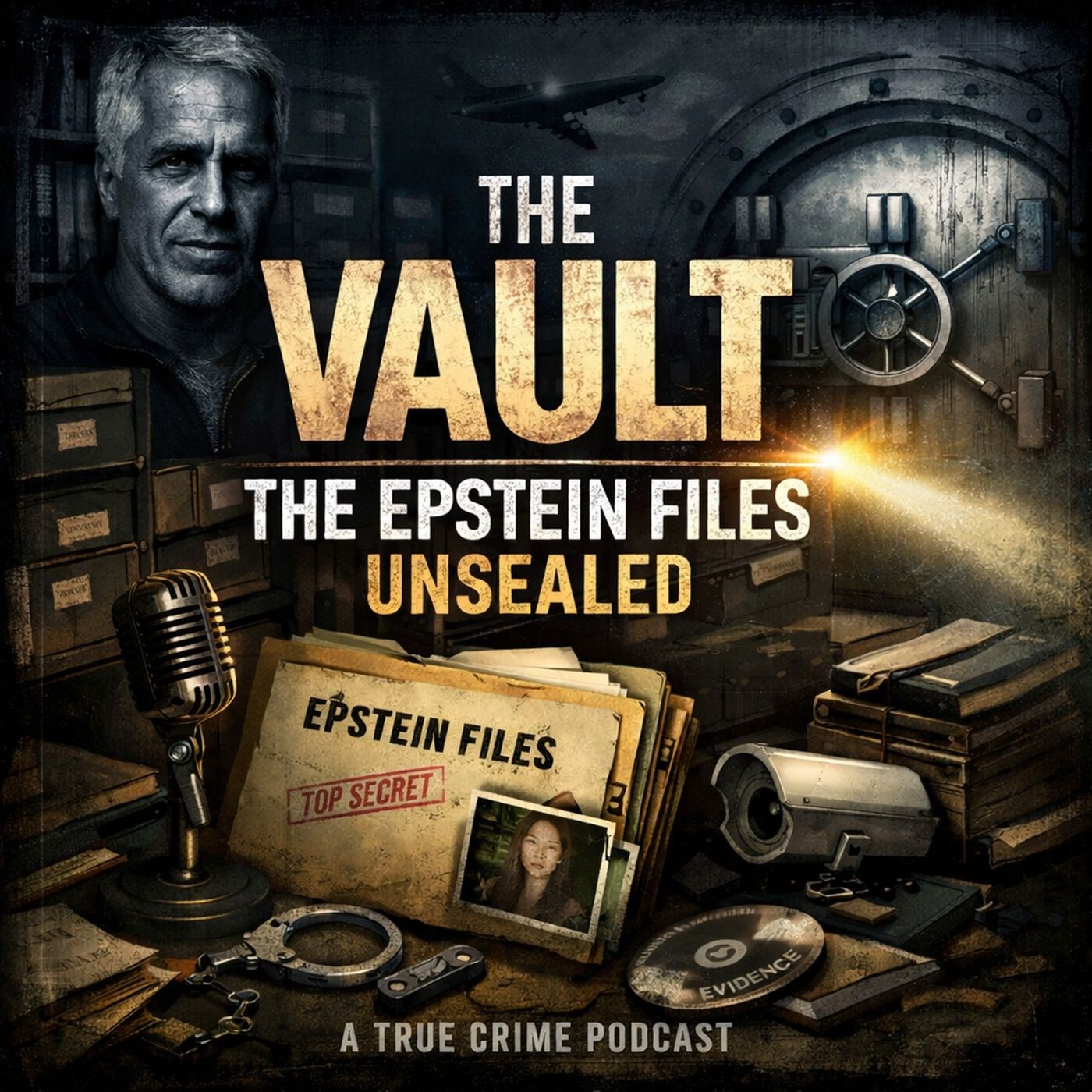
The Vault: The Epstein Files
Bobby Capucci
The Vault: The Epstein Files Unsealed is a deep-dive investigative podcast that pulls back the curtain on one of the most protected criminal networks in modern history. This series is built from the ground up on the actual paper trail—unsealed court records, depositions, exhibits, emails, and filings that were never meant to be read by the public. No pundit panels. No spin. Just the documents themselves, examined line by line, name by name, connection by connection—paired with precise, document-driven analysis that explains what the record truly shows.Each episode opens the vault on newly unsealed or long-buried Epstein files and walks listeners through what they actually reveal about power, money, influence, and the systems that failed survivors at every turn. Alongside the filings themselves, informed commentary breaks down the legal strategy, the institutional behavior, the contradictions, and the implications hiding between the lines. From judges’ orders and sealed exhibits to sworn testimony and back-channel communications, the show connects the dots the media often won’t—or can’t. Patterns emerge. Timelines collapse. Excuses fall apart.The Vault is a working archive in audio form, a living record of the Epstein case as told by the courts themselves—supplemented by rigorous analysis that provides context, challenges official narratives, and exposes where the record has been distorted, sanitized, or deliberately ignored. Every claim is grounded in filings. Every episode is anchored to the record. Listeners aren’t told what to think—they are shown what exists, what was said under oath, and what the commentary reveals about how those facts were buried, softened, or misrepresented.If you want to understand how Jeffrey Epstein was protected, who circled him, how institutions closed ranks, and why accountability keeps slipping through the cracks, The Vault: The Epstein Files Unsealed is where the record finally speaks for itself—and where the commentary ensures the documents do what no press release ever will.
Episodes
Mentioned books

Mar 15, 2026 • 15min
Jeffrey Epstein's Estate Turns Over Documents To Congress (3/15/26)
The House Oversight Committee has received hundreds of pages of new material from Jeffrey Epstein’s estate following congressional subpoenas. These include Epstein’s will, the infamous 2008 non-prosecution agreement, entries from his longtime address book, and a heavily redacted “birthday book” that Ghislaine Maxwell compiled for Epstein’s 50th birthday in 2003. The book contained messages, photos, and drawings from associates, sparking scrutiny because of one note signed “Donald” alongside a crude sketch, which Democrats say points to Donald Trump. Trump has flatly denied it, calling the note fake and politically motivated.The estate said it redacted names and identifying details of minors and private individuals to protect victims. It also emphasized it does not possess a so-called “client list” of people involved in Epstein’s sex-trafficking crimes, despite years of speculation. The handover reflects growing congressional pressure, led by Rep. James Comer and the House Oversight Committee, to uncover what Epstein’s records reveal about his finances, associates, and possible political connections.to contact me:bobbycapucci@protonmail.comsource:Jeffrey Epstein estate turns over more documents to House committee
Mar 15, 2026 • 13min
Perjury as Privilege: The DOJ’s Gift to Ghislaine Maxwell (3/15/26)
Ghislaine Maxwell’s proffer session with the DOJ was less about truth and accountability and more about performance and deceit. The entire premise of a proffer is simple: you trade truth for a chance at leniency. But Maxwell didn’t come to the table with intelligence, evidence, or leads that could help dismantle Epstein’s far-reaching web. She came armed with a rehearsed script of lies and character assassinations. She weaponized her time in that room not to aid justice, but to smear survivors who had already borne the crushing weight of humiliation in courtrooms and the press. The newly released emails now strip away any doubt about what happened—they show that Maxwell didn’t stumble or misremember. She perjured herself over and over, carefully contradicting her own sworn statements. This was deliberate, malicious dishonesty. And yet, instead of being dragged back to court with perjury charges and buried under the consequences, she was inexplicably rewarded with cushier accommodations. Sitting across from her during this travesty was none other than Deputy Director Todd “Baby Billy” Blanche, a man who should have cut the session short the moment the lies started, but who instead sat back, nodded, and let justice be mocked.The fallout from this disaster stretches far beyond Maxwell herself. For survivors, it was another betrayal layered on top of years of indifference and ridicule. They were once again slandered, this time under the very nose of the government agency tasked with protecting them. Their truth, earned through blood and tears, was tossed aside so Maxwell could preserve her own skin. For the public, the message couldn’t be clearer: the Department of Justice is not an impartial arbiter of the law, but a stage where the rich and connected get to rewrite the script in their favor. Accountability was promised, but what America got instead was a rigged performance where lies were treated as cooperation, and perjury was treated as a perk. A real justice department would have treated her dishonesty as a direct assault on the rule of law, stacking charges on her until her arrogance collapsed. But instead, Blanche and his colleagues chose complicity over courage, shielding Maxwell from consequences and exposing to everyone watching that in America, justice isn’t blind—it looks the other way when power is in the room.to contact me:bobbycapucci@protonmail.com
Mar 15, 2026 • 16min
From Private Appetite to Public Leverage: Epstein's Two-Tiered Trafficking Operation (3/15/26)
Jeffrey Epstein’s operation cannot be understood through the lens of a traditional sex trafficking ring. Unlike figures such as Heidi Fleiss, Epstein wasn’t in it for monetary gain or running a transactional enterprise. His network operated on two levels: the first was driven by his personal compulsions, where he targeted vulnerable high school girls in Palm Beach and New York to satisfy his own deviance. The second level was more strategic—trafficked women, often brought in by Ghislaine Maxwell or Jean-Luc Brunel, were used as leverage, positioned before powerful men in Epstein’s properties to entangle them in compromise and silence.This dual structure transformed his crimes into something far more insidious than prostitution or trafficking-for-profit. Epstein weaponized abuse itself, turning victims not only into prey but into tools of influence. The men who participated weren’t mere clients—they became co-conspirators, drawn into a system where their indulgence bound them to Epstein’s web of secrecy and power. In this sense, Epstein’s empire was less about sex as commerce and more about sex as control, creating a machinery of corruption that blurred every line between victim, perpetrator, and accomplice.to contact me:bobbycapucci@protonmail.com
Mar 15, 2026 • 36min
Mega Edition: Leon Black And His "Rap" Performance (3/15/26)
Leon Black’s relationship with Jeffrey Epstein spanned decades and has been a source of sustained scandal. Black, cofounder of Apollo Global Management, paid Epstein at least $158 million (and recent investigations suggest as much as $170 million) between 2012 and 2017 for tax, estate planning, and art-collection services. Black has acknowledged that working with Epstein was a “horrible mistake” and said he deeply regrets their association. Nonetheless, his payments and closeness to Epstein have invited intense scrutiny about what Black knew — or should have known — about Epstein’s criminal network. Meanwhile, congressional and regulatory probes have sought to uncover the full extent of their financial entanglements and whether Black’s use of Epstein’s services was beyond mere professional consults.In addition to the financial scandal, Black’s ties to Epstein have been tangled with serious allegations of sexual misconduct. Multiple lawsuits accuse Black of rape, including claims that in 2002, when introduced by Epstein, he assaulted a 16-year-old autistic girl in Epstein’s Manhattan townhouse. One prominent lawsuit filed by Cheri Pierson accused Black of attacking her in Epstein’s home; that lawsuit was later dismissed. Black has denied all criminal wrongdoing, asserting consensual relationships and rejecting claims against him as false. These overlapping allegations and financial links with Epstein have undermined Black’s reputation, led to his resignation as MoMA board chair and Apollo executive, and triggered ongoing legal and reputational battles.to contact me:bobbycapucci@protonmaill.com
Mar 15, 2026 • 40min
Mega Edition: Denise George And Her Role In The Epstein CICO Suit In The USVI (3/15/26)
Denise George, a seasoned attorney from the U.S. Virgin Islands, served as the territory's Attorney General from 2019 until her dismissal in December 2022. During her tenure, she was recognized for her unwavering commitment to justice, notably leading significant legal actions against the estate of Jeffrey Epstein.In early 2020, George filed a civil enforcement lawsuit against Epstein's estate under the Virgin Islands' Criminally Influenced and Corrupt Organizations Act (CICO). This legal action aimed to hold Epstein's estate accountable for alleged criminal activities, including human trafficking and sexual exploitation within the Virgin Islands. Her efforts culminated in a settlement in November 2022, wherein the estate agreed to pay the Virgin Islands over $105 million and half of the proceeds from the sale of Little St. James, Epstein's private island.to contact me:bobbycapucci@protonmail.com
Mar 15, 2026 • 42min
Mega Edition: Jeffrey Epstein And His Pal Alan Dershowitz (3/15/26)
Alan Dershowitz’s relationship with Jeffrey Epstein has drawn sustained criticism because it went far beyond a routine attorney-client connection and placed one of the country’s most famous legal scholars directly inside the machinery that protected a serial sex trafficker. Dershowitz was a prominent member of Epstein’s legal team during the 2008 non-prosecution agreement, a deal that secretly dismantled a federal trafficking case, shielded unnamed co-conspirators, and denied victims their rights under federal law. He publicly defended Epstein as a misunderstood figure, vouched for his character, and helped craft legal strategies that minimized consequences and discredited accusers, even as mounting evidence showed systematic abuse of underage girls. Critics argue that Dershowitz did not merely provide representation but actively participated in the legal architecture that allowed Epstein to continue offending, and in doing so lent elite credibility to one of the most damaging plea bargains in modern criminal history. His repeated insistence that the case was weak, complex, or unfairly portrayed has been widely condemned as revisionist and dismissive of survivor testimony.The relationship became even more controversial when Virginia Giuffre accused Dershowitz himself of sexual abuse, alleging that Epstein trafficked her to him when she was underage — an allegation Dershowitz has fiercely denied and fought through years of litigation, ultimately reaching a settlement without an admission of wrongdoing. Regardless of legal outcomes, critics say his public posture since then has only deepened distrust: he has repeatedly attacked accusers, questioned the credibility of survivors, and portrayed himself as a victim of conspiracy while continuing to defend Epstein’s network and minimize institutional failures. To many observers, Dershowitz embodies the very culture that enabled Epstein — a powerful insider using legal prestige to protect privilege, intimidate victims, and blur the line between advocacy and obstruction. His role is now inseparable from the scandal itself, not as a peripheral defender, but as one of the central architects of the legal shield that allowed Epstein’s crimes to persist unchecked for years.to contact me:bobbycapucci@protonmail.com
Mar 15, 2026 • 33min
Mega Edition: Jes Staley And His Dramatic Fall Due To His Relationship With Epstein (3/15/26)
The downfall of Jes Staley traces back to his long-running professional and personal relationship with Jeffrey Epstein, which resurfaced publicly years after Epstein’s crimes became widely known. While serving as CEO of Barclays, regulators began scrutinizing the extent to which Staley had been transparent about the relationship, including email contact that continued after Epstein’s 2008 conviction. Staley initially characterized Epstein as a limited professional acquaintance, but subsequent disclosures—particularly emails referring to Epstein as a “trusted friend”—undermined that account and raised concerns about candor and judgment at the highest levels of the bank.In 2021, UK regulators concluded that Staley had mischaracterized the nature of his ties to Epstein, leading to his forced resignation from Barclays and a formal investigation into whether he had misled the board and regulators. The episode effectively ended Staley’s career at the top tier of global banking and later followed him into litigation, including a lawsuit by JPMorgan Chase, where he had previously worked and overseen the Epstein relationship. Staley has argued that institutions used him as a scapegoat for broader failures, but the reputational damage proved decisive: his association with Epstein became inseparable from questions of credibility, oversight, and accountability—turning a once-powerful banking executive into one of the most prominent professional casualties of the Epstein scandal.to contact me:bobbycapucci@protonmail.com
Mar 15, 2026 • 25min
Mega Edition: The DOJ And It's Brazen Behavior When It Comes To The Epstein Files (3/14/26)
The Department of Justice has brazenly disregarded the clear mandates of the Epstein Files Transparency Act (EFTA), particularly the disclosure requirements and statutory deadlines laid out in Section 3. The law required the DOJ to release defined categories of records, provide detailed explanations for every redaction, and identify all government officials and politically exposed persons named in the materials. Instead of complying in full, the department released a narrow, heavily redacted collection of documents while withholding a vast volume of responsive records. The unredacted disclosure deadline came and went without meaningful compliance. What was produced lacked the comprehensive index and specificity the statute demanded. Millions of pages reportedly remain unreleased, despite Congress mandating transparency. The Section 3 report failed to deliver the granularity required by law, particularly in identifying who was named and on what basis redactions were made. Broad exemptions were invoked without the level of explanation the Act contemplated. Rather than submitting to the spirit and letter of the law, the DOJ controlled the scope of disclosure on its own terms. The result is selective transparency under a statute that was written to prevent exactly that outcome.The EFTA was designed to remove executive discretion from this equation and impose a binding transparency framework in a case defined by secrecy and institutional failure. By withholding large categories of material and failing to meet statutory deadlines, the DOJ has treated a congressional mandate as optional guidance. The department has cited privacy, investigative integrity, and classification concerns, but the Act anticipated those issues and required structured justification for each redaction. Instead, the response has been partial compliance coupled with procedural delay. When a federal agency declines to meet a legislated transparency deadline in a case involving powerful figures and systemic misconduct, it deepens public distrust. The failure to provide a full accounting of withheld records leaves Congress and the public unable to assess the completeness of the release. Courts traditionally defer to executive agencies on classification and disclosure decisions, limiting immediate judicial remedies. That places enforcement squarely back in the hands of Congress, which must decide whether to escalate through oversight powers. At its core, this is no longer just a records dispute; it is a constitutional test of whether statutory transparency mandates carry real enforcement power. The DOJ’s approach has transformed the EFTA from a promised reckoning into a prolonged institutional standoff.to contact me:bobbycapucci@protonmail.com
Mar 15, 2026 • 12min
Todd Blanche Gives His First Interview In The Wake Of His Conversation With Ghislaine Maxwell (3/14/26)
Todd Blanche’s CNN interview about his sit-down with Ghislaine Maxwell has been met with skepticism for good reason. Blanche framed his conversation with her as an exercise in transparency, but his insistence that it was “impossible” to determine if she was credible rang hollow, especially given the mountain of contradictions and lies Maxwell has already told under oath. Instead of pressing her on the details of Epstein’s network, Blanche largely leaned into a narrative that it was up to the “public” to decide, effectively punting the DOJ’s responsibility to establish facts. For someone in his position, such hedging looks less like neutrality and more like avoidance.What makes it worse is Blanche’s background and the circumstances. As a former Trump lawyer, his presence raises red flags about conflicts of interest, and the softball nature of his questions only fuels suspicion that this interview was more about optics than accountability. Maxwell’s transfer to a cushier, low-security facility right after this sit-down only adds to the perception that she is still receiving special treatment in exchange for selective cooperation. The entire spectacle looks less like a hard-nosed inquiry into one of the biggest sex-trafficking conspiracies of the modern era, and more like a carefully stage-managed charade designed to protect the powerful.to contact me:bobbycapucci@protonmail.comsource:Blanche breaks silence on meeting with Ghislaine Maxwell: 'Impossible' to say if she was credible - ABC News
Mar 15, 2026 • 14min
A Tale Of Wasted Privilege: Starring Prince Andrew (3/14/26)
A dive into how inherited privilege can be spectacularly misused. The show traces a fall from ceremonial duty to global ridicule. It examines loyalty to a convicted associate and a disastrously tone-deaf interview. It explores family distancing, financial dependence, and the lasting mockery that replaced any public service.

