

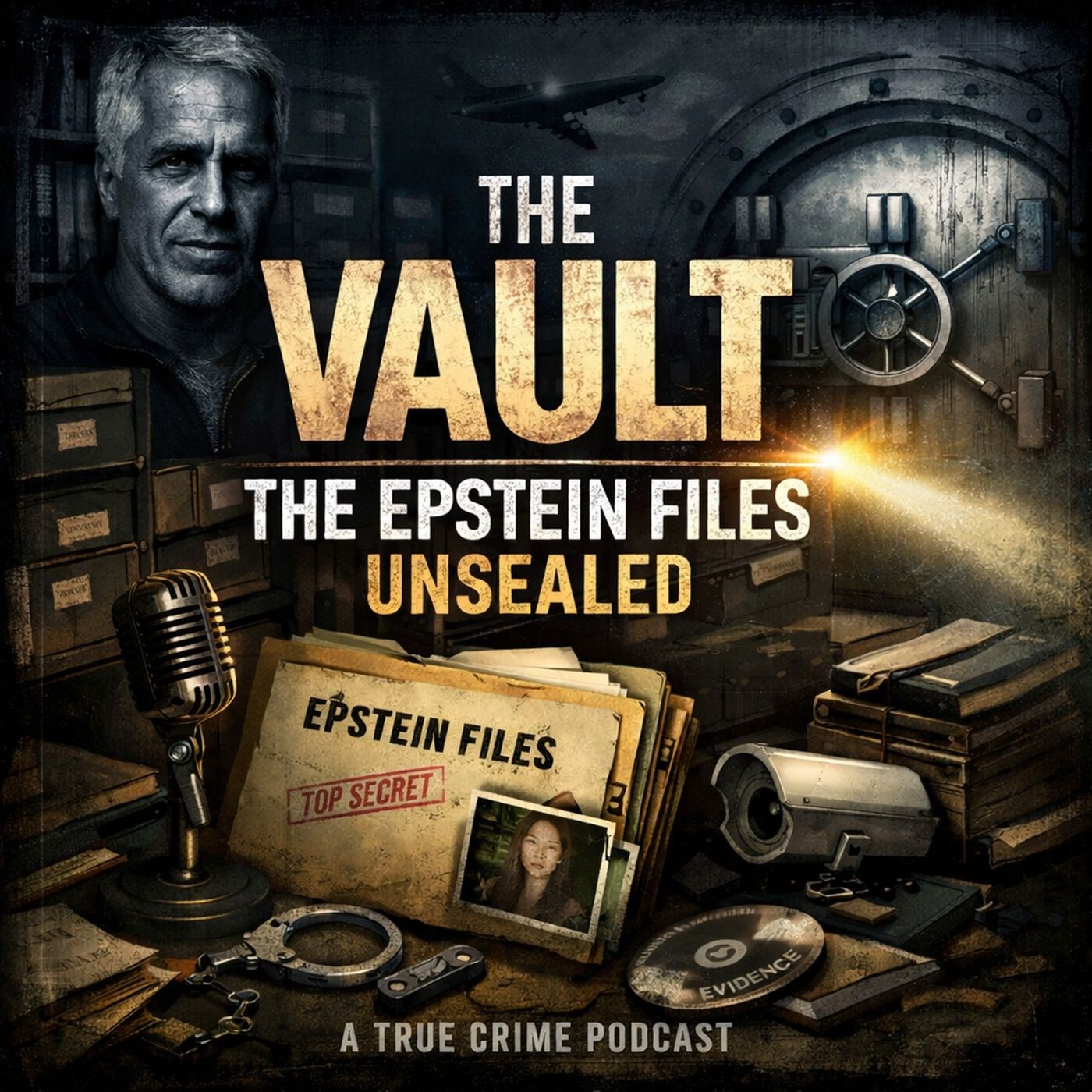
The Vault: The Epstein Files
Bobby Capucci
The Vault: The Epstein Files Unsealed is a deep-dive investigative podcast that pulls back the curtain on one of the most protected criminal networks in modern history. This series is built from the ground up on the actual paper trail—unsealed court records, depositions, exhibits, emails, and filings that were never meant to be read by the public. No pundit panels. No spin. Just the documents themselves, examined line by line, name by name, connection by connection—paired with precise, document-driven analysis that explains what the record truly shows.Each episode opens the vault on newly unsealed or long-buried Epstein files and walks listeners through what they actually reveal about power, money, influence, and the systems that failed survivors at every turn. Alongside the filings themselves, informed commentary breaks down the legal strategy, the institutional behavior, the contradictions, and the implications hiding between the lines. From judges’ orders and sealed exhibits to sworn testimony and back-channel communications, the show connects the dots the media often won’t—or can’t. Patterns emerge. Timelines collapse. Excuses fall apart.The Vault is a working archive in audio form, a living record of the Epstein case as told by the courts themselves—supplemented by rigorous analysis that provides context, challenges official narratives, and exposes where the record has been distorted, sanitized, or deliberately ignored. Every claim is grounded in filings. Every episode is anchored to the record. Listeners aren’t told what to think—they are shown what exists, what was said under oath, and what the commentary reveals about how those facts were buried, softened, or misrepresented.If you want to understand how Jeffrey Epstein was protected, who circled him, how institutions closed ranks, and why accountability keeps slipping through the cracks, The Vault: The Epstein Files Unsealed is where the record finally speaks for itself—and where the commentary ensures the documents do what no press release ever will.
Episodes
Mentioned books

Mar 17, 2026 • 19min
Wall Street Ties Raise Questions for Prosecutors Overseeing Epstein-Linked Matters (3/17/26)
Concerns have emerged over potential conflicts of interest involving Jay Clayton, the interim U.S. attorney for the Southern District of New York, whose office has jurisdiction over major financial crimes and historically handled cases connected to Jeffrey Epstein. Financial disclosures show Clayton holds more than $1.6 million in investments tied to large financial institutions and corporations. Because the Southern District has been involved in matters touching Epstein’s financial network and Wall Street entities, the holdings have raised questions about whether a prosecutor responsible for overseeing powerful financial investigations should maintain personal investments connected to the same sectors that may fall under federal scrutiny.The situation has fueled criticism about the broader system linking elite finance, corporate law, and federal prosecution. Clayton moved from private corporate law into government leadership roles and then into one of the most powerful prosecutorial positions in the country, illustrating how figures within the same financial and legal networks often rotate between regulatory agencies, private industry, and law enforcement. Critics argue that these overlapping relationships create an environment where investigations into powerful financial actors—including those connected to the Epstein scandal—are overseen by individuals who are themselves embedded within the same financial ecosystem.to contact me:bobbycapucci@protonmail.comsource:The “Epstein Class” Investigates Itself
Mar 17, 2026 • 13min
Congress Scrutinizes Conflicting Statements From Jeffrey Epstein Accountant Richard Kahn (3/17/26)
Richard Kahn, Jeffrey Epstein’s longtime accountant and co-executor of his estate, testified before the House Oversight Committee as part of Congress’s ongoing investigation into Epstein’s finances and network of associates. Kahn had worked with Epstein for more than a decade, managing his finances, investments, and various expenditures, including projects such as renovations on Epstein’s private Caribbean island. During the closed-door deposition, Kahn told lawmakers that his relationship with Epstein was strictly professional and that he never observed any evidence of sexual abuse or trafficking while handling Epstein’s financial affairs. He said that although he tracked Epstein’s spending carefully—including gifts to women and men—those transactions appeared to represent only a small portion of Epstein’s overall expenditures and did not raise red flags to him at the time.Kahn also expressed regret that he may have unknowingly assisted Epstein, saying that had he been aware of the crimes, he would have immediately stopped working for him. Lawmakers questioned him extensively about Epstein’s wealth, financial relationships with prominent individuals, and how his operation functioned for years without detection. The testimony comes amid broader congressional scrutiny of Epstein’s financial network and the role played by close associates who helped manage his assets. Kahn and Epstein’s longtime attorney Darren Indyke—both executors of the estate—have also faced legal challenges from victims alleging they helped facilitate aspects of Epstein’s operations, though they deny wrongdoing.to contact me:bobbycapucci@protonmail.comsource:Democrats say Epstein's accountant made "inconsistent" statements about Trump accuser - CBS News
Mar 17, 2026 • 12min
House Investigators Focus on Prison Guard Tova Noel in Epstein Death Investigation (3/17/26)
The House Oversight Committee is seeking to interview a former federal prison guard who was on duty the night Jeffrey Epstein died in custody at the Metropolitan Correctional Center in New York in August 2019. Lawmakers sent a letter requesting a transcribed interview with correctional officer Tova Noel as part of their ongoing investigation into the circumstances surrounding Epstein’s death. Noel and another guard, Michael Thomas, were previously charged in 2019 with falsifying prison records to make it appear they had conducted required security checks on inmates in the Special Housing Unit when they had not. The charges were later resolved through a deal with prosecutors and ultimately dismissed.The renewed congressional interest comes after newly released Justice Department records drew attention to Noel’s conduct and financial activity around the time of Epstein’s death. According to the documents, Noel’s bank had flagged a series of small cash deposits totaling roughly $12,000 between 2018 and mid-2019, with the final deposit occurring about ten days before Epstein died. Oversight Committee leaders said these disclosures, combined with ongoing public doubts about the official conclusion that Epstein died by suicide, have raised additional questions lawmakers want answered. The committee has asked Noel to appear for an interview on March 26 as part of its broader effort to examine security failures and unanswered issues surrounding Epstein’s final hours in federal custody.to contact me:bobbycapucci@protonmail.comsource:House Oversight committee seeks interview with prison guard on duty when Epstein died - ABC News
Mar 17, 2026 • 1h 3min
Mega Edition: Jeffrey Epstein And The Underbelly Of The Modeling Industry (3/17/26)
Jeffrey Epstein’s world bled right into the dark corners of the modeling industry — the kind of places where luxury and depravity blur together under the same chandelier light. He used modeling as both a cover and a recruitment pool, pretending to be a gatekeeper to fame and fashion while exploiting the industry’s obsession with youth, beauty, and access. Agencies, scouts, and so-called “talent finders” were part of this sleazy ecosystem — some complicit, others willfully blind — funneling vulnerable girls into Epstein’s orbit with promises of photoshoots, mentorships, or introductions to elite circles. Behind the high-fashion gloss was a global network of manipulation: fake casting calls, private jets filled with “models,” and connections to legitimate modeling agencies that lent Epstein’s operation an air of credibility. It wasn’t just sex trafficking — it was the corruption of an entire image-based industry where power could be traded for flesh and silence was the unspoken price of admission.What made it all so insidious was how normalized it became. Epstein’s connections to modeling power players like Jean-Luc Brunel, MC2 Model Management, and other agencies gave him a steady supply chain disguised as opportunity. Young women from Eastern Europe, South America, and small-town America were lured in by the same dream — the fantasy of walking Paris runways or being discovered at an upscale resort — only to find themselves trapped in something far darker. Epstein and his associates exploited the same machinery that made supermodels into icons, twisting it into a predatory conveyor belt. The “underbelly” wasn’t a hidden world at all — it was the same glitzy one the public adored, just seen from a different angle: the hotel rooms behind the runway, the cash envelopes, the passports held hostage, and the broken promise that fame could ever be worth that kind of nightmare.to contact me:bobbycapucci@protonmail.com
Mar 17, 2026 • 35min
Mega Edition: The Nasty Nature Of The Lawsuits Filed Against Leon Black (3/17/26)
The lawsuits filed against Leon Black in connection with Jeffrey Epstein are among the most graphic and disturbing to emerge from Epstein’s orbit. Several women, including Cheri Pierson and a plaintiff identified as Jane Doe, accuse Black of violent sexual assaults that allegedly took place inside Epstein’s Manhattan townhouse. Pierson claims Black raped her in 2002 after Epstein arranged what was supposed to be a massage appointment, describing the encounter as brutal and coercive. Another lawsuit alleges Black sexually assaulted a 16-year-old girl with autism and Down syndrome, leaving her bleeding and traumatized. Both cases portray Black as a predator who exploited Epstein’s network to target vulnerable women, echoing the broader pattern of abuse associated with Epstein’s inner circle. Black’s legal team has vehemently denied all allegations, dismissing the claims as false and opportunistic.Compounding the scandal is Black’s series of high-dollar settlements and legal maneuvering. In 2023, he quietly paid $62.5 million to the U.S. Virgin Islands to avoid potential litigation tied to Epstein’s trafficking operations there. He also succeeded in getting parts of other lawsuits dismissed on procedural grounds, including a defamation case brought by former model Guzel Ganieva, which was thrown out in early 2025. Still, the volume and nature of the claims — combined with his massive financial ties to Epstein and the Senate Finance Committee’s scrutiny of his payments — have left Black mired in controversy. The lawsuits’ explicit, violent allegations and the perception of systemic leniency have solidified his position as one of the most controversial figures to emerge from Epstein’s shadow.to contact me:bobbycapucci@protonmail.com
Mar 17, 2026 • 1h 9min
Mega Edition: Bill Gates And The Public Relations Tour After The Epstein Revelations (3/16/26)
Over the past several years, Bill Gates has embarked on a media tour of sorts, sitting down with outlets like PBS, CNN, and other major networks in an effort to explain why he maintained contact with Jeffrey Epstein even after Epstein’s 2008 conviction for soliciting sex from a minor. In interview after interview, Gates acknowledged that meeting with Epstein was a “mistake,” often repeating that he regretted the association and that there was no philanthropic outcome from their discussions. Yet the explanations consistently raised more questions than they answered. Gates initially suggested the meetings were centered around global health and charitable ambitions, but reporting later revealed multiple in-person visits to Epstein’s townhouse in New York, including at least one after his divorce announcement. The narrative that Epstein was simply a misguided gateway to philanthropic networking strained credibility, particularly given Epstein’s well-known status as a convicted sex offender by the time many of these meetings occurred.What ultimately undermined Gates’ attempts to contain the fallout was the shifting tone and evolving details across his public statements. In some interviews, he minimized the frequency of contact; in others, he admitted the meetings occurred several times. He framed the relationship as purely professional, yet he could not convincingly articulate what tangible benefit came from engaging Epstein at all. The repeated refrain of “it was a mistake” began to sound less like transparency and more like damage control. For critics, the issue was not simply that Gates met Epstein—it was that a billionaire with vast resources and global influence could not provide a clear, consistent account of why he chose to align, even briefly, with a man whose crimes were already public knowledge. The interviews, rather than resolving the controversy, reinforced a perception that the full story remains incomplete.to contact me:bobbycapucci@protonmail.com
Mar 17, 2026 • 13min
The USVI And Their Motion For An Epstein Related Summary Judgement Against JPMorgan (Part 4) (3/16/26)
In the now-concluded civil case Government of the U.S. Virgin Islands v. JPMorgan Chase & Co., the USVI sought a partial summary judgment before the case was settled, arguing that the evidence overwhelmingly showed JPMorgan knowingly facilitated Jeffrey Epstein’s sex-trafficking operation. The filing claimed that internal emails, compliance reports, and testimony proved the bank ignored repeated red flags about Epstein’s financial activity—including large cash withdrawals, suspicious wire transfers, and employee warnings linking him to underage abuse. The USVI contended that JPMorgan profited from Epstein’s wealth and social connections while turning a blind eye to clear indicators of criminal conduct, violating the Trafficking Victims Protection Act (TVPA) by financially enabling a known sex trafficker. In essence, the government asked the court to rule that JPMorgan was civilly liable on key elements of the case before it ever reachedJPMorgan denied wrongdoing and opposed the motion, insisting that there were factual disputes unsuitable for summary judgment, particularly regarding the bank’s knowledge and intent. The court ultimately declined to grant the USVI’s motion, finding that the issues were complex enough to warrant continued litigation—but the case ended shortly thereafter in December 2023, when JPMorgan agreed to a $75 million settlement with the U.S. Virgin Islands. The agreement included commitments for JPMorgan to enhance its compliance and anti-trafficking procedures while denying any admission of liability. Though the USVI didn’t win its partial summary judgment outright, the motion itself played a crucial role in forcing discovery that exposed internal JPMorgan communications and helped push the bank toward settlement.to contact me:bobbycapucci@protonmail.com
Mar 17, 2026 • 12min
The USVI And Their Motion For An Epstein Related Summary Judgement Against JPMorgan (Part 3) (3/16/26)
In the now-concluded civil case Government of the U.S. Virgin Islands v. JPMorgan Chase & Co., the USVI sought a partial summary judgment before the case was settled, arguing that the evidence overwhelmingly showed JPMorgan knowingly facilitated Jeffrey Epstein’s sex-trafficking operation. The filing claimed that internal emails, compliance reports, and testimony proved the bank ignored repeated red flags about Epstein’s financial activity—including large cash withdrawals, suspicious wire transfers, and employee warnings linking him to underage abuse. The USVI contended that JPMorgan profited from Epstein’s wealth and social connections while turning a blind eye to clear indicators of criminal conduct, violating the Trafficking Victims Protection Act (TVPA) by financially enabling a known sex trafficker. In essence, the government asked the court to rule that JPMorgan was civilly liable on key elements of the case before it ever reachedJPMorgan denied wrongdoing and opposed the motion, insisting that there were factual disputes unsuitable for summary judgment, particularly regarding the bank’s knowledge and intent. The court ultimately declined to grant the USVI’s motion, finding that the issues were complex enough to warrant continued litigation—but the case ended shortly thereafter in December 2023, when JPMorgan agreed to a $75 million settlement with the U.S. Virgin Islands. The agreement included commitments for JPMorgan to enhance its compliance and anti-trafficking procedures while denying any admission of liability. Though the USVI didn’t win its partial summary judgment outright, the motion itself played a crucial role in forcing discovery that exposed internal JPMorgan communications and helped push the bank toward settlement.to contact me:bobbycapucci@protonmail.com
Mar 17, 2026 • 12min
The USVI And Their Motion For An Epstein Related Summary Judgement Against JPMorgan (Part 2) (3/16/26)
In the now-concluded civil case Government of the U.S. Virgin Islands v. JPMorgan Chase & Co., the USVI sought a partial summary judgment before the case was settled, arguing that the evidence overwhelmingly showed JPMorgan knowingly facilitated Jeffrey Epstein’s sex-trafficking operation. The filing claimed that internal emails, compliance reports, and testimony proved the bank ignored repeated red flags about Epstein’s financial activity—including large cash withdrawals, suspicious wire transfers, and employee warnings linking him to underage abuse. The USVI contended that JPMorgan profited from Epstein’s wealth and social connections while turning a blind eye to clear indicators of criminal conduct, violating the Trafficking Victims Protection Act (TVPA) by financially enabling a known sex trafficker. In essence, the government asked the court to rule that JPMorgan was civilly liable on key elements of the case before it ever reachedJPMorgan denied wrongdoing and opposed the motion, insisting that there were factual disputes unsuitable for summary judgment, particularly regarding the bank’s knowledge and intent. The court ultimately declined to grant the USVI’s motion, finding that the issues were complex enough to warrant continued litigation—but the case ended shortly thereafter in December 2023, when JPMorgan agreed to a $75 million settlement with the U.S. Virgin Islands. The agreement included commitments for JPMorgan to enhance its compliance and anti-trafficking procedures while denying any admission of liability. Though the USVI didn’t win its partial summary judgment outright, the motion itself played a crucial role in forcing discovery that exposed internal JPMorgan communications and helped push the bank toward settlement.to contact me:bobbycapucci@protonmail.com
Mar 16, 2026 • 12min
The USVI And Their Motion For An Epstein Related Summary Judgement Against JPMorgan (Part 1) (3/16/26)
In the now-concluded civil case Government of the U.S. Virgin Islands v. JPMorgan Chase & Co., the USVI sought a partial summary judgment before the case was settled, arguing that the evidence overwhelmingly showed JPMorgan knowingly facilitated Jeffrey Epstein’s sex-trafficking operation. The filing claimed that internal emails, compliance reports, and testimony proved the bank ignored repeated red flags about Epstein’s financial activity—including large cash withdrawals, suspicious wire transfers, and employee warnings linking him to underage abuse. The USVI contended that JPMorgan profited from Epstein’s wealth and social connections while turning a blind eye to clear indicators of criminal conduct, violating the Trafficking Victims Protection Act (TVPA) by financially enabling a known sex trafficker. In essence, the government asked the court to rule that JPMorgan was civilly liable on key elements of the case before it ever reachedJPMorgan denied wrongdoing and opposed the motion, insisting that there were factual disputes unsuitable for summary judgment, particularly regarding the bank’s knowledge and intent. The court ultimately declined to grant the USVI’s motion, finding that the issues were complex enough to warrant continued litigation—but the case ended shortly thereafter in December 2023, when JPMorgan agreed to a $75 million settlement with the U.S. Virgin Islands. The agreement included commitments for JPMorgan to enhance its compliance and anti-trafficking procedures while denying any admission of liability. Though the USVI didn’t win its partial summary judgment outright, the motion itself played a crucial role in forcing discovery that exposed internal JPMorgan communications and helped push the bank toward settlement.to contact me:bobbycapucci@protonmail.com

