

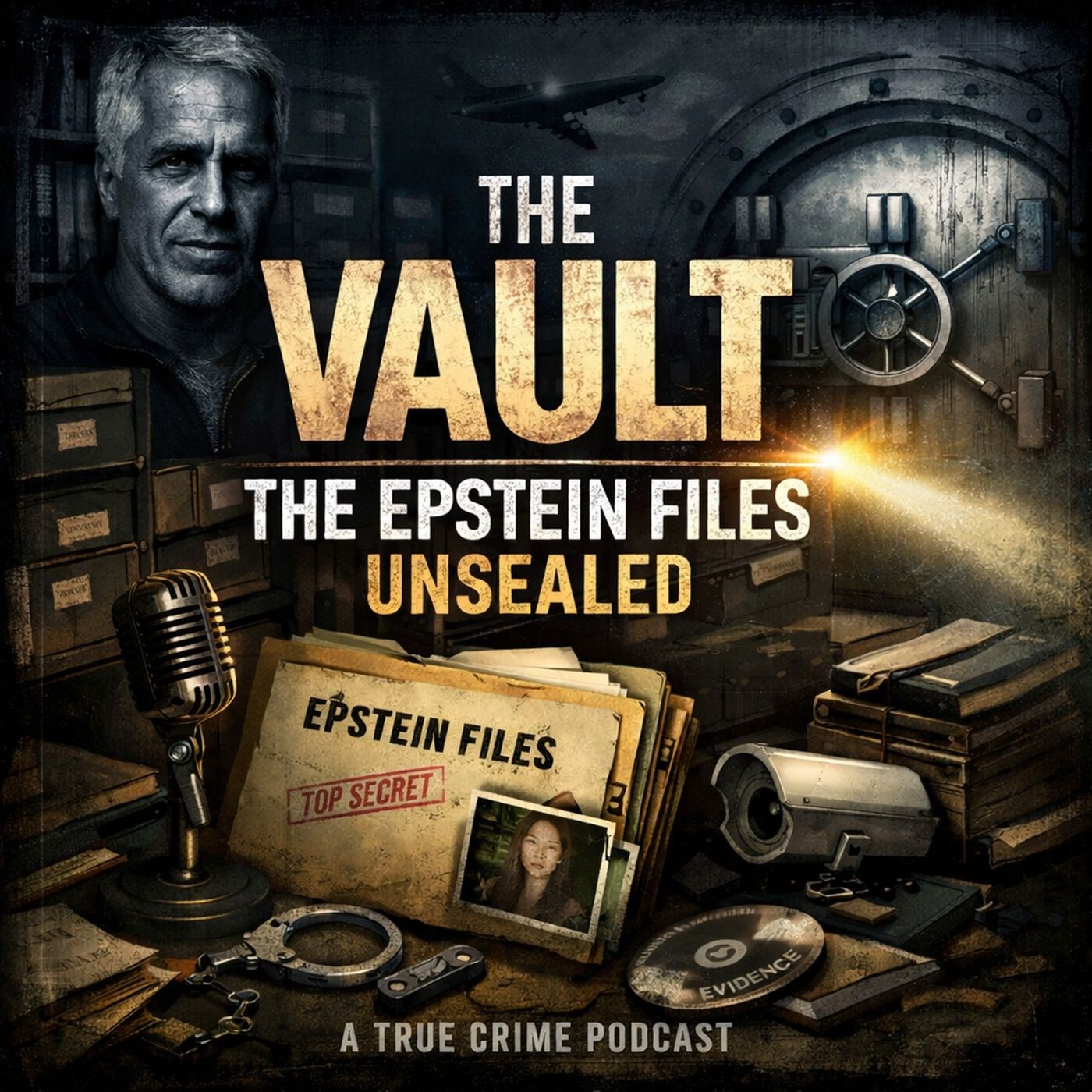
The Vault: The Epstein Files
Bobby Capucci
The Vault: The Epstein Files Unsealed is a deep-dive investigative podcast that pulls back the curtain on one of the most protected criminal networks in modern history. This series is built from the ground up on the actual paper trail—unsealed court records, depositions, exhibits, emails, and filings that were never meant to be read by the public. No pundit panels. No spin. Just the documents themselves, examined line by line, name by name, connection by connection—paired with precise, document-driven analysis that explains what the record truly shows.Each episode opens the vault on newly unsealed or long-buried Epstein files and walks listeners through what they actually reveal about power, money, influence, and the systems that failed survivors at every turn. Alongside the filings themselves, informed commentary breaks down the legal strategy, the institutional behavior, the contradictions, and the implications hiding between the lines. From judges’ orders and sealed exhibits to sworn testimony and back-channel communications, the show connects the dots the media often won’t—or can’t. Patterns emerge. Timelines collapse. Excuses fall apart.The Vault is a working archive in audio form, a living record of the Epstein case as told by the courts themselves—supplemented by rigorous analysis that provides context, challenges official narratives, and exposes where the record has been distorted, sanitized, or deliberately ignored. Every claim is grounded in filings. Every episode is anchored to the record. Listeners aren’t told what to think—they are shown what exists, what was said under oath, and what the commentary reveals about how those facts were buried, softened, or misrepresented.If you want to understand how Jeffrey Epstein was protected, who circled him, how institutions closed ranks, and why accountability keeps slipping through the cracks, The Vault: The Epstein Files Unsealed is where the record finally speaks for itself—and where the commentary ensures the documents do what no press release ever will.
Episodes
Mentioned books

Mar 21, 2026 • 14min
Inside the OIG Interview: Tova Noel’s Account of the Morning Jeffrey Epstein Died (Part 1) (3/21/26)
During the Office of Inspector General investigation into the death of Jeffrey Epstein at the Metropolitan Correctional Center in August 2019, correctional officer Tova Noel gave an interview describing how the morning unfolded when Epstein was discovered in his cell. According to her account, she and fellow officer Michael Thomas were assigned to monitor the Special Housing Unit overnight. Noel told investigators that when breakfast rounds began that morning, Thomas approached Epstein’s cell and noticed something was wrong. She said Thomas called out for assistance and that she moved toward the area, where Epstein was found hanging from a strip of bedding tied to the top bunk. Noel stated that Thomas entered the cell first and attempted to cut the ligature while she retrieved equipment to assist, after which they lowered Epstein to the floor so CPR could begin.However, the OIG investigation was highly critical of Noel’s conduct and the credibility of the circumstances she described. Investigators determined that Noel and Thomas had failed to perform the legally required inmate counts and physical security checks for hours during the night Epstein died, leaving him unmonitored in a high-risk suicide watch environment. The report also found that Noel later signed official count sheets falsely indicating that the checks had been completed, despite evidence showing they had not been. Surveillance records and other evidence suggested the officers spent large portions of the shift away from their assigned duties, and investigators concluded that their negligence created the conditions that allowed Epstein to remain unattended long enough to die. As a result, Noel’s interview with OIG was viewed less as a clear explanation of events and more as part of a broader record showing severe procedural failures and falsified documentation at the very time Epstein required the highest level of supervision.to contact me:bobbycapucci@protonmail.comsource:EFTA00117759.pdf
Mar 21, 2026 • 12min
From Riyadh to Wall Street: The Education of Jeffrey Epstein in Secrets and Shadows (Part 2) (3/21/26)
Jeffrey Epstein’s story doesn’t begin with the penthouse, the island, or the mugshot—it begins in the shadows of the Cold War. In the 1980s, he worked as a financial adviser for Saudi arms dealer Adnan Khashoggi, a man entangled in the Iran–Contra scandal and the massive Al-Yamamah arms deal. Through Khashoggi, British defense contractor Douglas Leese, and financier Steven Hoffenberg, Epstein was introduced to a world where money moved invisibly, arms were traded for oil, and intelligence agencies relied on businessmen as covert intermediaries. These early associations taught him the culture of power: secrets were currency, crimes could be reframed as strategy, and the right connections offered protection from the law.Epstein didn’t invent this playbook—he adapted it. Where Khashoggi traded weapons and oil, Epstein traded access and leverage, turning young victims into bargaining chips in a network of elites. His empire mirrored the same operating principles he absorbed in the 1980s: plausible deniability, hidden money flows, and the insulation of power. This is why his story is more than personal depravity—it’s proof that the system itself breeds and shields men like him. Epstein wasn’t a glitch in the matrix. He was the proof that it works, and the machinery that built him is still running, still producing new Epsteins, waiting for their turn in the spotlight.to contact me:bobbycapucci@protonmail.com
Mar 21, 2026 • 12min
From Riyadh to Wall Street: The Education of Jeffrey Epstein in Secrets and Shadows (Part 1) (3/21/26)
Jeffrey Epstein’s story doesn’t begin with the penthouse, the island, or the mugshot—it begins in the shadows of the Cold War. In the 1980s, he worked as a financial adviser for Saudi arms dealer Adnan Khashoggi, a man entangled in the Iran–Contra scandal and the massive Al-Yamamah arms deal. Through Khashoggi, British defense contractor Douglas Leese, and financier Steven Hoffenberg, Epstein was introduced to a world where money moved invisibly, arms were traded for oil, and intelligence agencies relied on businessmen as covert intermediaries. These early associations taught him the culture of power: secrets were currency, crimes could be reframed as strategy, and the right connections offered protection from the law.Epstein didn’t invent this playbook—he adapted it. Where Khashoggi traded weapons and oil, Epstein traded access and leverage, turning young victims into bargaining chips in a network of elites. His empire mirrored the same operating principles he absorbed in the 1980s: plausible deniability, hidden money flows, and the insulation of power. This is why his story is more than personal depravity—it’s proof that the system itself breeds and shields men like him. Epstein wasn’t a glitch in the matrix. He was the proof that it works, and the machinery that built him is still running, still producing new Epsteins, waiting for their turn in the spotlight.to contact me:bobbycapucci@protonmail.com
Mar 21, 2026 • 14min
From Wall Street to Washington: The Push to Investigate Jes Staley's Epstein Ties In The U.S. (3/21/26)
In Washington, U.S. Senator Elizabeth Warren has officially urged the nation’s top banking regulators — the Federal Reserve Board, the Office of the Comptroller of the Currency (OCC) and the Federal Deposit Insurance Corporation (FDIC) — to launch public and private investigations into Staley’s conduct while he was at J.P. Morgan Chase & Co. and later Barclays PLC. Warren’s letter alleges that Staley helped shield Epstein’s access to the banking system by intervening when internal red flags about Epstein’s transactions were raised and that despite the banks settling for large sums in sister cases, Staley has so far avoided U.S. accountabilityAt the same time, U.S. lawsuits are advancing against Barclays and Staley over alleged investor mis-representation. A judge in Los Angeles denied Staley’s request to dismiss a class-action claim that the bank and Staley misled investors about the true nature of his ties to Epstein after his arrest in 2019. The U.K.’s Financial Conduct Authority (FCA) earlier found that Staley misled regulators by approving a letter stating his relationship with Epstein was not “close,” whereas email evidence showed they were in contact well beyond what the letter claimed.to contact me:bobbycapucci@protonmail.com
Mar 21, 2026 • 36min
Mega Edition: Day Number 8 Of The Ghislaine Maxwell Trial (3/21/26)
The Ghislaine Maxwell trial, held in late 2021 in federal court in New York, centered on her alleged role as Jeffrey Epstein’s co-conspirator in a sex trafficking ring that preyed on underage girls for over a decade. Prosecutors accused Maxwell of grooming minors, gaining their trust, and then facilitating or participating in their abuse at the hands of Epstein between 1994 and 2004. The government’s case included testimony from four women, some of whom described in painful detail how Maxwell recruited them as teenagers under the guise of mentorship or financial assistance, only to manipulate them into sexual encounters with Epstein. Flight logs, photographs, and household staff testimony were used to place Maxwell at various Epstein properties and show her long-standing involvement in his lifestyle and operations.Maxwell’s defense team attempted to cast her as a scapegoat, arguing that she was being punished for Epstein’s crimes following his 2019 death in federal custody. They challenged the credibility of the accusers, questioned their motives, and pointed to the time gaps between the alleged crimes and the trial. Ultimately, the jury found Maxwell guilty on five of six federal charges, including sex trafficking of a minor, and not guilty on one count of enticing a minor to travel for illegal sex acts. The conviction marked a rare moment of accountability in a case that had long been plagued by cover-ups, prosecutorial failures, and elite protection. It also opened the door to further scrutiny of Epstein’s network, although many key figures remain untouched.to contact me:bobbycapucci@protonmail.com
Mar 21, 2026 • 43min
Mega Edition: Day Number 7 Of The Ghislaine Maxwell Trial (3/21/26)
The Ghislaine Maxwell trial, held in late 2021 in federal court in New York, centered on her alleged role as Jeffrey Epstein’s co-conspirator in a sex trafficking ring that preyed on underage girls for over a decade. Prosecutors accused Maxwell of grooming minors, gaining their trust, and then facilitating or participating in their abuse at the hands of Epstein between 1994 and 2004. The government’s case included testimony from four women, some of whom described in painful detail how Maxwell recruited them as teenagers under the guise of mentorship or financial assistance, only to manipulate them into sexual encounters with Epstein. Flight logs, photographs, and household staff testimony were used to place Maxwell at various Epstein properties and show her long-standing involvement in his lifestyle and operations.Maxwell’s defense team attempted to cast her as a scapegoat, arguing that she was being punished for Epstein’s crimes following his 2019 death in federal custody. They challenged the credibility of the accusers, questioned their motives, and pointed to the time gaps between the alleged crimes and the trial. Ultimately, the jury found Maxwell guilty on five of six federal charges, including sex trafficking of a minor, and not guilty on one count of enticing a minor to travel for illegal sex acts. The conviction marked a rare moment of accountability in a case that had long been plagued by cover-ups, prosecutorial failures, and elite protection. It also opened the door to further scrutiny of Epstein’s network, although many key figures remain untouched.to contact me:bobbycapucci@protonmail.com
Mar 21, 2026 • 32min
Mega Edition: Day Number 6 Of The Ghislaine Maxwell Trial (3/21/26)
The Ghislaine Maxwell trial, held in late 2021 in federal court in New York, centered on her alleged role as Jeffrey Epstein’s co-conspirator in a sex trafficking ring that preyed on underage girls for over a decade. Prosecutors accused Maxwell of grooming minors, gaining their trust, and then facilitating or participating in their abuse at the hands of Epstein between 1994 and 2004. The government’s case included testimony from four women, some of whom described in painful detail how Maxwell recruited them as teenagers under the guise of mentorship or financial assistance, only to manipulate them into sexual encounters with Epstein. Flight logs, photographs, and household staff testimony were used to place Maxwell at various Epstein properties and show her long-standing involvement in his lifestyle and operations.Maxwell’s defense team attempted to cast her as a scapegoat, arguing that she was being punished for Epstein’s crimes following his 2019 death in federal custody. They challenged the credibility of the accusers, questioned their motives, and pointed to the time gaps between the alleged crimes and the trial. Ultimately, the jury found Maxwell guilty on five of six federal charges, including sex trafficking of a minor, and not guilty on one count of enticing a minor to travel for illegal sex acts. The conviction marked a rare moment of accountability in a case that had long been plagued by cover-ups, prosecutorial failures, and elite protection. It also opened the door to further scrutiny of Epstein’s network, although many key figures remain untouched.to contact me:bobbycapucci@protonmail.com
Mar 21, 2026 • 33min
Mega Edition: Day Number 5 Of The Ghislaine Maxwell Trial (3/21/26)
The Ghislaine Maxwell trial, held in late 2021 in federal court in New York, centered on her alleged role as Jeffrey Epstein’s co-conspirator in a sex trafficking ring that preyed on underage girls for over a decade. Prosecutors accused Maxwell of grooming minors, gaining their trust, and then facilitating or participating in their abuse at the hands of Epstein between 1994 and 2004. The government’s case included testimony from four women, some of whom described in painful detail how Maxwell recruited them as teenagers under the guise of mentorship or financial assistance, only to manipulate them into sexual encounters with Epstein. Flight logs, photographs, and household staff testimony were used to place Maxwell at various Epstein properties and show her long-standing involvement in his lifestyle and operations.Maxwell’s defense team attempted to cast her as a scapegoat, arguing that she was being punished for Epstein’s crimes following his 2019 death in federal custody. They challenged the credibility of the accusers, questioned their motives, and pointed to the time gaps between the alleged crimes and the trial. Ultimately, the jury found Maxwell guilty on five of six federal charges, including sex trafficking of a minor, and not guilty on one count of enticing a minor to travel for illegal sex acts. The conviction marked a rare moment of accountability in a case that had long been plagued by cover-ups, prosecutorial failures, and elite protection. It also opened the door to further scrutiny of Epstein’s network, although many key figures remain untouched.to contact me:bobbycapucci@protonmail.com
Mar 21, 2026 • 43min
Mega Edition: Day Number 4 Of The Ghislaine Maxwell Trial (3/20/26)
The Ghislaine Maxwell trial, held in late 2021 in federal court in New York, centered on her alleged role as Jeffrey Epstein’s co-conspirator in a sex trafficking ring that preyed on underage girls for over a decade. Prosecutors accused Maxwell of grooming minors, gaining their trust, and then facilitating or participating in their abuse at the hands of Epstein between 1994 and 2004. The government’s case included testimony from four women, some of whom described in painful detail how Maxwell recruited them as teenagers under the guise of mentorship or financial assistance, only to manipulate them into sexual encounters with Epstein. Flight logs, photographs, and household staff testimony were used to place Maxwell at various Epstein properties and show her long-standing involvement in his lifestyle and operations.Maxwell’s defense team attempted to cast her as a scapegoat, arguing that she was being punished for Epstein’s crimes following his 2019 death in federal custody. They challenged the credibility of the accusers, questioned their motives, and pointed to the time gaps between the alleged crimes and the trial. Ultimately, the jury found Maxwell guilty on five of six federal charges, including sex trafficking of a minor, and not guilty on one count of enticing a minor to travel for illegal sex acts. The conviction marked a rare moment of accountability in a case that had long been plagued by cover-ups, prosecutorial failures, and elite protection. It also opened the door to further scrutiny of Epstein’s network, although many key figures remain untouched.to contact me:bobbycapucci@protonmail.com
Mar 21, 2026 • 16min
The Epstein Fade-Out: GOP Leaders Decide It’s Time to Move On (3/20/26)
Across both chambers, GOP senators and House members have largely treated the Epstein scandal as a closed chapter, not because the facts are settled, but because pursuing them is politically inconvenient. Once the headlines faded and the DOJ began slow-walking disclosures, Republicans who once thundered about elite corruption abruptly lost their voices. There has been no sustained push for enforcement of transparency laws, no coordinated effort to compel document production, and no real appetite to challenge DOJ defiance in court or through budgetary leverage. Instead, Epstein has been quietly downgraded from a supposed moral outrage to an archival nuisance—something to reference occasionally for clicks or talking points, but never to pursue with the seriousness it demands. The silence is not accidental; it is a choice.What’s most damning is that this retreat comes despite clear evidence that the DOJ has resisted congressional oversight at every turn. GOP lawmakers have the procedural tools to force accountability—subpoenas, contempt votes, appropriations pressure, and public hearings—but they have refused to use them. Rather than confront an executive branch that is openly stonewalling, most Republicans have chosen institutional comfort over confrontation, signaling that their outrage only extended as far as it was politically safe. Epstein, once framed as proof of a corrupt ruling class, now exposes something far simpler and uglier: a bipartisan unwillingness to challenge power when it threatens entrenched interests. By moving on and letting the DOJ dictate the terms, GOP lawmakers have effectively endorsed the cover-up they once claimed to oppose.to contact me:bobbycapucci@protonmail.comsource:'No longer in my hands': How Hill Republicans stopped caring about DOJ releasing the Epstein files

