

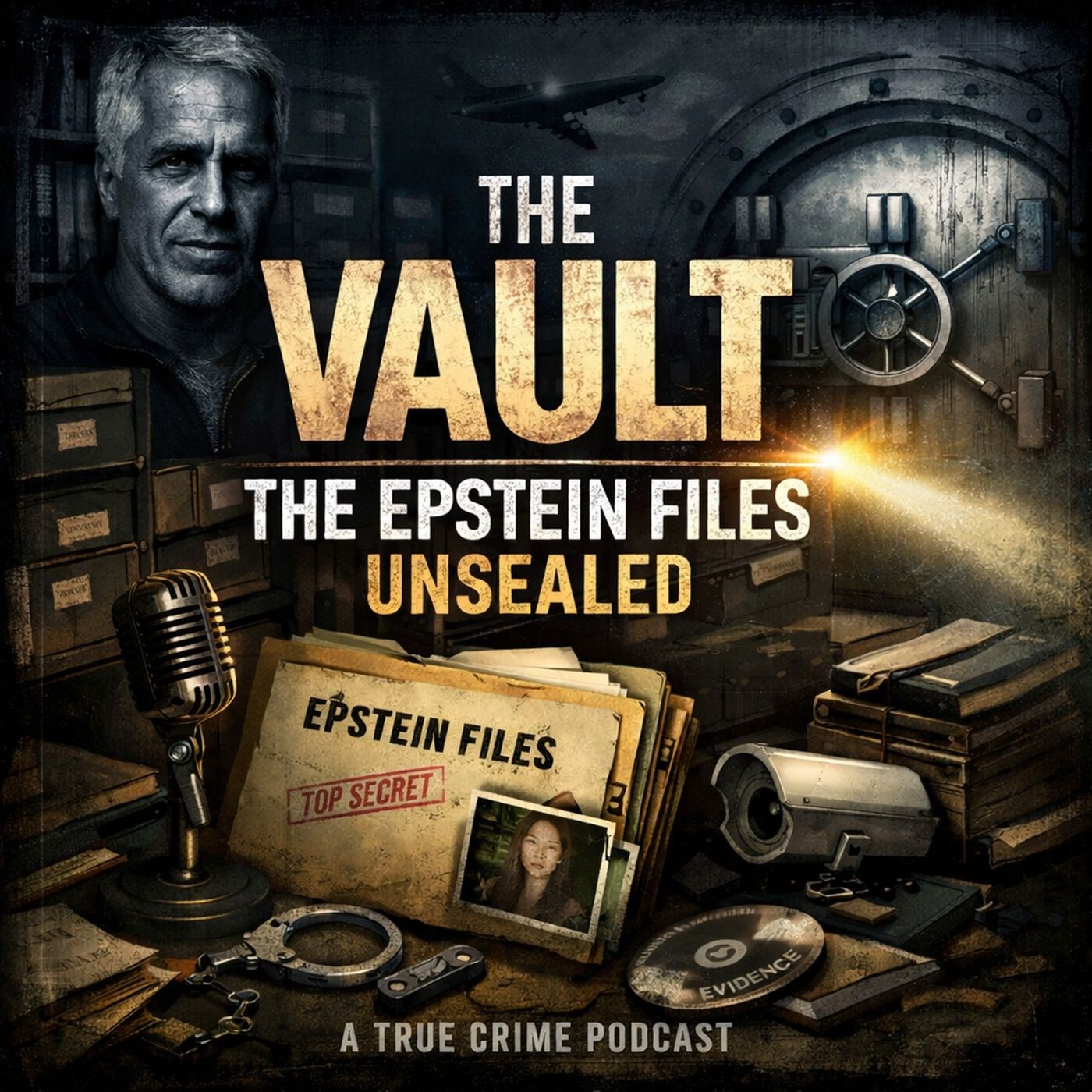
The Vault: The Epstein Files
Bobby Capucci
The Vault: The Epstein Files Unsealed is a deep-dive investigative podcast that pulls back the curtain on one of the most protected criminal networks in modern history. This series is built from the ground up on the actual paper trail—unsealed court records, depositions, exhibits, emails, and filings that were never meant to be read by the public. No pundit panels. No spin. Just the documents themselves, examined line by line, name by name, connection by connection—paired with precise, document-driven analysis that explains what the record truly shows.Each episode opens the vault on newly unsealed or long-buried Epstein files and walks listeners through what they actually reveal about power, money, influence, and the systems that failed survivors at every turn. Alongside the filings themselves, informed commentary breaks down the legal strategy, the institutional behavior, the contradictions, and the implications hiding between the lines. From judges’ orders and sealed exhibits to sworn testimony and back-channel communications, the show connects the dots the media often won’t—or can’t. Patterns emerge. Timelines collapse. Excuses fall apart.The Vault is a working archive in audio form, a living record of the Epstein case as told by the courts themselves—supplemented by rigorous analysis that provides context, challenges official narratives, and exposes where the record has been distorted, sanitized, or deliberately ignored. Every claim is grounded in filings. Every episode is anchored to the record. Listeners aren’t told what to think—they are shown what exists, what was said under oath, and what the commentary reveals about how those facts were buried, softened, or misrepresented.If you want to understand how Jeffrey Epstein was protected, who circled him, how institutions closed ranks, and why accountability keeps slipping through the cracks, The Vault: The Epstein Files Unsealed is where the record finally speaks for itself—and where the commentary ensures the documents do what no press release ever will.
Episodes
Mentioned books

Mar 25, 2026 • 12min
Inside the OIG Interview: Tova Noel’s Account of the Morning Jeffrey Epstein Died (Part 16) (3/24/26)
During the Office of Inspector General investigation into the death of Jeffrey Epstein at the Metropolitan Correctional Center in August 2019, correctional officer Tova Noel gave an interview describing how the morning unfolded when Epstein was discovered in his cell. According to her account, she and fellow officer Michael Thomas were assigned to monitor the Special Housing Unit overnight. Noel told investigators that when breakfast rounds began that morning, Thomas approached Epstein’s cell and noticed something was wrong. She said Thomas called out for assistance and that she moved toward the area, where Epstein was found hanging from a strip of bedding tied to the top bunk. Noel stated that Thomas entered the cell first and attempted to cut the ligature while she retrieved equipment to assist, after which they lowered Epstein to the floor so CPR could begin.However, the OIG investigation was highly critical of Noel’s conduct and the credibility of the circumstances she described. Investigators determined that Noel and Thomas had failed to perform the legally required inmate counts and physical security checks for hours during the night Epstein died, leaving him unmonitored in a high-risk suicide watch environment. The report also found that Noel later signed official count sheets falsely indicating that the checks had been completed, despite evidence showing they had not been. Surveillance records and other evidence suggested the officers spent large portions of the shift away from their assigned duties, and investigators concluded that their negligence created the conditions that allowed Epstein to remain unattended long enough to die. As a result, Noel’s interview with OIG was viewed less as a clear explanation of events and more as part of a broader record showing severe procedural failures and falsified documentation at the very time Epstein required the highest level of supervision.to contact me:bobbycapucci@protonmail.comsource:EFTA00117759.pdf
Mar 25, 2026 • 18min
Inside the OIG Interview: Tova Noel’s Account of the Morning Jeffrey Epstein Died (Part 15) (3/24/26)
During the Office of Inspector General investigation into the death of Jeffrey Epstein at the Metropolitan Correctional Center in August 2019, correctional officer Tova Noel gave an interview describing how the morning unfolded when Epstein was discovered in his cell. According to her account, she and fellow officer Michael Thomas were assigned to monitor the Special Housing Unit overnight. Noel told investigators that when breakfast rounds began that morning, Thomas approached Epstein’s cell and noticed something was wrong. She said Thomas called out for assistance and that she moved toward the area, where Epstein was found hanging from a strip of bedding tied to the top bunk. Noel stated that Thomas entered the cell first and attempted to cut the ligature while she retrieved equipment to assist, after which they lowered Epstein to the floor so CPR could begin.However, the OIG investigation was highly critical of Noel’s conduct and the credibility of the circumstances she described. Investigators determined that Noel and Thomas had failed to perform the legally required inmate counts and physical security checks for hours during the night Epstein died, leaving him unmonitored in a high-risk suicide watch environment. The report also found that Noel later signed official count sheets falsely indicating that the checks had been completed, despite evidence showing they had not been. Surveillance records and other evidence suggested the officers spent large portions of the shift away from their assigned duties, and investigators concluded that their negligence created the conditions that allowed Epstein to remain unattended long enough to die. As a result, Noel’s interview with OIG was viewed less as a clear explanation of events and more as part of a broader record showing severe procedural failures and falsified documentation at the very time Epstein required the highest level of supervision.to contact me:bobbycapucci@protonmail.comsource:EFTA00117759.pdf
Mar 25, 2026 • 14min
Inside the OIG Interview: Tova Noel’s Account of the Morning Jeffrey Epstein Died (Part 14) (3/24/26)
During the Office of Inspector General investigation into the death of Jeffrey Epstein at the Metropolitan Correctional Center in August 2019, correctional officer Tova Noel gave an interview describing how the morning unfolded when Epstein was discovered in his cell. According to her account, she and fellow officer Michael Thomas were assigned to monitor the Special Housing Unit overnight. Noel told investigators that when breakfast rounds began that morning, Thomas approached Epstein’s cell and noticed something was wrong. She said Thomas called out for assistance and that she moved toward the area, where Epstein was found hanging from a strip of bedding tied to the top bunk. Noel stated that Thomas entered the cell first and attempted to cut the ligature while she retrieved equipment to assist, after which they lowered Epstein to the floor so CPR could begin.However, the OIG investigation was highly critical of Noel’s conduct and the credibility of the circumstances she described. Investigators determined that Noel and Thomas had failed to perform the legally required inmate counts and physical security checks for hours during the night Epstein died, leaving him unmonitored in a high-risk suicide watch environment. The report also found that Noel later signed official count sheets falsely indicating that the checks had been completed, despite evidence showing they had not been. Surveillance records and other evidence suggested the officers spent large portions of the shift away from their assigned duties, and investigators concluded that their negligence created the conditions that allowed Epstein to remain unattended long enough to die. As a result, Noel’s interview with OIG was viewed less as a clear explanation of events and more as part of a broader record showing severe procedural failures and falsified documentation at the very time Epstein required the highest level of supervision.to contact me:bobbycapucci@protonmail.comsource:EFTA00117759.pdf
Mar 24, 2026 • 13min
Inside the OIG Interview: Tova Noel’s Account of the Morning Jeffrey Epstein Died (Part 13) (3/24/26)
During the Office of Inspector General investigation into the death of Jeffrey Epstein at the Metropolitan Correctional Center in August 2019, correctional officer Tova Noel gave an interview describing how the morning unfolded when Epstein was discovered in his cell. According to her account, she and fellow officer Michael Thomas were assigned to monitor the Special Housing Unit overnight. Noel told investigators that when breakfast rounds began that morning, Thomas approached Epstein’s cell and noticed something was wrong. She said Thomas called out for assistance and that she moved toward the area, where Epstein was found hanging from a strip of bedding tied to the top bunk. Noel stated that Thomas entered the cell first and attempted to cut the ligature while she retrieved equipment to assist, after which they lowered Epstein to the floor so CPR could begin.However, the OIG investigation was highly critical of Noel’s conduct and the credibility of the circumstances she described. Investigators determined that Noel and Thomas had failed to perform the legally required inmate counts and physical security checks for hours during the night Epstein died, leaving him unmonitored in a high-risk suicide watch environment. The report also found that Noel later signed official count sheets falsely indicating that the checks had been completed, despite evidence showing they had not been. Surveillance records and other evidence suggested the officers spent large portions of the shift away from their assigned duties, and investigators concluded that their negligence created the conditions that allowed Epstein to remain unattended long enough to die. As a result, Noel’s interview with OIG was viewed less as a clear explanation of events and more as part of a broader record showing severe procedural failures and falsified documentation at the very time Epstein required the highest level of supervision.to contact me:bobbycapucci@protonmail.comsource:EFTA00117759.pdf
Mar 24, 2026 • 16min
Pomp, Perversion, and Poppers: The Ghislaine Maxwell Party at Sandringham (3/24/26)
Prince Andrew’s decision to host a party for Ghislaine Maxwell at Sandringham—where sex drugs like poppers were reportedly found—reads less like royal history and more like a bad dark comedy. The idea of a Queen’s residence being turned into something resembling a low-rent Sopranos episode is almost surreal. The whole scene feels like parody: the Duke of York, standing beneath portraits of British monarchs, presiding over a soirée that sounds like Downton Abbey crashing headfirst into Trainspotting. It’s especially grotesque given Epstein’s reputation for avoiding drugs himself—he didn’t need them, he used them on others. The thought of those same tools of control and exploitation making their way into a royal estate is equal parts absurd and revolting.What makes it worse is the total lack of accountability. The Palace still tries to frame these scandals as “private matters,” as though international sex trafficking and narcotics at royal residences can be brushed under the Windsor rug. Every new revelation cements Andrew as a man incapable of understanding—or even pretending to care about—the damage he’s done to the Crown’s image. Once considered a symbol of British decorum, Sandringham now sits as a monument to how far the monarchy has fallen, its history tainted by the stench of scandal and the arrogance of a prince who believed himself untouchable. In the end, Prince Andrew didn’t just disgrace himself—he made royal scandal feel like a recurring sketch in a show that refuses to end.to contact me:source:Sex drugs 'found at party' disgraced Andrew hosted for Jeffrey Epstein and Ghislaine Maxwell in Sandringham, new Royal book claims | Daily Mail Online
Mar 24, 2026 • 17min
Shredded in Real Time: BOP Staff Destroy Epstein Files While Oversight Officials Were Present (3/24/26)
The discovery that Epstein-related documents were shredded during an active investigation severely weakens the credibility of the official narrative. The directive language—“make sure you get that box too”—points to intentional, targeted destruction rather than routine procedure, especially given that oversight officials were present at the time. This behavior does not align with a story built on negligence and bureaucratic failure. Instead, it introduces evidence of deliberate decision-making, suggesting that certain materials were removed because of their potential impact. When placed alongside the known irregularities—camera failures, falsified logs, and procedural lapses—the destruction of documents shifts the case away from coincidence and toward a pattern of controlled outcomes.Once parts of the evidentiary record are intentionally destroyed, the integrity of the entire investigation is compromised. Missing documents mean missing connections—timelines, communications, and accountability chains that can no longer be reconstructed. This creates permanent gaps that prevent any conclusion from being considered complete or definitive. Rather than reinforcing the official explanation, the destruction of evidence raises new questions about what was removed and why. As a result, the case no longer supports a simple narrative of failure, but instead suggests that the scope of what could be known was actively limited.to contact me:bobbycapucci@protonmail.com
Mar 24, 2026 • 12min
Flying Blind: Larry Visoski and the Art of Not Seeing (3/24/26)
Larry Visoski, Jeffrey Epstein’s longtime pilot, remains one of the most quietly scrutinized figures in the broader Epstein network. Having worked for Epstein from 1991 onward, Visoski logged countless flights for the financier, transporting powerful associates and, at times, underage passengers. Yet despite his proximity to Epstein’s inner circle — including being gifted land on Epstein’s Zorro Ranch property — Visoski has not faced criminal charges. During a 2009 deposition, he denied ever witnessing misconduct, maintaining that he “just flew the plane” and was unaware of any illegal activity. His testimony has long drawn skepticism from observers who question whether a man so close to Epstein’s operations could have truly been unaware of what was happening around him.The lack of legal consequences for Visoski highlights the selective accountability surrounding Epstein’s network. While Ghislaine Maxwell and several civil defendants have faced prosecution or lawsuits, others who played supporting logistical roles have largely avoided scrutiny. Visoski’s case underscores the complexity of pursuing criminal liability for individuals who may have enabled Epstein’s movements without direct evidence of participation in his crimes. It also raises a broader question: how far does responsibility extend for those who helped facilitate Epstein’s lifestyle — even if only by staying silent?As we continue to make our way through the deposition of Larry Visoski, it's quite obvious that he know's a lot more than he let on. The question is, why was he allowed to get away with it?to contact me:bobbycapucci@protonmail.com
Mar 24, 2026 • 15min
The Duke and the Devils: Epstein, Weinstein, and Maxwell at the Lodge (3/24/26)
The fact that Prince Andrew hosted Jeffrey Epstein, Ghislaine Maxwell, and Harvey Weinstein together at a shooting party at his Royal Lodge estate is nothing short of grotesque. You’ve got a convicted pedophile, his notorious fixer, and one of Hollywood’s most infamous sexual predators all rubbing shoulders with a royal — and this wasn’t some random social accident. It was a deliberate gathering of privilege, power, and moral decay. The timing makes it even worse: Epstein would be arrested just eight days later. The entire event reeks of the entitled arrogance that has defined Andrew’s downfall — a man so insulated by his own delusion that he thought nothing of entertaining predators under the Queen’s roof.What this shooting weekend really exposes is how the elite operate in their own lawless orbit, where accountability doesn’t exist and reputation is protected at all costs. These weren’t just casual acquaintances; they were connected through networks of money, influence, and shared secrecy. The absurdity of it — a prince firing shotguns with the architects of modern depravity — shows that the rot wasn’t just within Epstein’s world, but in every institution that gave him cover. It’s not a scandal of association anymore; it’s evidence of a cultural sickness where power shields the wicked and mocks justice itself.to contact me:bobbycapucci@protonmail.com
Mar 24, 2026 • 17min
Donald Trump and the Epstein Estate: The Jane Doe 4 Payment Questions (3/24/26)
The controversy centers on testimony and conflicting accounts about whether Jeffrey Epstein’s estate—controlled by co-executors Darren Indyke and Richard Kahn—made or considered making a payment to an accuser identified as “Jane Doe 4.” The issue emerged during congressional depositions, where lawmakers pressed for clarity on whether estate funds were used to settle claims tied to individuals who alleged abuse. At one point, confusion arose over whether a payment had been made to someone connected to allegations involving Donald Trump, but that claim was later walked back or clarified by attorneys, who said the individual in question may have been misidentified or not recognized by the executors.The dispute over Jeffrey Epstein’s estate has taken on added weight because of testimony referencing a potential payment tied to an accuser known as “Jane Doe 4,” whose allegations have been reported to include claims involving Donald Trump. During questioning, lawmakers pressed Epstein’s longtime associates and estate co-executors, Darren Indyke and Richard Kahn, about whether estate funds were used—or considered—to resolve claims connected to that accuser. At one point, statements suggested a payment may have been made, which would have lent credibility to the accuser’s claims by implying some level of acknowledgment or settlement. However, that assertion quickly became muddled, with attorneys and witnesses walking back or clarifying the testimony, saying there was confusion about the identity of the accuser and whether any such payment actually occurred.What makes this significant is not just the uncertainty, but what it implies about how Epstein’s estate is being managed. If a payment were made to an accuser tied to allegations involving Trump, it would raise serious questions about both the credibility of the claims and the decision-making process behind estate settlements. At the same time, the conflicting testimony and lack of clear documentation have fueled skepticism about transparency, particularly given Indyke and Kahn’s longstanding ties to Epstein and their control over victim compensation. The situation underscores a broader concern: whether the estate is functioning as a vehicle for fairly resolving claims—or as a tightly controlled system where financial decisions, legal exposure, and reputational risks for powerful figures are being carefully managed behind the scenes.to contact me:bobbycapucci@protonmail.comsource:Questions surround Epstein co-executors’ potential payment to 'Jane Doe 4'
Mar 24, 2026 • 42min
Mega Edition: Day Number 19 Of The Ghislaine Maxwell Trial (3/23/26)
The Ghislaine Maxwell trial, held in late 2021 in federal court in New York, centered on her alleged role as Jeffrey Epstein’s co-conspirator in a sex trafficking ring that preyed on underage girls for over a decade. Prosecutors accused Maxwell of grooming minors, gaining their trust, and then facilitating or participating in their abuse at the hands of Epstein between 1994 and 2004. The government’s case included testimony from four women, some of whom described in painful detail how Maxwell recruited them as teenagers under the guise of mentorship or financial assistance, only to manipulate them into sexual encounters with Epstein. Flight logs, photographs, and household staff testimony were used to place Maxwell at various Epstein properties and show her long-standing involvement in his lifestyle and operations.Maxwell’s defense team attempted to cast her as a scapegoat, arguing that she was being punished for Epstein’s crimes following his 2019 death in federal custody. They challenged the credibility of the accusers, questioned their motives, and pointed to the time gaps between the alleged crimes and the trial. Ultimately, the jury found Maxwell guilty on five of six federal charges, including sex trafficking of a minor, and not guilty on one count of enticing a minor to travel for illegal sex acts. The conviction marked a rare moment of accountability in a case that had long been plagued by cover-ups, prosecutorial failures, and elite protection. It also opened the door to further scrutiny of Epstein’s network, although many key figures remain untouched.to contact me:bobbycapucci@protonmail.com

