

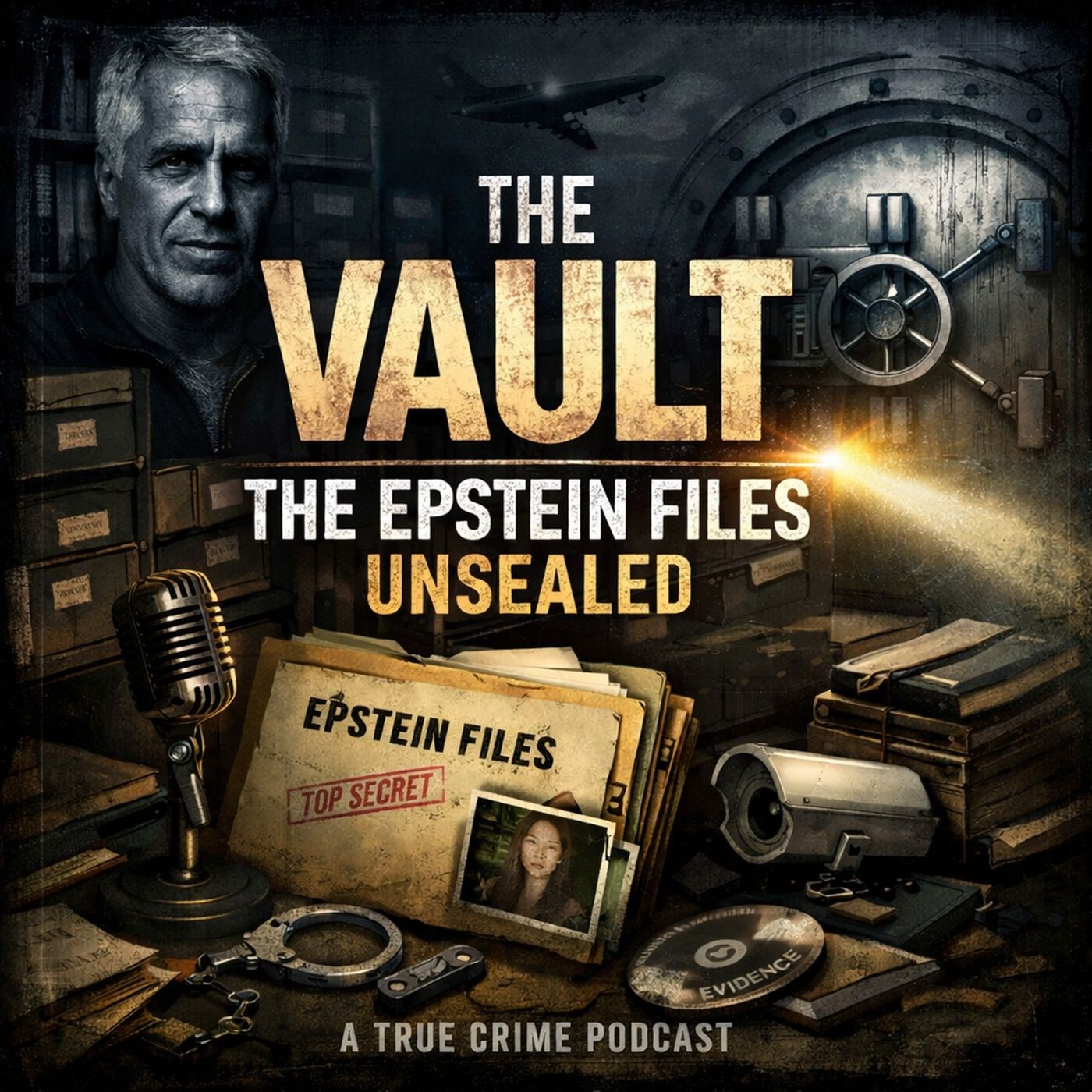
The Vault: The Epstein Files
Bobby Capucci
The Vault: The Epstein Files Unsealed is a deep-dive investigative podcast that pulls back the curtain on one of the most protected criminal networks in modern history. This series is built from the ground up on the actual paper trail—unsealed court records, depositions, exhibits, emails, and filings that were never meant to be read by the public. No pundit panels. No spin. Just the documents themselves, examined line by line, name by name, connection by connection—paired with precise, document-driven analysis that explains what the record truly shows.Each episode opens the vault on newly unsealed or long-buried Epstein files and walks listeners through what they actually reveal about power, money, influence, and the systems that failed survivors at every turn. Alongside the filings themselves, informed commentary breaks down the legal strategy, the institutional behavior, the contradictions, and the implications hiding between the lines. From judges’ orders and sealed exhibits to sworn testimony and back-channel communications, the show connects the dots the media often won’t—or can’t. Patterns emerge. Timelines collapse. Excuses fall apart.The Vault is a working archive in audio form, a living record of the Epstein case as told by the courts themselves—supplemented by rigorous analysis that provides context, challenges official narratives, and exposes where the record has been distorted, sanitized, or deliberately ignored. Every claim is grounded in filings. Every episode is anchored to the record. Listeners aren’t told what to think—they are shown what exists, what was said under oath, and what the commentary reveals about how those facts were buried, softened, or misrepresented.If you want to understand how Jeffrey Epstein was protected, who circled him, how institutions closed ranks, and why accountability keeps slipping through the cracks, The Vault: The Epstein Files Unsealed is where the record finally speaks for itself—and where the commentary ensures the documents do what no press release ever will.
Episodes
Mentioned books

Apr 2, 2026 • 14min
The United States And It's Response Brief To Maxwell's Motion For Appeal (Part 6) (4/1/26)
When the government files a brief in response to a defendant's appeal, its function is to present arguments and legal reasoning supporting the lower court's decision and opposing the defendant's arguments for overturning that decision. This brief serves to defend the conviction or ruling made against the defendant in the lower court.Typically, the government's brief will address the legal issues raised by the defendant on appeal, analyze relevant case law, statutes, and constitutional principles, and argue why the lower court's decision should be upheld. It may also address any procedural or evidentiary issues raised by the defendant.In essence, the government's brief is a key component of the appellate process, where both sides present their arguments to the appellate court, which will ultimately decide whether to affirm, reverse, or modify the lower court's decision.In this episode, we begin our look at the United States Governments brief in response to Ghislaine Maxwell's attempt at appealing her sentence.to contact me:bobbycapucci@protonmail.comsource:gov.uscourts.ca2.57831.79.0_1.pdf (courtlistener.com)
Apr 1, 2026 • 15min
The United States And It's Response Brief To Maxwell's Motion For Appeal (Part 5) (3/31/26)
When the government files a brief in response to a defendant's appeal, its function is to present arguments and legal reasoning supporting the lower court's decision and opposing the defendant's arguments for overturning that decision. This brief serves to defend the conviction or ruling made against the defendant in the lower court.Typically, the government's brief will address the legal issues raised by the defendant on appeal, analyze relevant case law, statutes, and constitutional principles, and argue why the lower court's decision should be upheld. It may also address any procedural or evidentiary issues raised by the defendant.In essence, the government's brief is a key component of the appellate process, where both sides present their arguments to the appellate court, which will ultimately decide whether to affirm, reverse, or modify the lower court's decision.In this episode, we begin our look at the United States Governments brief in response to Ghislaine Maxwell's attempt at appealing her sentence.to contact me:bobbycapucci@protonmail.comsource:gov.uscourts.ca2.57831.79.0_1.pdf (courtlistener.com)
Apr 1, 2026 • 11min
From Royalty to Ruin: The Fall of Prince Andrew (Part 2) (4/1/26)
Prince Andrew’s relationship with Jeffrey Epstein was not a mistake—it was a calculated choice sustained over years, even after Epstein's conviction for sex crimes. The Duke of York didn’t distance himself from Epstein—he doubled down, staying at his Manhattan mansion and walking through Central Park with him while the world watched. When accused by Virginia Giuffre of raping her while she was a trafficked teenager, Andrew responded not with cooperation or humility, but with denials, absurd alibis, and a multi-million dollar settlement to avoid testifying under oath. The infamous Newsnight interview only cemented his arrogance, exposing a man more concerned with salvaging his reputation than acknowledging the suffering of Epstein’s victims.What followed was a carefully managed retreat from public life. The monarchy, under increasing pressure, stripped Prince Andrew of his titles and public duties—not out of moral reckoning, but as a necessary step to contain the fallout. The legal system never pursued criminal charges, and media coverage often focused more on the royal family's image than the underlying allegations. Virginia Giuffre, through her persistence, brought global attention to a case that might otherwise have remained buried. In the end, Prince Andrew’s reputation remains permanently damaged, but the broader questions about accountability, privilege, and institutional protection remain unresolved.to contact me:bobbycapucci@protonmail.com
Apr 1, 2026 • 12min
From Royalty to Ruin: The Fall of Prince Andrew (Part 1) (4/1/26)
Prince Andrew’s relationship with Jeffrey Epstein was not a mistake—it was a calculated choice sustained over years, even after Epstein's conviction for sex crimes. The Duke of York didn’t distance himself from Epstein—he doubled down, staying at his Manhattan mansion and walking through Central Park with him while the world watched. When accused by Virginia Giuffre of raping her while she was a trafficked teenager, Andrew responded not with cooperation or humility, but with denials, absurd alibis, and a multi-million dollar settlement to avoid testifying under oath. The infamous Newsnight interview only cemented his arrogance, exposing a man more concerned with salvaging his reputation than acknowledging the suffering of Epstein’s victims.What followed was a carefully managed retreat from public life. The monarchy, under increasing pressure, stripped Prince Andrew of his titles and public duties—not out of moral reckoning, but as a necessary step to contain the fallout. The legal system never pursued criminal charges, and media coverage often focused more on the royal family's image than the underlying allegations. Virginia Giuffre, through her persistence, brought global attention to a case that might otherwise have remained buried. In the end, Prince Andrew’s reputation remains permanently damaged, but the broader questions about accountability, privilege, and institutional protection remain unresolved.to contact me:bobbycapucci@protonmail.com
Apr 1, 2026 • 13min
Campus Unrest at Bard: Leon Botstein, Epstein, and the Fight for Accountability (4/1/26)
Student protests at Bard College have intensified following revelations about longtime president Leon Botstein and his relationship with Jeffrey Epstein, reigniting scrutiny of the school’s history with sexual assault cases. Demonstrations in 2026 echo earlier protests dating back to 1991, with students arguing that Botstein’s ties to Epstein reflect deeper, longstanding issues in how the college has handled allegations of sexual misconduct. Documents and student accounts suggest Botstein maintained contact with Epstein even after being aware of accusations against him, fueling demands for accountability and, in some cases, his resignation.Beyond the Epstein connection, the controversy has reopened broader criticism of Bard’s institutional response to sexual assault over decades. Lawsuits, Title IX complaints, and student testimonies describe a pattern in which accused individuals were sometimes allowed to remain on campus, with Botstein previously holding significant authority over disciplinary outcomes. While the college has implemented reforms and denies systemic failures, many students and alumni argue that these measures fall short, pointing to a persistent culture of mistrust and calling for deeper structural change rather than limited internal reviews.to contact me:bobbycapucci@protonmail.comsource:Bard students say Epstein is just the tip of the iceberg
Apr 1, 2026 • 13min
UK Launches National Taskforce to Investigate Epstein-Linked Abuse Allegations (4/1/26)
British authorities have moved to escalate their response to the fallout from the Epstein document releases by creating a new national police taskforce focused specifically on potential exploitation and sexual abuse cases linked to the UK. The initiative is designed to coordinate intelligence across multiple police forces, which had previously been working in parallel, and to ensure that allegations tied to Epstein’s network—particularly those involving trafficking, abuse, or UK-based activity—are assessed in a more unified and systematic way. Officials expect the volume of claims to grow significantly as more information is reviewed, with investigators actively examining material from the recently released troves of U.S. files and encouraging witnesses to come forward with any relevant information.The taskforce is not yet a full criminal investigation in itself but serves as a central hub to evaluate evidence, prevent duplication between agencies, and determine which allegations meet the threshold for formal probes. Early lines of inquiry include potential trafficking routes through British airports, claims involving high-profile individuals, and whether Epstein’s network operated within the UK in ways that were previously overlooked. Authorities are also seeking access to unredacted U.S. documents to deepen their review, signaling that the investigation could expand significantly depending on what is uncovered, with law enforcement bracing for what one source described as a “tsunami” of new allegations tied to Epstein’s activities and associates.to contact me:bobbycapucci@protonmail.comsource:New police taskforce to investigate Epstein's UK sex ring | Daily Mail Online
Apr 1, 2026 • 15min
Millions Spent, Survivors Exposed: The DOJ’s Failed Epstein File Sanitization Operation (4/1/26)
The Department of Justice’s explanation that the exposure of Epstein survivors’ identities was merely an oversight collapses under scrutiny when weighed against the scale, resources, and sensitivity of the operation. This was not a rushed or underfunded review, but a deliberate, well-resourced effort specifically designed to protect victims while releasing information. Yet the failures were not random or evenly distributed; they disproportionately impacted survivors while leaving institutional actors comparatively shielded. That pattern undermines the credibility of the DOJ’s defense and raises serious questions about whether these errors were truly accidental or indicative of a deeper, more systemic issue. In a case already defined by decades of institutional failure, this latest breakdown reinforces the perception that the system continues to fall short when it matters most.As a result, survivors have begun taking legal action against the DOJ, alleging negligence and a breach of trust that has caused real and lasting harm. Beyond the legal consequences, the implications are broader and more troubling. The exposure of identities risks intimidating other survivors and discouraging future cooperation, effectively reinforcing the same culture of silence that allowed Epstein’s network to operate for so long. The DOJ’s limited accountability, lack of urgency, and reliance on procedural excuses have only deepened public skepticism. Whether the failures were due to negligence or something more intentional, the outcome is the same: trust has been eroded, harm has been done, and the burden now falls on the government to prove it is capable of correcting course.to contact me:bobbycapucci@protonmail.com
Apr 1, 2026 • 22min
Mega Edition: Danielle Bensky And The Lawsuit Filed Against Indyke And Kahn (Part 5-6) (4/1/26)
Danielle Bensky, along with other Jeffrey Epstein survivors, filed a lawsuit targeting Epstein’s estate and its co-executors, Darren Indyke and Richard Kahn, accusing them of failing in their fiduciary duties while overseeing the estate. The suit alleges that Indyke and Kahn—both longtime Epstein confidants—were not neutral administrators but individuals deeply tied to Epstein’s financial and personal operations, raising serious concerns about conflicts of interest. According to the claims, the estate was structured and managed in a way that prioritized protecting Epstein’s wealth and shielding key information, rather than fully compensating victims or facilitating transparency. Survivors argue that the executors had knowledge of Epstein’s activities or, at minimum, were willfully blind, and yet continued to control assets derived from those same abuses.The lawsuit further contends that the handling of claims through the estate’s compensation program was fundamentally flawed, with survivors alleging delays, limitations, and mechanisms that reduced payouts while insulating the estate from deeper scrutiny. Bensky and others argue that this process allowed Indyke and Kahn to maintain control over critical records and financial pathways that could expose the broader network surrounding Epstein. At its core, the case challenges whether justice can be achieved when the very individuals tasked with administering restitution are themselves alleged to be embedded in the system that enabled the abuse, turning what should have been a vehicle for accountability into another layer of protection for Epstein’s legacy.to contact me:bobbycapucci@protonmail.com
Apr 1, 2026 • 22min
Mega Edition: Danielle Bensky And The Lawsuit Filed Against Indyke And Kahn (Part 3-4) (4/1/26)
Danielle Bensky, along with other Jeffrey Epstein survivors, filed a lawsuit targeting Epstein’s estate and its co-executors, Darren Indyke and Richard Kahn, accusing them of failing in their fiduciary duties while overseeing the estate. The suit alleges that Indyke and Kahn—both longtime Epstein confidants—were not neutral administrators but individuals deeply tied to Epstein’s financial and personal operations, raising serious concerns about conflicts of interest. According to the claims, the estate was structured and managed in a way that prioritized protecting Epstein’s wealth and shielding key information, rather than fully compensating victims or facilitating transparency. Survivors argue that the executors had knowledge of Epstein’s activities or, at minimum, were willfully blind, and yet continued to control assets derived from those same abuses.The lawsuit further contends that the handling of claims through the estate’s compensation program was fundamentally flawed, with survivors alleging delays, limitations, and mechanisms that reduced payouts while insulating the estate from deeper scrutiny. Bensky and others argue that this process allowed Indyke and Kahn to maintain control over critical records and financial pathways that could expose the broader network surrounding Epstein. At its core, the case challenges whether justice can be achieved when the very individuals tasked with administering restitution are themselves alleged to be embedded in the system that enabled the abuse, turning what should have been a vehicle for accountability into another layer of protection for Epstein’s legacy.to contact me:bobbycapucci@protonmail.com
Apr 1, 2026 • 23min
Mega Edition: Danielle Bensky And The Lawsuit Filed Against Indyke And Kahn (Part 1-2) (3/31/26)
Danielle Bensky, along with other Jeffrey Epstein survivors, filed a lawsuit targeting Epstein’s estate and its co-executors, Darren Indyke and Richard Kahn, accusing them of failing in their fiduciary duties while overseeing the estate. The suit alleges that Indyke and Kahn—both longtime Epstein confidants—were not neutral administrators but individuals deeply tied to Epstein’s financial and personal operations, raising serious concerns about conflicts of interest. According to the claims, the estate was structured and managed in a way that prioritized protecting Epstein’s wealth and shielding key information, rather than fully compensating victims or facilitating transparency. Survivors argue that the executors had knowledge of Epstein’s activities or, at minimum, were willfully blind, and yet continued to control assets derived from those same abuses.The lawsuit further contends that the handling of claims through the estate’s compensation program was fundamentally flawed, with survivors alleging delays, limitations, and mechanisms that reduced payouts while insulating the estate from deeper scrutiny. Bensky and others argue that this process allowed Indyke and Kahn to maintain control over critical records and financial pathways that could expose the broader network surrounding Epstein. At its core, the case challenges whether justice can be achieved when the very individuals tasked with administering restitution are themselves alleged to be embedded in the system that enabled the abuse, turning what should have been a vehicle for accountability into another layer of protection for Epstein’s legacy.to contact me:bobbycapucci@protonmail.com

