

Truce - History of the Christian Church
Chris Staron
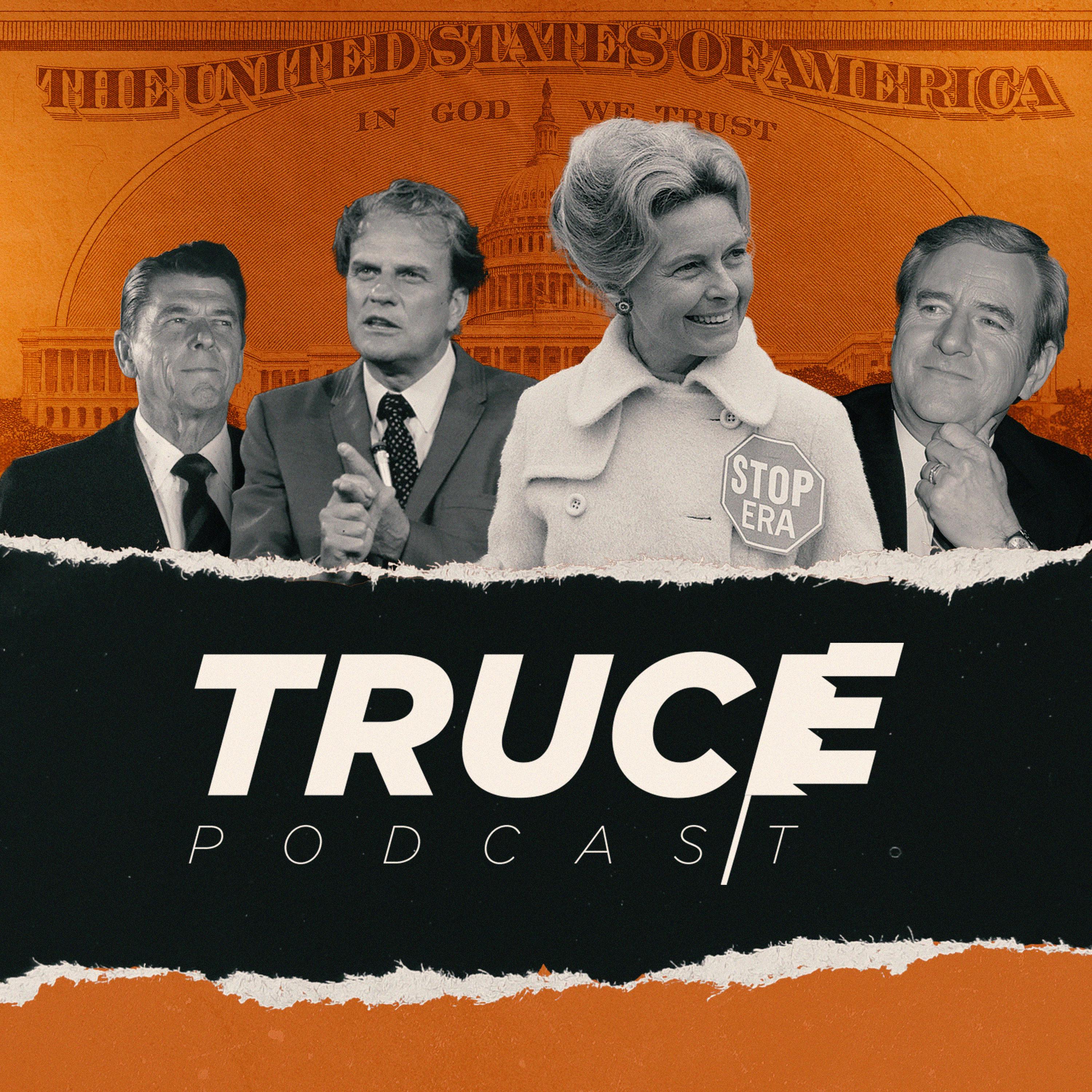
Truce explores the history of the evangelical church in America, from fundamentalism to pyramid schemes to political campaigns. Host Chris Staron uses journalistic tools to investigate how the church got here and how it can do better.The current season follows the rise of the Religious Right, examining the link between evangelicals and the Republican Party. Featuring special guests like Rick Perlstein, Frances Fitzgerald, Jesse Eisinger, Daniel K. Williams, and more.
Episodes
Mentioned books

Mar 24, 2026 • 43min
Republicans and Evangelicals | Why Christians Didn't Vote for Carter
Give to help Chris make Truce
Boy, the Religious Right did not like Carter, at least by 1980. Some of them, like Pat Robertson, had high hopes for him at the start. But they quickly grew to distrust the man from Georgia.
Why? In this episode, Chris goes through some of the top issues that evangelicals had with Jimmy Carter. They include his article in Playboy Magazine that mentions his struggles with sex (but also featured a strong gospel message), his support of the ERA, and his lackluster responses to their questions about abortion.
But... It's not as if Ronald Reagan was significantly better. Reagan was not a regular churchgoer like Carter. He consulted a medium for his decisions. He was a divorced former actor in a time when evangelicals didn't like Hollywood. So... how bad was this Carter guy that they didn't vote for him?
Our special guest for this episode is historian and author Rick Perlstein.
Sources:
Today story on Carter's church
Tampa Bay Times story on Carter's church
Associated Press story on Carter's church
Christianity Today article on Carter's 100th birthday
Reaganland by Rick Perlstein
Document the interview the Religious Right guys did
Criswell ad
Strom Thurmond ad
Playboy Magazine, November 1976
Reagan: An American Journey by Bob Spitz
White House Conference on Families: Listening to America's Families.
Pamphlet
God's Own Party by Daniel K Williams
The Evangelicals by Frances Fitzgerald
The Surprising Work of God by Garth Rosell
Jimmy Carter Library interview with Robert Maddox
Carter's speech to NAE (courtesy of Jimmy Carter Presidential Library)
Discussion Questions:
Why did some evangelicals so strongly oppose the ERA?
What did you see in the Playboy article that might be construed as unappealing to Christians?
If Reagan engaged in fortunetelling, why did some evangelicals follow him and not Carter?
Why have evangelicals become enamored of leaders? What has that done to our witness?
Learn more about your ad choices. Visit podcastchoices.com/adchoices

Mar 10, 2026 • 44min
Republicans and Evangelicals | The Many Plagues of Jimmy Carter
Give to help Chris make Truce
President Jimmy Carter's presidency (1977–1981) faced several major challenges, both domestically and internationally. One of the biggest domestic issues was the struggling U.S. economy. Carter inherited high inflation and unemployment, problems that worsened during his term. The country experienced "stagflation" — a combination of stagnant economic growth and high inflation. The energy crisis, marked by oil shortages and skyrocketing gas prices, further fueled economic instability. Though Carter promoted energy conservation and alternative energy development, many Americans viewed his efforts as inadequate or overly pessimistic.
Internationally, Carter faced major challenges in foreign policy. One of the most significant was the Iran Hostage Crisis, which began in November 1979 when 52 American diplomats and citizens were taken hostage at the U.S. Embassy in Tehran. The crisis lasted 444 days and was a major blow to Carter’s administration, especially after a failed rescue attempt. It deeply affected U.S. relations with Iran and damaged public confidence in Carter’s leadership. Though Carter did achieve a major diplomatic success with the Camp David Accords — a peace agreement between Egypt and Israel — the Iran Hostage Crisis ultimately overshadowed much of his foreign policy work.
Another major issue during Carter’s presidency was a perceived lack of effective leadership. Carter, known for his integrity and moral outlook, struggled to build strong relationships with Congress and the media. He often took a technocratic, detail-oriented approach to governing, which alienated many political allies. Critics saw his administration as indecisive and overly focused on long-term goals rather than immediate results. These perceptions contributed to a loss of public confidence and were a key factor in his defeat by Ronald Reagan in the 1980 presidential election.
The special guest for this episode is historian and author Rick Perlstein.
Sources:
Phyllis Schlafly's debate with Buckley
Reaganland by Rick Perlstein
Slate story on Chisholm
Video showing Carter's opposition to integrated busing
Reagan by Bob Spitz
The Invisible Bridge by Rick Perlstein
These Truths by Jill Lepore
Crash Course by Paul Ingrassia
C-SPAN clip of Carter's malaise speech
Who is Government? by Michael Lewis
Discussion Questions:
What do you find appealing about Carter?
How do voters sometimes use issues that are beyond a politician's control to judge them?
Why would Carter and his predecessors choose to give the Panama Canal to Panama?
How would an event like the hostage crisis impact an election?
Learn more about your ad choices. Visit podcastchoices.com/adchoices

Feb 24, 2026 • 55min
Republicans and Evangelicals | The Council for National Policy: Dark Money in the Church
Give to help Chris make Truce
Dark money is a problem in American politics and religion. What is it? Untraceable money that often comes from big donors, which is channelled through non-profits to hide the identity of the donor. This money is then able to back causes that may or may not be positive.
The Council for National Policy is an organization in the pipeline for Christian dark money. It finances groups like the Heritage Foundation, Focus on the Family, pro-life groups, Turning Point USA, and more. They also coordinate language around denial of climate change, COVID, and election results. Their first president was Tim LaHaye, but he is just the tip of the iceberg.
Our guide through this story is Anne Nelson, author of Shadow Network: Media, Money, and the Secret Hub of the Radical Right. It is an excellent resource that is critical for anyone interested in how some evangelicals tied themselves to the Republican Party.
Sources:
Biographical video from Turning Point USA about Foster Friess
Shadow Network by Anne Nelson
Christian Reconstruction: RJ Rushdoony and American Religious Conservatism by Michael McVicar
100 Things to See in the Night Sky Expanded Edition. By Dean Regas
Christianity and Oil in US History
Article on Nelson Bunker Hunt
Birchers by Matthew Dallek
The Road to Serfdom (comic version) adapted from Hayek
Reaganland and Before the Storm by Rick Perlstein
"Information Sheet, Council for National Policy," May 1984
Dark Money by Jane Mayer
article on Betsy DeVos as Secretary of Education
Ponzinomics by Robert Fitzpatrick
Justice Department article about Blackwater/ Prince
Adams, D. C., Robles, F., & Mazzetti, M. (2025). A Desperate Haiti Turns to Erik Prince, Trump Ally, In Fight Against Gangs. New York: New York Times Company.
Census data on Wyoming
Pat Robertson: A Life and Legacy by David Edwin Harrell Jr.
Leadership Institute website (accessed 8/8/25)
Email blast from National Religious Broadcasters titled: “NRB President & CEO to Advocate on Capitol Hill for AM Radio for Every Vehicle Act” released July 14, 2025
Salem Media website
NRB Article about Bott Radio
PRwatch.org article and video about CNP
Jackson Hole News and Guide article about Donald Trump Jr.'s visit to Jackson in 2016
New York Times article on Foster Friess
Tax documents from Turning Point USA, courtesy of Pro Publica
2017 Jane Mayer profile of Turning Point USA
ProPublica article on the Kochs
Time article on the Koch's and i360
Article on how many people didn't vote in 2024
New York Times article about Trump's call to the Georgia election rep
The Guardian article about Kirk's busing of people to the January 6, 2021, riot
EPA article about its origins
Discussion Questions:
What is dark money? Should Christians participate in it?
What are the functions of groups like the Council for National Policy?
Who was Foster Friess?
Why is it important to include a discussion of dark money when talking about things like Turning Point USA?
What is the connection between evangelicalism and oil?
Learn more about your ad choices. Visit podcastchoices.com/adchoices

Feb 10, 2026 • 53min
Republicans and Evangelicals | The Battle for the Mind
Give to help Chris make Truce
Tim LaHaye wrote different kinds of books. Books on marriage, sexuality, the end times, and those involved in social and political movements. In his young years, Tim LaHaye taught for the John Birch Society. His conspiratorial view of the world carried over into his theology, evidenced by the Left Behind series, as well as the topic of the show today, The Battle for the Mind. Published in 1980, this little book takes a negative view of humanism. He defines humanism as, essentially, everything that has gone with society in the last 2,000 years. It's a very broad, almost useless definition.
Humanism is actually a movement that started in Northern Italy around the 1200s, which tries to lift up the value of the human person. That takes a lot of different shapes, from secular or atheistic humanism to Christian humanism. In fact, as we argue in the episode, LaHaye's view misses the positive ways that humanism has shaped the United States and evangelicalism.
My guest today is Dr. Darrell Bock. He is the author or editor of over 45
books, including commentaries on Luke and Acts. He is the Executive
Director of Cultural Engagement and Senior Research Professor of New
Testament Studies at Dallas Theological Seminary. He's also a host of
DTS' podcast The Table.
Sources:
The Battle for the Mind by Tim LaHaye (1980)
Listen, America! by Jerry Falwell
The Oxford English Dictionary
Encyclopedia Britannica
Francis Schaeffer and the Shaping of Evangelical America by Barry Hankins
Fact-checking Chris on the Prohibition thing? Start here.
Discussion Questions:
Have you read anything by Tim LaHaye? What was it?
Are Christian books like this useful? Not useful? Why?
What is "humanism"? (it may be helpful to look it up outside the book)
Why is it important that LaHaye mischaracterized humanism?
What were LaHaye's ideas about education?
Learn more about your ad choices. Visit podcastchoices.com/adchoices

Jan 27, 2026 • 37min
Republicans and Evangelicals | What Scared Tim LaHaye
Give to help Chris make Truce
Tim and Beverly LaHaye were a prominent American evangelical Christian couple known for their influential work in ministry, literature, and conservative activism. Tim LaHaye, born in 1926 in Detroit, Michigan, was a pastor, author, and speaker who gained national recognition through his work in Christian fiction and prophecy interpretation. He served as a pastor for over 25 years before turning to full-time writing and speaking, often focusing on end-times theology and family values. Beverly LaHaye, born in 1929, was a vocal advocate for conservative Christian values and women’s roles in society, founding the organization Concerned Women for America in 1979.
Tim LaHaye is perhaps best known as the co-author of the Left Behind series, a best-selling collection of apocalyptic novels written with Jerry B. Jenkins. The series dramatizes a fictionalized version of the Rapture and subsequent tribulation, based on Tim’s interpretation of Biblical prophecy. These books sold over 80 million copies worldwide and sparked renewed interest in eschatology within evangelical circles. In addition to fiction, he wrote numerous nonfiction books addressing topics such as marriage, politics, and spirituality, always with a conservative Christian perspective.
Together, Tim and Beverly LaHaye were a formidable force in American evangelicalism, combining their talents in writing, activism, and public speaking to influence both Christian thought and conservative politics. Married for over 60 years until Tim's death in 2016, they left behind a legacy of fervent advocacy for their faith and values. While supporters praised their dedication to scripture and family, critics often challenged their political and theological positions. Regardless, their impact on late 20th and early 21st-century evangelicalism remains significant.
Sources:
Dreyfuss, R. (2004, Feb). "Reverend Doomsday". Rolling Stone, pp. 46-49.
White, G. (2001, Jul 07). "Evangelical power couple authors Tim and Beverly LaHaye, with scores of books between them, rank as four-star generals to many conservative Christians." [home edition]. The Atlanta Journal The Atlanta Constitution
God's Own Party by Daniel K Williams
PBS article on Comstock Laws
"The men from CLEAN". (1966, Sep 05). Newsweek, 68, 23-24.
Before the Storm by Rick Perlstein
How to Be Happy Though Married by Tim LaHaye
Divided We Stand by Marjorie Spruill
The Unhappy Gays by Tim LaHaye
For a Christian America by Ruth Murray Brown
Carlin v. Board of Education
Listen, America! by Jerry Falwell
With God on Our Side by William C Martin
Christianity Today article about Carter's presence at NRB
“Tim LaHaye--Waging War Against Humanism” Skelton, Nancy Los Angeles Times (1923-1995); Feb 22, 1981
BATTIATA, M. (1987, Oct 03). "Beverly LaHaye leads a powerful force from the right": [CITY edition]. St.Petersburg Times
Hacker, K. (1988, Mar 06). "A WOMAN OF ACTION: FUNDAMENTALIST BEVERLY LAHAYE IS BUSY RALLYING HER 'KITCHEN-TABLE LOBBYISTS' TO ALL SORTS OF POLITICAL CAUSES". Philadelphia Inquirer
NPR article about Moonies
The Evangelicals by Frances Fitzgerald
McMahon, M. (1999, Dec). Come, all ye faithful. The Spectator, 283, 18-19
The United States of Paranoia by Jesse Walker
Discussion Questions:
How have the LaHaye's impacted you?
Does it matter that Tim had so many fears?
He went on to help found the Council for National Policy, the far-right Christian dark money organization. Why does that feel ironic?
How was Tim tied to the battle over segregated academies?
How did LaHaye's background with the John Birch Society fit with his other beliefs?
Learn more about your ad choices. Visit podcastchoices.com/adchoices

Jan 13, 2026 • 45min
Republicans and Evangelicals | Pat Robertson and the Prosperity Gospel
Explore the fascinating rise of televangelism, showcasing how innovators like Oral Roberts transformed evangelism through charismatic broadcasts. Discover Pat Robertson's pivotal role in shaping the Christian Broadcasting Network, which not only promoted prosperity theology but also intertwined faith with political activism. The discussion highlights the explosive growth of Pentecostalism on television, fundraising gimmicks, and the blend of consumer culture with spiritual beliefs, revealing a complex legacy on American Christianity.

9 snips
Jan 6, 2026 • 42min
An American Coup in Guatemala
In this captivating discussion, historian Stephen Schlesinger, co-author of *Bitter Fruit*, delves into the 1954 U.S.-backed coup in Guatemala. He reveals how United Fruit's immense influence led to President Jacobo Arbenz's land reforms becoming framed as a communist threat. The conversation highlights the exploitative conditions on United Fruit plantations and examines the Dulles brothers' conflicts of interest driving U.S. policy. Schlesinger also discusses the long-term consequences of the coup, including the civil war that followed and the clash between American actions and professed Christian values.

Dec 16, 2025 • 54min
Republicans and Evangelicals: Bill Bright, Campus Crusade, and Cru
Give to help Chris continue to make Truce
William R. “Bill” Bright was born in 1921 in Coweta, Oklahoma. Though raised in a religious environment, he initially pursued business success and personal ambition. While attending the University of Southern California, Bright experienced a dramatic spiritual transformation through the influence of Christian leaders like Henrietta Mears. This encounter led him to surrender his life to Jesus Christ and ultimately shaped his calling toward full-time evangelism.
In 1951, Bill and his wife, Vonette, founded Campus Crusade for Christ at UCLA with a vision to reach college students with the Gospel. He later developed The Four Spiritual Laws, a simple evangelistic tract that became one of the most widely distributed Christian tools in history. Under his leadership, Campus Crusade grew into a global movement with ministries focused on students, athletes, families, the military, and professionals. Bright also launched the Jesus Film Project in 1979, which became one of the most-translated and widely viewed films in the world.
What's missing from most short bios of Bright is the depth of his involvement in the Religious Right. He organized or was present at some of their key gatherings, founded a publishing house to print their words, and raised funds among them.
Bill Bright remained dedicated to fulfilling the Great Commission, often engaging in long periods of fasting and prayer for spiritual guidance. He received the prestigious Templeton Prize in 1996 for his contributions to religion and reinvested the award into Christian ministry. When he died in 2003, Campus Crusade for Christ had expanded into nearly every nation, with thousands of staff and volunteers sharing the Gospel worldwide. Bright’s life stands as a testament to the global impact one person can have through faith, vision, and relentless obedience to God’s call.
My guest for this episode is historian John G. Turner, author of Bill Bright and Campus Crusade for Christ: The Renewal of Evangelicalism in Postwar America.
Sources:
Bill Bright and Campus Crusade for Christ: The Renewal of Evangelicalism in Postwar America by John G. Turner
The Evangelicals by Frances Fitzgerald
Reaganland by Rick Perlstein
God as Capitalist: Seminar Promotes Religion and Riches by Russell Chandler. Los Angeles Times (1923-1995); Jun 1, 1981; starts on page B3. Accessed via ProQuest (thanks to the Teton County Library for access!)
Tract: The Four Spiritual Laws
The Politics of Rage by Dan T. Carter
The Invisible Bridge by Rick Perlstein
Before the Storm by Rick Perlstein
God's Own Party by Daniel K. Williams
One Nation Under God by Rus Walton (page numbers mentioned in the episode correspond to the 1993 paperback edition). I also used the 1987 version from archive.org
Birchers by Matthew Dallek
In the Spirit of '76, published by Third Century Publishers Inc.
Jimmy Carter, the Politics of Family, and the Rise of the Religious Right by J. Brooks Flippen
The 700 Club's coverage of the "Washington for Jesus Rally"
Also, my guest, Dave Hopping, used to be in the comedy duo "Dave and Brian". They were pretty big! Here is one of their videos.
Discussion Questions:
Have you read The Four Spiritual Laws?
How has Campus Crusade/ Cru impacted your life? The life of your loved ones?
What threats did Bright perceive to American Christians? Where was he right? Where was he wrong?
What did you think of Rus Walton's book One Nation Under God?
Was Bright part of the Religious Right? To what degree?
Learn more about your ad choices. Visit podcastchoices.com/adchoices

Dec 2, 2025 • 36min
Republicans and Evangelicals I Jerry Falwell (part 2)
Rick Perlstein, a historian known for his work on the New Right, and Daniel K. Williams, an expert on evangelical politics, delve into the 1980s political landscape. They discuss how the New Right aimed to unite evangelicals, with Jerry Falwell as a key figure due to his media reach. The conversation highlights Falwell's role in the Moral Majority and its strategies, including voter registration drives. They also explore shifts in evangelical voting patterns, the impact of religious messaging, and how these movements shaped the Republican platform.

Nov 18, 2025 • 40min
Republicans and Evangelicals I Jerry Falwell (part 1)
Daniel K. Williams, a historian and author, joins to delve into the life of Jerry Falwell, a pivotal figure in American evangelicalism. They explore Falwell's transformation from a regional pastor to a media mogul and political powerhouse, highlighting his founding of the Moral Majority in 1979. The discussion touches on Falwell's controversial views on race, his separationist past, and the anxieties that fueled the rise of Christian conservatism. Williams also examines the strategic recruitment of evangelicals by political operatives, connecting faith with patriotism.

