

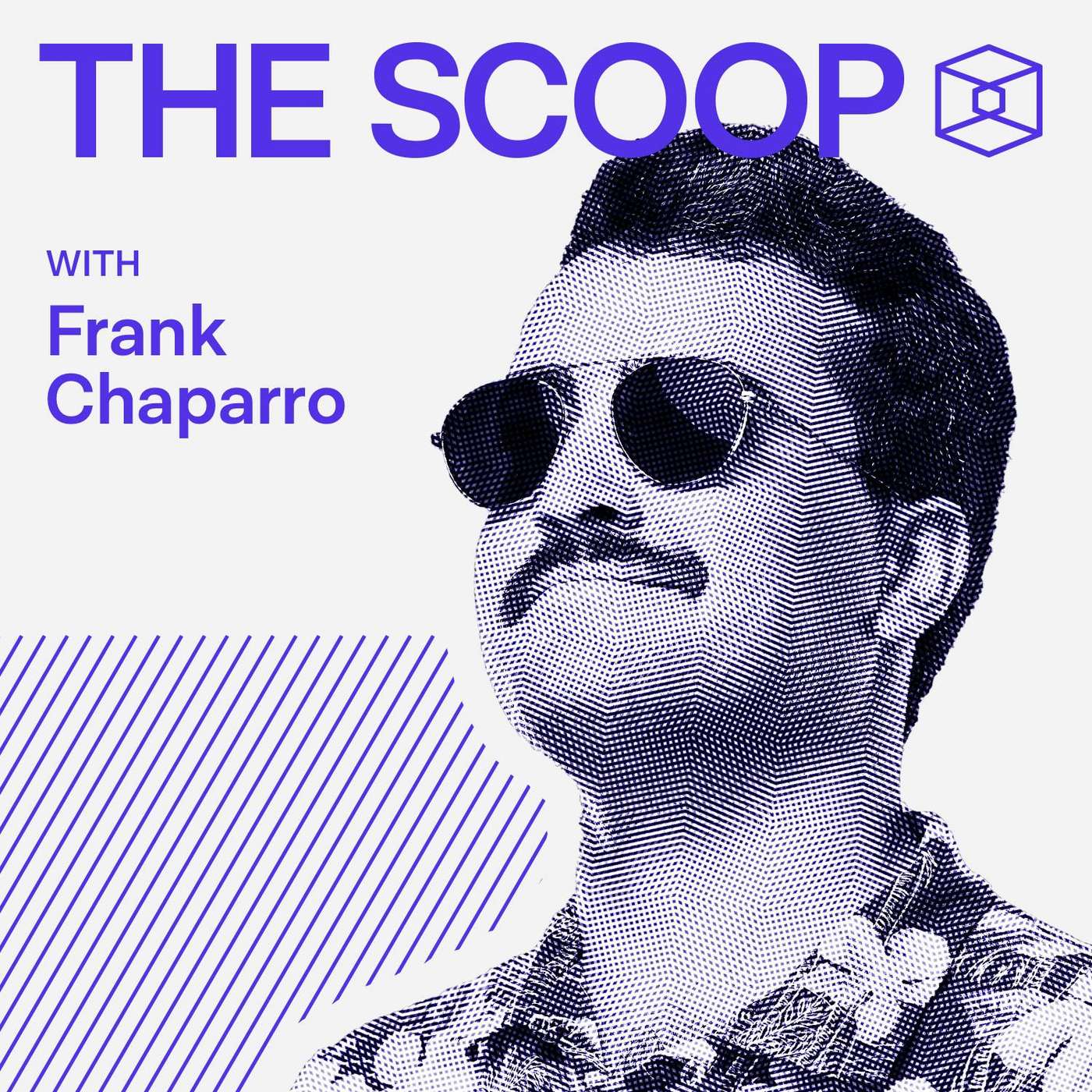
The Scoop
The Block
Welcome to The Scoop, The Block's flagship podcast covering finance and technology industries through unmatched interviews with top thought leaders, cultural icons and industry veterans. The Block’s Frank Chaparro hosts new guests every week, diving into breaking news and topics ranging from NFTs, to the impact of DeFi on Wall Street, to Bitcoin's role in the economy and beyond.
Episodes
Mentioned books

Jul 28, 2020 • 54min
CMS Holdings co-founders say DeFi claimed trader attention before bitcoin's volatility spike
In this week's episode, Cho and Matuszewski give the trader perspective on bitcoin and the DeFi scene, including:
How Circle Trade went from making an "ungodly" amount of money to being sold off to Kraken
Whether the market is at "peakFi"
Why big news events are having less of an impact on bitcoin price swings
An overview of the crypto brokerage wars, and how crypto firms will get "more violent" with each other over time.

Jul 21, 2020 • 45min
Larry Cermak breaks down why the Twitter hackers appear to be amateurs
On this week's episode of The Scoop, Cermak explained out how The Block first picked up on the biggest Twitter hack in history, and what the early hours of information gathering looked like. He also touched on:
The details that indicate the hack was either unplanned or executed by amateurs
What a front page BTC scam means for bitcoin adoption
The debate over Coinbase's move to block the addresses at the height of the hack
Where the stolen funds are now

Jul 15, 2020 • 44min
An inside look at how CoinFLEX is trying to create a repo market for crypto
CoinFLEX emerged in 2019 as one of the first marketplaces for physically-delivered crypto futures. Now, the Hong Kong-based firm has relaunched its platform to build out a repurchase market for digital assets.Mark Lamb, CEO of CoinFLEX, sat down with The Scoop this week to talk about the plan.In the traditional context, a repurchase market or "repo market" allows large clearing banks to exchange assets for short bursts, providing a quick way to finance other activities. Trillions of dollars a day move in the repo market. But in crypto, it's much smaller. No more than $50 million in repurchase transactions occur each day. There's also no counterpart to the traditional clearing bank, so most deals are done directly between two parties.CoinFLEX plans to be that intermediary, launching the CoinFLEX Repo Market in addition to adding spot and perpetual contracts to its current futures market. Lamb outlined how CoinFLEX plans to stake its claim as one of the first repo markets in crypto — similar to how it did that for physically-delivered futures. He also touched on:
How a plan to create a physical perpetual swap became a plan to create an entirely new type of instrument
The pros and cons of CoinFLEX's original platform, and how the firm aims to improve with the second iteration
Why institutional clients on the exchange want leverage that’s even higher than 100x or 250x
How CoinFLEX will be part of crypto's move to democratize access to high-leveraged finance and interest yield collection.
This episode of The Scoop is brought to you by Bitstamp, the original global cryptocurrency exchange. Since 2011, Bitstamp has been a cornerstone of the industry, earning the trust of over four million individuals and top financial institutions looking for a reliable trading venue. Whether you’re trading on our web platform, mobile app or industry-leading APIs, Bitstamp gives you the professional-grade tools you need to execute your strategy. Download the Bitstamp app or visit Bitstamp.net/Pro to learn more and start trading today!

Jul 8, 2020 • 58min
Former Goldman CFO breaks down why the digital dollar is better than bitcoin and stablecoins
R. Martin Chavez left his Goldman Sachs office in December after decades of work bringing new technology to Wall Street, most recently as Goldman's CFO, though his career began in Silicon Valley. Now, he's returned to the tech world, where he serves on the boards of health technology firms and has gotten involved in the conversation around the "digital dollar."On this week's episode of The Scoop, Chavez broke down some of the changes that have occurred at the intersection of health and technology due to the global pandemic. For instance, a world in quarantine has breathed new life into the field of telemedicine. He also explained why although he sees bitcoin as "an amazing research project," it doesn't quite qualify as money in his view.Chavez compared the coronavirus pandemic to the 2008 financial crisis, in that they are both wake up calls for policymakers. He said the pandemic has been a moment to examine how to build better systems, particularly in the health tech and industrial fields.Meanwhile, it's also illuminated the potential role of a U.S. central bank digital currency as a mechanism for stimulus delivery. While Chavez advocated for a blockchain-based digital dollar, he doesn't think private stablecoins are a suitable stand-in. "Stablecoins are stable right up until the instant that they're not stable," he said. Here are some of the more specific topics featured in the episode:
The themes and trends emerging in the health technology space that will be salient in a post COVID-19 world
How the pandemic illuminated the need for resilience in industrial companies and how technology can play a role in reform
What legislation is needed to reform industries that were hit hard, and how to prepare a more resilient supply chain
Why the former Wall Streeter and long time tech advocate says bitcoin isn't money
His view on central bank digital currencies and why stablecoins alone won't do the job of a digital dollar.
This episode of The Scoop is brought to you by Bitstamp, the original global cryptocurrency exchange. Since 2011, Bitstamp has been a cornerstone of the industry, earning the trust of over four million individuals and top financial institutions looking for a reliable trading venue. Whether you’re trading on our web platform, mobile app or industry-leading APIs, Bitstamp gives you the professional-grade tools you need to execute your strategy. Download the Bitstamp app or visit Bitstamp.net/Pro to learn more and start trading today!

Jul 1, 2020 • 56min
Zane Tackett has seen some of the crypto space's biggest events — here's what he's learned
Zane Tackett has witnessed some of the crypto industry's biggest moments. And he recently took a post as a sales and business development executive at FTX, giving him a first-hand look at growth occurring in the derivatives market today.It comes as a notable time for that particular corner of the crypto space, given that more that 100,000 bitcoin options contracts – a historic number totaling over $900 million – is slated to expire this Friday. Tackett will have a front row seat, and he talked about the growth factors for the derivatives market on this week's episode of The Scoop.He also touched on his history in the space, stretching back to his role in helping found the international team at OKCoin, now OKEx, an early mover in crypto futures.Tackett moved from OKEx to become director of community and product development at Bitfinex. He was at the forefront of the exchange's response to the 2016 hack in which 119,756 BTC were stolen."It was the worst period of my life," he said. "I think the initial 48 hours, I went 40 hours without sleeping, got two or three hours of sleep and was back at it. And you know, pretty much everyone on the team was the exact same way."After his time at Bitfinex, Tackett became head of OTC sales at B2C2 before moving to FTX this year.In this week's episode, Tackett discussed how each of these experiences informed his understanding of the market, as well as:
How crypto businesses can cater to both retail and institutional traders
Why a more standard user experience has been a key reason for growth in the space
Why bitcoin resiliency is a sign of growing maturity for the crypto space despite concerns about volatility
The firewalls in place between Alameda and FTX to mitigate concerns around conflicts of interest
Why the prime brokerage space is heating up in the U.S. compared to other regions
Tackett's experience working at Bitfinex during the exchange's biggest hack and what he learned.
Episode 25 of Season 2 of The Scoop was recorded remotely with The Block’s Frank Chaparro and Zane Tackett, a sales and business development executive at crypto derivatives exchange FTX.Listen below, and subscribe to The Scoop on Apple, Spotify, Google Play, Stitcher or wherever you listen to podcasts. Email feedback and revision requests to podcast@theblockcrypto.com.This episode of The Scoop is brought to you by Bitstamp, the original global cryptocurrency exchange. Since 2011, Bitstamp has been a cornerstone of the industry, earning the trust of over four million individuals and top financial institutions looking for a reliable trading venue. Whether you’re trading on our web platform, mobile app or industry-leading APIs, Bitstamp gives you the professional-grade tools you need to execute your strategy. Download the Bitstamp app or visit Bitstamp.net/Pro to learn more and start trading today!

Jun 24, 2020 • 49min
A high-frequency trading expert explains why you shouldn't fear how Robinhood makes money
Before Tarun Chitra built out his company, he spent years doing quantitative research and development for places like D.E. Shaw Research and Vatic Labs. Chitra took his experience in machine learning to create and head a simulation platform for crypto networks — Gauntlet — which garnered backing from companies like Coinbase, Distributed Global and Polychain, among others.Gauntlet provides tools for crypto developers to forecast security risks, possible governance snags and consensus mechanism issues. By forecasting such problems and showing how they could affect assets or network activity, developers can make more informed decisions about security and governance structures.In this week's episode of The Scoop, Chitra spoke from his experience in the high-frequency trading (HFT) world. Chitra's appearance coincided with growing concerns surrounding the market activity driven by Robinhood traders, as users of the app continue to buy up stocks that other investors have dumped.Much of the conversation also coincides with the conversation surrounding brokerage and payment for order flow (PFOF), as some critics object to selling order flow to market makers, claiming it creates a conflict of interest. The Block recently uncovered how Robinhood received more than $90 million in PFOF payments during Q1. Chitra discussed the HFT world's view on PFOF and broke down some of the nuance in the transactions on this week's episode.Chitra also touched on:
Why private exchange trade funds aren't that private
Whether open finance has structural advantages in comparison to legacy market structure
If those possible advantages are enough to drive volumes in the same league as traditional markets
The role of transparency in both the Open Finance and traditional finance ecosystems.
This episode of The Scoop is brought to you by Bitstamp, the original global cryptocurrency exchange. Since 2011, Bitstamp has been a cornerstone of the industry, earning the trust of over four million individuals and top financial institutions looking for a reliable trading venue. Whether you’re trading on our web platform, mobile app or industry-leading APIs, Bitstamp gives you the professional-grade tools you need to execute your strategy. Download the Bitstamp app or visit Bitstamp.net/Pro to learn more and start trading today!

Jun 17, 2020 • 54min
Former Coinbase top lawyer — suddenly a top banking regulator — explains how fintech can 'level the playing field'
In a matter of months, Brian Brooks made the move from Coinbase to head of the U.S. Office of the Comptroller of the Currency (OCC). Brooks left his job as the exchange's top lawyer in March, after his former OneWest Bank colleague and current Treasury Secretary Steve Mnuchin tapped him to become the COO and first deputy comptroller at the OCC. Just two months later, then Comptroller of the Currency Joseph Otting announced his departure, making Brooks acting Comptroller.On this week's episode of The Scoop, Frank Chaparro sat down with Brooks to talk about what it means to have a crypto veteran in the Comptroller's chair. Brooks will run the OCC for at least the next nine months, and maybe longer depending on the political machine. Regardless, he said he's confident he can get a lot done in the time he has, and he's got an eye towards shaping guidance that will help modernize the banking system."I think when you look at a lot of the protests that have been going on over the last week or so and a lot of the economic pain that's been felt over the last few months, what that tells me is that the system that's worked very well for some of us for a long time has not worked well for all of us," he said. "And so I think there's a direct connection between modernizing the banking system and creating more access for diverse communities than was historically the case."He broke down some of the topics he's been thinking about in relation to the OCC, including:
Beefing up the agency's Office of Innovation to better evaluate trends and provide written guidance
How blockchain technology can shrink wealth disparity by providing another route to establish credit
How federal regulation can help to level the playing field between banks and fintech firms
Why the digital dollar should come from the private sector, while the government handles the guidelines
Listen to this week's episode on Apple, Spotify, GooglePlay, Stitcher or wherever you listen to podcasts.

Jun 9, 2020 • 51min
Greycroft's cofounder talks social stock trading and how COVID-19 has impacted the venture landscape
Ian Sigalow has been in the venture capital (VC) space for over a decade, launching his firm Greycroft in 2006.Since then, he's taken some big swings in the fintech space, many of which have paid off. Greycroft manages about $2 billion today. He was an angel investor in Venmo at a time when people told him that PayPal had already won the race of free peer-to-peer service. On this week's episode of The Scoop, Sigalow discussed how one of the firm's latest investments — Public.com — could build a similar business by combining social elements with trading. Sigalow sits on the board of Public, which recently garnered Series B investments from the likes of Will Smith and Adobe chief product officer Scott Belsky. It's a social network for traders, allowing users to trade stocks as well as grow their information networks. "So we believe at Greycroft that there is an opportunity, just like there was when Venmo was founded, to create a multiplayer game inside of a stock brokerage around a feed, and to build the first socially native brokerage application in the world," he said.In this episode of The Scoop, Sigalow and The Block's Frank Chaparro explored Public's business as well as the VC landscape in the midst of COVID-19. The two also discussed:
Why companies trying to marry social networking and payment infrastructure have to do so from the outset
The lessons learned from Robinhood and other trading apps
The future plans for Public.com, including how the company makes money and executes orders
What the current economic uncertainty in the world means for the VC market
How COVID-19 accelerated expected trends in tech business developments, and how a 10-year plan meant Greycroft was already invested in many of these spaces

Jun 2, 2020 • 48min
Three Arrow's Su Zhu on the race to build a crypto prime broker
Last week, saw a deluge of prime brokerage news, capped off by Coinbase's announcement of its acquisition of crypto broker Tagomi.After months of rumors surrounding the two-year-old firm, the deal became one of Coinbase's biggest acquisitions in a move to fill out its institutional business of trading and custody services. With the deal inked, Coinbase is one step closer to becoming a full-scale prime broker.This week's episode features Su Zhu, crypto investor, market commentator and founder of crypto investing firm Three Arrows Capital — an early client of Tagomi. Zhu unpacked his thoughts on the recent deal, touching on some pain points, including the importance of neutrality in the prime brokerage world. The Coinbase deal leaves room for possible conflicts of interest, according to Zhu. The episode also explores:
Why Tagomi's neutrality as a prime broker could be questioned under Coinbase's ownership
The headwinds and tailwinds facing DCG's Genesis Trading and BitGo as they build out similar offerings
The type of trading strategies and opportunities a full-scale prime broker open up for crypto investors like Three Arrows
The reasons why Tether dominates Asian liquidity and doesn't have to worry about rivals taking its crown
How Binance messed up delisting FTX's leverage product, and how it speaks to a broader existential issue at the exchange
This episode of The Scoop is brought to you by Bitstamp, the original global cryptocurrency exchange. Since 2011, Bitstamp has been a cornerstone of the industry, earning the trust of over four million individuals and top financial institutions looking for a reliable trading venue. Whether you’re trading on our web platform, mobile app or industry-leading APIs, Bitstamp gives you the professional-grade tools you need to execute your strategy. Download the Bitstamp app or visit Bitstamp.net/Pro to learn more and start trading today!

May 26, 2020 • 51min
Robo advisor Betterment’s CEO says customers are ‘staying the course’
After a gloomy March and a proverbially rainy April, May has shaped up to be a – dare one say it – positive market from a macro market perspective.Despite the ongoing tragedy of the global coronavirus pandemic, investors appear to be buying. The S&P 500 broke 3,000 for the first time in March and the Dow is up broadly on positive sentiment that efforts to reopen businesses in the U.S. – all in the hopes of coaxing back consumers – will be successful. Yet despite the sense of optimism, analysts hesitate to call it a clear win, given the risks that remain.The Block sat down with John Stein, co-founder of robo advisor firm Betterment, who spoke about the macroeconomic picture in the context of his firm’s clients. Stein remarked that while the first quarter of 2020 was a strong one for signups – April even more so – the company has nonetheless felt the pinch amid difficult market conditions.“Our revenue is tied to assets under management. We see our pain, our own accounts are down. You know, my personal account is affected by a downturn in the market. And our customers feel that.” he told The Block. “But overall, our customers are staying the course.”We also explore:
How Betterment has fared in a world where remote work is the rule, not the exception
The ways in which the firm’s customer base reacted to this year’s market turbulence
How the first quarter of 2020 was one of Betterment’s best
Its checking account product
Staying competitive in a hyper-fast space where all eyes are on the market
This episode of The Scoop is brought to you by Bitstamp, the original global cryptocurrency exchange. Since 2011, Bitstamp has been a cornerstone of the industry, earning the trust of over four million individuals and top financial institutions looking for a reliable trading venue. Whether you’re trading on our web platform, mobile app or industry-leading APIs, Bitstamp gives you the professional-grade tools you need to execute your strategy. Download the Bitstamp app or visit Bitstamp.net/Pro to learn more and start trading today!

