

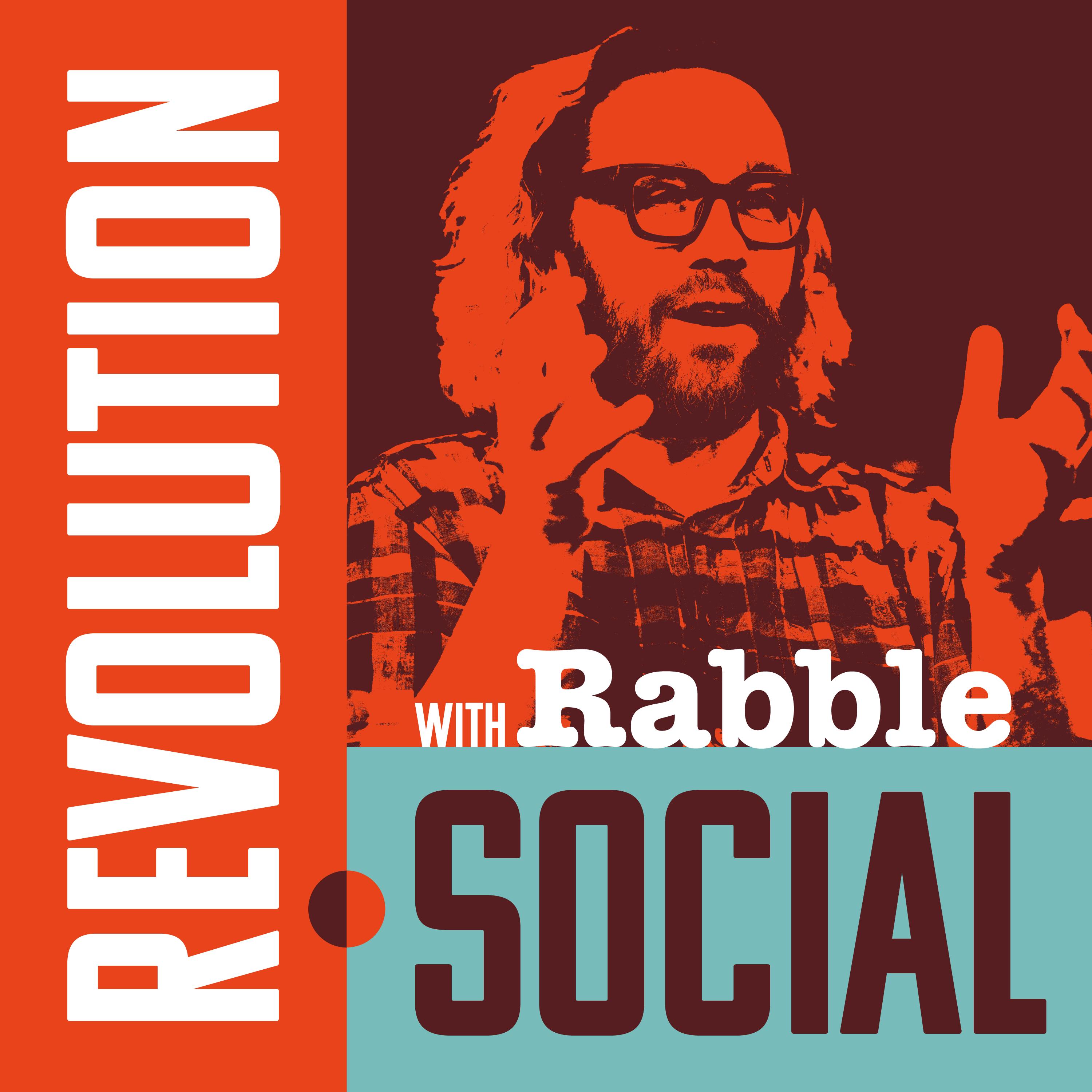
Revolution.Social
Rabble a.k.a. Evan Henshaw-Plath
A podcast about the future of social media and reclaiming our digital communities.Revolution.Social is hosted by technologist and community advocate Rabble, a.k.a. Evan Henshaw-Plath — who was Twitter’s first employee and hired Jack Dorsey. In weekly interviews, Rabble will interview thought leaders, technologists, academics, and more about the need for a new social media "bill of rights." Just as the original Bill of Rights protected individual freedoms from government overreach, we need fundamental protections from corporate control and surveillance capitalism. This is the start of a conversation about what developers are building, how they're building it, and what consumers need to be asking for. Guests will include Jack Dorsey (former CEO & co-founder of Twitter); Kara Swisher (host of On with Kara Swisher, co-host of Pivot); Cory Doctorow (science fiction author & former editor of Boing Boing); and Taylor Lorenz (founder of User Mag, host of Power User).
Episodes
Mentioned books

Mar 26, 2026 • 1h 1min
Ethical Venture Capital: Why Social Media Needs a Conscience (with Brad Burnham & Zoe Weinberg)
In an era of hypergrowth and enshittification, can venture capitalists win by investing with conscience? Today on Revolution.Social, Rabble talks to Union Square Ventures co-founder Brad Burnham and ex/ante founder Zoe Weinberg about digital agency, human rights, and tech that makes the world more inclusive and democratic.
"One of the broader objectives of ex/ante is to think about how do you move beyond surveillance capitalism?" Zoe says. "And the irony is not lost on me that venture itself is part of what created it. And so I think we have to be intellectually honest about that and also come up with a compelling reason why this time is going to be different."
Brad is a legendary investor known for his work in the early Web 2.0 era, when Union Square Ventures backed companies such as Twitter, Tumblr, and Etsy. But with hindsight, he says VCs have a "moral responsibility" to anticipate the consequences of their investments.
"The more time we spent with these companies, the better we understood that the more people in our network, the more valuable that network," Brad says. "What we didn't understand is that it was going to lead to the consolidation around Google, Apple, Facebook, Amazon. We didn't understand that it was so powerful and there was so much value ... that there was no way that a startup could compete with those dominant players."
Chapters:
0:00 Introduction
6:13 Brad’s Early Career and the Birth of Web 2.0
9:05 The Early Days of Union Square Ventures
11:01 Zoe’s Path From Conflict Zones to Digital Freedom
13:45 How Venture Capital Actually Works
18:46 The Evolution of Digital Marketplaces
22:09 The Shift from Open Protocols to Walled Gardens
29:41 Crypto as a New Economic Incentive Model
36:53 Is Technology "Neutral?"
40:33 Public Benefit Corporations
44:16 Personal Data Ownership in the Age of AI
53:25 Centralization vs. Human Agency
57:18 The Future of Agents and Liberatory Technology
Follow Rabble on Bluesky
Follow the podcast
This episode was produced and edited by Eric Johnson from LightningPod.fm, and executive produced by Alice Chan from Flock Marketing.
To learn more about Rabble’s Social Media Bill of Rights, and sign up for our newsletter, visit https://revolution.social/

Mar 19, 2026 • 57min
Escaping Algorithmic Binds: Creators vs. Corporate Platforms (w/ Bridget Todd & Rudy Fraser at SXSW)
The biggest social media platforms in the world have alienated their users and trapped them inside algorithms that only serve corporate interests. But there is good reason to have hope for the future of decentralized social apps, made for and by their communities.
In this live interview recorded at SXSW 2026 in Austin, Texas, Rabble speaks with Rudy Fraser, the creator of Blacksky Algorithms, and Bridget Todd, the host of the podcast There Are No Girls on the Internet and an affiliate at Harvard University's Berkman Klein Center for Internet and Society.
"I want to see more optimistic visions of the future," Rudy says. "I want to see less dystopian visions. I want to see more Afrofuturism ... There's lots of people talk about 'let a thousand flowers bloom.' I think it [decentralization] does open up opportunities for people to be really creative."
Rabble, Rudy, and Bridget spoke about the evolution of the creator economy, how to build a more equitable internet, and why podcasts are the most democratic form of social media.
“If you've ever listened to a podcast at the end, you probably hear the host say something along the lines of, Oh, subscribe on Spotify, Apple Podcasts, or wherever you get your podcasts,” Bridget says. “It really means something kind of radical because that's not just something that people say. It is true … If I say something that Apple doesn't like, Apple can't shut down my podcast because it doesn't work that way, thanks to the RSS feed.”
Chapters:
00:00 Introduction
02:40 Rudy Fraser and the Story of Blacksky
04:10 Bridget Todd on Identity and Technology
08:43 The Power of RSS Feeds
11:51 Rethinking Algorithms for Community Discovery
16:10 Explaining Decentralization to Mainstream Users
20:41 Economic Incentives and Monetization Models
24:46 Lessons from the Twitter Migration
27:57 Narrative Control and Cross-Platform Integration
31:34 Scalability and Digital Strikes
34:00 Rebuilding Infrastructure from First Principles
37:55 The Nuance Problem in Large-Scale Moderation
42:37 Beyond the Sharecropping System of Big Tech
46:58 The Right to Replatforming and Social Coding
51:56 Policy and Global Tech Regulation
Learn more about Blacksky: https://blackskyweb.xyz/
Listen to There Are No Girls on the Internet: https://www.tangoti.com/
Watch Rudy’s previous interview: https://youtu.be/UA1DutGDVcs?si=KoGgvv-u5DAyh4UM
Watch Bridget’s previous interview: https://youtu.be/lpXr_JvuVIw?si=zsiolnlf1OBaf1mt
Follow Rabble on Bluesky: https://bsky.app/profile/rabble.nz
Follow the podcast: https://revolution.social/episodes/
This episode was produced and edited by Eric Johnson from LightningPod.fm, and executive produced by Alice Chan from Flock Marketing.
To learn more about Rabble’s Social Media Bill of Rights, and sign up for our newsletter, visit https://revolution.social/

Mar 12, 2026 • 1h 8min
What Creators Can Do & AI Can’t (with Jim Louderback)
Jim Louderback is a media pioneer: a journalist and columnist who went on to become the CEO of the internet-based television network Revision3, and later of the global events business, VidCon.
Today, as the editor of the popular Inside the Creator Economy newsletter, he is thinking a lot about how creators can respond to AI.
"What are the things that they can uniquely do that AI can't?" he asks. "If you don't lean into the things that make you uniquely human ... I think we then just end up in this one-to-one world, where all media is crafted specifically 100% for us, and we have no fandom, we have no culture, we have no connections."
Today on Revolution.Social, Jim and Rabble talk about the history of blogging, video, social media, and digital celebrities; the "tragedy of the platforms," that creators on TikTok and YouTube don't know enough about their audiences; and the benefits of having some kind of gatekeepers in a creative ecosystem. They also discuss the pivotal role VidCon played in uniting digital influencers, and how Gen Z is making fandom more and more niche.
Chapters:
0:00 Introduction
5:43 The Impact of VidCon and Legitimatizing Creators
11:20 Community vs. Celebrity
14:19 Moving Beyond Platform Dependence
19:21 Parasocial Relationships and Personal Branding
22:19 Democratized vs. Institutional Gatekeepers
27:16 AI's Trust Crisis
34:40 Reclaiming Humanity with diVine
41:59 The Economics of Belonging
48:26 Streaming, Long-Form Content, and Real-Time Validation
56:54 The Failure of Video Replies
59:43 Nostalgia and the Future of Creator Ethics
Learn more about Jim: https://louderback.com/
Inside the Creator Economy: https://insidethecreator.beehiiv.com/
Follow Rabble on Bluesky: https://bsky.app/profile/rabble.nz
Follow the podcast: https://revolution.social/episodes/
This episode was produced and edited by Eric Johnson from LightningPod.fm, and executive produced by Alice Chan from Flock Marketing.

Mar 5, 2026 • 1h
An Alternate History of Social Media (with Ben Werdmuller)
Ben Werdmuller is the Senior Director of Technology at ProPublica and a seasoned technologist who has spent his career building platforms that prioritize social impact and integrity. In 2004, he co-founded the open-source social networking software Elgg, which for more than 20 years has served as an alternative to Facebook for governments, schools, and political movements around the world.
"They are very similar," Ben says of Elgg and Facebook. "PHP-based social network[s], both heavily inspired by LiveJournal ... They took different paths and now Mark has a private Hawaiian island, and I don't. And also, Mark has undermined democracies and been culpable in a genocide."
Today on Revolution.Social, Ben and Rabble talk about his career transitions from technologist to venture capitalist to his current technical leadership at ProPublica. They also discuss how the sensitivities with which journalists approach new technologies like AI; the ebbs and flows of the Indie Web movement; and how builders in tech, including vibe-coders, can choose to lean into ethics, community, and social good.
Chapters:
0:00 Introduction
3:08 Investigating Power at ProPublica
7:32 Media and Venture Capital Don't Mix
13:53 Why Newsrooms Struggle with Innovation
17:15 AI Can't Do Journalism
22:15 Subpoenas and Data Privacy
25:09 The Rise of the IndieWeb
32:11 Vibe Coding and Agentic Programming
42:45 Human Intent in an AI-Built Web
45:32 Open-Source Social with Elgg
51:26 Mark Zuckerberg's Divergent Path
56:31 Co-Designing the Future of Work and AI
Follow Rabble on Bluesky: https://bsky.app/profile/rabble.nz
Follow the podcast: https://episodes.fm/1824528874
This episode was produced and edited by Eric Johnson from LightningPod.fm, and executive produced by Alice Chan from Flock Marketing.
To learn more about Rabble’s Social Media Bill of Rights, and sign up for our newsletter, visit https://revolution.social/

Feb 26, 2026 • 1h 26min
Ethics Have Become Optional in Big Tech. We Can Do Better. (with Alex Komoroske)
Alex Komoroske spent over a decade at Google overseeing key initiatives for ads, Chrome, and Maps, before running Corporate Strategy at Stripe. At heart, he's a champion for the open web. Today, as the CEO and co-founder of Common Tools, Alex says technologists must lean into ethics and away from short-term results.
"We're in the late stage of this extractive kind of thing, where we're all just trying to wring more out of these walled gardens," Alex adds. "And what bothers me is that all of us seem to have forgotten that. And everyone's like, in this zombie state: 'Well, the thing says make number go up.'"
Today on Revolution.Social, Alex and Rabble talk about the challenges of maintaining interoperability in an era of proprietary lock-in; the difference between "hollow" vs. "resonant" tech experiences; and the Resonant Computing Manifesto, which Alex co-drafted last year. They also discuss the rightward political shift of Silicon Valley, Alex's Lord of the Rings-inspired archetypes for understanding builders, and how to curate cozy offline communities.
Chapters:
0:00 Introduction
5:24 The "Slime Mold" Theory of Organizations
10:53 The Fallacy of Measurement and KPIs
15:49 Christopher Alexander and Pattern Language
17:51 The Resonant Computing Manifesto
21:06 Chatbots vs. Agentic LLMs
26:54 Saruman vs. Radagast
31:53 Power Dynamics and "Money Disease"
38:45 How LLMs Change Software
42:52 The History of the Luddite Movement
47:54 APIs as Public Infrastructure
52:48 Lessons from the Open Web and Chrome
59:43 App Stores vs. The Web Sandbox
1:04:42 Balancing Open Systems with Speed
1:09:09 User-Driven Innovation at Twitter
1:10:53 Cloud Security Tiers and Data Privacy
1:16:44 The Power of Physical Salons and Curation
1:22:47 Hypersituated Software and Local Community
Follow Rabble on Bluesky: https://bsky.app/profile/rabble.nz
Follow the podcast: https://episodes.fm/1824528874
This episode was produced and edited by Eric Johnson from LightningPod.fm, and executive produced by Alice Chan from Flock Marketing.
To learn more about Rabble’s Social Media Bill of Rights, and sign up for our newsletter, visit https://revolution.social/

Feb 19, 2026 • 1h 13min
Silicon Valley Has Lost Its Moral Compass (with Anil Dash)
Anil Dash is a pioneering technologist, advocate for ethical tech, and former CEO of Glitch, who currently serves on the board of the Electronic Frontier Foundation. Looking back on his career, he says Silicon Valley has lost its moral compass because it no longer responds to shame.
"You stopped being able to say, don't do this thing, it makes you look bad," Anil says. "Facebook never cared about that. And most of the product managers at OpenAI used to work at Facebook.”
“If [they] were a person that joined Meta after they enabled the Rohingya genocide and then [they] went to work at OpenAI,” he adds, “And you're like, 'Hey, why does your product tell teenagers to self-harm?' They're going to be like, 'What's the problem?'"
Today on Revolution.Social, Anil and Rabble talk about the evolution of the independent web, the challenges of maintaining progressive values within the startup ecosystem, and how to use digital tools to foster a more democratic society. They also explore the backlash against AI, which Anil believes to be a manifestation of all the disruption the tech industry has caused in people's lives, and why that doesn't mean we have to give up on AI entirely.
Chapters:
0:00 Introduction
5:12 The History of Decentralization
12:07 AI Ethics and Intellectual Property
16:57 The Silicon Valley Playbook: Economic Disruption
24:50 What We Can Learn from Prince and Taylor Swift
31:18 The Culture of Curation: From Reblogging to Vine
41:16 The Decline of Corporate Shame and Accountability
46:15 AI as a Tech Industry Fashion Trend
54:15 Why Coding in AI Feels Better than Making Art
1:03:01 We Need a Rubric for Ethical, Human-Centric AI
1:08:46 Grassroots Resistance to Big Tech
Follow Rabble on Bluesky: https://bsky.app/profile/rabble.nz
Follow the podcast: https://episodes.fm/1824528874
This episode was produced and edited by Eric Johnson from LightningPod.fm, and executive produced by Alice Chan from Flock Marketing.
To learn more about Rabble’s social media bill of rights, and sign up for our newsletter, visit https://revolution.social/

12 snips
Feb 12, 2026 • 1h 8min
“I've Never Been More Optimistic” (Flipboard’s Mike McCue On the Open Social Web)
Mike McCue, serial tech exec who led Flipboard and helped shape the open web, discusses the shift from walled gardens to open social protocols. He talks about why follower counts no longer matter. He warns about rage-bait economics and the soullessness of AI content. He outlines creator-centered tools like Surf and why niche communities and human curation could win the future.

Feb 5, 2026 • 32min
Building Community vs. Building an Audience (with VidCon’s Jacques Keyser)
VidCon programming director Jacques Keyser says there’s a big shift happening in social media: Creators who once lived and died by the algorithm are increasingly looking for ways to “own” their audiences.
“No one can take your podcast away, no one can take your newsletter away,” Keyser says. “Once you've built that audience, that is yours, you own that … if you are on YouTube, if you're on TikTok, if you're on Meta, at any point you could violate one of the T's and C's [and lose your account].”
VidCon got its start as a small event in a hotel lobby organized by Hank and John Green, and today it’s one of the largest gatherings of digital creators, fans, and industry in the world. Today on Revolution.Social, recorded at the 1 Billion Followers Summit in Dubai, Rabble and Jacques talk about what has changed in the intervening years, both at VidCon and inside the creator economy as a whole.
They also talk about how follower counts have become meaningless, how creators actually make money, and why the rise of AI might paradoxically make real-life connection and human authenticity more valuable than ever.
Follow Rabble on Bluesky
Follow the podcast
This episode was produced and edited by Eric Johnson from LightningPod, and executive produced by Alice Chan from Flock Marketing.
To learn more about Rabble’s social media bill of rights, and sign up for our newsletter, visit https://revolution.social/

Jan 29, 2026 • 57min
The Battle for Digital Freedom and Why KOSA Ain’t It (with Evan Greer)
Evan Greer is a director at Fight for the Future, the digital rights organization that helped organize the SOPA blackout and continues to fight for an internet where ordinary people have a voice. As a parent, a trans activist, and someone who's spent over a decade in the trenches of internet policy, she brings a unique perspective to the debate over how we protect kids online.
“So many of these folks that say they want to protect kids are just not actually interested in listening to kids,” Evan says. “And it's really hard to protect kids when you don't listen to them… The amount of videos about Minecraft that I have subjected myself to just so that my kid doesn't feel ashamed coming and talking to me about what kind of content she's consuming has rotted my brain. But what it actually has led to is we do have a trusting relationship.”
Today on Revolution.Social, Evan and Rabble talk about how well-intentioned legislation such as KOSA, the Kids Online Safety Act, could become a powerful tool for censorship; why age verification requirements would make digital surveillance even worse; and why our ability to choose the apps we can install on our phones is set to become a “foundational human rights issue.” They also talk about the monopoly power of app stores, the hidden world of data brokers, and why the same politicians who claim to be tough on Big Tech refuse to pass basic privacy legislation.
Follow Rabble on Bluesky
Follow the podcast
This episode was produced and edited by Eric Johnson from LightningPod, and executive produced by Alice Chan from Flock Marketing.
To learn more about Rabble’s social media bill of rights, and sign up for our newsletter, visit https://revolution.social/

Jan 24, 2026 • 12min
An Update on diVine: Joyscrolling, AI Filtering, and Trust & Safety
Rabble and Alice Chan, Revolution.Social's host and executive producer, share an update on diVine, the new social video app that's bringing back the spirit of Vine and real human creativity (no AI content allowed!).
"We're not anti-AI," Alice says. "We just believe that there is great power in human creativity and that humans have kind of had that power taken away from them involuntarily."
Recording at the 1 Billion Followers Summit in Dubai, Rabble and Alice talk about how the diVine team is preparing to handle potentially millions of users, and how it’s partnering with trust and safety experts like Yoel Roth, and the team at Bluesky. They also discuss AI content detection, the forthcoming Android beta, and why we need to replace doomscrolling with “joyscrolling.”
Follow Rabble on Bluesky: https://bsky.app/profile/rabble.nz
Follow the podcast: https://episodes.fm/1824528874
This episode was produced and edited by Eric Johnson from LightningPod.fm, and executive produced by Alice Chan from Flock Marketing.
To learn more about Rabble’s social media bill of rights, and sign up for our newsletter, visit https://revolution.social/

