

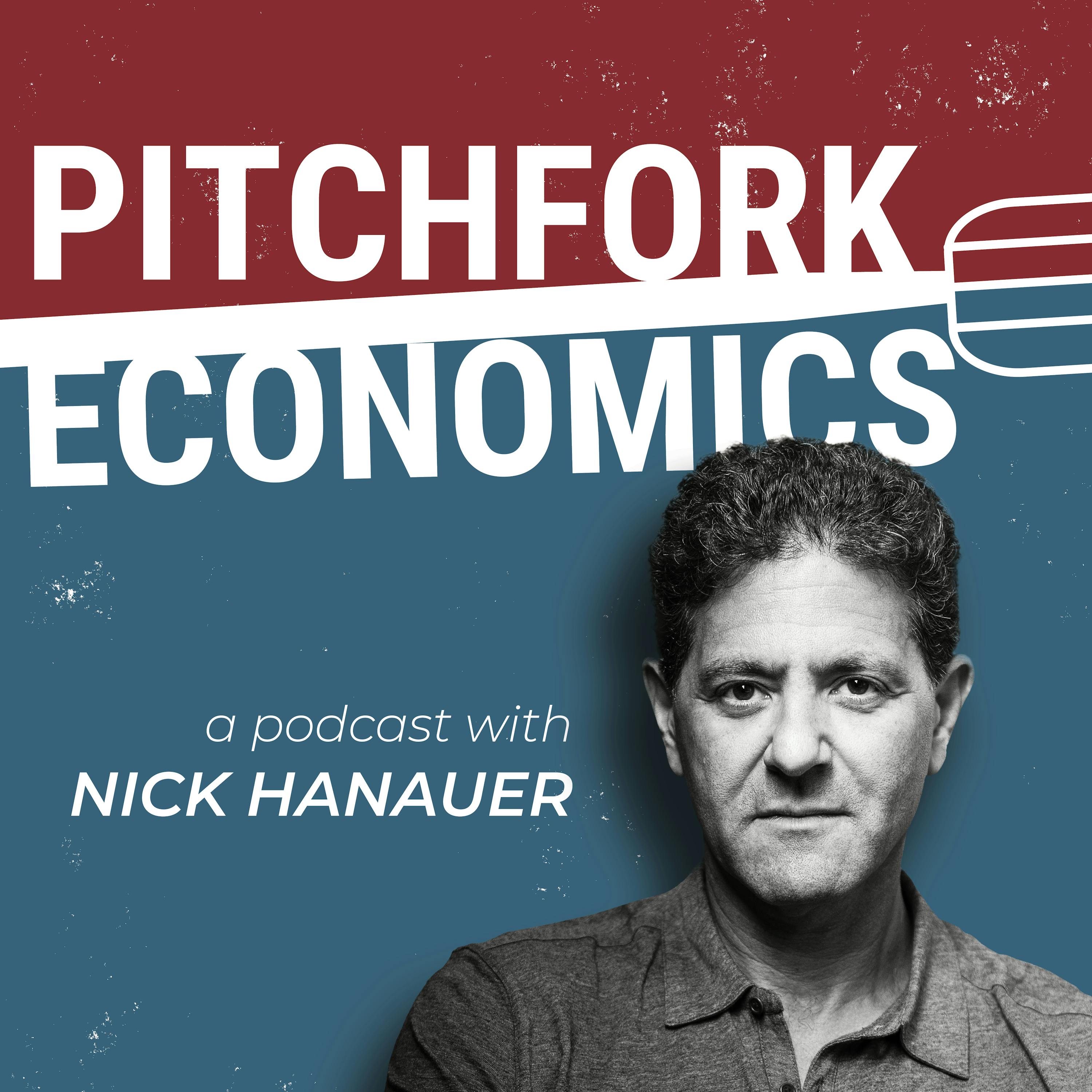
Pitchfork Economics with Nick Hanauer
Civic Ventures
We are living through a paradigm shift from trickle-down neoliberalism to middle-out economics — a new understanding of who gets what and why. Join zillionaire class-traitor Nick Hanauer and some of the world’s leading economic and political thinkers as they explore the latest thinking on how the economy actually works.
Episodes
Mentioned books

Aug 13, 2019 • 50min
Shared security, shared growth: a social contract for the 21st century (with Senator Mark Warner and Abby Solomon)
There are nearly 60 million gig economy workers in the U.S. workforce, yet benefits like health care, retirement, and paid leave are still tied to traditional salaried jobs. It is essential that we adopt new policies guaranteeing all workers the basic level of economic security necessary to sustain and grow the American middle class—and with it, the economy as a whole. This week, Senator Mark Warner and SEIU 775 Benefits Group Executive Director Abby Solomon imagine what a shared security system designed to fit modern flexible employment realities might look like. Senator Mark Warner is the senior U.S. Senator from Virginia. He serves on the Senate Finance, Banking, Budget, and Rules Committees as well as the Select Committee on Intelligence, where he is the Vice Chairman. From 2002 to 2006, he served as Governor of Virginia. Senator Warner spent 20 years as a successful technology and business leader in Virginia before entering public office. Twitter: @MarkWarnerAbby Solomon is the Executive Director of SEIU 775 Benefits Group, overseeing trusts for training, health, and retirement benefits for Washington state’s Home Care Aide workforce. The Benefits Group provides portable benefits to 50,000 home care workers. Previously, Abby was the Director of Home Care Campaigns at SEIU, where she led national advocacy campaigns representing 1.9 million workers and 100+ occupational fields throughout the United States and Canada. Twitter: @SEIU775BGFurther reading: Shared Security, Shared Growth: https://democracyjournal.org/magazine/37/shared-security-shared-growth/Portable Benefits for an Insecure Workforce: https://prospect.org/article/portable-benefits-insecure-workforceBuilding a portable benefits system for today’s world: http://seiu775.org/building-a-portable-benefits-system-for-todays-world/
Aug 6, 2019 • 46min
Educationism (with Diane Ravitch)
Like many rich Americans, Nick used to think that focusing their philanthropic efforts in the country’s education system could heal many of our biggest problems. But in The Atlantic last month, he admitted he was wrong—better schools won’t fix America unless we fix inequality first. He’s joined this week by Diane Ravitch, a giant in the education policy world who also changed her mind about what works and what doesn’t. Can these two converts from the theory of educationism find a new way to expand educational opportunity in America while also combating runaway income inequality?Diane Ravitch is a Research Professor of Education at New York University and a historian of education. She is the Founder and President of the Network for Public Education. From 1991 to 1993, she was Assistant Secretary of Education under President George H.W. Bush, where she led the federal effort to promote the creation of voluntary state and national academic standards. In her book ‘The Death and Life of the Great American School System: How Testing and Choice Are Undermining Education’, Ravitch examines her career in education reform and repudiates positions that she once staunchly advocated. Twitter: @DianeRavitchFurther reading: Better Schools Won’t Fix America: https://www.theatlantic.com/magazine/archive/2019/07/education-isnt-enough/590611/
Jul 30, 2019 • 1h 3min
The robots are coming… what now? (with Heidi Shierholz and Daron Acemoglu)
With every technological advancement since the dawn of time, conventional wisdom has warned that technology and automation kills jobs. But robots aren’t the root cause of our problems. Although technology has always changed the nature of work, this week's guests Heidi Shierholz and Daron Acemoglu argue that there is no evidence that it has led or will lead to overall increased joblessness, unemployment, or wage stagnation.Heidi Shierholz is a Senior Economist and the Director of Policy at the Economic Policy Institute. She was a Chief Economist at the U.S. Department of Labor under President Obama from 2014 to 2017. Her research and insights on labor and employment policy, the effects of automation on the labor market, wage stagnation, inequality, and many other topics routinely shape policy proposals and inform economic news coverage. Twitter: @hshierholzDaron Acemoglu is a Professor of Economics at the Massachusetts Institute of Technology. He is the co-author of the New York Times and Wall Street Journal bestselling book ‘Why Nations Fail’, with James A. Robinson. In 2005, he received the John Bates Clark Medal, awarded to economists under forty judged to have made the most significant contribution to economic thought and knowledge. Twitter: @DrDaronAcemogluFurther reading: The zombie robot argument lurches on (EPI): https://www.epi.org/publication/the-zombie-robot-argument-lurches-on-there-is-no-evidence-that-automation-leads-to-joblessness-or-inequality/How robots became a scapegoat for the destruction of the working class (The Week): https://theweek.com/articles/837759/how-robots-became-scapegoat-destruction-working-classAutomation, Job Loss, and the Welfare State (Council on Foreign Relations): https://www.cfr.org/event/automation-job-loss-and-welfare-stateRobots, or automation, are not the problem (EPI): https://www.epi.org/publication/robots-or-automation-are-not-the-problem-too-little-worker-power-is/Robots kill jobs. But they create jobs, too. (Brookings): https://www.brookings.edu/blog/up-front/2019/03/18/robots-kill-jobs-but-they-create-jobs-too/Where Do Good Jobs Come From? (Project Syndicate): https://www.project-syndicate.org/commentary/automation-vs-job-creation-by-daron-acemoglu-2019-04?barrier=accesspaylogThe Revolution Need Not Be Automated (Project Syndicate): https://www.project-syndicate.org/commentary/ai-automation-labor-productivity-by-daron-acemoglu-and-pascual-restrepo-2019-03?barrier=accesspaylog
Jul 26, 2019 • 9min
BONUS: What to listen for in the second round of presidential debates
The second round of presidential debates are quickly approaching. The debates move fast, and we know there’s a lot to sift through—so allow us to make it easier on you! In this pre-debates briefing, Nick and Zach lay out exactly what kind of economics talk you should be listening for ahead of next Tuesday and Wednesday’s festivities. Further reading: https://www.politico.com/magazine/story/2019/06/26/democratic-debate-economy-middle-class-analysis-growth-227217
Jul 23, 2019 • 35min
Health Care Part 2: One nation, with liberty and health care for all (with Sanders for President Campaign Co-Chair Nina Turner)
Medicare for All is the most ambitious health care proposal on the table right now, and the Bernie Sanders campaign is ground zero for making it a reality. In the second episode of a two-part series on health care, former Ohio State Senator and Sanders’ campaign co-chair Nina Turner explains why widely available and affordable high-quality health care would be revolutionary for the United States.Nina Turner was an Ohio State Senator from 2008 until 2014. In 2017, Turner became president of Our Revolution, a progressive political action organization spun out of Senator Bernie Sanders’ 2016 presidential campaign, and she is currently the national co-chair of Sanders’ 2020 campaign. Her podcast, We The People with Nina Turner, is available everywhere podcasts are posted. Twitter: @ninaturnerInstagram: @ninaturnerohioFurther reading: https://www.cnn.com/2019/02/25/health/what-does-medicare-for-all-mean/index.htmlhttps://www.vogue.com/article/sen-nina-turner-universal-programs-opinion
Jul 19, 2019 • 21min
BONUS: Don't Pass Go—without learning more about monopolies (with Barry Lynn)
We’re revisiting a timeless topic: monopolies! Expert Barry Lynn shares his thoughts on market concentration, the dangers of industrial monopolies like Boeing, and what ‘reigning in’ companies like Google, Facebook, and Amazon actually means.Barry Lynn is the Executive Director of the Open Markets Institute. Previously, he spent 15 years at the New America Foundation researching and writing about monopoly power. He is the author of ‘Cornered: The New Monopoly Capitalism and the Economics of Destruction’ and ‘End of the Line: The Rise and Coming Fall of the Global Corporation’. Twitter: @openmarketsFurther reading: https://www.theatlantic.com/business/archive/2017/02/antimonopoly-big-business/514358/https://openmarketsinstitute.org/op-eds-and-articles/why-competition-matters/https://www.theguardian.com/commentisfree/2018/jul/26/google-and-facebook-are-strangling-the-free-press-to-death-democracy-is-the-loserhttps://www.theguardian.com/commentisfree/2017/nov/02/facebook-google-monopoly-companies
Jul 16, 2019 • 45min
Health Care Part 1: Everyone does it better than us (with T. R. Reid)
When it comes to health care, every country in the world is running their own version of the same experiment—and the results vary widely in terms of cost and patient outcomes. In the first episode of a two-part exploration of health care, author T. R. Reid takes Nick and Stephanie on a tour of medical systems around the world. T. R. Reid is the author of the bestselling books ‘The Healing of America: A Global Quest for Better, Cheaper, and Fairer Health Care’ and ‘A Fine Mess—A Global Quest for a Fairer, Simpler, and More Efficient Tax Code’. He has become one of the nation’s best-known reporters through his books and articles, his documentary films, his reporting for the Washington Post, and his frequent commentary on NPR’s Morning Edition. Twitter: @therealtrreidFurther reading: https://www.goodreads.com/book/show/6402544-the-healing-of-america
Jul 9, 2019 • 56min
The decline of worker power (with David Rolf and Larry Mishel)
Not so long ago, economic growth was shared widely among Americans thanks to a suite of policies that boosted the bargaining power of workers. In recent years, employer power has increased while worker powers have been significantly eroded—and as a result, income inequality has grown at record rates. Experts David Rolf and Larry Mishel explain how this collapse of worker power came to be, and offer solutions that will tilt the scales of power back in the right direction.David Rolf is a labor leader, organizer, writer, and speaker working to build the next American labor movement. He is the founder and President Emeritus of SEIU 775 and a former Vice President of SEIU International. He led campaigns that helped organize hundreds of thousands of minimum-wage home care workers, and helped lead the nation’s first two successful campaigns for $15 minimum wages in SeaTac and Seattle.Twitter: @DavidMRolfLarry Mishel is a distinguished fellow at the Economic Policy Institute after serving as president from 2002-2017, where he has helped build it into the nation’s premier research organization focused on U.S. living standards and labor markets. Mishel has co-authored all 12 editions of ‘The State of Working America’, and has written extensively on wage and job quality trends in the United States.Twitter: @LarryMishelFurther reading: https://tcf.org/content/report/roadmap-rebuilding-worker-power/?session=1https://www.epi.org/publication/what-labor-market-changes-have-generated-inequality-and-wage-suppression-employer-power-is-significant-but-largely-constant-whereas-workers-power-has-been-eroded-by-policy-actions/https://psmag.com/economics/what-caused-the-decline-of-unions-in-america
Jul 2, 2019 • 34min
Our full conversation with Governor Jay Inslee
In March of this year, Washington state Governor Jay Inslee announced he is running for president on a platform of combating climate change. He has already succeeded in centering the political conversation around this central crisis of our time. We spoke with the governor for our April episode about the economics of climate change; here is our full unedited conversation.Jay Inslee first got into public service to fight for a new public high school in his community. He then went on to serve in the state legislature and in 1992 was elected to represent the 4th Congressional District in rural Eastern Washington. He later moved back to the Seattle area and was elected to Congress in 1998 where he served until 2012. In 2012 he was elected Washington's 23rd governor and is currently serving in his second term.Twitter: @JayInsleeLinks:https://www.vox.com/energy-and-environment/2019/5/4/18527458/climate-change-jay-inslee-for-president-2020https://www.nytimes.com/2019/03/01/us/politics/jay-inslee-on-the-issues.html
Jun 25, 2019 • 48min
A roadmap to utopia (with Rutger Bregman)
Rutger Bregman, who The Guardian has called “the Dutch wunderkind of new ideas”, joins us this week to daydream a better future. Bregman won international fame by taking on everyone from Tucker Carlson to the wealthy elites at Davos on the topic of income inequality, and here he lays out a positive economic vision using the pillars of his book ‘Utopia for Realists’: a universal basic income, open borders, and a 15-hour workweek. Rutger Bregman is a Dutch historian and author. He has published four books on history, philosophy, and economics. His book ‘History of Progress’ was awarded the Belgian Liberales prize for best nonfiction book of 2013, and the Dutch edition of ‘Utopia for Realists’ became a national bestseller and sparked a basic income movement that made international headlines. The book has been translated into 31 languages. Bregman has twice been nominated for the prestigious European Press Prize for his journalism work at The Correspondent. Twitter: @rcbregmanFurther reading: https://www.theguardian.com/commentisfree/2016/apr/18/solution-everything-working-less-work-pressurehttps://www.theguardian.com/books/2017/feb/26/rutger-bregman-utopia-for-realists-interview-universal-basic-incomehttps://www.washingtonpost.com/opinions/2019/02/20/dutch-professor-exposes-tucker-carlsons-fraud/?utm_term=.a252dc0fa581https://www.theguardian.com/business/2019/feb/01/rutger-bregman-world-economic-forum-davos-speech-tax-billionaires-capitalismhttps://twitter.com/nowthisnews/status/1090045108064579584

