

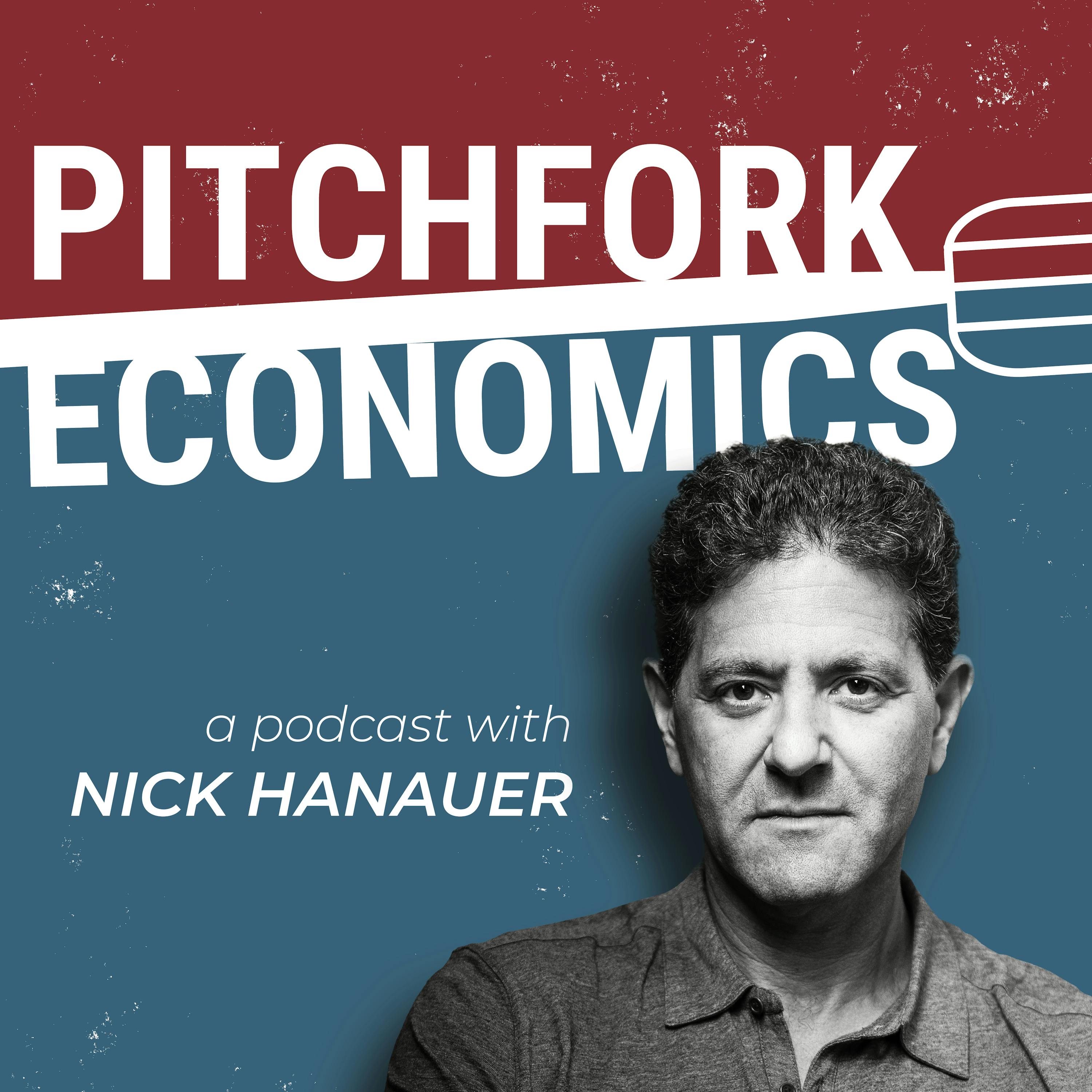
Pitchfork Economics with Nick Hanauer
Civic Ventures
We are living through a paradigm shift from trickle-down neoliberalism to middle-out economics — a new understanding of who gets what and why. Join zillionaire class-traitor Nick Hanauer and some of the world’s leading economic and political thinkers as they explore the latest thinking on how the economy actually works.
Episodes
Mentioned books

Nov 12, 2019 • 58min
Is economic orthodoxy evolving? (with Luigi Zingales)
‘Chicago School’ is a descriptor often used to signify conventional economic thinking. This week, our friend Luigi Zingales, a finance professor at the Chicago Booth School of Business, joins Nick and Goldy to find out where they agree—and where they disagree. They discuss wealth taxes, health care, student loan forgiveness, shareholder value maximization, the Green New Deal, and more. Luigi Zingales is a Professor of Entrepreneurship and Finance and the Director of the Stigler Center at the Chicago Booth School of Business. He is the author of two books: ‘Saving Capitalism from Capitalists’, with Raghuram G. Rajan, and ‘A Capitalism for the People: Recapturing the Lost Genius of American Prosperity’. Luigi is also the co-host of the podcast ‘Capitalisn’t’. Twitter: @zingales @zingales_itA Capitalism for the People: https://www.indiebound.org/book/9780465085958
Nov 5, 2019 • 48min
Can we hold big corporations to higher standards? (with Mayor Dave Bieter and E.J. Dionne)
Nick pitches a big idea to the mayor of Boise and political commentator E. J. Dionne: a suite of progressive labor standards that would hold large employers to higher standards nationwide. Is this the way to bring progressive, inclusive economic growth to rural America?Dave Bieter is the Mayor of Boise, Idaho. Now serving his fourth term, he is the longest serving Mayor in Boise’s history. Twitter: @MayorBieterE. J. Dionne writes about politics in a twice-weekly column for The Washington Post. He is also a government professor at Georgetown University, a visiting professor at Harvard University, a senior fellow in governance studies at the Brookings Institution and a frequent commentator on politics for NPR and MSNBC. He is a New York Times bestselling author, and his newest book ‘Code Red: How Progressives and Moderates Can Unite to Save Our Country’ is out next year. Twitter: @EJDionneFurther reading: Progressive Labor Standards: https://democracyjournal.org/magazine/51/progressive-labor-standards/
Oct 31, 2019 • 16min
HALLOWEEN SPECIAL: Trickle-Down or Treat
We asked our guests and listeners: what’s the spookiest, sneakiest, and scariest trickle-down trick? Find out what’s making Congresswoman Pramila Jayapal, Professor Stephanie Kelton, author Matt Stoller, and more good witches and wizards quake in their boots this Halloween.
Oct 29, 2019 • 55min
Tax me more, I’m rich (with Abigail Disney and Chye-Ching Huang)
Trickle-down economics would have you believe that the rich are job creators—the more money they have to invest in creating jobs, the better the economy is for everybody. This lie has had catastrophic effects: the top 0.1% of Americans now own more wealth than the bottom 90% of Americans combined. Class traitor Abigail Disney and tax expert Chye-Ching Huang are on this week to make the case for taxing the rich. Abigail Disney is a documentary filmmaker, philanthropist, and social activist. She is the granddaughter of Roy Disney, the co-founder of the Walt Disney Company.Twitter: @abigaildisneyChye-Ching Huang is the Director of Federal Fiscal Policy at the Center on Budget Policy Priorities, where she focuses on the fiscal and economic effects of federal tax and budget policy. She rejoined the Center in 2011 after working as a Senior Lecturer at the University of Auckland, where she taught tax law and conducted research in tax law and policy. Twitter: @dashching CenteronBudgetFurther reading: For the first time in history, U.S. billionaires paid a lower tax rate than the working class last year: https://www.washingtonpost.com/business/2019/10/08/first-time-history-us-billionaires-paid-lower-tax-rate-than-working-class-last-year/In Open Letter, Billionaires Co-Sign New Wealth Tax Proposal: ‘Revenue Should Come From the Most Financially Fortunate’: https://time.com/5613228/billionaires-calling-for-wealth-taxes/Want to grow the economy? Tax rich people like me: https://www.businessinsider.com/nick-hanauer-defends-wealth-tax-grow-economy-create-jobs-2019-7 Disney Heiress Calls for Wealth Tax: ‘We Have To Draw A Line’: https://www.npr.org/2019/06/28/736993245/disney-heiress-calls-for-wealth-tax-we-have-to-draw-a-lineTax Code Can Do More to Narrow Racial Gaps in Income and Wealth: https://www.cbpp.org/blog/tax-code-can-do-more-to-narrow-racial-gaps-in-income-and-wealthWealth tax explainer: Why Bernie Sanders, Elizabeth Warren and billionaires like George Soros alike are calling for a specialized tax on the ultra-wealthy: https://www.businessinsider.com/wealth-tax-definition-explained-elizabeth-warren-2019-7Fundamentally Flawed 2017 Tax Law Largely Leaves Low- and Moderate-Income Americans Behind: https://www.cbpp.org/federal-tax/fundamentally-flawed-2017-tax-law-largely-leaves-low-and-moderate-income-americans The Rich Can’t Get Richer Forever, Can They? https://www.newyorker.com/magazine/2019/09/02/the-rich-cant-get-richer-forever-can-theyThe Disney heiress who’s begging for a wealth tax says income inequality has created a ‘superclass’ in the US -- and it’s putting the American dream at risk: https://www.businessinsider.com/abigail-disney-income-inequality-american-dream-wealth-tax-2019-6How the Federal Tax Code Can Better Advance Racial Equity: https://www.cbpp.org/research/federal-tax/how-the-federal-tax-code-can-better-advance-racial-equity
Oct 22, 2019 • 60min
Will bad economics kill the Green New Deal? (with Naomi Klein and J.W. Mason)
The only thing holding us back from big, bold, progressive change is ourselves. When critics wonder if we can afford to pay for the Green New Deal, they couch their concerns in the language of neoliberal economics: they say that investing in the middle class, raising wages, and doing too much too quickly will ruin the economy. This week, Naomi Klein and J.W. Mason join us to explain why the economic status quo is the greatest barrier to the Green New Deal becoming a reality, and how we actually can afford to change our economy so drastically. Naomi Klein is an award-winning journalist and New York Times bestselling author. She is Senior Correspondent for The Intercept, a Puffin Writing Fellow at Type Media Center, and the inaugural Gloria Steinem Chair in Media, Culture and Feminist Studies at Rutgers University. Her most recent book, ‘On Fire: The (Burning) Case for a Green New Deal’, published worldwide in September, was an instant New York Times bestseller and a #1 Canadian bestseller. Twitter: @NoamiAKleinJ.W. Mason is a Fellow at the Roosevelt Institute, where he works on the Financialization Project, and an assistant professor of economics at John Jay College, CUNY. His current research focuses on the history and political economy of credit, including the evolution of household debt and changing role of financial markets in business investment. He also works on the history of economic thought, particularly the development of macroeconomics over the twentieth century. Twitter: @JWMason1Further reading and resources: On Fire: https://www.indiebound.org/book/9781982129910Can We Afford a Green New Deal? http://jwmason.org/slackwire/can-we-afford-a-green-new-deal/Decarbonizing the US Economy: Pathways Toward a Green New Deal: https://rooseveltinstitute.org/wp-content/uploads/2019/06/Roosevelt-Institute_Green-New-Deal_Digital-Final.pdfA Message from the Future with Alexandria Ocasio-Cortez: https://www.youtube.com/watch?v=d9uTH0iprVQWith a Green New Deal, Here’s What the World Could Look Like for the Next Generation: https://theintercept.com/2018/12/05/green-new-deal-proposal-impacts/
Oct 18, 2019 • 5min
Paul’s Book Review: Kochland
Be still, our hearts—it’s another book review, straight from the glittering literary mind of Paul Constant. This week, Paul recommends the New York Times Bestseller ‘Kochland’ by Christopher Leonard, a deeply reported investigation of Koch Industries’ secretive corporate power, smarmy public influence, and weird libertarian agenda. Plus: literal back-stabbing! Kochland: https://www.indiebound.org/book/9781476775388 Twitter: @paulconstantPaul’s website, The Seattle Review of Books: https://seattlereviewofbooks.com/
Oct 15, 2019 • 41min
The trade-offs of global trade (with Dean Baker and Port Commissioner Ryan Calkins)
In the 1990s and early 2000s, free trade was considered an unalloyed good. But now, policymakers and economists agree that global trade creates winners and losers—and they acknowledge that we've never really tried to fairly compensate the losers. Economist Dean Baker and Seattle Port Commissioner Ryan Calkins help us try to imagine a more equitable way forward on international trade. Dean Baker is a senior economist at the Center for Economic and Policy Research, an organization he co-founded in 1999. His areas of research include housing, consumer prices, intellectual property, trade, employment, Social Security, and Medicare. He is the author of several books, including ‘Rigged: How Globalization and the Rules of the Modern Economy Were Structured to Make the Rich Richer,’ and his blog, ‘Beat the Press,’ provides commentary on economic reporting. He is currently a visiting professor at the University of Utah. Twitter: DeanBaker13Ryan Calkins is a Port of Seattle Commissioner specializing in sustainable economic development, ensuring that our region's prosperity is shared among all of our communities. Commissioner Calkins also works as a nonprofit professional at Ventures, a charitable organization that supports low income entrepreneurs who are starting and growing businesses in the Puget Sound Area.Twitter: @ryancalkinsSEA
Oct 8, 2019 • 59min
How neoliberalism happened (with George Monbiot and Binyamin Appelbaum)
It’s trendy to mock the malicious pervasiveness of neoliberalism now, but have you ever wondered what its origins are? This week, George Monbiot and Binyamin Appelbaum join the show to uncover just where the dominant economic theory of our time came from and how it took hold. George Monbiot writes a weekly column for The Guardian and is the author of a number of books, most recently ‘Out of the Wreckage: A New Politics for an Age of Crisis’. As an investigative journalist and self-described “professional troublemaker,” George uncovers the complicated truths behind the world’s most persistent problems. Twitter: @GeorgeMonbiotBinyamin Appelbaum writes about economics and business for the editorial page of The New York Times. From 2010 to 2019, he was a Washington correspondent for the Times, covering economic policy in the aftermath of the 2008 crisis. His new book, ‘The Economists’ Hour: False Prophets, Free Markets, and the Fracture of Society’ is a Wall Street Journal Business Bestseller. Twitter: @BCAppelbaumFurther reading: Out of the Wreckage: https://www.indiebound.org/book/9781786632890The Economists’ Hour: https://www.indiebound.org/book/9780316512329Neoliberalism - the ideology at the root of all our problems: https://www.theguardian.com/books/2016/apr/15/neoliberalism-ideology-problem-george-monbiotGames Economists Play: http://bostonreview.net/class-inequality/marshall-steinbaum-games-economists-play
Oct 4, 2019 • 16min
BONUS: Rewriting the rules for an inclusive economy (with Darrick Hamilton)
As we reimagine the rules of our political and economic institutions, it is essential that racial justice be centered in the conversation. Darrick Hamilton explains how neoliberalism exploits existing structures of racism and power in America, and shares his optimism for a course-correction that will promote broadly shared prosperity. Darrick Hamilton is the Executive Director of the Kirwan Institute for the Study of Race and Ethnicity at The Ohio State University, and a fellow at the Roosevelt Institute. As a stratification economist, his research focuses on the causes, consequences, and remedies of racial and ethnic inequality in economic and health outcomes, which includes an examination of the intersections of identity, racism, colorism, and socioeconomic outcomes. Twitter: @DarrickHamiltonFurther reading: New Rules for the 21st Century: Corporate Power, Public Power, and the Future of the American Economy:https://rooseveltinstitute.org/wp-content/uploads/2019/04/Roosevelt-Institute_2021-Report_Digital-copy.pdf
Oct 1, 2019 • 54min
Why philanthropy can’t undo this mess (with Anand Giridharadas)
Few books have shaken the philanthropy world more than ‘Winners Take All’, Anand Giridharadas’s blistering critique of wealthy do-gooders. Global elites who ostentatiously give away hundreds of millions of dollars, he argues, are actually just preserving the status quo that grants them power in the first place. This week, Anand joins Nick and Goldy to explain how do-gooding perpetuates inequality. Anand Giridharadas is a writer. His most recent book, ‘Winners Take All: The Elite Charade of Changing the World,’ is a national bestseller. He is an editor-at-large for TIME, an on-air political analyst for MSNBC, and a visiting scholar at the Arthur L. Carter Journalism Institute at New York University. Twitter: @AnandWritesFurther reading: Winners Take All: https://www.penguinrandomhouse.com/books/539747/winners-take-all-by-anand-giridharadas/9780451493248Beware Rich People Who Say They Want to Change the World: https://www.nytimes.com/2018/08/24/opinion/sunday/wealth-philanthropy-fake-change.html

