

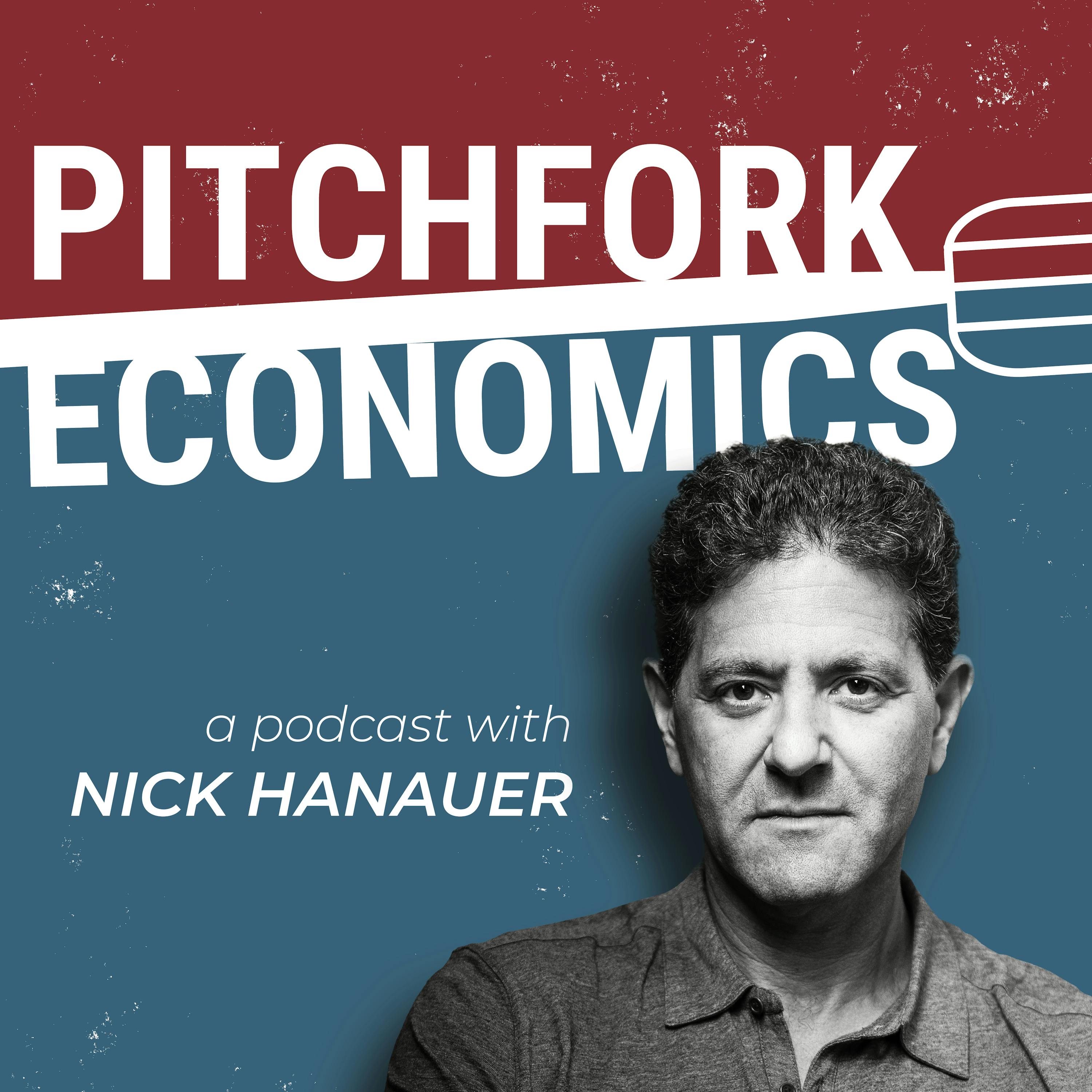
Pitchfork Economics with Nick Hanauer
Civic Ventures
We are living through a paradigm shift from trickle-down neoliberalism to middle-out economics — a new understanding of who gets what and why. Join zillionaire class-traitor Nick Hanauer and some of the world’s leading economic and political thinkers as they explore the latest thinking on how the economy actually works.
Episodes
Mentioned books

May 26, 2020 • 33min
Why Wall Street gets a bailout and you don’t (with Matt Stoller)
Why are rich corporations getting more stimulus money from the government, and getting it faster, than small businesses and individuals? Matt Stoller returns to the show to explain how recovery funds are distributed: Money isn’t neutral, and how money travels matters. Matt Stoller is the author of BIG, a newsletter about monopoly and finance, and the Director of Research at the American Economic Liberties Project. His recent book, ‘Goliath: The 100-Year War Between Monopoly Power and Democracy’, examines how concentrated financial power and consumerism transformed American politics.Twitter: @matthewstollerFurther reading: Subscribe to BIG: https://mattstoller.substack.com/welcomeThe Cantillon Effect: Why Wall Street gets a bailout and you don’t: https://mattstoller.substack.com/p/the-cantillon-effect-why-wall-street Congress “CARES” for Wealthy with COVID-19 Tax Policy Provisions: https://itep.org/congress-cares-for-wealthy-with-covid-19-tax-policy-provisions/The Relief Package Ushers in Trump’s Planned Economy: https://www.wired.com/story/the-relief-package-ushers-in-trumps-planned-economy/End Shareholder Primacy Once and For All: http://bostonreview.net/class-inequality/lenore-palladino-end-shareholder-primacy-once-and-allWe All Have a Stake in the Stock Market, Right? Guess Again: https://www.nytimes.com/2018/02/08/business/economy/stocks-economy.htmlWebsite: http://pitchforkeconomics.com/Twitter: @PitchforkEconInstagram: @pitchforkeconomicsNick’s twitter: @NickHanauer
May 19, 2020 • 41min
Why the market fails in a crisis (with Joseph Stiglitz)
One of the central theories of classical economics is that markets respond quickly and efficiently to changes in demand. But the pandemic clearly demonstrates that the markets aren’t the efficient adapters that classic economists believe them to be. Nobel laureate economist Joseph Stiglitz explains why the tendency to believe in the market is one of the most deeply rooted trickle-down myths, and why government intervention is the best way forward through this economic downturn. Joseph Stiglitz is a Nobel laureate economist and a professor at Columbia University. He is also the co-chair of the High-Level Expert Group on the Measurement of Economic Performance and Social Progress at the OECD, and the Chief Economist of the Roosevelt Institute. In 2011, Stiglitz was named by Time magazine as one of the 100 most influential people in the world. Known for his pioneering work on asymmetric information, Stiglitz focuses on income distribution, risk, corporate governance, public policy, macroeconomics, and globalization. His most recent book, People, Power, and Profits, was just released in paperback. Twitter: @JosephEStiglitzFurther reading: People, Power, and Profits: Progressive Capitalism for an Age of Discontent: https://www.indiebound.org/book/9781324004219Four Priorities for Pandemic Relief Efforts: https://rooseveltinstitute.org/four-priorities-for-covid19-pandemic-relief-efforts/Why Our Affluent Society Is Facing Shortages in the Face of the Coronavirus Pandemic: https://time.com/5811505/affluent-society-shortages-coronavirus-pandemic/Deficit Lessons for the Pandemic From the 2008 Crisis: https://prospect.org/economy/deficit-lessons-pandemic-2008-crisis/How the Economy Will Look After the Coronavirus Pandemic: https://foreignpolicy.com/2020/04/15/how-the-economy-will-look-after-the-coronavirus-pandemic/Top economist: US coronavirus response is like ‘third world’ country: https://www.theguardian.com/business/2020/apr/22/top-economist-us-coronavirus-response-like-third-world-country-joseph-stiglitz-donald-trumpWebsite: http://pitchforkeconomics.com/Twitter: @PitchforkEconInstagram: @pitchforkeconomicsNick’s twitter: @NickHanauer
May 15, 2020 • 22min
Author Interview: Inside the Secret War on Voting with Thom Hartmann
Paul is joined this week by radio host Thom Hartmann to introduce Thom’s most recent book, ‘The Hidden History of the War on Voting: Who Stole Your Vote and How to Get It Back’. In this poignant interview, Thom explains the strategies and tactics that elites have long employed to disenfranchise American citizens and suppress votes. Thom Hartmann is a progressive national and internationally syndicated talk show host. Talkers magazine named him America's most important progressive host and has named his show one of the top ten talk radio shows in the country every year for over a decade. A four-time recipient of the Project Censored Award, Hartmann is also a New York Times bestselling author of twenty-six books, translated into multiple languages. Twitter: @Thom_HartmannFurther reading: The Hidden History of the War on Voting: https://www.indiebound.org/book/9781523087785?aff=penguinrandomWebsite: http://pitchforkeconomics.com/Twitter: @PitchforkEconInstagram: @pitchforkeconomicsNick’s twitter: @NickHanauer
May 12, 2020 • 44min
Inequality and coronavirus (with Heather Boushey and Michelle Holder)
The burdens of this pandemic are not borne equally. Economists Heather Boushey and Michelle Holder join the show this week to expose how the coronavirus is exacerbating the already-deep inequalities in our society. Heather Boushey is the President & CEO and co-founder of the Washington Center for Equitable Growth. She is one of the nation’s most influential voices on economic policy and a leading economist who focuses on the intersection between economic inequality, growth, and public policy. Her latest book is Unbound: How Economic Inequality Constricts Our Economy and What We Can Do About It. Twitter: @HBousheyMichelle Holder is an Assistant Professor of Economics at John Jay College, City University of New York. Prior to joining the John Jay faculty, she worked professionally as an economist for over a decade in both the nonprofit and government sectors. Her research focuses on blacks and women in the American labor market, and her economic policy reports have been covered by the New York Times, the Wall Street Journal, the New York Amsterdam News, and El Diario. Her first book African American Men and the Labor Market during the Great Recession was released from Palgrave Macmillan in 2017. Michelle’s educational background includes master’s and doctoral degrees in economics from the New School for Social Research in NYC, and a Bachelor’s degree in economics from Fordham University.Twitter: @mlholder999Further reading: Unbound: https://www.hup.harvard.edu/catalog.php?isbn=9780674919310The coronavirus recession and economic inequality: a roadmap to recovery and long-term structural change: https://equitablegrowth.org/the-coronavirus-recession-and-economic-inequality-a-roadmap-to-recovery-and-long-term-structural-change/The “Double Gap” and the Bottom Line: https://rooseveltinstitute.org/wp-content/uploads/2020/03/RI_DoubleGap_Report_202003.pdfBefore COVID-19, corporate America shortchanged black women $50 billion annually: Why all women should care: https://msmagazine.com/2020/04/07/before-covid-19-corporate-america-shortchanged-black-women-50-billion-annually-why-all-women-should-care/Inequality and poverty were destroying America well before Covid-19: https://www.thenation.com/article/society/inequality-and-poverty-were-destroying-america-well-before-covid-19/Our uniquely American virus: https://prospect.org/coronavirus/our-uniquely-american-virus/Black Americans face alarming rates of coronavirus infection in some states: https://www.nytimes.com/2020/04/07/us/coronavirus-race.htmlThe coronavirus pandemic and the racial wealth gap: https://www.americanprogress.org/issues/race/news/2020/03/19/481962/coronavirus-pandemic-racial-wealth-gap/Website: http://pitchforkeconomics.com/Twitter: @PitchforkEconInstagram: @pitchforkeconomicsNick’s twitter: @NickHanauer
May 5, 2020 • 38min
Austerity will make this recession worse (with Mike Konczal)
When revenues and expenses don’t add up in times of crisis, governments often turn to budget cuts and other austerity measures to balance their accounts. But economists widely agree that the most valuable lesson from the Great Recession is that austerity made the recession worse and slowed down recovery. Mike Konczal joins the show this week to explain why, in a recession, stimulus is particularly powerful and austerity is particularly harmful. Mike Konczal is the Director of Progressive Thought at the Roosevelt Institute, where he works on financial reform, unemployment, inequality, and a progressive vision of the economy. He is a columnist at Vox, a contributor to The Nation, and a contributing editor at Dissent. Twitter: @rortybomb @rooseveltinstFurther reading: A forward-thinking policy response to the coronavirus recession: https://rooseveltinstitute.org/forward-thinking-policy-response-coronavirus-recession/The stimulus plan that we need now: https://www.thenation.com/article/economy/coronavirus-stimulus/With a uniquely fragile economy, stimulus is not enough: https://bostonreview.net/class-inequality-politics/mike-konczal-felicia-wong-uniquely-fragile-economy-stimulus-not-enoughPortugal dared to cast aside austerity. It’s having a major revival: https://www.nytimes.com/2018/07/22/business/portugal-economy-austerity.htmlWorst recovery in postwar era largely explained by cuts in government spending: https://www.epi.org/blog/worst-recovery-in-post-war-era-largely-explained-by-cuts-in-government-spending/What have we learned about austerity since the Great Recession? https://www.americanprogress.org/issues/economy/reports/2014/05/30/90621/what-have-we-learned-about-austerity-since-the-great-recession/The United States is not ready for a recession, but it can be: https://www.americanprogress.org/issues/economy/reports/2019/09/27/475075/united-states-not-ready-recession-can/Austerity is hammering state economies: https://www.americanprogress.org/issues/economy/reports/2012/06/21/11672/austerity-is-hammering-state-economies/Website: http://pitchforkeconomics.com/Twitter: @PitchforkEconInstagram: @pitchforkeconomicsNick’s twitter: @NickHanauer
May 1, 2020 • 27min
Labor regulations in the gaming industry (with Jennifer Hale)
Prolific voice actor Jennifer Hale joins Paul and Stephen to discuss her work in two very different fields: the video game industry, which largely isn't unionized, and the animated film industry, which enjoys strong union protections.Jennifer Hale is a voice actress known for her work in video game series including Baldur’s Gate, Mass Effect, Halo, World of Warcraft, Spider Man, and many more. In 2013, she was recognized by Guinness World Records as the most prolific female video game voice actor. Twitter: @jhaletweetsFurther reading: As video games make billions, the workers behind them say it’s time to unionize: https://www.latimes.com/business/technology/la-fi-tn-video-game-union-movement-20190412-story.htmlGame makers stare down major union drive: https://www.hollywoodreporter.com/news/video-game-makers-stare-down-major-union-drive-1269510Website: http://pitchforkeconomics.com/Twitter: @PitchforkEconInstagram: @pitchforkeconomicsNick’s twitter: @NickHanauer
Apr 28, 2020 • 37min
Leadership failure made the U.S. pandemic worse (with Ronald Klain)
Pathogens are inevitable—but the scale of disaster accompanying this pandemic was not. Ronald Klain, President Obama’s Ebola czar, joins Nick and Goldy to discuss why the extent of economic collapse and deaths we’ve seen from COVID-19 is borne of government unpreparedness and leadership failure, not fate. Ronald Klain is a lawyer who served as the White House Ebola response coordinator for President Obama. He has held a wide variety of legal and policy positions in government, including his service as chief of staff to VPs Biden and Gore, chief of staff to the attorney general, associate counsel to the president, and chief counsel to the Senate Judiciary Committee. He is currently an advisor to the Biden 2020 campaign.Twitter: @RonaldKlainFurther reading: Confronting the Pandemic Threat: https://democracyjournal.org/magazine/40/confronting-the-pandemic-threat/We’re past ‘if’ on the coronavirus. We’re on to ‘how bad will it be?’: https://www.washingtonpost.com/opinions/the-coronavirus-has-landed-in-the-us-heres-how-we-can-reduce-the-risk/2020/01/22/afebe9ee-3d53-11ea-baca-eb7ace0a3455_story.htmlTrump says US has coronavirus ‘completely under control’ as Washington state confirms first case outside of Asia: https://www.independent.co.uk/news/world/americas/trump-coronavirus-china-wuhan-disease-outbreak-airport-screening-travel-a9296926.htmlObama’s ebola czar on what strong federal response looks like: https://www.wired.com/story/ebola-czar-ron-klain-federal-coronavirus-response/The huge cost of waiting to contain the pandemic: https://www.nytimes.com/2020/04/14/opinion/covid-social-distancing.htmlWebsite: http://pitchforkeconomics.com/Twitter: @PitchforkEconInstagram: @pitchforkeconomicsNick’s twitter: @NickHanauer
Apr 21, 2020 • 36min
What’s happening in professional sports right now? (A curiosity break with Andrew Brandt)
What does the future of American sports look like? Okay, okay—we know this is out of our wheelhouse. But this week, we’re examining how the global pandemic has affected one very specific corner of the economy: professional sports leagues. Expert Andrew Brandt lays out the scale of losses due to cancellations in an industry that generates $80 billion a year just in direct revenue for North American leagues—plus several hundreds of billions more in indirect revenue for ancillary businesses (like the folks who staff the arenas). Andrew Brandt is Professor of Practice and Executive Director of the Moorad Center for the Study of Sports Law at Villanova Law School. A contributor to ESPN and Sports Illustrated, he is also the host of the ‘Business of Sports’ podcast. Twitter: @AndrewBrandtClips from CBS Evening News, NBC Sports, and ABC News.Further reading:The Coronavirus’s Economic Effect On Sports Could Be Staggering: https://fivethirtyeight.com/features/the-coronaviruss-economic-effect-on-sports-could-be-staggering/Nearly 75% of Americans Wouldn’t Attend Games If No COVID-19 Vaccine Is Developed, Poll Says: https://www.si.com/sports-illustrated/2020/04/09/poll-sports-coronavirus-returnWebsite: http://pitchforkeconomics.com/Twitter: @PitchforkEconInstagram: @pitchforkeconomicsNick’s twitter: @NickHanauer
Apr 17, 2020 • 21min
What’s changed since the 1918 pandemic? (A history lesson with Nancy Bristow)
How does our response to the coronavirus pandemic compare to our response 100 years ago, when what is commonly known as the “Spanish Flu” swept through America? Historian Nancy Bristow helps Annie understand the lessons American society learned from the 1918 influenza epidemic, and what we haven’t yet gotten right. Nancy Bristow is the History Department Chair at the University of Puget Sound, where she teaches twentieth-century American history with an emphasis on race, gender, and social change. She is the author of ‘American Pandemic: The Lost Worlds of the 1918 Influenza Epidemic’. Twitter: @univpugetsound@NancyKBristowFurther reading: American Pandemic on Bookshop.org, an independent site that’s raising money for independent bookstores that are closed during the pandemic: https://bookshop.org/books/american-pandemic-the-lost-worlds-of-the-1918-influenza-epidemic/9780190238551Or on IndieBound: https://www.indiebound.org/book/9780190238551Cities that went all in on social distancing in 1918 emerged stronger for it: https://www.nytimes.com/interactive/2020/04/03/upshot/coronavirus-cities-social-distancing-better-employment.htmlWebsite: http://pitchforkeconomics.com/Twitter: @PitchforkEconInstagram: @pitchforkeconomicsNick’s twitter: @NickHanauer
Apr 14, 2020 • 40min
Understanding the CARES Act (with Heidi Shierholz)
The Coronavirus Aid, Relief, and Economic Security Act (CARES) is big—but not big enough to protect working people. Economist Heidi Shierholz joins the show to explain where CARES falls short, and to recommend the safeguards we need to include in future bailout packages.Heidi Shierholz is a Senior Economist and Director of Policy at the Economic Policy Institute. Her team monitors wage and employment policies coming out of Congress and the administration, and advances a worker-first policy agenda. Twitter: @hshierholz@EconomicPolicy(News clip from FOX 17 VXMI)Further reading: Despite some good provisions, the CARES Act has glaring flaws and falls short of fully protecting workers during the coronavirus crisis: https://www.epi.org/blog/despite-some-good-provisions-the-cares-act-has-glaring-flaws-and-falls-short-of-fully-protecting-workers-during-the-coronavirus-crisis/A widening toll on jobs: ‘This thing is going to come for us all’: https://www.nytimes.com/2020/04/02/business/economy/coronavirus-unemployment-claims.htmlDoes the stimulus package pass the test? https://civicskunk.works/does-the-stimulus-package-pass-the-test-a070bf4922dc3.5 million workers likely lost their employer-provided health insurance in the past two weeks: https://www.epi.org/blog/3-5-million-workers-likely-lost-their-employer-provided-health-insurance-in-the-past-two-weeks/Nearly 20 million workers will likely be laid off or furloughed by July: https://www.epi.org/blog/nearly-20-million-jobs-lost-by-july-due-to-the-coronavirus/The CARES Act’s aid to state and local governments isn’t enough to shield vital public services from the coronavirus shock: https://www.epi.org/blog/the-cares-acts-aid-to-state-and-local-governments-isnt-enough-to-shield-vital-public-services-from-the-coronavirus-shock-lessons-from-the-great-recession-tell-us-why/States get billions in record stimulus - but say it’s not enough: https://www.politico.com/states/new-york/albany/story/2020/03/26/states-get-billions-in-record-stimulus-but-say-its-not-enough-1269230Here are safeguards needed in bailout packages to protect working people and fight corporate greed: https://www.epi.org/blog/any-industry-bailout-package-must-include-meaningful-protections-for-working-people-and-guardrails-against-corporate-greed/A portrait of disaster: https://www.epi.org/press/a-portrait-of-disaster-initial-ui-claims-jump-from-211000-to-6-6-million-in-three-weeks/Policymakers twice missed the chance to avert widespread job loss, now they should act to avoid more layoffs: https://www.epi.org/blog/policymakers-twice-missed-the-chance-to-avert-widespread-job-loss-now-they-should-act-to-avoid-more-layoffs/Congress “CARES” for wealthy with COVID-19 tax policy provisions: https://itep.org/congress-cares-for-wealthy-with-covid-19-tax-policy-provisions/Website: http://pitchforkeconomics.com/Twitter: @PitchforkEconInstagram: @pitchforkeconomicsNick’s twitter: @NickHanauer

