

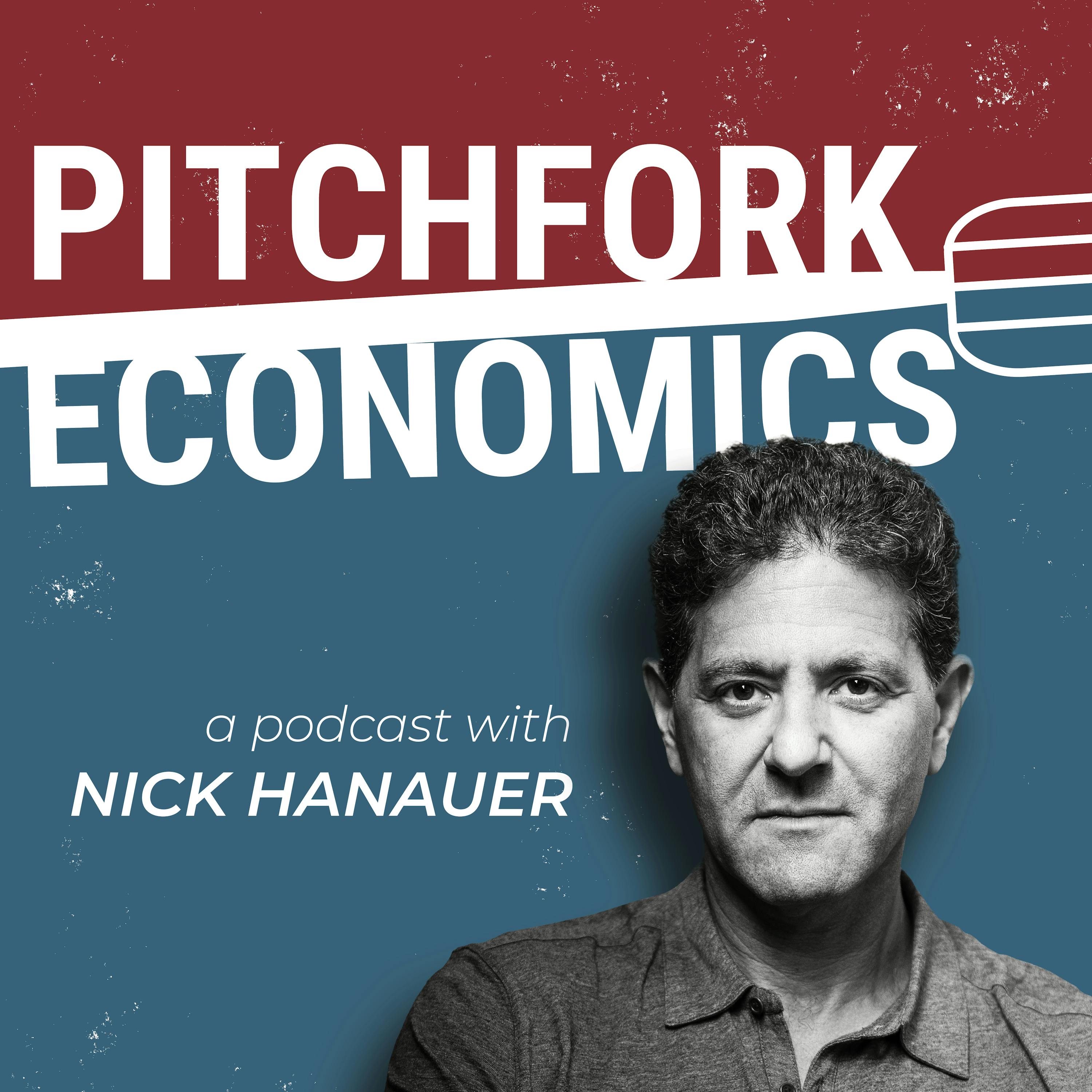
Pitchfork Economics with Nick Hanauer
Civic Ventures
We are living through a paradigm shift from trickle-down neoliberalism to middle-out economics — a new understanding of who gets what and why. Join zillionaire class-traitor Nick Hanauer and some of the world’s leading economic and political thinkers as they explore the latest thinking on how the economy actually works.
Episodes
Mentioned books

Jul 20, 2021 • 41min
Fiscal policy can help save the environment (with Sarah Bloom Raskin)
Can we create transformative climate outcomes by adopting new regulatory strategies? Financial regulation expert Sarah Bloom Raskin helps us explore what levers exist to steer fiscal and monetary policy toward lasting sustainability. Sarah Bloom Raskin is the former Deputy Secretary of the U.S. Department of the Treasury and a former Governor of the Federal Reserve Board. She served as the Commissioner of Financial Regulation for the State of Maryland from 2007 to 2010. She is currently a visiting professor and distinguished fellow at Duke Law School’s Global Financial Markets Center, and a member of President Biden’s Regenerative Crisis Response Committee, which recommends changes in fiscal, monetary, and financial regulatory policies that are likely to enable the U.S. to achieve net carbon neutrality before 2050. Twitter: @SBloomRaskinLearn more about the Regenerative Crisis Response Committee here: https://regenerativecrisisresponsecommittee.org/ Does environmental regulation kill or create jobs? https://policyintegrity.org/files/media/Jobs_and_Regulation_Factsheet.pdf Do regulations really kill jobs? https://www.theatlantic.com/business/archive/2017/01/regulations-jobs/513563/Website: http://pitchforkeconomics.com/Twitter: @PitchforkEconInstagram: @pitchforkeconomicsNick’s twitter: @NickHanauer
Jul 13, 2021 • 23min
Why billionaires are paying no taxes (LIVE from CAP)
Our friends at the Center for American Progress put on a great virtual event last week with Senator Sherrod Brown, discussing how the U.S. tax codes favors the wealthy and the tools Congress plans to use to rebalance the tax system. Twitter: @amprogYou can watch video of the event here: https://www.americanprogress.org/events/2021/06/21/500822/billionaires-paying-no-taxes/The Secret IRS Files: Trove of Never-Before-Seen Records Reveal How the Wealthiest Avoid Income Tax: https://www.propublica.org/article/the-secret-irs-files-trove-of-never-before-seen-records-reveal-how-the-wealthiest-avoid-income-tax Website: http://pitchforkeconomics.com/Twitter: @PitchforkEconInstagram: @pitchforkeconomicsNick’s twitter: @NickHanauer
Jul 6, 2021 • 32min
We all do better when we all do better (with JP Julien)
Contrary to fears that economic inclusion must come at the expense of economic growth, global management consulting firm McKinsey & Company's research and empirical evidence supports the idea that economic growth is at its best when it is most inclusive – but that equity needs to be embedded in systems from the start in order to be effective. What does ‘inclusion’ mean in the context of an economy that works for everyone? McKinsey's JP Julien explains how policymakers and companies can ensure that economic growth goes hand-in-hand with – and is enhanced by – reducing inequality.JP Julien is an Associate Partner at McKinsey & Company, where he serves US federal, state, and city governments on inclusive economic-development topics and supports private-, public-, and social-sector organizations in advancing racial equity. He is a leader of the McKinsey Institute for Black Economic Mobility, a global economic think tank focused on inclusive economic development and racial equity topics. Twitter: @McKinseyThe case for inclusive growth: https://www.mckinsey.com/industries/public-and-social-sector/our-insights/the-case-for-inclusive-growth Website: http://pitchforkeconomics.com/Twitter: @PitchforkEconInstagram: @pitchforkeconomicsNick’s twitter: @NickHanauer
Jun 29, 2021 • 28min
Summer Reading List!
It’s Nick and Goldy’s summer reading list! We want to know what you’re reading, too. Let us know on Instagram: @pitchforkeconomics. Remember to shop local and small when you can, or order from IndieBound or Bookshop.org—both of which support independent bookstores! All of these books are also likely available at your library. Every book mentioned in this episode: The WEIRDest People in the World: How the West Became Psychologically Peculiar and Particularly Prosperous by Joseph Henrich Escape from Rome: The Failure of Empire and the Road to Prosperity by Walter ScheidelThe Tyranny of Merit: What’s Become of the Common Good? by Michael J. SandelSuccess and Luck: Good Fortune and the Myth of Merit by Robert H. FrankThe Black Swan and Fooled by Randomness by Nassim Nicholas TalebDemocracy, Race, and Justice: The Speeches and Writings of Sadie T. M. Alexander by Nina Banks Why Buddhism is True by Robert WrightCaste by Isabel WilkersonHis Truth Is Marching On: John Lewis and the Power of Hope by Jon Meacham The Sum of Us: What Racism Costs Everyone and How We Can Prosper Together by Heather McGhee1491 by Charles C. MannNature’s God: The Heretical Origins of the American Republic by Matthew StewartThe Second World War by Winston Churchill Lafayette in the Somewhat United States by Sarah Vowell Debt by David Graeber Website: http://pitchforkeconomics.com/Twitter: @PitchforkEconInstagram: @pitchforkeconomicsNick’s twitter: @NickHanauer
Jun 22, 2021 • 38min
Post-pandemic booms (with Callum Williams)
Callum Williams from The Economist predicts what we can expect from the economy in the coming months based on past periods of massive non-financial disruption, including past pandemics and major world wars. Callum Williams is a senior economics writer at The Economist.Twitter: @econcallumWhat history tells you about post-pandemic booms: https://www.economist.com/finance-and-economics/2021/04/29/what-history-tells-you-about-post-pandemic-booms Website: http://pitchforkeconomics.com/Twitter: @PitchforkEconInstagram: @pitchforkeconomicsNick’s twitter: @NickHanauer
Jun 15, 2021 • 33min
Chipotle CEO Brian Niccol is a trickle-down clown
You probably saw the news that Chipotle is raising its menu prices by 4 percent, and that leadership is blaming the price increase on the fact that they had to raise their starting pay to $15 per hour. It’s not at all surprising to see a large employer like Chipotle blame rising wages for everything, but what was disappointing was the media’s willingness to repeat Chipotle’s story without looking deeper into the numbers: namely, none of the stories covering the price increases mentioned that Chipotle gave its CEO a $24 million raise last year, and that the company is in the middle of enacting a $153 million stock buyback program to enrich a handful of shareholders. Around here, that type of trick will land you the title of Trickle-Down Clown! This week Goldy has a few choice words to say about Chipotle’s behavior, and then we thought it would be a good time to revisit our stock buybacks episode with Senator Cory Booker for an explanation of the pervasiveness and dangers of the practice.Website: http://pitchforkeconomics.com/Twitter: @PitchforkEconInstagram: @pitchforkeconomicsNick’s twitter: @NickHanauer
Jun 9, 2021 • 38min
Inequality is bad for everyone (with Djaffar Shalchi)
We’re back to our favorite topic this week—TAX THE RICH! Beyond all the benefits that come from a well-funded social safety net, taxing the wealthy would lessen inequality, which would make most people—including the extravagantly wealthy—happier. Super-rich Danish entrepreneur Djaffar Shalchi shares the wisdom that Denmark understands: Inequality is bad for everyone. Djaffar Shalchi is an entrepreneur from Denmark and founder of Millionaires for Humanity, a network of wealthy people who advocate for raising taxes on wealthy people. He is also the founder and Executive Director of Move Humanity, a global initiative to mobilize at least one percent of the wealth of the world’s super-rich for the UN’s Sustainable Development Goals. Twitter: @djaffarshalchiOPINION: I’m a millionaire who wants to be taxed to pay for COVID-19: https://news.trust.org/item/20210329080742-gpnj6/ The American dream is now in Denmark: https://the.ink/p/the-american-dream-is-now-in-denmark Dear Mr. Deutsch: Come to “F***ing Denmark.”: https://medium.com/@humanact/dear-donny-deutsch-come-to-f-ing-denmark-ea6995bb684d Biden will seek tax increase on rich to fund child care and education: https://www.nytimes.com/2021/04/22/business/economy/biden-taxes.html Website: http://pitchforkeconomics.com/Twitter: @PitchforkEconInstagram: @pitchforkeconomicsNick’s twitter: @NickHanauer
Jun 1, 2021 • 38min
How U.S. policy was designed to suppress wages (with Larry Mishel and Josh Bivens)
Radical and rising economic inequality is no secret — and now, thanks to new research from the Economic Policy Institute, neither is its price tag nor its cause. There’s never been a study quite like this — one which places specific, real dollar amounts on every trickle-down policy American politicians have embraced. The study’s authors, Larry Mishel and Josh Bivens, explain how their work reveals that the massive upward redistribution of income our nation has suffered these past four decades can largely be attributed to policies intentionally designed to suppress the wages of American workers. Lawrence Mishel is a distinguished fellow at EPI after serving as president from 2002-2017. In the more than three decades he has been with EPI, Mishel has helped build it into the nation’s premier research organization focused on U.S. living standards and labor markets. Twitter: @LarryMishelJosh Bivens is the director of research at EPI. His areas of research include macroeconomics, fiscal and monetary policy, the economics of globalization, social insurance, and public investment. Twitter: @joshbivens_DCMiddle-class pay lost pace. Is Washington to blame? https://www.nytimes.com/2021/05/13/business/economy/middle-class-pay.html Identifying the policy levers generating wage suppression and wage inequality: https://www.epi.org/unequalpower/publications/wage-suppression-inequality/ Website: http://pitchforkeconomics.com/Twitter: @PitchforkEconInstagram: @pitchforkeconomicsNick’s twitter: @NickHanauer
May 25, 2021 • 31min
It’s not a labor shortage, it’s a wage shortage (with Heidi Shierholz)
You have no doubt seen the scary headlines warning of a “labor shortage” caused by the additional pandemic unemployment insurance payments. The coverage of this story is widespread, even though most economics reporters can find no credible evidence linking unemployment checks to a labor shortage. EPI economist Heidi Shierholz joins us to explain why UI and stimulus payments aren’t causing a “labor shortage”, and why the answer to this made-up problem is so clear: it’s the low wages, stupid. Heidi Shierholz is the Senior Economist and Director of Policy at the Economic Policy Institute. Twitter: @hshierholzShow us some love by leaving a rating or a review! RateThisPodcast.com/pitchforkeconomics Unemployment benefits are not creating a worker shortage: https://www.huffpost.com/entry/worker-shortage-unemployment-benefits_n_609056c3e4b09cce6c21a850 Is unemployment insurance behind the fast-food labor shortage? https://prospect.org/labor/is-unemployment-insurance-behind-fast-food-labor-shortage/ Restaurant labor shortages show little sign of going economywide: https://www.epi.org/blog/restaurant-labor-shortages-show-little-sign-of-going-economywide-policymakers-must-not-rein-in-stimulus-or-unemployment-benefits/ U.S. Labor Shortage? Unlikely. Here’s why: https://policydialogue.org/opinions/worker-shortages/ It’s not a ‘labor shortage’. It’s a great reassessment of work in America: https://www.washingtonpost.com/business/2021/05/07/jobs-report-labor-shortage-analysis/ The Myth of Labor Shortages: https://www.nytimes.com/2021/05/20/briefing/labor-shortages-covid-wages.html Website: http://pitchforkeconomics.com/Twitter: @PitchforkEconInstagram: @pitchforkeconomicsNick’s twitter: @NickHanauer
May 18, 2021 • 43min
Your non-compete clause is probably illegal (with WA Attorney General Bob Ferguson)
Non-compete clauses, and the lesser-known no-poach agreements between franchises, are shockingly common for low-wage workers. Although these contracts were originally intended to protect trade secrets among high-level executives, they have spiralled into an unfair labor practice that keeps wages low, limits employee mobility, and decreases competition. Washington state Attorney General Bob Ferguson explains how non-competes and no-poach agreements violate the law in many states, what his team did to get hundreds of huge employers across the country to cease and desist, and why you should tell your state’s Attorney General if you know of any low- or middle-income workers who are being forced into signing these agreements. Bob Ferguson is Washington State’s 18th Attorney General. As the state’s chief legal officer, Bob is committed to protecting the people of Washington against powerful interests that don’t play by the rules. Twitter: @BobFergusonAGShow us some love by leaving a rating or a review! RateThisPodcast.com/pitchforkeconomics Why aren’t paychecks growing? A burger-joint clause offers a clue: https://www.nytimes.com/2017/09/27/business/pay-growth-fast-food-hiring.htmlWorkers in Washington state win big under new non-compete law: https://www.emeryreddy.com/2019/09/workers-in-washington-state-win-big-under-new-non-compete-law/ Attorney General Bob Ferguson stops King County coffee shop’s practice requiring baristas to sign unfair non-compete agreements: https://www.atg.wa.gov/news/news-releases/attorney-general-bob-ferguson-stops-king-county-coffee-shop-s-practice-requiring AG Report: Ferguson’s initiative ends no-poach practices nationally at 237 corporate franchise chains: https://www.atg.wa.gov/news/news-releases/ag-report-ferguson-s-initiative-ends-no-poach-practices-nationally-237-corporate Website: http://pitchforkeconomics.com/Twitter: @PitchforkEconInstagram: @pitchforkeconomicsNick’s twitter: @NickHanauer

