

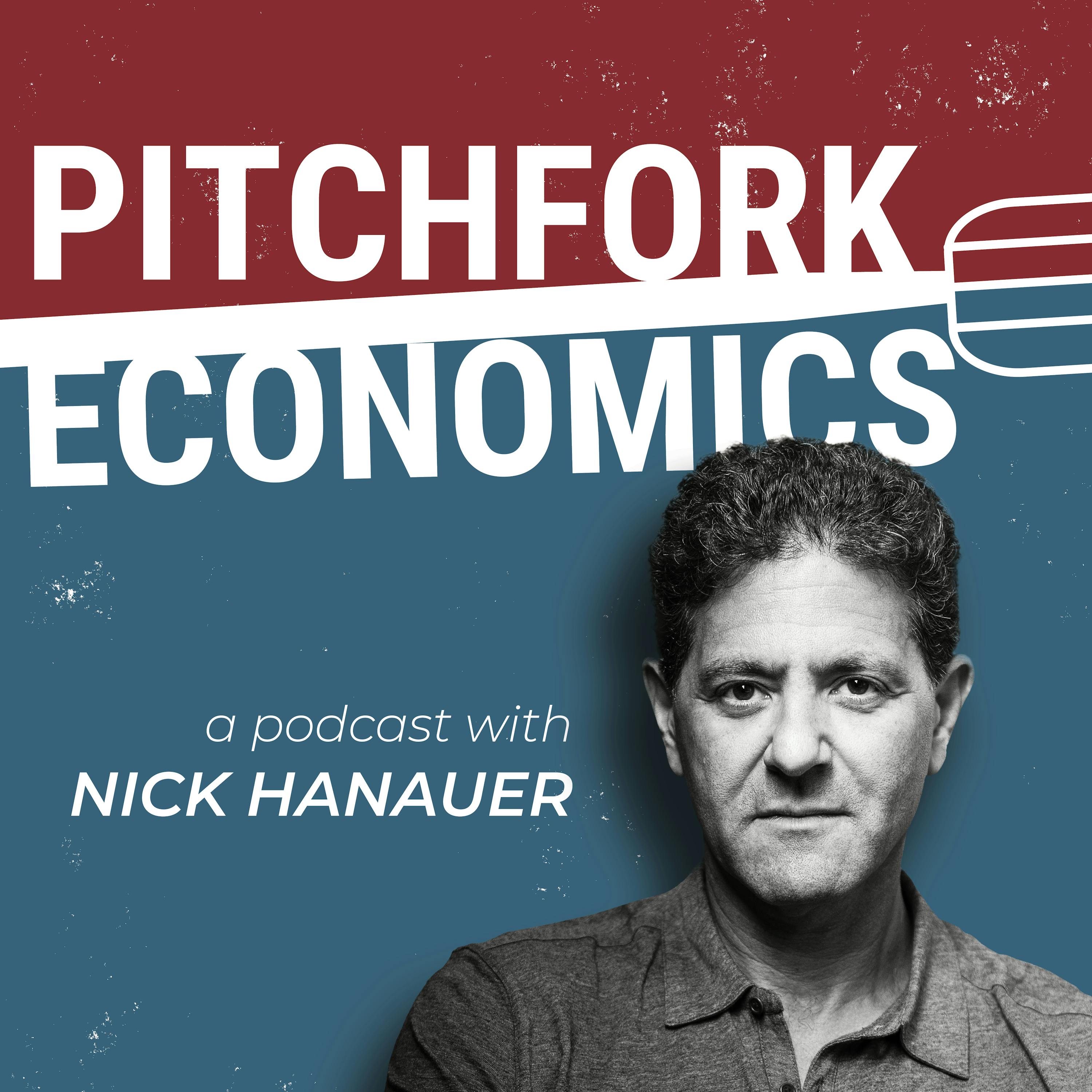
Pitchfork Economics with Nick Hanauer
Civic Ventures
We are living through a paradigm shift from trickle-down neoliberalism to middle-out economics — a new understanding of who gets what and why. Join zillionaire class-traitor Nick Hanauer and some of the world’s leading economic and political thinkers as they explore the latest thinking on how the economy actually works.
Episodes
Mentioned books

Jan 25, 2022 • 36min
Why privatizing public goods is bad for democracy (with Donald Cohen)
Even in the middle of a pandemic, trickle-down politicians still love to claim that the free market is the best way to resolve human problems and that the government can't be trusted to serve the public good. But when we privatize public health, utilities, and other shared necessities, we hand over control of those public goods—the things that we all need and that we need everyone to have— to for-profit entities that don’t answer to the public. Donald Cohen, an expert on privatization, shares examples and talks about the consequences of privatization in America.Donald Cohen is the founder and executive director of In The Public Interest, a national resource and policy center on privatization and responsible contracting. He's also co-author of the new book The Privatization of Everything: How the Plunder of Public Goods Transformed America and How We Can Fight Back.Twitter: @donaldrcohen12The Privatization of Everything: https://bookshop.org/books/the-privatization-of-everything-how-the-plunder-of-public-goods-transformed-america-and-how-we-can-fight-back/9781620976531 Why Privatization is Worse Than You Know: https://publicseminar.org/2022/01/why-privatization-is-worse-than-you-know/Opinion: The pandemic proved that privatization can’t provide enough public goods—like vaccines, education, justice, and a sustainable planet: https://www.marketwatch.com/story/the-pandemic-proved-that-privatization-cant-provide-enough-public-goodslike-vaccines-education-justice-and-a-sustainable-planet-11640027547 The Privatization of Everything: How the Plunder of Public Goods Transformed America and How We Can Fight Back: https://nextbigideaclub.com/magazine/privatization-everything-plunder-public-goods-transformed-america-can-fight-back-bookbite/31594/ A Conversation With Donald Cohen, Author of ‘The Privatization of Everything’: https://capitalandmain.com/a-conversation-with-donald-cohen-author-of-the-privatization-of-everything Website: http://pitchforkeconomics.comTwitter: @PitchforkEconInstagram: @pitchforkeconomicsNick’s Twitter: @NickHanauer
Jan 18, 2022 • 31min
Ending the tipped minimum wage (with Saru Jayaraman)
In most states, tipped workers are not subject to the minimum wage. Why? Because it’s legal to pay tipped workers a subminimum wage as low as the federal minimum of $2.13 per hour. As long as any worker in the country can be paid less than the minimum wage, the minimum wage is meaningless. Saru Jayaraman, a leader in the national fight for one fair wage, lays out the path forward. Saru Jayaraman is the President of One Fair Wage, an organization that fights to raise wages and working conditions for all tipped and service workers She is also the Director of the UC Berkeley Food Labor Research Center and the author of One Fair Wage: Ending Subminimum Pay in America. Twitter: @SaruJayaramanNew Year to bring higher minimum wages in record number of states and cities: https://www.cbsnews.com/news/higher-minimum-wages-2022-in-record-number-of-states/?utm_source=newsletter&utm_medium=email&utm_campaign=newsletter_axiospm&stream=top Arkansas waitress fired after $4,400 tip shows why tipping at restaurants has to stop: https://www.nbcnews.com/think/opinion/arkansas-waitress-fired-after-4-400-tip-shows-why-tipping-ncna1286076 When the minimum wage isn’t enough: https://commonwealthmagazine.org/economy/when-the-minimum-wage-isnt-enough/ Seven facts about tipped workers and the tipped minimum wage: https://www.epi.org/blog/seven-facts-about-tipped-workers-and-the-tipped-minimum-wage/ Website: http://pitchforkeconomics.com/Twitter: @PitchforkEconInstagram: @pitchforkeconomicsNick’s twitter: @NickHanauer
Jan 11, 2022 • 41min
Did the Federal Reserve’s policies make inequality worse? (with Christopher Leonard)
When the Federal Reserve makes money, where does it go? Turns out, the Fed’s hands are tied—it can’t do anything other than assume that the new money will trickle down into the hands of ordinary Americans through Wall Street’s coffers. And according to journalist Christopher Leonard, that’s put the United States’ economic stability at risk and accelerated income inequality. Christopher Leonard is a business reporter and executive director of the Watchdog Writers Group at the University of Missouri School of Journalism. He is the author of Kochland: The Secret History of the Koch Industries and Corporate Power in America. His new book is The Lords of Easy Money: How the Federal Reserve Broke the American Economy. Twitter: @CLeonardNewsThe Lords of Easy Money: https://bookshop.org/books/the-lords-of-easy-money-how-the-federal-reserve-broke-the-american-economy/9781982166632 How Nov. 2, 2010 Made the Rich So Much Richer: https://time.com/6112931/federal-reserve-wealth-inequality-recession/ The Fed’s Doomsday Prophet Has a Dire Warning About Where We’re Headed: https://www.politico.com/news/magazine/2021/12/28/inflation-interest-rates-thomas-hoenig-federal-reserve-526177 Website: http://pitchforkeconomics.com/Twitter: @PitchforkEconInstagram: @pitchforkeconomicsNick’s twitter: @NickHanauer
Jan 4, 2022 • 38min
How the radical right weaponized ideology (with Nancy MacLean)
If it seems to you like the ultimate goal of the most extreme conservatives is to undermine democracy and cripple democratic institutions—well, according to historian Nancy MacLean, you’re right. This week, MacLean unpacks the meteoric rise in popularity of the radical right’s ideas, and offers a way forward for progressives, based on lessons from successful social movements throughout American history. This episode was originally released in July 2020.Nancy MacLean is an award-winning scholar of the twentieth-century U.S. and the William H. Chafe Distinguished Professor of History and Public Policy at Duke University. Her book, Democracy in Chains: The Deep History of the Radical Right’s Stealth Plan for America, was a New York Times bestseller and finalist for the National Book Award, and The Nation magazine named it the “Most Valuable Book” of the year.Twitter: @NancyMacLean5Democracy in Chains: https://www.indiebound.org/book/9781101980965Website: http://pitchforkeconomics.com/Twitter: @PitchforkEconInstagram: @pitchforkeconomicsNick’s twitter: @NickHanauer
Dec 28, 2021 • 34min
How opportunity zones create windfalls for the uber-rich (with David Wessel)
The 2017 Tax Cuts & Jobs Act included a little-known provision establishing something called opportunity zones. The plan, which was lauded as a way to direct investments into under-developed communities in the U.S., created 8,764 tax havens that were almost immediately exploited by the wealthy to gobble up capital gains tax breaks. Pulitzer Prize-winning journalist David Wessel explains how opportunity zones came to be, who is profiting off of them, and why it’s so difficult to tweak the tax code without creating windfalls for the rich. David Wessel is a senior fellow in Economic Studies at Brookings and director of the Hutchins Center on Fiscal and Monetary Policy. He is the author of two New York Times bestsellers: “In Fed We Trust: Ben Bernanke’s War on the Great Panic” (2009) and “Red Ink: Inside the High Stakes Politics of the Federal Budget” (2012). His most recent book is “Only the Rich Can Play: How Washington Works in the New Gilded Age” (2021). He has shared two Pulitzer Prizes, one in 1984 for a Boston Globe series on the persistence of racism in Boston and the other in 2003 for Wall Street Journal stories on corporate scandals.Twitter: @davidmwesselThe Rich Have Found Another Way to Pay Less Tax: https://www.nytimes.com/2021/10/10/opinion/opportunity-zones-tax-loopholes.html?referringSource=articleShareOnly the Rich Can Play: https://bookshop.org/books/only-the-rich-can-play-how-washington-works-in-the-new-gilded-age/9781541757196Website: http://pitchforkeconomics.com/Twitter: @PitchforkEconInstagram: @pitchforkeconomicsNick’s twitter: @NickHanauer
Dec 21, 2021 • 38min
Are you in the 9.9 percent? (with Matthew Stewart)
In the U.S., inequality is often framed as the 99% versus the wealthiest 1%. But that’s not quite the right matchup. While the bottom 90% has done dramatically worse over the last several decades and the top 0.1% has done dramatically better, the 9.9% in between those groups still controls more than half of the wealth in the United States. Author and philosopher Matthew Stewart thinks that the 9.9% are not innocent bystanders, and he joins Nick and Goldy to discuss how this group is entrenching inequality and warping our culture. Matthew Stewart is an author and philosopher. He is the author, among other books, of Nature’s God and The 9.9 Percent. The 9.9 Percent: https://bookshop.org/books/the-9-9-percent-the-new-aristocracy-that-is-entrenching-inequality-and-warping-our-culture/9781982114183 The 9.9 percent is the new American aristocracy: https://www.theatlantic.com/magazine/archive/2018/06/the-birth-of-a-new-american-aristocracy/559130/ Who are the 9.9% A closer look at the math of American inequality: https://lithub.com/who-are-the-9-9-percent-a-closer-look-at-the-math-of-american-inequality/Website: http://pitchforkeconomics.com/Twitter: @PitchforkEconInstagram: @pitchforkeconomicsNick’s twitter: @NickHanauer
Dec 14, 2021 • 28min
Moving beyond racial liberalism (with Kyle Strickland)
How can we center the role of race in our economic policy and in our politics in a way that will drive real change? Kyle Strickland, the deputy director of race and democracy at the Roosevelt Institute, explains how our leaders have fallen under the sway of racial liberalism, which focuses solely on disavowing personal bigotry and overt discrimination. In order to realize true racial and economic justice, he argues we should move beyond racial liberalism and toward a greater understanding of the systemic injustices built into our political and economic systems.Kyle Strickland is the Deputy Director of Race and Democracy at the Roosevelt Institute. He is also the Senior Legal Analyst at the Kirwan Institute for the Study of Race & Ethnicity and the Director of My Brother’s Keeper Ohio. Twitter: @kstrickland_A New Paradigm for Justice and Democracy: https://rooseveltinstitute.org/wp-content/uploads/2021/11/RI_A-New-Paradigm-for-Justice-and-Democracy_Report_202111-1.pdf Website: http://pitchforkeconomics.com/Twitter: @PitchforkEconInstagram: @pitchforkeconomicsNick’s twitter: @NickHanauer
Dec 7, 2021 • 57min
The hidden costs of banking while poor (with Mehrsa Baradaran and Cate Blackford)
The average family earning $25,000 a year in the U.S. spends about $2,400 on financial transactions. Whether it’s the astronomical interest rates of a payday loan or the costs that come with being unbanked, the extractive practices of the financial services industry are effectively keeping the poor in poverty. Lawyer and author Mehrsa Baradaran and economic mobility expert Cate Blackford join Nick and Steph this week to explain why banking while poor is so expensive, and what states can do to rein in the people who profit from it. This episode was originally released in February 2020.Mehrsa Baradaran is a professor of law at UC Irvine. She writes about banking law, financial inclusion, inequality, and the racial wealth gap. Her scholarship includes the books How the Other Half Banks and The Color of Money: Black Banks and the Racial Wealth Gap. Twitter: @MehrsaBaradaranCate Blackford was the Director of Outreach and Donor Development at the Bell Policy Center when we recorded this episode, but she is now the Public Policy Director at Maine People’s Alliance. She was the Co-Chair of the 2018 Proposition 111 campaign in CO to limit the interest lenders could charge on payday loans and eliminate fees from payday lending products, which passed with 75% of the vote. Twitter: @catetiller Further reading: Capitol One to end overdraft penalties as CFPB takes aim at ‘exploitative junk fees’: https://www.washingtonpost.com/business/2021/12/01/capital-one-overdraft-fees/ How the Other Half Banks: https://www.hup.harvard.edu/catalog.php?isbn=9780674983960The Color of Money: https://www.hup.harvard.edu/catalog.php?isbn=9780674237476If the U.S. Government Treated Poor People as Well as It Treats Banks: https://www.theatlantic.com/business/archive/2015/10/if-the-us-government-treated-poor-people-as-well-as-it-treats-banks/410614/CO’s Prop 111 explained: https://coloradosun.com/2018/10/22/proposition-111-colorado-2018-explained/Briefed by the Bell - Predatory Economy: https://www.bellpolicy.org/2018/09/10/predatory-economy/How Do Payday Loans Work? https://www.incharge.org/debt-relief/how-payday-loans-work/Website: http://pitchforkeconomics.com/Twitter: @PitchforkEconInstagram: @pitchforkeconomicsNick’s twitter: @NickHanauer
Nov 30, 2021 • 36min
Make the clean stuff cheap (with Eric Beinhocker & Doyne Farmer)
Until very recently, the prevailing wisdom cautioned that transitioning to a clean energy economy would be extremely expensive, and therefore only possible if undertaken slowly. New research upends that thinking—when it comes to going green, the faster we go, the cheaper it will be. University of Oxford professors Eric Beinhocker and Doyne Farmer talk with Nick about a new strategy for clean technology that could transform the climate fight. Eric Beinhocker is a Professor of Public Policy Practice at the Blavatnik School of Government and the Executive Director of the Institute for New Economic Thinking at the University of Oxford’s Martin School. He is also a Supernumerary Fellow in Economics at Oriel College, and External Professor at the Santa Fe Institute. Twitter: @EricBeinhockerDoyne Farmer is Director of the Complexity Economics program at the Institute for New Economic Thinking. He is Baillie Gifford Professor in the Mathematical Institute at the University of Oxford and an External Professor at the Santa Fe Institute. Website: http://www.doynefarmer.com/Going big and fast on renewables could save trillions in energy costs: https://www.washingtonpost.com/business/energy/going-big-and-fast-on-renewables-would-save-trillions-in-energy-costs/A new strategy for climate: make the clean stuff cheap - https://democracyjournal.org/arguments/a-new-strategy-for-climate-make-the-clean-stuff-cheap/ Website: http://pitchforkeconomics.com/Twitter: @PitchforkEconInstagram: @pitchforkeconomicsNick’s twitter: @NickHanauer
Nov 23, 2021 • 34min
Why can’t we talk about homelessness? (with Josephine Ensign)
The number of unhoused Americans is at a historically high rate right now. This podcast is produced in Seattle, a city with the third highest homeless population in the U.S. Though many Seattleites identify as progressive, we can’t reach a consensus on how to help our most vulnerable populations—or even find agreement on the root causes of the housing crisis. Why are perspectives on homelessness, and possible solutions to it, so polarized? Josephine Ensign, a University of Washington nurse and health care provider for people experiencing homelessness, shares some of her insights from her career on the frontlines of this crisis. Josephine Ensign is a professor in the School of Nursing and an adjunct professor in the Department of Gender, Women & Sexuality Studies at the University of Washington. Her most recent book is Skid Road: On the Frontier of Health and Homelessness in an American City. Twitter: @josephineensignSkid Road: https://bookshop.org/books/skid-road-on-the-frontier-of-health-and-homelessness-in-an-american-city/9781421440132 Homelessness Rises Faster Where Rent Exceeds a Third of Income: https://www.zillow.com/research/homelessness-rent-affordability-22247/WA Department of Commerce: http://www.commerce.wa.gov/wp-content/uploads/2017/01/hau-why-homelessness-increase-2017.pdf Website: http://pitchforkeconomics.com/Twitter: @PitchforkEconInstagram: @pitchforkeconomicsNick’s twitter: @NickHanauer

