

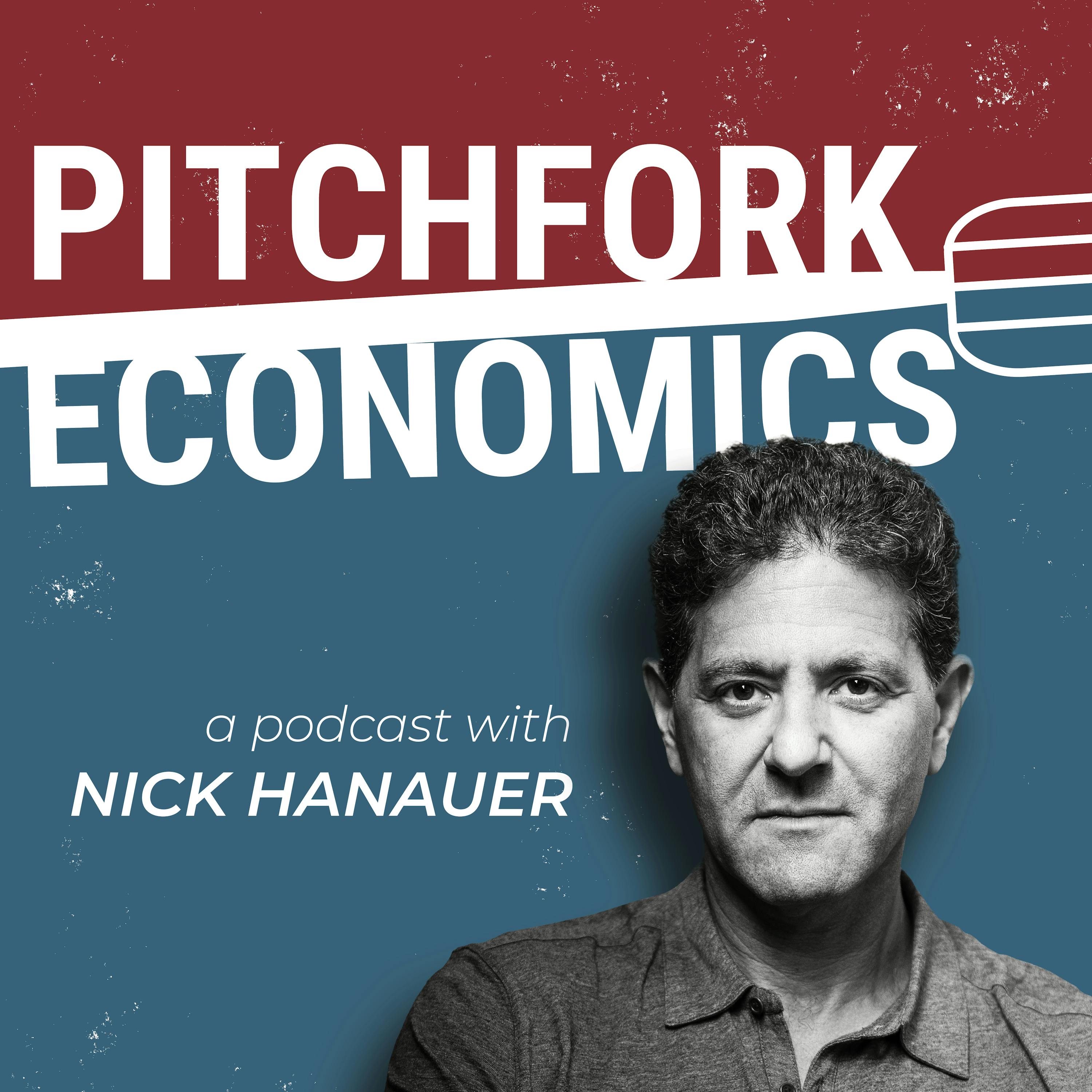
Pitchfork Economics with Nick Hanauer
Civic Ventures
We are living through a paradigm shift from trickle-down neoliberalism to middle-out economics — a new understanding of who gets what and why. Join zillionaire class-traitor Nick Hanauer and some of the world’s leading economic and political thinkers as they explore the latest thinking on how the economy actually works.
Episodes
Mentioned books

7 snips
Feb 27, 2024 • 41min
A Tale of Two Tax Systems (with David Cay Johnston)
While the average American worker is subject to a progressive income tax system where tax rates increase as income rises, the wealthy often exploit a range of loopholes and deductions that significantly reduce their tax burden—sometimes to the point where the biggest corporations and one-percenters pay nothing at all. David Cay Johnston, a tax policy expert and former investigative journalist for the New York Times, joins us today to help unravel the complexity of the American tax system, which has functionally created two different tax systems: One for the wealthy and powerful and one for everyone else.David Cay Johnston is an award-winning investigative journalist and author known for his expertise in tax policy and economic inequality. Johnston worked as a tax reporter for The New York Times for over a decade. At the Times, he won the Pulitzer Prize for Beat Reporting in 2001 for his coverage of tax loopholes and corporate tax evasion. Throughout his career, Johnston has authored several critically acclaimed books, including "Perfectly Legal: The Covert Campaign to Rig Our Tax System to Benefit the Super Rich—and Cheat Everybody Else" and “Divided: The Perils of Our Growing Inequality.” Twitter: @DavidCayJThe Whiteness of Wealth: How the Tax System Impoverishes Black Americans--and How We Can Fix It by Dorothy Brownhttps://bookshop.org/a/101360/9780525577331 More from David Cay Johnston: “Alvin Bragg’s roadmap to convict Donald Trump”https://www.nydailynews.com/2023/01/08/alvin-braggs-roadmap-to-convict-donald-trump/Perfectly Legal: The Covert Campaign to Rig Our Tax System to Benefit the Super Rich--and Cheat Everybody Elsehttps://bookshop.org/a/101360/9781591840695 Free Lunch: How the Wealthiest Americans Enrich Themselves at Government Expense (and Stick You with the Bill)https://bookshop.org/a/101360/9781591842484 Divided: The Perils of Our Growing Inequalityhttps://bookshop.org/a/101360/9781595589231 Website: http://pitchforkeconomics.comTwitter: @PitchforkEconInstagram: @pitchforkeconomicsNick’s twitter: @NickHanauer
Feb 20, 2024 • 56min
Why Flying Is Miserable And How to Fix It (with Ganesh Sitaraman)
Ganesh Sitaraman joins us today to discuss his new book, Why Flying Is Miserable And How to Fix It. Air travel has become an increasingly frustrating experience, with countless horror stories of cancellations, delays, lost baggage, cramped seats, and poor service. For most of the 20th century flying was luxurious and fun, so it’s especially baffling that air travel is plagued by these problems in the 21st century. Sitaraman delves into the reasons behind this dismal state of affairs, tracing it back to a deliberate choice made by elected leaders in the 1970s to roll back regulations, supposedly in order to increase competition and improve the experience of flying for everyone. After enduring half a century of turbulence caused by deregulation, people are fed up with the state of air travel, and Sitaraman gives us some insight into how we can begin to fix it.Ganesh Sitaraman is a law professor and the director of the Vanderbilt Policy Accelerator for Political Economy and Regulation. He was previously a senior advisor to Senator Elizabeth Warren on her presidential campaign and is a member of the Administrative Conference of the United States and the FAA’s Commercial Space Transportation Advisory Committee. Sitaraman is the author of several influential books, including "The Crisis of the Middle-Class Constitution," "The Public Option: How to Expand Freedom, Increase Opportunity, and Promote Equality," and his most recent book, “Why Flying Is Miserable And How to Fix It.”Twitter: @GaneshSitaramanWhy Flying Is Miserable And How to Fix It https://bookshop.org/a/101360/9798987053584 Book Website https://globalreports.columbia.edu/books/why-flying-is-miserable/More from Ganesh Sitaraman: The Atlantic - Airlines Are Just Banks Now https://www.theatlantic.com/ideas/archive/2023/09/airlines-banks-mileage-programs/675374/The Crisis of the Middle-Class Constitution https://bookshop.org/a/101360/9781101973455Website: http://pitchforkeconomics.comTwitter: @PitchforkEconInstagram: @pitchforkeconomicsNick’s twitter: @NickHanauer
Feb 13, 2024 • 41min
The Future of Bidenomics (with Jared Bernstein)
President Biden’s economic policies mark a paradigm shift away from the trickle-down economics that have held sway over Washington DC for the past 40 years. Bidenomics recognizes that a strong and inclusive economy grows from the middle class outwards, centering working Americans and their families rather than relying on a top-down approach that benefits the wealthy first and foremost. In this episode, President Biden’s chief economic advisor, Jared Bernstein, joins us to unpack the key ideas behind this middleout understanding of how the economy really works, and to explain how Bidenomics is reshaping the economy to truly work for all Americans—not just a wealthy few at the top. After helping to engineer a best-in-the-world economic recovery from the pandemic, Bernstein explains what's next for Bidenomics and the American economy.Jared Bernstein is a prominent economist and author who is widely recognized for his expertise in labor economics and income inequality. As the chair of the United States Council of Economic Advisers, he serves as President Biden’s top economic adviser. From 2009 to 2011. From 2009 to 2011, he served as Chief Economist and Economic Advisor to then-Vice President Biden. Bernstein is a prolific writer and commentator whose work emphasizes the importance of addressing income inequality and promoting policies that benefit working families and the broader economy.Twitter: @econjared46Website: http://pitchforkeconomics.comTwitter: @PitchforkEconInstagram: @pitchforkeconomicsNick’s twitter: @NickHanauer
Feb 6, 2024 • 42min
Making a case for the inheritance tax (with David Stasavage)
Over the next two decades, $30 trillion of wealth is expected to be transferred from Baby Boomers to their heirs. Journalists and financial experts have been referring to this event as the “Great Wealth Transfer,” and it's important that we understand the policies that make such a monumental transferral of generational wealth possible—not to mention the tremendous economic and societal implications of this unprecedented economic activity. In this episode, we have the privilege of speaking with David Stasavage, a renowned expert in taxation, inequality, and political economy, to help us unpack the origins and rationale behind the creation of the inheritance tax, and to explore the policies we can use to lessen economic inequality and put some of the Great Wealth Transfer to work for all Americans—not just the children of the wealthy few.David Stasavage is a prominent political scientist known for his expertise in taxation, inequality, and political economy. He is currently the Julius Silver Professor of Politics at New York University and a Fellow at the Center for Advanced Study in the Behavioral Sciences at Stanford University. He has conducted extensive research on taxation, particularly on the taxation of the wealthy and the role of inheritance taxes in addressing income inequality. His collaboration with Kenneth Scheve on inheritance taxes has shed light on public opinion and the potential effectiveness of these taxes in promoting economic fairness. He’s also the author of several books, including "States of Credit: Size, Power, and the Development of European Polities,” "Taxing the Rich: A History of Fiscal Fairness in the United States and Europe,” and “The Decline and Rise of Democracy.”Twitter: @stasavageDemocracy, War, and Wealth: Lessons from Two Centuries of Inheritance Taxation https://kfscheve.files.wordpress.com/2020/09/schevestasavage_twocenturies_apsr_2012.pdf States of Credit: Size, Power, and the Development of European Polities https://bookshop.org/book/9780691166735 Taxing the Rich: A History of Fiscal Fairness in the United States and Europe https://bookshop.org/book/9780691165455 The Decline and Rise of Democracy https://bookshop.org/book/9780691228976 Website: http://pitchforkeconomics.comTwitter: @PitchforkEconInstagram: @pitchforkeconomicsNick’s twitter: @NickHanauer
Jan 30, 2024 • 38min
How a New Economics Went Mainstream (with Suzanne Kahn)
Suzanne Kahn, Vice President of the Think Tank at the Roosevelt Institute, discusses the shift towards middle-out economics and its potential impact on economic inequality, democracy, and the climate crisis. They also explore the need to address corporate power, the influence of events like the financial collapse and the pandemic on economic thinking, and the emergence of new economic ideas and paradigms.
Jan 23, 2024 • 46min
Revisiting the Child Tax Credit (with Wendy Bach)
A bipartisan group of lawmakers has agreed to expand the Child Tax Credit again, but it will be smaller than the pandemic-era credit was. If this version of the Child Tax Credit is passed by Congress and signed into law, it would benefit 16 million children in low-income families and lift at least half a million kids out of poverty. We thought it would be a good time to revisit this episode from 2021 with professor Wendy Bach, in which she explains everything you need to know about what the Child Tax Credit actually is, why it's a good policy, and how it impacts people's lives. This episode originally aired on August 24, 2021.Wendy Bach is a legal scholar and professor specializing in poverty law, criminal justice, and social welfare policy. She is currently a professor of law at the University of Tennessee College of Law. Bach's work focuses on the intersection of poverty, race, and the criminal justice system, with a particular emphasis on the rights and experiences of low-income individuals. She is the author of the book Prosecuting Poverty, Criminalizing Care. She is a nationally recognized expert on poverty law and criminal justice issues. Twitter: @wendyabachCongress is close to expanding the child tax credit again − with a smaller boost for families this time https://theconversation.com/congress-is-close-to-expanding-the-child-tax-credit-again-with-a-smaller-boost-for-families-this-time-221382#What’s in the New Child Tax Credit Proposal https://newrepublic.com/article/178131/bipartisan-expanded-child-tax-creditProsecuting Poverty, Criminalizing Care https://bookshop.org/p/books/prosecuting-poverty-criminalizing-care-wendy-a-bach/18739149?ean=9781108465533Biden’s child tax credit is a step away from a discriminatory system https://qz.com/2034199/how-does-the-us-child-tax-credit-workTwo-thirds of people now receive monthly benefit checks https://www.peoplespolicyproject.org/2021/07/19/two-thirds-of-people-now-receive-monthly-benefit-checksThe time tax https://www.theatlantic.com/politics/archive/2021/07/how-government-learned-waste-your-time-tax/619568Website: http://pitchforkeconomics.comTwitter: @PitchforkEconInstagram: @pitchforkeconomicsNick’s twitter: @NickHanauer
Jan 16, 2024 • 45min
Medicare Drug Price Negotiations with (Margarida Jorge)
The pharmaceutical industry is one of the most opaque industries in America, and they take advantage of this lack of transparency by setting ever-higher prices for lifesaving prescription drugs like insulin. But provisions in the Inflation Reduction Act are curtailing the exorbitant price-gouging strategies that the pharmaceutical industry uses to pump up their profit margins at the expense of seniors and people with disabilities who use Medicare. This week, we’re talking to Margarida Jorge, the Executive Director of Health Care for America Now, to help us understand more about drug pricing and the impact that drug price negotiations will have on Medicare and its recipients. We apologize for the background noise you hear during this episode. We strive to provide you with the best possible audio quality, but sometimes external factors (like construction nearby) are beyond our control.Margarida Jorge is the Executive Director of Health Care for America Now. She has been a prominent advocate for affordable and accessible healthcare for three decades, and she was the chief architect of the 47-state field program that helped win the Affordable Care Act under President Obama. Margarida has played a key role in shaping healthcare policy and has been instrumental in shaping policy discussions, advocating for reforms that prioritize the needs of patients over the profits of pharmaceutical companies, lowering drug prices, and ensuring access to life-saving medications for all. Twitter: @MargaridaJorg17Health Care for America Now: https://www.healthcareforamericanow.orgLower Drug Prices Now: https://www.lowerdrugpricesnow.orgExplaining the Prescription Drug Provisions in the Inflation Reduction Act: https://www.kff.org/medicare/issue-brief/explaining-the-prescription-drug-provisions-in-the-inflation-reduction-act/#bullet01Big Drug Companies Are in Court to Stop Medicare Negotiation and Protect Their Sky-High Profits: https://www.protectourcare.org/big-drug-companies-are-in-court-to-stop-medicare-negotiation-and-protect-their-sky-high-profitsHow Prices for the First 10 Drugs Up for U.S. Medicare Price Negotiations Compare Internationally: https://www.commonwealthfund.org/publications/2024/jan/how-prices-first-10-drugs-medicare-negotiations-compare-internationallyDrug Companies Continue To Hike Prices Above Inflation: https://www.americanprogress.org/article/drug-companies-continue-to-hike-prices-above-inflation U.S. Prescription Drug Prices Are 2.56 Times Those in Other Countries: https://www.rand.org/pubs/research_reports/RR2956.html Website: http://pitchforkeconomics.comTwitter: @PitchforkEconInstagram: @pitchforkeconomicsNick’s twitter: @NickHanauer
Jan 9, 2024 • 35min
Three Economic Issues that Could Shape the 2024 Elections
National elections are won and lost on the economy. Of course they are: the state of the economy affects individuals' job security, income levels, access to healthcare, education, and overall quality of life, so it's not surprising that voters evaluate candidates based on their proposed economic policies and their ability to address pressing economic challenges. As we kick off a big year for elections and the economy, we take time in this episode to discuss the three most important economic issues that could shape the 2024 elections, especially at the presidential level. These are big challenges our country currently faces, and big challenges ought to be met with big transformative ideas that will improve people’s lives and grow the economy from the middle out. Subscribe to Civic Ventures President Zach Silk’s Substack, The Pitch: civicventures.substack.comDig into the biggest economic stories by visiting the Civic Ventures YouTube channel Who Gets What and Why: youtube.com/@WGWAWWebsite: http://pitchforkeconomics.comTwitter: @PitchforkEconInstagram: @pitchforkeconomicsNick’s twitter: @NickHanauer
Jan 2, 2024 • 21min
Seizing the Middle Out Moment
When Pitchfork Economics was started, our ideas about economic cause and effect were way outside the economic mainstream, and so much has changed in the last ten years. The economic world is shifting its thinking away from neoclassical ideas, and the primary middle-out economics messenger driving this paradigm shift is in the Oval Office. In this episode, Nick and Goldy explain how the podcast will sharpen our focus on how best to build the economy from the middle out. They’ll also distinguish the difference between Middle-Out Economics and Bidenomics and how Bidenomics is a departure from the trickle-down economics of Reaganism. Website: http://pitchforkeconomics.comTwitter: @PitchforkEconInstagram: @pitchforkeconomicsNick’s twitter: @NickHanauer
Dec 26, 2023 • 26min
Middle-Out Wins
2023 was a big year for middle-out policy and research, so we are recapping some of the biggest middle-out moments that are improving people's lives and helping us close the book on America’s neoliberal era. Today, Civic Ventures writer Paul Constant joins Goldy to help recap the biggest middle-out successes of 2023 that have benefited workers, and are changing the way people think about economic cause and effect. This episode shines a light on policies, movements, labor actions/strikes, groundbreaking reports, and research that have made a real difference in people's lives and is changing the way economists and policymakers think about and manage economic policy.Voicemail: 731-388-9334Email: pitch@pitchforkeconomics.comBidenomics is Real Economics https://time.com/6343967/bidenomics-is-real-economicsThe Transformation at the Heart of Biden’s Middle-Out Economic Agenda https://prospect.org/economy/2023-02-09-biden-middle-out-agendaMinimum Wage Effects and Monopsony Explanations https://justinwiltshire.com/minimum-wage-effects-and-monopsony-explanationsWebsite: http://pitchforkeconomics.comTwitter: @PitchforkEconInstagram: @pitchforkeconomicsNick’s twitter: @NickHanauer

