

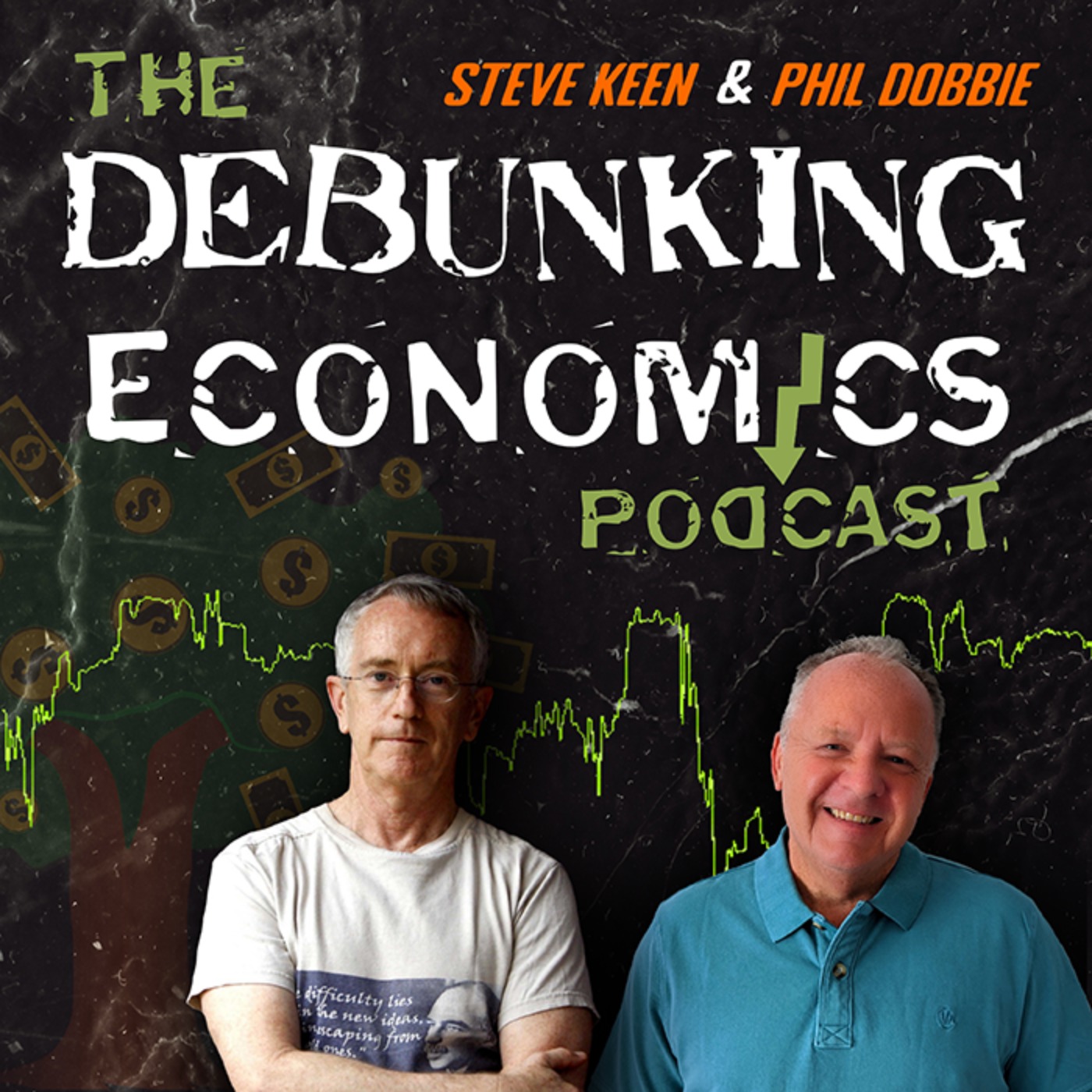
Debunking Economics - the podcast
Steve Keen & Phil Dobbie
Economist Steve Keen talks to Phil Dobbie about the failings of the neoclassical economics and how it reflects on society. Hosted on Acast. See acast.com/privacy for more information.
Episodes
Mentioned books

Mar 30, 2017 • 18min
Do poor people make the rich richer?
Karl Marx argued that the bourgeoisie got rich by creaming their wealth off the proletariat who did all the work. But in this podcast Prof Steve Keen tells Phil Dobbie that it’s not the capitalists who are getting rich from the workers – it’s the often ignored “third class” of citizen, who make up a large part of the wealthiest people on the planet. And they’ve been increasing their influence over recently decades. Hosted on Acast. See acast.com/privacy for more information.
Mar 27, 2017 • 15min
Does misinformation feed capitalism?
Traders buy and sell based, often, on hearsay. Mum and dad investors can take a punt based on advice from ‘experts’ or from the lies they see in a company prospectus. Whatever the level of investor, you always base decisions on imperfect information. Like with anything, the person doing the selling knows more about the state of the product than the one doing the buying. So, what if we had more information? Phil Dobbie asks Professor Steve Keen what would happen if the information imbalance didn’t exist. Could we avoid market crashes, for example? Can financial markets survive without cashed up gamblers? Hosted on Acast. See acast.com/privacy for more information.
Mar 21, 2017 • 24min
Government debt, when does it become a problem?
In the seventies US government debt was less than 40 percent of GDP. Now, it’s over 100 percent. And the US is still to pass a change to the debt ceiling, which inhibits the government’s ability to spend more money. In this edition of the Debunking Economics podcast, Phil Dobbie asks Professor Steve Keen when government debt becomes a significant issue. Conventional economics suggests too much spending can raise inflation, which reduces the attractiveness of government bonds, making it more difficult to raise money. And what about a reduction in a country’s credit rating? Steve suggests we think in too linear fashion on the issue. But there is a simple fix if the problem ever gets insurmountable. Hosted on Acast. See acast.com/privacy for more information.
Mar 17, 2017 • 14min
Which creates growth – supply or demand?
Which comes first, demand or supply? If you want to grow an economy should you offer money or tax cuts to increase demand, or should you fund jobs to create supply and wages. Donald Trump, like many politicians before him, believes cutting taxes will make more spending power available to create more jobs. Is he right, when many classical economists have argued the opposite – that job creation is the key to spending power. It’s the timeless chicken and egg question except, in this case, Prof Steve Keen believes there’s a very clear answer. Hosted on Acast. See acast.com/privacy for more information.
Mar 7, 2017 • 22min
Is Trump right about currency manipulation?
In this edition of the Debunking Economics podcast we test Donald Trump’s accusations that China, Japan and Germany are manipulating their currencies – something he hates, of course, because it makes it harder for him to achieve his aim, of returning the US to a positive balance of trade. It’s a big undertaking. Is he right that these countries have an unfair advantage over the US and, if so, will a tariff barrier really rectify the problem, or just start a trade war? Hosted on Acast. See acast.com/privacy for more information.
Mar 2, 2017 • 16min
Is Trump right about an import tariff?
Donald Trump has talked about a 20 percent tax on exports from Mexico to help pay for the wall, but has also spoken about a broader tax on all imports. Many fear it’s a form of protectionism that could spark a trade war, but perhaps they are misunderstanding the intent of Trump’s plan. It’s possible he is following the thinking of Oxford professor Michael Devereux who argues that corporate tax should be applied where consumption happens, rather than where profit is generated. That would mean, irrespective of where goods are made, if they are consumed in America, companies would be taxed. Companies that tried to manufacture elsewhere and sell to the US could end up being taxed in both countries, so it heightens the incentive to produce locally. Hosted on Acast. See acast.com/privacy for more information.
Feb 27, 2017 • 33min
Where QE is failing – time for a people’s QE
The Bank of England, like many central banks, has used Quantitative Easing as a tool to try and engender growth in the economy. It’s a tool they had to resort to when sustained low interest rates failed to achieve the desired outcome. In this podcast Phil Dobbie talks to Steve Keen about how QE is, why it’s failing and how to should be redesigned. Hopefully the Bank of England will listen, along with the Treasury. In fact, the UK’s Treasury Committee is running an inquiry into the Effectiveness and Impact of post-2008 UK Monetary Policy and we discuss Steve’s submission in the podcast. Hosted on Acast. See acast.com/privacy for more information.
Feb 20, 2017 • 25min
Is your money safe in the bank. Or is it time to buy gold?
You’ve probably seen them – emails telling you now is the time to buy gold. When currencies collapse, gold is the safe-haven that speculators turn to. In this episode, Phil Dobbie explores the idea of stocking up with gold, with Professor Steve Keen. Is gold safer than keeping money in a bank? Is it premature to buy gold right now? What are the signs that an economic downturn and banking crisis is occurring? But buying gold isn’t the answer – reducing your level of debt is. Hosted on Acast. See acast.com/privacy for more information.
Feb 17, 2017 • 22min
Do Banks Really Work for Us?
It’s very easy to look at the big salaries in the city and compare it to the average wage and assume bankers are taking us for a ride. But, for time immemorial we have needed money as a more effective means of trade than bartering. Who wants a chicken egg in exchange for today’s paper? So, banks emerged as the intermediary that enables trade. But, as Prof Steve Keen explains to Phil Dobbie, banks don’t just act as an intermediary, they also create money, and focus on encouraging us all to build up debt. So, can we regulate banks to ensure they work in ways which are best for the community? Part of the answer, says Steve, is to see them focus more on equity than loans. Hosted on Acast. See acast.com/privacy for more information.
Feb 7, 2017 • 21min
How does the government choose to spend?
Phil Dobbie asks Professor Steve Keen about the role of public sector spending. We’ve learnt that the government can create money, through its central bank, and this is, in effect, pumping new money into the economy. The alternate approaches, tax increases or austerity, pull money out of the economy. So public sector spending is a good thing, particularly when the economy is experiencing hardship – but how do they determine what’s best to spend money on. Aren’t government’s notoriously bad at decided how and where to inject funds? Isn’t there a need to focus on productivity rather than pushing up wages? Hosted on Acast. See acast.com/privacy for more information.

