

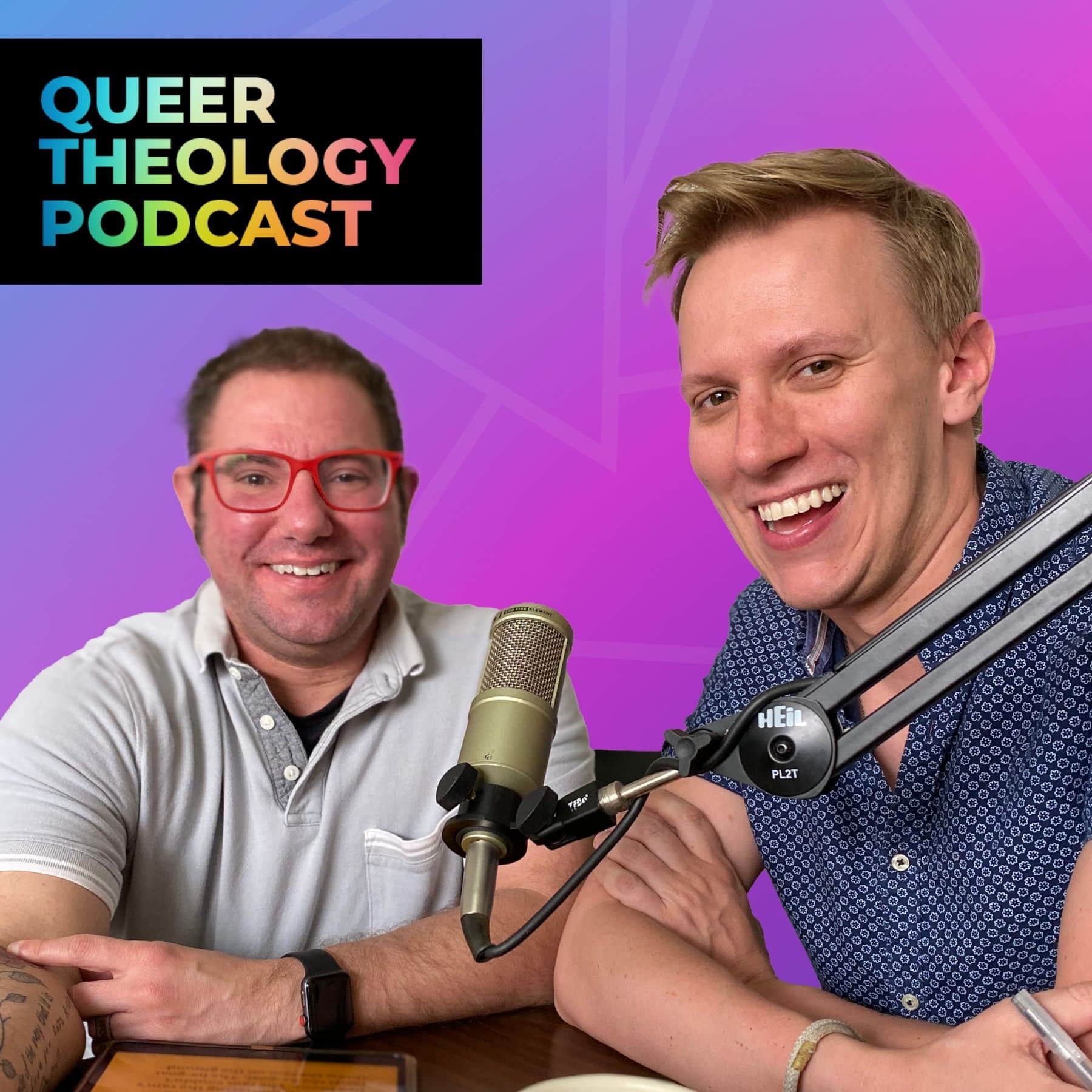
Queer Theology
Queer Theology / Brian G. Murphy & Shannon T.L. Kearns
The longest running podcast for and by LGBTQ Christians and other queer people of faith and spiritual seeker. Hosted by Fr. Shannon TL Kearns, a transgender Christian priest and Brian G. Murphy, a bisexual polyamorous Jew. and now in its 10th year, the Queer Theology Podcast shares deep insights and practical tools for building a thriving spiritual life on your own terms. Explore the archives for a queer perspective on hundreds of Bible passages as well as dozens of interviews with respected LGBTQ leaders (and a few cis, straight folks too). Join tens of thousands of listeners from around the world for the Bible, every week, queered.
Episodes
Mentioned books

Feb 9, 2020 • 29min
Sex & Love with Sarah – 1 Corinthians 13:4-8
This episode is special because we talk to Sarah, one of our Sanctuary Collective members. We talk about what it was like for her growing up with regard to sex and relationships. We also queer a text that Sarah picked from the Bible!
In this week’s text, we take a look at a word from 1 Corinthians. We talk about how the text is beautifully used to describe a kind of love that goes beyond sexual orientation and religious affiliation. Join us as we queer this week’s text!
Episode Transcript
Brian: Welcome to the Queer Theology podcast!
Fr. Shay: Where each episode, we take a queer look at the week’s lectionary readings. We’re the co-founders of QueerTheology.com and the hosts for this podcast. I’m Father Shay Kearns
B: And I’m Brian G. Murphy.
FS: Hello, hello! Welcome back to the Queer Theology podcast. We are excited to be back with you today. We’ve got a really special podcast coming up today, so we’re stoked about that. But first, Brian, what’s been going on in your world and life?
B: I just went to Disneyland. My good friend, whom we dated for many years and now we’re just friends – whatever just friends is. He is a Disney nerd and we have annual passes to Disneyland because it’s only $20 a month that you go once. So there’s a new Star Wars ride that just opened, so me, and Matt, and our friend Molly all went down to Anaheim. We got up at the crack of dawn because the way that they do it is that you have to be in the park at the time that it officially opens, at 8:00 AM. Then everyone frantically goes on the app on their phone to try and get a boarding group, and then that’s the digital queue for the ride. So I woke up at 5:00 AM and Matt picked me up at 6:00 AM and we drove to Anaheim and we got in the park with 10 minutes to spare. And then it’s just how fast is your cellphone and how fast are your fingers. So we got on the ride, we didn’t end up getting on until 4:00 PM, we just did all the stuff in the park and we went to the new cantina there. I got this drink that had this foam that made my mouth numb, which was wild. Then the ride was the most amazing ride I’ve ever been in my entire life. I won’t give any spoilers because it’s just incredible. It was so cool! Then we went immediately home and I fell asleep. What about you Shay?
FS: Yeah, I feel like in Minnesota, the winter — it’s hibernation mode and so I’m taking a lot of time to read books and write some things and relax. I’ve been reading this memoir about Sister Rosetta Tharpe who is this phenomenal and pretty unknown – she was a gospel singer. Started out as a gospel singer from the Pentecostal tradition, but did some cross-over work with blues. She played the electric guitar, she’s really phenomenal, and really was a groundbreaker. Some people call her the founder of rock ‘n roll. She was doing it before anyone else. It turns out that she had relationships with both men and women throughout her life. It’s been really fascinating to learn more about her, learn more about this unknown person who should be really well known. Who is just a phenomenal musician. There’s a great video on YouTube of her playing on a train platform, playing her electric guitar and singing with a group choir backing her. From the early ’60s, late ’50s that’s just wild!
B: That’s bonkers!
FS: Go check out. I think it’s the song, Up Above My Head. She’s just phenomenal, so I’ve been enjoying that and looking forward to reading some more books and chilling. Oh and I just joined the YMCA, so I’m super excited to start going and swimming. ‘Coz I got to do some swimming while I was out in LA with Brian and I just loved it. So I was like, “Oh! I’m gonna do this. I think this will be good self-care in Minnesota in winter, to get in a pool and swim.”
B: So today we have a special guest on our podcast, Sarah who was a member of Sanctuary Collective and first came into our orbit through Christianity and Polyamory course last year. Not dissimilar from the Faithful Sexuality course that we’re getting ready to do now, but also not quite the same but lots of overlaps. So we have an interview with her coming up, but before we dive in just a reminder that this podcast is brought to you by over 125 supporters on Patreon.
FS: If you enjoy this show and want to support it, you can do that for as little as $2/month at patreon.com/queertheology. Learn more about why we need your support and check out the perks at patreon.com/queertheology. Okay, on to the show!
B: Hey there, Sarah thank you so much for joining us today!
Sarah: No problem! I’m happy to be here.
B: So can you just tell us a little bit about your faith journey in, and not your whole life story, but what brought you to this point where you are today?
S: Sure, so I grew up in a relatively conservative Southern church in the Disciples of Christ umbrella in West Virginia. I was never really satisfied with the conservative theology of it was taught to me. It was a lot of just: this is what the Bible says, so this is what we believe; questions are okay as long as they’re the right kind of questions. So then when I went to college, I still was in West Virginia I moved from South to North, and I started taking religious studies courses because it allowed me to ask questions I’d never been allowed to ask before. That just bloomed into this love of literary, criticism of the Bible, as well as questioning my faith and how those two can tie together instead of push against each other. So then when I got out of college and out of my post-graduate work, I did a religious internship in Ohio, moved to Ohio, and then I was looking to do church work. I was interested in going to seminary, which I just started. In my looking for resources for a class that I was doing on sex, and gender, and the Bible. I stumbled upon Queer Theology, the website, and it was just right before the class was gearing up. So I just happened to hit it at the perfect moment, I think.
B: How awesome!
S: Yeah.
B: I can relate to lots of parts of that story, so can you share a little bit about how your faith, and your sexuality, and your sex life where interacting or not interacting?
S: I realized that I was not straight when I went away to college and found out that… I had friends. I was describing my relationship with other women from high school to college friends. They were like, “Sarah, that’s really gay.” I was, “No, no, no. We were just really good friends.” They were like, “Okay! I’m gonna trust your experience, but just know that a lot of that sounds really gay.”
Then I was like, “Oh wait. Maybe I am a queer woman.” Then I explored that in college and because I had such a strong Christian faith, I was, “Well, if I’m queer and I’m a good Christian. And this is what I believe about the Bible. There’s no reason that those can’t exist at the same time.” Then as I started to research, I realized there was a huge debate going on about sexuality and religion that I just completely glossed over because until you are exposed to a new aspect of identity sometimes it’s really easy to do that. Especially if the culture you grew up in isn’t talking about these issues.
So then I definitely was, “Okay, my view of the Bible has always been based on this idea that the ultimate challenge is loving everyone regardless of what they do in their spare time.” So yes I’m a queer woman, but I’m also a Christian. I’m gonna love myself and other queer people the same way because everyone has human value and deserves love. So to me it wasn’t necessarily reconciling those two ideas, that was just very inherent to me. It was more: how do I find the language in the Bible to support my idea? And how do I interpret scripture to get that?
FS: I love what you said about your realization that if you were queer and a good Christian then those two things must be okay. Because I think so many of us have this opposite: we take in everyone else’s ideas first instead of starting with ourselves and saying, “I believe these two things.” I love the fact that you have the confidence in yourself to just be, “Yeah. This is who I am and so these things can’t be opposed.” That’s really beautiful.
S: Aw! Thank you!
B: You mentioned wanting to find ways that you’re like queerness and sexuality could complement your Christian faith. But what was the challenges of having not yet found that? Or sort of the impetuous for wanting to go deeper beyond just it’s okay.
S: As far as who I am as a person, I am a seminarian right now, but my primary career is actually teaching high school Science. So I’m a scientist first, teacher second, and seminarian third. I had already done a lot of work to try and reconcile the ideas that science and religion could co-exist peacefully, but I knew that a lot of times the argument against science was that there was so much in the Bible that didn’t line up with it. So when I started to do my work on my sexuality and presenting it from a Biblical standpoint, I knew that I was going to have to find ways that the passages in the Bible and my sexuality intersected in order to prove that point to people. Just because I already had to do that with being a woman, and a scientist, and also religious. So I think that that’s kind of — I had laid the groundwork doing other, not proving work but just validation work in the past to build on there.
Then it’s just grown because, and you guys know this, but as you get older and as you started to dive into these issues you discover more about yourself. And I realized that not only was I a pansexual woman, but I was also polyamorous. How does that interact with church life? I’ve also realized that I’m demi-romantic and how do I find a healthy, faithful basis for that kind of relationship with the world and the Bible. Yeah!
B: You then got connected with us and we first met you through the Christianity and Polyamory course which is not the same thing as this Faithful Sexuality course that’s coming up, but I think there will be a lot of similar themes like working through negative cultural messages and really just messages and finding ourselves in Scripture. So can you share a bit about what the process of going through that was, and what that unlocked for you?
S: Yeah. So I signed up for that class ‘coz I was very, very new to the idea of Christian Polyamory. I’m in my third polyamorous relationship as we stand, and when I started that course, I was just out of the very first one that I had ever been in. And so I was just seeking knowledge and community that would tie to Christian Polyamory. Like I said, I just happened upon the class and I’m so glad I did just because the community that I found that there have been people that had done it before, people that were trying for the first time, people that had really succeeded and struggled with it, all of those perspectives were just phenomenal. But then there was the extra course work. I’m excited about this new course on the sexuality portion just because we talk about sexual ethics in the Polyamory course and that just blew me away. I’d never had to layout in words what my sexual ethic was, and that helped me realize that the relationship that I had been in had not been the healthiest polyamorous relationship, but it taught me so much about what I wanted going forward. And taught me how to communicate boundaries. Now as a pastor, in the between, between that class and now, I’ve come out to my church as both pansexual, polyamorous. It’s given me the language to help me put up boundaries between what questions they can ask, and what they can’t, and what I’m comfortable with. I don’t know. Just having the resources and language provided as well as that community that I can turn to if I needed to resource mind was just a phenomenal thing.
FS: That’s awesome! I would love to hear if you don’t mind sharing how it’s been coming out to your church? How’s the reaction been?
S: Well, okay I did mention that I’m in Ohio which is not necessarily the most socially-accepting state… [laughter]
B: It’s not San Francisco.
S: So I think that more than anything, people just were overwhelmed by curiosity and they forget that there are questions that you wouldn’t ask your pastor. I had someone ask me the other day if I had sex of all of my partners at once? I had to have a genuine conversation with them about would you ask a straight, male co-pastor this? Or would that be a question you would not ask? That was a realization for them.
It was scary at first, the first time I mentioned it was in a bulletin insert. Just about my history, what was bringing me to ministry at this church, and then it’s just been a bunch of small followup conversations from that. People are ready for it. Our church, in particular, is going through what the disciples call an open and affirming process. Which is basically just this affirmation that LGBTQ folks are not only welcomed in the church but would be included and offered leadership positions. Anyway, so me coming out as a pastor was both just because I want to be comfortable where I’m being a pastor, but also as a way — not to test the waters necessarily, but get the church ready to be, “Ah, yes. These people exist and they’re here already.” It’s been fun and just kind of keeps me on my toes. I haven’t had any horribly negative reactions yet which has been a blessing.
FS: Cool! Thanks for sharing that.
S: Yeah, thank you.
B: Before you signed up for the course, were you nervous about anything in terms of participating in it? If so, what was that?
S: I had a lot of nerves regarding talking to other people about Christian polyamory. Every Christian space I’ve ever been in has been relatively lukewarm to people that are queer in general. And I wasn’t worried about that at the website called Queer Theology [cross talk]
B: For sure!
S: But even when you start to get towards what a lot of people would consider the fringes, polyamory is what I think on the fringe as far as queer group goes. A lot of people are still judgmental about it, and you have a lot of internalized judgment when it comes to it. I’ve encountered that a lot in other Christian spaces. So I was nervous about entering this community and perhaps having to defend myself or my experience. In that space, I was still in that, “What if I’m not actually polyamorous since my first relationship failed?” And I think that a lot of people probably come to that space from that perspective of: “What if I’m not XYZ enough to be a part of your group?”
That was just the very opposite of what I experienced. The first week I was so nervous, but by week four I was so sad that it was almost over. There would be group calls again later, but that it wouldn’t just be this weekly thing in my life. I think the nerves will resolve themselves, but most nervous going through is acceptance in a space, especially Christian spaces are hard for LGBTQ people.
B: Yeah, it’s been a beautiful community. We’ve got folks that are polyamorous like you and I, monogamous, celibate, vanilla, a-sexual, demi-sexual, binary, trans, non-binary, the whole… it’s a beautiful tossed salad of identities. I think what’s beautiful is being able to share the ways in which I’ve found God through my experience with these identities, but also being able to then encounter the divine in other people whose identities and experiences are different than mine. I don’t have to judge them because someone is demi-sexual, or someone is a-sexual, or someone is celibate, and I’m slutting polyamorous. There’s stuff to celebrate in all of our identities and it’s not about prescribing one way that you have to be queer and Christian, asexual and Christian, but it celebrates the diversity of ways to be faithfully sexual.
FS: I think so often in Christian communities, there’s this idea that there’s one way to be faithful and Christian. What I love about being in community at Queer Theology is the way that we’re creating space for people to figure out what it means for them to be faithful. That that can look really different from person to person. I think it’s a beautiful way to say like our spirituality can, and should, and does inform our sexuality and also that that doesn’t have to look just one way.
B: Yeah. And that might change over time.
FS: Absolutely!
B: So what would you say was the highlight for you from your time in the course or one of your most memorable things that we did, or that you learned?
S: I don’t know. There was so many gems from that course that I took away, at the same time, I was also planning that sex and gender in the Bible. Life-study is what we call them. They’re basically just applied Bible studies. I just remember when we were talking at my church about, if communities, the ones that you were describing could exist and be like, “Yes! They do and I’m not going to oust this whole people, but I’m a part of one of those communities where there is this open exception and there’s this fluidity to it, that’s not stifling your theological growth, but bolstering it in a way that’s going to be healthy that you don’t see often in church communities. I wasn’t really struggling. I know a lot of people struggle with, I mentioned this before, but this idea that you can’t be Christian and poly. That was another one of those. Well, I’m poly and I’m a Christian so that’s gotta be wrong.
B: Dumb and done.
S: Yeah. But it was just really validating to hear the breath of experienced people had. So people that have been practicing polyamory for their whole lives up to this point versus people that were already married and exploring polyamory for the first time together. Just hearing my struggles echoed in other people and their solutions to it, helped me be more confident in both my thelogical background and in my own sexuality. So I really think that in classes like this, you learn skills to do that introspective work that will help you in your day to day life. As well as just the community aspect of it too.
B: Cool! Well, thank you for chatting with us a little bit about Christianity, polyamory, and sexuality. You’re gonna stick around for the second half of this podcast and we’re gonna queer the Bible together.
S: Excellent! I’m so excited!
B: Okay, let’s open up our Bibles and queer this text.
Today we are going to take a look at 1 Corinthians 13:4-8. This is a passage that Sarah picked. Sarah, in one quick sentence, can you tell us why you chose this passage?
S: There’s just so much love and equality in it, that I love it.
FS: Awesome! So I’m gonna go ahead and read it for us. This is from the Common English Bible. Again this is 1 Corinthians 13:4-8.
Love is patient, love is kind, it isn’t jealous, it doesn’t brag, it isn’t arrogant, it isn’t rude, it doesn’t seek its own advantage, it isn’t irritable, it doesn’t keep a record of complaints, it isn’t happy with injustice, but it is happy with the truth. Love puts up with all things, trusts in all things, hopes for all things, endures all things.
Love never fails. As for prophecies, they will be brought to an end. As for tongues, they will stop. As for knowledge, it will be brought to an end.
So Sarah, reading this, what comes up for you as we read this and what is this passage inspire in you?
S: I have always loved this passage because at least if you’re taking the text literally if you are just reading it off the page it never specifies what type of love that it’s talking about. So it applies to any type of love in your life. So when I think about it, even if I’m not in a romantic relationship this love is going to apply with how I interact with my best friends, when I interact with my church family, when I interact with even my students to some extent. It’s just this idea that whether you’re prophesying if you’re trying to predict the future, that is not always going to be solid ground. Knowledge won’t always serve you, but you’re always gonna have this idea that love will carry on and that’s what you’re going to be remembered for. It’s kind of like a legacy. So this not only builds how you should interact with the entire world regardless of this hierarchy of love that we’ve established. But it also just talks about how that’s the most important thing.
B: I think because this passage is often used in wedding ceremonies, I can’t help but think of it in that context. So it’s almost… it’s sometimes used as a formula for love between two people who like each other, and love each other, and how you should express that love. But what’s coming up for me today is perhaps because this is the Queer Theology podcast and we’re queering theology, but I’m thinking about the ways in which sometimes people try to use love against queer people, against us to say “I love you and that’s why I’m kicking you out of the house.” or “I love you and that’s why you have to go to conversion therapy.” or “I love you and that’s why I won’t come to your wedding.”
More specifically, my partner’s family and I had a strained relationship, and they’ve said a number of times, “But we love you, we love you, we love you.” I’m always like, “Okay, well like is it, are you patient and kind? Are you not jealous, and are you not arrogant, and are you not rude?” You keep saying love, but it doesn’t feel like love to me. I don’t see that love and so I’m into this idea that these are all the things that love is not. Sometimes saying what love isn’t is just as important as defining what love is.
FS: Something that jumped out to me in this passage is, like you Brian I’ve often heard this at weddings and it’s usually to me, feels kind of this sense of well, just love people and everything’s gonna be okay. It becomes this glossy thing, but the verse that jumped out to me is that “…it isn’t happy with injustice, but it is happy with the truth.” That’s not a love that glosses over oppression, it’s not a love that says we’ll just all hold hands and everything’s gonna be fine, let’s not talk about this hard things, it just that love is in the midst of revealing truth and that might not be happy. That might be really uncomfortable and painful, but that’s the point. And so that jumped out at me, this is a passage with more teeth than I think we often give it credit for.
B: Yeah, for sure. To bring back to this Faithful Sexuality course that we’re in the midst of registration for, that it’s not about anything goes. Well, if you’re sex-positive or if you’re a queer Christian or if you’re a progressive Christian. There is no God and anything goes. No! We have ethics, and morals, and divine centering. It’s maybe not the oppressive brand of Christianity that we’ve been told that it’s supposed to be. Anything else coming up for you Sarah?
S: I also love the “Love does not delight in injustice but rejoices with the truth.” because I’ve always told people — I’ve had a lot of friends that have had to use, I don’t want to use “tough love” because that’s used against a lot of people, it’s a form of abuse or whatever. So that’s not the words I want to use, but friends that have had to be like “Sarah. Let’s talk about boundaries. Let’s talk about ways that we can love each other in a way that is sustainable for both of us.” And I think that those are honestly more important of a conversation. A lot of times than this fluffy idea of, “Oh! I love everybody and I just want everybody to get along.” ‘Coz a lot of time, love is the work that you put in to keep it going. You know? You can love someone that you meet. You should still show that love to people, but a lot of the work of long-term friendships, long-term relationships, long-term connections is the work that you put in to keep it going. And a lot of times, that’s just sitting down and being, “I’m hurting and perhaps this is what’s causing it, but like we need to address it.” Then if you get into systemic issues, like Shay was saying, I think that’s beautiful, too. This idea that love is action. Love isn’t silence. Love is action. And moving in a direction towards justice.
FS: Yeah, so just a quick reminder that our Faithful Sexuality course, the registration is open for that. It’s gonna be closing in a week or so, so make sure that you jump on that if you are interested.
B: Queertheology.com/faithfulsexuality is where you can learn more and sign up!
[outro music plays]
B: The Queer Theology podcast is just one of many things that we do at QueerTheology.com which provides resources, community, and inspiration for LGBTQ Christians and straight cisgender supporters.
FS: To dive into more of the action, visit us at QueerTheology.com. You can also connect with us online: on Facebook, Tumbler, Twitter, and Instagram.
B: We’ll see you next week.
Download the transcript (PDF)
In this episode, we:
We talk to Sarah about her faith and sexuality, as well as her queer journey [starting at 4:47]
Sarah also shares the highlight of her experience with the Christianity and Polyamory Course [starting at 19:10]
We offer a queer reading of 1 Corinthians 13:4-8 and Sarah explains to us why she loves this text. We explore how “love” can be applied with anybody (and everybody) regardless of relationship, faith, and sex [starting 21:40]
If you want to support the Patreon and help keep the podcast up and running, you can learn more and pledge your support at patreon.com/queertheology
If you’d like to be featured in future episodes, email your question or Bible passage suggestion to connect@queertheology.com (more deets in the ep)
Links Mentioned in this episode:
queertheology.com/faithfulsexuality
1 Corinthians 13:4-8
Love is patient, love is kind, it isn’t jealous, it doesn’t brag, it isn’t arrogant, it isn’t rude, it doesn’t seek its own advantage, it isn’t irritable, it doesn’t keep a record of complaints, it isn’t happy with injustice, but it is happy with the truth. Love puts up with all things, trusts in all things, hopes for all things, endures all things.
Love never fails. As for prophecies, they will be brought to an end. As for tongues, they will stop. As for knowledge, it will be brought to an end.
Photo by Kristina Litvjak
The post Sex & Love with Sarah – 1 Corinthians 13:4-8 appeared first on Queer Theology.

Feb 2, 2020 • 19min
What Does God Require? – Micah 6:1-8
In this week’s text, we look at a word from the prophet Micah! It’s a favorite passage of ours and we can’t wait to unpack it and see what new things we can illuminate by bringing our queerness to bear on the text!
Episode TranscriptBrian: Welcome to the Queer Theology podcast!
Fr. Shay: Where each episode, we take a queer look at the week’s lectionary readings. We’re the co-founders of QueerTheology.com and the hosts for this podcast. I’m Father Shay Kearns
B: And I’m Brian G. Murphy.
B: Hello, hello, hello. Today is Sunday, February 2nd, 2020. It’s episode 314 of the Queer Theology podcast. Oh my gosh, years keep flying by. Welcome back.
Shay, what are folks need to know this week?
FS: Yeah, so just a quick reminder that our Faithful Sexuality course, the registration is open for that. It’s gonna be closing in a week or so, so make sure that you jump on that if you are interested. And as we’ve said before, if you have any questions about the course, if you are discerning whether or not it’s a right fit for you or not, you can feel free to send us an email connect@queertheology.com or reach out in our DMs on any of the social media.
We’re happy to discern with you and see if it might be a right fit. We only want people in the course that are super jazzed about being there and think that it’s going to be a good fit. If you’ve been thinking about it or just not sure, wanna talk more about it, reach out to us.
B: I can’t believe this is our 3rd week talking about this course on the podcast and I am just now realizing that I have not yet said: “Slide into our DMs” [laughter]. So slide into those DMs and we would love to chat more with you about it. And if you are ready to dive in, QueerTheology.com/faithfulsexuality is where you can learn more and sign up.
Bada bing bada boom!
Before we dive in, just a reminder as always, that this podcast is brought to you by over 125 supporters on Patreon.
FS: Our Patreons not only help to keep this show on the air but also support all of the free resources that we’re creating and have created over at QueerTheology.com. That stuff like articles, videos, PDF guides, every time we jump on Facebook live, all that is paid for by our Patreon supporters.
So thank you, thank you, thank you to all of the people that have supported us on Patreon.
B: So this week we want to give a shout out to Beatrice and Indigo, who we first met at a Queer Theology meetup here in Southern California and in addition to being supporters of us on Patreon, Indigo was also featured on the podcast at the end of last year. So thank you Beatrice and Indigo.
FS: If you enjoy this show and want to support it, you can do that for as little as $2/month at patreon.com/queertheology. You can also learn more about why we’re asking for your support in the first place. You can check out. We’ve got some perks over at patreon.com/queertheology.
B: This week’s question had a lot of backstory and so we’re going to distill it down and summarize it. It works out nicely because we’ve got a variation of this question a number of times over the years. It’s basically this:
So I’ve found Queer Theology and been exploring the intersections of queerness, and Christianity, and liberation theology. My mind is blown open and this is also awesome, and I want more. I want to dive deeper. And so, should I go to seminary to learn more, and pursue this, and be able to share that with others?
So Shay, as our resident seminary graduate, [laughter] if folks are jazzed about theology and finding a new fire maybe coming from a different version of Christianity that wasn’t as inspiring or realizing in a sort of scales falling off out of your eyes – Paul style. [laughter] The goodness of the queer gospel is seminary, the right next step, or what should folks be considering?
FS: Yeah! So I have a lot of opinions and feelings about the seminary question, so let me preface this by saying: I think seminary is fantastic. It can be a really incredible experience. The wisdom that I received in seminary, the community of friends that I made there, was literally life-changing. Also, at that same token, the debt that I incurred at seminary is life-changing, and has altered the course of my life, and has severely limited what I’m able to do. I graduated from seminary with probably $100,000 in debt, which is astronomical.
B: Mind-blowing!
FS: And also, I will never pay that back with a church job, right? The economic reality is such that churches don’t often have a lot of money to pay people. So I always offer that as a disclaimer upfront that I think that the idea that seminary is the only place that you can go to learn some of this stuff is not true. The reality that for someone like me, I felt called to ministry, I knew that as a queer and trans person that getting a job at a church, getting respect at all, as a queer and trans minister was going to be really difficult. So I went to a seminary that had name recognition because I knew that I needed a degree from that seminary in order to open doors. And indeed it has open doors and created some moderate opportunities. Opportunities that as a queer and trans person I would not have had otherwise.
And so that’s a long way of saying, I don’t know if seminary is right for you. I think that for some people, depending on the work that you’re called to do. If you feel called to be an ordained minister, in a denominational church. You will probably have to go to seminary. That’s the reality.
The good thing is that some seminaries are starting to realize that the student loan debt that they’re placing upon their graduates is not justice based. So lots of seminaries are starting to offer free seminary education which is amazing. There are other scholarships. I would say if you can go to seminary without incurring any debt at all, and that’s what you want to do, awesome! Go for it! And also, this idea that you have to go to seminary in order to learn things just isn’t true. But you do have to potentially have to work harder outside of seminary to learn the things that you might want to learn. So the discernment question is tricky. Though I do think that being in community with people who can help you discern what you’re called to do is a great first step. So my first recommendation always to folks is what community are you part of? Whether that’s a church community, whether that’s an online community, who are you walking with that can help you discern these things? And there’s both a sense of internal calling that folks have, but also, is anyone actually asking you to lead? Because seminary is really a degree that’s meant for leaders. It’s a degree that’s, a master divinity is really designed to be an active and ministry leadership degree. If all you want is the course work, I think there are other ways to go about that.
B: Yeah. So if you are looking for a first step to either start learning more about than you currently have before taking a plunge into seminary. Or you’re looking for a community to sort of walk alongside you as you figure out if seminary is right for you. Sanctuary Collective might be a good spot for you. It’s both those things. It’s full of resources to help you take your queer and liberation theology knowledge deeper to learn, explore, and grow. Also, it’s chock-full of 100/150 LGBTQ Christians and straight cis-gender supporters from around the world that were wrestling with this question. I know that over the years that we’ve had Sanctuary Collective, a few people have started at seminary, have decided to not go to seminary at all, have pursued spiritual direction, spiritual direction and coach training and certification. So there’s a lot of avenues for you and the folks in that community, including Shay and I, are happy to walk alongside of you and that process. I think one of the reasons why we created QueerTheology.com in general, and Sanctuary Collective in particular was to take all of the really dry academic stuff that is often inaccessible and make it more relevant, more resonant, and more accessible for folks. And so Sanctuary Collective is one of the places that you can start getting a taste of that. Of course, if Sanctuary Collective isn’t right for you, there’s also a ton of free resources all over our website and social media so you can begin that process as well. If you’re interested in learning more about Sanctuary Collective, go to QueerTheology.com/community and check that out.
Okay, so let us open up our Bibles and queer this text.
FS: This week we are taking a look at Micah, which is a fan favorite [laughter]. Both a fan favorite and a Brian and Shay favorite. So I’m gonna go ahead and read it for us. This is Micah 6:1-8. This is from the Common English Bible.
Hear what the Lord is saying:
Arise, lay out the lawsuit before the mountains;
let the hills hear your voice!
Hear, mountains, the lawsuit of the Lord!
Hear, eternal foundations of the earth!
The Lord has a lawsuit against his people;
with Israel he will argue.
“My people, what did I ever do to you?
How have I wearied you? Answer me!
I brought you up out of the land of Egypt;
I redeemed you from the house of slavery.
I sent Moses, Aaron, and Miriam before you.
My people, remember what Moab’s King Balak had planned,
and how Balaam, Beor’s son, answered him!
Remember everything from Shittim to Gilgal,
that you might learn to recognize the righteous acts of the Lord!”
What does the Lord require?
With what should I approach the Lord
and bow down before God on high?
Should I come before him with entirely burned offerings,
with year-old calves?
Will the Lord be pleased with thousands of rams,
with many torrents of oil?
Should I give my oldest child for my crime;
the fruit of my body for the sin of my spirit?
He has told you, human one, what is good and
what the Lord requires from you:
to do justice, embrace faithful love, and walk humbly with your God.
B: Hm, hm, hm, hm! I just love it.
FS: Yes, it’s very beautiful.
B: So I’m just about this particular passage for two, maybe three reasons. So first up, is I like the prophets. I feel like a broken record here just saying that it has been, reading the Bible again with fresh eyes has been so insightful to me and a reminder that justice is at the heart of our faith. It’s not a secondary thing. This is another reminder, it’s all over the Bible, every week we are talking about it. Justice is key and so, just like the prophets in particular where they put it so both plainly, put a point on it, and also poetically. It’s just, “Oh yes!” It’s just clear. You don’t have to dig deep or understand historical context to get it, it’s just do justice, love mercy, walk humbly.
The first half of this, or the middle section, it’s starting to get a little nuance or nerdy or historical. There are just words, and places, and people that we might not immediately know. And it reminds me of the process of going through the How to Read the Bible course, journey into the Bible. One of the prompts you had was to read through it and ask all the questions that come up for you. Then start trying to answer them. So this text that at first brush, I’m just “Yeah, justice! That’s what I take from this. Just justice. Go justice!” There’s also I think, if you wanted to, you could clearly sit and spend time with this passage for weeks or months, and really dive into who are these people, who’s Moses, who’s Aaron, who’s Miriam, who’s Beor’s son. What is this slavery that they were redeemed from. There’s a really rich and vibrant, perhaps complex back story. That is informing this poetic, prophetic statement towards the end of this passage. And so it’s sort of a yes and of. Sometimes you get this nice little meme-able nuggets. But also, that comes from a place of wrestling and struggling, and informed by so much more.
What about you, Shay?
FS: Yeah, I mean I love this passage mostly because of its simplicity. Right? You get this long, winded, kind of litany. It’s almost like this litany that we could repeat today: What have you been told? Don’t have sex before marriage. Don’t be gay. Go to church every Sunday. Give 10% of your money. Right? All of these things where God gives us this litany of – these are all the things that have been told you to do in order to be faithful. Then, God ends it with, “No actually I asked you to do justice, and love mercy, and walk humbly, and that’s it. So get on that.” [laughter] I think that to me it’s a good redirect, it’s a good recentering when I get all up in my head about like, “Oh I need to be doing X,Y, and Z. And I should be figuring out A,B, and C. I should do this, and this, and this.” And then it’s like, “Oh no, okay. What does it look like right now, in this moment, to love justice? What does it look like right now to be merciful? What does it look like right now to walk humbly?” I think that that can be a good recentering. You know we talked a couple of weeks ago, Zoe’s question about being on this hamster wheel of anxiety and I think this verse and passage could also be a great response to that. Like, sit yourself down, take some deep breaths, answer these three questions.
For me, part of the journey of being human and following in the way of Jesus, all of these things, is often asking myself, “What’s the next correct step?” I don’t have to figure out what does justice look like for the rest of my life? It’s like what does justice look like in the next hour? What can I do? What do I do? Where is injustice showing up in my life right now? Where is a lack of mercy showing up? That’s why I love this passage because of that reorientation, and the fact that it gets us off of that treadmill.
B: Also, can I just take a little moment for a personal nugget? That one of Shay and I’s best friends is named Micah, and Micah is the person who introduced us to each other. We met through Micah many, many years ago. This passage has a special place in my heart because of him and how he connected us together. And also, if you’ve ever wondered where the name Sanctuary Collective comes from, it comes from this project that Micah and I did. Oh god! I’m so old at this point, it was probably 10 years ago.
FS: More than that, I think.
B: So Micah had been queer at a Christian college at Eastern University and felt isolated, and alone, and unsupported. And so he wanted to change that for queer folks at Christian colleges who were coming behind him. So we started this project – this year-long project to support young adults that were organizing for LGBTQ activism in Christian communities. And assembled this amazing team of mentors and supporters, and also, a prayer team. Brought 12-20 people to New York city for weekend-long training, and sent them back into their communities with their mentors. It’s a really cool thing that we called Sanctuary Collective. Then retired that name for a number of years and when we were starting and a community for QueerTheology.com it was so clear that this thing that Micah had started with me is years ago, needed to be resurrected as it were. Then the name was just so apparent and so really cool to see Sanctuary Collective living on as our humble attempt to do justice and love mercy into the world. So that’s a cool little personal aside. Don’t forget that our Faithful Sexuality Course registration is open right now. You can learn more and join up at QueerTheology.com/community and yep, that is all for now and we will see you next week.
[outro music plays]
B: The Queer Theology podcast is just one of many things that we do at QueerTheology.com which provides resources, community, and inspiration for LGBTQ Christians and straight cisgender supporters.
FS: To dive into more of the action, visit us at QueerTheology.com. You can also connect with us online: on Facebook, Tumbler, Twitter, and Instagram.
B: We’ll see you next week.
Download the transcript (PDF)
In this episode, we:
Registration is open for the Faithful Sexuality course! [And Brian finally gets to say “Slide into our DMs] [starting at 0:46]
We shout out our Patron Beatrice and Indigo and talk about the power of Patreon [starting at 1:58]
We answer a listener question about how you decide whether or not seminary is the right next move. [starting at 3:17]
We offer a queer reading of Micah 6:1-8. We explore what God asks of us (and give a little insight into where the name of our online community “Sanctuary Collective” comes from). [starting at 9:55]
If you want to support the Patreon and help keep the podcast up and running, you can learn more and pledge your support at patreon.com/queertheology
If you’d like to be featured in future episodes, email your question or Bible passage suggestion to connect@queertheology.com (more deets in the ep)
Links Mentioned in this episode:
QueerTheology.com/faithfulsexuality
QueerTheology.com/community
Divine in the Differences, feat Indigo Rose
Micah 6:1-8
God’s dispute with Israel
Hear what the Lord is saying:
Arise, lay out the lawsuit before the mountains;
let the hills hear your voice!
Hear, mountains, the lawsuit of the Lord!
Hear, eternal foundations of the earth!
The Lord has a lawsuit against his people;
with Israel he will argue.
“My people, what did I ever do to you?
How have I wearied you? Answer me!
I brought you up out of the land of Egypt;
I redeemed you from the house of slavery.
I sent Moses, Aaron, and Miriam before you.
My people, remember what Moab’s King Balak had planned,
and how Balaam, Beor’s son, answered him!
Remember everything from Shittim to Gilgal,
that you might learn to recognize the righteous acts of the Lord!”
What does the Lord require?
With what should I approach the Lord
and bow down before God on high?
Should I come before him with entirely burned offerings,
with year-old calves?
Will the Lord be pleased with thousands of rams,
with many torrents of oil?
Should I give my oldest child for my crime;
the fruit of my body for the sin of my spirit?
He has told you, human one, what is good and
what the Lord requires from you:
to do justice, embrace faithful love, and walk humbly with your God.
Photo by Ben White
The post What Does God Require? – Micah 6:1-8 appeared first on Queer Theology.

Jan 26, 2020 • 28min
Unity In All? – 1 Corinthians 1:10-18
In this week’s text, we look at Paul’s words to the church in Corinth where he stresses unity. Is unity helpful or harmful? How does Paul understand his own role in the early Christian movement? What does it mean for people to work in solidarity with one another while also holding people to a higher standard?
Episode Transcript
Brian: Welcome to the Queer Theology podcast!
Fr. Shay: Where each episode, we take a queer look at the week’s lectionary readings. We’re the co-founders of QueerTheology.com and the hosts for this podcast. I’m Father Shay Kearns
B: And I’m Brian G. Murphy.
FS: Hello, hello, and welcome back to the Queer Theology podcast. It is Sunday, January 26 and we are excited to be back with you for a second version of our new, and revamped, and longer podcast, and so…
Together: Buckle in!
B: I can’t believe it’s already the end of January. The time is flying.
FS: I know! It’s wild! It’s wild! So what’s new in your world, Brian?
B: It’s still trucking along in trying to figure out my life-career, making all the money work. [laughs] So thank you to everyone who supports Queer Theology making it a little less stressful.
The website is ready which is wild to me! It’s been a long time coming and I don’t know now if we’re going to find glitches, so if you find glitches on the website please very gingerly let me know about them. There’s almost seven years of QueerTheology.com now. We’ve started with a one-page website. We were like, let’s just see what happens and we just keep adding more and more as ya’ll keep wanting more and more from us. So trying to make sense of seven years of content in a way that is useful to you and gets everything there but is not overwhelming and that nothing got lost in translation has been a challenge. So many spreadsheets , and spreadsheets, and spreadsheets trying to keep track of everything. So if you spot any glitches, let me know. That’s me. What about you Shay? You’re getting ready to come to me!
FS: Yeah! I’m super excited! I signed up for this 2-day workshop it’s called Something To Say and Rob Bell basically walks through a 2-day communications workshop on how to communicate better. It’s capped at 30 people, so I’m super excited to just be in a really intimate space of other creatives and communicators, and hopefully, learn some tips. I’ve long admired Rob Bell as a public speaker, the fact that he can give a 2-hour or more talk that involves science and deep theology, and never once look at notes is just… it’s just mind-blowing to me. I aspired to that level of ease with both message, and also content, and being.
So I don’t think he is going to fix my life in the next two days, but I’m certainly hopeful that he will give a push in the right direction.
I guess I just find him really inspiring the way that he has reinvented his life and his ministry, and his career a couple of times over. I’m just excited to be in the same room as him and kinda soak up that energy for a couple of days. Also, to not be in the tundra of Minnesota for a week and I think I’ll probably be the only person in LA in a tank top and swimming trunks. Everyone else will be in their jackets, but I’ll be like “Not Minnesota”. So I’m pretty stoked about that.
B: I’m excited for you to bring some of that learning and energy to the work that we’re doing here and just continue taking Queer Theology up it up to the next level. Making it more and more useful and engaging for folks. One of the things we set out to do all those years ago was to engage the head and the heart of theology. It has to be a sound faith, but it also has to be a meaningful faith. That’s what we’re trying to do and I’m excited to see what comes out of your time with Rob Bell.
FS: Yeah, and you’ve been working on a course for everyone too, yeah?
B: I sure have! It is coming so soon. We’re doing a Faithful Sexuality course. I think we’re going to open up registration later this week if you hop on the waitlist, you can get early registration and maybe a discount or bonus. You can go to QueerTheology.com/faithfulsexuality.
It’s like a few things. So it’s a one-part “Is it Ok to have sex?”, “What types of sex are okay to have?” We don’t want to spend too much time on that because there’s much more interesting questions when it comes to faith and sex. But we know that is a pressing question for lots of people, so there will be some info on that in there. But if you’ve already got that figured out and you’re like, “I’m good! I’m having the sex, I’m ready to roar!” Don’t worry that’s just the beginning of it. And then we’re gonna dive into what does our faith have to say about our sexuality? How does our sexuality inform our faith? How do we figure out and articulate into a sexual ethic that isn’t just: sex is bad, don’t have it until you get married and then it’s good, but only if you’re straight. I think that queer people figuring out a sexual ethic can be a really helpful and healthy thing, so we’re gonna do that.
Then we’re just going to look at the ways in which scripture is a little sexy. Both the parts of the Bible that talk about sex, but also the ways in which we use metaphor or imagery or allegory, and the ways in which sex have been a part of that; both in scripture and in art, and theology throughout the ages.
There’s some juicy stuff in there and the way we talk about God and community and sex and I think that it’s just going to be really fun to explore that. I know for everyone in the whole world that there’s so many negative cultural messages about sex and about our body. That is especially true for Christians and it’s especially true for queer people. Really making space to reclaim our sexuality as this good, holy, and sacred thing. That’s also fun and playful, and I’m just really excited to dive into it with the community that we’ve got. So keep on the lookout for that and if you’re interested in this QueerTheology.com/faithfulsexuality is where you can hop on the waitlist or if you’re listening to this next week or in two weeks and registration is already open, that will set up a redirect that takes you to the registration page so that you can dive in. And if you have any questions about the course or about sex, send us an email at connect@queertheology.com or send us a DM on any social media and we’ll talk through and help you figure out if this is right for you or what your options are.
Yep, so that’s the course that’s coming and I’m just jazzed about it.
FS: Yeah! It’s gonna be awesome. Alright! Before we dive in, this podcast is brought to you by over 125 supporters on Patreon.
B: Our Patreons not only keep this show on the air but also support all of the free resources that we create over at QueerTheology.com. It’s articles, videos, and PDF guides, and all that jazz. So thank you, thank you, thank you, thank you so much to all of our Patreon supporters.
FS: And today, we wanna give a shout out to one of our new Patreons, Jamie who just joined this past month. Thank you so much Jamie we’re super excited to have you as part of this community and to have you supporting this work.
B: Thank you! So if you out there enjoy this show and you want to support it, you can do that for as little as $2/month over at Patreon.com/QueerTheology. You can learn more about why we need this support, what it goes to and you can check out some of the perks that are available at the various levels again at Patreon.com/QueerTheology.
FS: Okay! On to the show!
We are gonna dive in with a listener question. Just a reminder that if you want your question to be featured on the podcast, you can send us an email at connect@queertheology.com. You can send us an audio file and we’ll feature your audio, or you can just send us in a regular email. We would love to feature your question and so today’s question comes from Zoe.
Zoe writes, “I still worry sometimes. Am I wrong? Is this kind of social justice the wrong kind? Even if I am the most justice-advocating, kindest person alive, being queer and defending queer people, am I going to be condemned for being those things once I die? Am I doing mental gymnastics in apologetics, and how will I defend myself if apologetics won’t work? Do you have any tips for quelling these anxieties?”
B: Ohh! I just want to first say that I feel this question on a gut and soul level. I’d like to think that I’ve put this question to rest many, many years ago. Also, I remember living in that fear and uncertainty. Just so vividly and viscerally. Just first off, I want to say to you Zoe and to anyone else who is listening and having similar questions: I feel you, and I’ve been there, and you are not alone. You’re not the first person and you won’t be the last, unfortunately, to have these worries and we’re here with you.
FS: I think this is probably or some variation on this question, is probably the questions that we get the most often at Queer Theology of people wondering: How do I deal with this anxiety? How do I know if I’m right or wrong? So yes, I too feel this deeply and also you’re definitely not alone. We get this question at least once a week and have for over seven years. This is the work. Right? This is the work.
B: So Christianity is often framed in the public discourse as this personal relationship with Jesus, going to church, believing a handful of things about God or Jesus or Bible or the world. So in that model of Christianity, justice becomes this thing that is secondary to Christianity. Or perhaps a distraction to Christianity. If there’s one thing that this Bible podcast shows, looking at the Bible, the actual Bible for almost seven years now, is that justice is not secondary to or in competition to Christianity but it is at the heart the faith story in both the Hebrew and Christian Bible.
Then there are like some Christians where they are “Well yeah, justice for some people but not our people.” is a good thing. I think, hopefully, that this podcast shows that we’re all wrapped up in this together. This specifically this question about worrying about what’s going to happen after you die. We have an article on the website that is it all about getting into heaven and we will put a link in the show notes to that article about the question, what happens after you die? Is Christianity about just getting into heaven? You can get the show notes for this episode at QueerTheology.com/313. Shay, what else would you add?
FS: What you said about justice is huge. I think there’s also this idea, this pray a prayer and you’re good to go. That’s not actually in scripture, so the justice work is more integral to what it means to be a Christian than praying that prayer. I also think that some of this idea of what can you say to me that will make this anxiety go away, is the uncomfortable truth that there is nothing that we can say that will make that anxiety go away. Part of what it means to deprogram yourself from a really toxic or traumatic first encounter with Christianity is number one, it takes time. It takes time to do that work and to do the unpacking work. I think you and I both know that sometimes those doubts still come up and even though you’ve done the work and you’ve been in therapy for forever and you don’t believe in that God anymore. Those messages die hard and that’s part of recovering from trauma is that those messages don’t ever go away.
But I do think that there is this sense that it does get easier after time and the more work that you do to unpack and to learn a different kind of faith. The less loud those voices get. I just want to share this quote that’s been super comforting to me, it’s by Marcus Borg who’s this great, popular theologian, and he has this quote about the afterlife that I think is really beautiful. He says, “So, is there an afterlife, and if so, what will it be like?” And his response is “I don’t have a clue. But I am confident that the one who has buoyed us up in life will also buoy us up through death. We die into God. What more that means, I do not know. But that is all I need to know.” And I revisit that quote a lot and hang on to it. Both because to me, it sums up so perfectly this idea that if I can trust in God and that God is good, then I don’t actually have to worry about getting it right and having it be a 100% right all the time. I don’t have to worry that I’m going to be smoked or struck done by a vengeful God after I die because I believe that God is loving and that the rest will sort itself out. I offer up that quote up to you, this idea “I am confident that the one who has buoyed us up in life will also buoy us up through death. We die into God. What more that means, I do not know. But that is all I need to know.”
B: Yeah. I think it can be tempting to take, well it’s not about saying this prayer and getting into heaven and that justice is at the heart of our faith. Translate that into, then I have to do the right things and that then, nervousness and anxiety about, am I doing the right things? Am I enough? Is my justice enough? Can replace that old question of am I still saved? You are already enough and you are good and whole, just as you are. If you want a little bit guidance, Shay wrote this amazing quick start guide for finding your faith that walks you through the process of deconstructing and reconstructing which you can get at queertheology.com/guide for free.
FS: Yeah! If questions like this are meaningful to you, if they feel helpful, we dive deeper into stuff like this all of the time in Sanctuary Collective. Sanctuary Collective is Queer Theology’s online community. It’s the place where Brian and I spend the bulk of our time hanging out with people. It’s a space for questions, for diving deeper into scripture, for getting support on everything from coming out, dating, mental health stuff, dealing with being trans, and also celebrating our wins together. Celebrating good dates, and new babies, and just fun that we have throughout the week. It’s a really beautiful community. If you would like to join this international community of folks, you can do that at QueerTheology.com/community we would love to see you inside Sanctuary Collective. It’s a really special place and we would love to have you be a part of it.
B: Okay, so let’s open up our Bibles and queer the text.
FS: This week we are taking a look at 1Corinthians 1:10-18. I’m going to read it because, well it is a passage…
B: It sure is.
FS: This is from the Common English Bible
Now I encourage you, brothers and sisters, in the name of our Lord Jesus Christ: Agree with each other and don’t be divided into rival groups. Instead, be restored with the same mind and the same purpose. My brothers and sisters, Chloe’s people gave me some information about you, that you’re fighting with each other. What I mean is this: that each one of you says, “I belong to Paul,” “I belong to Apollos,” “I belong to Cephas,” “I belong to Christ.” Has Christ been divided? Was Paul crucified for you, or were you baptized in Paul’s name? Thank God that I didn’t baptize any of you, except Crispus and Gaius, so that nobody can say that you were baptized in my name! Oh, I baptized the house of Stephanas too. Otherwise, I don’t know if I baptized anyone else. Christ didn’t send me to baptize but to preach the good news. And Christ didn’t send me to preach the good news with clever words so that Christ’s cross won’t be emptied of its meaning.
The message of the cross is foolishness to those who are being destroyed. But it is the power of God for those of us who are being saved.
B: I’m here for this text. First is, oh Paul! Always. I got whiplashed from the thoughts that I was having as we were reading this text. So the first thought that jumped out at me was, ohh not this! I can hear the ways in which this passage is used to silence queer people, women, folks of color. To just say, no you have to be unified and basically just be quiet and let us continue to beat up on you, but act like we’re all big, happy, unified family. There’s a way that this is used to silence differences in descent, and that always comes at the cost of marginalized folks. First I was eww no, and then, I very quickly was, oh but there is something there and it made me think of the ways in which sometimes the various parts of the LGBT community sometimes try to fracture apart. I’m thinking mostly of white cis gays and lesbians who want to say, let’s get this marriage important to me or the military is important to me. And we can jettison trans folks and maybe come back for you later, but actually, probably not. And bi people complicate the message around you can’t choose so we’re gonna ignore them. I see the various ways in which pride and ego, and identity play out in fracturing the LGBT community and that breaks my heart. So there’s a part of me that does long for this unified community, and can we come together and really take care of ourselves and support each other. And also thinking back to the time when this was written where the early followers of Jesus were a minority, and living under Rome, and occupation. Not the state-sponsored religion and very different than American and Western Christianity today. So the ways in which queer folks sometimes need unity to survive and these Christians folks also might have been — perhaps a strategic element of we need to not be divided because we are still vulnerable. That is very different than the powerful institutional church saying, be quiet and be absorbed into the board that is American Christianity.
What about you Shay, what is coming up for you with this text?
FS: First of all, this text makes me laugh because you can tell that Paul is writing the stream of consciousness letter, I didn’t baptized any of you. Except for those two people, but nobody else. Ooh, and that whole household, but I don’t remember if I did anyone else. Right? It’s again, to me, this indication of the fact that Paul didn’t intend for his letters to become scriptures, right? Again this is clear to me that had Paul’s intention been to set down something that would be handed down for centuries and would be considered on par with the Hebrew scriptures, this is not what he would’ve written. And he then says, “Christ didn’t send me to preach the good news with clever words.” So he doesn’t have this sense of himself as being the arbiter of what it means to follow Jesus. In fact, instead, he is trying to continually re-orient this new community back to what did Christ say? What did Jesus say? It’s unfortunate that often in American Christianity in particular, the emphasis has been on Paul’s words and work. When Paul was really trying to orient everyone back to Jesus. So I think that it’s an important corrective especially because this final verse, “the message of the cross is foolishness to those are being destroyed, but it is the power of God for those of us who are being saved.” I remember that verse being used all the time growing up. It was the sense of we understand Jesus because we are saved. And people are bashing Christianity because they are being destroyed. It was this mental gymnastics of will you reject it so, therefore, it’s foolishness to you and not the other way around. I think it’s important to remember that that’s not what Paul is trying to say. But also I think your point to this idea of a minority or marginalized group needing to be united. I think about its political season in the United States, it’s always political season in the United States, but the conversations that happen on the left around, “No. I’m a Bernie Bro”, “No. I want Elizabeth Warren.”, “No. I want Marianne Williamson”. The four people that say they want Marianne Williamson. [laughs]
There’s a sense of, “No. Only my guy or gal.” Then there’s these other folks that are saying, this insistence on ideological purity is why we ended up with the President that we have now. I think that there is a both-and. There is a responsibility of voting as harm reduction and figuring out what is the next right step. While also saying we need to hold people to a higher standard. So I think there is a both-and here of we can say no that this isn’t good enough. The ideal needs to be this and also what’s the thing that we can do right now that we can try to hopefully avert World War III. Those are both-and. I think that that is a fine line to walk. It’s a really tricky balance. It’s something that we need to be careful with because I think it quickly slides into what you were saying about, nope we’ll come back to you because we can get this passed without trans people. So let’s do it. We have to really be cognizant of the decisions that we are making, of the choices that we are making, of where we’re gonna say “Nope. You know what, if we can’t get it with everyone, we’re not gonna do it at all.” The moment where it says, “Nope if we don’t get this we’re really screwed, so we gotta do it.” I don’t have good and clear answers there, but it feels to me that this passage is calling us to grapple with all of that.
B: Yeah. Definitely important thoughts to reckon with and figure out what each of our appropriate way forward is. Just a final reminder, if you’re interested in our course on healthy and faithful sexuality, figuring out sexual ethics, finding ways in which your faith compliments your sex life, and your sexuality compliments your faith. Go to QueerTheology.com/faithfulsexuality to hop on the waitlist or depending on when your listening to this to sign up for the course. If you have any questions about what comes with it, what we’re gonna cover, if it’s the right fit for you, we would love to talk through that with you. Find us on Facebook, Twitter or Instagram and send us a DM and we’ll talk it through. We only want you to be a part of this course if it makes sense for you. So bring any questions that you’ve got to us we’re here to work it out with you. Again that’s QueerTheology.com/faithfulsexuality. I’m really excited about this course on exploring the inner sections of sex, and sexuality, and bodies, and the divine. It’s gonna be juicy. So that’s all I got for now.
FS: And again, if you’ve got a question for us for the podcast send an email to connect@queertheology.com. We would love to feature your question next time. Thanks so much for being here and we will see you next week.
[outro music plays]
B: The Queer Theology podcast is just one of many things that we do at QueerTheology.com which provides resources, community, and inspiration for LGBTQ Christians and straight cisgender supporters.
FS: To dive into more of the action, visit us at QueerTheology.com. You can also connect with us online: on Facebook, Tumbler, Twitter, and Instagram.
B: We’ll see you next week.
Download the transcript (PDF)
In this episode, we:
Chat about what’s happening in our personal lives and what’s new with Queer Theology [starting at 0:55]
We shout out our Patron Jaime and talk about the power of Patreon [starting at 7:17]
We answer a listener question about the anxiety about being a “social justice Christian” or being wrong for being an LGBTQ Christian [starting at 8:22]
We offer a queer reading of 1 Corinthians 1:10-18. Is unity helpful or harmful? [starting at 17:20]
If you want to support the Patreon and help keep the podcast up and running, you can learn more and pledge your support at patreon.com/queertheology
If you’d like to be featured in future episodes, email your question or Bible passage suggestion to connect@queertheology.com (more deets in the ep)
Links Mentioned in this episode:
queertheology.com/faithfulsexuality
Is it all about getting into heaven?
1Corinthians 1:10-18
Now I encourage you, brothers and sisters, in the name of our Lord Jesus Christ: Agree with each other and don’t be divided into rival groups. Instead, be restored with the same mind and the same purpose. My brothers and sisters, Chloe’s people gave me some information about you, that you’re fighting with each other. What I mean is this: that each one of you says, “I belong to Paul,” “I belong to Apollos,” “I belong to Cephas,” “I belong to Christ.” Has Christ been divided? Was Paul crucified for you, or were you baptized in Paul’s name? Thank God that I didn’t baptize any of you, except Crispus and Gaius, so that nobody can say that you were baptized in my name! Oh, I baptized the house of Stephanas too. Otherwise, I don’t know if I baptized anyone else. Christ didn’t send me to baptize but to preach the good news. And Christ didn’t send me to preach the good news with clever words so that Christ’s cross won’t be emptied of its meaning.
Photo by Tim Marshall
The post Unity In All? – 1 Corinthians 1:10-18 appeared first on Queer Theology.

Jan 19, 2020 • 22min
The Gospel of Queer Community – John 1:29-42
In this week’s Gospel we explore Jesus’ invitation to “come and see” and how that might resonate with queer communities.
In this week’s episode, we unveil our new, longer format podcast! You get more about what we’re up to, hear a listener question, and of course we queer a text!
In this episode, we:
Talk about the new website and what’s coming up with Queer Theology [starting at 0:35]
Talk about what’s going on in our personal lives [starting at 2:22]
Answer a reader question about books for young people wanting to know more about sexual identity [starting at 6:19]
Share about the online community and things that are coming up next [starting at 11:12]
Queer the Gospel of John and talk about the good news of queer community [starting at 12:13]
If you want to support the Patreon and help keep the podcast up and running, you can learn more and pledge your support at patreon.com/queertheology
If you’d like to be featured in future episodes, email your question or Bible passage suggestion to connect@queertheology.com (more deets in the ep)
Links Mentioned in this episode:
Miseducation of Cameron Post by Emily Danforth
The God Box by Alex Sanchez
Pride: Celebrating Diversity and Community by Robin Stevenson
Lumberjanes comic series by Noelle Stevenson, et al.
When Kids Ask Hard Questions: Faith-Filled Responses for Tough Topics by Bromleigh McCleneghan and Karen Ware Jackson
Better Nate Than Ever by Tim Federle
Other Podcast Mentioned in this episode:
Parenting Forward by Cindy Wang Brandt
Episode Transcript
Brian: Welcome to the Queer Theology podcast!
Fr. Shay: Where each episode, we take a queer look at the week’s lectionary readings. We’re the co-founders of QueerTheology.com and the hosts for this podcast. I’m Father Shay Kearns
B: And I’m Brian G. Murphy.
B: Hello, hello, hello! Today is Sunday, January 19, 2020, and today is also the first episode of our newly reformatted Queer Theology podcast.
FS: Yay!!! So exciting!
B: So bear with us as we might hit some road bumps, speed bumps along the way as we dive into this new format, but we’re excited to expand the podcast a little bit, feature some more of you, have extended episodes. So remember, if you would like to be featured on the podcast if you have a question, a topic, a Bible passage that you want us to talk about, email us at connect@queertheology.com. We also have a new website coming up very soon thanks to all of the supporters on Patreon. Shay, what are your thoughts on this new website?
FS: I am so excited. What we’ve been hearing for quite a long time is that people have had trouble finding things on the website or they’ve been looking for specific resources, and you and I knew that we had created them, but even we couldn’t always find them. So we’re super excited to roll out this new website and it’s really designed to help walk folks through, meet with folks wherever they are on their journey and kind of walk them through the next steps. So there is a really slick homepage that you can kinda select, here’s where I’m at, I’m looking for affirmation. Or I know that it’s okay to be gay, but I wanna figure out how my sexuality, my spirituality interact. Or I’m a religious leader and I need some resources to do that work better. So super excited about that, it’s gonna be really exciting for people. It’s gonna be exciting for us to be able to point you to new stuff and everything’s gonna be right there. It’s gonna be great!
B: Yeah! I’m excited as well. And also, how’s your January going so far?
FS: It’s fine. [laughs] It is very cold in Minnesota and Brian you’ve been sending me screenshots of the weather in LA which is not helping. And so that’s making me a little crabby…
B: Okay, I’m gonna stop doing that.
FS: Yeah. It’s January Minnesota so things are… yeah, it’s winter.
B: I’m trying to get you excited for your trip to LA.
FS: Yes! I am heading to LA at the end of the month to attend a 2-day Communication Workshop with Rob Bell which I am super, super, super excited about. And I am excited about the New Year, just getting used to a new schedule and trying to accomplish some new goals and so I’m a little bit overwhelmed at this point. But it also is getting exciting. How about you?
B: Yeah. And we’re gonna have a Facebook live on the 29th while Shay is in town to celebrate the new website. So keep your eyes and ears peeled for more of that. So yeah, my January is going well. It’s sunny and lovely here in Los Angeles. Today it’s only going to be in the mid 60s and so I’m wearing a sweatshirt because it’s a little chilly [laughs].
FS: -1. It is -1.
B: I literally can’t even imagine that so cold. But my unemployment is running out next month and so it’s a little nervous making, so I’m super thankful for all the folks that have supported us on Patreon and the ones who are yet to come who are going to support us on Patreon in the future, name that and claim that. Really being unemployed and Queer Theology being now my only job, every single dollar makes a difference so thank you to all of that. And I got a little late of a start, I felt like to the New Year. I like to do an annual review, and set some goals, and make some plans at the end of December, but I was traveling to visit family and friends on the East Coast. So I’ve kinda been doing that, still at that process has spilled over into the New Year. But I’m feeling really good about journaling, and getting back into running, and Matt and I went to the pool a few days ago and went swimming for the first time – which was really cool. So, just new adventures. I’m really excited about this Faithful Sexuality course that we’ve got coming up. I’ve started working behind the scenes. So it’s a really exciting January – February. It’s cold and more cold where you are than where I am, but it’s cold and dark and winter, in the Northern Hemisphere at least, but some cool stuff is coming along so I’m pretty excited about that.
FS: Yeah. It’s gonna be a really good first quarter of 2020. It’s exciting.
B: So before we dive in, this podcast is brought to you by over 125 supporters on Patreon.
FS: Our Patreons not only help to keep the show on the air, but also support all the free resources we create at QueerTheology.com: articles, videos, PDF guides, and more. So thank you, thank you, thank you to all our Patreon supporters.
B: And this week, we want to give a shout out to Bex who was one of our supporters of our Patreon. And they’ve been a supporter for two months now. So thank you Bex, we really appreciate your support. As I said, literally every dollar makes a difference.
FS: If you enjoy this podcast and want to support it, you can do that for as little as $2/month at Patreon.com/queertheology. Learn more about why we need your support and check out all of the perks at Patreon.com/queertheology.
B: Ok. And so, let’s get on with the show.
This week we have a question from Jennifer, and Jennifer asks: “My daughter is turning 12. Very mature for her age. She has recently expressed an interest in the LGBT community, she is also at the same time, questioning her faith. 12 is such an uncertain age and she likes to read. So my question is: could you recommend any age-appropriate books that she may enjoy and may discover who she is?”
Shay what would you recommend in this situation?
FS: Yeah. So 12 is tricky right? Because I think that you could potentially read middle-grade books or even books aimed at younger kids or you could be reading some young adult novels. So sometimes it depends on your reading level and maturity level. So some books that I have really loved that I think are great, and that are more on the LGBTQ side, I really love The Miseducation of Cameron Post by Emily Danforth. It’s a really beautiful book. It might be challenging for a 12-year-old: it’s a little bit of a tough read, but…
B: It’s heavy.
FS: Yeah. But it’s so beautiful and so well done. And this book is a little bit older and I haven’t read it in a while, so I’m not entirely sure how it holds up, but The God Box by Alex Sanchez is another young adult novel. That’s about coming to terms with your sexuality and your faith all at the same time. I remember really liking that one when I was grappling with my own sexuality and faith. It’s aimed for young adults. And then doing some Googling, there’s a book called Pride: Celebrating Diversity & Community by Robin Stevenson. This is a non-fiction book that’s aimed at middle-grade folks and so I think that would be a great look at just the diversity and community. And there are lots and lots and lots of people who have been reading and loving the comic or graphic novel series Lumberjanes by Noelle Stevenson. It’s been on my list for a long time, but I hear people raving about this series and little kids are reading it, older folks are reading it. So that’s a great book. It’s gonna be really fun and will be good for all reading levels.
B: Another book recommendation that I have is Better Nate Than Ever by Tim Federle. It’s set in a school context and the protagonist is a young character and it’s queer, and about other kid stuff as well. I work with Tim a few years ago on some LGBT issues in education work. He has since gone on to writer-broadway musical and has a cocktail book for adults. And he’s just a marvelous person. And so Better Nate Than Ever is a good read. I also just want to acknowledge that this is such a lovely question to hear from a parent. Wanting to be proactive in cultivating this sensitive exploration of queerness when it comes to your kid. So many queer kids or questioning kids with an interest in the LGBT community have had parents shut that down or read books about how they can fix it. So it’s heartwarming to hear.
I also wanna offer some resources for you, Jennifer, for parents out there. There’s a podcast called Parenting Forward by Cindy Wang Brandt who I met last year at the UCF conference. We were both in the podcast stage there. She’s so smart and thoughtful and it’s all about progressive, faithful parenting. So the whole podcast might be helpful, but this specifically I’m thinking of a recent episode that was specifically about talking to your child about doubt and questions. The episode that I’m thinking of, I’ll put a link in the show notes to this episode which you can get at queertheology.com/312, but that episode is aimed more towards a younger kid, but this is an advice that transcends age, how to address kids when they come with questioning their faith. Then a book for you, they might check out is called When Kids Ask Hard Questions: Faith-filled Responses for Tough Topics by Bromleigh McCleneghan and Karen Ware Jackson. We will put links to all of these books in the show notes for this episode, so you can go find them and buy them or get the full title so you can check it out from your local library at queertheology.com/312.
FS: And just a reminder that if you’ve got a question that you want us to tackle on the podcast, you can send us an email at connect@queertheology.com. You can send an audio file if you want us to feature the audio of your question, that would be really fun. Or you can also send it just in a regular email format. We would love to answer your questions on the air, so please submit those at connect@queertheology.com.
B: Throughout the week we dive into questions just like this and many more inside of Sanctuary Collective which is QueerTheology’s online community and resource library. We talk about parenting, we talk about dating, we talk about creativity. There’s actually a book club inside of there so very topical for this discussion this week. We talk about doubt, and queering our faith, and what our faith says about our sexual or gender. It’s just really awesome and I’ve met some amazing friends, and we hear from folks that they’ve really learned and grown, and so if that’s something that interests you. The podcast is whetting your whistle and you want some more, head on over to queertheology.com/community to learn more about Sanctuary Collective and join up!
FS: Alright! Now we’re gonna head into our lectionary reading for January 19, 2020. We’re super excited to continue to tackle theology and the Bible. So let’s open up our Bibles and queer this text.
B: This week we’re going to be looking at John 1:29-42. I will read it to you now from the Common English Bible.
The next day John saw Jesus coming toward him and said, “Look! The Lamb of God who takes away the sin of the world! This is the one about whom I said, ‘He who comes after me is really greater than me because he existed before me.’ Even I didn’t recognize him, but I came baptizing with water so that he might be made known to Israel.” John testified, “I saw the Spirit coming down from heaven like a dove, and it rested on him. Even I didn’t recognize him, but the one who sent me to baptize with water said to me, ‘The one on whom you see the Spirit coming down and resting is the one who baptizes with the Holy Spirit.’ I have seen and testified that this one is God’s Son.”
The next day John was standing again with two of his disciples. When he saw Jesus walking along he said, “Look! The Lamb of God!” The two disciples heard what he said, and they followed Jesus.
When Jesus turned and saw them following, he asked, “What are you looking for?”
They said, “Rabbi (which is translated Teacher), where are you staying?”
He replied, “Come and see.” So they went and saw where he was staying, and they remained with him that day. It was about four o’clock in the afternoon.
One of the two disciples who heard what John said and followed Jesus was Andrew, the brother of Simon Peter. He first found his own brother Simon and said to him, “We have found the Messiah” (which is translated Christ). He led him to Jesus.
Jesus looked at him and said, “You are Simon, son of John. You will be called Cephas” (which is translated Peter).
Okay, Shay. What do we do with this text? And in what ways is it maybe a little queer?
FS: Yes, it’s kind of a quirky little story and I think you and I both know this that we talk a lot about how the gospel narratives don’t always match up. And I think that this is really a clear one. Right? Not only is the baptism narrative that we get in John very different than the one that we get in Matthew, which we talked about actually just last week. But it’s also this beginning of Jesus’ ministry is really different right? Like in Luke, Jesus gets baptized and He goes into the desert for 40 days. And so in this text, we have Jesus gets baptized and then the very next day he’s hanging out with his disciplines. He already has disciples and lunches in. So that’s super weird. So I don’t know, do you have other thoughts about this inability to match the text?
B: Yeah! I think that that’s so important because for so many people it’s ingrained that the Bible is literal. If you’re not reading it literally, you are doing something wrong. Or it’s a lesser way of reading the Bible or sort of an imitation version of Christianity. That’s just not the case. As you were saying, we just last week looked at Matthew’s version of this story which if you want to go back and listen to, you can listen to queertheology.com/311, but I think more to the point is that these differences are a reminder that the Bible isn’t even asking us to take it literally. That John was written a long time after Matthew, the author of John may or may not have seen Matthew or known that it existed. But John is so different than Matthew, Mark, and Luke that the author is not even trying to make it line up. And then the people who compiled the Bible obviously looked at John and Matthew, and were like yup, these two are both valuable and put them in the Bible and called them Canon, and could have said: if we were trying to discern a literal history when compiling a Bible, folks might have said well we have to figure out which one of these are “real”. And instead, the people who compiled the Bible looked at all four of the gospels and said, all four of these are real and true in some way. And because they contradict themselves like matters of history. They’re clearly not real and true and sort of like history textbooks sort of way. And so just like remembering that. Then those differences can then lead to really important questions like, “What is this text trying to tell us?” In the places that they are different, “What did those differences mean? Why do they matter? What can we learn from those differences?” And I think that is, perhaps a more time than we have in this one episode to explore, but there is some juice there. And we talk a little bit about that in our How to Read the Bible Course, which if you didn’t take, you can get on the waitlist at queertheology.com/courses. But looking at how it all comes together and what we know and what we don’t know is just part of the process of taking apart Scripture and finding meaning.
What else is coming up in this passage for you Shay?
FS: I was really intrigued by this section where the people, Jesus notices that these people are following him around and they ask Him: “Where are you staying?” And His response is “Come and see.” So they go and they see where he’s staying and they remain with him and then some of them just never leave. I just think there’s something really beautiful, both about that response of “Come and see”. And you and I talk a lot about how the goodness of Queer Theology and the goodness of queer and trans Christians is a gift to the church in the world, and that we don’t necessarily need to be fighting to stay in the church. Instead, we often say to people “Come and see.” That’s happening out here. That’s happening amongst our communities. That’s happening in our clubs, and in our homes, and all of that. There’s something to me that when cis-gender and straight allies do that work of coming and seeing – that it’s actually really beautiful and that they get something out of it, and that they can then choose to stay and be a part of it. That’s where the goodness is. It’s not like these disciples said to Jesus, “Why don’t you come back to the temple and to the structures and try to get them to change?” It’s, “No. We’re gonna do this new thing over here, so why don’t you come with us?”
B: Yes!
FS: That’s really powerful to me.
B: It also reminds me of stories that I’ve heard from people and/or representatives in plays or movies about big urban cities that became queer enclaves in the 60s’, 70s’, and 80s’. And waves of new queer people coming into the city and trying to find their way in the era before smartphones, and the internet, and Yelp. Just sort of being taken in and “come follow me and I’ll show you to this club or you can crash in this apartment.” This is so silly but in the Downtown Abey movie which it takes place in 1940, maybe, the character Tomas – spoiler alert, is gay and he gets taken into this warehouse/club in the 1940s’ and there’s this British man in British, fancy attire but being queer together. This idea of “come and see”, this beauty and divinity of both queerness and faith – I love. It reminds me in ways in which I met some of my friends. I’m thinking of a friend in particular, Leo who we just met at a diner and came home with us, and stayed on our couch and ended up living with us for quite a long time. Became one of my best friends. I think that queer people can really resonate with this idea of becoming fast friends with strangers and then coming into homes and creating family. Something magical happening there that is lovely and can change the world. I love this little queer nugget in the weird, weird gospel of John.
[both laughs]
FS: We hope that you’ve enjoyed this new and longer podcast. Just a reminder that we’re gonna put a bunch of links in the show notes, so you can see those at queertheology.com/312. We’ll put the links to the books, to the entire podcasts that we mentioned. Just as a reminder if work like this matters to you, if you wanna support this we would love for you to become a Patreon. You can go to Patreon.com/queertheology and join for as little as $2/month and help keep this podcast expanding and on the air.
B: Thank you and we’ll see you next week.
[outro music plays]
B: The Queer Theology podcast is just one of many things that we do at QueerTheology.com which provides resources, community, and inspiration for LGBTQ Christians and straight cisgender supporters.
FS: To dive into more of the action, visit us at QueerTheology.com. You can also connect with us online: on Facebook, Tumbler, Twitter, and Instagram.
B: We’ll see you next week.
The post The Gospel of Queer Community – John 1:29-42 appeared first on Queer Theology.

Jan 13, 2020 • 12min
The Biblical Origins of Queer Theology – Isaiah 42:1-9, Matthew 3:13-17
In this week’s episode, we dive into the unexpected Biblical foundation for queering theology. Reinterpreting scripture isn’t something that we came up with — it’s not something new at all! It’s a process and a work that has been done ever since Biblical times.
Episode TranscriptBrian: Welcome to the Queer Theology podcast!
Fr. Shay: Where each episode, we take a queer look at the week’s lectionary readings. We’re the co-founders of QueerTheology.com and the hosts for this podcast. I’m Father Shay Kearns
B: And I’m Brian G. Murphy.
FS: Hello, hello! Welcome back to the QueerTheology podcast. This week we are taking a look at the lectionary text for Sunday, January 12, 2020. We’re actually going to look at two of them today because, well, you’ll find out.
Both: [laughs]
FS: We’re gonna look at Isaiah 42:1-9 and Matthew 3:13-17, so I’m gonna go ahead and read both of these for you. Neither of them are very long. So this is Isaiah 42:1-9, this is from the common English Bible.
God’s servant describedBut here is my servant, the one I uphold; my chosen, who brings me delight.I’ve put my spirit upon him; he will bring justice to the nations
He won’t cry out or shout aloud or make his voice heard in public.He won’t break a bruised reed; he won’t extinguish a faint wick, but he will surely bring justice.
He won’t be extinguished or broken until he has established justice in the land.The coastlands await his teaching.
God the Lord says— the one who created the heavens, the one who stretched them out, the one who spread out the earth and its offspring, the one who gave breath to its people and life to those who walk on it—
I, the Lord, have called you for a good reason. I will grasp your hand and guard you, and give you as a covenant to the people, as a light to the nations, to open blind eyes, to lead the prisoners from prison, and those who sit in darkness from the dungeon.
I am the Lord; that is my name; I don’t hand out my glory to others or my praise to idols.
The things announced in the past—look—they’ve already happened, but I’m declaring new things. Before they even appear, I tell you about them.
And this is Matthew 3:13-17
At that time Jesus came from Galilee to the Jordan River so that John would baptize him. John tried to stop him and said, “I need to be baptized by you, yet you come to me?”
Jesus answered, “Allow me to be baptized now. This is necessary to fulfill all righteousness.”
So John agreed to baptize Jesus. When Jesus was baptized, he immediately came up out of the water. Heaven was opened to him, and he saw the Spirit of God coming down like a dove and resting on him. A voice from heaven said, “This is my Son whom I dearly love; I find happiness in him.”
Alright! So queer ’em up, Brian!
B: I am just living for these two verses working together or passages working together in tandem. If you didn’t notice, I’m gonna underline some things for you.
In Isaiah we hear, “But here is my servant, the one I uphold; my chosen, who brings me delight.” And then in Mathew we see, “…heaven opening up and the spirit of God coming down and a voice from heaven saying, ‘This is my Son whom I dearly love; I find happiness in him.'”
Clearly, there are parallels in languages between this voice from heaven in Matthew and this passage from Isaiah, it’s like a harkening back to it. And so, I’m remembering that growing up I heard that you could look at all of these different places in the Hebrew Bible, that “predicted” who of the Messiah would be, the coming Messiah. You could look at the gospels, which were supposed to be this factual, historical documentary style retelling of what happened and you could see all of the various ways in which Jesus “fulfilled” these “prophecies”. Which BTW, lots of the folks that Christians are pointing to as prophecies of the Messiah in the Hebrew Bible, actual Jewish folks are “What are you talking about? That’s not what that passage means?” So you just need to put that out there.
But more the point is that the gospels and the Bible in general is often not supposed to be this literal, factual, historical recounting of what happened as sort of objective truth. And we know that because sometimes the authors of the passages themselves outright say that – explain that it’s a metaphor or a story or a myth. But also the Bible, in particular the gospels, in places contradict themselves. It’s not possible that Matthew and John, for instance, are both historically, factually accurate. Which does not mean that they are not true, or good, or useful. It means we have to stop trying to use them in a way that they weren’t intended to be used. And so instead, if we understand the gospels as and I mean this in the most generous way possible, religio-political propaganda, right? There are people spreading religious-political message with an agenda to convince you about truth and goodness, which is what we’re all doing. We do that here. Jerry Falwell did it. Franklin Graham is doing it. Donald Trump is doing his own version. We’re all doing it. So that’s happening here.
The gospel writers are looking at their sacred texts and saying, “What does our sacred texts and our religious tradition have to say about that which is happening right here and right now.” And that wasn’t is a deeply Jewish thing to do. That rabbis and Jewish religious leaders throughout the ages have done and continue to do today. So this is not a new thing. That is something that we us queer Christians continue to do. Also, it’s not something we made up right? We are asking ourselves, “What does our religious tradition and religious text have to say about this moment here in time?” I think that it’s important for us to remember that that practice is a deeply Biblical, faithful, historic thing to do. So when we ask ourselves, “What is my faith have to say about the US, Mexico border?” or “What is my faith have to say about my open and polyamoruos relationship?” or “What is my faith have to say about XYZ?” That’s what faith is for. If it doesn’t have something to say about your life now and what the meaning is there, then it’s dead. As Christians we say that we have a living faith. I was excited to find this clear reminder that the work that we do in Queering Theology is just a continuation of the work that folks have been doing throughout the millennia.
I also have a million other things to say about this passage as like entry way into justice, but what about you Shay?
FS: You pretty much summed it all up for me. I do think that it’s important to know that the author of Matthew had a very specific audience in mind, right? That audience wouldn’t have known this Isaiah text. It’s not like the Bible was put together in a way after the fact. People had access to some of this work and some of these things. We’re commenting on it and reflecting on it, and I think that that’s important and that’s how we make sense of our faith. That’s how we make sense of this story and this is how Matthew was trying to make sense of both his own tradition, but also this thing that had happened with Jesus. And trying to make sense of it for a new community who is trying to figure out, “Okay well, if we believe this stuff and now this has happened. How do we make sense of that?” And I think that is a really valid, and deeply faithful thing to do. Like you were saying Brian, I think that we continue to do that work and we often will get feedback when we’re doing talks on QueerTheology whatever, isn’t it really not right that you bring a queer perspective to the Bible because we didn’t have language back then, and yadahyadahyadah. People and communities of faith have been doing this type of work for years. Everything that we do around theology is meaning making and it’s trying to make sense of God’s relationship to the world, our relationship to God, and how we make sense of it all. I think that meaning “making work” has to be done from our personal perspective, it has to be done from our own context, it has to be done from our own lives, and we have to bring our whole lives to bare on those questions. That’s the work! That’s the work that we are called to do. That’s the work that the early church was doing. That’s the work!
B: Yeah. Amen!
There’s a whole other podcast episode in here that maybe in three years when this text comes back around that we’ll do; but I also just want to, if you want to study more, just note here that in time Jesus’ ministry back to this passage in Isaiah and the author of Matthew here is setting Jesus in a deeply political context because Isaiah goes on to talk about: opening blind eyes, leading prisoners from prison, and those who sit in the darkness from the dungeon, being a light to the nations. Right? It’s not just a voice from the heaven. It’s also what that then translates into in the here and now, and on earth. If you’re looking to studying more, there’s an entry way into some Jesus political stuff, and we got more on the politics of Jesus on the website. If you go to QueerTheology.com, you can find that. They’ll be a way to find it on the new website, coming soon.
FS: Yeah, and just a reminder that we are soliciting both questions for the podcast and also Bible passages that you want us to tackle and you can submit those by sending us an email at connect@queertheology.com. You can send us an audio file with your question, you can send us just a text or email, and we’ll read it out. If you want to tell us why you’re picking a certain Bible passage that you want us to tackle, feel free to drop it in there too. We’re super excited about starting to incorporate more of you into this show coming up in a little bit.
B: And our Patreon campaign is ongoing to make this work sustainable. We know each and everyone of the folks who pledge, because we see you come in and message you and talk to you, and we value all of that support. So if this work is meaningful to you, we would love to have your support so that we can keep doing this. You can go to Patreon.com/queertheology and for as little as $2 a month help to keep this podcast on the air and this work online. So that’s all for now and we’ll see you next week.
[outro music plays]
B: The Queer Theology podcast is just one of many things that we do at QueerTheology.com which provides resources, community, and inspiration for LGBTQ Christians and straight cisgender supporters.
FS: To dive into more of the action, visit us at QueerTheology.com. You can also connect with us online: on Facebook, Tumbler, Twitter, and Instagram.
B: We’ll see you next week.
Download the transcript (PDF)
In this episode, we talk about:
The parallels in the language used in two separate passages
Why the Bible and its passages shouldn’t be used in a way that they’re not intended for
Understanding the Bible and its underlying politics
If you want to support the Patreon and help keep the podcast up and running, you can learn more and pledge your support at patreon.com/queertheology
If you’d like to be featured in the episode, email your question or Bible passage suggestion to connect@queertheology.com (more deets in the ep)
Isaiah 42:1-9
God’s servant describedBut here is my servant, the one I uphold;my chosen, who brings me delight.I’ve put my spirit upon him;he will bring justice to the nations.He won’t cry out or shout aloudor make his voice heard in public.He won’t break a bruised reed;he won’t extinguish a faint wick,but he will surely bring justice.He won’t be extinguished or brokenuntil he has established justice in the land.The coastlands await his teaching.God the Lord says—the one who created the heavens,the one who stretched them out,the one who spread out the earth and its offspring,the one who gave breath to its peopleand life to those who walk on it—I, the Lord, have called you for a good reason.I will grasp your hand and guard you,and give you as a covenant to the people,as a light to the nations,to open blind eyes, to lead the prisoners from prison,and those who sit in darkness from the dungeon.I am the Lord;that is my name;I don’t hand out my glory to othersor my praise to idols.The things announced in the past—look—they’ve already happened,but I’m declaring new things.Before they even appear,I tell you about them.
Matthew 3:13-17
At that time Jesus came from Galilee to the Jordan River so that John would baptize him. John tried to stop him and said, “I need to be baptized by you, yet you come to me?”Jesus answered, “Allow me to be baptized now. This is necessary to fulfill all righteousness.”So John agreed to baptize Jesus. When Jesus was baptized, he immediately came up out of the water. Heaven was opened to him, and he saw the Spirit of God coming down like a dove and resting on him. A voice from heaven said, “This is my Son whom I dearly love; I find happiness in him.”
Photo by Jaredd Craig
The post The Biblical Origins of Queer Theology – Isaiah 42:1-9, Matthew 3:13-17 appeared first on Queer Theology.

Jan 6, 2020 • 15min
New Year Goals, Sexual Resolutions, Trans Theology (and more!)
Happy New Year from the QueerTheology.com team! We’re excited to be back behind the mics and rolling out new episodes with you.
In this episode, we talk about:
How we spent our new year’s eveNew Year resolutions vs goals vs word of the yearSexual resolutionsUpcoming courses (how to queer the Bible! trans theology! and more!)Update on our Patreon campaignHow you can be featured on the podcast
What are you looking forward to in 2020? We’d love to hear from you. Tag us on social media to let us know.
If you want to support the Patreon and help keep the podcast up and running, you can learn more and pledge your support at patreon.com/queertheology
If you’d like to be featured in the episode, email your question or Bible passage suggestion to connect@queertheology.com (more deets in the ep)
The post New Year Goals, Sexual Resolutions, Trans Theology (and more!) appeared first on Queer Theology.

Dec 30, 2019 • 8min
What Child Is This? Matthew 1:18-24
As you may know by now, we’re taking a break this December to work on things behind the scenes. We are reorganizing and redesigning the website to make it more helpful for everyone. Also, we are taking this time to brainstorm on how to make the podcast even better. So stay tuned for that. Until then, here’s one of our favorite Christmas-themed podcasts.
The birth of Jesus brings out a lot of emotions and learnings for Christianity, but most especially to queer folks. As we fight against injustice and oppression, we sometimes get frustrated at ourselves, at our lack of power, and our lack of time. But the narrative reminds us of someone who was born a child, learned His way through life and experience, and ultimately fulfilled His purpose on Earth. So take the time to learn. Breathe deeply. Be patient.
Episode TranscriptBrian: Welcome to the Queer Theology podcast!
Fr. Shay: Where each episode, we take a queer look at the week’s lectionary readings. We’re the co-founders of QueerTheology.com and the hosts for this podcast. I’m Father Shay Kearns
B: And I’m Brian G. Murphy.
FS: Welcome back to the Queer Theology podcast, Father Shay here. Brian and I are taking a bit of a break for the month of December. So we’re replaying some of our favorite episodes from Advent and Christmas’ past. We hope you enjoy them!
This week, Brian and I are looking at the lectionary text for December 22 and we are gonna take a look at the Matthew text which is Matthew 1:18-24 which is a pretty common one read around this time of the year. One of the birth narratives of Jesus. So Brian, what comes up for you when you read this?
B: I’m really glad that we get to look at this passage because my understanding of this story from when I was an Evangelical to how I understand this today is just so different. I think it really sort of highlights the value that Queer Theology brings to people. Not just Queer Theology, but progressive theology, liberation theology. And so what sticks out to me is that Jesus the Messiah, was born to an unwed woman living under occupation in the Middle East right? I mean that’s just not at all how I imagined Jesus being born. After his birth, they have to flee, so they’re immigrants. So I think it’s really interesting where God chooses to become incarnate and dwell among us and with whom. Right from the very beginning, right from the birth of Jesus, God is doing that in the margins. As a Queer Christian who finds himself marginalized through times, I find that really powerful to imagine that God didn’t come to the seat of power. He came to the margins.
What about you Shay?
FS: You know I resonate with all of that for sure. I think also in this passage, I’m fascinated by Joseph and it’s funny because the different birth narratives in Matthew and Luke, they are so different. In this one, pretty much the whole thing is told through Joseph’s perspective. I just find him to be this, a really fascinating figure. Obviously, he was engaged to be married and finds out his beloved or his betrothed is pregnant from the Holy Spirit. And he tries to do right by her. I’m just really kind of touched by that. Also, fascinated by the fact that he then kind of disappears from the narrative. Like he is around for Jesus’ birth and then he’s gone. So I have a lot of questions about what happened to Joseph and what role did he have in Jesus’ life. I think that’s a really fascinating story.
There was this great scene in the nativity story which as a film – there are things to quibble with. There’s this lovely scene where he and Mary are on the road to Bethlehem and they’re finally talking about how they feel about what’s happening to them. Joseph says to Mary, “I wonder if I’ll be able to teach him anything.” I thought it was such a touching moment in the film and showed the humanity of this man about to become a father, but clearly, there’s something special about this kid, and so what do you do with that? I think that’s really interesting.
B: I’m also fascinating – or think it’s powerful, that at one point the Messiah was a child, and Joseph probably did teach him things, and Mary and Joseph fed him and clothe him. He went and learned in the synagogue. So, not to compare myself to Jesus [laughs] but, I think that we’re all on our own journeys and we don’t come into this world knowing everything. So if the Christ can be born a child and have to learn, certainly Brian G. Murphy, who is trying to be a better person and live my life justly, surely I have things to learn as well. To give myself permission to not get hung up when I mess up or when I don’t know something. To always be learning and growing so that I can continue that journey of growth.
FS: Yeah, I mean if you think about it, Jesus didn’t really start His ministry until He was in His 30’s. So I wonder, too, and I think this is a really important point. It took Him a while to find what exactly was that He was called to do. It took Him 30 years to start His public ministry and we don’t really know what He was doing during that time. But one would assume that He was learning. One would assume that living under occupation was shaping His consciousness and was maybe creating in Him an activist spirit that was getting ready, but that He wasn’t ready until He was 30 to really start a movement. I think that’s something that’s – I often feel impatient, right? Or I’m too old to be doing anything, and I’m 33…
B: Time to get crucified! [laughs]
FS: Time to get crucified right? But sometimes worried that like: “Oh man! I’ve missed out on being able to be a part of the movement.” It’s like, “No! It takes time, just chill out and it will happen.”
B: Yeah. I think also that’s a good reminder to me as a white man that I often feel this, “Oh! Now I learned about something and now I wanna fix it!” Sometimes it takes time to learn enough and formulate a plan and talk with other people before you launch your movement. So to folks in all different strides, it’s okay to be patient. Maybe at the first sight of injustice, you gotta have to start your own movement, but take the time to learn and be shaped by experiences around you. And when the time comes to enter Jerusalem and take the stand, ride in on a donkey and take your stand, but it’s okay to build the movement.
FS: We hope you enjoyed this vintage Queer Theology podcast. Just as a reminder, we are taking a break for the month of December so that we can regroup, and recoup, and head into the New Year feeling fresh. If you want to support us, you can go to patreon.com/queertheology. Your support is making all of the difference in making this work sustainable. We’ll see you next time.
[outro music plays]
B: The Queer Theology podcast is just one of many things that we do at QueerTheology.com which provides resources, community, and inspiration for LGBTQ Christians and straight cisgender supporters.
FS: To dive into more of the action, visit us at QueerTheology.com. You can also connect with us online: on Facebook, Tumbler, Twitter, and Instagram.
B: We’ll see you next week.
Download the transcript (PDF)
Today’s episode highlights:
What’s up with Matthew’s birth narrative? What does it mean that the child Jesus was born where and when he was? What can we learn from this story as queer people? Brian and Shay tackle a common Christmas story and put a queer spin on it.
Thank you for listening to this podcast. If this or any of our podcasts mean something to you, or you find the articles and videos transformative, engaging and inspiring we would like to ask for your support in order for us to continue with this work and touch more lives. It would mean the world to us if you can visit and support us at patreon.com/queertheology.
Matthew 1:18-24
This is how the birth of Jesus Christ took place. When Mary his mother was engaged to Joseph, before they were married, she became pregnant by the Holy Spirit. Joseph her husband was a righteous man. Because he didn’t want to humiliate her, he decided to call off their engagement quietly. As he was thinking about this, an angel from the Lord appeared to him in a dream and said, “Joseph son of David, don’t be afraid to take Mary as your wife, because the child she carries was conceived by the Holy Spirit. She will give birth to a son, and you will call him Jesus, because he will save his people from their sins.” Now all of this took place so that what the Lord had spoken through the prophet would be fulfilled:Look! A virgin will become pregnant and give birth to a son, And they will call him, Emmanuel.(Emmanuel means “God with us.”)When Joseph woke up, he did just as an angel from God commanded and took Mary as his wife.
Photo by Pro Church Media
The post What Child Is This? Matthew 1:18-24 appeared first on Queer Theology.

Dec 23, 2019 • 11min
Mary’s understanding of God – Luke 1:47-55
This December, we are taking a break from the regular lectionary reading to recoup, regroup and redesign the website. We are working hard at making sure that for 2020, Queer Theology will be even more useful. So for this week, here’s a vintage podcast—one of our best Advent podcasts.
This week’s passage is part of Mary’s Magnificat — a badass hymn that shows how she understands God. Already, before Jesus is even born, we see the seeds of what will become his ministry planted and nurtured by his mother Mary.
Episode TranscriptBrian: Welcome to the Queer Theology podcast!
Fr. Shay: Where each episode, we take a queer look at the week’s lectionary readings. We’re the co-founders of QueerTheology.com and the hosts for this podcast. I’m Father Shay Kearns
B: And I’m Brian G. Murphy.
B: Hello there! It’s Brian G. Murphy, I’m one of the co-founders of QueerTheology.com and one of the hosts of this podcast.
As you may know, the Queer Theology podcast has been around for a long time and so this year for Advent, we’re digging into the archives and republishing some of our favorite and most popular Advent and Christmas-themed episodes. So we’ve got that coming for you shortly. We also, as you may have heard, recently launched a Patreon campaign to make this work more sustainable.
So thank you, thank you, thank you to everyone who has donated. It has made a huge difference in our lives and warmed my heart. I’m super thankful and grateful for that. We still have a bit of a ways to go to reach our goal, so if you’re interested in keeping the podcast, and the website, and the articles, and the emails, and all that good stuff alive we would treasure your support. You can go to patreon.com/queertheology to make a pledge. But we are not wasting any time even though we’re not quite at our goal. We’re getting started on the work of re-working this work, [laughs] lots of work words there. So we’re taking December to do some behind the scenes work. We’re regrouping here on the podcast and we’re redesigning the website, so even though these are old episodes we are still hard at work, and we’re looking forward to sharing all that with you soon. But for now, sit back, relax, and enjoy this Advent-themed episode.
Merry almost Christmas from the Queer Theology podcast! This week we’re taking a look at a lectionary text for Sunday, December 24th. We’re going to be looking at Luke 1:47-55. I will read it to you now from the Common English Bible.
In the depths of who I am I rejoice in God my savior. He has looked with favor on the low status of his servant.
Look! From now on, everyone will consider me highly favored because the mighty one has done great things for me. Holy is his name.
He shows mercy to everyone, from one generation to the next, who honors him as God.
He has shown strength with his arm.
He has scattered those with arrogant thoughts and proud inclinations.
He has pulled the powerful down from their thrones and lifted up the lowly.
He has filled the hungry with good things and sent the rich away empty-handed.
He has come to the aid of his servant Israel, remembering his mercy, just as he promised to our ancestors, to Abraham and to Abraham’s descendants forever. [CEB]
A-men.
FS: Amen indeed.
B: [laughs] Shay. Okay. How do we – what’s queer about this passage?
FS: Oh – all of it. [both laugh] I love that this is the passage that is for Christmas Eve. This is Mary’s song – this is part of the Magnificat. We have this hymn, basically, sung by a young woman, who is a person of color, a refugee, pregnant and unmarried, and basically she sings this badass song saying, “God is going to send the rich away empty-handed, pull the arrogant down from their thrones, and lift up the lowly and fill the hungry. If that isn’t radical, I don’t know what is. And yet—
B: Amen.
FS: —how rarely did I hear anything like this preached in my churches growing up. I have never heard a, like, eff-the-rich Christmas Eve sermon at the candlelight service before we sing Silent Night. Right? [Brian laughs] It’s all about this sanitized, cute, baby being born. And maybe the baby does some good stuff in the world, but, like, I know in my churches growing up, that baby was on the cross before Christmas Eve even got over. He hadn’t even been born, and we had skipped his entire ministry. So I love this passage. I love that this is set up. I love that Mary gets to speak and have this huge hymn that becomes this hymn of the church. And I think that it’s queer because, a, women are still silent in our churches, especially young women. And b, this kind of upheaval of the order, where the hungry are fed and the poor are lifted up; that’s such a radical thing, and I think that, when we talk about who are the most marginalized, we’re still talking about – they’re still hungry people. There are still people who are poor and lowly who need to be lifted up. I think that we have, in this passage, this vision of what Jesus is coming to do and who he’s coming to be. I think that’s really beautiful. I have to laugh a little bit, because Rachel Held Evans on twitter the other day quoted Luke, and someone commented – a dude, of course—
B: Duh.
FS: —commented back, “You know, I was really on board with you, but your line about ‘the rich,’ that’s really offensive.” And she was like, “I was literally quoting the gospel. I don’t know what you want me to do.” I think that so often we ignore what is literally written in the gospel in order to make something else into our gospel. So, I love this passage of bringing this back, of like, ‘this is what it’s about.’ It’s uncomfortable sometimes. And that’s probably as it should be.
B: You know, one of the sort of sayings that some folks bandy about about Christmas is like, a child came to save the world. For many people, that gets played out as like, this child came to grow up to get crucified on the cross to forgive us of our sins so we could get into Heaven. But here we have Mary, the mother of Jesus, being like, “No! This is what this means.” All those things that you just said, that the hungry are filled with good things, that the rich are sent away empty-handed, that the powerful are pulled down from their thrones. This was said at a time when there was a powerful person sitting on a throne. And obviously the gospels were written after Jesus’s ministry had concluded – he was no longer on earth anymore [laughs] but the movement was continuing on. To include this passage in what became the canon – not every single thing that was ever written about Jesus made it into our sacred text, our scripture. That could be a whole, multiple-episode look into why and what didn’t. But this got in! That early Christians were like, no, this right here, this is critical to the gospel. And what it means is, at a time when we’re being persecuted by the powerful, we’re going to still include that part of this movement is to pull the powerful down from their thrones and to lift up the lonely. That this was included matters. We’ve had a few really great passages over the past few weeks, sort of getting at the heart of God, and what it means to encounter the divine, and what salvation means and looks like. And that these really radical texts are right in our sacred texts and our Bibles that are in every single church in America, that these passages are included in the lectionary – it’s all sitting there, right in front of our faces, hiding in plain sight, just waiting for us to pay attention. So, if you’re a queer person, a progressive person, a radical person, who’s listening to this – who you are and the work that you’re doing is integral to the story of God. We need you to stick around and keep doing that work, and continuing to be a badass like Mary. That’s the Christmas story.
FS: We know that that kind of work does start to take its toll on people, and especially around the holidays, when many of us have to deal with unaffirming family or churches. That can be really tough. We also just really want to encourage you to take care of yourself during this holiday season, to do the things you need to do to make sure that you can continue to do this work, to make sure that you are connecting with people who care about you and love you just as you are, to shore you up to continue to do this work. We’ve created all sorts of resources around self-care and around self-care at the holidays in particular over at Queer Theology. Brian, where can they find those?
B: You can just go to QueerTheology.com/selfcare and we’ll send you over some videos and articles and worksheets, all about taking care of yourself, especially around the holidays, especially around unaffirming family and friends and churches.
FS: We’re going to take next week off of the podcast to celebrate the holidays and to get ready for the new year ahead. We’ve got some really exciting stuff coming up, starting off right in January. We’re going to take a week off to get ready for that. We hope you have a wonderful holiday. We’ll be around if you need to reach out to us – you can always reach us at connect@queertheology.com. We’re really grateful for you all and hope that you have a great holiday and head into the new year feeling rested and loved and ready to take on the world.
B: If you enjoyed this episode we would love to hear from you. We would love to hear your new thoughts on this old episode, so find us at any of the social media: Facebook, Instagram, Twitter, all of that jazz. Send us a message, tag us in a post, whatever floats your boat. Remember we still need some more help on Patreon to make this work possible: to continue the podcast; to continue the articles and the videos; the workshops and all that. If this work has been meaningful to you and you want to make sure that it survives, and thrives, and continues to touch lives. You can help us by pledging your support at patreon.com/queertheology. Thank you so much and we will see you next week.
[outro music plays]
B: The Queer Theology podcast is just one of many things that we do at QueerTheology.com which provides resources, community, and inspiration for LGBTQ Christians and straight cisgender supporters.
FS: To dive into more of the action, visit us at QueerTheology.com. You can also connect with us online: on Facebook, Tumbler, Twitter, and Instagram.
B: We’ll see you next week.
Download the transcript (PDF)
Today’s episode highlights:
How is this hymn relates to queer folks?Mary’s side and her “truth”
Holidays can be tough for LGBTQ folks with unaffirming families or churches. We put together a 3-part video series to help you through it. Get it here.
Thank you for listening to this podcast. If this or any of our podcasts mean something to you, or you find the articles and videos transformative, engaging and inspiring we would like to ask for your support in order for us to continue with this work and touch more lives. It would mean the world to us if you can visit and support us at patreon.com/queertheology.
Luke 1:47-55
In the depths of who I am I rejoice in God my savior. He has looked with favor on the low status of his servant. Look! From now on, everyone will consider me highly favored because the mighty one has done great things for me. Holy is his name. He shows mercy to everyone, from one generation to the next, who honors him as God. He has shown strength with his arm. He has scattered those with arrogant thoughts and proud inclinations. He has pulled the powerful down from their thrones and lifted up the lowly. He has filled the hungry with good things and sent the rich away empty-handed. He has come to the aid of his servant Israel, remembering his mercy, just as he promised to our ancestors, to Abraham and to Abraham’s descendants forever.”
The post Mary’s understanding of God – Luke 1:47-55 appeared first on Queer Theology.

Dec 16, 2019 • 6min
Waiting on Advent – Isaiah 35:1-10, Psalm 146:5-10
December is probably the busiest time of the year, but at Queer Theology, December 2019 is a time to work extra hard from the backend to make sure that Queer Theology 2020 is LIT! So Brian and Shay are taking a break from the regular lectionary reading and instead, we will be showcasing some of our best Advent podcasts.
So this week, it’s all about the meaning of Advent and how counter-cultural it is. What can we learn from waiting and longing? How does the Christmas story go against our American sensibilities?
Episode TranscriptBrian: Welcome to the Queer Theology podcast! Fr. Shay: Where each episode, we take a queer look at the week’s lectionary readings. We’re the co-founders of QueerTheology.com and the hosts for this podcast. I’m Father Shay Kearns B: And I’m Brian G. Murphy. FS: Welcome back to the Queer Theology podcast, Father Shay here. Brian and I are taking a bit of a break for the month of December. So we’re replaying some of our favorite episodes from Advent and Christmas’ past. We hope you enjoy them! This week, Brian and I are talking about the third Sunday of Advent and we’re gonna take a look at the Isaiah passage and the Psalm. So, Brian, you seem pretty excited about Advent this year. What is resonating with you in these passages? B: These passages remind me that I’m not crazy. I think every year I get less and less excited about Christmas and more, and more, and more over it. I recently read this article about Advent and Christmas on the Huffington post and I realized/remembered that we’re not in Christmas time yet, we’re in Advent. I really love Advent. Ever since I was a little kid, O Come, O Come Emmanuel has been my favorite Christmas song. There’s just something about Emmanuel – God with us that’s why I find the Christian stories so compelling. So as I was reading the Isiah and the Psalm passages I remembered the things that I don’t like about modern Christmas, modern Christianity are not the Biblical parts of the story. And that we don’t wait for Jesus to be born so that He can make up for our pitiful existence and get us into heaven. We wait for Jesus to be born because it’s God incarnate in a broken world. He is coming to heal it. And so I look at this Isaiah passage where they talk about: “The desert and the dry land will be glad. The eyes of the blind will be opened, The ears of the deaf will be cleared.” I look at the Psalm passage and it says: “The Lord: who makes prisoners free. The Lord: who makes the blind see. The Lord: who straightens up those who are bent low. The Lord: who loves the righteous. The Lord: who protects immigrants.” I’m like, “Yes!” this is the type of God that I believe in. Jesus was an immigrant, He was born to a single mother and we read at Psalm that we’re waiting for this Messiah and that is just really exciting to me. Especially as a queer person who spends a lot of time waiting for justice and equality. For the family to accept me. I understand the waiting and it’s also a really exciting time to be a queer person because lots of those things are coming to fruition. So these passages really resonate with me. FS: You know, at the church we’ve been reading The First Christmas by Marcus Borg and John Dominic Crossan, and that book really takes a look at the differences between the Matthew and Luke accounts of the Christmas story. But really, even more so, it takes a look at the ways in which the Christmas story is very much a setup in opposition to Rome. That all of the titles that Jesus was called in the gospels are the ones that were Ceasars’ title. So very much this idea that the Christmas story is really subversive. I think this idea of Advent is really subversive. It’s a time of waiting and I think for Americans were not very good often at waiting. B: No. FS: It’s a time of longing and a culture that’s very much “I’m gonna get what I want, and I’m gonna get it right this second”, the idea of longing for something is not something that we talk about very often. So I love those ideas and those themes of Advent. But I also love this idea that the story of Christmas isn’t just something that happened 2000 years ago, nor is it something that’s just were waiting around until Jesus comes back. Right? But there’s something really present about this story. The fact that God is with us means that we can still be about the business of standing in opposition to empire and we can be about building the kingdom of God now. That’s really exciting to me. Much more exciting than kind of a sanitized and sentimental manger scene. FS: We hope you enjoyed this vintage Queer Theology podcast. Just as a reminder, we are taking a break for the month of December so that we can regroup, and recoup, and head into the New Year feeling fresh. If you want to support us, you can go to patreon.com/queertheology. Your support is making all of the difference in making this work sustainable. We’ll see you next time. [outro music plays] B: The Queer Theology podcast is just one of many things that we do at QueerTheology.com which provides resources, community, and inspiration for LGBTQ Christians and straight cisgender supporters. FS: To dive into more of the action, visit us at QueerTheology.com. You can also connect with us online: on Facebook, Tumbler, Twitter, and Instagram. B: We’ll see you next week.
Download the transcript (PDF)
Today’s episode highlights:
We take a look at Isaiah and Psalm and share what these passages mean to us in relation to Advent
Traditional vs. modern Christmas celebrations
How Christmas is a setup against Rome
Thank you for listening to this podcast. If this or any of our podcasts mean something to you, or you find the articles and videos transformative, engaging and inspiring we would like to ask for your support in order for us to continue with this work and touch more lives. It would mean the world to us if you can visit and support us at patreon.com/queertheology.
Isaiah 35:1-10
The desert and the dry land will be glad; the wilderness will rejoice and blossom like the crocus. They will burst into bloom, and rejoice with joy and singing. They will receive the glory of Lebanon, the splendor of Carmel and Sharon. They will see the Lord’s glory, the splendor of our God. Strengthen the weak hands, and support the unsteady knees. Say to those who are panicking: “Be strong! Don’t fear! Here’s your God, coming with vengeance; with divine retribution God will come to save you.” Then the eyes of the blind will be opened, and the ears of the deaf will be cleared. Then the lame will leap like the deer, and the tongue of the speechless will sing. Waters will spring up in the desert, and streams in the wilderness. The burning sand will become a pool, and the thirsty ground, fountains of water. The jackals’ habitat, a pasture;[a] grass will become reeds and rushes. A highway will be there. It will be called The Holy Way. The unclean won’t travel on it, but it will be for those walking on that way.[b] Even fools won’t get lost on it; no lion will be there, and no predator will go up on it. None of these will be there; only the redeemed will walk on it. The Lord’s ransomed ones will return and enter Zion with singing, with everlasting joy upon their heads. Happiness and joy will overwhelm them; grief and groaning will flee away.
Psalm 146:5-10
The person whose help is the God of Jacob— the person whose hope rests on the Lord their God— is truly happy! God: the maker of heaven and earth, the sea, and all that is in them, God: who is faithful forever, who gives justice to people who are oppressed, who gives bread to people who are starving! The Lord: who frees prisoners. The Lord: who makes the blind see. The Lord: who straightens up those who are bent low. The Lord: who loves the righteous. The Lord: who protects immigrants, who helps orphans and widows, but who makes the way of the wicked twist and turn! The Lord will rule forever! Zion, your God will rule from one generation to the next! Praise the Lord!
Photo by Zach LuceroThe post Waiting on Advent – Isaiah 35:1-10, Psalm 146:5-10 appeared first on Queer Theology.

Dec 8, 2019 • 10min
Advent: What Are We Waiting For?
As you all may know by now, Brian and Shay are taking December to regroup, redesign the website and prepare for the relaunch of the podcast in 2020. We are working hard behind the scenes, so we will be republishing vintage, but some of our best Advent podcasts.
As Advent draws near, let’s take a look at how this very important season resonates from a queer perspective. How does Advent and all the happenings in the world make it all seem like we are in anguish waiting, but also feeling like a new dawn is coming on the horizon?
Episode TranscriptBrian: Welcome to the Queer Theology podcast!
Fr. Shay: Where each episode, we take a queer look at the week’s lectionary readings. We’re the co-founders of QueerTheology.com and the hosts for this podcast. I’m Father Shay Kearns
B: And I’m Brian G. Murphy.
B: Hello there! It’s Brian G. Murphy, I’m one of the co-founders of QueerTheology.com and one of the hosts of this podcast.
As you may know, the Queer Theology podcast has been around for a long time and so this year for Advent, we’re digging into the archives and republishing some of our favorite and most popular Advent and Christmas-themed episodes. So we’ve got that coming for you shortly. We also, as you may have heard, recently launched a Patreon campaign to make this work more sustainable.
So thank you, thank you, thank you to everyone who has donated. It has made a huge difference in our lives and warmed my heart. I’m super thankful and grateful for that. We still have a bit of a ways to go to reach our goal, so if you’re interested in keeping the podcast, and the website, and the articles, and the emails, and all that good stuff alive we would treasure your support. You can go to patreon.com/queertheology to make a pledge. But we are not wasting any time even though we’re not quite at our goal. We’re getting started on the work of re-working this work, [laughs] lots of work words there. So we’re taking December to do some behind the scenes work. We’re regrouping here on the podcast and we’re redesigning the website, so even though these are old episodes we are still hard at work, and we’re looking forward to sharing all that with you soon. But for now, sit back, relax, and enjoy this Advent-themed episode.
This week we’re going to break away from talking about one particular text for the lectionary. Instead, just tackle about Advent in general. So Shay, it’s Christmas time, it’s Advent what resonates for you with this time of year in general, and also from a queer perspective?
FS: I’ve been thinking a lot and preaching a lot about: the fact that Advent is really this time of waiting. But not just waiting for happy things, but really that there’s almost this anguish waiting in all of the passages leading up to Christmas in the lectionary. I think that with everything that’s going on in the world, with things that are happening in Ferguson and Ohio, and the marches that are happening all over the country. There’s something really poignant in this idea of an anguish waiting and cry for justice that really resonates with me. I’m so thankful to be part of a church tradition that makes space for some of these uncomfortable emotions, and allows us to sit with our pain and our grief, allows us to rail at the fact that things aren’t the way that they’re supposed to be. Then at the same token calls us to believe that a new birth is possible. I think that phrase “another world is possible”, there’s so much of that that resonates at this time of the year especially as we think about the way that Jesus’ coming brought about a shift in the world. Also, if we have our own awakening and get on board with justice that we can also create a shift in the world. So yeah, that’s what’s been going through my head the last couple of weeks.
What about for you?
B: This year in particular, I’m thinking a lot about what this first Advent was really like. In the past, we’ve talked about what was the first Palm Sunday really like. I had never applied that to Advent until, I guess I have, but extra much this year. Especially in the wake of Mike Brown, Eric Garner, Black Lives Matter. The first Advent and the first Christmas wasn’t Mary in the suburbs and Jesus was born to live a chill life, and then die, and then magically our sins are forgiven. Right? Jesus was born in an occupied land to an oppressed people, armed instructions were not uncommon. This was a chaotic time and looking back obviously, the Gospels were written after the life and mystery of Jesus.
But looking back on it, they have said it all began – this is our origin story right? It all began here. It’s easy to look back a hundred years later and say this was the beginning. You never know when you’re in it. Is this the beginning of the next big thing or is this just a — on the radar. But earlier before the podcast started, we were talking about it feels like “pregnant” with the possibility in the world right now. I’m particularly excited that I’ve over the years learned that there are areas in which I can lead, and I’m gifted in, called to that. And there are some areas and some times where I’m called to follow. When it comes to racial justice and police brutality, I’m glad that over the years I’ve learned to follow. What an honor and privilege it is to join into this movements, as a person who cares about my community and who cares about justice to say, I get to be a part of something bigger, but also it’s not just academic philisophical bigger thing; real lives hang in the balance. And we get to be a part of that.
I think that was the same for Jesus right?
The Advent story, real lives were affected by the coming of Jesus, that set off this whole amazing ministry. We’re not in the throes of His ministry yet, but something is entering into the world. It’s really cool to see that – as queer folks, and as people who are inspired by the Jesus story. That we have a place in that also.
FS: I’ve been loving watching the leaders of this movement are all really young which is really exciting to see. To see fierce, young activists who are really setting the stage for this new movement. That’s awesome. I’ve also loved watching how queer-inclusive they are. Many of the organizers in Ferguson and the ones that started the Black Lives Matter hashtag on Twitter are queer. That’s been really cool to see. The fact that they’re calling for inclusion of queer folks in the movement is really heartening and it’s exciting. To me, it seems like this is the moment where if we can all understand how our struggles are connected and support one another. For white folks to really follow and be a part of this movement, I think that that’s really exciting. These folks are doing amazing work and it’s awesome to see.
B: My friend Asher that I do Legalize Trans with – one of the co-founders of Legalize Trans, he’s from Ferguson. His dad still lives there and he’s at Vanderbilt Divinity, he goes back to Ferguson every second he can. And yet, these are, I like what you said Shay that we’re all already a part of this. It’s not like destiny is happening out there. We’re already a part of it, so get with it.
If you enjoyed this episode we would love to hear from you. We would love to hear your new thoughts on this old episode, so find us at any of the social media: Facebook, Instagram, Twitter, all of that jazz. Send us a message, tag us in a post, whatever floats your boat. Remember we still need some more help on Patreon to make this work possible: to continue the podcast; to continue the articles and the videos; the workshops and all that. If this work has been meaningful to you and you want to make sure that it survives, and thrives, and continues to touch lives. You can help us by pledging your support at patreon.com/queertheology. Thank you so much and we will see you next week.
[outro music plays]
B: The Queer Theology podcast is just one of many things that we do at QueerTheology.com which provides resources, community, and inspiration for LGBTQ Christians and straight cisgender supporters.
FS: To dive into more of the action, visit us at QueerTheology.com. You can also connect with us online: on Facebook, Tumbler, Twitter, and Instagram.
B: We’ll see you next week.
Download the transcript (PDF)
Today’s episode highlights:
How this church season resonates to us
What does all of this waiting call us to do?
Thank you for listening to this podcast. If this or any of our podcasts mean something to you, or you find the articles and videos transformative, engaging and inspiring we would like to ask for your support in order for us to continue with this work and touch more lives. It would mean the world to us if you can visit and support us at patreon.com/queertheology.The post Advent: What Are We Waiting For? appeared first on Queer Theology.

