

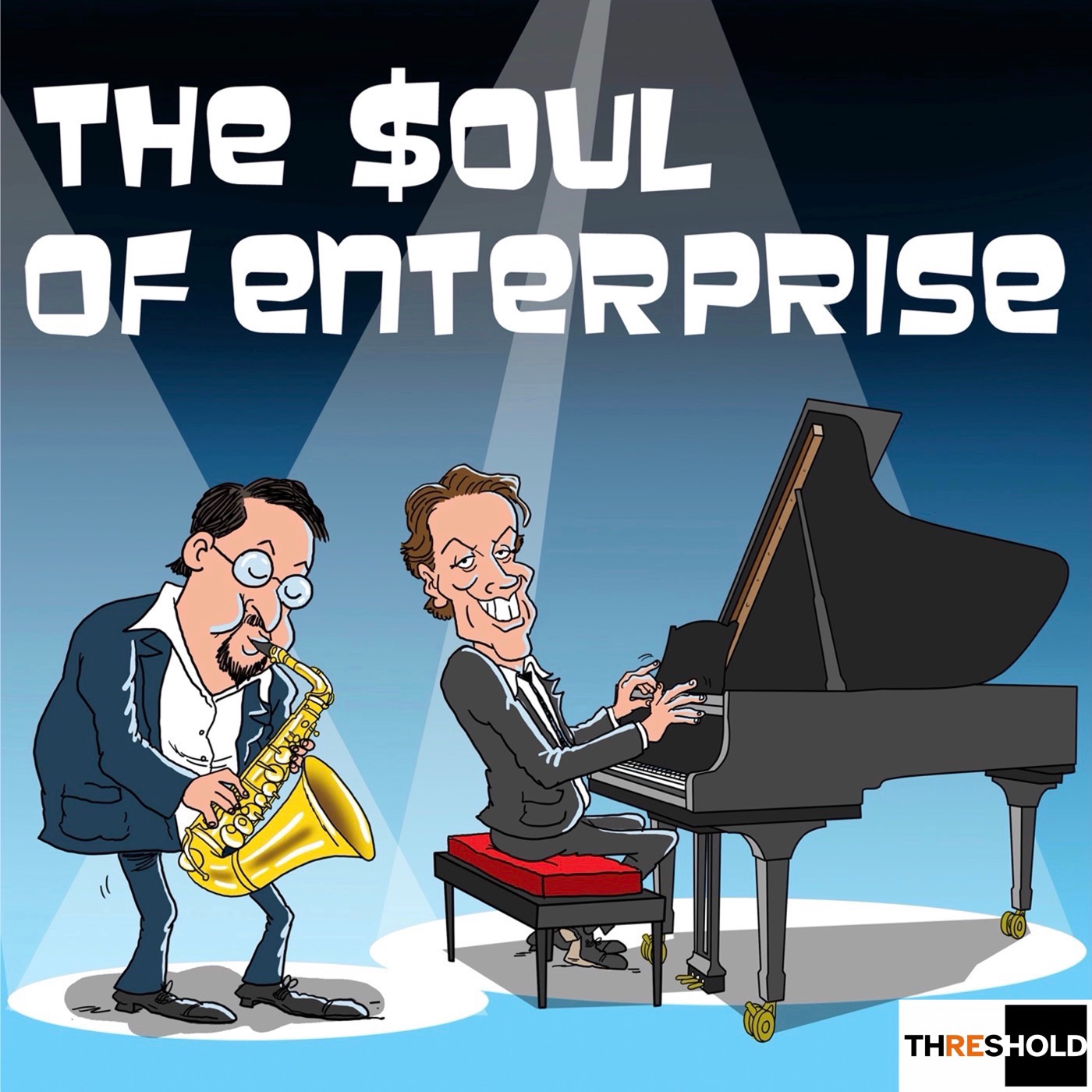
The Soul of Enterprise: Business in the Transformation Economy by THRESHOLD
Ron Baker and Ed Kless
The Soul of Enterprise is designed to champion the insight that wealth is created by intellectual capital, a product of the inexhaustible human spirit.
Wealth is above all an accumulation of possibilities. These possibilities lie hidden in the womb of the future, waiting to be discovered by human imagination, ingenuity, and creativity, manifested in free enterprises dedicated to the service of others. Tune in to The Soul of Enterprise, with Ron Baker and Ed Kless, broadcast live.
Wealth is above all an accumulation of possibilities. These possibilities lie hidden in the womb of the future, waiting to be discovered by human imagination, ingenuity, and creativity, manifested in free enterprises dedicated to the service of others. Tune in to The Soul of Enterprise, with Ron Baker and Ed Kless, broadcast live.
Episodes
Mentioned books

Aug 15, 2014 • 55min
Episode 7 - Everyday Ethics: Doing Well and Doing Good
All businesses have a vested interest in virtue. Business is dependent on the moral and cultural institutions of a free society. The economic and ethical point of a business entity is to serve others. Business is a morally serious enterprise, in which it is possible to act either immorally or morally. It requires moral conduct to thrive in the long run. Yet business ethics means a great deal more than obeying the civil law and the various accountancy acts and regulations. It means imagining and creating a new sort of world based upon the principles of individual creativity, community, realism, and the other virtues that make up the spirit of enterprise. Ethical behavior of businesspeople is expected each and every day. Failure to follow ethical behavior jeopardizes your personal and professional future. What ethical obligations do you have to your customers, employer, team members, and outside stakeholders? Trolleyology, would you kill the fat man?
Aug 8, 2014 • 57min
Episode 6 - Interview with Distinguished Professor of Economics Deirdre McCloskey
Why did the Industrial Revolution happen where and when it did? Our guest will be the Distinguished Professor of Economics Deirdre McCloskey, who teaches economics, history, English, and communication at the University of Illinois at Chicago. Ron and Ed will focus on her latest book, Bourgeois Dignity: Why Economics Can't Explain the Modern World (2010), which argues that it was an ideological change, rather than saving or exploitation, that made us rich. The book is the second in a widely noticed trilogy on The Bourgeois Era. The first was The Bourgeois Virtues: Ethics for an Age of Commerce (2006), asking if a participant in a capitalist economy can still have an ethical life (briefly, yes). Join us for what is sure to be a fascinating conversation with one of the country's leading economic thinkers.
Aug 1, 2014 • 57min
Episode 5 - Replacing the Annual Appraisal Agony
Do you know anyone who was motivated going into, or coming out of, their annual performance appraisal? Most organizations and employees are dissatisfied with the performance appraisal process, so it remains a curiosity why this methodology continues to exist. Performance appraisals don't improve performance and they don't drive careers; they are an incidental effect of other dynamic systems. In essence, appraisals are the paper-shuffling ritual that sanctifies decisions already made. Ed and Ron will discuss why it's a legal myth that performance appraisals protect you from litigation; and why appraisals instinctively focuses on weaknesses, not strengths. We will also provide three replacements for the annual performance appraisal: Peter Drucker's Manager's letter; After Action Reviews; and Key Predictive Indicators.
Jul 25, 2014 • 57min
Episode 4 - How Much Does the Economy Weigh?
Ed and Ron will explore the following insight from Thomas Sowell: After all, the caveman had the same natural resources at their disposal as we have today, and the difference between their standard of living and ours is a difference between the knowledge they could bring to bear on those resources and the knowledge used today. We will also discuss the five stages in human economic history, from hunter and gatherers to the Industrial Revolution, and now a knowledge economy; the differences between data, information and knowledge; the physical fallacy and why we continue to cling to this outdated mode of thinking about our economy; and how hard it is to make a toaster from scratch. A framework for leveraging your organization's intellectual capital will be presented.
Jul 18, 2014 • 58min
Episode 3 - The Second Law of Marketing: All Prices are Contextual
On our July 11th show we discussed The First Law of Marketing: The Value of Value. The Second Law of Marketing—that all prices are contextual—is just as critical to help your organization communicate value, and help convince your customers to pay for that value. Most customers are not price sensitive; they are value conscious. So how can you communicate value, rather than simply competing on low price? One of the most customer-centric strategies your company can deploy is to offer an array options to your customers. Customers prefer options, especially in today's world where they face a plethora of choices regarding who, when, what, and how to patronize a business. We simply must get over the false idea that there is one optimal price for a customer. There is a range of optimal prices, commensurate with the value being created. We will also discuss Goldilocks pricing, along with the Anchor and Framing Effects involved in pricing.
Jul 11, 2014 • 56min
Episode 2 - The First Law of Marketing: The Value of Value
Adam Smith was confounded. One of the greatest economic and social thinkers in the history of ideas struggled with the so-called diamond-water paradox. None of us would be able to live beyond a couple of weeks without water, yet its price is relatively cheap compared to the frivolous diamond. Most people resolve this paradox by replying the supply of diamonds is scarce compared to water. But this theory lacks explanatory power. Ron and Ed will compare and contrast The Labor Theory of Value with the subjective theory of value, developed by the Marginalist Revolution of 1871-1874. The idea that all value is subjective seems obvious is retrospect, given how consumer preferences and tastes can change on a whim. Ron and Ed explore the present-day consequences for enterprise that subscribe to one or the other of these theories. They both cannot be right. The correct one is known as the First Law of Marketing: All Value is Subjective. There is value in having a correct theory of value.
Jul 4, 2014 • 58min
Episode 1 - Declaring Independence from the Tyranny of Taylorism
Ron and Ed discuss the Cult of Efficiency beginning with an explanation of Frederick Winslow Taylor the father of so called Scientific Management. Business aren't paid to be efficient. There's nothing more useless than being efficient at doing the wrong things. Industries at peak efficiency are destined for obsolescence, think buggy whip manufacturers. Effectiveness trumps efficiency and creates true competitive advantage. Would you want an efficient or effective heart surgeon? This is why Walt Disney didn't produce Snow White and Three Dwarfs. The McKinsey Maxim of What you can measure you can manage will also be discussed, and why it's dangerously wrong. Also, why Frederick Taylor was wrong in treating management as a science, and Ron and Ed will propose a superior concept to effectiveness. That of efficaciousness.

