

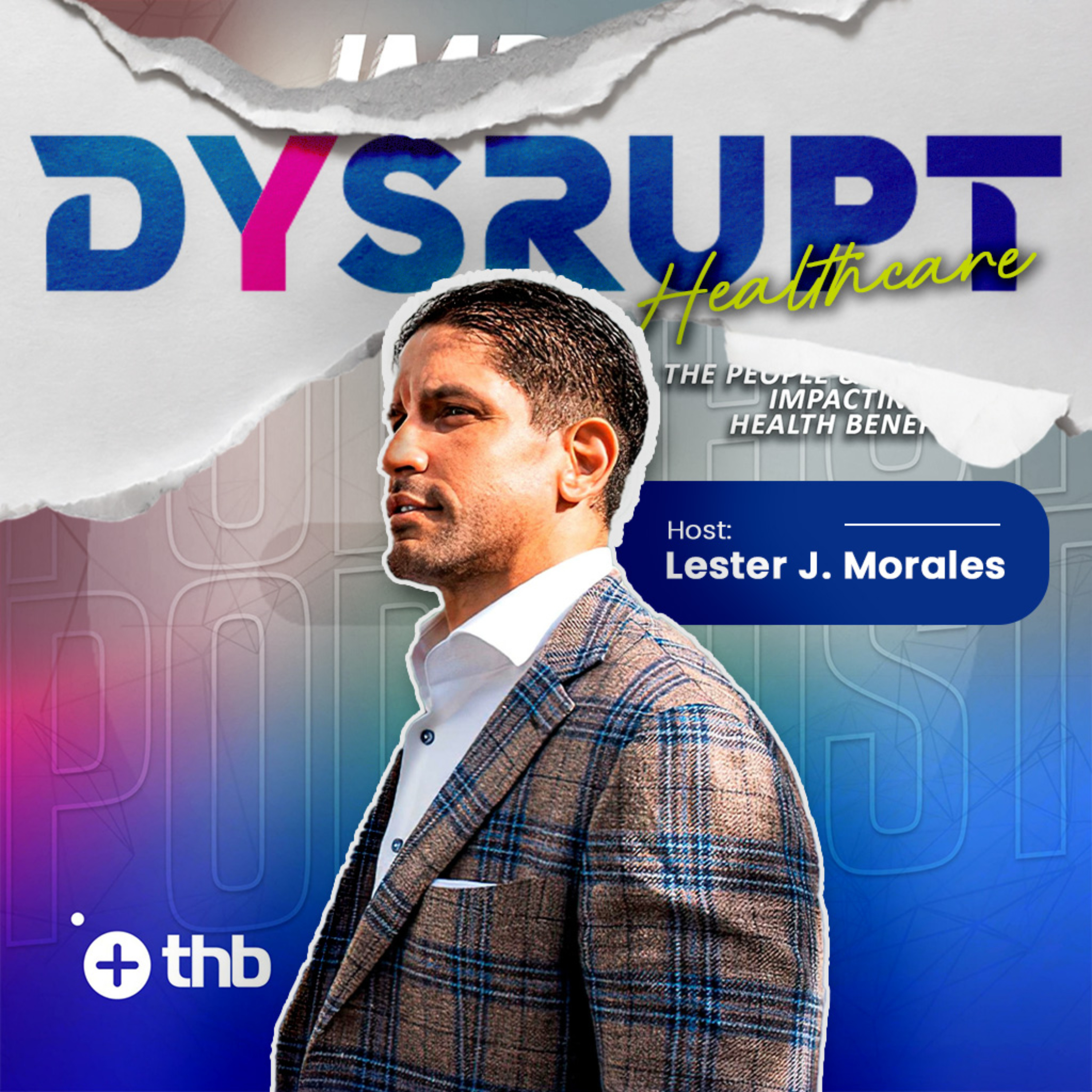
Dysrupt Healthcare Podcast
Lester J. Morales
Dysrupt Healthcare exposes the truth about rising health benefits—one of the top 3 expenses for companies. Host Lester J. Morales interviews industry leaders using bold, proven strategies to cut healthcare costs by 20%+ while improving care quality. This podcast is for employers ready to challenge the status quo and take control of their benefits. Real stories. Real savings. Real change.
Need to see it to believe it? Subscribe to Dysrupt Healthcare now!
Need to see it to believe it? Subscribe to Dysrupt Healthcare now!
Episodes
Mentioned books

Mar 4, 2026 • 54min
Direct Contracting Done Right: How Employers & Hospitals Win Together with: Doug Hetherington
What if employers and hospitals weren’t negotiating againsteach other… but building together?In this episode of the Dysrupt Healthcare Podcast,Lester sits down with Doug Hetherington, founder of Health to Business, to talk about a different approach to healthcare purchasing one rooted in transparency, partnership, and long-term alignment.This isn’t about fighting the system.It’s about strengthening relationships inside the communities we all serve.Doug shares:✔ Predictable payments✔ Stronger patient relationships✔ Reduced collection strain✔ Better plan stability✔ Healthier communitiesAt its core, this episode is about moving from atransactional model to a community health partnership model.Hospitals are not the enemy.Employers are not the enemy.Misalignment is the problem and alignment is the solution.If you’re a hospital leader, CFO, employer, broker, oradvisor, this conversation will give you a new lens on what’s possible when we build together.
Jan 28, 2026 • 42min
“Duh.” Why Imaging Is the Easiest Way to Cut Healthcare Costs Without Hurting Employees
Imaging is often treated like a “small” service line item.It’s not.In this episode of the Dysrupt Healthcare Podcast, Lester sits down with Dr. Cristin Dickerson, practicing radiologist and founder of Green Imaging, to unpack one of the most overlooked—and easiest—wins in healthcare cost containment.Here’s the headline:Imaging can represent 11–13% of total healthcare spend, not the 5% most carriers report.And the price variation can be 8–10x for the exact same exam.In this conversation, we cover:Why imaging costs are rising faster than overall healthcare inflationHow hospitals and private equity have distorted imaging pricingThe real math behind $4,700 CT scans vs. $485 alternativesWhy imaging is the easiest lift for employers (no doctor disruption, no plan overhaul)How employers can offer $0 out-of-pocket imaging and still save millionsThe access problem nobody talks about: delayed care due to deductiblesWhy “free imaging” does not increase unnecessary utilizationHow direct contracting creates a win for employers, employees, and providersWe also walk through a real case study:2,500-employee company3,800 imaging transactions$2.7M in savingsSignificant reduction in deductible exposureImproved access, productivity, and employee trustThis isn’t theory.It’s arithmetic.If you’re an employer, advisor, CFO, or HR leader wondering where to start in 2026—this is it.As Lester puts it:“This isn’t witchcraft. Nobody loses. And that almost never happens in healthcare.”Learn more or request an impact assessment at greenimaging.net.Like, share, comment, and—most importantly—do something different.
Jan 13, 2026 • 19min
Stop Renewing Like a Victim: What Employers Must Do Differently in 2026
If you’re an employer, you’re one of the largest purchasers of healthcare in the U.S.—and somehow you have the least control.This is a summary episode of our conversation with Nurse Deb (Deb Alt), President of AIMM, and it drops right after the turn of the calendar—Happy 2026—in what many are calling the worst renewal season in years.Here’s the hard truth:If you didn’t do anything different during renewal… why did you expect a different result?In this recap, Lester breaks down the mindset shift employers (and advisors) must make to stop being passive victims of a system designed to be opaque—and start acting like real purchasers.We cover:Why healthcare is confusing on purpose (and how it mirrors getting a grocery bill with zero itemization)The dangerous gap: employers scrutinize paperclips, but not their 2nd/3rd largest expenseWhy consumers research cars, flights, and concerts—but not surgeons, facilities, or cost differencesWhat changes when you build a plan around advocacy (call the nurse first)The uncomfortable “wait, what?” reality of misaligned incentives in healthcare and advisory modelsWhy raising deductibles and payroll contributions is not a strategy—and never bends the curveIf you’re an employer, ask yourself:Do I actually see my claims? Do I get data? Do we do pre-renewal?Or am I stuck in “thank you sir, may I have another”?If you’re an advisor:If your entire book is carrier-centric, this is your challenge to rethink what “advising” really means.Watch/listen with one goal: What’s one thing I can take from this episode and do differently this year?Like, share, and comment what topics you want next—and if you haven’t heard the full episode with Nurse Deb, go listen to it right after this.
Jan 7, 2026 • 48min
Best Care, Lowest Cost? The Math Behind Nurse-Driven Healthcare Navigatio
What if the fastest way to lower healthcare costs… is to finally put the patient at the center?In this powerful conversation, host Lester Morales sits down with Deb Alt — “Nurse Deb” — Founder and President of AIM, a team of nurses and physicians who guide patients through the two most confusing systems in America: healthcare delivery and health insurance.This episode exposes the misaligned incentives that keep costs rising, why patients actually get worse outcomes with traditional navigation, and how a nurse-led model radically improves both quality and affordability.Deb breaks down:Why patients—not doctors—should handle prior authorizationsHow top-quality care is actually cheaper in a fee-for-service systemReal stories of redirecting patients to better outcomes for $0 out-of-pocketWhy 64% of Americans avoid care because of cost fearsHow employers can eliminate deductibles + copays and STILL spend lessThe cultural shift required to make employees want to call the nurseWhy the MLR (Medical Loss Ratio) rule keeps insurers from lowering claims costsThe math behind Deb’s ability to cut claim spend 50% in year oneWhether you're an employer, CFO, advisor, or simply someone who’s felt lost inside the healthcare maze, this episode is a masterclass on how real change happens.This isn’t concierge care. It’s the way healthcare should have worked all along.📌 Want an analysis of your plan data or a clinical quality breakdown?Use the link in the show notes to request the free assessment Deb mentions.
Dec 31, 2025 • 7min
We Have Been Dysrupted, And We Are Ready
In our final episode of the year, Lester J. Morales shares the real why behind moving from Impact Healthcare to Dysrupt Healthcare. This isn’t a cosmetic change—it’s a sharpened mission informed by everything we learned this season: self-funding that actually bends the curve, PBM transparency, employer-led innovation, and data over hype.Here’s the blueprint for the next chapter:Keep the straight-talk interviews with advisors, clinicians, employers, and operators.Add case files where costs drop and outcomes rise—“with the receipts.”Ship practical Monday-morning playbooks you can run in the wild.Elevate patient and employer voices to anchor what truly matters.Key takeawaysThe strategic reason for the shift—and why now.What stays: candor, data, employer-first lens.What’s new: deeper case studies + step-by-step execution.How this community moves from insight to repeatable systems in the new season.Follow Dysrupt Healthcare Podcast, share this finale with your team, and send the case studies you want dissected next season. We have been dysrupted—and we’re ready.
Dec 24, 2025 • 15min
The PBM Problem Exposed: Why 1–3% of Members Drive 60% of Costs
In this recap episode, host Lester Morales breaks down the powerful conversation with Rachel Strauss — widely known as the “PBM Princess” and one of the clearest, boldest voices exposing how pharmacy benefit managers (PBMs) really work.Rachel spent much of her career inside a leading PBM that didn’t play the traditional rebate and spread-pricing games. Today, she’s on a mission to educate employers, advisors, and everyday consumers on the hidden mechanics of drug pricing — and why most people have no idea what they’re actually paying for.In this recap, Lester dives into:The emotional, financial, and human cost of a broken pharmacy systemHow PBMs actually make money (and why the incentives are completely misaligned)Why a $10 copay tells you nothing about the true price of a drugThe spread-pricing “black box” and how it hurts patients, employers, and local pharmaciesThe shocking reality: 1–3% of plan members drive up to 60% of total pharmacy spendWhy employers can reduce costs by 50–70% on high-cost drugs using modern, patient-first strategiesThe false belief that “employees won’t understand change” — and how it delays real solutionsReal-world paths to get the exact same medication for employees at zero costRachel and Lester outline a simple but powerful truth: If the PBM profits when drug prices stay high, the game will never change.This episode is a must-listen for employers, advisors, CFOs, HR leaders, and anyone who wants to understand why pharmacy costs are exploding — and what to do about it.👉 Listen to the full conversation with Rachel Strauss in the main episode.
Dec 17, 2025 • 45min
The Pharmacy Benefit Game Is Rigged — Here’s How to Beat It (ft. Rachel Strauss)
The pharmacy benefit world is broken — and it’s costing employers millions while pushing families into medical debt.In this eye-opening episode of the Disrupt Healthcare Podcast, Lester Morales is joined by Rachel Strauss, founder & CEO of PBM Princess Consulting and one of the most outspoken pharmacy reform advocates in the country.After 23 years inside a major PBM, Rachel has seen every angle of how drugs are priced, discounted, rebated, repackaged, and marked up — often leaving patients confused, employers overcharged, and advisors in the dark.Together, Lester and Rachel unpack:• Why 5% of members drive 80–90% of pharmacy spend• How fully insured carriers inflate drug prices in reporting• The truth about rebates and why they almost never benefit employers• Why employers are told “there’s nothing you can do” — even when there absolutely IS• International sourcing (Canada, Israel, UK, NZ)• 340B pharmacy partnerships• Patient assistance programs• Medication recycling (90% cost reduction)• How Rachel saved a Texas city 60% on their top 7 drugs within 30 daysRachel breaks down why this exploding class of drugs is the single biggest threat to employer healthcare budgets — and how to prepare before 2030 hits.Rachel and Lester share the emotional stories behind their work — from medical bankruptcy to life-saving treatments — and why pharmacy reform isn’t just financial… it’s deeply personal.If you are an employer, advisor, HR leader, or healthcare innovator, this conversation will completely shift how you think about pharmacy benefits and what’s possible.🔥 What PBMs don’t want employers to know💊 Real pharmacy strategies that work — today⚠️ The GLP-1 Problem (Ozempic, Wegovy, Mounjaro)❤️ Why this matters: the human impact
Dec 11, 2025 • 15min
Why Healthcare Is Actually a Finance Problem
In this recap of the Disrupt Healthcare Podcast, host Lester J. Morales breaks down a powerful conversation with Dean Jargo, CEO of Fair Market Health, whose personal story and financial background expose a truth most employers never hear:👉 Healthcare isn’t a healthcare problem. It’s a finance problem.Dean—longtime CFO and free-market advocate—shares how his wife’s cancer and emergency heart surgery forced him into the system as a consumer, not an executive. In that vulnerable moment, even a numbers expert couldn’t make sense of the bills, the stress, or the total lack of transparency. And that’s the point.The system is designed to be confusing.But it doesn’t have to be.Lester recaps the key themes of the conversation, including:Why the real payers of healthcare (employers & employees) are separated from the sellers of healthcare (hospitals & providers)How misaligned incentives make premiums go up every year—while benefits get worseThe insane friction created by deductibles, out-of-pocket costs & denied accessWhy direct contracting and fair-market pricing consistently save 35–40% on big-ticket proceduresThe emotional and financial toll on families navigating the system while dealing with serious medical eventsWhy CFOs need to stop delegating benefits decisions and start treating them like the massive P&L line item they areWhy the status quo carriers have no incentive to change—and why real reform must come from inside the industryThis episode is a must-listen for employers, CFOs, benefits advisors, HR leaders, and anyone tired of feeling powerless in the healthcare system.If you’ve ever thought:“There has to be a better way…”—this recap outlines exactly what that better way looks like.
9 snips
Nov 26, 2025 • 40min
Why CFOs Are Sitting on a Hidden Gold Mine in Their Health Plans with Dean Jargo
Most CFOs would never tolerate sloppy spending anywhere else in the P&L… except in the second-largest expense of the business: healthcare.In this episode of the Disrupt Healthcare Podcast, host Lester J. Morales sits down with Dean Jargo, former CFO and founder of Fair Market Health, to unpack why the traditional fully-insured model is structurally misaligned — and how employers can use free-market, direct contracting strategies to pay less while giving employees better access to care.Dean shares how his perspective shifted after his wife’s cancer and emergency heart surgery threw his family deep into the healthcare system. From there, he breaks down why insurance networks aren’t really negotiating “for” employers, how minimum loss ratio rules (MLR) incentivize higher claim costs, and why CFOs must get directly involved instead of delegating everything to HR and big brokerage firms.You’ll also hear how Fair Market Health helps employers buy services like MRIs, surgeries and other procedures directly from providers at a fair price, often:Saving 35–45% on individual services purchased directReducing total plan spend by 10–20%Waiving member out-of-pocket costs while still paying providers fairly and quicklyIf you’re a CFO, CEO, HR leader or advisor, this conversation will change how you think about your health plan, your broker — and your responsibility to your people.Show NotesWhy fully-insured carriers are structurally incentivized for higher claim costs, not lowerWhat a fair market, direct-pay model looks like for hospitals, employers and employeesHow deductibles & out-of-pocket for employees show up as accounts receivable on the hospital sideWhy hospital systems obsess over revenue instead of net profit, collection costs and time value of moneyThe biggest mindset blocks for hospital administrators and employer C-suitTimestamps00:00 – 01:04 | Intro: From Impact to Disrupt Healthcare — and why the Y matters01:05 – 03:21 | Meet Dean Jargo: finance background, free-market mindset, and his wife’s cancer + emergency heart surgery story03:22 – 04:57 | What is Fair Market Health? Creating a truly “fair price” marketplace between buyers and sellers of healthcare04:58 – 08:32 | Who really decides the price of an MRI? The illusion of “negotiated discounts” in traditional networks08:33 – 12:08 | Why carriers don’t benefit from lowering costs: MLR rules, revenue growth and misaligned incentives12:09 – 14:06 | Dean’s biggest surprise: how many high-quality vendors already exist to run better, partially self-funded plans14:07 – 17:46 | The “cost of change” myth and why disruption is actually what employees are begging for17:47 – 20:20 | Transparent pricing + waived out-of-pocket: how buying direct actually increases access to care20:21 – 22:43 | Deductibles vs A/R: the moment Lester realized member cost-sharing is just hospital accounts receivable22:44 – 25:04 | Hospitals chasing revenue vs. focusing on net profit, collection costs and time value of money25:05 – 27:26 | The win–win–win triangle: hospital, employer and employee all benefit in a direct model27:27 – 29:38 | The emotional toll: EOBs, confusing bills and stress stacked on top of serious illness29:39 – 32:00 | On the provider side: revenue myopia and “we’ve always done it this way” thinking32:01 – 33:05 | On the employer side: how CEOs & CFOs delegate benefits decisions into misaligned hands33:06 – 35:08 | Claims analysis 101: what Dean finds when he reprices 12–24 months of claims data35:09 – 36:19 | Access advantage: why direct-pay patients move to the top of the schedule36:20 – 37:36 | Dean’s message to CFOs: get engaged — your health plan is probably your highest-ROI project37:37 – 38:22 | Lester’s example: $3.5M in Rx savings vs $25–30M in extra sales38:23 – 39:23 | Where to find Dean and final call to action for financial leaders39:24 – 40:23 | Closing: why we must disrupt healthcare before it breaks
Nov 19, 2025 • 14min
RBP, Transparency & Real Savings: Heath Potter (Six Degrees Health) — Recap with Lester J. Morales | Dysrupt Healthcare
In this quick recap of the Dysrupt Healthcare Podcast, host Lester J. Morales distills key takeaways from his interview with Heath Potter, Chief Growth Officer at Six Degrees Health—a leader in reference-based pricing (RBP) and transparent reimbursement.Lester challenges the industry’s fear of RBP, calls out incentive conflicts that keep employers in the dark, and explains (in plain English) how bottom-up “Medicare-plus” pricing gets to a fair price—without the games behind “big network discounts.” He also shares real-world wins, access myths vs. facts, and why collaboration (not litigation) is the sustainable path.You’ll learn:Why many advisors still resist RBP—and how to sanity-check that biasTop-down (billed charges minus “discount”) vs. bottom-up (Medicare-plus) pricingHow modern RBP uses data + negotiation to reach fair provider paymentsAccess & member experience: what’s changed from RBP 1.0 to todayCase stories: open access, community contracts, and keeping dollars localHow to request a no-obligation impact/savings analysis to compare modelsIf you’re a self-funded employer, HR/benefits leader, or advisor, this recap gives you the essentials in minutes—so you can decide whether to dive into the full episode.00:00 – “This podcast has been disrupted.”00:07 – What these recap episodes are (and why)00:40 – Guest context: Heath Potter, Six Degrees Health (RBP leader)01:03 – Love it? Hate it? Why advisors feel strongly about RBP02:24 – Gut-check your bias: incentives, overrides, and “follow the money”03:27 – Hundreds of RBP implementations: wins vs. rare rough patches05:23 – The core value of RBP: transparency and bottom-up pricing06:38 – “Discount off what?” Charge master, billed charges, and the game06:55 – RBP in one line: get to the price (Medicare-plus)07:05 – Why Six Degrees’ data-driven, collaborative model works09:17 – Many hospitals already use RBP-ish logic internally10:10 – Imagine a fair-price roundtable… and the reality today10:39 – Six Degrees’ posture: start fair, show data, negotiate10:51 – Real examples: open access, family stories, local community wins11:37 – When carriers and hospitals fight… the member/employer loses11:58 – Strategy: collaborate with good actors; limit exposure to bad ones12:21 – Employers: if your advisor won’t teach RBP, reconsider12:45 – If we don’t solve it, government will—lead the change13:09 – CTA: request an impact analysis to compare savings13:46 – Listen to the full episode with Heath Potter; share/like/feedback14:00 – Thanks for listening to the Dysrupt recapGuest: Heath Potter, Chief Growth Officer — Six Degrees HealthHost: Lester J. Morales — Dysrupt Healthcare Podcastreference based pricing, RBP, Medicare plus pricing, Six Degrees Health, Heath Potter, Lester J Morales, self funded employers, healthcare transparency, cost containment, medical claims, employer health plans, open access, negotiation not litigation, benefits advisors, Dysrupt Healthcare Podcast🕒 Timestamps🔗 Guest & Host🔍 SEO Keywords / Tags

