

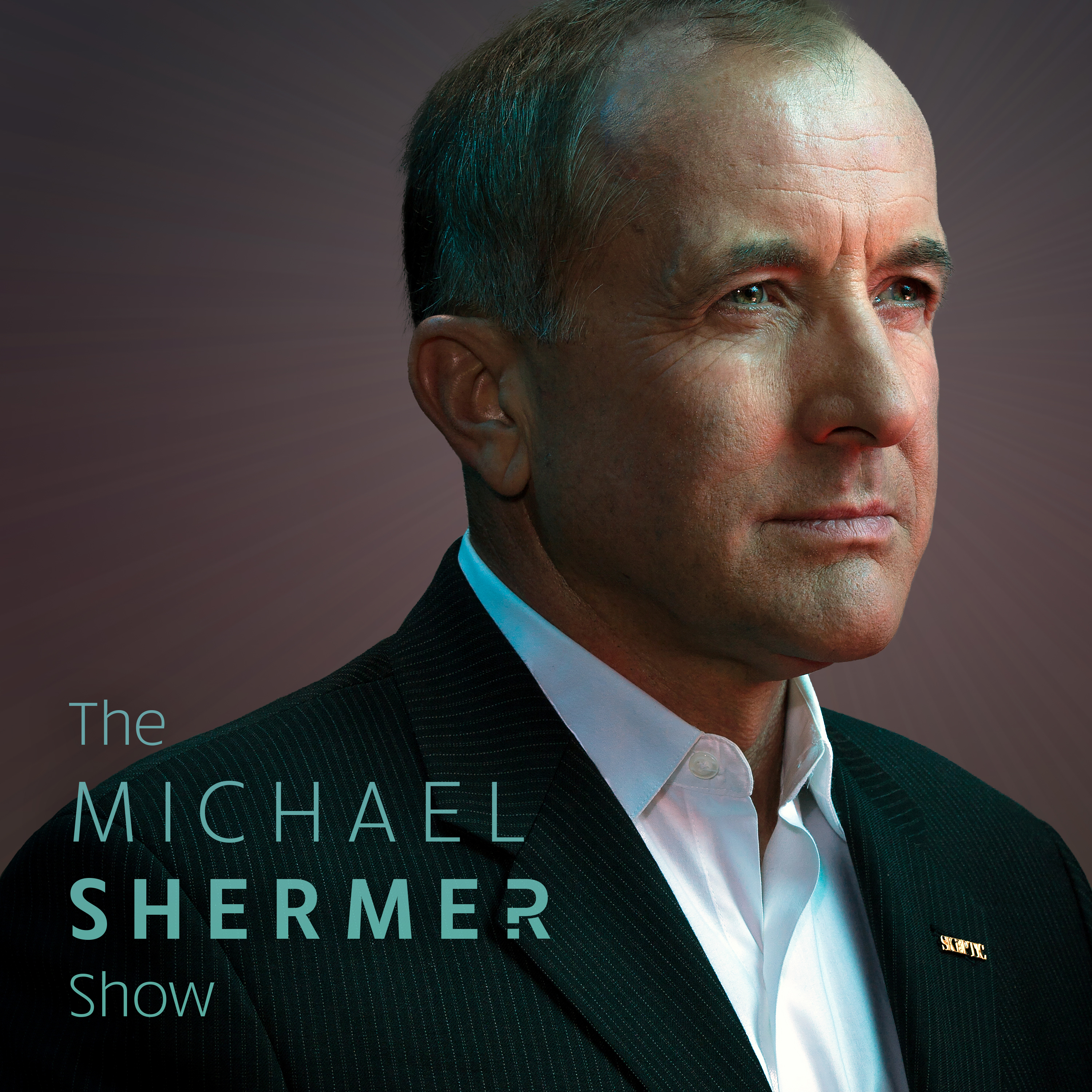
The Michael Shermer Show
Michael Shermer
The Michael Shermer Show is a series of long-form conversations between Dr. Michael Shermer and leading scientists, philosophers, historians, scholars, writers and thinkers about the most important issues of our time.
Episodes
Mentioned books

49 snips
Jan 6, 2026 • 1h 50min
What Makes You "You" When Everything Is Just Atoms?
Nikolay Kukushkin, a neuroscientist and author of "One Hand Clapping," delves into the intricate nature of consciousness. He discusses how even simple cells exhibit memory, challenging the notion that human mind is merely a collection of neurons. Kukushkin explores the evolutionary advantages of complexity, the dominance of bacteria, and how memory and abstraction drive thought. He wonders why we feel unique despite being made of the same atoms as everything else, linking the mystery of self to the continuum of consciousness in living organisms.
43 snips
Jan 3, 2026 • 1h 22min
Rethinking the Discovery of DNA
Matthew Cobb, a professor of biological sciences and historian of science, discusses the life of Francis Crick, co-discoverer of DNA's double helix. He reveals how Crick’s career was shaped by luck, chance encounters, and creative debates, rather than being predetermined. Cobb also clarifies misconceptions surrounding Rosalind Franklin's contributions and examines Crick's pivot from molecular biology to consciousness studies. He emphasizes Crick's materialist views on life and the brain, critiquing the proliferation of theories about consciousness.
Dec 30, 2025 • 1h 5min
How One Black Man Dismantled the KKK, One Conversation at a Time
Daryl Davis, a musician and author, has uniquely dismantled the KKK through dialogue, persuading over 200 members to leave the hate group. In this engaging conversation, he discusses the roots of radicalization, emphasizing the psychological clash between prejudice and personal connection. He advocates for early education on antisemitism and racism, arguing today's division presents an opportunity for discourse. Davis shares impactful stories that illuminate how conversation can break down hate and spark change, making way for hope amid polarization.
19 snips
Dec 28, 2025 • 1h 30min
The Collapse of Open Inquiry: Sacred Victims and Forbidden Questions
In this engaging discussion, Eric Kaufmann, a politics professor and director at the Centre for Heterodox Social Science, explores the complexities of identity politics and its impact on open inquiry. He argues that certain identities have become morally sacred, stifling honest debate and shaping current culture conflicts. Kaufmann critiques the shift from equal opportunity to enforced equal outcomes and highlights the dangers of selective sacred concerns. He also examines free speech limits and the role of emotional safety in academia, all while discussing historical 'awokenings' and their implications.
17 snips
Dec 23, 2025 • 1h
The Future of Brain Implants: Restoring Speech, Regaining Mobility, Treating Pain
Matt Angle, the founder and CEO of Paradromics, is revolutionizing neurotechnology with high-data-rate brain-computer interfaces. He shares fascinating insights into how these devices can restore speech for paralyzed patients and enhance control of prosthetics. Angle highlights the challenges and breakthroughs of decoding neural activity and the regulatory landscape for bringing these innovations to clinical trials. He also addresses ethical concerns and the future possibilities of sensory prostheses and cognitive augmentation, sparking a thought-provoking discussion on consciousness and technology.
23 snips
Dec 20, 2025 • 1h 26min
The Original Alien Craze: When People Believed in Martians
David Baron, an award-winning science journalist and author, delves into the astonishing Martian craze of the early 20th century, revealing how blurry telescopes and charismatic figures like Percival Lowell turned speculation into accepted facts. He explores the influence of early science fiction, Nikola Tesla's claims of extraterrestrial signals, and the media's pivotal role in shaping public belief in Martians. Baron connects this historical fascination to modern debates about UFOs and aliens, raising intriguing questions about how scientific ideas capture our imagination.
28 snips
Dec 16, 2025 • 2h 8min
How AI Sees Science Differently Than We Do
Chris Edwards, a teacher and author with expertise in world history, discusses how AI can reshape our understanding of science. He argues that scientific discoveries aren't always in the right order and suggests reordering them around the concept of entropy. This shift may lead AI to produce insights that challenge traditional narratives. Edwards also explores the connections between thermodynamics, evolution, and public understanding, ultimately warning that our educational methods need to evolve alongside these emerging ideas.
11 snips
Dec 13, 2025 • 1h 14min
Can You Spot a Killer? The Dangerous Fantasy of Criminal Profiling
In this engaging discussion, Rachel Corbett, a features writer and author known for her work on crime and culture, explores the mythos surrounding criminal profiling. She reveals how our desire for neat explanations can lead us astray, showcasing the failures of profiling through studies and real-life cases. Corbett connects historical roots, the allure of true crime, and the unsettling truth behind normal-looking perpetrators. The conversation also touches on the role of randomness in violence and the ethical dilemmas of past psychological experiments.
Dec 8, 2025 • 1h 2min
Why Wars Last Longer Than Experts Predict
For nearly two centuries, international relations have been premised on the idea of the "Great Powers." As the thinking went, these mighty states—the European empires of the nineteenth century, the United States and the USSR during the Cold War—were uniquely able to exert their influence on the world stage because of their overwhelming military capabilities. But this conception of power fails to capture the more complicated truth about how wars are fought and won. Our focus on the importance of large, well-equipped armies and conclusive battles has obscured the foundational forces that underlie military victories and the actual mechanics of successful warfare. Phillips O'Brien suggests a new framework of "full-spectrum powers," taking into account all of the diverse factors that make a state strong—from economic and technological might, to political stability, to the complex logistics needed to maintain forces in the field. Drawing on examples ranging from Napoleon's France to today's ascendant China, he offers a critical new understanding of what makes a power truly great. Phillips Payson O'Brien is a professor of strategic studies and head of the School of International Relations at the University of St. Andrews in Scotland. He is the author of six books, including his latest War and Power: Who Wins Wars—and Why.
38 snips
Dec 6, 2025 • 1h 45min
The Emergent Mind: From Ant Colonies to Human Thought to Artificial Intelligence
In this insightful discussion, Jay McClelland, a pioneering cognitive scientist from Stanford, and Gaurav Suri, a computational neuroscientist at San Francisco State, explore the evolution of thought and consciousness. They delve into how simple neural networks can create complex behaviors, examine the enigma of consciousness, and debate the future of AI in relation to human intelligence. From the intricacies of memory retrieval to the challenges of modeling subjective experience, their conversation reveals the fascinating interplay between brain function and emergent behavior.

