

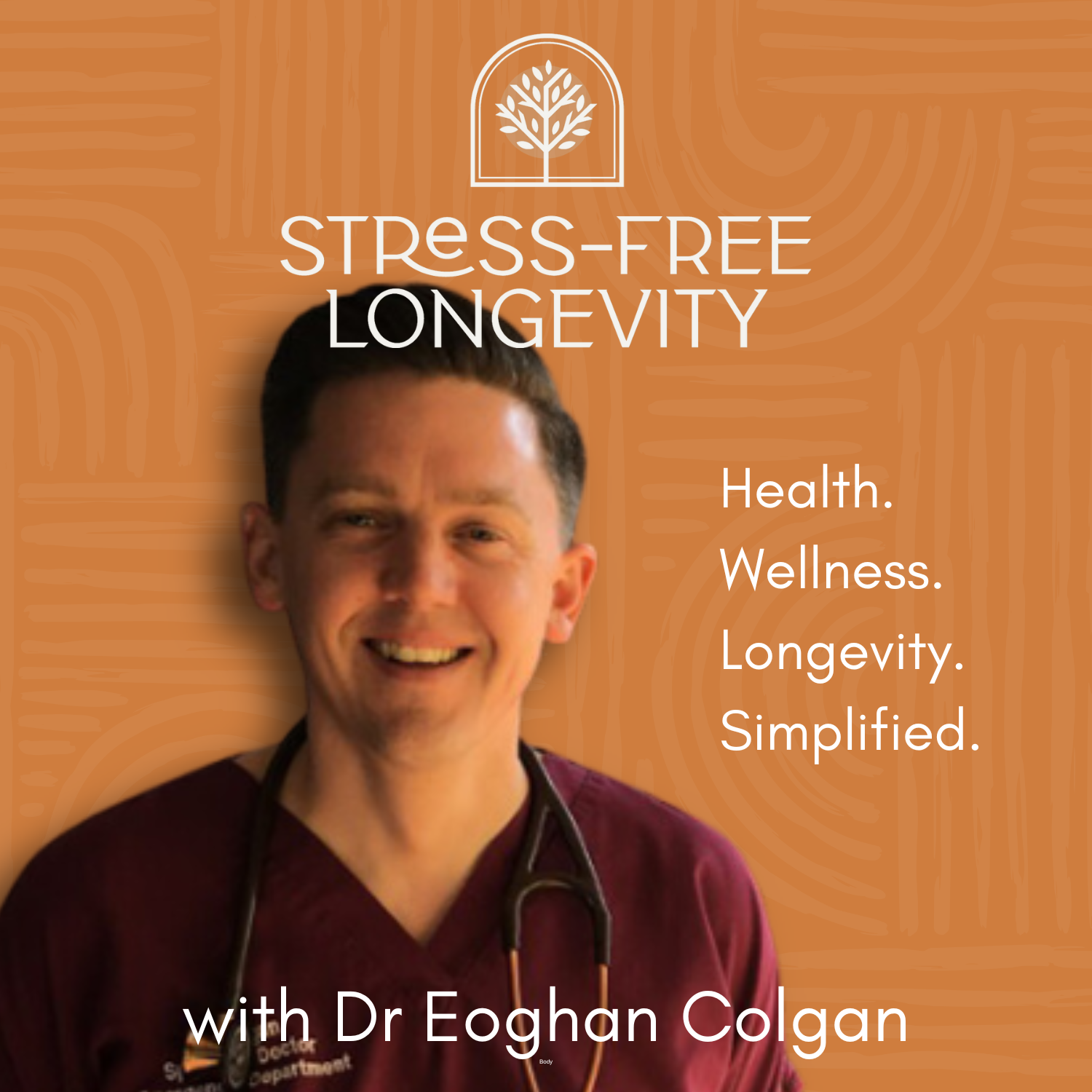
Stress-Free Longevity
Dr Eoghan Colgan
Feeling overwhelmed by conflicting health advice? Join Dr. Eoghan Colgan and leading scientists as they cut through the noise to uncover what really works. We explore the science behind life’s essential pillars, finding simpler paths to wellness. No rigid rules – just clear, evidence-based insights you can trust. For curious minds seeking better ways to live well.
Episodes
Mentioned books

Mar 11, 2025 • 1h 2min
Episode 3: Understanding Aerobic Exercise with Dr Niels Vollaard
Episode Overview
In this enlightening conversation, Dr. Niels Vollaard, an exercise physiologist at the University of Stirling, challenges common misconceptions about aerobic exercise and reveals the science behind effective physical activity. Dr. Vollaard's research focuses on finding the minimum amount of aerobic exercise needed to achieve significant health benefits, with particular emphasis on high-intensity interval training protocols.
Key 'Aerobic Exercise' Insights:
Exercise Isn't Healthy, Recovery Is: Dr. Vollaard explains that aerobic exercise itself creates stress on the body—including inflammation and muscle damage—but it's the recovery process that delivers health benefits
The Intensity-Duration Relationship: Higher intensity aerobic exercise requires less time to achieve similar health benefits compared to lower intensity exercise that must be performed for longer durations
Evolutionary Mismatch: Our bodies evolved expecting daily physical activity for survival, but modern sedentary lifestyles have created a mismatch that leads to disease
The REHIT Protocol: Dr. Vollaard's research has developed a 10-minute aerobic exercise protocol with just two 20-second all-out sprints that can deliver significant health benefits
Beyond Weight Loss: Aerobic exercise should be viewed primarily as a tool for long-term health and preventing chronic disease, not just for short-term aesthetic goals
The Barrier Problem: Most people don't enjoy aerobic exercise, making sustainability the biggest challenge for long-term adherence
Want the complete framework?
Get The Vital 3 Method guide free — the evidence-based system for sustainable health after 40.
Download the Free Guide
Expert 'Aerobic Exercise' Takeaways
Incorporate some form of higher-intensity aerobic exercise to get more health benefits in less time
Focus on building aerobic exercise habits that are sustainable for decades, not just weeks or months
Consider cycling-based aerobic exercise for high-intensity training with lower injury risk
Look for ways to integrate physical activity into daily routines rather than making it a separate task
Understand that any increase in aerobic exercise will provide health benefits, even if modest
The goal isn't immediate results but ensuring better health in your 60s, 70s, and beyond
About Our Guest
Dr. Niels Vollaard is an exercise physiologist at the University of Stirling. Having studied at the University of Maastricht, completed a master's at Aberdeen, and earned his PhD at the University of Essex, his career has included positions at Heriot-Watt University in Edinburgh and the University of Bath. Dr. Vollaard's research has shifted from sports performance to health optimisation, with a particular focus on developing time-efficient aerobic exercise protocols that deliver maximum health benefits with minimal time investment.
Visit Dr Niel Vollaard's Academic Profile
Watch the 'Aerobic Exercise' Interview
'Aerobic Exercise' Resources
Click on webpage below
CAROL REHIT exercise bike
It's not about willpower
A doctor's guide to healthy living and making it stick
What's inside
Why healthy living matters for you and your loved ones
The actions that make a difference - not 100 biohacks that don't!
My exact program that helped me lose 14kg in weight, reverse my metabolic age, and feel in the best shape of my life
Tips on using AI to supercharge your lifestyle changes
First Name
Please enter your name.
Email Address
Please enter a valid email address.
Send me the Free PDF!
Please check your email for further instructions. Check your junk mail if you cannot find the email in the next few minutes.
Something went wrong. Please check your entries and try again.
I will not share your details with any third party
Additional Interviews
Are you interested in other expert interviews on health, wellness and longevity topics? Click on the links below to discover more.
Sleep
The most under-rated life pillar of all!
Sleep Content
Exercise
The foundation of lasting health
Exercise Content
Nutrition
The fuel that shapes your wellbeing
Nutrition Content
The post Episode 3: Understanding Aerobic Exercise with Dr Niels Vollaard first appeared on Stress-Free Longevity.

Feb 25, 2025 • 1h 11min
Episode 2: Understanding Cardiometabolic Health with Professor Jason Gill
Episode Overview
In this insightful conversation, Professor Jason Gill, a professor of cardiometabolic health at the University of Glasgow discusses the complex relationship between diet, physical activity, and health. With over 25 years of research experience, Prof. Gill brings clarity to often misunderstood topics about weight management, healthy eating, and long-term wellbeing.
Key 'Cardiometabolic Health' Insights:
The Complexity of Calories: Why "calories in, calories out" is true but oversimplified, and how different foods affect our body's processing of calories
Ultra-processed Foods: A nuanced look at why not all ultra-processed foods are harmful, and the real mechanisms behind their impact on weight
The Truth About Diets: Evidence showing that different diets achieve similar results, with adherence being the key factor
Energy Density and Portion Size: How these factors influence our eating behaviour more than we realise
The Role of Food Types: The importance of balanced nutrition, with specific insights on carbohydrates, proteins, and fats
Long-term Success: Why we need 1000-day plans instead of 100-day plans for sustainable health
Want the complete framework?
Get The Vital 3 Method guide free — the evidence-based system for sustainable health after 40.
Download the Free Guide
Expert 'Cardiometabolic Health' Takeaways
Focus on building long-term, sustainable habits rather than quick fixes
Find an eating approach you can stick to rather than following the latest trend
Understand food energy density and manage portion sizes
Aim for about 50% of calories from carbohydrates, focusing on low-glycemic options
Choose plant-based fats over animal-based when possible
Eat slower to allow your body's fullness signals to work effectively
About Our Guest
Professor Jason Gill is a Professor of Cardiometabolic Health at the University of Glasgow. His research spans three main areas: epidemiology of chronic disease, biological mechanisms of diet and exercise effects, and development of lifestyle interventions. With funding from prestigious organizations including research councils in the United Kingdom, Diabetes UK, the British Heart Foundation, and the European Commission, his work has contributed significantly to our understanding of how lifestyle factors influence health outcomes.
Visit Professor Gill's Academic Profile
Watch the 'Cardiometabolic Health' Interview
'Cardiometabolic Health' Resources
Key Research Discussed:
Celis-Morales (2018) Associations of grip strength with cardiovascular, respiratory, and cancer outcomes and all cause mortality. prospective cohort study of half a million UK Biobank participants.
GIll (2020) Linking volume and intensity of physical activity to mortality
Gill (2023) Potential impact of wearables on physical activity guidelines and interventions. opportunities and challenges
Gill, Sattar (2014) Fruit juice - just another sugary drink
Hall (2015) Calorie for Calorie, Dietary Fat Restriction Results in More Body Fat Loss than Carbohydrate Restriction in People with Obesity
Hall-2019-Ultra-processed-diets-cause-excess-calorie-intake-and-weight-gain
Ross (2016) Effects of an Injected Placebo on Endurance Running Performance.
Stamatakis (2023) Association of wearable device-measured vigorous intermittent lifestyle physical activity with mortality
Stamatakis (2023) Journey of a thousand miles. from 'Manpo-Kei' to the first steps-based physical activity recommendations
It's not about willpower
A doctor's guide to healthy living and making it stick
What's inside
Why healthy living matters for you and your loved ones
The actions that make a difference - not 100 biohacks that don't!
My exact program that helped me lose 14kg in weight, reverse my metabolic age, and feel in the best shape of my life
Tips on using AI to supercharge your lifestyle changes
First Name
Please enter your name.
Email Address
Please enter a valid email address.
Send me the Free PDF!
Please check your email for further instructions. Check your junk mail if you cannot find the email in the next few minutes.
Something went wrong. Please check your entries and try again.
I will not share your details with any third party
Additional Interviews
Are you interested in other expert interviews on health, wellness and longevity topics? Click on the links below to discover more.
Sleep
The most under-rated life pillar of all!
Sleep Content
Exercise
The foundation of lasting health
Exercise Content
Nutrition
The fuel that shapes your wellbeing
Nutrition Content
The post Episode 2: Understanding Cardiometabolic Health with Professor Jason Gill first appeared on Stress-Free Longevity.

Feb 7, 2025 • 38min
Episode 1: Understanding Stress with Professor Stafford Lightman
Episode Overview
In this enlightening conversation, Professor Stafford Lightman, a distinguished neuroendocrinologist from the University of Bristol, helps us understand what stress really means for our bodies and minds. With decades of research experience studying hormones and their effects on the brain, Prof. Lightman brings clarity to a often misunderstood topic that affects us all.
Key 'Stress' Insights:
The Difference Between Stress and Stressors: Prof. Lightman explains why we should focus on identifying specific stressors rather than the vague concept of "stress"
Acute vs. Chronic Stress: While acute stress serves as an adaptive, survival-promoting response, chronic exposure to stressors can be maladaptive and potentially harmful
The Myth of Stress Testing: Why popular stress tests, particularly salivary cortisol measurements, don't provide meaningful information about individual stress levels
The Role of Sleep: The critical importance of regular sleep patterns and how disrupted sleep rhythms can impact overall health
Modern Life and Stress: Whether we're really more stressed than previous generations, and how modern stressors differ from historical ones
The Wellness Industry: A critical look at how the commercialization of wellness might actually be creating more stress
Want the complete framework?
Get The Vital 3 Method guide free — the evidence-based system for sustainable health after 40.
Download the Free Guide
Expert 'Stress' Takeaways
Focus on what you can control in your environment
Maintain regular sleep patterns
Share your concerns with others rather than keeping them to yourself
Engage in achievable projects that provide a sense of accomplishment
Be wary of oversimplified "stress tests" and quick-fix solutions
Aim for balance across all aspects of life rather than intensive focus on single areas
About Our Guest
Professor Stafford Lightman is a Professor of Medicine at the University of Bristol, specializing in neuroendocrinology - the study of how hormones affect the brain and vice versa. With a background in anthropology and extensive field research experience, he brings a unique perspective to understanding human behaviour and its biological underpinnings.
Visit Professor Lightman's Academic Profile
Watch the 'Stress' Interview
It's not about willpower
A doctor's guide to healthy living and making it stick
What's inside
Why healthy living matters for you and your loved ones
The actions that make a difference - not 100 biohacks that don't!
My exact program that helped me lose 14kg in weight, reverse my metabolic age, and feel in the best shape of my life
Tips on using AI to supercharge your lifestyle changes
First Name
Please enter your name.
Email Address
Please enter a valid email address.
Send me the Free PDF!
Please check your email for further instructions. Check your junk mail if you cannot find the email in the next few minutes.
Something went wrong. Please check your entries and try again.
I will not share your details with any third party
Additional Interviews
Are you interested in other expert interviews on health, wellness and longevity topics? Click on the links below to discover more.
Sleep
The most under-rated life pillar of all!
Sleep Content
Exercise
The foundation of lasting health
Exercise Content
Nutrition
The fuel that shapes your wellbeing
Nutrition Content
The post Episode 1: Understanding Stress with Professor Stafford Lightman first appeared on Stress-Free Longevity.

