

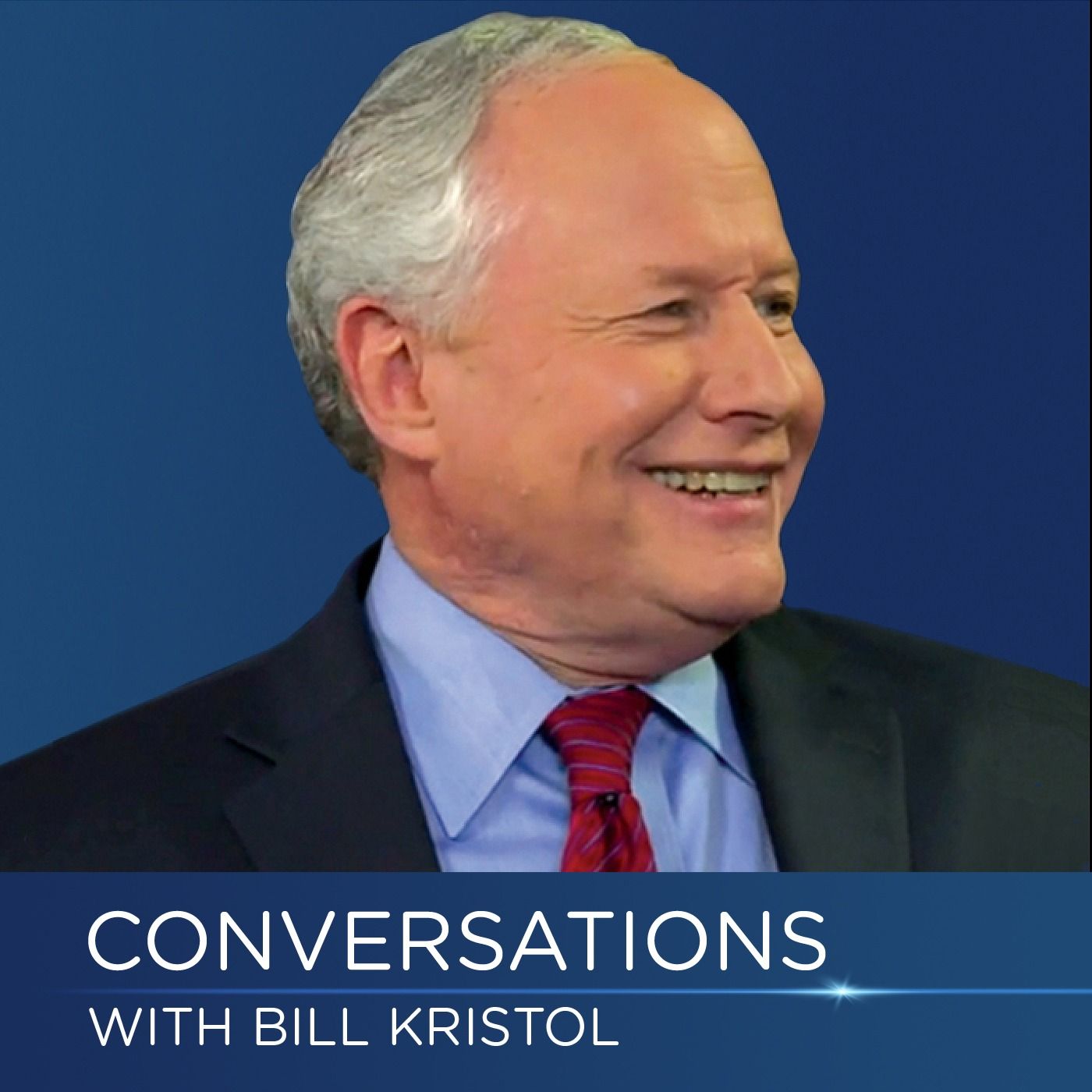
Conversations with Bill Kristol
Bill Kristol
Conversations with Bill Kristol features in-depth, thought-provoking discussions with leading figures in American public life.
Episodes
Mentioned books

Feb 1, 2016 • 1h 15min
Harvey Mansfield on Our Political Parties
In his seventh conversation, Mansfield considers our two parties, the ideas behind them, and the qualities that often go with being a Democrat or a Republican. Mansfield argues that the Democrats are the “party of progress”—and that progressivism may be headed for a crisis. Mansfield calls the Republicans the “party of virtue” and suggests that Republicans should not only speak about freedom but also about virtue.

Jan 18, 2016 • 1h 15min
Larry Summers on Political Correctness and our Universities
In his second conversation with Bill Kristol, Harvard President Emeritus and former Treasury Secretary Larry Summers reflects on the current climate of political correctness on campuses and its effects on freedom of thought and the pursuit of knowledge. Summers also discusses significant controversies from his tenure as president of Harvard, including his opposition to boycotts of Israel, his battle against grade inflation, and his interest in bringing ROTC back to campus. Finally, Kristol and Summers consider how technological developments might shape the future of higher education.

Jan 4, 2016 • 1h 7min
Ayaan Hirsi Ali on the Challenge of Radical Islam
A best-selling author and fellow at Harvard’s Kennedy School and the American Enterprise Institute, Ayaan Hirsi Ali is a brave, impassioned, and provocative analyst of the problems in Islam, today, including the dangers of what she calls “Islamic totalitarianism.” In this conversation, Hirsi Ali narrates her own experiences as a young woman in Kenya attracted by radical Islam and explains the dangerous allure of Islamism to youth all over the world. She calls on Westerners to assert the superiority of liberal societies to political Islam—and argues that our current obsession with multiculturalism and political correctness has rendered us ill-equipped to do so.

Dec 21, 2015 • 1h 41min
Leon Kass on Bioethics, the Bible, and Athens and Jerusalem
Leon R. Kass, M.D., is Professor Emeritus at the University of Chicago, the Madden-Jewett Chair at the American Enterprise Institute, and one of the nation’s most distinguished bioethicists. In this conversation, Kass recounts how he turned from the study of medicine to an examination of the moral questions and problems that modern science and technology pose for human life. Kass suggests that science, for all of the benefits it has brought to us, may not offer an adequate account of life as we experience it. Kristol and Kass also discuss the Bible as a source of wisdom and the similarities and differences between the Biblical view of man and the one found in Greek philosophy.

Dec 7, 2015 • 1h 7min
Harvey Mansfield on Niccolo Machiavelli and the Origins of Modernity
In the sixth conversation in our series, Mansfield explains why we should consider Machiavelli not only the founder of modern politics but also a founder of modern science and economics. What was the character of Machiavelli’s critique of Christian morality? Why did he reject the political teaching of the ancient political philosophers like Plato and Aristotle? Harvey Mansfield addresses these and other questions in this provocative discussion of one of the most famous political thinkers of all time.

Nov 23, 2015 • 1h 18min
Larry Summers: An Economist in Government
Larry Summers describes key moments from his time in government, including responses to the Mexican Peso Crisis of 1994 and the financial crisis of 2008. He also explains how he got involved in public policy and government, and offers some thoughts on tensions between the world of theoretical policy-making and the practice of politics. Finally, Summers gives his take on differences between the two presidents he has served, Bill Clinton and Barack Obama.

Nov 9, 2015 • 1h 26min
Thomas Donnelly and Gary Schmitt on the U.S. Military and Foreign Policy
Thomas Donnelly and Gary Schmitt are Co-Directors of the Marilyn Ware Center for Security Studies at the American Enterprise Institute. In this conversation, Donnelly and Schmitt explain how the U.S. military has become dangerously underfunded and what we need to do to rebuild it. Donnelly and Schmitt also consider the character of the threats we face, why America must lead, and the benefits of American engagement in Europe, the Middle East, Asia, and Latin America.

Oct 26, 2015 • 1h 7min
Arthur Brooks on the American Enterprise Institute and Think Tanks Today
In this conversation, Arthur Brooks, president of the American Enterprise Institute, offers an inside account of the work of AEI and reflects on the changing role of think tanks today. He also recounts his own intellectual path which took him from a career as a professional French horn player to the academy and now to the presidency of AEI. Finally, Kristol and Brooks discuss how to challenge the intellectual complacency on college campuses and consider the state of conservative ideas and politics in America today.

Oct 12, 2015 • 1h 28min
Paul Cantor on Popular Culture
In his second conversation with Bill Kristol, University of Virginia literature professor Paul Cantor focuses on American popular culture and what we can learn about America and the world from our greatest television shows and movies. Cantor analyzes our best television series—including Deadwood, The Walking Dead, Breaking Bad, The Simpsons, and Seinfeld—and explains why we should take them seriously. Cantor and Kristol also discuss American cinema—including The Godfather, Scarface, and The Searchers—and consider the enduring appeal of gangster films and Westerns. Finally, Cantor argues that conservatives have been wrong to ignore popular culture and makes the case for why they should pay attention.

Sep 28, 2015 • 1h 20min
Newt Gingrich on America and the State of the World
In his second conversation with Bill Kristol, Newt Gingrich reflects on the serious domestic and foreign policy challenges confronting the United States. Looking at the world, he offers his take on the threats posed by Islamism, Russia, and China. Here at home, he explains how feckless bureaucracy is undermining political, economic, and technological initiative, and sketches some ideas for reforming or eliminating bureaucracy. Finally, Gingrich and Bill Kristol discuss President Obama and his legacy, as well as how a new president could reverse course.

