

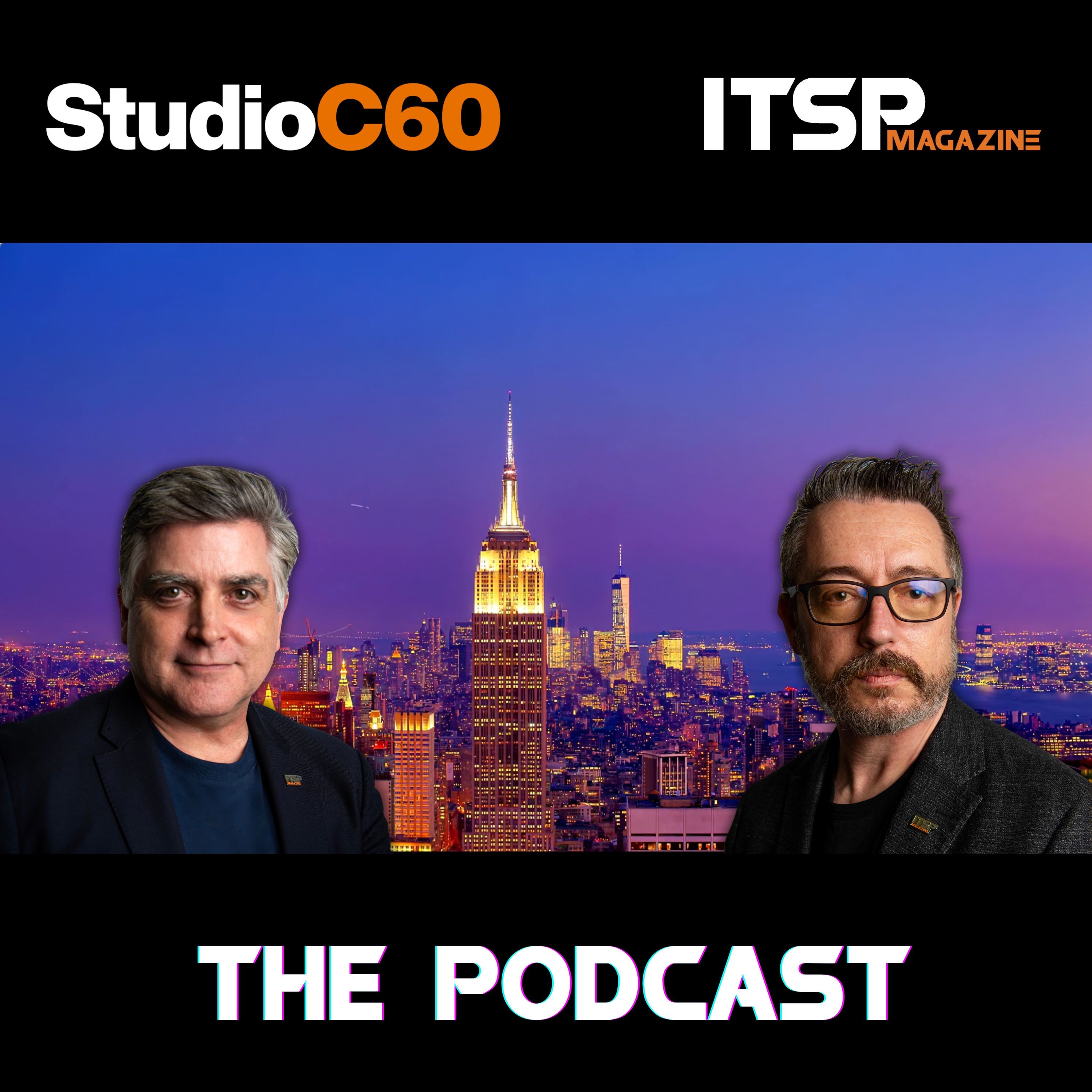
The ITSPmagazine Podcast
ITSPmagazine, Sean Martin, Marco Ciappelli
Founded in 2015, ITSPmagazine began as a vision for a publication positioned at the critical intersection of technology, cybersecurity, and society. What started as a written publication has evolved into a comprehensive repository for all their content—podcasts, articles, event coverage, interviews, videos, panels, and everything they create.
This is where Sean Martin and Marco Ciappelli talk about cybersecurity, technology, society, music, storytelling, branding, conference coverage, and whatever else catches their attention. Over a decade of conversations exploring how these worlds collide, influence each other, and shape the human experience.
This is where you'll find it all.
This is where Sean Martin and Marco Ciappelli talk about cybersecurity, technology, society, music, storytelling, branding, conference coverage, and whatever else catches their attention. Over a decade of conversations exploring how these worlds collide, influence each other, and shape the human experience.
This is where you'll find it all.
Episodes
Mentioned books

Jul 30, 2025 • 1h
Black Hat 2025: More Buzzwords, Same Breaches? | What’s Heating Up Before Black Hat 2025: Top Trends Set to Shake Up this Year’s Hacker Conference | An ITSPmagazine Webinar: On Location Coverage with Sean Martin and Marco Ciappelli
In this thought leadership session, ITSPmagazine co-founders Sean Martin and Marco Ciappelli moderate a dynamic conversation with five industry leaders offering their take on what will dominate the show floor and side-stage chatter at Black Hat USA 2025.Leslie Kesselring, Founder of Kesselring Communications, surfaces how media coverage is shifting in real time—no longer driven solely by talk submissions but now heavily influenced by breaking news, regulation, and public-private sector dynamics. From government briefings to cyberweapon disclosures, the pressure is on to cover what matters, not just what’s scheduled.Daniel Cuthbert, member of the Black Hat Review Board and Global Head of Security Research at Banco Santander, pushes back on the hype. He notes that while tech moves fast, security research often revisits decades-old bugs. His sharp observation? “The same bugs from the ‘90s are still showing up—sometimes discovered by researchers younger than the vulnerabilities themselves.”Michael Parisi, Chief Growth Officer at Steel Patriot Partners, shifts the conversation to operational risk. He raises concern over Model-Chained Prompting (MCP) and how AI agents can rewrite enterprise processes without visibility or traceability—especially alarming in environments lacking kill switches or proper controls.Richard Stiennon, Chief Research Analyst at IT-Harvest, offers market-level insights, forecasting AI agent saturation with over 20 vendors already present in the expo hall. While excited by real advancements, he warns of funding velocity outpacing substance and cautions against the cycle of overinvestment in vaporware.Rupesh Chokshi, SVP & GM at Akamai Technologies, brings the product and customer lens—framing the security conversation around how AI use cases are rolling out fast while security coverage is still catching up. From OT to LLMs, securing both AI and with AI is a top concern.This episode is not just about placing bets on buzzwords. It’s about uncovering what’s real, what’s noise, and what still needs fixing—no matter how long we’ve been talking about it.___________Guests:Leslie Kesselring, Founder at Cyber PR Firm Kesselring Communications | On LinkedIn: https://www.linkedin.com/in/lesliekesselring/“This year, it’s the news cycle—not the sessions—that’s driving what media cover at Black Hat.”Daniel Cuthbert, Black Hat Training Review Board and Global Head of Security Research for Banco Santander | On LinkedIn: https://www.linkedin.com/in/daniel-cuthbert0x/“Why are we still finding bugs older than the people presenting the research?”Richard Stiennon, Chief Research Analyst at IT-Harvest | On LinkedIn: https://www.linkedin.com/in/stiennon/“The urge to consolidate tools is driven by procurement—not by what defenders actually need.”Michael Parisi, Chief Growth Officer at Steel Patriot Partners | On LinkedIn: https://www.linkedin.com/in/michael-parisi-4009b2261/“Responsible AI use isn’t a policy—it’s something we have to actually implement.”Rupesh Chokshi, SVP & General Manager at Akamai Technologies | On LinkedIn: https://www.linkedin.com/in/rupeshchokshi/“The business side is racing to deploy AI—but security still hasn’t caught up.”Hosts:Sean Martin, Co-Founder at ITSPmagazine | Website: https://www.seanmartin.comMarco Ciappelli, Co-Founder at ITSPmagazine | Website: https://www.marcociappelli.com___________Episode SponsorsThreatLocker: https://itspm.ag/threatlocker-r974BlackCloak: https://itspm.ag/itspbcwebAkamai: https://itspm.ag/akamailbwcDropzoneAI: https://itspm.ag/dropzoneai-641Stellar Cyber: https://itspm.ag/stellar-9dj3___________ResourcesLearn more and catch more stories from our Black Hat USA 2025 coverage: https://www.itspmagazine.com/bhusa25ITSPmagazine Webinar: What’s Heating Up Before Black Hat 2025: Place Your Bet on the Top Trends Set to Shake Up this Year’s Hacker Conference — An ITSPmagazine Thought Leadership Webinar | https://www.crowdcast.io/c/whats-heating-up-before-black-hat-2025-place-your-bet-on-the-top-trends-set-to-shake-up-this-years-hacker-conferenceCatch all of our event coverage: https://www.itspmagazine.com/technology-and-cybersecurity-conference-coverageWant to tell your Brand Story Briefing as part of our event coverage? Learn More 👉 https://itspm.ag/evtcovbrfWant Sean and Marco to be part of your event or conference? Let Us Know 👉 https://www.itspmagazine.com/contact-us___________KEYWORDSsean martin, marco ciappelli, leslie kesselring, daniel cuthbert, richard stiennon, michael parisi, rupesh chokshi, blackhat2025, event coverage, on location, conference Hosted by Simplecast, an AdsWizz company. See pcm.adswizz.com for information about our collection and use of personal data for advertising.

Jul 30, 2025 • 32min
Making Honeypots Useful Again: Identity Security, Deception, and the Art of Detection | A Conversation with Sean Metcalf | Redefining CyberSecurity with Sean Martin
⬥GUEST⬥Sean Metcalf, Identity Security Architect at TrustedSec | On LinkedIn: https://www.linkedin.com/in/seanmmetcalf/⬥HOST⬥Host: Sean Martin, Co-Founder at ITSPmagazine and Host of Redefining CyberSecurity Podcast | On LinkedIn: https://www.linkedin.com/in/imsmartin/ | Website: https://www.seanmartin.com⬥EPISODE NOTES⬥Sean Metcalf, a frequent speaker at conferences like Black Hat, DEF CON, and RSAC, brings a sharp focus to identity security—especially within Microsoft environments like Active Directory and Entra ID. In this episode, he walks through the practical and tactical role of honeypots and deception in detecting intrusions early and with higher fidelity.While traditional detection tools often aim for broad coverage, honeypots flip the script by offering precise signal amidst the noise. Metcalf discusses how defenders can take advantage of the attacker’s need to enumerate systems and accounts after gaining access. That need becomes an opportunity to embed traps—accounts or assets that should never be touched unless someone is doing something suspicious.One core recommendation: repurpose old service accounts with long-lived passwords and believable naming conventions. These make excellent bait for Kerberoasting attempts, especially when paired with service principal names (SPNs) that mimic actual applications. Metcalf outlines how even subtle design choices—like naming conventions that fit organizational patterns—can make a honeypot more convincing and effective.He also draws a distinction between honeypots and deception technologies. While honeypots often consist of a few well-placed traps, deception platforms offer full-scale phantom environments. Regardless of approach, the goal remains the same: attackers shouldn’t be able to move around your environment without tripping over something that alerts the defender.Importantly, Metcalf emphasizes that alerts triggered by honeypots are high-value. Since no legitimate user should interact with them, they provide early warning with low false positives. He also addresses the internal politics of deploying these traps, from coordinating with IT operations to ensuring SOC teams have the right procedures in place to respond effectively.Whether you’re running a high-end deception platform or just deploying free tokens and traps, the message is clear: identity is the new perimeter, and a few strategic tripwires could mean the difference between breach detection and breach denial.⬥SPONSORS⬥LevelBlue: https://itspm.ag/attcybersecurity-3jdk3ThreatLocker: https://itspm.ag/threatlocker-r974⬥RESOURCES⬥Inspiring Post: https://www.linkedin.com/posts/activity-7353806074694541313-xzQl/Article: The Art of the Honeypot Account: Making the Unusual Look Normal: https://www.hub.trimarcsecurity.com/post/the-art-of-the-honeypot-account-making-the-unusual-look-normalArticle: Trimarc Research: Detecting Kerberoasting Activity: https://www.hub.trimarcsecurity.com/post/trimarc-research-detecting-kerberoasting-activityArticle: Detecting Password Spraying with Security Event Auditing: https://www.hub.trimarcsecurity.com/post/trimarc-research-detecting-password-spraying-with-security-event-auditing⬥ADDITIONAL INFORMATION⬥✨ More Redefining CyberSecurity Podcast: 🎧 https://www.seanmartin.com/redefining-cybersecurity-podcastRedefining CyberSecurity Podcast on YouTube:📺 https://www.youtube.com/playlist?list=PLnYu0psdcllS9aVGdiakVss9u7xgYDKYq📝 The Future of Cybersecurity Newsletter: https://www.linkedin.com/newsletters/7108625890296614912/Interested in sponsoring this show with a podcast ad placement? Learn more:👉 https://itspm.ag/podadplc Hosted by Simplecast, an AdsWizz company. See pcm.adswizz.com for information about our collection and use of personal data for advertising.

Jul 29, 2025 • 36min
Supply Chain Transparency Isn’t Just Technical—It’s a Business Imperative | A LevelBlue Brand Story with Theresa Lanowitz
As digital infrastructure becomes increasingly interwoven with third-party code, APIs, and AI-generated components, organizations are realizing they can’t ignore the origins—or the risks—of their software. Theresa Lanowitz, Chief Evangelist at LevelBlue, joins Sean Martin and Marco Ciappelli to unpack why software supply chain visibility has become a top concern not just for CISOs, but for CEOs as well.Drawing from LevelBlue’s Data and AI Accelerator Report, part of their annual Futures Report series, Theresa highlights a striking correlation: 80% of organizations with low software supply chain visibility experienced a breach in the past year, while only 6% with high visibility did. That data underscores the critical role visibility plays in reducing business risk and maintaining operational resilience.More than a technical concern, software supply chain risk is now a boardroom topic. According to the report, CEOs have the highest awareness of this risk—even more than CIOs and CISOs—because of the direct impact on brand reputation, stock value, and partner trust. As Theresa puts it, software has become the “last mile” of digital business, and that makes it everyone’s problem.The conversation explores why now is the time to act. Government regulations are increasing, adversarial attacks are intensifying, and organizations are finally beginning to connect software vulnerabilities with business outcomes. Theresa outlines four critical actions: leverage CEO awareness, understand and prioritize vulnerabilities, invest in modern security technologies, and demand transparency from third-party providers.Importantly, cybersecurity culture is emerging as a key differentiator. Companies that embed security KPIs across all business units—and align security with business priorities—are not only more secure, they’re also more agile. As software creation moves faster and more modular, the organizations that prioritize visibility and responsibility throughout the supply chain will be best positioned to adapt, grow, and protect their operations.Learn more about LevelBlue: https://itspm.ag/levelblue266f6cNote: This story contains promotional content. Learn more.Guest: Theresa Lanowitz, Chief Evangelist of AT&T Cybersecurity / LevelBlue [@LevelBlueCyber]On LinkedIn | https://www.linkedin.com/in/theresalanowitz/ResourcesTo learn more, download the complete findings of the LevelBlue Threat Trends Report here: https://itspm.ag/levelbyqdpTo download the 2025 LevelBlue Data Accelerator: Software Supply Chain and Cybersecurity report, visit: https://itspm.ag/lbdaf6iLearn more and catch more stories from LevelBlue: https://www.itspmagazine.com/directory/levelblueLearn more about ITSPmagazine Brand Story Podcasts: https://www.itspmagazine.com/purchase-programsNewsletter Archive: https://www.linkedin.com/newsletters/tune-into-the-latest-podcasts-7109347022809309184/Business Newsletter Signup: https://www.itspmagazine.com/itspmagazine-business-updates-sign-upAre you interested in telling your story?https://www.itspmagazine.com/telling-your-story Hosted by Simplecast, an AdsWizz company. See pcm.adswizz.com for information about our collection and use of personal data for advertising.

Jul 29, 2025 • 18min
ThreatLocker to Unveil Game-Changing Zero Trust Innovations at Black Hat 2025 | Visit Them at Booth #1933 | A ThreatLocker Pre-Event Coverage of Black Hat USA 2025 Las Vegas | Brand Story with John Lilliston
ThreatLocker to Unveil Game-Changing Zero Trust Innovations at Black Hat 2025 | Visit Them at Booth #1933 | A ThreatLocker Pre-Event Coverage of Black Hat USA 2025 Las Vegas | Brand Story with John LillistonJoin ITSP Magazine's Marco Ciappelli and Sean Martin as they preview ThreatLocker's exciting Black Hat 2025 presence with Detect Product Director John Lilliston. Discover upcoming major announcements, hands-on hacking demos, and how ThreatLocker's default deny approach is revolutionizing enterprise cybersecurity through comprehensive zero trust implementation.As Black Hat USA 2025 approaches, cybersecurity professionals are gearing up for one of the industry's most anticipated events. ITSP Magazine's Marco Ciappelli and Sean Martin recently sat down with John Lilliston, ThreatLocker's Detect Product Director, to preview what promises to be an exciting showcase of zero trust innovation at booth 1933.ThreatLocker has become synonymous with the "default deny" security approach, a philosophy that fundamentally changes how organizations protect their digital assets. Unlike traditional security models that allow by default and block known threats, ThreatLocker's approach denies everything by default and allows only approved applications, network communications, and storage operations. This comprehensive strategy operates across application, network, and storage levels, creating what Lilliston describes as a "hardened system that stops adversaries in their tracks."The company's rapid growth reflects the industry's embrace of zero trust principles, moving beyond buzzword status to practical, enterprise-ready solutions. Lilliston, who joined ThreatLocker in February after evaluating their products from the enterprise side, emphasizes how the platform's learning mode and ring fencing capabilities set it apart from competitors in the application control space.At Black Hat 2025, ThreatLocker will demonstrate their defense-in-depth strategy through their Detect product line. While their primary zero trust controls rarely fail, Detect provides crucial monitoring for applications that must run in enterprise environments but may have elevated risk profiles. The system can automatically orchestrate responses to threats, such as locking down browsers exhibiting irregular behavior that might indicate data exfiltration attempts.Visitors to booth 1933 can expect hands-on demonstrations and on-demand hacking scenarios that showcase real-world applications of ThreatLocker's technology. The company is preparing major announcements that CEO Danny Houlihan will reveal during the event, promising game-changing developments for both the organization and its client base.ThreatLocker's Black Hat agenda includes a welcome reception on Tuesday, August 5th, from 7-10 PM at the Mandalay Bay Complex, and Houlihan's presentation on "Simplifying Cybersecurity" on Thursday, August 7th, from 10:15-11:05 AM at Mandalay Bay J.The convergence of practical zero trust implementation, cutting-edge threat detection, and automated response capabilities positions ThreatLocker as a key player in the evolving cybersecurity landscape, making their Black Hat presence essential viewing for security professionals seeking comprehensive protection strategies.Keywords: Black Hat 2025, zero trust security, cybersecurity conference, ThreatLocker, default deny strategy, endpoint protection, application control, threat detection, enterprise security, network security, cybersecurity solutions, security automation, malware prevention, cyber threats, information security, security platform, Black Hat USA, cybersecurity innovation, managed detection response, security operationsLearn more about ThreatLocker: https://itspm.ag/threatlocker-r974Note: This story contains promotional content.Learn more.Guests:John LillistonCybersecurity Director | Threat Detection & Response | SOC Leadership | DFIR | EDR/XDR Strategy | GCFA, GISP | https://www.linkedin.com/in/john-lilliston-4725217b/Hosts:Sean Martin, Co-Founder at ITSPmagazine | Website: https://www.seanmartin.comMarco Ciappelli, Co-Founder at ITSPmagazine | Website: https://www.marcociappelli.com______________________ResourcesLearn more and catch more stories from ThreatLocker: https://www.itspmagazine.com/directory/threatlockerThreatLocker® Welcome Reception | Don't gamble with your security! Join us at Black Hat for a lively Welcome Reception hosted by ThreatLocker®. Meet our Cyber Hero® Team and dive into discussions on the latest advancements in ThreatLocker®Endpoint Security. It's a great opportunity to connect and learn together! Time: 7PM - 10PM | Location: Mandalay Bay Complex RSVP below and we'll send you a confirmation email with all the details.[ Welcome Reception RSVP ]Learn more about ITSPmagazine Brand Story Podcasts: https://www.itspmagazine.com/purchase-programsNewsletter Archive: https://www.linkedin.com/newsletters/tune-into-the-latest-podcasts-7109347022809309184/Business Newsletter Signup: https://www.itspmagazine.com/itspmagazine-business-updates-sign-upAre you interested in telling your story?https://www.itspmagazine.com/telling-your-story Hosted by Simplecast, an AdsWizz company. See pcm.adswizz.com for information about our collection and use of personal data for advertising.

Jul 25, 2025 • 50min
From Black Hat to Black Sabbath / Ozzy: AI Agents and Guitars (again!) + Entry Level Cybersecurity Jobs, Robots Evolution, and the Weekly Recap You Didn’t Expect | Random and Unscripted Weekly Update with Sean Martin and Marco Ciappelli
ITSPmagazine Weekly Update | From Black Hat to Black Sabbath / Ozzy: AI Agents and Guitars (again!) + Entry Level Cybersecurity Jobs, Robots Evolution, and the Weekly Recap You Didn’t Expect - On Marco & Sean's Random & Unscripted Podcast __________________Marco Ciappelli and Sean Martin are back with another random and unscripted weekly recap—from pre-Black Hat buzz and AI agents to vintage wood guitars, talent gaps, and Glen Miller debates. This week’s reflection hits tech, music, and philosophy in all the right ways. Tune in, ramble with us, and subscribe. __________________Full Blog Article This week’s recap was a ride.Sean and I kicked things off with the big news: we’re officially consistent. Weekly recap number… I lost count. But we’re doing it. We covered what ITSPmagazine’s been working on, what we’ve been publishing, and where our minds are wandering lately (spoiler: everywhere).Black Hat USA 2025 is just around the corner, and we’re deep into prep mode. I even bought a paper map. Why? I don’t know. But we’ve got some great pre-event conversations already out—like our annual chat with Black Hat GM Steve Wylie, plus briefings with Dropzone AI (get ready for “agentic automation” to be the next big buzzword) and Akamai (yes, bots and APIs again, but with a solid strategy twist).We also talked about a fantastic episode Sean did on resonance and reinvention—featuring Cindy, a luthier in NYC who builds custom guitars using century-old beams from historic buildings. The pickups even use the old nails. Music and wood with a past life. It’s beautiful stuff.Speaking of stories, I officially closed down the Storytelling podcast. But don’t worry—I’m still telling stories. I’ve just shifted focus to “Redefining Society and Technology,” my newsletter and podcast series where I explore how humans and tech evolve together. This week’s edition tackled the merging of humans and machines as a new species. Isaac Asimov meets Andy Clark.We also got a bit philosophical about AI and jobs. If machines take over the “easy” roles, where do humans begin? Are we cutting off our own training paths?Sean’s episode with John Solomon dug into the cybersecurity hiring crisis—challenging the idea that we have a “talent gap.” The real issue? We’re not hiring or nurturing people properly.Oh, and I finally released my long-overdue interview with Michael Sheldrick from Global Citizen. Music. Social impact. Doing good. It’s all there. I’m honored to support even a small piece of what he’s building.And yes… Ozzy. RIP. Music never dies.So if you’re into random reflections with meaning, tech with humanity, and stories that don’t always follow the rules—subscribe, share, and join the ride.See you in Vegas. Or the future. Or somewhere in between.________________ KeywordsBlack Hat USA 2025, ITSPmagazine recap, Marco Ciappelli, Sean Martin, cybersecurity podcast, AI in cybersecurity, agentic automation, Dropzone AI, Akamai APIs, HITRUST security, Global Citizen, Michael Sheldrick, storytelling podcast, Redefining Society, Andy Clark, Isaac Asimov, human-machine evolution, cybersecurity talent gap, custom guitar NYC, Ozzy tributeHosts links:📌 Marco Ciappelli: https://www.marcociappelli.com📌 Sean Martin: https://www.seanmartin.com Hosted by Simplecast, an AdsWizz company. See pcm.adswizz.com for information about our collection and use of personal data for advertising.
Jul 25, 2025 • 22min
Bots, APIs, and Runtime Risk: What Exposures Are Driving AI Security Innovation in 2025 | An Akamai Pre-Event Coverage of Black Hat USA 2025 Las Vegas | Brand Story with Rupesh Chokshi
Ahead of Black Hat USA 2025, Sean Martin and Marco Ciappelli sit down once again with Rupesh Chokshi, Senior Vice President and General Manager of the Application Security Group at Akamai, for a forward-looking conversation on the state of AI security. From new threat trends to enterprise missteps, Rupesh lays out three focal points for this year’s security conversation: protecting generative AI at runtime, addressing the surge in AI scraper bots, and defending the APIs that serve as the foundation for AI systems.Rupesh shares that Akamai is now detecting over 150 billion AI scraping attempts—a staggering signal of the scale and sophistication of machine-to-machine activity. These scraper bots are not only siphoning off data but also undermining digital business models by bypassing monetization channels, especially in publishing, media, and content-driven sectors.While AI introduces productivity gains and operational efficiency, it also introduces new and uncharted risks. Agentic AI, where autonomous systems operate on behalf of users or other systems, is pushing cybersecurity teams to rethink their strategies. Traditional firewalls aren’t enough—because these threats don’t behave like yesterday’s attacks. Prompt injection, toxic output, and AI-generated hallucinations are some of the issues now surfacing in enterprise environments, with over 70% of organizations already experiencing AI-related incidents.This brings the focus to the runtime. Akamai’s newly launched Firewall for AI is purpose-built to detect and mitigate risks in generative AI and LLM applications—without disrupting performance. Designed to flag issues like toxic output, remote code execution, or compliance violations, it operates with real-time visibility across inputs and outputs. It’s not just about defense—it’s about building trust as AI moves deeper into decision-making and workflow automation.CISOs, says Rupesh, need to shift from high-level discussions to deep, tactical understanding of where and how their organizations are deploying AI. This means not only securing AI but also working hand-in-hand with the business to establish governance, drive discovery, and embed security into the fabric of innovation.Learn more about Akamai: https://itspm.ag/akamailbwcNote: This story contains promotional content. Learn more.Guests:Rupesh Chokshi, SVP & General Manager, Application Security, Akamai | https://www.linkedin.com/in/rupeshchokshi/Hosts:Sean Martin, Co-Founder at ITSPmagazine | Website: https://www.seanmartin.comMarco Ciappelli, Co-Founder at ITSPmagazine | Website: https://www.marcociappelli.com______________________ResourcesLearn more and catch more stories from Akamai: https://www.itspmagazine.com/directory/akamaiLearn more about ITSPmagazine Brand Story Podcasts: https://www.itspmagazine.com/purchase-programsNewsletter Archive: https://www.linkedin.com/newsletters/tune-into-the-latest-podcasts-7109347022809309184/Business Newsletter Signup: https://www.itspmagazine.com/itspmagazine-business-updates-sign-upAre you interested in telling your story?https://www.itspmagazine.com/telling-your-story Hosted by Simplecast, an AdsWizz company. See pcm.adswizz.com for information about our collection and use of personal data for advertising.

Jul 24, 2025 • 49min
How to Hack Global Activism with Tech, Music, and Purpose: A Conversation with Michael Sheldrick, Co-Founder of Global Citizen and Author of the book: “From Ideas to Impact” | Redefining Society And Technology Podcast With Marco Ciappelli
⸻ Podcast: Redefining Society and Technologyhttps://redefiningsocietyandtechnologypodcast.com Title: How to hack Global Activism with Tech, Music, and Purpose: A Conversation with Michael Sheldrick, Co-Founder of Global Citizen and Author of “From Ideas to Impact”Guest: Michael SheldrickCo-Founder, Global Citizen | Author of “From Ideas to Impact” (Wiley 2024) | Professor, Columbia University | Speaker, Board Member and Forbes.com ContributorWebSite: https://michaelsheldrick.comOn LinkedIn: https://www.linkedin.com/in/michael-sheldrick-30364051/Global Citizen: https://www.globalcitizen.org/Host: Marco CiappelliCo-Founder & CMO @ITSPmagazine | Master Degree in Political Science - Sociology of Communication l Branding & Marketing Consultant | Journalist | Writer | Podcasts: Technology, Cybersecurity, Society, and Storytelling.WebSite: https://marcociappelli.comOn LinkedIn: https://www.linkedin.com/in/marco-ciappelli/_____________________________This Episode’s SponsorsBlackCloak provides concierge cybersecurity protection to corporate executives and high-net-worth individuals to protect against hacking, reputational loss, financial loss, and the impacts of a corporate data breach.BlackCloak: https://itspm.ag/itspbcweb_____________________________⸻ Podcast Summary ⸻ Michael Sheldrick returns to Redefining Society and Technology to share how Global Citizen has mobilized billions in aid and inspired millions through music, tech, and collective action. From social media activism to systemic change, this conversation explores how creativity and innovation can fuel a global movement for good.⸻ Article ⸻ Sometimes, the best stories are the ones that keep unfolding — and Michael Sheldrick’s journey is exactly that. When we first spoke, Global Citizen had just (almost) released their book From Ideas to Impact. This time, I invited Michael back on Redefining Society and Technology because his story didn’t stop at the last chapter.From a high school student in Western Australia who doubted his own potential, to co-founding one of the most influential global advocacy movements — Michael’s path is a testament to what belief and purpose can spark. And when purpose is paired with music, technology, and strategic activism? That’s where the real magic happens.In this episode, we dig into how Global Citizen took the power of pop culture and built a model for global change. Picture this: a concert ticket you don’t buy, but earn by taking action. Signing petitions, tweeting for change, amplifying causes — that’s the currency. It’s simple, smart, and deeply human.Michael shared how artists like John Legend and Coldplay joined their mission not just to play music, but to move policy. And they did — unlocking over $40 billion in commitments, impacting a billion lives. That’s not just influence. That’s impact.We also talked about the role of technology. AI, translation tools, Salesforce dashboards, even Substack — they’re not just part of the story, they’re the infrastructure. From grant-writing to movement-building, Global Citizen’s success is proof that the right tools in the right hands can scale change fast.Most of all, I loved hearing how digital actions — even small ones — ripple out globally. A girl in Shanghai watching a livestream. A father in Utah supporting his daughters’ activism. The digital isn’t just real — it’s redefining what real means.As we wrapped, Michael teased a new bonus chapter he’s releasing, The Innovator. Naturally, I asked him back when it drops. Because this conversation isn’t just about what’s been done — it’s about what comes next.So if you’re wondering where to start, just remember Eleanor Roosevelt’s quote Michael brought back:“The way to begin is to begin.”Download the app. Take one action. The world is listening.Cheers,Marco⸻ Keywords ⸻ Society and Technology, AI ethics, generative AI, tech innovation, digital transformation, tech, technology, Global Citizen, Michael Sheldrick, ending poverty, pop culture activism, technology for good, social impact, digital advocacy, Redefining Society, AI in nonprofits, youth engagement, music and change, activism app, social movements, John Legend, sustainable development, global action, climate change, eradicating polio, tech for humanity, podcast on technology__________________ Enjoy. Reflect. Share with your fellow humans.And if you haven’t already, subscribe to Musing On Society & Technology on LinkedIn — new transmissions are always incoming.https://www.linkedin.com/newsletters/musing-on-society-technology-7079849705156870144You’re listening to this through the Redefining Society & Technology podcast, so while you’re here, make sure to follow the show — and join me as I continue exploring life in this Hybrid Analog Digital Society.End of transmission.____________________________Listen to more Redefining Society & Technology stories and subscribe to the podcast:👉 https://redefiningsocietyandtechnologypodcast.comWatch the webcast version on-demand on YouTube:👉 https://www.youtube.com/playlist?list=PLnYu0psdcllTUoWMGGQHlGVZA575VtGr9Are you interested Promotional Brand Stories for your Company and Sponsoring an ITSPmagazine Channel?👉 https://www.itspmagazine.com/advertise-on-itspmagazine-podcast Hosted by Simplecast, an AdsWizz company. See pcm.adswizz.com for information about our collection and use of personal data for advertising.
Jul 23, 2025 • 42min
Hiring for the Present Is Hurting the Future of Cybersecurity: Why “Entry-Level” Rarely Means Entry | A Conversation with John Salomon | Redefining CyberSecurity with Sean Martin
⬥GUEST⬥John Salomon, Board Member, Cybersecurity Advisors Network (CyAN) | On LinkedIn: https://www.linkedin.com/in/johnsalomon/⬥HOST⬥Host: Sean Martin, Co-Founder at ITSPmagazine and Host of Redefining CyberSecurity Podcast | On LinkedIn: https://www.linkedin.com/in/imsmartin/ | Website: https://www.seanmartin.com⬥EPISODE NOTES⬥The cybersecurity industry keeps repeating a familiar line: there’s a shortage of talent. But what if the real issue isn’t the number of people—but the lack of access, mentorship, and investment in human potential?In this episode of Redefining CyberSecurity, Sean Martin speaks with John Salomon, an independent cybersecurity consultant and a contributor to the Cybersecurity Advisors Network (CyAN), about how the hiring structure in our industry may be the problem—not the solution. Together, they explore why entry-level roles rarely provide an actual point of entry, and how hiring practices have been shaped more by finance and compliance than by people development.Salomon draws on decades of experience to outline the problem: security is often treated as a pure cost center, so training and mentorship are deprioritized. Early-career professionals are expected to be “job-ready” from day one, and organizations rarely account for the long-term payoff of investing in apprenticeships or junior hires.He also points to the silent collapse of informal mentorship that once defined the field. Leaders used to take risks on new talent. Now, hiring decisions are driven by headcount limitations and performance metrics that leave no room for experimentation or learning through failure.The conversation shifts toward action. Business and security leaders need to reframe cybersecurity as a growth enabler and start viewing mentorship as a risk mitigation tool. Investing in new talent not only strengthens your team—it supports the stability of the industry as a whole.And it’s not just on companies. Universities and student organizations must create more opportunities for experiential learning and interdisciplinary collaboration. Leaders can support these efforts with time, not just budget, by showing up and sharing what they’ve learned.Whether you’re a CISO, founder, or just getting started, this episode challenges the idea that “mentorship is nice to have” and shows how it’s a cornerstone of sustainable cybersecurity.⬥SPONSORS⬥LevelBlue: https://itspm.ag/attcybersecurity-3jdk3ThreatLocker: https://itspm.ag/threatlocker-r974⬥RESOURCES⬥Inspiring Post: https://www.linkedin.com/posts/activity-7332679935557300224-1lBv/⬥ADDITIONAL INFORMATION⬥✨ More Redefining CyberSecurity Podcast: 🎧 https://www.seanmartin.com/redefining-cybersecurity-podcastRedefining CyberSecurity Podcast on YouTube:📺 https://www.youtube.com/playlist?list=PLnYu0psdcllS9aVGdiakVss9u7xgYDKYq📝 The Future of Cybersecurity Newsletter: https://www.linkedin.com/newsletters/7108625890296614912/Interested in sponsoring this show with a podcast ad placement? Learn more:👉 https://itspm.ag/podadplc Hosted by Simplecast, an AdsWizz company. See pcm.adswizz.com for information about our collection and use of personal data for advertising.
Jul 23, 2025 • 20min
Dropzone AI Brings Agentic Automation to Black Hat USA 2025 | A DROP ZONE AI Pre Event Coverage of Black Hat USA 2025 Las Vegas | Brand Story with Edward Wu Founder/CEO at Dropzone AI
As Black Hat USA 2025 approaches, the cybersecurity world is buzzing with innovation—and Dropzone AI is right at the center of it. With roots in Seattle and a mission to bring true intelligence into the security operations center (SOC), the Dropzone AI team is gearing up for a packed week in Las Vegas, from BSides to the AI Summit, and finally at Startup City (booth #6427).Founded by Edward Wu, former Head of AI/ML at ExtraHop Networks, Dropzone AI was built on a key realization: the last thing SOCs need is another flood of alerts. Instead, they need help processing and acting on them. That’s where Dropzone comes in—offering an AI-powered security analyst that doesn’t just detect threats, but investigates, correlates, and takes action.During a recent pre-event chat with ITSPmagazine’s Sean Martin and Marco Ciappelli, Edward explained the core philosophy behind the platform. Unlike hype-driven claims of “fully autonomous SOCs,” Dropzone takes a practical, tiered approach to automation. Their agentic AI system performs full investigations, determines the nature of alerts (true vs. false positives), and recommends or executes containment actions depending on risk tolerance and policy.The tech has found particular traction with lean security teams, or those expanding toward 24/7 coverage without adding headcount. Rather than replacing humans, the platform augments them—freeing analysts from the drudgery of low-priority alert triage and giving them space to focus on strategic work. As Edward put it, “Nobody wants to be a tier-one analyst forever.” Dropzone helps make sure they don’t have to be.The platform integrates across existing security stacks and data sources, drawing from threat intel, logs, and endpoint signals to build a full picture of every alert. Security teams retain full control, with human-in-the-loop decision-making remaining the standard in most use cases. However, for low-risk assets and off-hours scenarios, some customers are already authorizing autonomous action.With conversations at Black Hat expected to revolve around the reality of AI in production—not just the vision—Dropzone is entering the perfect arena. From demonstrating real-world impact to sharing insights on agentic design and trust boundaries, their presence will resonate with everyone from analysts to CISOs.Whether you’re building out your SOC, questioning your MDR provider, or simply overwhelmed with alert fatigue, this may be your signal. Dropzone AI isn’t selling buzzwords. They’re delivering results. Visit them at Startup City, booth #6427, and see for yourself what the future of alert triage and SOC efficiency looks like—one investigation at a time. Note: This story contains promotional content. Learn more.Guests:Edward Wu, Founder/CEO at Dropzone AI On LinkedIn: https://www.linkedin.com/in/edwardxwu/DROPZONE AI: https://itspm.ag/dropzoneai-641Hosts:Sean Martin, Co-Founder at ITSPmagazine | Website: https://www.seanmartin.comMarco Ciappelli, Co-Founder at ITSPmagazine | Website: https://www.marcociappelli.com______________________ResourcesVisit the DROPZONE Website to learn more: https://itspm.ag/dropzoneai-641Learn more and catch more stories from Dropzone on ITSPmagazine: https://www.itspmagazine.com/directory/dropzoneaiLearn more about ITSPmagazine Brand Story Podcasts: https://www.itspmagazine.com/purchase-programsNewsletter Archive: https://www.linkedin.com/newsletters/tune-into-the-latest-podcasts-7109347022809309184/Business Newsletter Signup: https://www.itspmagazine.com/itspmagazine-business-updates-sign-upAre you interested in telling your story?https://www.itspmagazine.com/telling-your-story Hosted by Simplecast, an AdsWizz company. See pcm.adswizz.com for information about our collection and use of personal data for advertising.

Jul 22, 2025 • 24min
Resonance and Reinvention: Crafting Sound from Salvaged History | A Conversation with Cindy Hulej | Music Evolves with Sean Martin
Guest and HostGuest: Cindy Hulej, Luthier/Artist | Website: https://www.cindyguitars.com/Host: Sean Martin, Co-Founder at ITSPmagazine and Host of Redefining CyberSecurity Podcast & Music Evolves Podcast | Website: https://www.seanmartin.com/Show NotesWhat happens when the story of a city becomes part of the music we make? In this episode of Music Evolves, host Sean Martin sits down with luthier and artist Cindy Hulej of Cindy Guitars to explore how reclaimed wood from historic New York buildings is transformed into custom electric guitars—each one uniquely shaped by memory, material, and imagination.Craft as InnovationCindy’s process at Carmine Street Guitars isn’t just about building instruments—it’s about listening to what the material has to say. The beams salvaged from landmarks like the Chelsea Hotel and John Lennon’s former home aren’t just structural—they carry decades of vibration, weather, and presence. That physical history directly shapes how these guitars sound, feel, and resonate—offering a kind of analog innovation rooted in human touch and intention.Cindy describes how she and her husband Johnny repurpose old beams, often salvaged from 1800s-era buildings, and transform them into guitars that are not only playable but deeply resonant—physically and emotionally. The aged wood, shaped by centuries of seasonal change, yields a tone that’s warm and chimey, with a resonance modern lumber can’t match. “You’re working with material that’s already lived a hundred lives,” she explains. “You just have to unlock the next one.”Creativity Beyond ConventionEach guitar is made by hand, down to the smallest detail. From collaborating with boutique pickup winders to mixing finishes from shellac flakes, Cindy builds instruments that are both sonic and visual statements. No two are alike—because the creative process isn’t about repeating perfection, it’s about shaping something personal and alive. Whether players come with a precise vision or just a feeling, Cindy helps translate that into tone and form.Reimagining the Past to Shape the FutureThis isn’t just about guitars. It’s about the convergence of history, artistry, community, and sound. This episode challenges the idea that innovation must come from new tech or flashy trends. Sometimes, the most meaningful advances come from rethinking old materials and techniques.Cindy’s guitars are a form of living history—reminding us that sound isn’t just produced, it’s inherited, interpreted, and carried forward. And, Cindy’s path from bartending to building some of the most soulful instruments in New York is a reminder that craft isn’t just skill—it’s commitment to meaning.About Rick Kelly and Carmine Street GuitarsCarmine Street Guitars, located in New York City’s Greenwich Village, is a hand-built electric guitar workshop led by legendary luthier Rick Kelly. Known for using reclaimed old-growth wood from historic buildings across the city, Rick has built instruments for renowned musicians such as Lou Reed, Patti Smith, Bob Dylan, and many others. His approach blends time-honored techniques with a reverence for the city’s past, crafting guitars that are as storied as the musicians who play them. At the heart of the shop’s ethos is a commitment to individuality, craftsmanship, and sonic integrity—values continued today through Cindy Guitars and the growing creative community within the space.SponsorsAre you interested in sponsoring this show or placing an ad in the podcast?Sponsorship 👉 https://itspm.ag/annual-sponsorshipAd Placement 👉 https://itspm.ag/podadplcResourcesCarmine Street Guitars: https://carminestreetguitars.comMore From Sean Martin on ITSPmagazineMore from Music Evolves: https://www.seanmartin.com/music-evolves-podcastMusic Evolves on YouTube: https://www.youtube.com/playlist?list=PLnYu0psdcllTRJ5du7hFDXjiugu-uNPtWOn Location with Sean and Marco: https://www.itspmagazine.com/on-locationITSPmagazine YouTube Channel: https://www.youtube.com/@itspmagazineBe sure to share and subscribe! Hosted by Simplecast, an AdsWizz company. See pcm.adswizz.com for information about our collection and use of personal data for advertising.

