

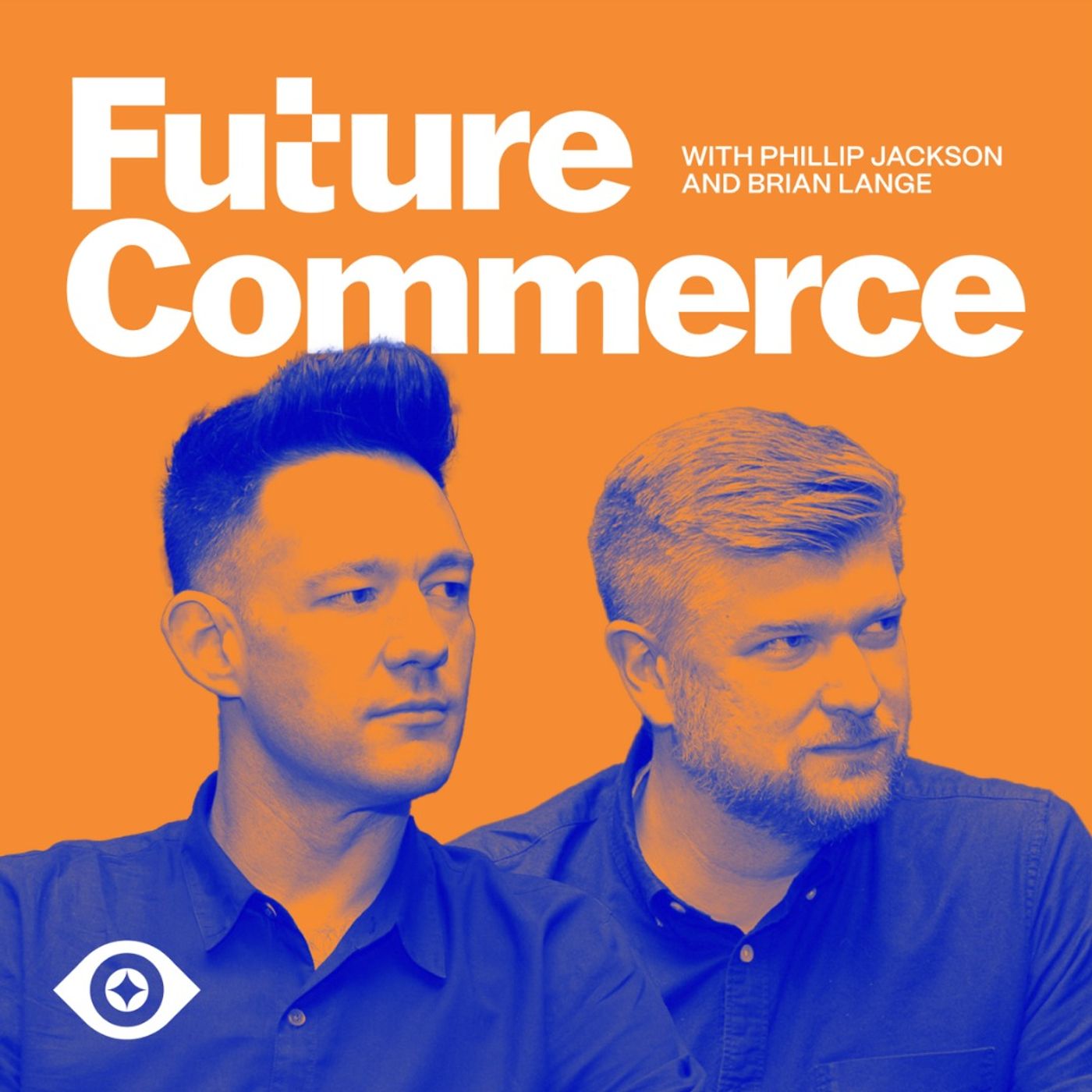
Future Commerce
Phillip Jackson, Brian Lange
Future Commerce is the culture magazine for Commerce. Hosts Phillip Jackson and Brian Lange help brand and digital marketing leaders see around the next corner by exploring the intersection of Culture and Commerce.
Trusted by the world's most recognizable brands to deliver the most insightful, entertaining, and informative weekly podcasts, Future Commerce is the leading new media brand for eCommerce merchants and retail operators.
Each week, we explore the cultural implications of what it means to sell or buy products and how commerce and media impact the culture and the world around us, through unique insights and engaging interviews with a dash of futurism.
Weekly essays, full transcripts, and quarterly market research reports are available at https://www.futurecommerce.com/plus
Trusted by the world's most recognizable brands to deliver the most insightful, entertaining, and informative weekly podcasts, Future Commerce is the leading new media brand for eCommerce merchants and retail operators.
Each week, we explore the cultural implications of what it means to sell or buy products and how commerce and media impact the culture and the world around us, through unique insights and engaging interviews with a dash of futurism.
Weekly essays, full transcripts, and quarterly market research reports are available at https://www.futurecommerce.com/plus
Episodes
Mentioned books

May 6, 2019 • 50min
"Are We Being Fairly Compensated For Our Data?" (w/ Danny Sepulveda, VP for Global Government Relations @ Media Math)
Former Ambassador and Deputy Assistant Secretary Daniel Sepulveda joins us to talk about Privacy, CCPA, GDPR, and the fundamental right to control our own data. Listen now!
Show Notes:
Main Takeaways:
With all the talk about digital privacy, how that data being used is a question many are asking, and former Ambassador and Assistant Secretary Danny Sepulveda is here to talk data and everything that comes along with it.
In 2018 California passage passed a data privacy law, will other states follow suit in 2019?
There are three big service providers when it comes to Big Data, do we even have to name them anymore?
The genie is out of the bottle on data itself, but there needs to be context around how that data is being used, especially by massive companies with unparalleled power.
California Set a Standard For Data Privacy Laws: Will Other States Follow Suit?
Future Commerce is beyond excited to haveformer Ambassador and Assistant Secretary Danny Sepulveda on the show, Danny is currently the VP of Government Relations at Media Math.
Brian wonders if someone will someone show up to the Senate in high-end denim at some point?
Brian says that how corporations use and utilize data is one of the most critical issues of our micro-generation.
So CCPA: or the California Consumer Privacy Act, has set a standard for states to set limits on what big corporations can do with their users' data.
Brian asks Danny if other states will follow California's example, and what is being done on a federal level?
New Jersey and Illinois both have begun to discuss digital privacy laws similar to the CCPA.
No One Won in Washington State: Is Data Privacy Partisan?
In New Jersey, AB 4902, would give users actual control over their personal data privacy.
A 2008 law passed in Illinois bans companies from using a person's scans of people's faces, irises, and fingerprints without consent, and that formerly hypothetical situation has become very real now.
Brian and Danny agree that the genie is pretty much out of the bottle when it comes to this new data-driven society.
In Washington state, the Washington Privacy Act failed to pass the house of representatives, for a multi-layered partisan reason.
Will companies step up to the plate to help retailers comply with CCPA and emerging regulations surrounding digital privacy?
2020 is Heating up: Why Everyone Cares About Silicon Valey:
So are any campaigns jumping on the digital-privacy bandwagon for 2020?
Both Elizabeth Warren and Amy Klobuchar have spoken about the need to modify and reform current anti-trust laws.
It's pretty troubling that there is an incredible amount of power being concentrated in Silicon Valley.
One of Danny's wishes for consumers in this data-driven market is that they can be seen the way they as the consumer wish to be seen.
Danny Sepulveda's Perscription to Merchants: Now And Later:
One of the ways Brian recommends that retailers can get ahead of this data overload is to collect their own data for customers so that they don't have to get it from someplace else down the road.
Brian asks Danny what his recommendations are for retailers and merchants, long-term and short-term.
Danny says in the short term, retailers need to be focused on building relationships and maintaining relationships with clients and continue providing value.
In the long term, Danny says it is imperative for companies to have in-house team members that know as much about the technology being utilized as the tech companies they partner with.
Go over to Futurecommerce.fm and give us your feedback! We love to hear from our listeners!
Retail Tech is moving fast, and Future Commerce is moving faster. Hosted by Simplecast, an AdsWizz company. See pcm.adswizz.com for information about our collection and use of personal data for advertising.

Apr 26, 2019 • 49min
"Deliciously Sinful" - Brand Sustainability in the Age of Impulse Luxury (w/ Ingrid Milman)
Ingrid Milman (Ann Taylor, LOFT) sits in this week in our Earth Week deep-dive to discuss sustainability, transparency in supply chain, and "deliciously sinful" luxury impulse buys. Who has the true influence on the eco-conscious purchase decision - the brand or the consumer? How can fashion lead the conversation in transparent supply chain and manufacturing processes? Featured brands this week: Outdoor Voices, Rent the Runway, Reformation, H&M, Allbirds and more. Listen now!
Show Notes:
Main Takeaways:
Director of Digital at Ann Inc, Ingrid Millman, is co-hosting this week.
Earth Day has turned into Earth Week and, there are lots of sustainability stories to share.
Can rental Services like Rent the Runway find a way to make dry-cleaning more eco-friendly?
Instagram ads somehow turned Phillip into a sneakerhead.
Earth Day Becomes Earth Week: Capitalizing on Saving The Planet:
Before we get into Earth Day, Ann Inc has a new rewards program, and for the first time, customers receive rewards for spending across the entire portfolio.
Also, Ingrid's professional views expressed on FC do not reflect those of her employer.
Anyways, Rent the Runway used Earth Day 2019 to publish its sustainability report on Twitter, showing how RTR as a service is helping to reduce waste.
Ingrid loves Rent the Runway, and has been a long time subscriber, even pre-unlimited, but feels that if RTR wants to be genuinely sustainable, the company will need to look into more eco-friendly dry cleaning options.
Phillip says that RTR is the Uber of dry cleaning, they partner with local dry cleaners to get all of the clothes dry cleaned consistently.
Phillip points out that three years ago, Rent the Runway would have gone to IPO.
Everything is Re-sellable in 2019: People Are DIYing Marie Condo:
Ingrid is obsessed with the Marie Condo effect and the results from its popularity.
There's been a surge in the number of people utilizing both physical thrift stores, and online platforms like Poshmark, thredUP, and luxury re-sell platforms like The RealReal.
Ingrid points out that there needs to be a change to the way these resell platforms operate: namely that there needs to be more of a focus on creating solutions for their customers. As of now, there's not a lot of value proposition outside of general resell.
Phillip doesn't know if he trusts the resale market, and questions if perhaps if companies are posing as third-party sellers.
Phillip also blames Instagram for turning him into a sneakerhead, because Instagram forces him to buy an insane amount of sneakers through their targeted advertising.
Has retail followed more of a meme culture than an influencer culture?
Ingrid makes a fascinating point: Many people develop their actual sense of style in High School and/or college, but they cannot usually afford to outfit that style entirely, but people in their 30's are targeted by luxury brands more because they have a wholly different purchasing power, and now can make "deliciously sinful" luxury purchases.
Sustainability as a Search Term: Will Legacy Brands Adapt?
Ingrid has noticed a trend with Google search terms, including sustainability, cotton fiber, dress garments, and for some reason the brand Free People.
Phillip poses a question regarding sustainability: Do consumers care about sustainability because of the PR push that the brands they trust are putting out? Or are brands increasing their PR around sustainability because they know their customer care about it?
Ingrid makes a great point that GenX and anyone near that age group cares less about sustainability because it's not on their radar, as opposed to millennials (and anyone under 35), who may make sustainability a key focus of their purchasing choices.
If legacy brands want to pick up a younger customer, then they are going to have to put a much larger focus on sustainability efforts.
This is especially true considering how many younger brands are beginning their brands with eco-friendly products like Allbirds.
Earthday 2019: Brands Are Stepping up Sustainable Efforts:
So in honor of Earth Week, Ingrid and Phillip are sharing some brands that are truly pushing sustainability.
One such brand is The Reformation, who has a seriously sustainable slogan: "Being naked is the #1 most sustainable option. We're #2", which is pretty freaking awesome.
Another thing to love about this brand is their transparency: They list all of their sustainability practices on their website including energy efficiency, recycling, and more, and they also list the sustainability sequence on each project page.
H&M has also announced transparency in supply chain initiative, which promises full transparency in supplier names, location, etc.
Another brand that has stood out in their efforts is Outdoor Voices, an apparel tech company that Phillip says makes "everyone feel like they're invited to the party.
Outdoor Voices uses sustainable fabrics in their products, like merino wool, and rec poly made from upcycled post-consumer water bottles.
Also: In our bonus episode for Earthday, Phillip talked about Allbirds instituting a carbon tax on themselves to offset emissions and make the already eco-friendly brand 100% carbon neutral.
Ingrid poses one final food for thought question: A movement that runs parallel to the transparency in clothing push is the organic food movement. So why is the transparency in clothing movement moving into the mainstream at a much faster pace?
Go over to Futurecommerce.fm and give us your feedback, or you can reach out on Instagram, Twitter, or any of our social channels. We love hearing from our listeners and hearing your thoughts on current trends in retail.
And you can reach out to Ingrid on Instagram at → ing_stagram
Retail Tech is moving fast and Future Commerce is moving faster. Hosted by Simplecast, an AdsWizz company. See pcm.adswizz.com for information about our collection and use of personal data for advertising.

Apr 23, 2019 • 6min
Bonus - Earth Day 2019
What do Amazon, Everlane, Allbirds and New York City have in common? They have all announced Carbon Offset initiatives. Brian's out so this is our first mini-episode covering some of the stories that landed on Earth Day, April 22, 2019. Listen now! Hosted by Simplecast, an AdsWizz company. See pcm.adswizz.com for information about our collection and use of personal data for advertising.

Apr 19, 2019 • 51min
"Data-Driven Storytelling" - feat. Rachel Swanson, Method + Mode Research
In the age of brands having veritable lakes of data, how do you action and champion the story behind the data - how do you use it to bring real insight into who your customer is and what she wants? In this episode we sit down with Rachel Swanson, founder of Method + Mode, a market research firm, to take some of Future Commerce's own medicine - to listen to our audience and learn from the data that was generated from our first-ever audience survey.
Show Notes:
Main Takeaways:
Future Commerce conducted an audience survey study at the beginning of this year, and Rachel Swanson of Method + Mode is here to talk results.
Future Commerce is working to create a community around the content we produce.
What can the FC team learn from our incredible audience?
Data is more than just numbers, and proper implementation may require a facilitator to connect the dots.
Before Method + Mode: Data-Based Storytelling Can Change Everything:
Rachel Swanson from Method + Mode is here, and she breaks down the results of Future Commerce's first-ever audience survey.
Rachel started her career working at digital agencies in the era of split-testing (also known as A/B testing.
Then, over ten years ago, Rachel got a job working at Condé Nast, working in-house with Glamour, and W for three plus years each, honing the brand messaging and positioning for ad sales with a data-driven method.
What drove Rachel while working in partnerships with brands, was the innovation and the drive to bring out the white space, which ultimately pushed her to strike out on her own.
"Helping innovators Innovate is kind of how I see what I do."
Success & Failures: What We Can Learn From Our Audience:
This survey taught the FC team so much about our audience, and their feedback was invaluable to the development of our show.
Phillip points out two main problems that Future Commerce faced before this survey and our rebrand. One issue being our content was much better than our logo suggested, and two being that even though retail voices were listening to Future Commerce, we didn't know who they were.
Rachel discusses some of the key points from the survey, including that our listeners are 60/40 B2B-B2C focused, and that listeners are looking for more diversity in guests and topic discussion.
Also, thankfully listeners do seem to like the back-and-forth that Phillip and Brian engage in, which is probably a good thing.
Does Our Future Audience Want to See Phillip and Brian in HD?
Brian asks Rachel what our audience cares slightly-less about?
Apparently, our current listeners have little desire to Phillip and Brian on video, which seems to devalue Phillip's Ulta Beauty makeup haul.
Brian wonders whether future listeners may be more interested in video, mainly depending on the context.
Our audience does seem to respond well to our growing Instagram game.
Also, since we learned that our audience favors consistency, Phillip wants everyone to know our new episodes come out on Friday's.
Storytelling VS. Lakes of Data: Find Someone to Connect The Dots:
Brian asks Rachel if she can explain what makes for proper research?
Rachel explains though many people equate data and research, they aren't the same. Data becomes unless it is married with human connection is what drives standout work.
And as Rachel points out machine learning cannot derive everything, because it lacks that human connection.
These are all reasons to work with someone who can decipher that data and connect the dots, be it in-house or otherwise.
It's more than just lakes of data; it's about storytelling, and connection with your customers.
Rachel: "If you're not an expert on your customers or your audience you're not doing your job as an executive."
Want to reach out to Rachel, and Method + Mode ? Go over to --> ソ .
Go over to Futurecommerce.fm and give us your feedback! We love to hear from our listeners!
Retail tech is moving fast, and Future Commerce is moving faster! Hosted by Simplecast, an AdsWizz company. See pcm.adswizz.com for information about our collection and use of personal data for advertising.

Apr 12, 2019 • 54min
"The Modern Consumer Has Trust Issues" feat. Scott Emmons, CTO at Current Global
Are digital experiences the gateway to a more accessible luxury experience for millennial consumers? Scott Emmons opens up to us about his successes at Neiman Marcus, the future of technology adoption at retail brands, and how he's bringing that culture of innovation and technology leadership to other brands in his new role at Current Global. Hosted by Simplecast, an AdsWizz company. See pcm.adswizz.com for information about our collection and use of personal data for advertising.

Apr 5, 2019 • 37min
"Shallow Fakes", Models and Robots - an Interview with SuperPersonal founder Yannis Konstantinidis
Our analysis of "deep fakes" continues as we sit down with SuperPersonal, the technology which maps a customer's face into the stores that they shop online. Founder Yannis Konstantinidis talks about the evolution and eventuality of the use of the technology, customer expectation, the blurred lines of privacy and personalization, and much more.
Show Notes:
Main Takeaways:
In one of Future Commerce's most anticipated interviews: SuperPersonal Founder Yannis Konstantinidis is here to talk tech.
With personalization being the future of pretty much everything, how will technology like SuperPersonal's fit into the retail space?
Yannis is a big fan of Future Commerce
What are the ethical implications of this kind of technology?
Can SuperPersonal Change The Way Consumers Shop Online?
Brian and Phillip are beyond excited to interview Yannis Konstantinidis, the Founder of Super Personal, all about his terrifying and insanely cool technology.
SuperPersonal is a tech company that enables actual personalization and allows users to see themselves in clothes that they have never worn before.
Phillip and Brian are both fans but also terrified of this technology
What's astonishing about this technology is that all it requires is a 15-second video of the user to be functional.
And as Yanis points out, there's an obvious need for this kind of technology, because people who buy online want to see what they will look like in the clothes beforehand.
From Shallow to Deep Fakes: Terrifying Tech on The Rise:
Phillip points out that people are engaging with similar technology every-single day just on a grander scale like with Samuel L Jackson managing to de-age 50+ years in Captin Marvel.
Phillip asks Yanis if this kind of technology is going to be more prevalent in films?
What SuperPersonal is doing is very different because they are creating technology for the everyday consumer.
Before anything, more consumers need to be educated about manipulative technology, shallow-fakes, deep-fakes, and image-based fake news, especially in politics.
Brian questions how/if SuperPersonal's technology would fit into the rising problem of data piracy?
Yannis says that this technology wouldn't work with the sorts of things data pirates would want to utilize it for, it pretty much works with fashion, and that's it.
And what is the ethical responsibility for SuperPersonal or similar companies/solutions?
Yannis explains that SuperPersonal is a closed system, and they don't share the data because of their ethical responsibility with their user's data.
Customer Collaboration in Retail: Super Personal Edition
The more content that is put out online, the more potential for content manipulation.
So who is the perfect retail customer for Super Personal's technology?
Yanis says that for right now either smaller players in the retail space, like brands would have the most use for SuperPersonal's solutions or large players who want to use it for smaller projects, like the launch of a new project.
Brian says that this kind of technology is what Future Commerce has been looking out for since episode eight.
Go over to Futurecommerce.fm and give us your feedback! We love to hear from our listeners!
Retail Tech is moving fast and Future Commerce is moving faster. Hosted by Simplecast, an AdsWizz company. See pcm.adswizz.com for information about our collection and use of personal data for advertising.

Mar 29, 2019 • 43min
"I'm Lovin' It": Upselling french fries in the age of personalization
In this episode, we unpack Instagram and Pinterest: is social commerce the new "dot-com"? Can a fast food chain be a good steward of an AI-based startup? Plus: Glossier and Rent the Runway go Unicorn, Apple Credit, and Jeremy King leaves Walmart.
Show Notes:
Main Takeaways:
It's our 100th episode, cue the confetti and champagne!
McDonald's acquires personalization company Dynamic Yield, and it's an interesting choice to say the least.
Levi's going public? Crapple? How much more can we talk about this?
Apple Credit is on its way in, will it be less terrible than everyone thinks it will be?
Two female-focused (and founded) amazing brands hit unicorn status, which is super awesome.
Is Mcdonalds Secretly a Tech Company That Serves Burgers?
There's so many McDonalds jokes to be made it's not even funny, most of them about obesity and high blood pressure.
The news of the week is McDonald's acquiring professional service/personalization company, Venture Yield, which has some people scratching their heads in confusion.
Brian says McDonald's is a technology company that serves hamburgers, Phillip does not react well to this.
Hot take: It is cheaper for McDonald's to acquire Dynamic Yield for 300M and let it enable all of its programs on the personalization front, and still allow the company to operate as a personalization engine to the masses writ large in e-commerce.
Essentially it is cheaper for them to acquire Dynamic Yield then it would be to contract with them in the next three to five years.
And maybe this acquisition is a talent play so McDonald's can use Dynamic Yield's personalization capabilities to be able to make a play in the future economy.
However, can McDonald's, being well McDonald's actually be good stewards of this brand when they can't even be good stewards of their milkshake machine?
Brian makes the point that Dynamic Yield may actually help McDonald's make their customer experience better.
Is Dot-Com Going The Way of The Dodo?
Jeremy King is leaving Walmart, and heading to Pinterest.
Phillip says Instagram commerce is Commerce 3.0.
Pinterest is back in the commerce game, just in time for their impending IPO, and it's basically 2016.
Phillip says commerce on Instagram and Pinterest will eliminate the need for websites, especially with the discovery elements on these platforms, and it's Amazon's worst nightmare.
What about Shopify? Shopify could be a pretty big threat to Amazon as well, and it's the cereal of choice for private equity, and VC backed D2C brands.
Brian makes the point that dot-com will still be necessary in the future for certain types of purchases and will be part of a brand's strategy for future growth.
Phillip compares dot-com to fax machines, which is pretty great, and says that brands will not need to heavily invest in dot-com because websites are not aiding in discovery.
Pinterest Signals a Step Towards Better Tech by Hiring Jeremy King:
Jeremy is King moving over to Pinterest signals that they are looking to level up their tech game, through technology platform and developer adoption.
Could Pinterest see a similar technological revolution to Walmart?
Phillip throws out vague sports references
Warning: retailers really shouldn't miss the bus on Instagram like they did on Amazon, it will be a huge mistake, huge.
Phillip tries to buy sneakers, which is shocking but there's a story: somehow purchasing through the Nike app is not as seamless as it seems, and Phillip almost ended up with four pairs of the same sneakers.
Apple is Not a Bank: Stop Pretending This is Real
So why should we care about Apple credit?
Brian questions whether Phillip wants to talk about this at all.
Shoutout to Brian
Commerce impact: To get the rewards at the reward rate you have to use Apple Pay as opposed to the titanium card, which will make Apple loyalist demand that retailers accept Apple Pay anywhere.
Brian throws shade at Apple loyalists.
Apple is basically just a money machine at this point, but at least Apple Credit seems better than the Apple home speaker.
Brian and Phillip are not qualified to talk about finance or banking or budgeting systems.
News Stories of The Week: It's Pretty Crazy Out There:
Levi's goes public, just as it rolls out customizable jeans and avenues to customer-influenced personalization.
UPS is partnering with a blockchain company with the best name ever, Inextion Zippy to build a block-chain capable B2B e-commerce platform.
Brian thinks this is going basically nowhere, which is probably true.
In unicorn news: two major female-founded brands have hit the 1B valuation mark, Rent the Runway and Glossier.
This achievement is a huge accomplishment for all involved but hats off especially to CEO of Rent the Runway, Jennifer Hyman, and Glossier founder Emily Weiss.
Phillip and Brian have a hard time logging off the show, and it's pretty funny.
Go over to Futurecommerce.fm and give us your feedback! We love to hear from our listeners!
Retail Tech is moving fast, and Future Commerce is moving faster. Hosted by Simplecast, an AdsWizz company. See pcm.adswizz.com for information about our collection and use of personal data for advertising.

Mar 18, 2019 • 51min
"Transforming Showrooms into Collaboration Spaces"
Live from Shoptalk 2019, there's a lot to say about brands, Levi's keynote, and puppies which seem to be everywhere! Future Commerce Director of Content Lianne Hikind joins the show, and clienteling is a major theme at Shoptalk sessions.
Show Notes:
Main Takeaways:
Phillip and Brian podcast live for the third time from #Shoptalk2019!
FC's Director of Content Lianne Hikind joins the show
Why does anybody think giving free haircuts at a conference is a good idea?
Shoptalk launches Retail Club to help retailers and merchants network.
Boring brands continue to die off because they are not engaging with customers.
Trouble With Tribbles: Payment Providers in 2019:
Paypal Credit is a familiar face on the Shoptalk marketplace floor.
Brian regrets not getting a free haircut at Shoptalk, though why there are free haircuts at a conference is confusing, and slightly unsanitary.
Maybe the free haircuts are connected to the abundance of payment providers because all the money that people would have spent on a haircut, or makeup, they could spend on their payment solution.
Are Shoptalk attendees channeling Alex Honnold from Free Solo?
Future Commerce's Resident Puppy Analyst: Shoptalk Shop Talk:
Phillip points out that there are puppies everywhere at Shoptalk, it's true, and it's fantastic.
Lianne joins the show to bring some millennial perspective and literally drops her mic.
Stylitics, a B2B outfit, and styling technology company was impressive, their new feature of allowing the customer to curate outfits in-store is going to change the in-store shopping game.
Phillip uses the term hornswoggled, which apparently makes him old.
One of the best sessions at Shoptalk was Marc Rosen EVP at Levi's keynote: and he was wearing Levi's jeans which made the session all the better.
Levi's is re-inventing itself by offering customers customizable options, which in the era of personalization is an excellent idea.
Levi's is a pretty ancient brand, starting out over 165 years ago, by creating better jeans for miners to wear while they worked, the original customer feedback loop.
Lunch Tables Are Lit at Shoptalk: Connecting With Brands Over Bread:
One of the best places to meet exciting brands at Shoptalk? The breakfast and lunch tables.
Phillip had the opportunity to chat with Adidas Speed Factory, Adidas had a very similar story to Levi's in regards to the evolution in the supply chain, and now they're making products closer to fulfillment, cutting down on the time it takes to make each product.
Brian and Lianne had a long conversation with Flowers Foods, who have acquired a new line of gluten-free bread, which will save Lianne from missing out on bread.
And there is no better way of getting Shoptalk attendees to connect, then over food and coffee.
And a company that is not to be named was overheard talking about how GDPR is already causing pain for U.S based brands.
Which answers the question as to whether GDPR will have an impact on large companies, because the multiple companies heard talking about pain points, are not small business.
Why Isn't Anyone Talking About Voice?
In the Future Commerce pre-Shoptalk show, Phillip questioned why almost no one was talking about voice-technology at the show.
Brian says that the capability for voice tech isn't there yet and that it's not conducive to commerce.
There are no retailers displaying voice technology at Shoptalk.
So what is the future of voice tech, and how will companies implement it into existing strategy?
One brand that is talking about voice is KFC, who we heard from at Future Stores Miami, but they're using it to enhance the experience of their employees.
Retailers Agree: 2019 is The Year of Clientelling:
The founders of Shoptalk just announced Retail Club, which is a year-round localized club as a way for retailers and merchants to meet, discuss, and network.
Hopefully, this will be a great way to build out localized communities.
"Part of the future of commerce is making sure that retail becomes a more sustainable place for people to work and grow."
Brian caught Next Generation Shopping Experiences with Emar Malls and Rent the Runway, in which interviewer Ian Friedman from Goldman Sachs Investment Partners questioned the panelists about clientelling, which we all know is the theme of 2019.
E-commerce providers are incredibly tribalistic: Why?
Phillip points out that while e-commerce providers are tribalistic, customers themselves don't care which provider they're using as long as those platforms provide the needed services.
Customers care about having a joyful experience, and that doesn't include search and browse anymore.
Levi's is bringing customers an experience they'll be able to appreciate, bringing the tailor shop into the center of the store, in order to have a conversation with every customer.
And digital retailers are having a brick-and-mortar renaissance, bringing customers into the actual conversation.
Store Closings: Boring Brands Continue to Die Off:
One major theme at Shoptalk is the announcements regarding store closings.
So who's dying... cough closing? Victoria Secret, Elf, Gap, Tesla, etc., with over 5500 store closings projected this year, and it's only March!
And while some retailers are liquidating their retail space, in another corner retail space is being re-purposed.
Brian loves talking about Elon Musk.
Will Lyft and Uber start demanding government subsidies in 5-10 years?
And Walmart who has decided not to be boring had an excellent 4th Quarter.
And somehow Best Buy has survived the "retail apocalypse" and is thriving, could anyone have predicted that?
The "retail apocalypse" is as we all know, just the end of boring retail.
Go over to Futurecommerce.fm and give us your feedback! We love to hear from our listeners!
Retail Tech is moving fast and Future Commerce is moving faster. Hosted by Simplecast, an AdsWizz company. See pcm.adswizz.com for information about our collection and use of personal data for advertising.

Mar 12, 2019 • 24min
Capture a Customer, Capture a Household - Interview with Michelle Cordeiro Grant, CEO of Lively (Live at Shoptalk 2019)
Lively CEO and Founder Michelle Cordeiro Grant sits down with us at Shoptalk 2019 to talk about how they're using community to drive commerce in an authentic way - and in so doing creating entire households of customers by partnering and empowering women who are "Wild at Heart, with Boss Brains".
Show Notes:
Main Takeaways:
Brian and Phillip are interviewing Michelle Cordeiro Grant, CEO, and Founder of Lively live at #Shoptalk2019!
Lively is more than just a lingerie brand, it's a community of women who are passionate and purpose driven.
Does everybody need an emerald bralette with a stripe: Maybe?
The intimates industry is valued at more than 13B a year, how does Lively differentiate itself?
The Lively community has produced seven companies by merely bringing together entrepreneurial women with similar value systems.
From Concept to Customer: How Lively Came to Be:
Michelle Cordeiro Grantt CEO and Founder of Lively, says she basically grew up in retail, starting at Federated Merchandising Group, working with brands like Macy's, before eventually landing at Victoria Secret where she spent most of her tenure.
Something that really intrigued Michelle about Victoria Secret was the story behind the brand, and also the fact that while the lingerie-intimates industry is worth 13B per year, Victoria Secret owns 35% of that pie, which is pretty insane.
This start-up was not going to be just another lingerie brand in the space, Michelle wanted Lively to be a brand that would represent individuality, passion, and purpose.
Which is precisely what Lively is doing, and the brand has created a community and brand experience that encourages women to be powerful and purposeful.
Want vs. Need: Lively is Changing the Conversation Around Buying Bras:
Why is the conversation around bras always about a replacement?
When it comes to clothing or shoes, most women buy more than they "absolutely need," so why are bras always placed in a need-only category?
Michelle makes the point that women have two types of bras they generally own, the really comfortable and yet hideous day-to-day bras, and the really beautiful semi-artwork bras that are horrifically uncomfortable, and Lively is aiming to change that narrative on lingerie.
The focus of Lively's offerings is to offer beautifully crafted pieces (not only regular bras and undies they also sell swimwear and active bras) that are actually comfortable enough for every day.
Really cool feature alert: 70% of Lively's bras don't have any underwire, which is excellent especially if women want to be comfortable and well, breath.
And since sizing is so important to so many, Lively started out offering 22 sizes, but now offers 30, with plans to go even beyond that.
Community Driven Commerce: More Than Just a Brand:
Brian asks how Lively is adjusting to the increased options in this market, especially since they were early adopters.
Michelle makes it clear that Lively began, and continues its growth through community. Lively currently has 65,000 ambassadors all throughout the world, who promote the brand, and in exchange Lively will create events around those ambassador's interests.
Lively is a digitally native D2C brand but has a physical retail location on in Soho in NYC, which allows the brand to offer a genuinely omnichannel brand experience, both online and in-store.
Phillip asks if Lively has a unique customer that will shop online vs. in-store, Michelle says that when customers purchase in-store, they may leave with 7-9 bras enough to replace their entire collection, while online shoppers are more cautious buying less quantity because they are trying out the product.
Also, Lively has tapped into generational commerce, with mother's and daughters shopping together in-store, and entire households of women purchasing products.
And the absolutely best part of Lively is that they are entirely community-centric in their merchandising choices, increasing their offerings as requested by their customers, adding swimwear, sports bras, and their motto says it all "today bras and undies, tomorrow the world.
Lively is Bringing Women Together to Innovate and Create:
Another way that Lively is fostering community is by actually having in-person events like "Founder Fridays," in which women entrepreneurs can come to Michelle's office and ask her all of the beginning questions that all entrepreneurs want answers to.
Seven companies have been started after Lively's inception, just because of the community Lively fostered.
Phillip questions what the next five years look like for Lively?
"We've been very focused on long-term growth. We are very focused on retention and loyalty. Building out physical retail spaces but also leveraging community experience.
Brian is so excited that in the year of clientelling Lively is working on building long term partnerships with their customers.
This is especially important in a year that has seen record store closings for other.. less relationship... focused brands, like Victoria's Secret.
So what can the Future Commerce audience learn from Michelle, and Lively?
Michelle says that Lively has built its brand around the community, and they want to break down the glass wall that sees women-owned business only receiving 2% of VC funding.
"When women are given the opportunity to lead, the things they will create will be logical and practical and amazing."
Go over to Futurecommerce.fm and give us your feedback! We love to hear from our listeners!
Retail Tech is moving fast and Future Commerce is moving faster Hosted by Simplecast, an AdsWizz company. See pcm.adswizz.com for information about our collection and use of personal data for advertising.

Mar 6, 2019 • 28min
Deep Fakes for Commerce: A New Era of Personalization for Retail
CVS launches "Beauty Mark," its truth-in-advertising campaign; while AI is generating plausibly "real faces." Meanwhile, companies like SuperPersonal are putting customers into model try-on videos. Have "deep fakes" - AI algorithms that map faces and micro-expressions onto stock footage - come to retail? How can they help? How can they hurt?
Show Notes:
Main Takeaways:
Brian and Phillip are podcasting live from #Shoptalk2019!
Deep fakes are getting a little too real to be comfortable.
Personal body mapping for try-on is becoming a reality.
Can companies figure out how to keep their data in-house?
Who's Waldo: Can Humans Even Spot Deep Fakes Anymore?
Deep fakes are becoming more and more realistic, and it's getting creepy.
Future Commerce was ahead of the curve in starting to discuss the phenomenon of deep fakes, which became a buzzword in 2017 when anonymous Reddit users began to use AI to map video streams of celebrities faces onto pornographic images.
Deep fakes have moved beyond the original use-case, and have also been used in political situations, which can have serious implications, especially as deep fakes are getting harder and harder to distinguish.
Also: an effort to combat photoshopped images and promote body positivity, CVS has launched a truth-in-advertising campaign called Beauty Mark, that puts a watermark on all untouched photos, and forces outside brands to identify any untouched images in their promotional campaigns.
There are plenty of start-ups that have sprung up around this phenomenon, one being Truepic, an image-authentication company dedicated to combatting fake social media accounts, doctored photos as well as deep fakes.
Want to be even more creeped out by all of this? There's a former Uber developer who has come up with a fake-face generator, and the images are a little too close for comfort.
And just in case all of this isn't bad enough, here's a "deep fake" image of Steve Buscemi's face on Scarlett Johansen's body at an award's show.
Personalization in 2020: Turning Regular People Into Models:
Personalization, especially in retail has become a theme of 2019, and the tech is finally catching up.
Phillip says that while most virtual try on applications are not very good, Warby Parker has changed the game.
Warby Parker's AR powered virtual try on is so good, it's almost like looking in a mirror, and they are using the same depth map as Apple's facial recognition software for iPhone.
Another company that's working to change the virtual try-on experience is SuperPersonal, an AI-powered virtual dressing room experience that would allow retailers to "multiply e-commerce photography to account for different ethnicities, skin-colors, and age-groups, without the need to shoot multiple models".
"Personalization in 2020 is the whole website is literally you".
Brian makes the point that because of the last 6-8 months of advancements in AI and machine vision, models will not be needed, and will only be required as "aspirational content."
Levi's New Story: From Finished Goods to Customizable Clothing:
One session that was good at Shoptalk was the keynote by Marc Rosen from Levi's, in which he talked about how Levi's was going to be offering customizable jeans.
This changes Levi's from a company that just sells the finished product, to one that sells unfinished products that can be customized by the customer.
And this is changing Levi's entire business model because now their fulfillment centers are part of the supply chain because they are becoming part of the manufacturing process when they process these customizable goods.
And Levi's has eliminated a lot of the process that used to require manual labor to increase efficiency, replacing the old methods with laser-beams and finishes.
Levi's has also hired an AI officer, to get better omnichannel data on customers.
How Can Companies Get to Know Their Omnichannel Customers?
So because 2019 is the year of clientelling, retailers and brands are having to build relationships with their customers, and they need the data to do it.
Phillip points out that the more companies aggregate the data in-house and operationalize it as a tech company, the more they will be able to figure out what works, and what doesn't.
During Brian's interview with Chris Homer from thredUP, Chris mentioned that thredUP has a policy of testing internally, and figuring out what works in-house, before bringing in tools to supplement those processes.
Companies need to figure out what works best for them and double down on that, and they also need to build real systems to house all the data that is collected, in order to utilize it effectively.
There's so much more to see and experience at Shoptalk2019! Stay tuned for more insights, and highlights from the show! Also, let us know, what was your favorite part of #Shoptalk2019 so far?
Go over to Futurecommerce.fm and give us your feedback! We love to hear from our listeners!
Retail Tech is moving fast and Future Commerce is moving faster. Hosted by Simplecast, an AdsWizz company. See pcm.adswizz.com for information about our collection and use of personal data for advertising.

