

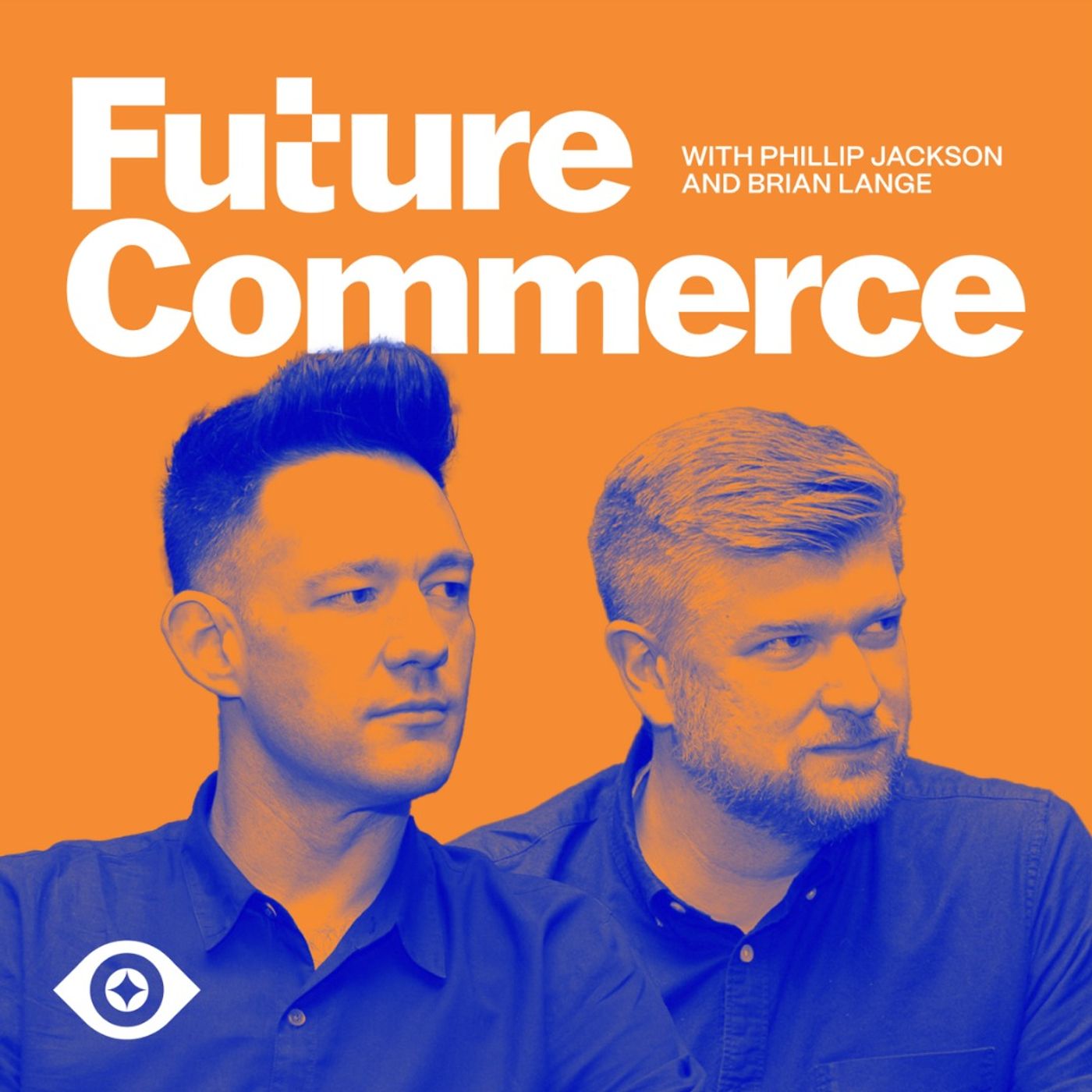
Future Commerce
Phillip Jackson, Brian Lange
Future Commerce is the culture magazine for Commerce. Hosts Phillip Jackson and Brian Lange help brand and digital marketing leaders see around the next corner by exploring the intersection of Culture and Commerce.
Trusted by the world's most recognizable brands to deliver the most insightful, entertaining, and informative weekly podcasts, Future Commerce is the leading new media brand for eCommerce merchants and retail operators.
Each week, we explore the cultural implications of what it means to sell or buy products and how commerce and media impact the culture and the world around us, through unique insights and engaging interviews with a dash of futurism.
Weekly essays, full transcripts, and quarterly market research reports are available at https://www.futurecommerce.com/plus
Trusted by the world's most recognizable brands to deliver the most insightful, entertaining, and informative weekly podcasts, Future Commerce is the leading new media brand for eCommerce merchants and retail operators.
Each week, we explore the cultural implications of what it means to sell or buy products and how commerce and media impact the culture and the world around us, through unique insights and engaging interviews with a dash of futurism.
Weekly essays, full transcripts, and quarterly market research reports are available at https://www.futurecommerce.com/plus
Episodes
Mentioned books

Aug 23, 2019 • 49min
Shopping as Yourself Online (w/ Sabrina Abney, Mizzen + Main and David Pastewka, Drapr)
What does the perfect fit really look like? Sabrina Abney, Ecommerce Director at Mizzen + Main, and David Pastewka , Co-Founder at Drapr, join the show to talk optimizing virtual try-on solutions, "comfortable AF" clothing, technology in digital-first marketplaces, and crafting the best-possible customer journey.
Listen now!
Main Takeaways:
David Pastewka, co-founder of Drapr, and Sabrina Abney, Director of eCommerce at Mizzen+Main, join Brian and Phillip on today's episode.
Mizzen+Main is using innovative technologies like Drapr to take the online customer experience to new levels of personalization and ease.
Customers are becoming increasingly accustomed to a one-to-one retail experience, and body data is allowing brands to create just that.
Body data is allowing brands to get deeper insights into their customer bases to not only understand physical attributes of their core customers, but also to predict what sizes need to have larger inventory to meet consumer demand.
A Virtual Try-On Company Meets Quality and Comfort: The Drapr/Mizzen+Main Story:
Phillip met David a few months ago at the Drapr booth during RetailX and was taken back by how
Drapr allows customers to virtually see how clothing from various retailers will fit over their actual bodies in a way that is as close to photo-realism as possible while browsing on a store's website.
Sabrina takes us through a brief history of Mizzen+Main and how the founder came up with the idea after observing a bunch of sweaty interns.
Phillip remembers the first time he encountered Mizzen+Main through one of their memorable domain: comfortable.af.
Solving Fit Issues of Digitally Native Brands: Drapr Saves the Day:
Sabrina comments that all digitally native brands are challenged by the fact that customers can't try on products before they commit to a purchase.
The ability to see what a piece of clothing looks like on your body is a huge boon when it comes to making the decision to purchase.
Brian recalls the marketing campaign that featured JJ Watt as a great example of way to identify customers that connect with your brand.
Drapr is trying to replicate the experience of trying something on your body, and then standing in front of a mirror.
The Science Behind Try-On Technology: Replicating Fabric Online:
Brian asks David about how they handle the ways in which different types of fabrics behave and interact when worn.
While the "feel" of fabric cannot yet be captured online, the fit and draping qualities of Mizzen+Main shirts were captured with 3D scanning and cloth simulation.
The main goal of the process was the capture the realism of the shirts to make renderings as true to life as possible.
Sabrina explains that innovation is the fabric of Mizzen+Main's products and brand identity, and the technology behind Drapr is the perfect intersection of values.
Benchmarks of Success: Quantifying Innovation:
How do brands determine what is a successful innovation when the metrics of success are constantly evolving along with technology?
Sabrina reveals that there are KPIs that are being tracked (which are constantly being tweaked) along with invaluable customer surveys.
Brian geeks out the potential massive reduction in product returns that come along with the ability to see how clothing fits before purchasing.
"Success doesn't look like just a conversion, but looks like a positive customer experience which requires the ability to quantify whether or not it's a good experience."
Conversations Drive Direction: The Power of Customer Feedback:
Phillip asks David if the conversations that are being had with their customers are informing the future direction of Drapr.
Every single case and customer is so different, so the conversations give invaluable insight into how customers behave and what benefits them most along the customer journey.
The data from just the first set of customers using their tool has given Drapr enough information and direction to shape the next few months of development.
Phillip harkens back to the episode with Jeremy King and how everyone at eBay was required to speak directly to customers as part of the company culture.
Doing More to Earn Customer Loyalty: The Cost of Being a Premium Brand:
What can premium brands do to encourage customers to spend more on products that are at more of a premium price?
Sabrina speaks about how listening to their customers and making their voices heard attributes greatly to brand loyalty in addition to their innovation.
Mizzen+Main is in all Nordstrom stores across the country, has over 700 retail partners, and has started opening their own branded stores.
Just getting a customer to feel the fabric and try the shirts on is a huge factor in customer attribution, and it doesn't necessarily matter where the customers interact with the fabric.
Shaping the Future: Content Creation from Body Data:
Brian asks both Sabrina and David if digital try-on has lead or if it will lead to content creation sometime in the future.
David says that content creation will play a huge part in Drapr's future, where you won't be putting clothing on a body that looks like you, but you will be simulating clothing on your actual body.
This extremely personalized image of a customer in a digitally rendered version of clothing is immediately shareable and be considered content creation.
Brand loyalty doesn't necessarily translate to loyalty of the technology that powers it so how do you bridge the gap from brand loyalty to loyalty in technology?
Intimate Personal Knowledge: The Management of Body Data:
Sabrina discusses the conversations that Mizzen+Main had with Drapr regarding the usage of customer data and how that data would be managed.
Who will own the data in this partnership between Mizzen+Main and Draper, the brand or the technology provider?
Can body data of a customer base help in the future development of a brand?
Brian brings up how a 3D body scanning app is in on Drapr's roadmap amd David confirms that there will be pilot programs being released within the next few months.
Making It Easy: How to Use Body Data for a Tailored Customer Experience:
Creating audience segments and campaigns for these segments based on body data is a natural trajectory for Mizzen+Main's marketing plan.
Sabrina mentions how size data can be used for birthday specific marketing, as a pain point in birthday marketing is that advertised pieces would not always be available in the customer's size.
Customers want a more one-to-one experience with product recommendations in not just style and color, but with fit and size that make it easier for them to shop.
Brian asks Sabrina is Mizzen+Main's customers will come to expect a personalized experienced based on their body data in the future.
Beyond the Customer Journey: Further Uses for Customer Body Data:
With the knowledge of customers' sizes, Brian asks Sabrina if body data affects the supply chain in regards to planning production trends.
As their core customer starts to get older, the body types and sizes that sell the most products change along with the customer ages.
Sabrina enlightens us that they are using their own version of predictive modeling to plan how much to make of certain sizes.
When customers find another brand that has clothing in their size, Sabrina predicts that it might already be too late and you have probably already lost that customer.
Five Years From Now: What Does the Future Look Like:
David predicts that everyone will be shopping as themselves online due to the undeniable advantages of shopping online.
Technology is progressing to the point where you will soon visit a brand's website and see pictures of yourself there in that brand's clothing.
Sabrina thinks virtual try-on will replace size guides in regards to customer expectations on clothing sites.
The entire customer journey from email, to advertising, and even to browsing websites will be tailored to an individual level.
Brands Mentioned in this Episode:
Drapr
Mizzen+Main
Nordstrom
As always: We want to hear what our listeners think! With body data becoming more robust, where do you think the future of retail personalization will be within the next few years? Is there a point where customer data goes too far when it comes to intimate physical knowledge of customers' bodies?
Let us know in the content section on Futurecommerce.fm, or reach out to us on Twitter, Facebook, Instagram, or Linkedin.
Have any questions or comments about the show? You can reach out to us at info@futurecommerce.fm or any of our social channels; we love hearing from our listeners!
Retail Tech is moving fast, but Future Commerce is moving faster. Hosted by Simplecast, an AdsWizz company. See pcm.adswizz.com for information about our collection and use of personal data for advertising.

Aug 19, 2019 • 4min
Monday Update: The Future Commerce Sustainability Initiative
Few updates for your Monday morning: we launched the Future Commerce Sustainability Initiative, we're publishing bonus content on the next two Tuesdays, we're at Etail East in Boston and don't miss this next Friday's episode with Mizzen and Main!
>> Click here to subscribe to FC Insiders today! Hosted by Simplecast, an AdsWizz company. See pcm.adswizz.com for information about our collection and use of personal data for advertising.

Aug 16, 2019 • 55min
"Off-Platform": Building Tools to Discover the World (w/ Jeremy King, Pinterest)
Pinterest is giving their community tools to engage in commerce, not to interact more online but to get out and discover the world around them. In this episode, we interview Jeremy King, the SVP of Engineering at Pinterest and former CTO of Walmart.com, to discover how they're using advanced machine vision and context to power the catalogs and commerce experiences both on-and-off-platform.
Listen now!
Main Takeaways:
Jeremy King, SVP of Technology at Pinterest, joins Brian and Phillip on today's episode.
Is the open-source format the "secret sauce" to being successful when developing advancements in technology?
Inspiration engines like Pinterest are fostering real-world interactions and building communities.
Customization through personalization sometimes leads to repetitive product recommendations, but there are ways to battle this using big data.
Jeremy King: A Brief Professional History:
Jeremy has been at Pinterest for only 4 months, but previously spent 8 years at Walmart running Walmart Labs and helped them go through their digital transformation.
Brian heard Jeremy's talk at NRF and asks Brian how he ended up at Walmart and to talk a bit about his journey with the company.
Eight years ago, Walmart did not have a very large presence online, but throughout his tenure at the company, they vastly expanded their eCommerce entity.
Technology Leadership: What is the Secret Sauce?:
Phillip harkens back months ago to when Wayfair was on the show and comments on how open-source adoption can change the image of your brand.
Leadership from a technology perspective is a monumental task in regards to advancement in technologies for brands.
Jeremy talks about the difficulties that corporations such as Walmart face in technology that simply does not scale to the massive size of the corporation itself.
Open-source contributions and a healthy approach to technology selection are the "secret sauce" that Jeremy attributes to success in technological leadership.
"Most companies these days have to have a new respect for how much technology plays in their success or failure".
Open-Source Technology: The Power of the Community:
If you are using technologies that are not open-source, you are typically beholden to the direction and decisions of a single organization as opposed to the community of open-source technology.
Try things in house first, and then look for other solutions that don't already lie within your team.
Pick the places where you want to be innovative and insource those things then outsource everything else to save you time and effort.
What parts of your business do you outsource and where are you trying to innovate in-house?
Social Media versus Discovery: How to Make Something Shoppable:
With over 300 million visitors a month, Pinterest was going to be a unique opportunity for Jeremy to scale the team and build technology for a product that people already love.
How do you make a discovery platform like Pinterest more shoppable?
As a discovery engine, people go to Pinterest with a positive mentality so making shopping more accessible is the goal as opposed to interrupting social media behaviors.
Pinterest is also a great platform for team collaboration as it allows a positive and creative environment to share ideas and feedback.
The Shift Towards Commerce: The Evolution of Purchasing:
The number one request from Pinners is to have a clear and easy way to purchase items that they have fallen in love with while using the platform.
Retailers are often surprised that their catalogs are largely already in Pinterest due to people pinning their favorite products.
Brian and Phillip also refer to their most recent episode and bring up how discovery platforms are replacing traditional department store experiences.
People are coming to Pinterest to build inspiration, something that was traditionally accomplished with physical catalogs and in-store experiences.
Room For All: Discovery for Both Big and Small:
Hundreds of millions of pins as catalog items are helping small companies with discovery as 97% of Pinterest's top 1000 searches are unbranded.
Companies can use Pinterest to introduce themselves to prospective shoppers and reach people they never would be able to reach otherwise.
Brian identifies this as a great example of passive shopping and Phillip expands on the concept in specific reference to Pinterest.
Any other shopping experience would rely on the conversion at the moment of product consideration, but with Pinterest, people are looking to be inspired along their entire retail journey.
The Secret Sauce: How to Succeed in Technology:
Phillip asks Jeremy to give the listeners some about on criteria about decisions regarding technology and how to outfit a team.
Jeremy recalls how he brought the startup mentality to Walmart and created the world's largest startup with Walmart labs.
Access to data on a company-wide basis is paramount for your team to be able to use that data to solve problems.
There are also some basic company culture choices that Jeremy recommends such as engineers sitting with your business team to expedite business decisions and processes.
The Digital Community: Fostering Relationships Offline:
Brian asks Jeremy how he sees technology either bringing communities together and then how commerce relates to the building of a digital community.
Pinterest's goal is to help you find inspiration so that you can bring your ideas to life in the real world, and when ideas overlap, they create real-world relationships.
The team at Pinterest wants you to get out there and go do things, and the communities you find of like-minded individuals are natural by-products of this.
Brian gets some visions of shared Pinterest workshops in the future, and Phillip sees it as the antidote to the digital wellness movement.
Jeremy's Predictions: The Landscape of the Next Five Years:
Phillip asks Jeremy to talk about his predictions for the next five years from a technology and commerce perspective.
Jeremy says that machine learning technology is what makes Pinterest so great, and hundreds of calculations a second tailor your Pinterest home page.
Where will machine learning technology be in five years and how do you think machine learning engines like Pinterest can use that technology to provide the best experience for their users?
According to Jeremy, machine learning development will contribute greatly to the beautification and personalization of discovery platforms over the next few years.
Quantifying Serendipity: Overcoming the Issues of Customization Through Personalization:
Brian brings up how customization through personalization can lead consumers to only seeing the same type of products and asks Jeremy to talk about how Pinterest is tackling this issue.
With its use of boards as a method of categorization, Pinterest can tailor the machine learning model to find out what people are inspired by.
If you can quantify the moment of inspiration (coined Serendipity by Jeremy) you will be able to calculate the most effective times to break the mold of recommended products and boards.
Knowing what your customers need and what they want can only be found by actually communicating with your customers.
Brands Mentioned in this Episode:
Pinterest
Walmart
Wayfair
Jet.com
As always: We want to hear what our listeners think! Is the open-source format of technology building something you would implement for your brand?
Let us know in the content section on Futurecommerce.fm, or reach out to us on Twitter, Facebook, Instagram, or Linkedin.
Have any questions or comments about the show? You can reach out to us at info@futurecommerce.fm or any of our social channels; we love hearing from our listeners!
Retail Tech is moving fast, but Future Commerce is moving faster. Hosted by Simplecast, an AdsWizz company. See pcm.adswizz.com for information about our collection and use of personal data for advertising.

Aug 9, 2019 • 50min
"Meatless Mania"
🎶"I love you, you love me, Barney's filing bank-rupt-cy!" PLUS: who is the vegan-curious Subway customer? Listen now!
Main Takeaways:
Vice President of Global E-Commerce and Customer Experience at e.l.f Cosmetics, Ingrid Millman, is co-hosting with Brian and Phillip this week.
Barneys New York has filed for bankruptcy but does this spell the end for the high-end department store model?
The perception of luxury is shifting with younger generations and brands that don't change with the times will eventually phase out.
AriZona Iced Tea has partnered with a cannabis brand and the pairing could be a benchmark for the future of cannabis retail.
Barneys Is Bankrupt: Tough Times for High-End Department Stores:
Barneys New York has filed for bankruptcy (no Phillip, not the dinosaur) and Ingrid captures up all of our inner feelings by saying that the Sex and the City characters within all of us are saddened by the news.
Brian has surprisingly never seen Sex and the City, so Ingrid makes him take a Buzzfeed quiz which yields surprising results.
There is a rapid expansion of markets that don't make sense for the Barneys brand that has succeeded at being a single store in New York.
Ingrid states that it is a tough time for high-end department stores and brings up how other big names in high-end department stores (like Henri Bendel) have been closing.
Discovery on Instagram: Are Department Stores Dead?:
Brian rebuttals by saying there have been many luxury stores that have been very successful in taking their business online.
"The department store was traditionally the place where discovery happened, but now discovery happens on Instagram."
With the advent of social media and the tailoring of advertisements that accompanies it, Instagram knows more about you than a department store ever would.
Brian guesses that Barneys Warehouse could have been a contributing factor in Barneys' demise because a lot of what Barneys sold was sold at a discount at Barneys Warehouse.
The Cannibalization of High-End Pricing: What is the Cost of Discounting?:
Phillip points out that the concept of doubling down on your high-end inventory before you make the addition of discount products to your brand has never been talked about on the show before.
A recent article mentioned that the Nordstrom family wants to increase its ownership of Nordstrom beyond 50% as a result of their plummeting sales.
There are a lot of luxury brands that cannibalize their full price sales by selling through discount outlets such as Nordstrom Rack.
Phillip states that casualization in the workplace and a shift in the perception of luxury are contributing factors to the failing high-end department model.
The Flash Sale Model: Disillusionment Through Discount:
Ingrid attributes the financial recession around 2008 as the advent of flash sale type brands such as Giltand these discounted luxury goods removed some of the enchantment that was associated with luxury goods.
The older generations are typically buying the traditionally high-end brands and if those brands do not take notice of the buying habits of younger consumers, they will being to age out.
Phillip identifies Barneys as a cultural icon that he would have previously considered too big to fail, but it will have to change dramatically to stay around.
Brian points out the continuing trend of brands that are struggling even though they are trying to innovate such as Walgreens having to close hundreds of stores.
The Competitive Edge: Battling Against Giants:
CVS has announced a paid offering called Carepass that promises discounts, free shipping, and prescription delivery for about half the price of Amazon Prime. (Funny how this announcement lines up with Walgreen's announcing their store closings...)
Brian predicts that we will begin to see more offerings like this from different brands popping up to compete with Amazon.
Disney+, ESPN+, and Hulu will be bundled for $12.99 and Phillip points out that we've come full circle and are back to where we started: with basic cable.
Phillip is excited to try something aside from Netflix because he only watches The Office.
Mountains of Digital Waste: The Ruins of Digital Civilization:
Ingrid is very into all of the cooking shows on Netflix such as The Great British Bakeoff, Chef's Table, and The Final Table.
Brian states that he wishes you could just buy the equipment that was being shown on the cooking shows while watching. (Or the shoes right off of Carrie's feet. RIght, Brian?)
Streaming Service Linear Commerce is the ability to purchase products directly from digital media as it is being displayed in various programs.
Phillip recently heard about "the mountains of digital waste" we create that we use for a moment and then never again, but it will exist forever in data houses that require fossil fuels to be powered.
Recycle Commerce: Single-Use Plastics As Sustainable Currency?:
Brian gets excited about being able to swap plastic bottles for a train ticket in Rome as part of a 12-month program called "Ricicli + Viaggi," or Recycle + Travel that aims to reduce the usage of single-use plastics.
Ingrid has a conspiracy theory and is worried that this program will have an opposite effect and make people buy more plastic bottles because they will be able to use them to get train tickets.
S'well recently announced food storage containers and Phillip thinks that they are really pretty.
Brian loves the idea of sustainable currency and wonders why we can't factor other things in such as adding a carbon offset value to everything we purchase. (Credit to Phillip for that idea.)
Weed and Iced Tea: The Pairing You Never New You Wanted:
Brian has been champing at the bit to talk about AriZona Iced Tea's venture into the world of weed with their partnership with Dixie Brands, Inc.
AriZona Iced Tea and Adidas recently collaborated on a shoe that was initially sold for $0.99, caused such a crowd that the NYPD had to shut down the launch, and then later started being sold for upwards of $700.00 per pair.
There are lots of interesting collaborations between cannabis companies and "nostalgia brands" such as the recent pairing between Green Growth Brands and Abercrombie & Fitch.
Beyond Meat: Major Food Chains Are Exploring Meatless Options:
Subway is going to be testing out plant-based Meatball Marinara sandwiches at select locations.
Subway is not alone in their shift towards meatless options as Del Taco, Burger King, Tim Hortons, and Little Caesar's are all going to have Beyond Meat or Impossible Burger options.
Ingrid brings up that there are tons of people that are interested in reducing the amount of meat they consume or going meatless but they live in areas where those options are not readily available. (Brian lovingly dubs these areas "Meatless Deserts".)
Phillip brings up a Twitter thread from Charlie Bilello that chronicles the rise of Beyond Meat and the numbers are incredibly indicative towards the success of meatless products.
Both Brian and Ingrid share some love for Oatly and how their marketing is making oat milk look like the coolest thing ever.
Brands Mentioned in this Episode:
Barney's New York
Henri Bendel (R.I.P.)
Barneys Warehouse
Nordstom
Gilt
Walgreens
CVS
S'well
AriZona Iced Tea
Dixie Brands, Inc.
Adidas
Green Growth Brands
Abercrombie & Fitch
Subway
Oatly
As always: We want to hear what our listeners think! Where do you see the high-end department store model in five years? Is cannabis a sustainable business model when it comes to partnering with non-cannabis brands?
Let us know in the content section on Futurecommerce.fm, or reach out to us on Twitter, Facebook, Instagram, or Linkedin.
Have any questions or comments about the show? You can reach out to us at info@futurecommerce.fm or any of our social channels; we love hearing from our listeners!
Retail Tech is moving fast, but Future Commerce is moving faster. Hosted by Simplecast, an AdsWizz company. See pcm.adswizz.com for information about our collection and use of personal data for advertising.

Aug 2, 2019 • 28min
The Attention Economy
When brands like Outdoor Voices launch a new content platform it gets us thinking about retail-brands-turned-content-creators and begs the question: who is the winner in the attention economy? Do brands have what it takes to create engaging and timely content? Listen now!
##Main Takeaways:
In today's brand economy, everyone is expected to be a storyteller and have content play a large part in their retail strategy.
Brian and Phillip use their own experience as a guide and describe the qualities it takes to be a successful content creator.
In some cases, content is dictating how product is being created so brands that master their content game are becoming majorly successful.
Strategy is an integral part of achieving your goals and it takes a specific skillset to combine strategy with brand development.
###The State of Content: Everyone Has to Be a Storyteller:
Outdoor Voices is launching a storytelling marketing platform called The Recreationalist that is positioned around showcasing the fun in outdoor activities as opposed to most outdoor brands that focus on performance.
Brian states that we are at the peak content level period where every brand needs to be a storyteller and everything is content.
The way we are consuming content has changed dramatically in the past ten years and we are more willing to put our focus on content that is current and innovative.
Creating content consistently is a large commitment that extends past just being employed at a company.
###The Lasting Content Creator: Avoiding Creative Burnout in A Demanding Climate:
Given their standing as "authorities" on the subject, Brian and Phillip describe the perfect combination of qualities that allows someone to be a consistent content creator. (Strangely it sounds like they're reading their own biographies. Imagine that.)
You can't have a strategy without a goal, and everyone on your team should know what that strategy is and have a clear direction on how to achieve it.
Creating content in a particular media takes a different skill set that might sometimes conflict with your ability to be a successful retailer.
If you're going to get into the content game, get in with both feet and don't just try to do it halfway.
###The Shifting Tide: Content is King:
In the attention economy, most brands are competing for the same groups of content consumers so these brands must stand out from their competitors.
Brian recently heard a VP of Product at a large furniture retailer say that it's better to create content, see how that content performs, and then create a product that fits that content.
"People want to quantify that you're spending has a direct return but when you're creating content, what you're spending on is brand."
Aggregating the listeners or consumers of your content is a challenge because they are coming from such disparate places across all channels.
###What's On the Horizon?: A Sneak Peek at the Future of Future Commerce:
Phillip is excited to announce that Gladly is now a sponsor of the show and to check out last week's episode with Charlie Cole and Joseph Ansanelli. (Welcome to the family!)
In the most recent issue of Chips + Dips, aperitif culture was examined and Phillip suggests that Future Commerce could be your retail aperitif. (That was a stretch...)
Brian thinks that the world is ready for a canned Gin & Tonic and has an entire five-year strategy for this plan. (Well this episode derailed fast.)
Phillip teases that Ishani Gujral from Madrona Venture Labs will be making an appearance on the show soon to talk about how they approach ideation and how they help founders launch new companies.
Brands Mentioned in this Episode:
Outdoor Voices
Gladly
Madrona Venture Labs
As always: We want to hear what our listeners think! How can you use content to identify a trajectory for your message and brand? Is outsourcing a content creator a good expenditure of funds?
Let us know in the content section on Futurecommerce.fm, or reach out to us on Twitter, Facebook, Instagram, or Linkedin.
Have any questions or comments about the show? You can reach out to us at info@futurecommerce.fm or any of our social channels; we love hearing from our listeners!
Retail Tech is moving fast, but Future Commerce is moving faster. Hosted by Simplecast, an AdsWizz company. See pcm.adswizz.com for information about our collection and use of personal data for advertising.

Aug 1, 2019 • 30min
August Bonus Episode - NRF Interview with Sheetz, Rituals
Hosted by Simplecast, an AdsWizz company. See https://pcm.adswizz.com
for information about our collection and use of personal data for
advertising.

Jul 26, 2019 • 52min
"Making a Lasting Impression in a Single Moment of Time" (w/ Charlie Cole, CDO @ Tumi and Joseph Ansanelli, CEO @ Gladly)
How do modern brands create joyful customer experiences that last a lifetime? Charlie Cole, Chief Digital Officer of luxury travel brand Tumi, Joseph Ansanelli, CEO of customer support platform Gladly join us to talk about how to know your customer, how to anticipate their needs, and how to stand out in a sea of startup DTC players. Listen now!
Main Takeaways:
Charlie Cole (Chief Digital Officer, TUMI) and Joseph Ansanelli (CEO and Co-Founder, Gladly) join Brian and Phillip as their special guests on today's episode.
Most brands today focus on custom acquisition as opposed to focusing on the lifetime value of their customers.
Brands like TUMI are adapting their customer service to include new mediums of communication to meet customers where they want to be met.
Non-transactional experiences that exist in a single moment are what retailers are striving to capture digitally to create lasting memories and brand affiliation.
How Gladly Got Started: A Brief History:
Joseph starts by discussing how it was clear that the way in which consumers today engage, communicate, and transact has radically changed in the past decade and how this affected how companies interacted with consumers.
Gladly set out to not only transform the way people do commerce but also how a brand services, engages with and markets to its consumers.
As Joseph was coming up with Gladly, Charlie was one of the first people that he reached out to as Charlie was pushing the boundaries of what you could do in the direct-to-consumer world.
'Given his professional history, TUMI was Charlie's attempt to work for a larger company and was known for making amazing things in a remarkably customer-centric way.
Charlie recounts how Joseph's initial pitch of Gladly made a lot of sense and was better than anything else on the market and how it fit with their goal of modernizing the customer experience.
The Slippery Slope of Personalization: Customizing Customer Experience With Big Data:
Charlie mentions that many data points are collected from customers, some voluntarily and some that customers might not even know that they are volunteering.
How do brands use this data to enhance the customer experience?
Customer "value" is usually interpreted as a revenue number as opposed to quantifying a positive retail experience.
Gladly allows brands to understand the entire customer journey and leverages that data to help the customer as much as possible.
Conversion rate is such a small part of the customer journey, and it bugs Charlie when eCommerce companies brag about it.
Treating Customer Like Humans: The Value of Connection:
"The best marketing is customer service, and if you treat people as people, it will pay dividends down the road."
Joseph brings up that one of Gladly's goals is to enable brands to meet customers in places where those customers want to be reached.
TUMI's phone number is now text message enabled, meaning that customers can elect to communicate via SMS as opposed to being locked into a phone call.
Brian brings up how Ingrid Milman (in her most recent appearance on the show) said that customer relationship is an even higher priority than the brand story.
The Bigger Problem: How Retail Has Evolved to Backseat Customers:
Charlie completely agrees with Ingrid's comment and says that one of the problems that we have as retailers is that most of our incentives are based on the acquisition of customers.
Most talks at conferences are based on how to boost acquisition metrics and are rarely focused on improving customer experience.
Joseph agrees that the primary goal should be to make lifelong customers and to get the industry-wide narrative to change, we have change incentives and what we measure as points of success.
He also brings up that KPIs for customer service should also be updated to reflect the number of people spoken to as opposed to speed or efficiency because people are at the core of customer service.
"It's less about how long things go, and more about how well things go."
Finding Your Company's North Star: Using Qualitative Data to Boost Lifetime Value:
Phillip asks Charlie and Joseph if we as a community of retailers think we are capturing customers, but in reality, are only capturing transactions.
When you think of enduring brands, they understand that it is not about the transaction and is really about the long term relationship.
Companies like Apple and Harley Davidson are the pinnacles of great brands that have customers whose love for the brand goes beyond the product to the point of people even getting tattoos of the logo on their bodies.
In Charlie's first couple months at TUMI, one of the first things they had to do was revamp their marketings as everything was evaluated on a last-click basis.
If you can qualitatively identify your company's North Star, it will help to steer away from transactional-based evaluations.
Digital Empathy: Consumer Communication Through Modern Channels:
Charlie and Joseph are asked if brands are concerned about how their voice is coming across in voice and chat.
TUMI provides chat and SMS and knows that consumers want to communicate through these channels, and you can easily to deliver empathetic communication through text because we all desire to communicate in that way.
Brands tend to be deathly afraid of customer service going off script, especially when communicating through SMS.
Brian brings up the story from the "Late-Stage Capitalism" episode in which his father made some amazing connections with employees from Costco and agrees that giving customer representatives the space to get to know their customers, that's when you start to see the benefits of lifetime value.
"Give people data to help them, don't give people data to program them".
Predictions for the Future: Evolving Data Capture:
Phillip asks where we are headed and what we can expect of the next few years as reality brands are planning for the future.
Charlie foresees a world in which you never look at a screen to know the status of your orders thanks to the advances in voice technology.
Seventy-five years ago, shop owners knew who their customers were and developed personal relationships with them, and Joseph wants to be able to enable relationships like this in a remote, online world.
There's a sense that the spoken word intent of a single, actionable expression of need is the future of voice technology.
The tricky (but fun) part for brands will be capturing the experiences of in-person shopping that people didn't know they needed and delivering those memorable experiences in a digital and marketable format.
Brands Mentioned in this Episode:
TUMI
Gladly
Apple
Harley Davidson
Costco
e.l.f cosmetics
As always: We want to hear what our listeners think! How can brands envision a future where customers want to interact with them in mediums of the customers' choices?
Let us know in the content section on Futurecommerce.fm, or reach out to us on Twitter, Facebook, Instagram, or Linkedin.
Have any questions or comments about the show? You can reach out to us at info@futurecommerce.fm or any of our social channels; we love hearing from our listeners!
Retail Tech is moving fast, but Future Commerce is moving faster. Hosted by Simplecast, an AdsWizz company. See pcm.adswizz.com for information about our collection and use of personal data for advertising.

Jul 19, 2019 • 36min
Trustwashing
We ask the question - is social activism by brands virtue-signaling or tone-deaf marketing? Listen now!
Main Takeaways:
Woke-washing has become more and more prevalent in today's economy, where social awareness is a major selling point.
Are there ways to be socially conscious without completely being dedicated to a cause or movement?
Woke gatekeepers are the first to point out how brands are deviating from their message, even if those brands are putting in the extra work to remain socially conscious.
Is it possible for a discount store to also be ethically sourced?
The Woke Debaucle: Setting the Record Straight:
To set the record straight, Phillip and Brian clarify that they indeed know what "woke" means (do they though?) despite coming off as a Baby Boomer and Gen Xer, respectively.
Just a short while after the episode on woke commerce dropped, there was an article posted on woke-washing.
Phillip thinks that there is something about this particular time of year that leads to brands using patriotism and socially conscious messaging as part of their marketing.
There was another article recently that said that woke-washing is beginning to infect the advertising industry due to brands running purpose-driven campaigns, but failing to take real action.
Real-World Examples: How Do You Do "Woke" Right?
"If you are highlighting something that you do to your customers for a specific cause or issue and highlight that yourself as part of your marketing, that is not very woke."
Brian and Phillip refer back to Patagonia, whose customers and typical customer persona does not always match up to Patagonia's political views.
Patagonia is an excellent example of a company that would rather lose some business in pursuing something right and just as opposed to just focusing on financial gain.
Phillip bets that there are very few businesses that can claim that they genuinely favor social or environmental benefits as opposed to money.
Levels of Wokeness: Is It All or Nothing?:
Brian questions if a brand needs to be dedicated entirely to a social cause to be authentic.
Phillip refers to the opening line of the woke-washing article that brings up "razor company talking about #MeToo and a burger chain tackling depression".
Do you think Burger King was commenting on mental health with their Real Meal Campaign and did this make them woke?
Brian proposes changing the terminology to "social awareness commerce." (And there were cringes to be had by all from this statement.)
Phillip brings up Emily Singer's newsletter called Chips + Dips that talks about really cool things in the direct-to-consumer world, but more specifically DIP:011 that talks about Everlane being a great example of a socially conscious brand.
Brian brings up Krochet Kids as an example of a great, ethically sourced brand.
Combatting the Critiques: How To Deal With Woke Gatekeepers:
It needs to be clear that you care about the communities that you are involved in.
Phillip asks the listeners: "If you set out to be socially conscious as a strategy, is that inherently undoing the good you are trying to accomplish?" (That's a great question.)
Phillip brings up a recent article in the New York Times by Allbirds that is content that is truly about birds in partnership with the National Audobon Society.
Brian uncomfortably combines Gary Vaynerchuk and woke in the same sentence and cements his place as a Gen Xer (which wasn't a secret).
The Halo Effect: Discount Stores in a Strong Economy:
Brian questions what a "woke dollar store" would look like. (Oh boy. There will be a link included at the end so you can send in your hate mail.)
Is there a way for a discount store that sources its goods from areas of the world that have unfair labor practices to also be sustainable created and produced?
While they may not sell fresh fruit at dollar stores, the next best thing would probably be Aldi.
Phillip brings up Dress Barn as an example of a discount store that is struggling in an economy in which people can afford better goods.
Brian mentions Brandless as a brand that fulfills both the discount requirements as well as being ethically sourced.
Phillip also finds and briefly goes over the Dollar Tree Sustainability Report.
Brands Mentioned in this Episode:
Patagonia
Gillette
Burger King
Everlane
Krochet Kids
Allbirds
Aldi
Dress Barn
Brandless
As always: We want to hear what our listeners think! Can a brand make small contributions to social change, or do they have to be fully invested in a cause to be authentic?
Let us know in the content section on Futurecommerce.fm, or reach out to us on Twitter, Facebook, Instagram, or Linkedin.
Have any questions or comments about the show? You can reach out to us at info@futurecommerce.fm or any of our social channels; we love hearing from our listeners!
Have hatemail after all that "woke" discussion? Send it to or .
Retail Tech is moving fast, but Future Commerce is moving faster. Hosted by Simplecast, an AdsWizz company. See pcm.adswizz.com for information about our collection and use of personal data for advertising.

Jul 12, 2019 • 39min
"Late-Stage Capitalism"
Phillip and Brian get into the implications of multi-generational branding, the ever-changing face of retail interactions, and discuss how empowering employees is key to boosting customer retention. Listen now!
Main Takeaways:
Retail experiences that go above and beyond the normal call of duty can lead to brand loyalty that spans several generations.
Retail used to be based upon in-person interactions with shopkeepers and store owners, but how do we bring these interactions into the digital age?
Multi-Generational loyalty can be achieved by empowering employees to create memorable interactions with customers.
How do you make employee benefits as flexible and beneficial as possible for the complicated lives of your employees?
Beyond the Sales Floor: The Multi-Generational Nature of Retail Relationships:
Brian recounts two Costco associates that spent a lot of time talking with Brian's father and how their relationship transcends a typical retail relationship in which the front end retail associate considers his customer his friend.
This relationship is an example of peak clienteling in which the relationships that Brian's father built with the Costco employees led to Brian having a strong affiliation witch Costco: a textbook example of multigenerational retail.
Phillip mentions up a conversation he had on a Merchant to Merchant episode with Birdwell Beach Britches (say that five times fast), a company that has been around for so long that they have become a generational outpost for Venice Beach.
Brian brings up a past episode with Michelle Cordeiro Grant in which she spoke about catering towards multi-generational shopping trips.
Brands are having to be more community-oriented and it makes sense that if you have a great experience with a brand, you will want to share that brand with your family.
Retail of the Past: The Malls Before Starcourt:
In the past, there were shops in towns with owners that lived in those towns and were part of the community. (Did you catch the Stranger Things reference in the section title?)
The relationships forged in these small-town shops lasted for generations and if you were able to recreate the brand loyalty of these old school relationships, then you would be monstrously successful.
Brian brings up a recent New York Times Article in which the author enjoyed working in retail, but was ashamed to admit that they worked in retail at all.
"Investing in your own employees as much as you invest in your customers is a huge topic that we should be spending a lot more time talking about."
Building Connections: Old Fashioned Relationships in a Digital World:
If we focus on multi-generational retail experiences that create real connections akin to those that existed in the past, then we might be able to foster relationships that strengthen brand loyalty.
Ultimately, the challenge is to bring the interactions of a pre-digital retail world into the modern era and create relationships.
If you are a luxury retailer, the challenges are only compounded because everyone has a different definition of luxury and the personal retail interactions have to be even more personalized.
It's a conversational challenge to empower retail associates to have meaningful interactions, but companies like Half Price Books are empowering their employees by allowing them to curate their own assortments.
Hiring good people and then giving them the freedom to address their customers directly in a place that they feel empowered is a key factor in creating lasting relationships.
Empowering Employees: The Key to Positive Retail Experiences:
Phillip brings up an article about Target boosting employee benefits and points out that if you want people to stay at a job for a long period of time, then you have to cater to their lives and treat them as part of your community,
This sort of positive and flexible company culture trickles all the way down to customer interactions and leads to better retail experiences.
On the other end of the spectrum, Phillip brings up Late Stage Capitalism that pretty much boils down to as the horrible things that capitalism forces people to do in order to survive. (Delightful.)
The longer that retail brands exist, the more they have to provide to shareholders and the more they have to increase their earnings, and eventually, this leads to underpaid employees.
Phillip thinks that maybe the brands that continue to thrive by prioritizing employee values are the ones that remain privately held.
As always: We want to hear what our listeners think! How can you create an environment that fosters memorable retail interactions? How do you build a strategy that uses technology that plays into actual community building?
Let us know in the content section on Futurecommerce.fm, or reach out to us on Twitter, Facebook, Instagram or Linkedin.
Have any questions or comments about the show? You can reach out to us at info@futurecommerce.fm or any of our social channels, we love hearing from our listeners!
Retail Tech is moving fast, but Future Commerce is moving faster. Hosted by Simplecast, an AdsWizz company. See pcm.adswizz.com for information about our collection and use of personal data for advertising.

Jul 5, 2019 • 27min
Overcoming Choice Paralysis (feat. Claudine Bianchi, CMO at Zoovu)
Our 2019 theme of clienteling for digital commerce continues with an interview with Claudine Bianchi, CMO at Zoovu, a Guided Commerce service which connects customer needs to products and services from retail brands. Listen now!
Show Notes:
Main Takeaways:
Future Commerce has declared 2019 the year of "clienteling" and personalized experiences for consumers.
Zoovu is helping (mostly) B2C companies create curated product search selections for their customers.
Amazon brands that work with Zoovu are seeing incredible returns at 3X pre-Zoovu sales.
The future of retail and commerce is a world in which the ability to hyper-personalize experiences for customers is accessible to business worldwide.
Zoovu is Bringing The Sales Associate Experience Online:
Claudine Bianchi, CMO at zoovu, is on the podcast today, explaining how zoovu helps connect customer needs to actual products.
Zoovu is an AI-conversational marketing platform that can replicate the in-store sales associate experience for online shopping experiences.
So what is Zoovu's mission, and how can it help retailers and brands connect with their customers?
Well, according to Claudine, Zoovu is working to solve "choice paralysis" for the customers of B2C brands and retailers.
For example, one brand that Zoovu works with is Clairol, a haircare brand, and through using Zoovu, Clairol is to able to help customers choose the hair care product that is best for their individual hair type.
Data-Driven Personas: Separating The Experts & Beginners:
"What Zoovu does is through a series of questions it narrows down choices and actually connects you with the products that are most likely to satisfy your requirements."
One of the coolest parts of Zoovu is that the platform uses anonymous data to craft personas and then curates products for customers based on answers to questions asked.
Claudine says that cameras are a great example of this, because even though there may be aspiring photographers and expert level photographers shopping for cameras, they all have the same goal, to take great photographs.
So as opposed to every-camera-ever Zoovu will make targeted suggestions that will fit the specifications the user is looking for.
Phillip says that five years ago, a lot of marketers were turning to more sophisticated platforms because they were tired of overly broad email campaigns.
"It's like going into the store, without having to go into the store."
Do You Even Zoovu: ROI Metrics for Brands:
Phillip asks Claudine what she thinks the next step of the shopping experience is, and what are the metrics that brands that are listed on Amazon that work with Zoovu use to determine ROI?
Claudine says that Zoovu works with over 80 brands on Amazon and that those brands are seeing 3x the sales pre-Zoovu, which is incredible.
Some of those brands, according to Claudine, are seeing conversion rates of 107%, because what brands can accomplish when they have the correct data is incredible.
"Some of the key metrics are conversion rates, increasing sales, decreasing return rates, increase in average order value up upwards of 70-80%.
Everyone's Welcome to Zoovu With Zoovu:
So Zoovu integrates with a multitude of platforms including Magento, Shopify, SalesForce, Adobe, and many others.
Claudine also explains the actual AI (machine learning) powering Zoovu: "We've been looking at e-commerce and sales patterns for the past ten years, and we've been able to develop the types of algorithms that will help determine the questions we ask next."
So where can retailers and brands looking to Zoovu go to find out more?
Claudine says that the Zoovu website is a great place to find out more, as there are live samples to demonstrate the power of the platform, a pretty robust blog, and plenty of ways to contact the Zoovu team.
Claudine's predictions for the next five years of retail and commerce:
"We're going to see a lot more adoption of technology into the retail and buying experience everything from AR to promote our products and to support service those products. The online experience is going to get a lot more personalized and targeted. So that consumers will see products they want to want to see, and for how much they want to pay. We're going to see this vast customization on the global level where it's not just the major players. Anyone with a website will be able to reach people who they never were able to reach before. And consumers will have unprecedented access to products that they didn't know existed".
As always: we want to hear from our listeners! Do you currently use Zoovu? How are you engaging with your customers? Are you asking the right questions and using that data to power your customer experience?
Let us know in the comment section on Futurecommerce.fm, or reach out to us on Twitter, Facebook, Instagram or Linkedin! We love hearing from our listeners! Hosted by Simplecast, an AdsWizz company. See pcm.adswizz.com for information about our collection and use of personal data for advertising.

