

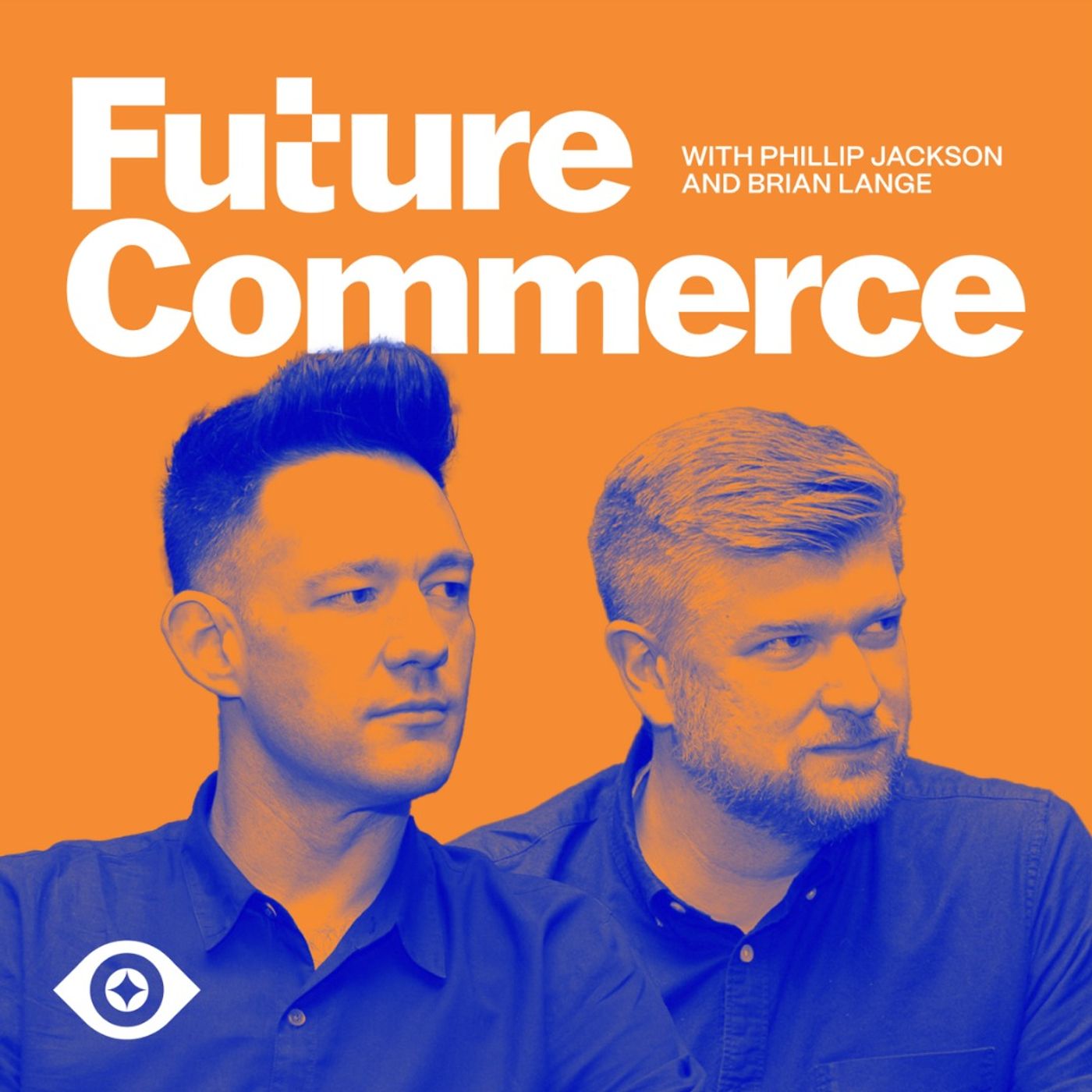
Future Commerce
Phillip Jackson, Brian Lange
Future Commerce is the culture magazine for Commerce. Hosts Phillip Jackson and Brian Lange help brand and digital marketing leaders see around the next corner by exploring the intersection of Culture and Commerce.
Trusted by the world's most recognizable brands to deliver the most insightful, entertaining, and informative weekly podcasts, Future Commerce is the leading new media brand for eCommerce merchants and retail operators.
Each week, we explore the cultural implications of what it means to sell or buy products and how commerce and media impact the culture and the world around us, through unique insights and engaging interviews with a dash of futurism.
Weekly essays, full transcripts, and quarterly market research reports are available at https://www.futurecommerce.com/plus
Trusted by the world's most recognizable brands to deliver the most insightful, entertaining, and informative weekly podcasts, Future Commerce is the leading new media brand for eCommerce merchants and retail operators.
Each week, we explore the cultural implications of what it means to sell or buy products and how commerce and media impact the culture and the world around us, through unique insights and engaging interviews with a dash of futurism.
Weekly essays, full transcripts, and quarterly market research reports are available at https://www.futurecommerce.com/plus
Episodes
Mentioned books

May 1, 2020 • 37min
"The Fight Of My Life" feat. Christina Stembel, CEO & Founder of Farmgirl Flowers
Christina Stembel joins Brian to discuss what the last few months has looked like from a CEO and owner of a "nonessential" business's perspective. Hosted by Simplecast, an AdsWizz company. See https://pcm.adswizz.com
for information about our collection and use of personal data for
advertising.

Apr 30, 2020 • 25min
"The Consultation Is Not Where It Begins And Ends" feat. Ariel Kaye, CEO and Founder of Parachute
Brian sits down with Ariel Kaye, CEO and founder of Parachute Home to discuss innovation in crisis as a home goods brand. Hosted by Simplecast, an AdsWizz company. See https://pcm.adswizz.com
for information about our collection and use of personal data for
advertising.

Apr 28, 2020 • 48min
Gen Z Founders: "Grind and Put In the Work"
Gen Z founders Lesley De La Uz of LUDU, Madison Semarjian of Mada, and Chris Meade of Crossnet join the show to discuss their journeys as some of the first Gen Z founders in the retail world. Hosted by Simplecast, an AdsWizz company. See https://pcm.adswizz.com
for information about our collection and use of personal data for
advertising.

Apr 24, 2020 • 43min
"Customers Need Safety" - feat. Summer Jelinek
Main Takeaways:
We have a super exciting guest this week, and she used to work for the happiest place on earth
Brian's not on the show this week so, things might get a little dark
Does anyone do branding better than Disney (probably not)
What does the future of commerce, the future of brands, the future of this planet even look like anymore?
Was February Two Months or Two Years Ago?
Since time has absolutely no meaning anymore, it seems like February was forever ago, but two months ago, Phillip and Lianne met Summer Jelinek at Future Stores Miami after hearing her deliver an inspirational, impactful, keynote speech about authentic customer experience.
So let's talk more about Summer:
Summer Jelinek is a speaker and trainer with over twenty years of leadership experience with major corporations like Walt Disney Corporation, Disney Institute, and HEB.
Summer connects with audiences all over the world by redefining what consumer experience means in a modern context.
In an age where consumer experience has become all-important, where the social contract between brands and customers is in full effect, this level of understanding is essential to the growth of modern companies.
Fun fact: Summer first fell in love with the idea of the consumer experience at a ski ranch in New Hampshire and a dude ranch in Colorado
Do All Brands Know Their Audience As Well As Disney Does?
One of the most important considerations for any company is to know their audience and to have their audience consistently be a part of the brand's journey. Disney has their branding down to a science.
Summer says Disney brands absolutely everything from their pretzels to their soft drinks, and it's all a part of the story.
"It's just who doesn't want to eat a little bit of magic and pixie dust whenever you're having a bad day"?
Phillip mentions an essential aspect of the brand-customer relationship: "The better you know your audience, the more receptive I think they'll be to the kind of messaging that you could craft at this moment."
Summer says that Walt Disney World is an economic indicator, when the economy is good people are going to Disney, and when it's terrible people stop going (editor's note: whoa )
It's worth noting that Disney has handled the crisis and results of it rather well; even as the parks have closed, it's felt as though the pixie dust has dimmed a little bit.
Retail Right Now: What Does The Situation Even Look Like?
Amidst the raging COVID-19 pandemic, questions remain on everyone's mind, what is the new normal in retail, and how are brands and consumers going to adjust to the current situations?
Phillip asks Summer what she thinks about the current situation on the ground?
There's a lot to consider:
Firstly, there are a lot of brands who are doing incredibly well, and specific categories are booming (at least right now) because of the pandemic, while others are struggling to stay afloat
And as Summer mentions, right now, whether a brand is doing well, we're all just trying to survive through this.
The trick for businesses who are not doing as well right now is to become creative and figure out what they're next steps are, regardless of how long this lasts, with the information we all have right now.
Summer has some advice for brands looking at this right now: Instead of asking, why is this happening to me, ask how are we going to survive and why is this happening for me? What am I going to learn? What am I going to do differently? How am I going to set myself apart as a leader of the pack?
While most businesses may have the technology in place, adapting to the current environment may be more of a people problem.
A Sense of Normalcy Is What We All Need:
Looking to the future is essential, but it's just as important to figure out what consumers need right now, and the steps that are essential to keep everyone safe.
So how does one feel normal in the middle of a global pandemic that has led to almost 20% unemployment?
Summer mentions that one of the struggles for brands may be having to give consumers an authentic brand experience even while limiting human interaction
Phillip brings up a company that has managed to keep its authentic brand experience undiluted: Chick-fil-A, which as a brand (a fast-food one at that that even has GF options) has managed to maintain a sense of normalcy even as they follow the rules.
Summer gives her perspective for the next six months and says that there will be growing pains as everything reopens, but we may all be better for it.
There is a lot that brands can do with this time, and even join in and celebrate with their customers as this all comes to some kind of end, it could be an inspiring time for brands.
Extra notes:
Phillip mentions an article he wrote for FC Insiders called From Plows to Swords, it's fantastic, and you can read it here
Also mentioned during the show is a piece by Brian on authenticity in brand experiences during COVID-19, you're going to want to read that as well, check it out here.
If you want to reach out to Summer (and you should), you can go to → SummerJelinek.com
And Summer also mentioned that if anyone is looking for resume help during this scary time with lots of layoffs, you can send her an email at .
Also, → What is something that a brand has done that has made you feel a sense of normalcy during this chaotic time?
Let us know in the content section on Futurecommerce.fm, or reach out to us on Twitter, Facebook, Instagram, or Linkedin.
Have any questions or comments about the show? You can reach out to us at Hello@futurecommerce.fm or any of our social channels; we love hearing from our listeners! Hosted by Simplecast, an AdsWizz company. See pcm.adswizz.com for information about our collection and use of personal data for advertising.

Apr 17, 2020 • 51min
Wyze Leadership: "This Changes the Climate Going Forward" (feat. Anthony Potgieter, Wyze)
"I think that eCommerce only grows as we move forward, as people are being forced to realize the benefit of shopping online." Today's interview unpacks the eCommerce investment and technology adoption efforts of DTC consumer electronics and home automation brand, Wyze. Hosted by Simplecast, an AdsWizz company. See https://pcm.adswizz.com
for information about our collection and use of personal data for
advertising.

Apr 10, 2020 • 37min
Brands x Better feat. Adam Bridegan, CMO - Rhone
"What we are Witnessing is the Humanity of Love" is a phrase that shook us in this interview. Brands like Rhone, M. Gemi, Cotopaxi, and more have banded together to raise hundreds of thousands of dollars for COVID-19 relief in a matter of days. On pace to raise over one million dollars in the month of April alone, they have gained the attention of over 60 other brands ready to join their ranks.
Sign up today at Brands for Better's website: brandsxbetter.com Hosted by Simplecast, an AdsWizz company. See pcm.adswizz.com for information about our collection and use of personal data for advertising.

Apr 3, 2020 • 31min
Consumer Spending to Follow Maslow's Hierarchy, feat. Jake Cohen, Director of Product Klaviyo
Klaviyo's Director of Product Management joins us to talk about Klaviyo's COVID-19 response and their sudden transformation into a collaborative media organization. Using their own data and insights, as well as consumer research, they're helping businesses make real-time decisions during the economic fallout of coronavirus.
Main Takeaways:
What does the next generation and cutting edge commerce even mean anymore?
Phillip and Brian are joined this week by Jake Cohen, Director of Product at Klaviyo to talk all about how Klaviyo has responded to the COVID-19 pandemic
How can companies respond to this pandemic in a way that centers their customer's needs and wants?
March has been the longest year in history
What can insights regarding consumer behavior help brands better understand their customers?
A New Reality: How Klaviyo Has Adapted To Their Customers Needs:
Phillip and Brian are joined this week by Jake Cohen, Director of Product at Klaviyo, who was late but for an excellent reason.
Klaviyo decided that business, as usual, wasn't right in this new reality, so they repurposed half of their marketing team for an extraordinary project
Klaviyo spun up a news organization in three days (whoa) they've administered surveys to both consumers and brands to help both sides understand where the money is going.
Now they are spinning up content guides and tutorials to help brands address the changes that are happening every single day at this crazy time
Also, Jake announces a new part of the Klaviyo website that is 100% dedicated to this effort to help both companies and consumers (so cool).
COVID-19 Calamity: How Will The Crisis Change How Marketing Works?
"Never let a good crisis go to waste" (bad in politics, useful in our industry as long as it's customer-centric).
One of the fundamental truths of marketing: The truth about humans is that It takes triggers to get us to have action.
Klaviyo's primary goal is to help customers, which is why they've been building this new content goldmine.
Consumers usually break up buying into essentials and non-essentials: except now this has all been turned on its head (the emergence of the new essential category).
Klaviyo is working to bring all the insights directly to customers so that they can then use those insights to exist in this new world of spending and selecting.
Brands Coming Together: Business Coming Together In Partnership:
Recently, Phillip moderated a digital panel which Jake was on along with Olivia McNaughten from Yotpoo and Jan Soerensen from Nosto all about the current state of customer experience.
Is COVID-19 forcing companies to step it up and innovate?
One of the values that Klavivo has recently dusted off is that they work publically, and that ethos has helped guide this new project that aimed at helping business grow
SPEED> PERFECTION
Klaviyo is on track to publish 15 pieces of content on what is going on and what to do about it for 11 days!
Writers note: Our new in-episode music is my new favorite thing
The Story of Today: Stitching Together Insights For Better Buying:
So what is the story behind buying patterns and consumer behavior in this new world that we all somehow live in now?
Specific brand categories seem to be performing super well during this crisis: beauty and cosmetics seem to be staying healthy as part of the new essentials category
Fulfillment centers are working hard to ship out to their customer (and working with local government), but are also working hard to keep their employees safe with proactive and preventive measures.
Zoom works super well until it doesn't
Some brands are seeing massive bumps of anywhere to 200-1000% (over 50% of brands are seeing these enormous numbers)
Spending Shoots Up: People Are Buying Comfy Clothes:
So, where are consumers spending their money right now?
People are spending more, but they are putting their money into "new essential categories" aimed at making the fact that everyone is stuck at home maybe forever a bit more comfortable
March has been the longest month of Phillip's month (ditto).
Jake says that one way to look at spending is through Maslow's hierarchy of needs, each rung representing a different layer of consumer spending which may be one of the coolest ways to understanding how people are spending their money,
If you have kids, you have an entirely different set of needs (i.e., surviving and keeping your kids entertained)
If you want to check out Klaviyo's daily briefings and participate in their survey, click here →
Also, you can email Jake Cohen at and send him all your feedback on what they are doing.
As always: We want to hear what our listeners think! What is the number one consumer spending insight that you have seen throughout the COVID-19 pandemic?
Let us know in the content section on Futurecommerce.fm, or reach out to us on Twitter, Facebook, Instagram, or Linkedin.
Have any questions or comments about the show? You can reach out to us at Hello@futurecommerce.fm or any of our social channels; we love hearing from our listeners! Hosted by Simplecast, an AdsWizz company. See pcm.adswizz.com for information about our collection and use of personal data for advertising.

Mar 27, 2020 • 26min
Bright Spots Amid Chaos - eCommerce Leadership in the COVID-19 Economic Crisis
We point out some bright spots in the wake of COVID-19 and offer up our help to businesses needing to obtain grants from the SBA at this time.
Future Commerce is offering assistance to SMB eCommerce businesses who need help applying for Small Business Administration Disaster Recovery loans.
Drop us a line at hello@futurecommerce.fm and we'll do our best to get you the right resources.
Links:
1909 West Palm Beach: weare1909.org
SBA Disaster Recovery Loan Process: Resource portal here
Future Commerce Insiders #031
Summersalt launches emotional support hotline
Hosted by Simplecast, an AdsWizz company. See pcm.adswizz.com for information about our collection and use of personal data for advertising.

Mar 20, 2020 • 46min
Uncharted Territory: Amazon and COVID-19 (feat. Kiri Masters)
Phillip and Brian sit down with Kiri Masters to talk about how the ongoing Covid-19 pandemic is affecting the world of DTC.
Main Takeaways:
Kiri Masters, the Founder of Bobsled Marketing and author of Amazon for CMOs, joins Briand and Phillp in this week's episode.
How is eCommerce being affected by Amazon restrictions on nonessential products?
The world has entered an unprecedented period of social distancing, and brands are dealing with this in different ways.
Brands are stepping up in comforting and creative ways to protect their customers and boost morale during these trying times.
Growth Amongst the Chaos: The Steadfast Power of Amazon:
Phillip has some fascinating insights by watching booming categories amongst the brands that he manages through Something Digital.
Seemingly every day, there are new records for brands in the Health & Wellness space.
Kiri sees significant performance in Health & Personal Care, CPG and Grocery, Beauty, and specific areas of apparel.
Aside from a decrease in non-critical purchases, Amazon is not going anywhere anytime soon, even amidst a pandemic.
Guaranteeing the Essentials: Dealing with Emergency Prioritization:
There's an interesting dichotomy between the increase in online shopping and a wariness to spend money due to wavering job security.
There is a restriction on items in nonessential categories that is stopping companies centered in these categories from shipping their goods into Amazon.
Essential categories include Pet, Baby, Food, Industrial & Scientific, and Health & Personal care.
Some brands cannot get their product shipments out to carriers and are being blocked by the Amazon restrictions.
To keep up with demand, Amazon is reportedly adding 100,000 jobs to deal with a surge in online shopping.
The Illusion of Choice: What's Actually There?:
Brian has noticed that there has never been a period with fewer options on Amazon than right now.
Amazon pain points traditionally felt by larger brands are proving themselves to be precisely what keeps the system working and full of inventory in times like this.
Would an Amazon version of Uber surge-pricing have prevented some of the hoarding that has happened around the world?
As the supply chain has been massively impacted as a result of the Covid-19 pandemic, brands have had to choose between maintaining prices and selling out of product or raising prices to ensure supply over the next three months,
The Truth of Price Gouging: Not All is Black or White:
When it's in the consumer's favor, everyone is on board with price discounts to move excess product, but should the opposite also be true?
We need to hold brands and Amazon accountable if there is legitimate price gouging happening; still, we can't forget that businesses need to make adjustments to stay in business and keep employing their staff.
In the not so distant future when price elasticity becomes widely available due to technology advances in brick and mortar locations, we will be able to meet the demand for products in times of emergency.
While price elasticity is present in some things (like gas), we are not used to seeing the influx of price when it comes to basic needs.
The Next Few Days: Predictions for the Very Near Future:
Kiri predicts that if you are in a category that Amazon has deemed nonessential, then every minute of the Amazon restriction counts towards the longevity of your business.
"If you are in an essential category, this is the time to evaluate each channel, think about where the demand is coming from, and analyze the supply chains that get your product into each of those channels."
You also need to decide what course of action to take to keep the lights on for your business, and this choice might be a difficult one.
What are some steps you can take right now to protect the longevity of your business?
A Call for Unity: The Rose Garden:
Recently, President Trump invited the CEOs of major retailers to showcase a plan on how the government was partnering with the private sector to combat the virus.
Essentially, large retailers are guaranteeing not only essentials will be stocked within brick and mortar locations across the nation, but that these locations would also be locations for other virus-related services.
Jeff Bezos was interestingly absent from this panel.
There is a tremendous amount of power in brick and mortar in moments like this, and even Amazon cannot provide essentials at scale when compared to brick and mortar in times of crisis.
Looking Locally: The Effects on Communities:
Local establishments such as bars, salons, and restaurants, are shut down across the globe, not all of these businesses may survive this period of quarantine.
How will our communities be affected by the virus once the initial panic and quarantine have passed?
Brands need to consider how they will support their local communities post-pandemic
Will new work-from-home policies and adjusted methods of social interactions prove to be beneficial for our society?
Brian published an article for Insiders this week that talks about the opportunity for DTC brands in small towns, and why it's important to support local businesses now more than ever.
We are at peak distraction levels currently regarding the abrupt changes to our lives, but things will calm down, and we will get into the grooves of this new way of life.
Keeping It Positives: Brands That Are Doing Things Right:
Phillip asks Kiri if she has had any recent experiences with brands that have not been tapping into the zeitgeist of the virus and are doing notable things.
Kiri is currently in Colombia in South America and recently received an email from the CEO of Rappi (a grocery delivery service) that detailed the logistical changes that have occurred since the virus began its spread.
This explanation of what the company is doing to ensure safety from the CEO of the company was comforting for Kiri.
Something brands should consider, is reaching out to their active customer base to show what you are doing to protect them and to manage expectations within the virus climate.
To help people escape the self-quarantine madness: Sexual Wellness company Unbound Babes created an epic collaborative and self-regulating Google Sheet of references, activities, and content for people to reference during these times of social distancing.
Brands Mentioned in this Episode:
Amazon
Uber
Rappi
Unbound Babes
As always: We want to hear what our listeners think! What are some actions you can take right now to protect your brand during these uncertain times?
Let us know in the content section on Futurecommerce.fm, or reach out to us on Twitter, Facebook, Instagram, or Linkedin.
Have any questions or comments about the show? You can reach out to us at info@futurecommerce.fm or any of our social channels; we love hearing from our listeners! Hosted by Simplecast, an AdsWizz company. See pcm.adswizz.com for information about our collection and use of personal data for advertising.

Mar 13, 2020 • 1h 5min
Make the Data Come Alive: Vision 2020 Retrospective feat. Rachel Swanson, Founder of Method + Mode
Main Takeaways:
Phillip and Brian are joined today by research guru, Rachel Swanson, founder of Method + Mode which gives bespoke insights for brand growth.
First, Brain and Phillip give a COVID-19 update.
The trio review Rachel’s work on Future Commerce’s Vision 2020 Report and reflect on the process of the research and give their own insights to the findings.
Rachel makes data come alive and creates a story from the data she gathers.
The three discuss the cyclical nature of retail and how DTC brands are evolving and how they think brands will continue to evolve in the future.
And they throw in a few hot takes, just for the fun of it.
COVID-19 Update from Future Commerce
We were off message with our episode last week when we published our episode talking about Ingrid speaking at Shoptalk 2020 which then got canceled.
Brian lives in the Seattle area. There are no gatherings of more than 250 people allowed, even with religious gatherings.
Businesses in the Seattle areas are struggling with the lack of interaction.
An interesting statistic, a lot of DTC toilet paper companies are having a very high amount of traffic on their sites. Who Gives a Crap, Bippy, and No. 2 are all out of stock.
There’s an interesting development in how technology can aid in this environment.
We’ve seen a big step up in corporate responsibility in response to the virus.
We’re no longer a manufacturing-driven economy, we’re a services-driven economy and the service industry’s suffering will impact the entire global economy.
Storefronts selling services JUST overtook storefronts selling goods, which makes the impact of COVID-19 even more unfortunate.
What is Method + Mode?
Rachel is a market researcher & brand strategist, focusing on leveraging custom research to inform business executives and decisions.
Rachel has a heavy background in media, fashion, and beauty.
Method + Mode creates a custom research plan to help their clients get the research they need.
Bespoke insights for brand growth.
Making the Data Come Alive
Originally, Future Commerce worked with Method + Mode to do some audience research
Most recently, Rachel worked with Future Commerce on our Vision 2020 Report.
Rachel doesn’t do academic research.
She works with existing hypotheses, business objectives, and consumer reality. The key is to triangulate the three into succinct research that services the objectives of the business.
Rachel’s approach is to lay a foundation towards the hypotheses and then to validate or disprove those hypotheses.
Asking non-binary questions in a way that requires a response is a great way to get a sense of broader themes.
More people have a better understanding of why they won’t do something, rather than why the will do something, so Rachel often asks why people won’t do something in creating her surveys.
Writing a good survey is a skill that requires a lot of practice.
Gaining Insights from your Data
In your surveys, you always want to throw in some issues that will help disprove some of your biases.
Rachel includes multiple ways of exploring important objectives to create consistency in answers.
When understanding benchmarks, the Vision 2020 report wanted to go as broad as possible.
Hot Takes on Amazon
Amazon is not a retailer anymore, it’s a utility.
We’ve crossed into a threshold where the consumer isn’t fully cognizant of where they’re receiving their content from.
Phillip calls this “Primenesia”
This Amazon utility is enabling a lifestyle that is impossible to match by other retailers and content providers at the same level.
Apple is attempting to step into the content space now.
Rachel compares Amazon’s structure and function to almost being like a Verizon now.
Brian’s gut instinct was to check a knife set he found at Macy’s on Amazon. He bought the set from Amazon, even though it was the same price. Why? He knew what to expect, and could easily purchase it from Amazon.
Back to content, Amazon makes it so simple to stream content through the prime video app. At this point, they’re controlling the content.
On the Vision 2020 report, the number 3 cited reason for having Amazon Prime was for video content.
In 20 months, Prime added 35% to Prime Membership by going global with Prime.
Sustainability is coming to the forefront of consumer consciousness, and there might be a growing distaste for how Amazon operates.
Brian thinks that although Amazon is the Verizon of the world, there’s going to be a T-Mobile.
Brian would rather pick Amazon than Target, but someday, he might pick say, a Walmart.
Enough About Amazon… The Broader eCommerce Landscape
Retail is cyclical. We’re starting to see a swing back to brick & mortar shops.
Rachel thinks DTC as a mechanism is great branding, but there’s always been DTC.
Example, the Sears catalog.
Social media has helped DTC brands tremendously.
Globalization has helped the ability for DTC, fueled by social to grow
Showfields is basically a department store.
Could Barney’s have saved themselves if they had been more futuristic and partnered with emerging brands on social?
DTC is giving female founders a good opportunity. If you equate DTC with a local shop, a lot of them are actually owned by women. For example, florists, beauty shops, gift shops, boutiques, etc. Women do the majority of purchasing, therefore have more of the purchasing power.
There’s a connection and tactile component of retail that people said would go away but it never has, it’s just morphed.
Is DTC a misnomer? DTC is a way of starting but it’s doubtful the successful brands will stay purely digital forever.
How Accurate Was Our Survey?
Phillip asks Rachel if we were off the mark compared to Retail Dive’s research that says 40% of consumers have shopped DTC, whereas ours only said 30%.
Rachel responds that she was encouraged by their reportings. She doesn’t know their methodology, but their methods and definitions and sampling could be different than ours.
Ultimately, we were on target with another national poll that Rachel compared our insights to.
Phillip reiterates that we’re #MoreThanAPodcast.
We want to be more open and transparent about how we make predictions and give insights.
Hot Takes Lightning Round
Rachel: Sustainability is such a “catch-all” phrase. It sounds great in theory but there’s too many forms of sustainability. We need a clarification of what that actually means for the brand.
There’s still a big chasm between those who are thrifting for need and those who are thrifting for presentation.
Brian: Sustainability is not convenient.
Nordstrom is creating credibility by creating a resale market, called See You Tomorrow.
Find Rachel at Methodandmode.co
Brands Mentioned in this Episode:
Who Gives a Crap
Bippy
No. 2
Amazon
Apple
Verizon
Macy’s
T-Mobile
Target
Walmart
Sears
Showfields
Barney’s
Wraby Parker
Sephora
Ulta
Glossier
Rodan + Fields
Retail Dive
2PM
Nordstrom
As always: We want to hear what our listeners think! What are your thoughts on the shift towards profitability for direct to consumer brands?
Let us know in the content section on Futurecommerce.fm, or reach out to us on Twitter, Facebook, Instagram, or Linkedin.
Have any questions or comments about the show? You can reach out to us at hello@futurecommerce.fm or any of our social channels; we love hearing from our listeners! Hosted by Simplecast, an AdsWizz company. See pcm.adswizz.com for information about our collection and use of personal data for advertising.

