

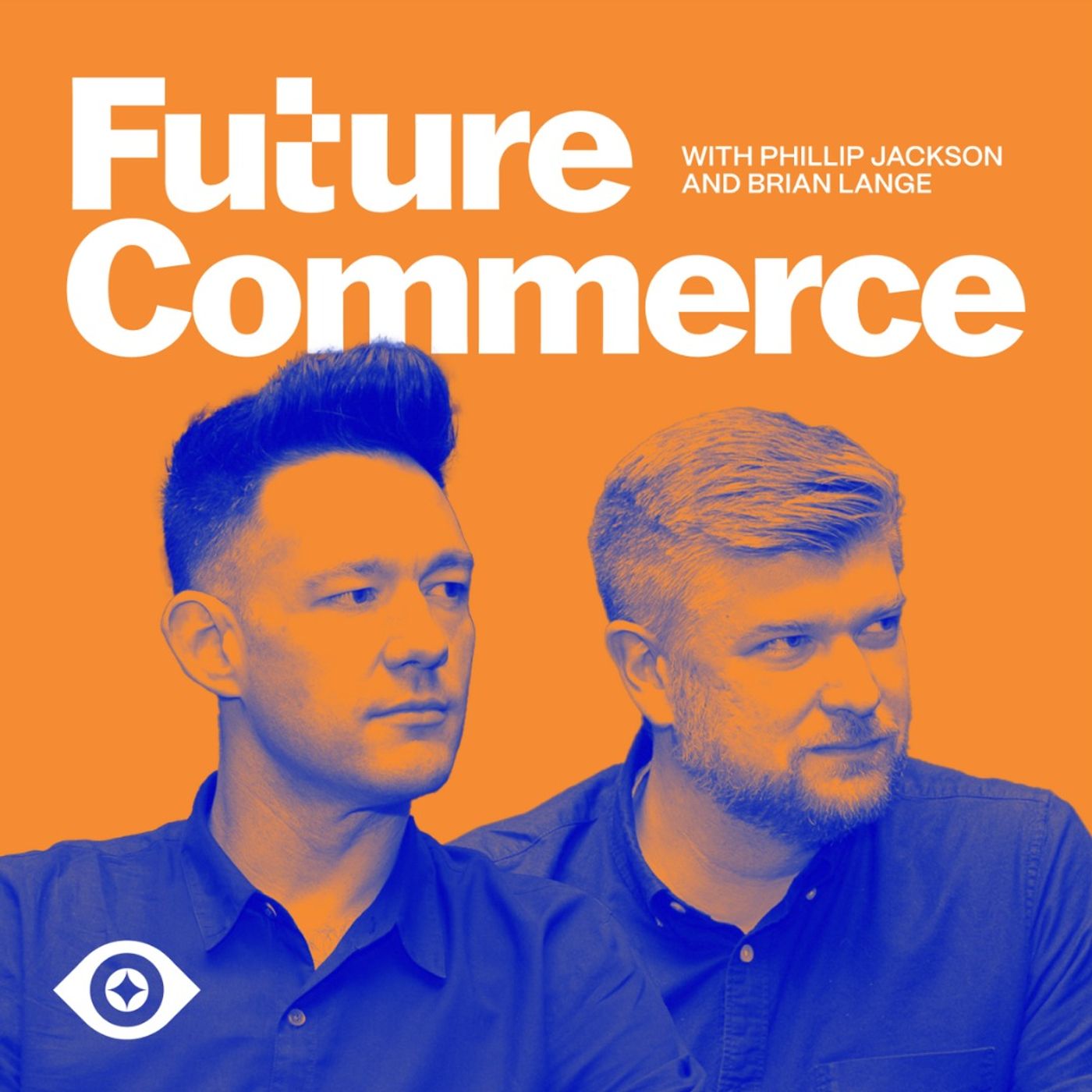
Future Commerce
Phillip Jackson, Brian Lange
Future Commerce is the culture magazine for Commerce. Hosts Phillip Jackson and Brian Lange help brand and digital marketing leaders see around the next corner by exploring the intersection of Culture and Commerce.
Trusted by the world's most recognizable brands to deliver the most insightful, entertaining, and informative weekly podcasts, Future Commerce is the leading new media brand for eCommerce merchants and retail operators.
Each week, we explore the cultural implications of what it means to sell or buy products and how commerce and media impact the culture and the world around us, through unique insights and engaging interviews with a dash of futurism.
Weekly essays, full transcripts, and quarterly market research reports are available at https://www.futurecommerce.com/plus
Trusted by the world's most recognizable brands to deliver the most insightful, entertaining, and informative weekly podcasts, Future Commerce is the leading new media brand for eCommerce merchants and retail operators.
Each week, we explore the cultural implications of what it means to sell or buy products and how commerce and media impact the culture and the world around us, through unique insights and engaging interviews with a dash of futurism.
Weekly essays, full transcripts, and quarterly market research reports are available at https://www.futurecommerce.com/plus
Episodes
Mentioned books

Jun 9, 2023 • 55min
The [True] Cost of Convenience
Welcome to the membership revolution where suddenly airlines are the talk of the town. With a flat fee comes compromise, but are you willing to give up convenience for a cheaper price? Also, if you haven’t yet, take a look at your Shop Pay app and check your wallet out. You may have some cash to burn sitting in the account courtesy of the annual “Shop Pay Shop Day,” which totally existed before this year…right? Tune in now to hear the rest.Loyalty is a Two-Way Street{00:13:14} “The loyalty in the ERP space, and what your business actually runs on that has a lot of bearing on how you choose your eCommerce stack in enterprise.” - Phillip{00:20:16} “What I've always realized, especially when being budget conscious, there's always a cost associated. It's either your time, your patience, or your dollars. And sometimes paying more means that you get a little bit more of your time and you save a little bit of patience.” - Phillip{00:25:08} “We're becoming much more isolated from each other, so naturally, the workplace has become the place that has to help compensate for this because you have to have a community of people that you work with in the workplace. And that's why we have the rise of these social groups and mandated social groups within the workplace, not just for entertainment and for bringing your whole self to work, but there's also an element of just trying to find people and connect with people who have similar life experiences.” - Phillip{00:33:00} “During economic downturns and uncertainty, brands tend to look at memberships or loyalty, maybe a subscription program, as the thing that makes up the difference. It is a lever for the business and not a benefit for the customer.” - Phillip{00:38:06} “I've bought into things before where I'm like, "Man if I just bought stuff piecemeal a la carte, this would have been better." Why did I go for the bundle or the membership? And I now have paid way more than I would have otherwise.” - Brian{00:50:55} “Getting people to the Shop app, it's adoption has a lot of opportunity. There are still a lot of legs, and there's still so much growth opportunity for that, as far as people using it for shopping experiences that Shopify hasn't even touched that yet.” - Brian{00:51:51} “There is a wealth of new channel growth for tomorrow. There's something brand new happening right in front of our eyes. You want to talk about loyalty and how irrational it is, to capitalize on that, you kind of have to be thinking about the future, and you have to see this through.” - Phillip{00:53:08} “This new channel, new platform growth that is being set up in front of us could come from somewhere else in the world and I think it would probably be open source because I think that that's how you tend to see things like this play out in international contexts is through open source projects.” - BrianAssociated Links:Find out more about The Visions Summit at RICE 2023 and make plans to meet us there!Have you checked out our YouTube channel yet?Subscribe to Insiders and The Senses to read more of what we are witnessing in the commerce world! Listen to our other episodes of Future CommerceHave any questions or comments about the show? Let us know on futurecommerce.com, or reach out to us on Twitter, Facebook, Instagram, or LinkedIn. We love hearing from our listeners! Hosted by Simplecast, an AdsWizz company. See pcm.adswizz.com for information about our collection and use of personal data for advertising.

Jun 7, 2023 • 12min
The Caregiver's Mission
For a customer to have a seamless experience while dealing with grief and trauma requires exceptional service and unbelievable logistics infrastructure. They need care. For the three founders at Titan Casket, Scott Ginsberg, Joshua Siegel, and Liz Siegel, this is core to their story as a brand. Listen now to this episode of Archetypes!Direct to Exhumer{00:01:38} The Caregiver continually supports others, making sacrifices on their behalf. They are honorable, selfless, and loyal. The Caregiver offers unconditional love and has a strong sense of responsibility for others to protect and provide a safe place where others can feel nurtured and cared for.{00:05:36} “You may have seen us talk about being the Warby Parker of Caskets and that's not because we're direct to consumer. It's because what Warby saw was there was one manufacturer that controlled all the supply and they also owned the channels of distribution. And so they thought there was a better way of working outside of that. And it's the same thing in caskets.” - Josh{00:09:56} “These are families right in the middle of it. They want to talk about their loved one. And so we hire very carefully, and the team we put in place has no limitations around how long they can spend with clients.” - Josh{00:10:53} “We have a business. We make money, but at the same time, too, the client is saving 50% or more of what they would ordinarily spend at a funeral home. And we get to help every day.” - ScottAssociated Links: Learn more about Titan CasketCheck out other Future Commerce podcastsSubscribe to Insiders and The Senses to read more of what we are witnessing in the commerce world!Have any questions or comments about the show? Let us know on Futurecommerce.com, or reach out to us on Twitter, Facebook, Instagram, or LinkedIn. We love hearing from our listeners! Hosted by Simplecast, an AdsWizz company. See pcm.adswizz.com for information about our collection and use of personal data for advertising.

Jun 2, 2023 • 41min
[STEP BY STEP] What Frameworks Should I use to Qualify Good Software for my Business?
This season on Step by Step, we are asking what does “seamless” mean to my eCommerce business and how do I demystify that in a way that helps me select the right solutions and softwares that make a seamless experience come to life? Just like the suiting and the apparel that KASHIYAMA provides to its customer, there is no one size fits all solution in eCommerce today. Selecting software correctly and well in your organization requires a lot of orchestration and effort and sometimes some frameworks and tips and tricks on how to do that well. BJ McCahill knows all about this and has incredible insights to share. Listen now!In this episode:{0:10:19} - “We calculated at one point there were over 10 million combinations of types of products that you can order. So just looking at the platform where we were going to house our website, that was a huge consideration. Even though initial order volume wasn't going to be that high, we knew the data complexity needed something that was robust and something that could support that.” - BJ{0:15:13} - “Obviously all of these software companies are trying to sell you something. And so maybe they're putting their best foot forward. So you may need to dig a little bit deeper with recommendations from people in the industry, recommendations from agencies that you're working with to make sure that what they're explaining to you is how it works in reality as well.” - BJ{0:19:05} - “Budget plays a huge role obviously in any business decision, but specifically in terms of software selection, you hear the term Total Cost of Ownership, and that is really, really key to think about. The number that you're seeing presented by this software or this agency is not maybe the total number that you're going to end up paying.” - BJ{0:30:08} - “We needed to be able to offer a seamless experience between in-store and online and not every software was going to support that, but it was something that we learned was going to be key to our customer experience that we were offering to be able to really deliver that omnichannel experience for the customers.” - BJ{0:31:59} - “One of the nuances in modern commerce is that you get to this stage of growth where the choices that you make severely feed back into the mindset of how you build your business and they become sort of sympathetic to each other. Having flexibility and being able to build quickly are underappreciated parts of having a software stack.” - PhillipAssociated Links:Learn more about BJ McCahill and KASHIYAMAListen to more Step by Step episodes.Have you checked out our YouTube channel yet?Get your copy of Archetypes, our recently published 240-page journal! Check it out at ArchetypesJournal.comSubscribe to Insiders and The Senses to read more of what we are witnessing in the commerce world! Listen to our other episodes of Future CommerceHave any questions or comments about the show? Let us know on Futurecommerce.com, or reach out to us on Twitter, Facebook, Instagram, or LinkedIn. We love hearing from our listeners! Hosted by Simplecast, an AdsWizz company. See pcm.adswizz.com for information about our collection and use of personal data for advertising.

Jun 1, 2023 • 27min
[STEP BY STEP] What is the Importance of Consolidating my Technology?
This season on Step by Step, we are asking what does “seamless” mean to my eCommerce business and how do I demystify that in a way that helps me select the right solutions and softwares that make a seamless experience come to life? Join us as we hear from Michael Chen, Director of eCommerce Operations at Sugarfina, to break down the term “single handshake” and look more closely at consolidation of operations in your eCommerce business. Listen now!In this episode:{0:08:20} - “From the backend side, there are a lot of softwares we have to use to eliminate all the friction points from the time {consumers} find the website and go on the website to check out and pay. That should be really, really smooth.” - Michael{0:14:32} - “Right now everything is in Magento. We have Adobe Live Search, we have Product Recommendations, and everything is working in one place. So I don't have to go to different places, which save a lot of time and headache.” - Michael{0:16:01} - “Saving money is an important thing, but I would look at it as is the software actually better. If you're going to consolidate, is it actually better for the business? There are a lot of factors, so I wouldn't say saving money is the most important thing. There's a lot of research you have to do.” - Michael{0:18:32} - “To extract the most amount of value from any piece of software requires an intimate understanding and time spent in using the software, and the hard things become easy over time. So you grow into these capabilities. You don't just turn it on on day one.” - Phillip{0:23:51} - “You have to be focused on forward progress and continual improvement because your competitors are, and if they're doing it, you have to be more efficient and more optimized.” - MichaelAssociated Links:Learn more about Michael Chen and Sugarfina.Listen to more Step by Step episodes.Have you checked out our YouTube channel yet?Get your copy of Archetypes, our recently published 240-page journal! Check it out at ArchetypesJournal.comSubscribe to Insiders and The Senses to read more of what we are witnessing in the commerce world! Listen to our other episodes of Future CommerceHave any questions or comments about the show? Let us know on Futurecommerce.com, or reach out to us on Twitter, Facebook, Instagram, or LinkedIn. We love hearing from our listeners! Hosted by Simplecast, an AdsWizz company. See pcm.adswizz.com for information about our collection and use of personal data for advertising.

May 31, 2023 • 54min
[STEP BY STEP] What Does “Fully-Integrated” Mean in the DXP Era?
This season on Step by Step, we are asking what does “seamless” mean to my eCommerce business and how do I demystify that in a way that helps me select the right solutions and softwares that make a seamless experience come to life? Joining us on the podcast in this episode is Rebecca Hall, Director of Digital Solutions Consulting at Blue Acorn ICI, and Doug Hatcher, her counterpart on the sales side of the business, a solutions consultant. And they're going to answer this question, "What does fully-integrated mean in the DXP era?” Listen now!In this episode:{0:11:32} - “DXPs provide: a very good way to visualize and analyze how people are interacting with the brand so you can customize it and better personalize the experience people are getting to it.” - Doug{0:14:46} - “The beauty of composable architecture and personalization is that you're really hitting those specific customers, really hitting those specific audiences, and you're serving up a unique experience almost per person. So it's not just per brand, it's per customer as well that we can really dig in and create a unique experience.” - Rebecca{0:24:57} - “The team and the tool have to be mutually aligned. it becomes much more impactful when you're making software decisions because all of them are interdependent. Future-proofing to some degree is just buying more durable software that's capable of doing more and growing over time without you having to completely rip and replace.” - Phillip{0:28:55} - “We're able to deliver, like immediately deliver, relevant experiences to your customers that may help them find what they're looking for and reduce some of the noise, as well as help you target immediately somebody who is actually looking for something specific.” - Rebecca{0:37:51} - “There are things that these platforms can't necessarily predict or just have a capability for out of the box. So there's always going to be a need to do custom development. More and more though, the customization that we're doing isn't on the front end, isn't trying to build the customer experience in a new and unique way. We try to focus that on a custom configurator piece or one thing that we can compose into the broader solution.” - Doug{0:44:47} - “ If we know what we have, we're able to use that data better and we can actually make better suggestions as we go along as well. It's all about data.” - RebeccaAssociated Links:Learn more about Rebecca Hall, Doug Hatcher, and Blue Acorn ICIListen to more Step by Step episodes.Have you checked out our YouTube channel yet?Get your copy of Archetypes, our recently published 240-page journal! Check it out at ArchetypesJournal.comSubscribe to Insiders and The Senses to read more of what we are witnessing in the commerce world!Listen to our other episodes of Future CommerceHave any questions or comments about the show? Let us know on Futurecommerce.com, or reach out to us on Twitter, Facebook, Instagram, or LinkedIn. We love hearing from our listeners! Hosted by Simplecast, an AdsWizz company. See pcm.adswizz.com for information about our collection and use of personal data for advertising.

May 30, 2023 • 40min
[STEP BY STEP] Mastering Omnichannel Integration for Seamless Shopping
This season on Step by Step, we are asking what does “seamless” mean to my eCommerce business and how do I demystify that in a way that helps me select the right solutions and softwares that make a seamless experience come to life? In this episode, we are talking to Keith Menezes, who's the Director of Commercialization at Walmart, the world's largest retailer. We're going to talk about how we master omnichannel integration and provide for a seamless experience not just for customers, but also for employees and some of the decisions that are made in making the technology that Walmart has built to create incredible omnichannel experiences available for the rest of the world. Listen now!In this episode:{0:06:28} - “A vibrant retail ecosystem where we're all really serving other merchants and customers, I think helps all of us.” - Keith{0:10:32} - “It's not just about the technology, it's about the system, and then it's also about the change management. If you deploy a piece of technology and it just doesn't make sense in context of how the employee is doing their job and the UI and the experience itself is just complicated or hard to understand, adoption will plummet, but most importantly, customers aren't going to get what they're looking for, which then will ultimately impact their perception of your brand, and then loyalty, which is going to lead to churn.” - Keith{0:14:49} - “What has happened in the market is you've seen the growth of outsourced fulfillment, other providers out there that maybe exist as marketplaces where customers may go, they'll place an order, and then this third party will go into the store, pick the items for you and deliver it for you. And brands have loved that because they've gotten the growth. But now two years later, post-pandemic, what they're evaluating is what did we give up to get that?” - Keith{0:21:41} - “Fulfillment, even though it's invisible, it is an expression of your brand and you really have to get items to customers in the way that the customer is expecting them.” - Keith{0:26:416} - “Retail companies are in the business to sell products to customers. And the evolution has been really slow. And I don't know if people have picked up on it, but we are now buying software that's purpose built to be transactional software because it's built by the people who have to power their own businesses on it. And that is a fundamental shift away from, "You need software. We build software. Here's your software.’" - Phillip{0:33:45} - “Through Store Assist, we're giving you the capability to create these white label kind of fulfillment experiences. It's all your brand. We're existing in the background and then all the data that's coming back really is yours. You understand how customers are interacting with you and then empowering you to make decisions on what you ultimately serve up to your customers.” - KeithAssociated Links:Learn more about Keith Menezes and Walmart Commerce Technologies.Listen to more Step by Step episodes.Have you checked out our YouTube channel yet?Get your copy of Archetypes, our recently published 240-page journal! Check it out at ArchetypesJournal.comSubscribe to Insiders and The Senses to read more of what we are witnessing in the commerce world!Listen to our other episodes of Future CommerceHave any questions or comments about the show? Let us know on Futurecommerce.com, or reach out to us on Twitter, Facebook, Instagram, or LinkedIn. We love hearing from our listeners! Hosted by Simplecast, an AdsWizz company. See pcm.adswizz.com for information about our collection and use of personal data for advertising.

May 29, 2023 • 47min
[STEP BY STEP] What Does “Seamless” Mean in my eCommerce Operations?
This season on Step by Step, we are asking what does “seamless” mean to my eCommerce business and how do I demystify that in a way that helps me select the right solutions and softwares that make a seamless experience come to life? To start this season off, we welcome the CEO of Whisker, Jacob Zuppke, to share about his incredible amount of experience in building a technology company that today is omnichannel, selling in retailers, selling via an app, and making your life a better place by making your pets' lives better. Listen now!In this episode:{0:07:19} - “As you grow up from a company from small to big pretty quickly, I think you end up making a lot of decisions because you don't have a person for everything. We've evolved, but not drastically. I still want my department leaders selecting software. I don't want a central IT hub making those decisions on behalf of each department because I think that's a siloed approach that doesn't get each user what they want. ” - Jacob{0:12:39} - “Having different perspectives is probably the most important thing. Somebody that represents different areas of the business and what their needs may or may not be at a later time. And then thinking through, can we get at least two years out of that?” - Jacob{0:24:39 } - “Software decisions drive our hiring decisions. Moving from Google Cloud, when we were on it with Firebase and its suite of products, to AWS in 2017 or 18, has driven thee entirety of our decision-making process since then.” - Jacob{0:32:05} - “You're working in a software every day. You're training your entire people around how to use it. If those people aren't part of the decision-making and then also future planning around what is next and how you intend to get there and at least being mindful of that, I think that you're making a decision in a vacuum, and I don't think that that's going to benefit any organization.” - Jacob{0:32:36} - “You have to grow up at some point and big kid software makes you make decisions. You have to grow up and having juvenile platforms that make a bunch of decisions for you has its strengths. But it also may limit your ability to make decisions and grow an org and have informed decisions and perspectives from people who have had to solve a number of challenges, not just the software part.” - Phillip{0:37:08} - “When you're oftentimes changing those decisions frequently you lose the trust in a team. Going back a few years, I think we were pivoting too frequently. And I think now that we've got a better way of approaching software decisions, we're making less frequent decisions that are more sound and more aligned with where the business is going for the next couple of years.” - JaobAssociated Links:Learn more about Jacob Zuppke and Whisker.Listen to more Step by Step episodes.Have you checked out our YouTube channel yet?Get your copy of Archetypes, our recently published 240-page journal! Check it out at ArchetypesJournal.comSubscribe to Insiders and The Senses to read more of what we are witnessing in the commerce world!Listen to our other episodes of Future CommerceHave any questions or comments about the show? Let us know on Futurecommerce.com, or reach out to us on Twitter, Facebook, Instagram, or LinkedIn. We love hearing from our listeners! Hosted by Simplecast, an AdsWizz company. See pcm.adswizz.com for information about our collection and use of personal data for advertising.

May 26, 2023 • 48min
Mockup Madness: The Gamification of the Checkout Experience
Mockup Culture is everywhere these days. We have seen things from Wes Anderson Star Wars to Gucci Spring lookbooks created in MidJourney, the possibilities are truly endless. Join Phillip and Brian as they explore the notion that we now live in a time where any dream can be transformed into reality, no matter how bizarre or outlandish. They explore how prominent brands like Telfar are embracing the concept, utilizing gamified pricing strategies to captivate consumers. As they dissect these phenomena, they unravel the concepts of "hyperstition" and "metamodernism" and examine their implications for the modern consumer. Stay tuned for some content teasers from Phillip and Brian, as they hint at what's to come at our Visions Summit in Chicago.Tonal Shift{00:09:42} “Why does Dollar Shave Club or Glossier choose a Shopify? There's an operational cost associated with selling online and it gets more expensive every day, especially the more custom software you have and the more esoteric your business model is online. By choosing a platform that imposes a constraint on you, theoretically, you can drive the cost down.” - Phillip{00:16:09} “The things that create inherently shareable content and the things that are truly remarkable and worthy of talking about are things that are building so close to the edge of possibility that it requires a tremendous amount of investment.” - Phillip{00:17:18} “What we're seeing, and you wrote a whole article on this recently on mockup culture, is this idea that actually customers and fans and audiences are now having real influence on the greater brand.” - Brian{00:26:02} “Metamodernism is when a piece of content or something is created that's both critique and embrace of something. Some of these mockups are super interesting because they are commentary, they are ironic and sarcastic, but they're also good ideas.” - Brian{00:31:01} “This multifaceted way of engaging in media and art has a direct bearing on commerce because commerce powers it all.” - Phillip{00:40:55} “What algorithmic timelines do and what generative AI allows for people to create through hyperstition is that my idea of Hermes or Gucci or Nike is no longer fundamentally the same as yours.” - Phillip{00:43:41} “It's not personalization so much as your brand is going to hit differently for different people. You need to hit the notes that say the things that you're wanting to say to that person that maybe achieve the same outcome for a different person, but it's done differently.” - BrianAssociated Links:Find out more about The Visions Summit at RICE 2023 and make plans to meet us there!Have you checked out our YouTube channel yet?Subscribe to Insiders and The Senses to read more of what we are witnessing in the commerce world!Listen to our other episodes of Future CommerceHave any questions or comments about the show? Let us know on futurecommerce.com, or reach out to us on Twitter, Facebook, Instagram, or LinkedIn. We love hearing from our listeners! Hosted by Simplecast, an AdsWizz company. See pcm.adswizz.com for information about our collection and use of personal data for advertising.

May 24, 2023 • 15min
A Hero's Journey
What does it take to build a brand that stands out as a Hero? How does the Hero’s story inspire us and bring about positive impact in the world around us? Listen now as Ju Rhyu shares with Phillip some of her Hero’s journey in building Hero Cosmetics!Standout Success{00:02:47} Ju knew that acne care is an emotional and sensitive area of the market, and she wanted the name of the product and of the brand to be positive and connect emotionally with consumers who needed the solution the product would provide{00:05:25} “When we started, even though we started on Amazon, I always knew this business would be an omnichannel business because when you have a pimple emergency, two day free shipping is great, but nothing sometimes is as good as being able to walk into a store and pick up a product that same day.” - Ju{00:06:00} Hero’s first in-store launch went so well that it went nationwide pretty quickly, and then two years later was in Target where one SKU became a mulit-million dollar SKU within one year{00:11:00} “I definitely have the philosophy that I'll always do what's right for the business. And if I'm no longer the right person, then I will gladly step aside and make room for a real professional.” - Ju{00:13:34} “I’m constantly amazed at people who are at the highest levels of success or fame or however we hold them, when asked about who their heroes are, they pull out a Tom Rinks or a Scott Norton who has never been mentioned on Twitter, not once. I think that that's really interesting.” - PhillipAssociated Links: Learn more about Ju Rhyu and Hero CosmeticsCheck out other Future Commerce podcastsSubscribe to Insiders and The Senses to read more of what we are witnessing in the commerce world!Have any questions or comments about the show? Let us know on Futurecommerce.com, or reach out to us on Twitter, Facebook, Instagram, or LinkedIn. We love hearing from our listeners! Hosted by Simplecast, an AdsWizz company. See pcm.adswizz.com for information about our collection and use of personal data for advertising.

May 19, 2023 • 55min
Navigating Legal Landmines
Any business comes with risks, and there are many legal issues around advertising that can become major if a brand doesn’t have arms around what those are and how to avoid them. From differing terms of agreement to the variety of laws per state, there is a good deal to navigate, and it takes an expert to wade through. How do you realistically have a thriving enterprise or a business with these kinds of encumbrances? Listen now to our conversation with Robert Freund and his take on this changing environment and how it affects all of us! Applying Old Laws to New Situations{00:08:05} The rules of disclosure, that were never really clear before, are undergoing scrutiny and clarification from the FTC for situations such as an influencer receiving product and then creating content about it and other examples that can really determine strategy{00:13:22} “The FTC's rule is that the disclosure has to be clear and conspicuous, which effectively means your audience can't miss it.” - Robert{00:16:45} “These old laws and rulings that are not effectively law become a tangled web that we have woven because of the heavy commercialization of the way that content has emerged.” - Phillip{00:18:21} “There's always that sort of lag time between what the law says, what courts tell us the law means and what marketers are out there doing.” - Robert{00:25:08} Legal problems, whether legitimate or not, have always been a part of running a business, but the time frame for encountering a legal problem is business is much shorter now{00:30:58} As advertisers get more creative and competitors get more daring, there will continue to be more pushback from the FTC and more lawsuits filed against business owners that can even look back as much as three or four years, so it’s important to not fall prey to using those tactics to justify staying competitive{00:38:05} Legal entanglements and risk associated with them influence the way businesses are built and also where they are being built now, which actually changes the way we think about global commerce and global eCommerce, and that’s not necessarily a good thing{00:49:58} “As you go to try and do something more and further that stands out, of course, the top influencers are pushing legal boundaries. That's probably how they got there in the first place.” - BrianAssociated Links:Learn more about Robert FreundFind out more about The Visions Summit at RICE 2023 and make plans to meet us there!Have you checked out our YouTube channel yet?Subscribe to Insiders and The Senses to read more of what we are witnessing in the commerce world! Listen to our other episodes of Future CommerceHave any questions or comments about the show? Let us know on futurecommerce.com, or reach out to us on Twitter, Facebook, Instagram, or LinkedIn. We love hearing from our listeners! Hosted by Simplecast, an AdsWizz company. See pcm.adswizz.com for information about our collection and use of personal data for advertising.

