

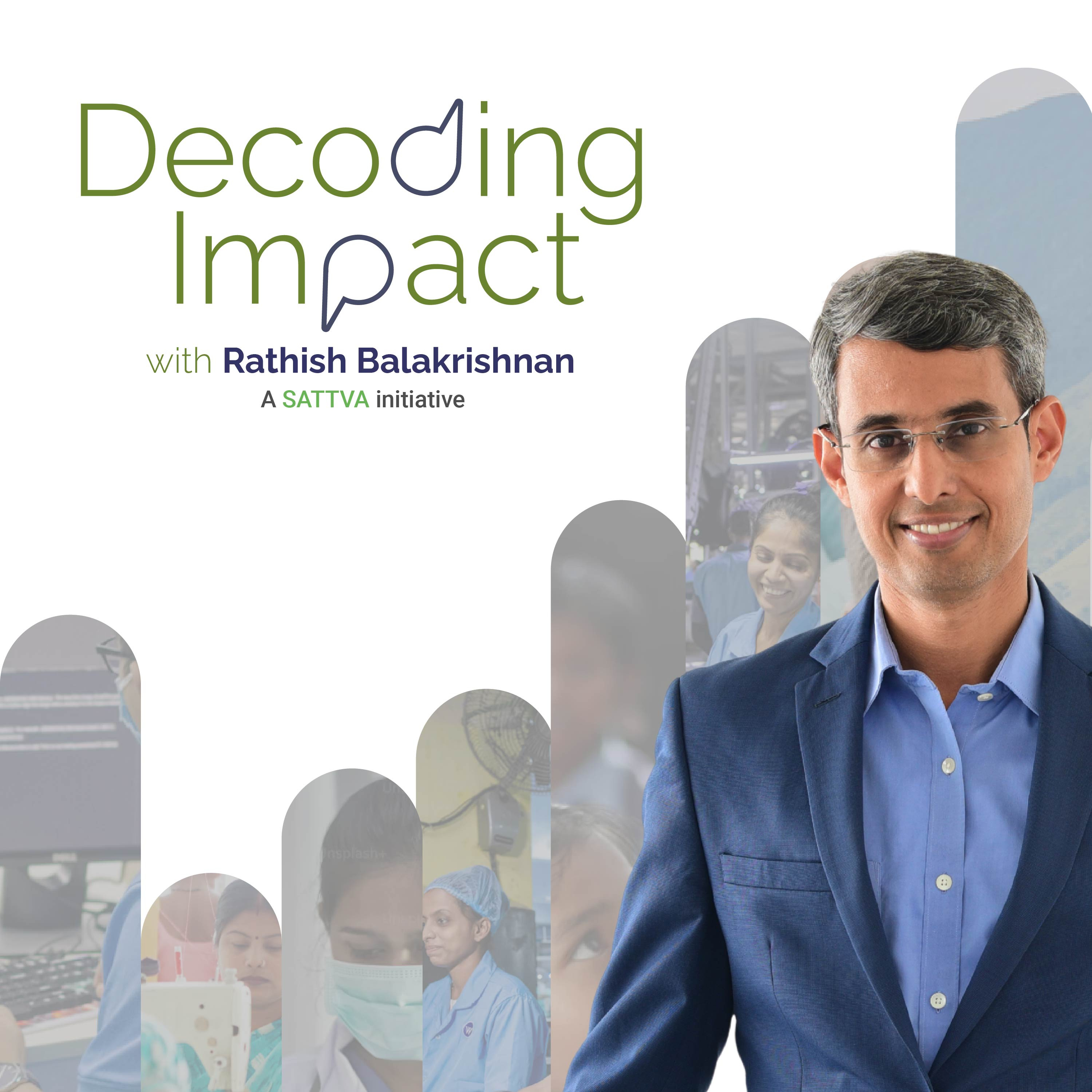
Decoding Impact with Rathish Balakrishnan
A Sattva Initiative
Welcome to Decoding Impact, a social impact podcast hosted by Rathish Balakrishnan, Co-founder and Managing Partner of Sattva Consulting.
Through Decoding Impact, we aim to spotlight critical societal issues, the solutions currently available and the substantial barriers and trade offs that exist today to achieve them.
Thought-provoking conversations with innovators, experts and leaders from civil society, business and government and offers a unique platform to spotlight tangible solutions to achieving societal impact.
Join the journey, let's decode impact, one conversation at a time.
Through Decoding Impact, we aim to spotlight critical societal issues, the solutions currently available and the substantial barriers and trade offs that exist today to achieve them.
Thought-provoking conversations with innovators, experts and leaders from civil society, business and government and offers a unique platform to spotlight tangible solutions to achieving societal impact.
Join the journey, let's decode impact, one conversation at a time.
Episodes
Mentioned books

May 14, 2024 • 4min
#RapidFire ft. Ramraj Pai
Get to know more about our latest guest featured on Decoding Impact, Ramraj Pai, through this revealing rapid fire!
Listen to the latest episode of Decoding Impact!:
🔴 Youtube
🟣 Apple Podcast
🔵 Amazon
🔗 Website

May 4, 2024 • 1h 14min
Decoding the Rupee for Rupee impact of blended finance ft. Ramraj Pai
At the core of enabling sustainable development it comes down to how it is funded that determines the success or failure of making true and lasting progress. Currently we face a significant challenge with achieving the Sustainable Development Goals (SDGs) by 2030, as there is a huge constraint in the lack of available funds to meet out the expense of realising these goals. So how can finance maximise impact?
In this latest episode of Decoding Impact we explore the topic of Blended Finance as a potential solution that can diversify sources of capital, from both commercial and public stakeholders. Through this discussion we break down and help listeners understand what is blended finance, the nuances behind its application, the risks, and where it should not be used, the enabling ecosystem that would allow blended finance to scale, and the regulatory challenges.
Joining host Rathish Balakrishnan to discuss this topic is Ramraj Pai, Senior Advisor and ex-CEO at the Impact Investors Council (IIC). From his experience in social financing, Ramraj is able to shed light on this seemingly obscure topic and explain it in a very practical and example-based manner. If you want to understand blended finance, or look at how capital can enable impact with a rupee for rupee value, tune into this episode of Decoding Impact today!
Explore some of our SKI products related to this topic:
• Decoding Green Growth with Amitabh Kant• Decoding Climate Finance with Varad Pande
• Guidebook: CSR and Corporate Philanthropy Towards Innovation
• Investing for Impact: Social Stock Exchange in India
Guest: Ramraj Pai
Host: Rathish Balakrishnan
Producer: Meenakshi Iyer
Produced by: Pickle Jar Media
Chapters:
00:00 - Precap
01:28 - Welcome
01:38 - Topic & Guest Intro
03:05 - Ramraj Pai's journey in blended finance
06:51 - Lessons from working in the impact ecosystem
12:25 - Blended Finance for dummies
18:48 - Understanding four essential truths of blended
finance
22:29 - The nuances of stakeholders in blended finance
31:14 - Summarising insights around blended finance and considering the larger framework
36:12 - Categories for blended finance application
39:41 - The role of blended finance to scale innovation
42:20 - What is limiting the supply and demand of blended finance?
47:03 - The mindset shift needed for development financing to be catalytic & innovative
50:44 - Where can funders begin their blended finance journey and how can the government enable them?
55:44 - Summarising insights on how to enable the ecosystem and infrastructure for blended finance
59:04 - Regulatory challenges
01:04:36 - Blended finance and the four stages of the innovation life cycle
01:06:54 - Summary of key insights and enabling domestic philanthropy and the Social Stock Exchange
01:12:56 - Summary and thanks

Apr 27, 2024 • 3min
#RapidFire ft. Kaushal Jaiswal
Get to know more about our latest guest featured on Decoding Impact, Mr. Kaushal Jaiswal, through this revealing rapid fire!
Listen to the latest episode of Decoding Impact!:
🔴 Youtube
🟣 Apple Podcast
🔵 Amazon
🔗 Website

Apr 18, 2024 • 60min
Decoding micro-irrigation for farmers and its role in India's water crisis ft. Kaushal Jaiswal
A part of solving India’s water crisis lies on its farms. From soil, to grain, cultivation, to harvesting, none knows the agrarian land in India and its potential more than our farmers. By empowering farmers with technology that will help them with greater yield, while enabling water conservation for the nation, the agriculture sector in India could be transformed.
The solution? Micro-irrigation. How has irrigation and the water problem evolved together in India? What is the promise of micro-irrigation? What are the barriers preventing this solution from scaling? Join Rathish Balakrishnan in the latest episode of Decoding Impact in discussion with Kaushal Jaiswal, MD at Rivulis Irrigation, for this practical discussion on micro-irrigation, the potential of India’s farmers, and a way forward to conserve water in India.
Explore some of our SKI products related to this topic:
• Transforming Crop Cultivation: Advancing Water Efficiency in Indian Agriculture
• Worsening Water Stress in Agriculture: Is There a Glimmer of Hope?
Guest: Kaushal Jaiswal
Host: Rathish Balakrishnan
Producer: Meenakshi Iyer
Produced by: Pickle Jar Media
Time Stamps & Chapters:
00:00 - Precap01:35 - Welcome01:55 - Topic intro03:02 - Guest intro07:08 - How has discussing irrigation and the water problem evolved in India10:00 - Micro-irrigation as a practice in the North vs. the South of India13:01 - The invisible cost of water in agriculture14:45 - Understanding the value of drip irrigation19:44 - Are benefits of micro-irrigation visible to the farmer?23:08 - Why is the adoption of micro-irrigation so low in India today?30:59 - The role of AI in democratising micro-irrgation systems and set-up.33:07 - The maintenance of micro-irrigation systems35:27 - The solution to scaling micro-irrigation38:53 - Reducing the friction for financing & the role of subsidies41:58 - Scaling micro-irrigation for 1 million farmers43:18 - The most investable solutions to scale micro-irrigation in agriculture45:09 - Crops to prioritise for micro-irrigation48:22 - Regions to prioritise for micro-irrigation49:19 - The market for micro-irrigation in East India52:23 - Financing micro-irrigation through climate financing56:05 - Summary and Thanks58:57 - Outro

Apr 5, 2024 • 60min
Decoding the systemic challenges of women in agriculture ft. Ireena Vittal
The recent interim budget focused on how to enable women farmers, looking at how they can be raised up along with other smallholder farmers across India. Today, in certain key agricultural value chains like sugarcane, women make up 50% of the workforce. Yet their work is significantly undervalued as they face a 60% pay gap. This speaks to the deeper systemic challenges women in agriculture face, with their role and contributions being largely obscured.
In the first episode of season 3 of Decoding Impact Rathish Balakrishnan spoke with Ireena Vittal, one of India's most respected independent consultants and advisors in agriculture, emerging markets and urban development. Through the episode they discussed:
• How certain key agricultural value chains operate
• Making all agricultural value chains equitable for all smallholder farmers regardless of gender
• How women in agriculture can help themselves within these value chains through self help groups and collectivisation
• The nuanced interplay of social norms impacting the economic empowerment of women
Explore some of our SKI products related to this topic:
• Gender Inclusivity in Commercial Agriculture
• Formalising the Female Workforce in Indian Agriculture
Guest: Ireena Vittal
Host: Rathish Balakrishnan
Producer: Meenakshi Iyer
Produced by: Pickle Jar Media
Time Stamps & Chapters:
0:00 - Precap
1:20 - Introduction
2:59 - Guest Introduction
3:33 - Ireena Vittal’s Journey
5:00 - The invisibility of women in Agriculture
8:37 - The power equation for women in Agriculture
13:20 - The power of Collectives for women in Agriculture
16:27 - The systemic issues in agriculture - How do we address these?
17:28 - Understanding different agriculture value chains (part 1)
23:33 - Understanding different agriculture value chains (part 2
31:04 - Challenges in the Indian agriculture industry inhibiting smallholder farmers)
36:09 - The role of businesses in catalysing equitable agriculture
40:57 - Women in agriculture need better pay
45:17 - Women need to participate in the market
51:53 - Solutions to empower women in agriculture
55:01 - Shifting the gender equation at the intermediary layer in agriculture
58:12 - Summary & thanks
58:52 - Outro

Oct 27, 2023 • 1h 21min
Decoding Account Aggregators with Shalini Gupta
Despite gains in its financial inclusion journey, access to financial services is limited to 86% of India's population. Access to credit specifically is a persistent challenge, reflected in the unmet credit need of Rs 25 lakh crores - aggravated by disaggregated data and tedious data sharing processes.
Account aggregators are introducing open banking in India. They have the potential to revolutionise the credit market, empowering millions of customers to access and share their financial data across institutions in a secure and efficient manner. To talk more about account aggregators and how these can enable financial digital inclusion, we have with us Shalini Gupta, the Head of Strategy at Sahamati. Sahamati is a member-driven industry alliance formed to facilitate adoption of the account aggregator ecosystem in India.
----
For more, follow Sattva Knowledge Institute on our Website, LinkedIn, Instagram, and Twitter.
Host: Rathish Balakrishnan | Linkedin | Twitter
Guest: Shalini Gupta | LinkedIn
Producer: Anagha Wankhede
Audio Engineer & Editor: Abhilash Raikar
Designer: Usha Sondhi Kundu
----
Content Sections
00:00 - Decoding Impact Introduction
00:48 - Introduction to the topic and guest
02:32 - What is an Account Aggregator?
06:40 - What financial information is viable and who will use it?
10:21 - Personal Finance Management (PFM) Use Cases
13:14 - How big is the AA system today?
15:37 - A User's Journey in the AA Framework
18:17 - Common AA Apps
18:59 - Value in Data Sharing
24:53 - Resolving Conflicts of Purpose between Financial Entities
28:40 - A New Approach to Gauging Financial Health
34:36 - What is Sahamati's Role?
37:59 - How can Account Aggregators Unlock Value?
50:30 - The Interplay of OCEN and AA
55:57 - PFM for Women
59:11 - Account Aggregators for the Government
1:03:01 - What needs to fall in place?
1:08:02 - Employing Imagination to Utilise AA
1:13:54 - The Role of Philanthropic Capital
1:19:02 - Summary and outro

Oct 10, 2023 • 1h 4min
Decoding a Life Cycle Approach to Mental Health with Dr. Pratima Murthy
India is grappling with a severe mental health crisis, with over 197 million Indians diagnosed with mental disorders, exacerbated by a wide treatment gap. The good news is that there is growing recognition of the importance of mental health in the country. However, a thorough understanding of what it entails, what forms mental well-being takes, how it should be approached and conceptualised, is lacking.
Mental well-being is intertwined with economic, cultural, social and other factors at various stages of an individual’s life. Effective interventions, therefore, should be contextualised to these aspects. How can public policy, market solutions and community solutions be designed with these in mind?
Joining us on World Mental Health Day to share her reflections on making mental health a key part of India’s development agenda, is Dr Pratima Murthy. Dr. Murthy is the Director of NIMHANS, where she has been pivotal in initiating Tele Manas, and establishing the state-of-the-art Centre for Addiction. She has also worked with the National Human Rights Commission to improve care for persons with mental illness.
For more, follow Sattva Knowledge Institute on our Website, LinkedIn, Instagram, and Twitter.
Host: Rathish Balakrishnan | Linkedin | Twitter
Guest: Dr. Pratima Murthy | Linkedin
Producer: Meenakshi Iyer
Audio Engineer & Editor: Abhilash Raikar
Designer: Usha Sondhi Kundu
Content Sections:
00:48 Introduction to the topic and guest
02:14 Why is mental well-being critical?
04:17 Recognising interconnections
08:10 Vocabulary and mental models
12:22 Context-specific intervention design
15:38 Designing population-scale interventions
23:11 Perinatal well-being
26:06 Mental health in schools
36:01 Mental health in workplaces
39:42 Prisons as a crucial locus
44:55 Mental health for the elderly
47:54 Improving access to care
51:41 Designing mental well-being models
58:22 Recommendations for philanthropy
1:02:15 Summary and Outro

Sep 15, 2023 • 55min
Decoding Universal Health Coverage with Dr. Nachiket Mor (Part 2)
In Part 2 of our discussion on Universal Health Coverage, host Rathish Balakrishnan and guest Dr Nachiket Mor dive into the need to define the right problems while taking a digital public goods approach to UHC, challenges with financing, and lessons from other countries. They also discuss how the private and public sectors can rethink existing approaches to healthcare delivery, and collaborate to implement an efficient working model for UHC in India.
Dr. Nachiket Mor is trained as an economist. His current work is principally focused on the design of national and regional health systems. He is a Visiting Scientist at The Banyan Academy of Leadership in Mental Health and a Senior Research Fellow at the Centre for Information Technology and Public Policy at IIIT Bangalore. He is also a Commissioner on the Lancet Commission on Reimagining India's Health System.
Listen to Part 1 here: https://open.spotify.com/episode/5rsqLW3phlu3XLRgX1kteg
For more, follow Sattva Knowledge Institute on our Website, LinkedIn, Instagram, and Twitter.Host: Rathish Balakrishnan | Linkedin | Twitter
Guest: Dr. Nachiket Mor | Linkedin | Twitter
Producer: Meenakshi IyerAudio Engineer & Editor: Abhilash RaikarDesigner: Usha Sondhi Kundu
Content Sections0:00 - Decoding Impact Introduction0:48 - Introduction to topic and guest02:13 - Accelerating UHC with Digital Public Goods07:02 - Articulation of DPGS16:04 -Promises of Healthcare19:23 - Financing in UHC23:21 - Incentives for public health26:35 - Managed Care29:56 - Making Strategic Purchases effective34:30 - District as a unit35:37 - Private Sector Participation Models44:23 - White spaces47:40 - Imagining a Working Model in Health52:06 - Summary and Outro

Sep 8, 2023 • 1h 10min
Decoding Universal Health Coverage with Dr. Nachiket Mor (Part 1)
Globally, universal health coverage (UHC) has been highlighted as an important goal, because of its close links to poverty reduction and potential to enhance the economic growth of countries.
From public to private health care, across primary, secondary, and tertiary care, and whether we look at the challenges and opportunities for physicians or community health workers, the promise of UHC is heady and exciting. Through this two-part discussion with Dr. Nachiket Mor, not only an expert in health, but someone who is deeply passionate about health and health systems, host Rathish Balakrishnan explores the plethora of trade-offs and barriers to realising UHC in India.
In part one of this discussion Dr. Mor helps us understand what universal health coverage is, highlights existing bright spots, looks at the role of primary care, and discusses how we can talilor an approach to UHC that leverages India’s strengths.
Dr. Nachiket Mor is trained as an economist. His current work is principally focused on the design of national and regional health systems. He is a Visiting Scientist at The Banyan Academy of Leadership in Mental Health and a Senior Research Fellow at the Centre for Information Technology and Public Policy at IIIT Bangalore. He is also a Commissioner on the Lancet Commission on Reimagining India's Health System.
For more, follow Sattva Knowledge Institute on our Website, Linkedin, Instagram, and Twitter.
Host: Rathish Balakrishnan | Linkedin | Twitter
Guest: Dr. Nachiket Mor | Linkedin | Twitter
Producer: Meenakshi Iyer
Audio Engineer & Editor: Abhilash Raikar
Designer: Usha Sondhi Kundu
Content Sections
0:00 - Decoding Impact Introduction
0:47 - Introduction to topic and guest
02:47 - Where is India in relation to Universal Health Coverage today?
09:58 - The People vs. Politics of UHC
13:14 - Building things for the greater good rather than to feel good
15:55 - Key levers to think about UHC
20:45 - Understanding the Indian context
21:57 - What is working well & opportunites in India
24: 57 - More examples in India of what is working well
26:52 - Building a multidisciplinary approach top down
29:52 - The missing tissue between ideas and intent
32:05 - Finding solutions and how to think about financing UHC
36:44 - Evolving the role of community health aids for UHC
43:21 - Learnability of community health aids
44:42 - The effect of localising community workers
46:11 - Avoiding the pitfalls of isomorphic mimicry
50:52 - Reflection and opportunities
52:41 - Understanding the true cost of UHC for India
01:00:08 - We need a high trust system to realise UHC
01:05:33 - Summary and Outro

Aug 25, 2023 • 1h 9min
Decoding Agricultural Technology (Agritech) with Parmesh Shah
Technology has the potential to revolutionise Indian agriculture. There are innovations in seed and bioengineering platforms, use of robots and AI and blockchain that are enhancing efficiency and transparency in the sector. India's agritech industry comprises over 1300 companies and is projected to reach over ₹1 trillion by 2025. The recent 2023-24 budget allocated INR 450 crores to the Digital Agriculture Mission and INR 600 crores for technology driven agriculture promotion.
However, despite these promising tailwinds, the low adoption of technology by farmers remains a major challenge, and agritech penetration in India remains abysmally low at around 1%. In today's episode of Decoding Impact, we try to understand the potential of a platform-based approach for agritech, the importance of directing the right capital to address the right issues, and how we can take a systems approach to identify key enablers for the successful scale up of agritech.
Our guest for this episode is Mr. Parmesh Shah, the Global Lead for Data, Digital Agriculture and Innovation at the Agriculture and Food Global Practice of the World Bank. Mr. Shah is currently managing a global programme on scaling up data-driven digital agriculture, involving data platforms and establishing ecosystems for innovation, entrepreneurship and incubation across 38 countries.
For more, follow Sattva Knowledge Institute on our Website, Linkedin, Instagram, and Twitter.
Host: Rathish Balakrishnan | Linkedin | Twitter
Guest: Parmesh Shah | Linkedin | Twitter
Producer: Meenakshi Iyer
Audio Engineer & Editor: Abhilash Raikar
Designer: Usha Sondhi Kundu
Content Sections:
0:00 - Decoding Impact Introduction0:48 - Introduction to topic and guest02:37 - The current agri tech landscape
05:58 - Defining agtech solutions & tech
10:03 - Successful solution categories
13:53 - The need for physical plus digital infrastructure
23:41 - 5 key principles
25:46 - Systemic challenges to agtech adoption
33:49 - Understanding platforms and agri tech
42:20 - Summarising the platform "cake" layers
43:35 - Different types of capital
49:22 - Building a platform-based approach
57:25 - Challenges for big business and the State
01:04:10 - Role of Philanthropy
01:07:20 - Summary and thanks

