

The Modern Manager
Mamie Kanfer Stewart
Host Mamie Kanfer Stewart shares practical approaches to help you be a great manager. Learn more at: https://themodernmanager.com/
Solo episodes are like mini-courses, providing actionable tips based on experience and research. Guest episodes are engaging conversations that elicit insights and suggestions for how to apply the ideas.
Learn more about effective meeting practices, communication skills, managing conflict, team building, time management, group dynamics, goal setting and accountability, team competencies, productivity and collaboration technologies, organizational culture, and more.
Be sure to follow the podcast on your favorite platform so you never miss a new episode!
Solo episodes are like mini-courses, providing actionable tips based on experience and research. Guest episodes are engaging conversations that elicit insights and suggestions for how to apply the ideas.
Learn more about effective meeting practices, communication skills, managing conflict, team building, time management, group dynamics, goal setting and accountability, team competencies, productivity and collaboration technologies, organizational culture, and more.
Be sure to follow the podcast on your favorite platform so you never miss a new episode!
Episodes
Mentioned books

Dec 14, 2021 • 30min
183: Use Your Most Powerful Voice with Judy Weinman
Your voice is the most powerful tool you own! When you are confident in who you are and grounded in what you’re saying, the words flow with ease. But sometimes, without noticing, our voice betrays us. If we ignore how we speak, we may be undermining the message we’re trying so to hard to convey. Now, today’s guest is Judith Weinman. Judy is a speech, voice, and communications trainer who helps individuals and corporations cultivate personal and professional communication skills so that they function most optimally. She has provided individual and group programs to companies including Bloomberg, IBM, Ernst & Young, NYU Business School, Mt. Sinai Hospital, Bank of China, the U.N., and others. She has a background in speech/language pathology and also offers workshops that focus on empowering women's voices, non-native English speakers, and neurolinguistically diverse communicators. Judy and I talk about how to use your voice to more effectively communicate, including how to be more conscious of your voice, bring greater authenticity into your voice, and demonstrate greater executive presence through voice. Members of the Modern Manager community can get one of three available voice coaching sessions with Judy. Become a member by joining the Modern Manager community. Subscribe to my newsletter to get episodes, articles and free mini-guides delivered to your inbox. Read the related blog article: Why Your Speaking Style Might Be Limiting You At Work KEEP UP WITH JUDYWebsite: https://www.accentjweinman.com/LinkedIn: https://www.linkedin.com/in/judith-weinman-2625ab5b/ Key Takeaways:The voice should be grounded in the body for it to sound authentic and trustworthy. Breathing opens up constrictions in the body, making the person sound more relaxed. Keep your throat open when you speak. People often speak from the throat instead of the chest, making their voice sound strained or weak.Tone is primal and powerful; we hear tone before understanding words and therefore instinctually pick up meaning from it. To become aware of your tone, listen to feedback and notice how people respond to you. Develop a flexibility of voice to use in different circumstances. Explore how your voice can sound supportive vs directive.Humans think in phrases and clauses not perfect sentences. Pace yourself and breathe as you speak giving you time to craft your thoughts into words. When we’re nervous, we make ourselves smaller. Open up your chest rather than caving in. Be supportive by telling your team you believe in their potential while trying to build their communication skills. mamie@mamieks.com
Dec 7, 2021 • 15min
182: Improve Your Executive Functioning Skills
Executive functioning is a set of cognitive skills that help us manage time, plan, prioritize, initiate and complete tasks, regulate emotions, and resist distractions. These skills impact how we perform at work and in life – it’s the foundation of self-management.
This is the second of two episodes on executive functioning skills. This episode reviews strategies to improve executive functioning skills so you can help yourself or support that colleague. The first episode (#178) explains what executive functioning skills are and how they show up in the workplace, as well as how you can assess yourself and your colleagues in each area.
The full episode guide includes an overview of the process and tips from today as well as specific suggested approaches for some of the most common executive functioning challenges people struggle with at work. Get it when you join the Modern Manager community or purchase the full guide at www.themodernmanager.com/shop.
Get the free mini-guide at themodernnmanager.com/miniguides.
Subscribe to my newsletter to get episodes, articles and free mini-guides delivered to your inbox.
Read the related blog article: Improve Performance by Improving Executive Functioning Skills
Key Takeaways:
There are eleven executive functioning skills our brains use to process and decide on an action.
Notice when the struggle is a combination of executive functioning skills that work together to compound a weakness.
Changing behavior is hard. Before trying to develop a skill, look for ways to reduce your reliance on that skill.
Try altering the environment in ways that minimize usage of a weaker skill.
Try adding motivation, both incentives or penalties, that could give you the extra push.
If neither of those are enough, look for ways to improve the weaker skill like finding a coach or practicing the skill.
Create a development plan to help you or a team member work more effectively.
Clarify the real problem, envision what success looks like, brainstorm solutions, decide on a plan, and track progress.
Additional Resources:
Book: Smart but Scattered
mamie@mamieks.com
Nov 30, 2021 • 24min
181: How to Foster Self-Directed Learning with Tom Tonkin
From a young age, much of our lives have been directed by others. Our parents, teachers, and other adults tell us what to do and how to do it. In many cultures, it’s not until adulthood that we are truly able to be self-directed, and by that point, it can be difficult for some of us to know how to show up most effectively without the constant direction from others. Yet self-direction is an important, and often underutilized, skill in today’s workplace.
Today’s guest is Dr. Tom Tonkin. Tom is an award-winning researcher, author, and CEO and Founder of The Conservatory Group with 25 years of experience in corporate America under his belt. Tom’s organization provides high-touch services to business executives that want to improve themselves, their team, and their environment. Tom is also involved at an executive level in two organizations with DE&I at the forefront, SAMI and Diversity Equity Inclusion.
Tom and I talk about variations in how our brains work and different styles, how that impacts how we collaborate with our team members, how our brains like to learn, and a lot more.
Members of the Modern Manager community get the Self-Directed Learner Assessment. Updated with the latest research, this resource will help you improve your self-direction. Get it when you join the Modern Manager community.
Subscribe to my newsletter to get episodes, articles and free mini-guides delivered to your inbox.
Read the related blog article: How Managers Can Support More Effective Learning
KEEP UP WITH TOM:
LinkedIn: https://www.linkedin.com/in/drtomtonkin/
Twitter: @DrTomTonkin
The Conservatory Group: https://www.theconservatory.group
Key Takeaways:
There is a spectrum of preference from completely self-directed (independent) to completely directed (dependent) when it comes to learning and managing ourselves.
Managers who like to command, tend to work well with people who prefer to be directed. Managers who like to be hands-off, tend to work well with people who are highly independent.
Managers need to learn to work with all types of people regardless of style or preference.
We learn soft skills and hard skills differently because they live in different parts of the brain.
When we teach soft skills of dealing with people, we need to teach through roleplaying.
When roleplaying, it’s important the conditions be as real as possible e.g. no psychological safety, similar context, so people can learn through real practice.
Hard skills can be taught through more traditional learning methods and practice modes.
If we increase our desire, initiative, persistence, and resourcefulness, we can strengthen our conative brain and learn new skills.
mamie@mamieks.com
Nov 23, 2021 • 30min
180: Improving the Foundations of Management with Rachel Pacheco
For a first time manager, it can feel like a bait-and-switch: You were told you’re now a manager but what they should have said is you now have to lead meetings, give feedback, make hard decisions, manage conflict, set deadlines and hold people accountable, and about a million other things. Even for experienced managers, it can feel like we’ve never really developed all the skills needed to succeed at this part of our job.
Today’s guest is Rachel Pacheco. Rahel is the author of Bringing Up the Boss, a faculty member at the Wharton School in the Management Department and a Start-up advisor.
Rachel and I talk about what management actually is and then we get into some of the most common areas that managers - both new and seasoned - struggle with like setting clear expectations, giving constructive feedback, and motivating team members, and what you can do to develop these skills.
Members of the Modern Manager community get 35% off Rachel’s book Bringing Up The Boss. Get the discount code when you join the Modern Manager community.
Subscribe to my newsletter to get episodes, articles and free mini-guides delivered to your inbox.
Read the related blog article: Management Fundamentals Every Manager Should Excel In
KEEP UP WITH RACHEL:
Website: www.rachelpacheco.com
Book: https://www.amazon.com/Bringing-Up-Boss-Practical-Managers/dp/1953295010
Key Takeaways:
Management is the broad term for dozens of activities managers are responsible for. These activities can be categorized as (1) managing individuals, (2) managing a team collectively, and (3) managing yourself.
Managers who fear micromanaging end up not giving their team enough structure.
Keep goals simple and few so your team can prioritize. Don’t be too goal-focused that your team forgets other important tasks.
Give clear expectations for what “good” looks like.
Explain the impact of what you’re doing to increase motivation and big picture thinking.
Frequent feedback is one of a manager's most important jobs but we avoid it because it doesn't feel “nice”. Yet, withholding feedback harms our employees’ ability to get better, hurting their future success.
Employees feel anxious without feedback because they want to know how they’re doing.
We need to understand what motivates each employee, what gives them a sense of satisfaction at work.
We can learn individual motivations by asking what they enjoyed in their present/past job or doing a motivation survey.
mamie@mamieks.com
Nov 16, 2021 • 32min
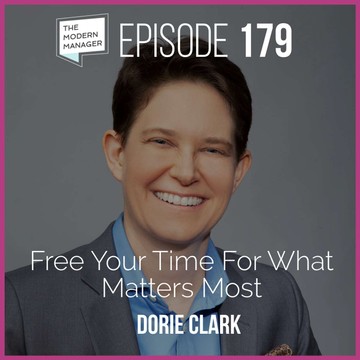
179: Free Your Time For What Matters Most with Dorie Clark
It's easy to get caught up in the game of doing. There are so many opportunities in life. Saying no can be one of the most difficult things managers need to do to protect their time. We want to do it all, but at the end of the day, being so busy doesn’t make us happy or help us achieve our goals. Saying no forces you to figure out what's important, gives you more time to focus on the long term, makes you more deliberate with your decisions, and reminds you of what life is all about.
Today’s guest is Dorie Clark. Dorie has been named one of the Top 50 business thinkers in the world by Thinkers50. She is a keynote speaker and teaches for Duke University’s Fuqua School of Business. She is also the author of Entrepreneurial You, Reinventing You, and Stand Out, which was named the #1 Leadership Book of the year by Inc. magazine. A former presidential campaign spokeswoman, she writes frequently for the Harvard Business Review.
Dorie and I talk about lessons from her new book, The Long Game, about how to become a long-term thinker in a short-term world! Which, hint, is all about how we prioritize and spend our precious time
Members of the Modern Manager community get my Saying No cheat sheet to help you remember when to say no and how to say no in ways that still feel good. Get it when you join the Modern Manager community.
Subscribe to my newsletter to get episodes, articles and free mini-guides delivered to your inbox.
Read the related blog article: How To Stop Being So Busy
KEEP UP WITH DORIE
Twitter: https://twitter.com/dorieclarkLinkedIn: https://www.linkedin.com/in/doriec/Facebook: https://www.facebook.com/dorieclarkauthor/Instagram: https://www.instagram.com/dorieclark/YouTube: https://www.youtube.com/DorieClarkThe Long Game Free Self-Assessment: https://dorieclark.com/longgame/
Key Takeaways:
There are many reasons we continue to be “too busy” even when we say we don’t like it, including that we feel important when we’re busy and it’s uncomfortable to stop and rethink our strategy.
Take advantage of unexpected free time by having a plan. Identify your goals and know what your next step is for each.
Set aside time to strategize in order to be proactive not reactive.
Ask “Is this the best use of my time” when an opportunity arises, instead of “Can I do this?”
When an opportunity arises, it’s either a “Hell yes” or “no”. If it’s not a 9 or 10 for what you want to do, turn it down.
People usually only get offended when you delay responding to an offer or invitation. Say no quickly. It can be helpful to create scripts for turning down opportunities.
Stop overbooking your future self with unimportant things by asking, “Would I do that this week?”
Teach your team how to prioritize and say no.
Additional Resources:
Episode 8: Optimize Your Time with Dorie Clark
mamie@mamieks.com

Nov 9, 2021 • 16min
178: What Are Executive Functioning Skills?
Executive functioning is a common topic amongst parents and educators of teens, but rarely discussed in the workplace. Yet, it’s the set of capabilities that we use daily to regulate our emotions, thinking, and behavior which collectively allow us to deliver results. This skill set, like any other, needs to be understood by managers so that we can improve ourselves and support our colleagues.
This is the first of two episodes on executive functioning skills. This episode is focused on what executive functioning skills are and how they show up in the workplace, as well as how you can assess yourself and your colleagues in each area. The second episode (#182) will be strategies to improve each area, so if you discover your own weakness or that a colleague struggles with a particular skill, you’ll have some ideas for how to help yourself or support that colleague.
The full episode guide includes an overview of the eleven executive functioning skills, how they interact and natural groupings that compound, and questions for reflection to help you assess yourself and your colleagues. Get it when you join the Modern Manager community or purchase the full guide at www.themodernmanager.com/shop.
Get the free mini-guide at themodernnmanager.com/miniguides.
Subscribe to my newsletter to get episodes, articles and free mini-guides delivered to your inbox.
Read the related blog article: 11 Executive Functioning Skills Needed In The Workplace
Key Takeaways:
There are eleven executive functioning skills our brains use to process and decide on an action.
Motivation and context matter to our ability to perform these skills. We may have strengths or struggle under different conditions.
Response inhibition is being able to thoughtfully control our response rather than reacting to stimuli.
Working memory holds onto relevant information for a short period of time.
Emotional control navigates feelings in a healthy way.
Sustained attention is the capability of sticking to a task, especially when tiring, challenging or boring.
Task initiation is the ability to jump in on a project without procrastinating.
Planning and prioritizing means creating plans, identifying key steps, and sticking to it.
Organization involves keeping information, things (physical and digital) and activities orderly.
Time management is about using time wisely and accurately predicting time needed.
Goal Directed Persistence is the ability to set goals and work towards them.
Flexibility is the ability to shift and pivot as needed.
Metacognition is seeing the bigger picture and reflecting on your own thoughts and behavior objectively.
We can have friction with our colleagues, when these skill sets clash.
Additional Resources:
Book: Smart but Scattered
mamie@mamieks.com

Nov 2, 2021 • 33min
177: Measuring Diversity, Equity, and Inclusion in Your Team with Erica Lee
Organizations are prioritizing DEI, but what is guiding their decisions? It’s important to gather data that can inform strategies, programmatic investments, and help track progress. But what data is captured, as well as how that data is gathered, is critical.
Today’s guest is Erica Lee. Erica is the co-founder and COO of Pluto, a startup advancing DEI through analytics and communication tools. Her background is in law, international development and policy.
Erica and I talk about how to measure diversity, equity, and inclusion within your team or organization. We talk about the process of gathering data, protecting privacy, turning responses into insight and more.
Members of the Modern Manager community get a complimentary 30-minute consult with me to help you strategize rolling out a DEI survey. Get it when you join the Modern Manager community.
Subscribe to my newsletter to get episodes, articles and free mini-guides delivered to your inbox.
Read the related blog article: What Most DEI Surveys Get Wrong—And How to do it Right
KEEP UP WITH ERICA
Website: https://pluto.life/Linkedin: https://www.linkedin.com/in/erica-lee-2013/
Key Takeaways:
We can approach DEI just like any other business goals: using data driven strategy and tracking progress.
DEI surveys need to go deeper than HR data to help us understand diversity.. They should provide an opportunity for people to see themselves in the responses.
DEI surveys should address equity and inclusion such as a person’s sense of belonging, if they are getting the promotions and pay they desire, and more.
Pluto creates an evolving story from the survey responses rather than just a checklist. “Other” is never an option.
The best surveys are ones where people can reflect and learn about themselves.
When people don’t trust surveys, they disengage. They need to feel their information and privacy are protected.
Managers were surprised to learn from Pluto about their team’s mental health issues.
If Pluto isn’t the right tool for your team, find pre-built DEI surveys that ensure privacy. Don’t use an excel spreadsheet where you can see individual responses!
DEI shouldn’t be siloed to an individual or team; it affects all aspects of business and is therefore everyone’s responsibility.
After you gather information and prioritize your strategy, remember to track your progress. Repeat the survey to measure the impact of your DEI initiatives over time.
mamie@mamieks.com
Oct 26, 2021 • 30min
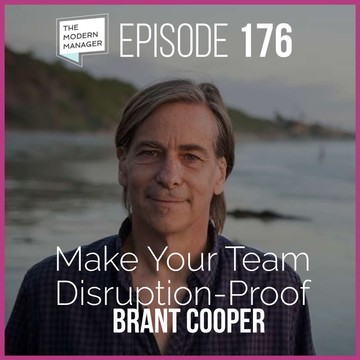
176: Make Your Team Disruption-Proof with Brant Cooper
Between technology, globalization, and a pandemic, it’s no wonder that businesses are experiencing disruption faster than ever. Regardless of industry or location, teams and organizations need to develop the skills to navigate regularly changing environments and increasing ambiguity.
Today’s guest is Brant Cooper. Brant is the CEO of Moves the Needle and New York Times bestselling author of The Lean Entrepreneur and his new book Disruption Proof: Empower People. Create Value. Drive Change. Brant has a unique take on disrupting our current way of thinking in order to be closer to customers, move faster, and act bolder. With over two decades of expertise helping companies bring innovative products to market, he blends agile, design thinking, and lean methodologies to ignite entrepreneurial action within large organizations.
Brant and I talk about the 5 E’s of becoming disruption proof and what you and your team can do to make better decisions and be prepared for whatever the future brings.
Get a downloadable reference of the 5-E’s which you can print and display in your office to help you remember to embrace Empathy, Exploration, Evidence, Equilibrium and Ethics in your work. Get it when you join the Modern Manager community.
Subscribe to my newsletter to get episodes, articles and free mini-guides delivered to your inbox.
Read the related blog article: How To Prepare Your Team To Weather Any Storm
KEEP UP WITH BRANT
LinkedIn: https://www.linkedin.com/in/brantcooper/Twitter: @brantcooperWebsite: https://brantcooper.com/Book: https://brantcooper.com/disruption-proof/
Key Takeaways:
Disruption-proof teams learn to navigate the uncertainty and changes of business life. They are able to thrive within unstable conditions.
You can’t execute through a crisis. It requires innovation and experimentation.
The five E’s to disruption-proof teams are Empathy, Exploration, Evidence, Equilibrium, and Ethics.
Teams need to listen to what their clients want. This is best done by observing real life, with the person interacting with the tool or experience rather than from surveys or interviews. People are terrible at predicting their future behaviors.
Teams and managers must shift from being knowers/experts to learning/exploring. Challenge assumptions and explore possibilities.
Cut through biases and opinions by relying on evidence gathered from data.
Create equilibrium by shifting between execution mode and innovation mode. While it may seem efficient to separate teams that focus oninnovation from those that focus on execution, all teams need both.
Carve out time for your team to innovate every week or month.Toencourage more exploration time, show your boss the results of these creative ideas and experiments.
Staying grounded in your corporate and personal ethics is critical, especially with new technology and data. Make ethics front and center for your team.
mamie@mamieks.com

Oct 19, 2021 • 34min
175: A Manager’s Guide to Social Media with Bianca Lager
The rise of social media has allowed employers and managers to gain access to their people’s private lives in ways never before possible. While it may seem like a gift to be able to instantly gain insight into who someone “really” is, the question every manager must answer is, “is it worth it?”
Today's guest is Bianca Lager. Bianca is a business manager, consultant and public speaker whose specialties include organizational development, career growth, and online reputation management. Bianca is also the President of Social Intelligence, a consumer reporting agency focused on online risk for human resources.
Bianca and I talk about social media and work - what’s appropriate behavior and what’s not, social media and hiring, and more.
Get a sample social media policy provided by Bianca when you join the Modern Manager community. Check out membership levels at www.themodernmanager.com/join - and get 20% off any level if you work for a government or nonprofit agency.
Subscribe to my newsletter to get episodes, articles and free mini-guides delivered to your inbox.
Read the related blog article: Is It OK To Check My Employees’ Social Media?
KEEP UP WITH BIANCA:
LinkedIn: www.linkedin.com/in/biancacalhounlager/
Key Takeaways:
Checking on our team members’ social media accounts hampers our productivity and may result in a false narrative about the person.
Ethically and legally, checking can be a violation of the person’s protected class info.
Checking for hate group affiliation is often too complicated, as these groups use benign names. Seeing political affiliations may not be constructive for building relationships.
Assess the level of threat of possibly problematic posts, acknowledge the narrative you created, and decide on a course of action with your HR partner.
If an employee is using social media during the work day, don’t react in the moment. It may just be a quick break. Don’t over police people’s behavior. Address it later as part of your regular feedback process if the behavior becomes problematic.
Create a Social Media Policy. Outline expected behaviors, rules, legal standards, documentation procedures, and any punitive actions.
Give everyone the same policy. The more universal and consistent, the better.
mamie@mamieks.com
Oct 12, 2021 • 14min
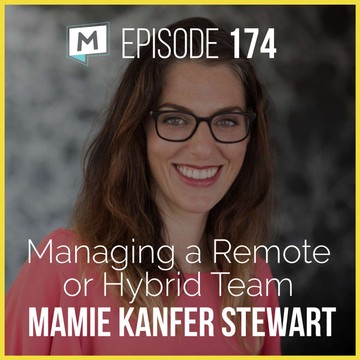
174: Managing a Remote or Hybrid Team
While much of leading a team is the same regardless of whether you’re co-located or geographically disbursed, leading from a distance can feel significantly harder. Even after 18+ months of working remotely, we still haven’t figured out how to optimize our virtual teamwork.
This episode tackles the critical elements that managers need to focus on when managing remotely.
The full episode guide to building trust and culture in a remote environment when you join the Modern Manager community. Or purchase the full guide at www.themodernmanager.com/shop.
Get the free mini-guide at themodernnmanager.com/miniguides
Read the related blog article: The Four Essential Elements To Managing Virtually
Key Takeaways:
The secret ingredient to successful remote teams is trust.
Trust is made up of familiarity, reliability, and communication.
Because we can’t connect easily in organic ways, we need to actively pursue ways to connect virtually on a casual, personal level.
Remote work means less physical oversight and collaboration. Set clear expectations, deadlines, check ins, and goals.
Because all of your team’s communication happens through technology, it’s even more important to make communication clear and simple. Discuss how and when to use each communication tool.
Meetings are an essential communication tool to both build relationships and get work done.
If you don’t build a virtual culture, a default culture will happen.
Culture is what we celebrate. Give credit to teammates who are reinforcing the team’s norms and expectations.
Consider how to celebrate and include the diverse values and ideas that each team member brings to the table.
Additional Resources:
Episode 49: Engaging and Productive Virtual Meetings
mamie@mamieks.com

