

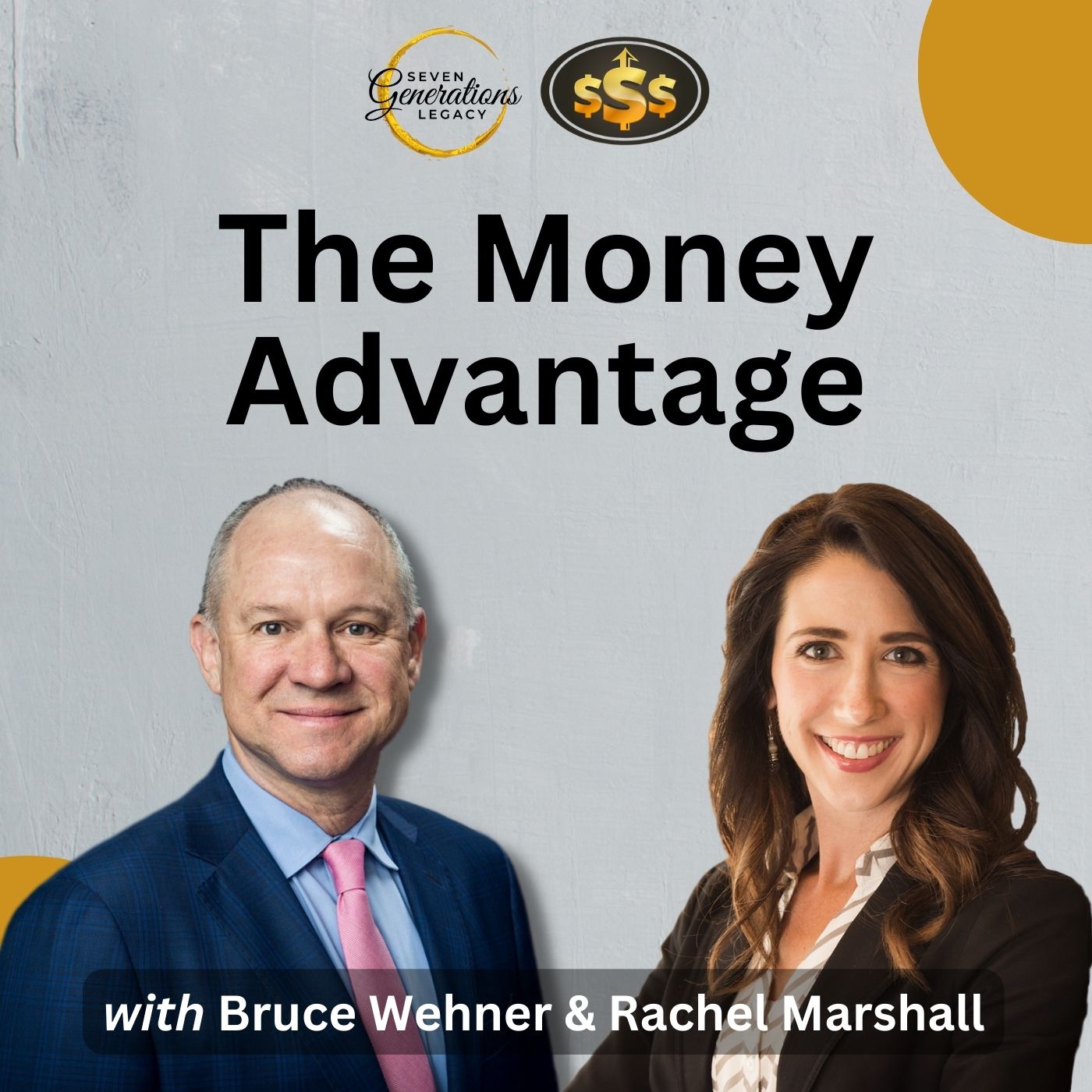
The Money Advantage Podcast
Bruce Wehner & Rachel Marshall
Personal Finance for the Entrepreneurially-Minded!
Episodes
Mentioned books

Aug 26, 2024 • 43min
Leaving an Inheritance to My Great-Grandchildren
Do you want to give your kids the best possible chance at life, but you’re afraid of spoiling them, or worse? Are you concerned that leaving an inheritance will only end in disaster? Learn why "leaving an inheritance to my great-grandchildren" is a good thing and how to do it.
Many parents are undecided about whether they want to leave an inheritance to their children. They fear raising ungrateful “trust fund babies” or leaving their kids with money they cannot possibly be good stewards of. Some parents didn’t receive an inheritance at all, so they don’t think their own children could possibly need it.
https://www.youtube.com/live/x-tY0oVUqcU
But what if you could leave an inheritance not only to your children but your grandchildren, and even your great-grandchildren? It’s not about how much money you have, it’s about how you prepare your children to take good care of that money and become value creators in their own right.
Today, we’re talking about how the Marshall family approaches money and inheritance, and how you can begin preparing your kids to be great stewards of your legacy now and later. Learn how and why I am leaving an inheritance to my great-grandchildren, and you can too. Tune in now!
The Inheritance SpectrumThe Marshall Family ValuesHave Your Kids Create ValueLeaving an Inheritance to My Great-GrandchildrenFinancial Wisdom for KidsBook A Strategy Call
The Inheritance Spectrum
Leaving an inheritance to your children or grandchildren can be a tricky subject to navigate. There are many pros and cons to both leaving or not leaving an inheritance that has a lot to do with HOW you go about it. In our case, we think inheritance is a spectrum of sorts. On one end, you’ve got those who are just dumping money on the next generation without much preparation or care. On the other side of the spectrum, you have people who are intentionally withholding an inheritance for various reasons. Then, you have everything in between.
The side that is against leaving an inheritance generally comes from two schools of thought. Some people believe that they weren’t left anything, and so their children don’t need it either. They want to be selfish with their money, and they want their kids to figure it out on their own. The other camp is the parents who don’t wish to ruin their kids by spoiling them or leaving them with a cushy life without developing the work ethic or business savvy to keep it.
Both sides of this spectrum are pretty extreme and can be damaging. There’s a middle ground that we advocate for that can actually ensure that your legacy lasts for generations, and that’s by building something to leave your children while also raising them to be good stewards of it. This could include involving your kids in the family business, teaching them good money principles, and making sure that they know how to continue growing their assets. By doing this, you create a generation that can do the same with their children so that many generations down the line your family is still prospering.
[09:50] “It’s not the money that causes the problems. The challenge is money brings up all of this emotion… we attach it to our identity, our sense of self-worth.”
The Marshall Family Values
One of my family’s values is freedom. Most people conjure up the same mental image of freedom, but there are actually two major meanings of the word freedom when we go back to Hebrews in scripture. There’s a good form of freedom and a bad form of freedom. The way that most people conceptualize freedom is to be free FROM something—for example, freedom from obligations. This is why many people think of retirement as one of the ultimate freedoms because they won’t be tied down or expected to do anything.
The other kind of freedom is the freedom to choose—not to be free of obligations, but to pick the obligations that matter to you and develop accordingly. This choice is about service, and it allows you to build a fulfilling life that has incredible ripple effects.
When you instill this kind of mindset within the family, you see how it creates this wellspring of good not just inside of your family, but outside of it. And this kind of freedom naturally attracts money, because money is a result of providing value in the marketplace. We’ve seen the positive evidence of this approach in our own family, and we know the seeds are there for our children to be good stewards of the family legacy.
Have Your Kids Create Value
In our family, we decided not to give an allowance to our children and instead encouraged them to create value. This eventually led to our daughter creating her own business, after attending a five-day course that helped her think about the many ways in which she could provide value. The idea had to be both something she was interested in AND something that people wanted and would be profitable.
Eventually, our daughter decided she wanted to bake and sell cookies, so we workshopped ways in which this could be a recurring, profitable business. What we landed on was a cookie club, where she made and delivered cookie dough for people to bake in their own homes so that they could enjoy the freshly baked cookie smell. Her business is now in its fourth year and still going strong.
Even now, we’re always talking about ways to improve and develop cookie club while also slinging other possible business ventures. So now our children are considering all of the ways that they can provide value to other people, and it’s incredible to see her grow in this way.
If you have children that aren’t quite ready to start a business yet, you can still instill these principles through chores, because chores provide value to the family. There’s a wide variety of age-appropriate chores that your children can do, and these responsibilities help them be contributors. Additionally, think about what chores are expected on an ongoing basis and what chores are above and beyond that you might pay for.
Once your children are earning money, be sure to teach them good stewardship of that money, too. Help your children to save a percentage of their money. When our daughter started earning money, we encouraged her to give 10%, save 40%, and use the other 50% how she chose. This is a priority.
[29:00] “Whatever you put your attention on is the thing that’s going to grow. And if you celebrate something and you reward your children for something—you bring it up on a regular basis and you compliment them and you praise them for something—that’s going to be the thing that they want to continue doing.”
Leaving an Inheritance to My Great-Grandchildren
Our inheritance for our children and grandchildren lives in a trust so that it will exist well beyond us and benefit our family for generations. The money is designed to be used based on our family values, to fund things that we would do while we’re living. The family bank includes stipulations for repaying the money, as well as caveats for when that money need not be paid back.
Our intention with this is to create a money supply that is going to last and last well beyond us, without “spoiling” anyone or encouraging poor stewardship. This trust is funded by our whole life insurance, and will only grow as the family grows and as death benefits are paid. This is the balance between dumping money and withholding money—creating purpose for our money that our family members are a part of creating.
Financial Wisdom for Kids
We’ve actually developed a course called Financial Wisdom for Kids, which identifies five key lessons that your kids must learn in order to handle their inheritance well. The course walks you through how to teach these lessons and includes age-appropriate examples for you to develop these skills at any age.
Get 54% off our Financial Wisdom For Kids, so you can equip your children with the top 5 financial literacy lessons they need and avoid the pitfalls of unprepared heirs squandering their inheritance when you buy Seven Generations Legacy: Design a Multigenerational Legacy of More Than Money for just $4.99 https://sevengenerationslegacy.com/.
Book A Strategy Call
Are you ready to take control of your finances and legacy? We offer two powerful ways to help you create lasting impact:
Financial Strategy Call – Discover how Privatized Banking, alternative investments, tax-mitigation, and cash flow strategies can accelerate your time and money freedom while improving your life today. Let us show you how to align your financial resources for maximum growth and efficiency. Book a Strategy Call with our team today.
Legacy Strategy Call – If you want to uncover your family values, mission, and vision, and create a legacy that’s about more than just money, we can guide you through the process of financial stewardship and family leadership. Save time coordinating your family’s finances while building a legacy that lasts for generations. Book a Legacy Strategy Call to learn more about how we can help.
We specialize in working with wealth creators and their families to unlock their potential and build a meaningful, multigenerational legacy.
Aug 19, 2024 • 40min
Whole Life Insurance Tax Benefits – How They Work and Why They Matter
Explore the intriguing tax benefits of whole life insurance and the historical events that shaped its landscape. Discover how pivotal legislation from the 1980s transformed financial strategies and the effects of the 1974 move away from the gold standard. Uncover the complexities of Modified Endowment Contracts and how they impact long-term financial planning. This discussion provides valuable insights into leveraging whole life insurance effectively, appealing especially to wealthier individuals seeking disciplined savings and tax advantages.
Aug 12, 2024 • 51min
Family Business Dynamics, with Savannah Suttle
Do you want to grow and scale a family business, but family business dynamics are getting in the way?
https://www.youtube.com/live/vZkpINzoFts
Unlock the secrets to harmonizing family business dynamics and business operations with Savannah Suttle from Schema Consulting to reveal the powerful impact of psychotherapy and marriage and family therapy techniques on family-run businesses. You'll learn how to navigate the complex interplay between evolving family roles and business practices, ensuring a cohesive approach to tackling both personal and professional challenges, especially during generational transitions.
Discover the keys to balancing business needs with employee well-being as we tackle the intricacies of role reassessment and transparent communication. Savannah shares her wisdom on creating win-win scenarios where individual growth and business success go hand in hand. We discuss the critical importance of addressing difficult decisions head-on, fostering a culture of open dialogue that prevents fear and conflict avoidance, and underscoring the necessity of placing the right people in the right positions for maximum team morale and efficiency.
Finally, we explore the essential strategies for scaling family businesses, emphasizing radical transparency and effective communication. Savannah guides us through the pitfalls of over-relying on long-standing employees without proper succession planning and highlights the importance of nurturing the next generation's authenticity and innovation. From strategic leadership transitions to fostering a shared vision, this episode equips you with the tools to ensure your family business remains vibrant and appealing for future generations, creating a lasting legacy of wealth and collaboration.
So, if you want to discover how your family businesses can navigate complex dynamics and turn challenges into opportunities to grow your reach, impact, and team ... tune in now!
How Behavior Therapy Leads to Family Business DynamicsNavigating Family Business GrowthMaking Tough DecisionsPassing Businesses from Generation to GenerationBook A Strategy Call
How Behavior Therapy Leads to Family Business Dynamics
While now Savannah works with family businesses, she got her start in behavior therapy, specifically marriage and family therapy. What’s unique about this field is that it’s a structural form of psychotherapy—if you can change the structure of the family, you can change the dynamic of the family. So changing one piece of the system will change the whole system.
This structure is very close to, and even overlapping, with business structures. And if you have a family business, the dynamics are even more entwined. What Savannah found is that some of her clients who had family businesses had cemented some of their family dysfunction into their business operations. The problem is that at one point the dysfunction was actually functional, and served a positive purpose at one point. But then, over time, the business/family outgrew those roles or procedures, and yet they left them baked into the process. Those dysfunctions are then difficult to remove because the family has not come to terms with who they have become and what they need.
[04:53] “Who you were when you started the business is probably not who you are now. And what you needed then is probably not what you need now.”
Navigating Family Business Growth
One of the ways in which family businesses may fail to adapt is how they scale. It’s one thing to manage a team of 10 people—especially when you know and love them—and another thing to manage a team of 150 people. The challenges of a team of 150 are different even from a team of thousands.
[09:32] “The problem is when you start scaling and you’ve got a lot of people now, it’s usually a matter of headcount. Then all of a sudden you only have 24 hours in a day and you can’t talk to everybody and build relationships with everybody.”
When you start a small, family business, you typically know exactly who you’re working with and how you’ll be working with them. However, as you continue to grow, you cannot expect these same systems to work with the same results.
One solution is systematizing your structures so that you’ve got efficient communication in any business structure you may have, rather than having endless catch-up meetings and making people chase information. But if that worked for you with a small team, it may be baked into your business even as it grows, causing some real miscommunication and struggle. What you cannot do is just hope it will get figured out—it won’t. You’ve got to create the structure so that people can fit into it.
Making Tough Decisions
In addition to building your team as you grow, you also need to build the right team, in the right ways. Sometimes, this means that you need to approach certain problems in a way that keeps morale high and strengthens bonds. Other times, this means you need to transition away from people who are not working within your team anymore. This is difficult as a business owner, especially if you have had a long relationship with someone.
[14:29] “The decision itself is often scary. It’s scarier more than painful… It’s only scary because you think there might be a possibility of a bad outcome. Okay, great—let’s design outcomes that work for everybody. And I know that sounds easier said than done, but it’s actually pretty doable.”
If a team relationship is no longer working for your business, you’ve got to make a change. And you can focus on having positive outcomes and communication through it all. How can you as a business owner get what you need and want, while also having a positive transition with the person in question?
[16:51] “I think a lot of times people end up getting pretty conflict-avoidant, and conflict avoidance is a recipe for being taken advantage of in business. And that’s true whether you’re the owner or the employee.”
By avoiding what needs to be done, all you can do is stagnate.
Passing Businesses from Generation to Generation
If you’re building a family business, there’s going to come a time when you pass the reigns to the next generation, whether that’s your children or other relatives who have expressed interest and competence in the field. This can be a tricky transition even when it seems like there’s a desire from the next generation because you’re not just handing over a fortune. You’re handing over processes, procedures, employee relationships, culture, and so much more. If the next generation has been involved with the business before transitioning, this might be an easier process. However, even that is not without its challenges.
This also means that right now, if you’re building a family business, you’ve got to start thinking about these things. How will you involve the next generation now? How can you pass on the things you’ve learned, as well as the context in which you learned them? You have got to prepare your family to take over the business if that’s what you wish.
[32:47] “This is a relay race, it’s not just a solo marathon. I mean it can be if you want it to be, if that’s how you’re going to participate in your life. But if you expect that you’re just going to solo marathon it and then somebody else is going to solo marathon it and there’s not really going to be an overlap or a clear baton pass, you’re setting yourselves up for failure. Because what happens is that the first generation will pave the way, build the things, and kind of hoard all this tribal knowledge and context. They understand how and why they built the things they did, they made the mistakes. Then they have Gen Two come along, who takes over, and if they have not done a good enough job of passing along a lot of that context… Gen Two learns that they are not supposed to make mistakes and they are not supposed to change anything… [they] just need to keep the wheels on the wagon.”
This may not seem like such a bad thing until you consider the NEXT 30 years. When Gen Three comes along, if nothing has changed, it’s going to seem terribly outdated and there are going to be so many questions and hurdles that could be impossible to overcome. They might not even want to take up the mantle. And so while the business lasted beyond you, it still doesn’t have lasting power.
[35:18] “The vision itself is not sufficient. You have to allow for people to step into their own authenticity within a framework of collaboration. They have to figure out how to continue working as a team. They have to figure out how to incorporate change.”
Book A Strategy Call
Are you ready to take control of your finances and legacy? We offer two powerful ways to help you create lasting impact:
Financial Strategy Call – Discover how Privatized Banking, alternative investments, tax-mitigation, and cash flow strategies can accelerate your time and money freedom while improving your life today. Let us show you how to align your financial resources for maximum growth and efficiency. Book a Strategy Call with our team today.
Legacy Strategy Call – If you want to uncover your family values, mission, and vision, and create a legacy that’s about more than just money, we can guide you through the process of financial stewardship and family leadership. Save time coordinating your family’s finances while building a legacy that lasts for generations. Book a Legacy Strategy Call to learn more about how we can help.
We specialize in working with wealth creators and their families to unlock their potential and build a meaningful, multigenerational legacy.
6 snips
Aug 5, 2024 • 56min
Whole Life Insurance Loans Explained
Explore the fascinating world of whole life insurance loans and how they can create your personal banking system. Discover the benefits of tax-free growth and the strategic use of cash value as collateral for non-recourse loans. Learn why policy loans aren't considered debt and how mutual insurance companies provide financial stability. Unravel the Infinite Banking Concept and its emphasis on long-term strategies for loan repayment. Gain insights on managing outstanding loans and mastering personal finance for greater control and empowerment.
Jul 29, 2024 • 1h 1min
Real Estate Investing in Today’s Economy, with Anna Kelley
Today, we're talking with Anna Kelley, impact real estate investor, multifamily operator, and real estate mentor and coach, about the state of real estate investing.
https://www.youtube.com/live/7AneSvWF6tQ
With today's federal debt and high inflation environment, Anna cautions that it's time to be in capital preservation mode, not focused on cash flow and appreciation.
So if you want to see how to invest during times of uncertainty, and understand the signs of the times to determine when to use value add vs. buy and hold strategies in different economic cycles, tune in now!
With a wealth of experience spanning multiple economic downturns, Anna offers invaluable advice on understanding macroeconomic trends and adapting investment strategies. We also tackle the realities of working from home, the normalization of disruptions, and how the professional landscape has evolved post-COVID-19.
Join us as we dissect the intricate dynamics of today's real estate market. Anna Kelly shares her journey from humble beginnings to becoming a prominent real estate expert. We delve into the risks and rewards of various investment strategies, from syndications and non-traded REITs to distressed commercial properties, emphasizing the importance of informed decision-making amidst rising interest rates and economic uncertainty. Through real-world examples, we explore the impact of social media on investment behaviors and the necessity of a cautious, well-researched approach.
Understanding Real Estate Investment CyclesWhere Are We Now?Tips for Commercial and Residential Real EstateAbout Anna KelleyConnect with Anna KelleyBook A Strategy Call
Understanding Real Estate Investment Cycles
[14:22] “It doesn’t matter how smart you are, it doesn’t matter how good your job is [or] how much you know about investing, and how much you know in real estate. If you’re not really paying attention to the macro signs that things are shifting, you can make some really bad decisions about debt and go into it at the wrong time. And you can make some really bad decisions about the stock market and anything you invest in.”
In 2009, Anna Kelley decided she would never be blindsided by the marketplace again. She took the initiative to learn about market cycles and how to pay attention to major shifts in the market. Now that she understands the market cycles, she finds that Warren Buffett’s advice is timeless and true: “Be greedy when everyone’s fearful, and be fearful when everyone’s greedy.”
At a very high level, investment cycles begin at a “trough,” or a recession—basically when things have not been going well economically. This is the point at which interest rates drop in an effort to get people spending again. This recession period can generally last anywhere from 10-18 months, and then the following 2-3 years are often when the economy wakes back up again and people start to feel comfortable. It's not an overnight process, Kelly shares, but one that takes time. People have trouble trusting the economy at first, so it takes a while to build that trust back up.
Then, you get to the expansion period. This is the peak of the investment cycle, and while it can seem like a great thing, it also signals that the next recession is on the way. It might take a few years, but you’ve got to be aware of what is going on around you to take advantage of the cycles.
[21:11] “At the moment that there is absolute panic and everybody’s afraid, that is the maximum point of opportunity.”
The reason this part of the cycle is rife with opportunity is that there’s less competition, and lots of people aren’t thinking about opportunity. If you can buy when things are at a low point and just hang on to them, you’ve got a leg up on the market. In Anna’s personal opinion, we haven’t seen the end of the recession yet, we’re still at the top of it, and it will likely take some years to recover from that. Despite that, she thinks inflation will rear its head again after the recovery. So the assets she is investing in now have got to be able to ride out that recession and also be strong during the recovery phase, regardless of inflation.
Where Are We Now?
We’re in a recession, but it’s a lot different from recessions of the past because it was ushered in by unprecedented amounts of money being fed into the economy. People received stimulus checks during COVID-19, and money was just being printed like no tomorrow. And now there’s this bifurcated economy. In May, Anna Kelley says that 66% of Americans were living paycheck to paycheck, even households with $250k incomes. But that also means that 34% of people are doing just fine.
At this point, people stop spending money, so employers feel like they have to tighten their belts and make layoffs. Ironically, this causes inflation to stop in its tracks. This doesn’t mean prices go down, but they do stop going up, generally speaking.
Tips for Commercial and Residential Real Estate
[51:34] “The good thing about buying today is if you have the funds… you can buy properties for pennies of the dollars compared to where they were two years ago. The risk is that you think they’re going to go back to a really low cap rate and rates are going to go right back to zero, and if rates don’t go right back to zero and cap rates stay higher, and you have more inflation in the next couple of years, that cap rate will go right back up, and you could actually have the same problem that people are having today. So you’ve got to be really careful in commercial real estate. You can buy on pennies for the dollar today, but you’ve got to have the wherewithal that you have a low loan-to-value loan.”
On the flip side, if you’re interested in residential real estate, now is a good opportunity to see what’s available around you. For example, you might be able to strike a deal with an investor who owns a small duplex or fourplex and is feeling overwhelmed by their loan. Look to areas with high demand for housing and low supply, and also be sure to seek conservative states that are landlord-friendly and have low taxes. Homes are going to have less cash flow, but are usually longer-term situations. That’s where you’re going to make the most money if you go in and buy now.
[57:18] “You want to make sure that your cash on cash return is better than what you could get on a five-year treasury rate.
About Anna Kelley
Anna Kelley is an impact investor, passionate about creating real estate wealth that lasts and serves a greater purpose, and helping others to do the same. She is dedicated to investing for meaningful impact in the lives of her students, investors, and residents. In addition to investing in real estate for over 20 years, Anna was a top ranked private banker for Bank of America, where she managed the financial relationships of high net worth individuals and businesses. Her 2 decades of working with high net worth individuals to build wealth through both traditional investments and real estate, gives her valuable insight to help you create, grow, and preserve your wealth.
Connect with Anna Kelley
Consulting on investments
Connect on Instagram
Book A Strategy Call
Do you want to coordinate your finances so that everything works together to improve your life today, accelerate time and money freedom, and leave the greatest legacy? We can help! Book an Introductory Call with our team today https://themoneyadvantage.com/calendar/, and find out how Privatized Banking, alternative investments, or cash flow strategies can help you accomplish your goals better and faster. That being said, if you want to find out more about how Privatized Banking gives you the most safety, liquidity, and growth… plus boosts your investment returns, and guarantees a legacy, go to https://privatizedbankingsecrets.com/freeguide to learn more.
Jul 22, 2024 • 47min
Fractional Reserve Banking Creates Inflation: Infinite Banking is the Solution
Inflation causes everything to feel more expensive, so what do you do to protect your money from inflation? Today, we’ll explore the link between inflation and fractional reserve banking and how Infinite Banking is the sound money solution.
https://www.youtube.com/live/ay4aDG2phBg
A thought-provoking journey through inflation, fractional reserve banking, and the revolutionary concept of infinite banking. This episode promises to demystify how the traditional banking system and increased currency supply fuel inflation, challenging widespread misconceptions.
You’ll gain a deeper understanding of inflation’s root causes by contrasting liberal views with Austrian economic theories, and learn how your everyday choices can influence market prices and how they relate to the average rate of return on your money.
Next, we shift gears to tackle the often-overlooked topic of healthcare pricing elasticity. Hear real-life stories about how informed consumer decisions can lead to significant savings on prescriptions and medical procedures.
Discover practical strategies for price negotiation without confrontation, and understand the ripple effects of increased money circulation on the economy. We’ll also discuss the impact of government policies like minimum wage hikes on business expenses and overall market pricing.
Finally, explore a smarter financial strategy that sidesteps the pitfalls of fractional reserve banking. By leveraging whole life insurance policies, you can protect your assets from inflation and achieve greater financial security.
Rachel and Bruce explain the benefits of mutual insurance companies, which maintain robust reserves, and how these practices can create a more stable personal economy.
This episode is packed with insights into what fractional reserve banking does and actionable advice to help you take control of your financial destiny and build a prosperous future.
So, if you want to learn how to ensure more economic stability and prosperity, tune in today!
What You’ll LearnWhat Is Inflation in a Fractional Reserve Banking System?The Nature of Banking Under the Fractional Reserve SystemAvoiding the Risks of Fractional Reserve BankingResources:Book a Strategy Call: Explore Alternatives to Fractional Reserve BankingFAQs About Fractional Reserve BankingWhat is fractional reserve banking in simple terms?How does fractional reserve banking create inflation?Why does this system disadvantage savers?Is fractional reserve banking used everywhere?What’s the alternative to using traditional banks?Can I learn more about how banks really operate?
What You’ll Learn
What fractional reserve banking is and how it quietly affects your financial stability
Why the fractional reserve system contributes to rising prices and weaker dollars
How inflation is created—and why it punishes savers the most
The surprising connection between bank loans and money creation
What fractional reserve banking does to your purchasing power over time
How government policies and circulating currency impact market prices
Why Infinite Banking may offer a safer, more predictable alternative
What Is Inflation in a Fractional Reserve Banking System?
We all feel the effects of inflation, but what is it really? Inflation is when a dollar becomes less valuable. This is why bread used to cost a couple of nickels and now costs more than a couple of dollars. One of the major reasons for inflation is that our banks continue to pump more dollars into the banking system, decreasing the overall value of a single dollar.
Our current banking system, fractional reserve banking, allows banks to keep only a fraction of their customers’ money in reserves. This means that banks can do more business than they actually have available.
While this can stimulate the economy on some level, this also means that money is being created out of thin air. This is what the fractional reserve system does: it expands the money supply far beyond what actually exists in deposits, and when this happens en masse, it can create major instability. After all, the more money in circulation, the more prices begin to creep up to match.
This system quietly penalizes savers. As the purchasing power of your money erodes, saving in traditional bank accounts means losing value year after year. To that end, understanding what fractional reserve banking does to your long-term financial position is key to protecting your wealth.
➡️ To learn more about how inflation connects to alternative strategies, check out our article on inflation and PrivatizedInflation and Privatized Banking.
The Nature of Banking Under the Fractional Reserve System
Let’s look more closely at how banking, as most people know it, works. If you deposit $1,000 in the bank, your institution is not required to have that exact amount in a vault somewhere just for you. In fact, they’re not even required to have that $1,000 at all. They’re only required to have a fraction of that on hand, and right now, it’s somewhere in the ballpark of a 1 to 10 ratio. So of the $1,000 you’ve deposited, the banks only have to keep $100 on hand.
When you take a loan from the bank, they’re “creating” that loan out of dollars that do not exist in their reserves. This is a key part of how banks create money from loans—by expanding credit beyond actual deposits, and then you’re paying it back with dollars that do exist. Just the actions of taking loans with our banking institutions are inflating the money supply. This is the fractional reserve system explained in practice: a structure that allows for credit expansion without a matching reserve base. Then what happens if you want to liquidate your account, if the banks only have 10% on hand at a given time?
Avoiding the Risks of Fractional Reserve Banking
These are all things that can make banking tenuous. And yet, by taking control of the banking function with whole life insurance, you can mitigate much of this harm. When you take policy loans, for example, you’re borrowing money that does exist (because life insurance companies have to keep full reserves), and backing it with your cash value as collateral.
And what if you could make private loans to friends and businesses in need of capital? Wouldn’t that prevent an inflationary event, because you’re loaning them real money backed by collateral? While this isn’t going to reverse inflation, it can significantly help, while also making sure that you’re not at the mercy of banks to get money.
Ultimately, what is fractional reserve banking if not a system built on instability? Opting out means choosing a model backed by real reserves instead.
[39:32] “The reason why Infinite Banking is different is because you’re not creating an inflationary event by creating additional dollars when you are using your life insurance policy. And the value of that is that on… a moral basis, on a personal basis, you are saying, ‘I am not choosing to create this inflationary environment or the rest of the economy.’”
Resources:
Khan Academy
(More specifically, here’s the Inflation unit)
Book a Strategy Call: Explore Alternatives to Fractional Reserve Banking
Do you want to coordinate your finances so that everything works together to improve your life today, accelerate time and money freedom, and leave the greatest legacy? We can help!
Talk to an advisor about alternatives to the fractional reserve system - book an Introductory Call with our team today, and find out how Privatized Banking, alternative investments, or cash flow strategies can help you accomplish your goals better and faster.
That being said, if you want to find out more about how Privatized Banking gives you the most safety, liquidity, and growth… plus boosts your investment returns, and guarantees a legacy, check out our free Privatized Banking guide to learn more.
FAQs About Fractional Reserve Banking
What is fractional reserve banking in simple terms?It’s a system where banks only keep a fraction of customer deposits on hand and lend out the rest. This allows them to create money through loans, but also introduces risk if too many people withdraw funds at once.How does fractional reserve banking create inflation?By issuing loans with money that doesn’t physically exist in reserves, the system increases the money supply. This often leads to higher prices, reducing the purchasing power of your savings.Why does this system disadvantage savers?As more money enters circulation, each dollar becomes less valuable. That means the money sitting in your savings account quietly loses value over time.Is fractional reserve banking used everywhere?Yes, it’s the standard model in most modern economies. Central banks around the world regulate reserve requirements, but the principle is widely adopted.What’s the alternative to using traditional banks?Some people use strategies like Infinite Banking, where whole life insurance policies with guaranteed reserves replace the role of a bank.Can I learn more about how banks really operate?Our article on how banks create money from loans breaks it down further with real-world examples.
Jul 15, 2024 • 51min
Buy Term and Invest the Difference: Does It Really Work?
Are you trying to decide which type of life insurance to buy? You want to protect your family in case something happens, so how do you do it best?
https://www.youtube.com/live/QDyfZjPaMgc
Whole life insurance is often rejected as expensive and a poor “investment,” while mainstream opinion leans in favor of the “buy term and invest the difference” strategy, which involves opting for cheap insurance coverage and investing the dollars you save.
We’ll guide you through the compelling story behind the “Buy Term and Invest the Difference” strategy, a concept born from Art Williams’ personal experiences in the late 1960s.
By examining the benefits and pitfalls of this popular approach, we empower you to make informed decisions tailored to your unique financial goals and risk tolerance.
Explore the vital distinctions between whole life and term life insurance, and learn why a one-size-fits-all solution may not serve your best interests. Through relatable analogies and real-life examples, we break down the often misunderstood aspects of life insurance, helping you see the bigger picture.
We also address the psychological and financial barriers that many face when considering life insurance, sharing insights from LIMRA and Dr. Wade Pfau on how whole life insurance can provide a stable safety net during economic downturns.
Finally, we delve into the concept of becoming your own banker, illustrating how this alternative perspective can offer unparalleled financial flexibility and security.
By understanding the sequence of returns risk and leveraging whole life insurance loans during market downturns, you can protect your investment portfolio and ensure long-term financial stability.
Join us for an episode packed with actionable insights and strategies to enhance your financial planning journey.
What You'll LearnWhat Is Whole Life Insurance?What Is Term Insurance?Quick Comparison TableThe Buy Term Invest the Rest Strategy ExplainedThe Discipline ProblemMarket Risk and Investment Coverage Gaps and Health ChangesTerm Policies: 1% Pay Out RateWhole Life Insurance: 100% Payout RateTerm Premiums Skyrocket, Whole Life Stays Level
What You'll Learn
Why the buy-term, invest-the-rest approach only works with perfect execution (and why most people fail)
The hidden costs that make term insurance more expensive than you think over time
Why less than 1% of term policies ever pay out—and what that means for your family
The discipline problem: why people buy term but never actually invest the difference
How market volatility can destroy years of disciplined investing overnight
Why getting priced out of term coverage as you age creates a dangerous protection gap
When this strategy might actually make sense (hint: it's rare)
A better approach that combines guaranteed growth, tax advantages, and permanent protection
The Myth of “Buy Term and Invest the Difference”
The idea of “buy term and invest the difference” is really common in the financial sphere because, on the surface, it seems to make a lot of practical sense. After all, you’re being told “buy cheap insurance to get the protection, then build your wealth in investments.”
The problem is that this strategy doesn’t work with certain goals. There isn’t a singular, perfect insurance strategy to trump all else. There are myriad ways to get coverage, depending on what you want out of your dollars.
Many people believe that Art Williams is the origin of this phrase; after his father passed, the whole life insurance death benefit didn’t seem as large as what a term insurance policy could have been, and for less money.
He felt strongly that his father had been sold the “wrong” policy, and so his life’s mission became to get rid of whole life insurance.
Curiously, he partnered with a mutual company, and the phrase “buy term, invest the difference” was born.
Breaking Down Insurance, Investments, and More
So, what are the elements of “buy term and invest the difference”? It may sound like there are two things at play here, but really, there are many factors to consider.
While, of course, there’s term insurance and stocks (or other investments, technically), you have to ask what that strategy is being compared to. And what that’s being compared to is whole life insurance.
What Is Whole Life Insurance?
Whole life insurance is insurance that is with you for your whole life, and if done with IBC in mind, can also be used as a warehouse for your wealth.
Whole life insurance is guaranteed to pay out no matter what age you die, and if you live to the “end” of the policy (called endowment), the death benefit gets paid directly to you.
This is permanent insurance in the truest sense.
What Is Term Insurance?
Comparatively, term insurance is insurance that you only have for a portion of your life. There’s no cash value component, and once your term is up, you are no longer insured.
This means that there is no guarantee of a death benefit ever being paid. The trade-off is that it’s much less expensive on a purely dollar-for-dollar basis.
Quick Comparison Table
FeatureWhole Life InsuranceTerm InsuranceBuy Term Invest the RestDurationPermanent (whole life)Temporary (set term)Term coverage + separate investmentsCash ValueYes, builds over timeNo cash valueNo insurance cash value, relies on investment accountsPremiumsHigher, but levelLower initially, increases with ageLower insurance cost, but requires separate investment contributionsDeath Benefit Guarantee100% guaranteed to payOnly pays if death occurs during termOnly guaranteed during term periodInvestment ComponentBuilt-in cash value growthRequires separate investmentsSeparate investments (stocks, bonds, mutual funds)Access to MoneyPolicy loans against cash valueNoneSubject to investment account rules and taxes
The Buy Term Invest the Rest Strategy Explained
Because term insurance is much cheaper and does not have a cash component, the argument is that you can use the “difference” in cost from whole life to term insurance to make investments. The argument is that you can get a higher death benefit AND put your money to work.
Here's how it's supposed to work: You calculate what you'd pay for a whole life policy, then buy a cheaper term policy instead.
You take that monthly savings — the "difference" — and invest it in stocks, bonds, or mutual funds. The theory is that your investments will grow faster than the cash value in a whole life policy, leaving you with more money in the end, plus the death benefit protection you need.
Of course, that sounds great. The problem is that this isn’t the ideal solution for everyone.
Why the Buy Term Invest the Rest Strategy Has Limitations
For starters, there are many reasons for people to want permanent insurance. If you want to guarantee your kids have an inheritance no matter when you die, whole life insurance is necessary.
Additionally, IBC strategies — warehousing wealth, deploying "other people's money," and uninterrupted compounding — only work with whole life insurance.
It works because of the specific structure of the policy, which allows policyholders to take loans against their cash value in a tax-advantaged way.
This means you can have whole life insurance and make investments down the line.
The buy term and invest the difference strategy only works if executed perfectly, and most people don't execute it perfectly.
The Discipline Problem
Another common pitfall of buying term insurance and investing the difference is that… many people are not investing the difference. In some cases, they can't, and in others, there is just no discipline.
And so you have people managing to purchase cheap insurance, but they have no savings or investments working for them to build or store wealth. In these cases, is buying term and investing the difference actually helping? Or is it just an illusion?
While whole life insurance has a higher price tag, it also functions as a place to store money. And with every premium payment, you're building cash value, which can be leveraged for anything you want.
This means that the cash value you build is liquid and can function like a savings account, with no extra payments necessary.
This can be a good way for someone to put money into "savings" without extra steps because the premium payment "feels" like paying a bill.
Market Risk and Investment
Furthermore, investments in the stock market can be volatile and might not have the desired results. That money isn't liquid and can have steep tax penalties for accessing.
Market volatility can destroy years of disciplined investing overnight. While whole life insurance offers guaranteed cash value growth, your investment portfolio could be down 20% or more, exactly when you need the money.
There's also the sequence of returns risk. If the market performs poorly in your early investing years, you may never recover enough to match what a whole life policy would have provided.
Coverage Gaps and Health Changes
Then, you have to think — what are the downsides of "buy term and invest the difference"?
Those who exclusively use this strategy will have plenty of coverage for a short time, but if they decide they want permanent coverage later, it could be too late. Their health could change, or something else could make them ineligible for whole-life insurance.
This is one of the most overlooked risks of the strategy. Term insurance premiums skyrocket as you age, and many policies simply won't renew past a certain age.
If you develop diabetes, heart disease, or any number of health conditions during your term period, you might find yourself completely uninsurable when the policy expires. At that point, all the money you've invested doesn't provide any death benefit protection for your family.
Is Term Insurance Actually Cheaper?
Above,
Jul 8, 2024 • 26min
Leave a Legacy: The Two Essentials for Lasting Impact
Do you want to make a difference that lasts for generations? If you have children or grandchildren that you want to benefit, bless, and uplift, you can make plans now to accomplish that priority.
Before you start planning, though, there are two essentials you'll need. These two components will help you get started and follow through so that you complete your plans.
https://www.youtube.com/live/KxXNLrJJwz0
Rachel Marshall's near-death experience during childbirth was more than just a life-changing event; it was a wake-up call that transformed her perspective on the fragility of life and the urgency of planning for the future.
This episode urges us to rethink our priorities and embrace a mindset that transcends personal gain to create a ripple effect of positive impact. Rachel's poignant story serves as a powerful reminder that our current mindset shapes our behaviors and results, urging us to seize our resources to make a meaningful, lasting difference for future generations.
Join us as we explore how shifting from self-centered thinking to an impact-driven approach can revolutionize both our personal lives and professional endeavors.
Rachel emphasizes the importance of building generational wealth and fostering family enterprises that serve not just ourselves but our descendants. We delve into the concept of creating multi-faceted wealth—encompassing financial, human, social, intellectual, and spiritual capital—using the ancient Iroquois' seven-generation perspective as inspiration.
This episode is a compelling call to action to adopt long-term thinking and commit to creating value for others, laying the groundwork for a legacy that promotes human flourishing across generations.
Tune in today to get equipped with the right mindset so you can ensure your efforts to provide for your children, protect your family, leave an inheritance, complete your estate planning, pass on family wealth, and—through Comprehensive Financial Planning—train your children to leave a lasting impact.
Personal Crisis to LegacyTwo Essentials for Lasting ImpactThe Decision to Create WealthThe 7-Generation LensBook A Strategy Call
Personal Crisis to Legacy
If you want to leave a legacy, make a difference, and leave the world a better place, you will have to think differently and become a different person to do it. Legacy wasn’t always on my mind; there was a time when I took my life and health for granted. It wasn’t until a personal crisis that I came face to face with reality: life is not guaranteed.
After an already difficult birth, my situation took a turn when I began losing an overwhelming amount of blood, and I ended up needing a full blood transfusion. Our family was faced with the very real possibility that I would not make it. I'm grateful to be here today, but I'm also profoundly grateful for the complete shift that experience was for how Lucas and I approach life and legacy. Tomorrow is not guaranteed, do not wait to make positive change and prepare your legacy.
[05:10] “The fact that our lives are not guaranteed makes us realize that we have power today while we have our mental faculties and our breath to be able to do so much that will impact the lives of our children and grandchildren beyond us.”
Two Essentials for Lasting Impact
If you’re ready to create lasting impact for your children, grandchildren, and many generations beyond that, you’ve got to change your mindset. It’s not as simple as it sounds, however. Our actions follow our thinking, so it’s critical that you’re not just changing your behaviors to try and achieve results. You’ve also got to change your mind. That way, you’re living and embodying the transformation you’re trying to achieve, rather than paying it mere lip service.
[06:15] “If you just try to do the right tactics and strategies and figure out what the successful people are doing, and you just try to implement behavior… the challenge is you can exhaust yourself… when your mindset is still over here, stuck in the old way… that’s pulling you back into your old way of operating.”
In order to accomplish a full transformation, you’ve got to shift your thinking from a self-centric standpoint to a world-centric standpoint. Rather than examining your actions from a standpoint of personal gain, you want to think about how your actions can benefit the world around you. How will your actions benefit your clients, your children, your community? If you want to leave a legacy, you have to think beyond yourself, to the things and people you’ll leave behind.
Examples of a legacy could include a charitable foundation that lasts beyond your lifetime. It could be the banking system—like a Family Banking Formula—that you leave to your kids, who in turn leave to their kids, and hopefully on in perpetuity. Your legacy could be your company, or it could be as simple as the fond way that people remember you. You won’t always get to choose your impact, but you can choose the actions you take in the here and now, and that has a lot of influence on what impression you leave behind.
So what are the two key elements of your mindset that you need in order to make this shift?
The decision to create wealth.
A seven-generation lens.
If you can lean into these two components wholeheartedly, you’ll get 80% of the way there. But you can’t focus on just one, you’ve got to adopt both.
The Decision to Create Wealth
The most important thing to remember in this regard is that wealth and money are not the same thing. Money is a financial tool that facilitates wealth, and wealth is the fullness of experience, as Dan Sullivan puts it in his book, “10x is Easier than 2X”. Wealth is human flourishing. When you have purpose, fulfillment, and fullness in your life, you are wealthy.
So why is it important to have the DECISION to create wealth? Because by choosing to create flourishing in your life, and beyond, you are thinking beyond money. You’re thinking about your actions and what it means to live a full life. You are transforming your mindset to inform your actions.
[15:36] “You’re not just thinking about the money that you can get to your kids and grandkids, or the money that they’ll have, or the money that they’ll use. Instead, you’re thinking about the kind of people that they become—the character, the stewardship, the values that they’ll exhibit, the kinds of relationships they’ll have, the opportunities they’ll have, the access they’ll have. So if you think about how to create that for your children, you will think about developing multiple areas of their life. You’ll think about how to develop their human capital, their social capital, their intellectual capital, their spiritual capital, and their financial capital.”
By committing to human flourishing, you’re setting yourself up to be a producer and leader. You’ll do immeasurable good because you are seeking human flourishing, and financial capital will follow because that is how our economy works.
The 7-Generation Lens
Next, you’ve got to adopt your 7-generation glasses. In other words, you have to change your worldview to one that includes seven generations—something Legacy Planning is designed to help you implement. Rather than thinking only about the impact of your actions on your children and grandchildren, what about seven generations in the future? Won’t that shape how you spend your money, the lessons you teach your children, and so much more?
[22:15] “When you’re thinking way beyond you, now your lens makes the decision so much clearer because you’re not just thinking about how you can do something that’s going to have a short-term…result. You’re thinking about the longest-term solutions, the things that will last…[and] actually matter after you’re gone.”
So, are you ready to transform and start building your legacy?
Book A Strategy Call
Are you ready to take control of your finances and legacy? We offer two powerful ways to help you create lasting impact:
Financial Strategy Call – Discover how Privatized Banking, alternative investments, tax-mitigation, and cash flow strategies can accelerate your time and money freedom while improving your life today. Let us show you how to align your financial resources for maximum growth and efficiency. Book a Strategy Call with our team today.
Legacy Strategy Call – If you want to uncover your family values, mission, and vision, and create a legacy that’s about more than just money, we can guide you through the process of financial stewardship and family leadership. Save time coordinating your family’s finances while building a legacy that lasts for generations. Book a Legacy Strategy Call to learn more about how we can help.
We specialize in working with wealth creators and their families to unlock their potential and build a meaningful, multigenerational legacy.
5 snips
Jul 1, 2024 • 45min
Infinite Banking Concept: Maximizing Financial Windfalls
Delve into maximizing financial windfalls through life insurance policies, strategic funding durations, benefits of convertible term life insurance, and integrating significant windfalls into policies. Explore using windfalls wisely like a sailboat, avoiding modified endowment contract laws, and cash flow strategies aligned with individual financial goals and circumstances.
5 snips
Jun 24, 2024 • 0sec
Why Dividend Rates Don’t Matter
Exploring the misconceptions around dividend rates in Infinite Banking, revealing why they don't matter. Emphasizing the importance of qualitative factors and company stability in selecting the right insurance company. Discussing the impact of guaranteed interest rates on insurance contracts and the value of setting up an Infinite Banking policy for accessing liquid capital and compound growth.

