

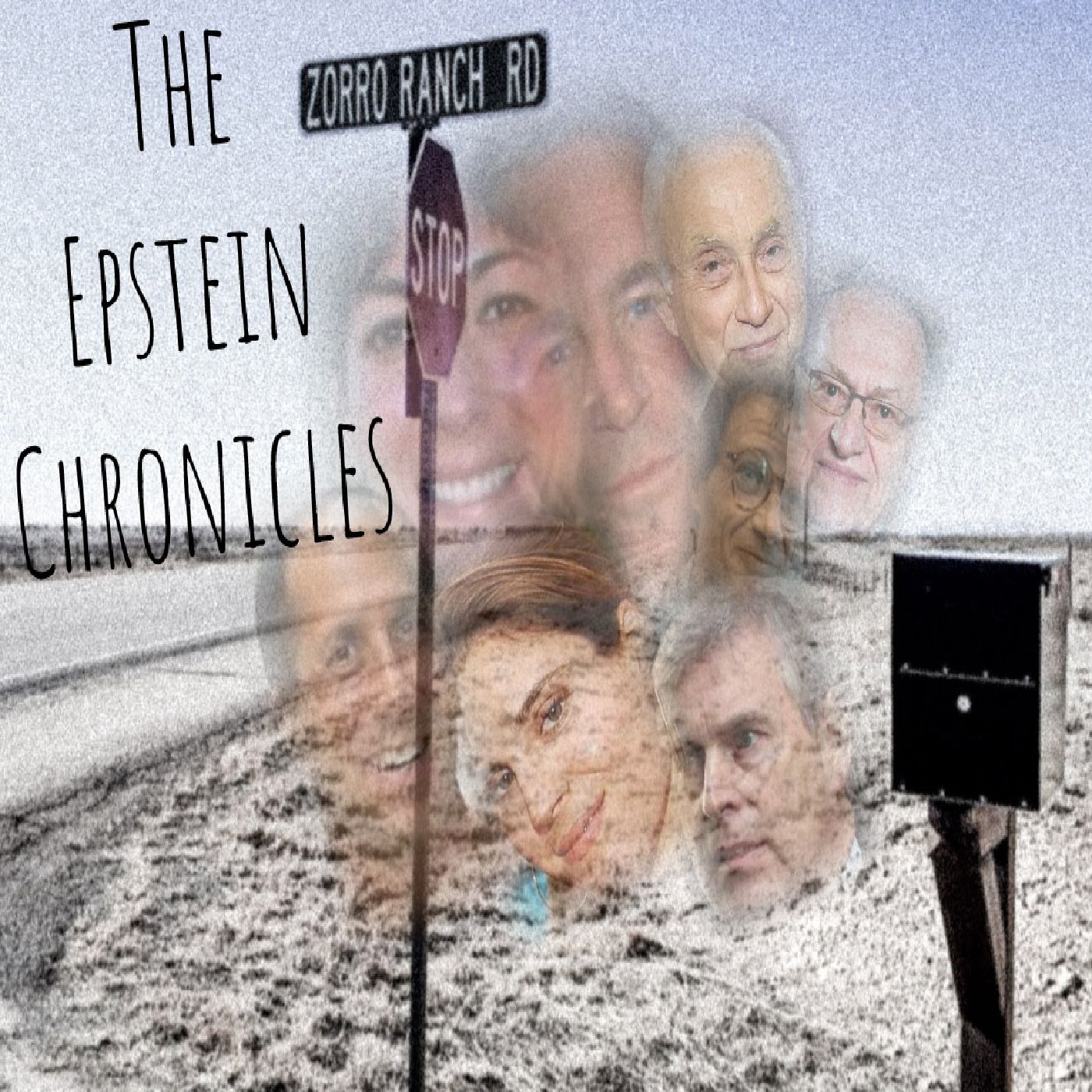
The Epstein Chronicles
Bobby Capucci
Jeffrey Epstein was a multi millionaire who had political and business ties to some of the most rich and powerful people in the world. From businessmen to politicians at the highest levels, Epstein broke bread with them all. Yet for years the Legacy media and the rest of high society looked the other way and ignored his behavior as multiple women came forward with allegations of abuse. Even after he was convicted and subsequently received a sweetheart deal those same so called elites welcomed him back with open arms. Now after his death and the arrest of Maxwell, the real story is starting to come together and the curtain has begun to be drawn back and what it has revealed is truly disturbing. From Princes to Ex Presidents, the cast of scoundrels in this play spans continents and political affiliations leaving us with a transcontinental criminal conspiracy possibly unlike any we have ever seen before. In this podcast we will explore all of the levels of Jeffrey Epstein and his criminal enterprise. From his most trusted assistants to obscure associates, we will leave no stone unturned as we swim through the muck searching for clarity and answers to some of the most pressing questions of the case. From interviews with people directly involved in the case to daily updates, the Epstein Chronicles will have it all. Just like our other project, The Jeffrey Epstein Show, you can expect no punches pulled and consistent content. We have covered the Epstein case daily(everyday since October 1st 2019) and will continue to do so until there are convictions. With a library of well over 1k shows, you can expect a ton of content coming your way including on scene reporting from the Maxwell trial and from places like Zorro Ranch. Thank you for tuning in and I look forward to having you all along for the ride.(Created and Hosted by Bobby Capucci)Become a supporter of this podcast: https://www.spreaker.com/podcast/the-epstein-chronicles--5003294/support.
Episodes
Mentioned books

Apr 20, 2026 • 49min
Mega Edition: Todd Blanche And His Cozy Prison "Fireside" Chat WIth Ghislaine Maxwell (Part 16-18) (4/19/26)
On August 22, 2025, the U.S. Department of Justice released redacted transcripts and audio recordings of a two-day interview it conducted in July with Ghislaine Maxwell, who is serving a 20-year federal prison sentence for her role in Jeffrey Epstein’s sex-trafficking ring. During the interview, Maxwell denied ever seeing any inappropriate behavior by former President Donald Trump, describing him as a “gentleman in all respects,” and insisted she “never witnessed the president in any inappropriate setting in any way.” She also rejected the existence of a so-called “client list,” countering years of speculation, and claimed to have no knowledge of blackmail or illicit recordings tied to Epstein.In addition to defending high-profile figures, Maxwell expressed doubt that Epstein’s death was a suicide, while also rejecting the notion of an elaborate conspiracy or murder plot. The release of the transcripts—handled under the Trump-era Justice Department—has stirred sharp political debate. Trump allies have framed her remarks as vindication, while critics and Epstein’s survivors question her credibility, pointing to her conviction and suggesting her words may be aimed at influencing potential clemency or political favor.to contact me:bobbycapucci@protonmail.comsource:Interview Transcript - Maxwell 2025.07.24 (Redacted).pdfBecome a supporter of this podcast: https://www.spreaker.com/podcast/the-epstein-chronicles--5003294/support.
Apr 20, 2026 • 12min
Former Attorney General Bill Barr Gives His Jeffrey Epstein Related Testimony To Congress
Bill Barr’s closed-door appearance before the House Oversight Committee was less an act of revelation and more of carefully dosed denial and damage control. While he acknowledged Epstein’s death resulted from a “perfect storm of screw-ups,” he denied awareness of missing surveillance footage or any so-called “client list” of associates. And despite widespread media focus on camera blind spots and unmonitored jail lapses, Barr insisted no evidence had emerged contradicting the official suicide determinationCritics argue that Barr’s testimony underscored the DOJ’s reluctance to fully own up to systemic failure. His assertion that he was “personally satisfied” with the outcome—and his resistance to acknowledging deeper institutional faults—fueled the notion that his role was protecting narrative more than uncovering truth. The hearing did little to quell concerns, instead leaving many in Congress and the public convinced there’s more yet to emerge.to contact me:bobbycapucci@protonmail.comsource:Barr tells House he saw no evidence linking Trump to Epstein crimes: Comer | Fox NewsBecome a supporter of this podcast: https://www.spreaker.com/podcast/the-epstein-chronicles--5003294/support.
Apr 20, 2026 • 13min
The DOJ Asks The Court To Unseal Epstein/Maxwell Grand Jury Exhibits As Well As Testimony
The U.S. Department of Justice (DOJ) has formally asked federal judges to unseal the grand jury exhibits—not just the testimony transcripts—from the investigations into Jeffrey Epstein and Ghislaine Maxwell. The request, filed on August 8, 2025, specifies that any released materials should redact victim identities and sensitive personal information, while notifying individuals named in exhibits not previously admitted during Maxwell’s trial. The DOJ has also requested that these materials remain sealed until after August 14 to allow time for notifications to relevant third parties.The move follows mounting pressure from the public, victims, and lawmakers for greater transparency in the Epstein‑Maxwell cases. Victims and their attorneys remain divided: some support unsealing for accountability, while others worry about their safety, privacy, and potential political motivations behind the DOJ’s timing. Maxwell’s legal team strongly opposes the unsealing, arguing that, unlike Epstein (who is deceased), Maxwell is alive and actively litigating her case. They warn that unsealing grand jury materials could intrude on her due process rights and jeopardize her ongoing appeals and any future retrial.to contact me:bobbycapucci@protonmail.comsource:DOJ seeks to unseal Jeffrey Epstein, Ghislaine Maxwell grand jury recordsBecome a supporter of this podcast: https://www.spreaker.com/podcast/the-epstein-chronicles--5003294/support.
Apr 19, 2026 • 16min
From Santa Fe to Silence: Zorro Ranch and Jeffrey Epstein (Part 2 )
Jeffrey Epstein’s Zorro Ranch in New Mexico was far more than a secluded estate—it was a fortress of influence, shielded by political connections, legal loopholes, and geographic isolation. Acquired in the early 1990s through ties to the powerful King family, the sprawling property benefited from a sex offender registry loophole that allowed Epstein to avoid public monitoring after his 2008 conviction. With friends like former Governor Bill Richardson, proximity to the elite Santa Fe Institute, and state trust land leases that expanded his buffer of privacy, Epstein found in New Mexico a jurisdiction uniquely suited to let him operate unchecked.Despite credible victim accounts placing abuse at the ranch, New Mexico authorities never conducted a serious investigation, choosing instead to hand the matter over to federal prosecutors. This “punting” avoided the political fallout that might have come from probing Epstein’s local connections and land deals, but it also ensured that years of potential evidence went uncollected. By the time the federal case took center stage in 2019, Zorro Ranch was little more than a missed opportunity for justice—proof that in New Mexico, as elsewhere, the powerful can secure safe harbor when the right people look the other way.to contact me:bobbycapucci@protonmail.comBecome a supporter of this podcast: https://www.spreaker.com/podcast/the-epstein-chronicles--5003294/support.
Apr 19, 2026 • 13min
From Santa Fe to Silence: Zorro Ranch and Jeffrey Epstein (Part 1 )
Jeffrey Epstein’s Zorro Ranch in New Mexico was far more than a secluded estate—it was a fortress of influence, shielded by political connections, legal loopholes, and geographic isolation. Acquired in the early 1990s through ties to the powerful King family, the sprawling property benefited from a sex offender registry loophole that allowed Epstein to avoid public monitoring after his 2008 conviction. With friends like former Governor Bill Richardson, proximity to the elite Santa Fe Institute, and state trust land leases that expanded his buffer of privacy, Epstein found in New Mexico a jurisdiction uniquely suited to let him operate unchecked.Despite credible victim accounts placing abuse at the ranch, New Mexico authorities never conducted a serious investigation, choosing instead to hand the matter over to federal prosecutors. This “punting” avoided the political fallout that might have come from probing Epstein’s local connections and land deals, but it also ensured that years of potential evidence went uncollected. By the time the federal case took center stage in 2019, Zorro Ranch was little more than a missed opportunity for justice—proof that in New Mexico, as elsewhere, the powerful can secure safe harbor when the right people look the other way.to contact me:bobbycapucci@protonmail.comBecome a supporter of this podcast: https://www.spreaker.com/podcast/the-epstein-chronicles--5003294/support.
Apr 19, 2026 • 12min
Inside The OIG Interview: The Warden's Statement Detailing The Death Of Jeffrey Epstein (Part 21) (4/19/26)
Lamine N'Diaye, in his interview with the Office of the Inspector General, essentially tried to turn the Metropolitan Correctional Center into a scapegoat while positioning himself as a bystander to its failures. He leaned heavily on the narrative that the facility was already broken—staff shortages, overtime abuse, infrastructure decay—as if that somehow absolved him of responsibility rather than underscoring the urgency of his role. What stands out is not just what he admitted, but what he avoided: there is little evidence in his account of decisive leadership, no clear record of aggressive intervention, and no meaningful acknowledgment that the buck was supposed to stop with him. Instead, he described a system failing in slow motion while he remained at the helm, fully aware of the cracks but unwilling—or unable—to reinforce them before they gave way.Even more troubling is how his interview reflects a pattern of deflection that mirrors broader institutional behavior in the wake of Jeffrey Epstein’s death. N’Diaye pointed to correctional officers missing rounds, falsifying logs, and working under extreme fatigue, but failed to explain why those conditions were tolerated under his command, especially after Epstein had already been flagged as a high-risk inmate following a prior incident. The responsibility didn’t disappear into the system—it sat squarely in his office, and his testimony reads less like accountability and more like damage control. The overall picture is not of a warden overwhelmed by circumstances, but of a leader who allowed a known crisis environment to persist unchecked, then attempted to retroactively frame it as inevitable once the worst-case scenario unfolded.to contact me:bobbycapucci@protonmail.comsource:EFTA00119019.pdfBecome a supporter of this podcast: https://www.spreaker.com/podcast/the-epstein-chronicles--5003294/support.
Apr 19, 2026 • 20min
Inside The OIG Interview: The Warden's Statement Detailing The Death Of Jeffrey Epstein (Part 20) (4/19/26)
Lamine N'Diaye, in his interview with the Office of the Inspector General, essentially tried to turn the Metropolitan Correctional Center into a scapegoat while positioning himself as a bystander to its failures. He leaned heavily on the narrative that the facility was already broken—staff shortages, overtime abuse, infrastructure decay—as if that somehow absolved him of responsibility rather than underscoring the urgency of his role. What stands out is not just what he admitted, but what he avoided: there is little evidence in his account of decisive leadership, no clear record of aggressive intervention, and no meaningful acknowledgment that the buck was supposed to stop with him. Instead, he described a system failing in slow motion while he remained at the helm, fully aware of the cracks but unwilling—or unable—to reinforce them before they gave way.Even more troubling is how his interview reflects a pattern of deflection that mirrors broader institutional behavior in the wake of Jeffrey Epstein’s death. N’Diaye pointed to correctional officers missing rounds, falsifying logs, and working under extreme fatigue, but failed to explain why those conditions were tolerated under his command, especially after Epstein had already been flagged as a high-risk inmate following a prior incident. The responsibility didn’t disappear into the system—it sat squarely in his office, and his testimony reads less like accountability and more like damage control. The overall picture is not of a warden overwhelmed by circumstances, but of a leader who allowed a known crisis environment to persist unchecked, then attempted to retroactively frame it as inevitable once the worst-case scenario unfolded.to contact me:bobbycapucci@protonmail.comsource:EFTA00119019.pdfBecome a supporter of this podcast: https://www.spreaker.com/podcast/the-epstein-chronicles--5003294/support.
Apr 19, 2026 • 12min
Witness in Public, Suspect in Private: The Andrew Mountbatten Windsor Contradiction (4/19/26)
Internal communications reveal that U.S. investigators were seeking to question Prince Andrew not merely as a cooperative witness, but as someone whose involvement warranted deeper scrutiny. The language used by officials suggests they did not view him as a peripheral figure, raising questions about why the public narrative consistently framed him as willing to assist while authorities appeared to be treating him with greater suspicion behind the scenes.At the same time, his legal team is described as actively working to control or limit that interaction, pushing to position him as a witness rather than someone under potential investigative focus. These efforts reportedly hindered attempts by U.S. authorities to secure a formal interview, adding to the broader pattern in the Epstein case where individuals tied to the inner circle were able to avoid direct questioning, despite clear interest from investigators.to contact me:bobbycapucci@protonmail.comsource:Andrew Mountbatten-Windsor's team blocked FBI Epstein probe after being told he was a suspect, not a witness | Daily Mail OnlineBecome a supporter of this podcast: https://www.spreaker.com/podcast/the-epstein-chronicles--5003294/support.
Apr 19, 2026 • 45min
Mega Edition: Todd Blanche And His Cozy Prison "Fireside" Chat WIth Ghislaine Maxwell (Part 13-15) (4/19/26)
On August 22, 2025, the U.S. Department of Justice released redacted transcripts and audio recordings of a two-day interview it conducted in July with Ghislaine Maxwell, who is serving a 20-year federal prison sentence for her role in Jeffrey Epstein’s sex-trafficking ring. During the interview, Maxwell denied ever seeing any inappropriate behavior by former President Donald Trump, describing him as a “gentleman in all respects,” and insisted she “never witnessed the president in any inappropriate setting in any way.” She also rejected the existence of a so-called “client list,” countering years of speculation, and claimed to have no knowledge of blackmail or illicit recordings tied to Epstein.In addition to defending high-profile figures, Maxwell expressed doubt that Epstein’s death was a suicide, while also rejecting the notion of an elaborate conspiracy or murder plot. The release of the transcripts—handled under the Trump-era Justice Department—has stirred sharp political debate. Trump allies have framed her remarks as vindication, while critics and Epstein’s survivors question her credibility, pointing to her conviction and suggesting her words may be aimed at influencing potential clemency or political favor.to contact me:bobbycapucci@protonmail.comsource:Interview Transcript - Maxwell 2025.07.24 (Redacted).pdfBecome a supporter of this podcast: https://www.spreaker.com/podcast/the-epstein-chronicles--5003294/support.
Apr 19, 2026 • 42min
Mega Edition: Todd Blanche And His Cozy Prison "Fireside" Chat WIth Ghislaine Maxwell (Part 10-12) (4/19/26)
On August 22, 2025, the U.S. Department of Justice released redacted transcripts and audio recordings of a two-day interview it conducted in July with Ghislaine Maxwell, who is serving a 20-year federal prison sentence for her role in Jeffrey Epstein’s sex-trafficking ring. During the interview, Maxwell denied ever seeing any inappropriate behavior by former President Donald Trump, describing him as a “gentleman in all respects,” and insisted she “never witnessed the president in any inappropriate setting in any way.” She also rejected the existence of a so-called “client list,” countering years of speculation, and claimed to have no knowledge of blackmail or illicit recordings tied to Epstein.In addition to defending high-profile figures, Maxwell expressed doubt that Epstein’s death was a suicide, while also rejecting the notion of an elaborate conspiracy or murder plot. The release of the transcripts—handled under the Trump-era Justice Department—has stirred sharp political debate. Trump allies have framed her remarks as vindication, while critics and Epstein’s survivors question her credibility, pointing to her conviction and suggesting her words may be aimed at influencing potential clemency or political favor.to contact me:bobbycapucci@protonmail.comsource:Interview Transcript - Maxwell 2025.07.24 (Redacted).pdfBecome a supporter of this podcast: https://www.spreaker.com/podcast/the-epstein-chronicles--5003294/support.

