

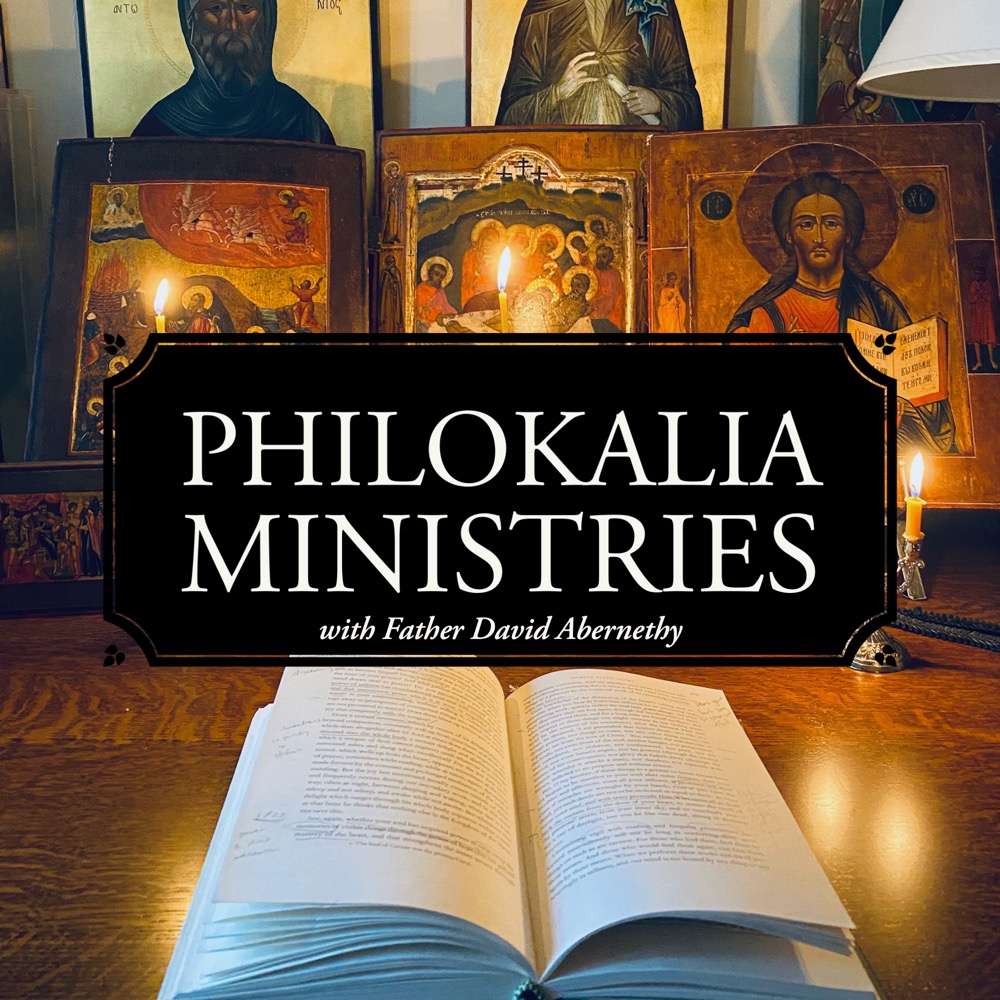
Philokalia Ministries
Father David Abernethy
Philokalia Ministries is the fruit of 30 years spent at the feet of the Fathers of the Church. Led by Father David Abernethy, Philokalia (Philo: Love of the Kalia: Beautiful) Ministries exists to re-form hearts and minds according to the mold of the Desert Fathers through the ascetic life, the example of the early Saints, the way of stillness, prayer, and purity of heart, the practice of the Jesus Prayer, and spiritual reading. Those who are involved in Philokalia Ministries - the podcasts, videos, social media posts, spiritual direction and online groups - are exposed to writings that make up the ancient, shared spiritual heritage of East and West: The Ladder of Divine Ascent, Saint Augustine, the Philokalia, the Conferences of Saint John Cassian, the Ascetical Homilies of Saint Isaac the Syrian, and the Evergetinos. In addition to these, more recent authors and writings, which draw deeply from the well of the desert, are read and discussed: Lorenzo Scupoli, Saint Theophan the Recluse, anonymous writings from Mount Athos, the Cloud of Unknowing, Saint John of the Cross, Thomas a Kempis, and many more.
Philokalia Ministries is offered to all, free of charge. However, there are real and immediate needs associated with it. You can support Philokalia Ministries with one-time, or recurring monthly donations, which are most appreciated. Your support truly makes this ministry possible. May Almighty God, who created you and fashioned you in His own Divine Image, restore you through His grace and make of you a true icon of our Lord and Savior Jesus Christ.
Philokalia Ministries is offered to all, free of charge. However, there are real and immediate needs associated with it. You can support Philokalia Ministries with one-time, or recurring monthly donations, which are most appreciated. Your support truly makes this ministry possible. May Almighty God, who created you and fashioned you in His own Divine Image, restore you through His grace and make of you a true icon of our Lord and Savior Jesus Christ.
Episodes
Mentioned books

Jul 21, 2022 • 60min
The Ladder of Divine Ascent - Chapter IV: On Obedience, Part V
We continued our discussion of Step 4 on Obedience. As deeply challenging as St John’s teachings are and as jarring as the examples of monks being tested can be, a light begins to shine through to the dark places of our minds that resist allowing ourselves to be conformed to the obedience of Christ.
Obedience as well as Love is cruciform. It involves a dying to self, self-will, and vanity in order that true meekness, love, and freedom might emerge.
The trials that the monks endured were not something meant to break down their personality or to crush them and throw them into despair. Rather, their shepherd, in imitation of Christ, sought only to purify their hearts and perfect their virtue. They entered into the monastic life with a clear understanding of its asceticism. It is distinctively Christian.
All that they do, every aspect of their life is meant to direct them to Christ and conform them to His image; to let His love bloom within their hearts.
It turns out that the truest and straightest path to freedom is obedience. Our confidence in this reality comes not from our own understanding but from what we see in Christ himself. By being obedient to His Father in love salvation comes to the world.
---
Text of chat during the group:
00:08:31 FrDavid Abernethy: page 76 para 27
00:09:45 FrDavid Abernethy: about time
00:29:32 Carol: do you see any parallels to this outside of the monastery?
00:35:44 Anthony: Religious persons with office of shepherd who act unjustly, without really caring for souls but being subject to vices, spreads poison to anyone who experienced them, damaging trust for the person to offer in future. Willingness to obey must then carefully be built up - by the person whose trust was damaged.
00:36:25 Art: Just a comment: This calls to mind the soldier attached to country, Corps, comrades, who is prepared to accomplish the mission, even a suicide mission, at the price of his blood. Death before dishonor is a common saying.
00:38:21 Anthony: of compegne
00:44:11 Ren: This teaching is initially very difficult to handle - that is, the idea of someone who is good and fruitful being dishonored for the sake of virtue and, ultimately, for the sake of Christ. However, I believe this is similiar to what you often say about asceticism (how it is accepted in every area of life but the spiritual): Purification by dishonor/humbling is something we accept when it comes to sports, the military, education, elite level performance/fine arts, etc… and in these areas we accept that the dishonor shown to the aspirant is given in order to refine, test, and perfect their dedication and love. The exact same thing is happening here, as Climacus says “A soul attached to the shepherd with love and faith for Christ’s sake.” In the end, that is the only goal of the monk - union with Christ.
00:53:14 Carol: Hebrews 12:6 And this all speaks to the love and providence of God, and the way we are called to respond to suffering.
00:54:40 Ashley Kaschl: I agree with Father. I think we cheapen something when we make it easy to obtain. Two quotes come to mind:
“Do not claim to have acquired virtue unless you have suffered affliction, for without affliction virtue has not been tested.” -St. Mark the Ascetic
“Nothing in the world is worth having or worth doing unless it means effort, pain, difficulty. I have never in my life envied a human being who led an easy life. I have envied a great many people who led difficult lives and led them well.” -Teddy Roosevelt
00:56:13 Debra: Thanks for sharing those, Ashley
01:00:57 Babington (or Babi): I haven’t understood the issue with that part of the Lord’s Prayer since Jesus was led by the Holy Spirit into the wilderness where He was then tempted, obviously with His Father’s permission, before beginning His public ministry.
01:09:16 Anthony: I just saw a short video of former Mike Tyson telling two young men that the 3 years he spent in prison were the best of his life, because he was given deep peace. One young man challenged him how could this be, when there was a time Tyson earned millions for one fight. Tyson replied that God may give us what we ask for to show us we can't handle what we want. And the Tyson in this video was calm and peaceful, unlike his life as a star, really sounding like a Christian.
01:09:36 Anthony: former boxer - sorry
01:10:57 Ren: “Bless you prison, bless you for being in my life. For there, lying upon the rotting prison straw, I came to realize that the object of life is not prosperity as we are made to believe, but the maturity of the human soul.”
01:11:55 Anthony: Don King?
01:12:32 Ren: The full quote is extraordinary. Something to frame.
01:13:36 Sheila Applegate: This ----> Tyson replied that God may give us what we ask for to show us we can't handle what we want.
01:16:08 Ren: It was granted to me to carry away from my prison years on my bent back, which nearly broke beneath its load, this essential experience: how a human being becomes evil and how good. In the intoxication of youthful successes I had felt myself to be infallible, and I was therefore cruel.
In the surfeit of power I was a murderer and an oppressor.
In my most evil moments I was convinced that I was doing good, and I was well supplied with systematic arguments. It was only when I lay there on rotting prison straw that I sensed within myself the first stirrings of good. Gradually it was disclosed to me that the line separating good and evil passes not through states, nor between classes, nor between political parties either—but right through every human heart—and through all human hearts. . . .
That is why I turn back to the years of my imprisonment and say, sometimes to the astonishment of those about me: “Bless you, prison!”
I . . . have served enough time there. I nourished my soul there, and I say without hesitation: “Bless you, prison, for having been in my life!”
—Aleksandr Solzhenitsyn
01:17:17 Babington (or Babi): Thank you!
01:17:26 Cindy Moran: Thank you, Father for this important session.
Jul 19, 2022 • 1h 5min
The Evergetinos - Hypothesis XXII, Part III
Both an inspiring and challenging section from the Evergetinos this evening! The Fathers speak to us about the monastic life and its clear focus; a clarity that perhaps we have lost in more recent times. The monk lives for God, to seek God, to listen to God, and to pray. This he does as part of the Body of Christ, the Church, for the salvation of others. And yet we are shown how easy it is to cast off that “sweet yoke” of the Lord where He no longer has authority over us. Even a monk would gravitate away from what is described as the “Divine Wheat” that is drenched by the heavy rain of heavenly life bestowing Spirit. We leave peace and converse with God simply to be distracted by fleshly realities. We choose what is of passing and lesser value and let the divine slip through our fingers.
The monks show us that we are to guard the heart; in particular by guarding our words and what we listen to. We must always seek to make our speech edifying, seasoning our words with Divine salt so as to preserve the purity of heart in the others as well as in ourselves. We must not listen to unprofitable words but flee the situation where we are tempted. No one should be so deluded so as to think that we can expose ourselves to angry, hostile, or wicked words and not become wicked ourselves. All such things remain lodged in the memory, imagination and heart. Our relationship with God must be precious in our eyes even if this means avoiding those who are acquisitive or licentious. Rather we must gravitate to the righteous man who through his words and deeds will draw us closer to God.
Do we want to be saved? This is the most powerful question of the night. It is a humbling thing to acknowledge our poverty of spirit and so we can develop a resistance to God’s call to draw close to him. One may not want to be saved or find it too humiliating and so cling to a false self image. May God preserve us from such delusions.
---
Text of chat during the group:
00:11:29 FrDavid Abernethy: page 190
00:11:37 FrDavid Abernethy: last paragraph
00:33:50 Anthony: In a way, this is an example of giving up a lesser good (awareness of others, or a form of fellowship) for the benefit of achieving a greater good?
00:36:09 maureencunningham: It seems like the early chuch was aware of demons
00:36:21 Jos: it gets even worse when it's about politics and religion
00:36:31 maureencunningham: It seems the America church has learned to adjust to them
00:36:58 maureencunningham: The early church called them demons
00:39:21 Paul Grazal: You wonder what engagement he had that made him think that. I can think of a few that ive had that i should have avoided
00:40:58 Paul Grazal: Yes Thank You
00:41:38 Rachel Pineda: Tubes of paint... ,and books..
00:45:54 Anthony: Too much buying and selling and we don't know how to "be" but only to become; thus Americans are great in markets and inventions, but we neglect basic metaphysics about life, and we are now existing as several coexisting lost generations.
00:49:08 Lee Graham: We are entertaining ourselves to death
00:49:36 Carol: books and legos
00:50:41 Anthony: Or "The Great Wall" in 3D
00:57:20 Anthony: St. John of Damascus: "whether I will or not, O Lord, save me - quick, quick - for I perish." Paraphrase from the Melkite Publicans Prayer Book.
00:59:37 maureencunningham: is it like piano it comes with much practice before one can play Bach
01:04:10 Daniel Allen: Like the Pharisee and the publican, the delusion of the holy person vs the truth of the sinner
01:07:51 Anthony: I think it has something to do with an urge which has good roots: "It is not good for man to be alone." This is a good thing, but out of order.
01:09:11 Daniel Allen: The language of God is silence is something I thought about recently and why silence? And because it’s the silence that allows Him to be heard, like the gentle breeze that Elijah heard. He doesn’t replace our voice, He waits to be heard.
01:12:00 Debra: I'm a scheduled Adorer, at my parish. And I really struggle with just sitting in silence. I feel like I should be praying a rosary, or reading about the saints...doing something
How can I develop the practice of sitting still? My brain is always racing through stuff
01:14:04 Paul Fifer: I think Holy Hours were set to an Hour because it takes about 20 minutes to quiet our minds and hearts and enter into the Silence.
01:15:11 Debra: Paul: At least 20 minutes
01:16:06 Jos: is it advisable to think about God in the abstract or should we focus on Jesus as God to stay out of delusions in the face of the really mysterious idea of God?
01:20:27 Bridget McGinley: Thank you for that explanation Father.
01:21:04 Anthony: I just finished it. It's amazing, drawing on the Greek fathers so sounds very orthodox
01:22:14 Rachel Pineda: Thank you
Jul 14, 2022 • 1h 1min
The Ladder of Divine Ascent- Chapter IV: On Obedience, Part IV
Tonight we continued with St. John’s Step on Obedience. We are presented with an image that may be unfamiliar to us. Obedience is not presented as something that is crushing to the human spirit. It can be humiliating - in the sense that it seems to drive out from the soul and the heart all vestige of arrogance, fierceness, and hostility towards others. Yet, what emerges from this exercise of faith is conformity to Christ. When it is rooted in a true love for one’s shepherd, one’s Elder, then a kind of voluntary innocence begins to emerge; a childlike trust in the Elder that prevents a person from speculating about his motives or thinking that he is being driven by xmalice.
When we know that we are being guided by love then we are able to embrace even the most challenging of things. Obedience becomes are very food; something nourishing as it was for Christ himself. When perfected, it can bring about not only personal transformation but the transformation of every relationship that exists within our lives. When we let go of all machinations and all forms of calculation and seek simply to love and give ourselves in love - peace and freedom emerge. We should speak of obedience as something that ultimately brings joy. Indeed, we should see all the virtues as doing exactly that – bringing us into the joy of the kingdom.
---
Text of chat during the group:
00:10:10 Art: In case anyone is interested.
00:10:16 Art: Upcoming online course:
THE WAY OF THE PILGRIM: Entering Into the Jesus Prayer
Instructor: Very Rev. Stephen Freeman
Event Description
"Pray without ceasing." —1 Thessalonians 5:17
What is prayer, and how does one learn how to pray? In this talk, journey with Fr. Stephen Freeman and a pilgrim in 19th-century Russia to explore the meaning of prayer in our lives.
Event Details
https://instituteofcatholicculture.org/events/the-way-of-the-pilgrim
Tuesday, August 23
Pre-Class Discussion: 7:30 PM EST
Lecture: 8:00 PM EST
Registration is required
00:12:03 Fr. Miron Jr.: yep!
00:12:44 FrDavid Abernethy: page 73, para 20
00:31:49 maureencunningham: The task was a lie or was he and Epicepic ?
00:39:55 Anthony: Vocation is seen as a job, matching personal characteristics to charisms of a community of the need to have clergy and religious
00:45:46 Debra: Would he have been allowed to receive Eucharist...attend Mass?
00:46:21 Bridget McGinley: The journey of the spiritual life in such a short paragraph. Beautifully spoken and written. We go through the same journey over a lifetime.
00:47:24 Bridget McGinley: It is easy to see that God should reward us for the little we do instead of being humble and low at the gift.
00:49:33 Bonnie Lewis: Thank you Father. That was going to be my question, that he would be filled with sadness. And yet, his life ended in a joyful death.
00:55:19 Anthony: Is this simple character the "Holy Fool"? Or is that something else?
00:57:24 Ambrose Little, OP: Can you elaborate on "voluntary innocence” in this context?
01:02:20 Ambrose Little, OP: Maybe also it is "take no thought for tomorrow, what you shall eat, or what you shall wear.." That is also a kind of. innocence--simply trusting that God will provide.
01:03:01 Liz: In some Communities, were the Superior (or other brothers) does similar or more humilliating actions out of truly malice, can it also be taken as an instructive tool by the one who is suffering it unjustly, just out of the evil will of another one? Maybe this is also related with the voluntary innocence, without second-guessings. Can this be applied in the secular life? To which extent can we distinguish it from the line of the "human dignity"?....
01:03:33 Carol: "real joy, which is paradisal innocence and attachment to God through the whole splendor of being alive." Olivier clement
01:08:33 Anthony: The monastic literature refers to beginning in community life before solitary life as the best way to live. Natural law leads to the valuable community of family life. In our day, there are so many single people, by choice or by circumstance, from age 18 or sadly even earlier. Our age appears to be an aberration. Do you have spiritual advice for so many solitaries thrust into solitary life, a period of being neither monastic nor familial?
01:14:44 maureencunningham: Thank You
01:15:36 carolnypaver: Song of Tears?
01:16:57 Cindy Moran: Thank you, Father! Great session!!
01:17:04 Liz: Thank you Father!
Jul 12, 2022 • 1h 13min
The Evergetinos - Hypothesis XXII, Part II
We picked up this evening with our reading of the very challenging Hypothesis 22: the Fathers’ teaching to avoid the world and worldly relations. However, we must understand that when they speak of the world they speak of those things or relationships that are driven more by the passions than by grace and the love of God.
Central to this is having a rightly ordered love that is focused upon Christ. All things must begin and end with Him and all things are judged in light of the Love of the Kingdom. This Love must become the lens through which we view all things, most especially our own thoughts and desires. What is it - at this moment - that is going to be pleasing to God or fulfill our obedience to our elder? Are we doing things in subtle ways simply to please ourselves; always seeking to form and fashion our own identity and to be the source of meaning for ourselves and our lives?
For a Christian living in the world to “stay in one’s cell“ means to keep watch over my inner self, my own heart. This is why the Fathers put forward as an essential practice unceasing prayer, and particular the Jesus Prayer. It is only by constantly calling out to God that we are given the strength and the grace to love God and to love others in the way He desires for us. We are called to be Christ for one another and so our love and our actions must be Christlike. To be anything otherwise is to strip the gospel of its power to make ourselves unrecognizable as those who have been made sons and daughters of God.
---
Text of chat during the group:
00:17:12 carolnypaver: Congratulations!🥳
00:18:31 Debra: What are we congratulating? I came in late
00:18:50 carolnypaver: 500 podcasts for Fr. David!
00:19:09 Ambrose Little, OP: remarkable progress. how did we get to p188?? 🙂
00:20:07 Debra: Oh, wow! Thanks Carolyn!
00:32:55 Anthony: Does this mean that even as being a contemplative is a vocation, staying in a city to minister must be a specific vocatiom?
00:59:00 Rachel: I love that song!
01:01:29 Annie Karto: So true about doing more than what God asks, especially in ministry
01:05:15 Erick Chastain: Stop being friends as much as possible with worldly people. It will help everything tremendously. Having done this it helps remove many occasions of sin.
01:10:42 Carol Nypaver: It’s difficult to remember, as parents, that the goal of parenting is not that our children love us but to raise them to be citizens of Heaven, which sometimes causes them to hate us.
01:11:19 Rachel: Thank you Carol!
01:12:04 Erick Chastain: I read it as saying we should flee from the world as much as possible, including worldly people, to protect ourselves from the flaring of the passions
01:13:04 Erick Chastain: but without abandoning our responsibilities if we are not a monk
01:19:59 John White: The author of The Imitation of Christ paraphrased the Roman philosopher/playwright Seneca "As often as I have been among men, I have returned home a lesser man"
01:20:10 Ambrose Little, OP: Challenge to connect with people if we always are trying to be aloof.
01:20:11 iPad (10)maureen: I think the monk you met You spotted Joy, It Joy we give up things
01:23:31 iPad (10)maureen: I say the. Jesus prayer when something I do not like is on TV
01:23:40 Ambrose Little, OP: You could try time boxing. Like “I'll watch an hour with you" or something and/or “just this show on this day" or similar.
01:24:39 Erick Chastain: that's a great suggestion Ambrose!
01:30:13 Annie Karto: What beautiful teaching Fr. Thank you
01:31:32 Daniel Swinington: thank you
Jul 7, 2022 • 1h 3min
The Ladder of Divine Ascent - Chapter IV: On Obedience, Part III
We picked up this evening once again with Step 4 on Obedience. John describes it for us as standing before God with a kind of simplicity and humility; truthful living before God and others. When we live in this manner we unburden ourselves and so run a good race without a heavy conscience and also protected from the cunning of the demons who make exacting investigation of our deeds.
After describing obedience and defining it, John then turns to give us beautiful examples of those who lived it in an heroic fashion. In particular, we are told of a thief who seeks admittance to a monastery. Gradually the superior test his obedience through the confession of his sins privately and publicly. The thief does this with profound humility and obedience that is shocking even to Saint John. It is then that he is received into the monastery and given the habit. He overcame the shame of his sin through the shame of bringing all things to light.
St. John goes on to describe the fruit that this bore within the community. They were so formed by the spirit of obedience through their skillful superior and physician of souls, that they began to live the angelic life. Their love and generosity towards each other was unparalleled. They would seek to protect each other’s consciences and also to take each other’s burdens upon themselves.
---
Text of chat during the group:
00:07:36 FrDavid Abernethy: starting tonight on page 70, paragraph 9
00:41:45 renwitter: Without this type of public, and total confession, is there any way to attain to a similar level of freedom? I feel like so many carry certain sins as secrets from all but their confessor, and maybe spouse.
00:44:14 Fr. Miron Jr.: 1st sunday of Great Lent
00:55:47 renwitter: This also perfectly compliments what we discussed in the Evergetinos on Monday - the simple, very easy way that idle conversation becomes evil conversation, and thus something that needs to be avoided even in the very beginning when it seems really harmless. There is nothing harmless about what is idle.
01:03:28 Ashley Kaschl: It’s not hard since a lot of things die in this heat 😂
01:04:17 Barb Heyrman: I am reminded of a homily on one very hot & humid Sunday. “If you think this is hot…try bell.”
01:07:59 renwitter: I am reminded of my favorite quote from an old cartoon (the context is the Dad of the family dropping his son off for Sunday school). Son: “But Dad, Sunday school is so not cool." Dad: “You know what's not cool Bobby? Hell.”
01:08:32 Ashley Kaschl: 😂😂
01:16:15 Ashley Kaschl: I was on the go earlier, so you don’t have to respond to this, Father.
But the public confession of past wrongs in the earlier paragraphs reminds me of the General Judgment.
01:16:19 Ashley Kaschl: And in contemplating that, at first, there’s a real, gripping fear that all will be made clear, nothing will be hidden. Since sin is an absence, an act contrary to reality, that wounds both us and the Body, this type of confession, which we will all endure in the end, can’t NOT be healing and ultimately freeing.
But then, in understanding the sacramental life, Who and where I’m made for, and if one has a penitential disposition, it’s less about standing in shame or fear, and more like we would stand before everyone with a deep recognition, humility, and admission for having been who we are not and did not want to be.
01:21:14 Rachel Pineda: Thank you!
01:21:16 Bonnie Lewis: Thank you Father!
01:21:36 Bonnie Lewis: A blessed birthday to you !
01:21:40 Maple(Hannah) Hong: Thankk you
01:21:43 Rachel Pineda: Happy Birthday! LOL 60
01:21:45 Sheila Applegate: Happy Birthday!
01:22:00 carolnypaver: Birthday Blessings!
01:22:02 kevin: happy Birthday
01:22:05 Maple(Hannah) Hong: Happy Birthday!
01:22:10 Rachel Pineda: The kids still think you are ancient but look young. God bless! Happy Birthday!
Jul 5, 2022 • 1h 17min
The Evergetinos - Hypothesis XXI, Part VI and Hypothesis XXII, Part I
We began this evening with the final pages of Hypothesis 21 describing the importance of not opening one’s conscience to an individual unless guided by the Grace of God to do so. It is not a small thing to entrust oneself to the care of another, especially the care of one’s soul. Therefore we are counseled to be discriminating. For the elder that we choose, or rather the elder that God chooses for us, is a gift; a relationship of love and devotion. An Elder does not see himself as detached from our struggles but rather enters into them and takes penance and prayer upon himself for our healing. We do not struggle in isolation. Understanding the importance of this relationship,then, we should pray for our elder and love him.
Moving on to Hypothesis 22 we are warned to avoid meetings with careless men and avoiding anything that would disturb the peace of our heart or the stillness that has been hard won. We must never see idle conversation as insignificant. Rather we must understand that if allow ourselves to be drawn along by such conversations our consciences will coarsen and we will find ourselves engaged in grievous conversations and behaviors.
We are given a wonderful example of an elder who, because of his purity and innocence, finds God responding immediately to his prayers for others. No impediment is placed before the action of God‘s grace in his life or acting through his intercession. We should not be surprised when the Fathers tell us that if we neglect our relationship with God or treat His grace cheaply that our prayers go unanswered.
---
Text of chat during the group:
00:23:16 B K-LEB: like fr zozima
00:29:29 Ambrose Little, OP: “outraged ... since he did not rely totally on the help of God." Love that.
00:31:10 Anthony: So much for "Grace Alone." One the one hand, all good is from God, all good is a grace. But, we must exercise the faculty of human nature (which is also a gift) to choose the grace, to at least choose a desire for the grace. I think St. Anselm says this in "One Truth" or "On Free Will"
00:32:22 Anthony: "On Truth"
00:39:21 Anthony: In America, we tie sin to things: sugary drinks, alcohol, guns, etc. It is very selective. But traditionally, sin is attached to our deficiencies of soul - and a Puritan look at sin does not take this psychology into account.
00:40:36 Sheila Applegate: Attachment to having life the way we want it?
00:50:10 B K-LEB: i agree anthony
00:50:38 B K-LEB: i personally think the inner spiritual sins are far worse than the physical sins
00:52:02 B K-LEB: i'd rather go to heaven fat and humble than thin and proud, haha
00:53:18 Ren: It would be so good for seminarians to read this particular hypothesis when they study confession. So much meaningful, and practical advice. The way to engage the penitent, the call to enter into repentance with them…all just so good.
00:54:41 B K-LEB: too much theology can make us proud pharisees
00:56:56 Anthony: Copts require new priests to spend 40 days in monastery
00:57:56 Bridget McGinley: The Jesuits used to not be able to listen to women's confessions until they had been a priest for 10 years.
01:02:50 B K-LEB: isn't spiritual pride essentially the worst kind of sin?
01:04:59 Anthony: He gives us a remedy: using the 2nd person plural in the Our Father so we lump ourselves together with all other sinners: "Forgive US OUR trespasses as WE forgive those who trespass against us / Lead US not into temptation but deliver US from evil."
01:20:36 Ren: The warning that idle words quickly become harmful ones is really, really helpful. I have often seen this happen in myself, yet I’ve never heard it explicitly said that the one can so easily lead to the other. It casts a far more serious light on consenting to idle conversation, knowing how easily it leads to something more sinister. So many “little sins” become more sinister when you examine the greater sins that the open the door to. I know that even thinking about addressing this is terrifying for me…but it does make me think about how much idle conversation one is exposed to in television, movies, radio, social media…definitely thought provoking.
01:31:06 Ren: Awesome way to make a discussion of the Fathers topically connected to the holiday :D GO REVOLUTION!! ;-)
01:34:46 B K-LEB: thank u so much
Jun 30, 2022 • 58min
The Ladder of Divine Ascent - Chapter IV: On Obedience, Part II
This evening we picked up with Step 4 on Obedience. Saint John puts it before us in an unvarnished fashion. It is hard work. It offers us great freedom; freedom from all of our concerns about the things of the world, daily circumstances, or what others do or say to us. Yet, it is a rough way because it means letting go of our own will, self-judgment and opinion. We freely give these things over to another who becomes our “helmsman”. The helmsman becomes our “nous” - the eye of the heart - while we lack that purity of heart.
One does not choose to live in obedience indiscriminately, Saint John tells us. Rather, we must make sure that we embrace obedience and give our judgment over to one who can truly guide us along the path that leads to the kingdom. Otherwise, Saint John tells us, we should get no profit from our subjection. For this reason we must write the good deeds of our elder on our hearts and constantly remember them. For once we have chosen to live in obedience, either under an elder or within our particular vocation in life and to our particular vows, we are inevitably going to be attacked by the evil one who desires to make us distrust our elder.
Obedience is of the greatest value because in humbling the mind in the body it frees us from all the things that stir the passions within us. Obedience is not meant to be a form of oppression or of infantilizing others. An elder is to embrace his disciple with the greatest love and desire for his well-being. For in the end he will be held responsible for the one God has placed in his care.
---
Text of chat during the group:
00:11:14 FrDavid Abernethy: page 69 n.4
00:11:19 FrDavid Abernethy: On obedience
00:17:13 Fr. Miron Kerul-Kmec Jr.: I’m young!
00:29:29 Anthony: For what it's worth, here are attorney saints: Augustine, Fidelis Sigmaringen, Thomas More, Aloysius Gonzaga. The only one I think who was led to the spiritual life without trauma was Fidelis of Sigmaringen. There have to be more attorney-saints.
00:30:38 Anthony: Well, St. Thomas More began well but was rarified through trauma
00:40:22 Ambrose Little, OP: sometimes you do. 😄
00:44:54 Anthony: St Seraphim of Sarov: "Headache may be caused by agitated and excessively forced mental activity." Last sentence of Spiritual Instruction #15. Maybe obedience helps us avoid overthinking.
00:49:14 M C: I have found it difficult to find an orthodox spiritual director.
00:53:35 Ambrose Little, OP: Would you think that this guidance applies to, e.g., our bishop and/or the Holy Father? The CCC says we owe religious submission of intellect and will. Makes me wonder about what's going on in the Church these days.
00:58:19 Ambrose Little, OP: Definitely recommend reading the Holy Father's letter on the liturgy published today. Very powerful stuff. (Sorry, gotta run to pick up the younguns. God bless, y'all.)
00:58:59 Art: Desidero Desideravi
01:02:33 Anthony: Book recommendation: "Papacy and Revolution" by EEY Hales. It was the "conservative" (but really liberal because they were so headstrong?) Jansenists who unwittingly had a seminal role in bringing about the French Revolution.
01:04:39 Anthony: i.e. Oliver Cromwell in England
01:13:00 Sam Rodriguez : My first exposure of that teaching “put no trust in yourself” was the Spiritual Combat by Scupoli. Is a core tenet of his, from the earliest pages, if I remember correctly
01:15:46 M C: Thank you!
01:15:53 Cindy Moran: Thank you Father!
01:16:06 Maple(Hannah) Hong: Thank you!
Jun 28, 2022 • 57min
The Evergetinos - Hypothesis XXI, Part V
What a beautiful group this evening. Once again we hear a young brother asking questions about transgressing the commands and guidance given by an elder. What we hear over and over again is an emphasis upon the fact that an elder is not disconnected from one in his care. If a person transgresses a command or ignores the guidance of an elder, he is to return to him without fear or with the expectation that his humility will be met with anything but gentleness, tenderness, and further counsel. Of course, this does not mean we fall into neglect or become indifferent about striving to live holy lives. What we find in the Fathers again and again is an emphasis upon the value of repentance; turning to God with humble hearts and receiving a flood of his grace and mercy.
Again the brother asks if one should simply neglect to learn about the spiritual life so as not to be held accountable for particular sins. The elder quickly tells him that such a thought is sinister in that it blocks the path to true healing. Sin brings its own suffering. Repentance is a gift from God that opens up a path to healing and hope. Why would one not want to know the path that God has opened up for us? Why would one not desire the wisdom of the counsel of the fathers in order that they might truly be healed? Furthermore, the elder emphasizes that God values the person of his servants precisely because they imitate Christ himself. They offer advice with intense and warm prayer to God and make their own the sufferings of others crying out to God, “Master save us, we perish.“ Save US! We do not struggle as Christians in isolation but we embrace one another’s struggles as our own.
---
Text of chat during the group:
00:16:40 David Fraley: Hello to all.
00:16:52 FrDavid Abernethy: page 180 letter K. Hypothesis 21
00:17:17 FrDavid Abernethy: hi Dave
00:17:25 FrDavid Abernethy: where are the snacks??
00:19:01 maureencunningham: thank you Ren
00:24:58 carolnypaver: What page/section?
00:25:09 renwitter: =Page 181
00:25:16 carolnypaver: TY
00:34:35 Sheila Applegate: I often feel like Sisyphus rolling the rock up the hill only to have it come crashing down. Rinse. Repeat.
00:35:39 Debra: Same
Jun 23, 2022 • 1h 10min
The Ladder of Divine Ascent - Chapter III: On Exile, Part V and Chapter IV: On Obedience, Part I
We returned this evening to Step 3 on Exile. St. John concludes by simply telling us that exile - simplifying one’s life - creates a stable character. This is a precious gift and so we must guard our minds and our hearts so that we do not corrupt ourselves by entering once again into what is worldly and disorderly. Saint John concludes Step 3 by taking a moment to speak to us about dreams. A dream involves the minds activity when the body is asleep. The mind, as we know, can be very active; often swept along by the things of day-to-day life or by what rest deep within the unconscious. Saint John warns us that the demons can use our dreams by playing the role of prophet. They convince us that our dreams have deep meaning, they tell us something important about the future, or tell us what is happening in a loved one’s life. Demons can transform themselves into angels of light and lead us into a kind of unholy joy and conceit over what is revealed within our dreams. We can find the demons making sport of us when we so much credence to their interpretation. Therefore, we should distrust our dreams; knowing that like the fantasies in our waking hours they can be used against us in dangerous ways.
We then turned to Step 4 on Obedience. Saint John begins to emphasize its importance for us in the spiritual battle. We are to seek this as one of our most important weapons because it conforms us in a special way to Christ - whose food was to do the will of His heavenly Father. An obedient soul listens deeply to what God and one’s superior is telling him. Obedience protects us from the delusion of our own judgment, opinions and reasons. We do not see all ends and the fact that we ignore this does not go unnoticed by the evil one.
---
Text of chat during the group:
00:11:12 FrDavid Abernethy: page 66 paragraph 24
00:28:36 Lee Graham: Entertaining our thoughts while awake
00:34:29 Iwona Bednarz-Major: Aquinas says that our imagination can be seen by demons (and good angels, as originally they are both superb intellectual beings), since they are formed in our intelligence. Is that where the spiritual warfare takes place in dreams (logismoi)?
00:39:26 Ryan Schaefer: At Franciscan U a lot of students supposedly had visions. Some students seemed very proud of the fact that they’ve seen angels, seen the future, etc… always seemed like a red flag to me
00:43:56 Bridget McGinley: Little nervous, I don't dream ( at least I don't remember). My soul!?!?
00:46:50 Cindy Moran: ]
00:49:09 Ryan Schaefer: The TORs at Franciscan always told us that we would receive consolations if we are following Gods will. Often they said if we are not following God then we would NOT receive a “spirit of peace”. Is this incorrect? How does this relate to para. 29
00:52:05 Rachel: Everytime I've read this, it has confused me a bit. Since it can be dangerous to speak about the interior life on account of the demons who will try to trick us at every moment, how are we supposed to approach confession and the revealing of thoughts to one's confessor or spiritual director? Even here it seems to me one has to be very discerning and careful.
00:52:10 Rachel: LOL
00:56:29 Ambrose Little, OP: well!
00:56:56 Rachel: Okay, ! That was what I was going to ask about the grace of the Sacrament. But we went on to dreams etc. :) I think when I first became Catholic this witnessing was something that made me pause. Wow, thank you
00:57:04 Iwona Bednarz-Major: Fr. David, continuing my previous thought, I was always thinking that demons can only have an insight into our inner life based on our behavior but lately I've read Aquinas: Summa, First Part, Question 111. The action of the angels on man
Article 3. Whether an angel can change man's imagination? with hims stating: “I answer that, Both a good and a bad angel by their own natural power can move the human imagination. " and then explaining further that thought: “An angel changes the imagination, not indeed by the impression of an imaginative form in no way previously received from the senses”, I was perplexed. If you would have any insight on that from your perspective in the future, that would be great. Thank you.
00:58:57 Rachel: Oh, I missed this week's class. 🙃
00:59:47 sue and mark: ok, thank you..
01:02:43 Iwona Bednarz-Major: thank you
01:18:02 Lee Graham: I totally agree with you
01:20:45 Anthony: Obedience has a very important role in daily work. As craftsman is obedient to the methods of the trade and masters; a government worker is obedient to the law's "you shall" in regard to enforcement - especially when he does not want to enforce the law; a day laborer is obedient to the payor. Obedience is especially essential in a medieval guild system. All life is master-apprentice.
01:22:44 Anthony: mass commodity is modern edicatin
01:22:49 Anthony: education
01:22:59 Ashley Kaschl: Sorry I didn’t type fast enough before but I wanted to touch on what you were saying a paragraph ago about obedience and humility.
I think you’ve said before that at the heart of the word ‘Obedience’ is the meaning ‘to hear’, and that humility, being tied to obedience, is prone to silence.
I was thinking about something I heard a couple years back from my pastor that the word Silent, is comprised of the same letters which spell the words Listen and Enlist. So it just brought to mind that in humble silence of our prayer we listen (obedience) for His voice so that He can enlist us in the particular task He has set before us, that we might be caught up in God’s purpose.
01:23:54 Carol Nypaver: Wow!
01:27:15 Cindy Moran: Thank you Father...so wonderful to be here!
01:27:17 Sheila Applegate: Thanks again, Father.
01:27:20 Ryan Schaefer: God bless you father thank you!
01:27:21 Art: Thank you Father. Goodnight all.
01:27:21 Miron Kerul Kmec: Thank you
Jun 21, 2022 • 1h 2min
The Evergetinos - Hypothesis XXI, Part IV
We continued with the incredible counsel of the Fathers about how one discerns when to embrace the advice and counsel of others, specifically one’s Elder. The first distinction made is about advice - counsel that is a part of the spiritual tradition as a whole and so valuable in and of itself. This should be embraced faithfully - for it is given by the goodness and kindness of one’s Elder. When that relationship has grown throughout the course of the years a command may be given by an Elder. This command, however, is only given under specific circumstances; never casually. One must have a kind of clarity and sense of commitment to what is being asked of the Elder. This is to be done by making a prostration, a bodily action and sign of obeisance showing one’s desire to take hold of the command of the Elder. The Elder, then, in an equally concrete fashion must give his blessing. In doing so he takes upon himself the commitment to pray and fast that the one in his care would be able to fulfill the command. We see in all of this the depth of the relationship that must exist between an Elder and the one in his charge. We do not simply expose ourselves to information, reading the writings of the Elders and applying them to our lives. Rather, we enter into a living tradition and it is in and through this relationship between an elder and the one in his care that spiritual growth is made. It is a relationship of love that mirrors the relationship that Christ has with each of us. He calls us to give ourselves to Him and follow Him and in doing so He gives us himself in the most holy Eucharist. The command always holds within it the grace to help us fulfill it.
---
Text of chat during the group:
00:17:46 FrDavid Abernethy: Anthony Coniaris
00:17:55 FrDavid Abernethy: Beginnners Guide to the Philokalia
01:09:50 Ren: This reminder that the Elder prays for the one whom he counsels is very helpful. I am not sure there is anything more humbling than being prayed for - or fasted for! Knowing that another is investing themselves so deeply on your behalf definitely spurs one on to greater dedication. The gift demands a response.
01:11:26 Ren: Yes. Wow. Imagine that: God himself, in the person of Christ, fasted for each one of us. Spent himself praying for each of us. So very humbling.
01:12:09 Carol Nypaver: Absolutely.
01:20:09 Ren: Just a little PSA for everyone: we have switched our email service to MailChimp. If you did not receive an email in advance of tonight’s group, please check your spam filter, and mark it as not junk. Thank you!
01:21:32 David Fraley: Thanks Fr David!
01:21:47 Debra: The short link, tonight, still triggered a 'Threat Warning' from Avast lol
01:21:58 Ambrose Little: stop using Avast
01:22:20 Fr. Miron Kerul-Kmec Jr.: 2nd experience with baptism!
01:22:28 Eric Williams: Keeping you busy and out of trouble. ;)
01:22:54 Debra: You're making me want to switch to the East lol

