

The History of the Americans
Jack Henneman
The history of the people who live in the United States, from the beginning.
Episodes
Mentioned books

Sep 23, 2021 • 34min
#39 Set Fair For Roanoke Part 1
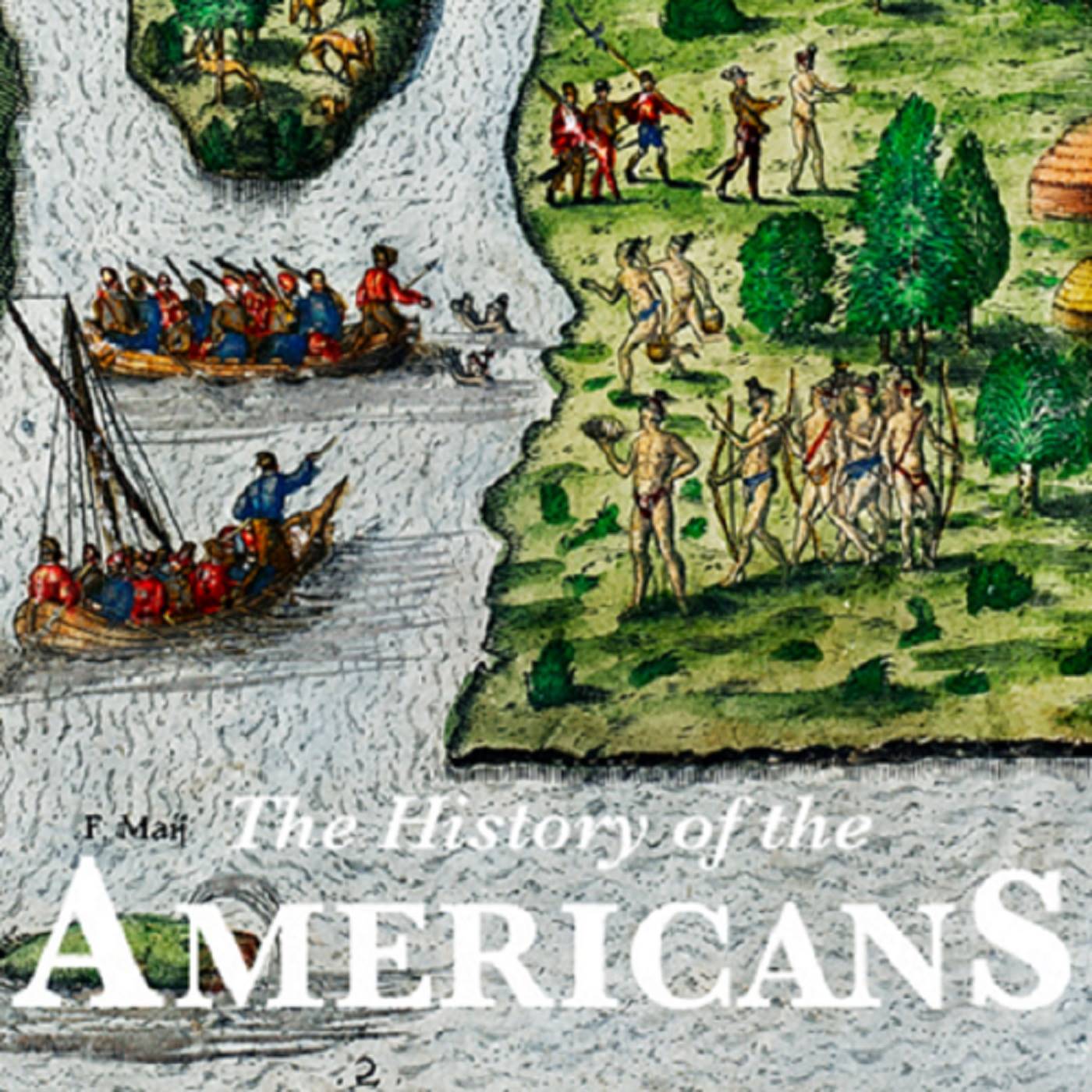
In the spring of 1584, Sir Walter Ralegh (the spelling he used), now the chief organizer and promoter of English settlement in North America, dispatched two ships to the Outer Banks of North Carolina on a mission of reconnaissance. They explored Hattaras Island and Roanoke Island, and the area between Pamlico Sound in the south and the mouth of the Chesapeake in the north. They brought home to England two Indians, Manteo and Wanchese, who would go on to speak English and would have a huge impact on the two subsequent attempts to settle English people in the area.
#VastEarlyAmerica
Website: The History of the Americans
https://subscribebyemail.com/thehistoryoftheamericans.com/?feed=podcast
Selected references for this episode
James Horn, A Kingdom Strange: The Brief and Tragic History of the Lost Colony of Roanoke
David Beers Quinn, Set Fair for Roanoke: Voyages and Colonies, 1584-1606
Sep 16, 2021 • 38min
#38 The Road to the Roanoke Colonies
In this episode we discuss the planning for the first English colonization of North America in the context of England’s strategy to resist Spanish hegemony and Protestantism’s defense against Catholicism. We look at the key figures who advocated for, invested in, and led the first English settlement efforts, which include the two failed expeditions and tragic ending of Sir Humphrey Gilbert, which set up his younger half-brother, Sir Walter Ralegh, to take over the project.
#VastEarlyAmerica
Website: The History of the Americans
https://subscribebyemail.com/thehistoryoftheamericans.com/?feed=podcast
Selected references for this episode
James Horn, A Kingdom Strange: The Brief and Tragic History of the Lost Colony of Roanoke
John Butman and Simon Targett, New World, Inc.: The Story of the British Empire’s Most Successful Start-Up
David Beers Quinn, Set Fair for Roanoke: Voyages and Colonies, 1584-1606
Sep 9, 2021 • 45min
#37 Sir Francis Drake: Around the World in 1018 Days Part 3
In this episode we chase Francis Drake and the Golden Hind from the equator, just off the west coast of South America, all the way around the world and back to England. Along the way Drake claims the northwest coast of North America for England, naming it “Novo Albion,” cuts a trade deal with Babu, the Sultan of the Moluccas, and makes it back to England in the most remarkable feat of sailing in the sixteenth century. Drake becomes one of England’s richest men, is knighted by Elizabeth and becomes one of her closest advisors, and finds himself in the middle of a changed geopolitical landscape. Tensions with Spain have risen considerably, and Drake is in the middle of it.
#VastEarlyAmerica
Website: The History of the Americans
https://subscribebyemail.com/thehistoryoftheamericans.com/?feed=podcast
References for this episode
Samuel Bawlf, The Secret Voyage of Sir Francis Drake: 1577-1580
Melissa Darby, Thunder Go North: The Hunt for Sir Francis Drake’s Fair & Good Bay
Miranda Kaufmann, Black Tudors: The Untold Story
John Sugden, Sir Francis Drake
Aug 27, 2021 • 42min
#36 Sir Francis Drake: Around the World in 1018 Days Part 2
When last we left Drake and company, it was August 1578, and the fleet had spent a good part of the southern winter in the protected harbor at Port Saint Julian, in today’s Argentina, about a hundred miles north of the entrance to the Strait of Magellan. That was where Drake was headed, because that was the only way that any European knew of to get into the Pacific Ocean by heading west.
In the next seven months, Drake and his crew would make the fastest crossing of the Strait during the fifteenth century, discover Drake’s Passage and thereby overturn the received wisdom of Europe’s geographers (who believed South America was connected to a southern continent at the South Pole), and by some measures have the most spectacular run of any English pirate or privateer in history. We also learn the origin of the name “penguin,” which makes great dinner party conversation.
#VastEarlyAmerica
Website: The History of the Americans
https://subscribebyemail.com/thehistoryoftheamericans.com/?feed=podcast
References for this episode
Samuel Bawlf, The Secret Voyage of Sir Francis Drake: 1577-1580
John Sugden, Sir Francis Drake
NASA Lunar Eclipse Database
Aug 21, 2021 • 36min
#35 Sir Francis Drake: Around the World in 1018 Days Part 1
On September 26, 1580, some fisherman not far from shore in the English Channel saw a small ship, riding low in the water, moving cautiously toward Plymouth Sound. A man aboard the ship hailed the fisherman and asked whether the Queen was alive? The fisherman replied to Sir Francis Drake that she was, but that a plague – influenza, apparently — was raging in Plymouth itself.
1018 days after he had set sail from England, Drake had returned with a hold full of treasure and a trove of important information about the world. Before he could approach Plymouth, however, he had to know whether Elizabeth, who had sent him on a secret mission through the Strait of Magellan to the west coast of North America, was still queen, or whether a successor, who might well have been Catholic and an ally of Spain, now reigned.
This is part 1 of the story of the second circumnavigation of the globe, and the extraordinary things that happened along the way. In today’s episode, Drake discovers a cure for scurvy 180 years before a Scottish doctor in the Royal Navy learned that citrus fruits did the job, and his sailors make the coolest souvenirs in history, at least that we know of. And that’s the very least of it, for Drake sets the stage for the English settlement of North America.
#VastEarlyAmerica
https://subscribebyemail.com/thehistoryoftheamericans.com/?feed=podcast
References for this episode
Samuel Bawlf, The Secret Voyage of Sir Francis Drake: 1577-1580
John Sugden, Sir Francis Drake
Scurvy
Facebook: https://www.facebook.com/HistoryOfTheAmericans
Email: thehistoryoftheamericans@gmail.com
Aug 13, 2021 • 41min
#34 Drake’s War
This episode is the second of our series on Sir Francis Drake. Last week, we revisited the catastrophic battle of San Juan d’Ulua in the harbor near Vera Cruz, Mexico between the English trader, smuggler, and slaver John Hawkins and arriving ships of the Spanish treasure fleet. Francis Drake, still with no “sir” at the front of his name, had limped back to England in one of the two surviving ships, arriving in January 1569. He fumed at the duplicity of the Viceroy of Mexico, who had breached a guarantee of safe conduct he had given the English. Drake vowed to wage war against the Spanish and vex Philip of Spain from one end of his realm to another. This episode looks at Drake’s voyages to the Caribbean in 1570, 1571, and again in 1572-73. These expeditions, which kicked off the era of English piracy in the Caribbean, made Drake a rich man, sorely vexed Philip, and made Drake famous at home and infamous among the Spanish. They would also earn Drake the wealth, credibility, and social status necessary to get the backing and authorization he would need to explore the west coast of the Americas and circumnavigate the globe from 1577-80.
#VastEarlyAmerica
https://subscribebyemail.com/thehistoryoftheamericans.com/?feed=podcast
References for this episode
Samuel Bawlf, The Secret Voyage of Sir Francis Drake: 1577-1580
John Sugden, Sir Francis Drake
Aug 7, 2021 • 36min
#33 Sir Francis Drake and the Rise of English Sea Power
This episode introduces Sir Francis Drake, and describes the moment when he declared a personal war on Philip II of Spain, a war that would change everything.
Sir Francis Drake was essential to the history of the Americans. The father of English sea power, Drake and a small group of English West Country seamen cleared the way for the English settlement of North America. Drake almost single-handedly provoked the Spanish into war with England and then twice beat the Spanish navy, once by ambushing a good part of it in port in 1587 and then doing more than any other English commander to beat the famous Spanish Armada the next year. Had that war gone the other way, England might never have become a global naval power and thereby an empire, the English language might never have become the lingua franca of commerce around the world, and English settlement in North America would have unfolded very differently, if it had happened at all.
#VastEarlyAmerica
https://subscribebyemail.com/thehistoryoftheamericans.com/?feed=podcast
References for this episode
Samuel Bawlf, The Secret Voyage of Sir Francis Drake: 1577-1580
John Sugden, Sir Francis Drake
Jul 30, 2021 • 38min
#32 Queen Elizabeth I: What You Need To Know!
Queen Elizabeth I, who came to power at the impossibly young age of 25 in 1558, was of critical importance to the English project in North America, and therefore to the history of the Americans. She would prove to be an extraordinarily adept leader who would fend off enemies to English sovereignty and Protestantism, both at home and abroad, for the next 44 years. In this episode we talk about Elizabeth the person, and William Cecil, her most important advisor for most of her long reign. The two of them, along with John Dee, other intellectuals and courtiers, English merchant adventurers, and the more successful pirates and privateers, invented imperial England, and defended her against enormous geopolitical and religious threats from Europe, particularly Philip II’s Spanish empire. Eventually, they underwrote the first English settlements in the lands now making up the United States.
#VastEarlyAmerica
https://subscribebyemail.com/thehistoryoftheamericans.com/?feed=podcast
Reference for this episode
Alison Weir, The Life of Elizabeth I
Jul 23, 2021 • 37min
#31 England in the 1500s and the Rise of the Merchant Adventurers
England was quite late to the North American party, yet ultimately established the most enduring and therefore consequential settlements. An overview of England of the 1500s, economically, politically, and geopolitically, is useful, even essential, to understanding how English North America unfolded.
By 1572, England was firmly in Protestant hands, had its own ambitions for overseas expansion, and was increasingly working to constrain Spanish power without starting a war it would probably lose. Elizabeth I was on the throne and had been for 13 years, and she had surrounded herself with a group of advisors who were very much concerned with extending English power into the world at large. The question is, how did England get to that point? This week’s episode, titled “England in the 1500s and the Rise of the Merchant Adventurers,” rolls us back in time to get to that very question.
#VastEarlyAmerica
https://subscribebyemail.com/thehistoryoftheamericans.com/?feed=podcast
References for this episode
John Butman and Simon Targett, New World, Inc.: The Story of the British Empire’s Most Successful Start-Up
Samuel Bawlf, The Secret Voyage of Sir Francis Drake: 1577-1580
Jul 15, 2021 • 43min
#30 The Spanish on the Atlantic Coast and the Strange Story of Don Luis
The year is 1566. Pedro Menéndez de Avilés has founded St. Augustine and ejected the French from Florida. In this episode, we are going to look at the next Spanish moves in the region, all of which were designed to secure Spain’s treasure fleets and interdict French and English incursions into North America. These include Pedro Menendez’s exploration of Florida proper, which we will only touch upon, the expeditions of Juan Pardo into the Carolinas and Tennessee from 1566 to 1568, and the catastrophic failure of a Jesuit mission to the entrance of the Chesapeake Bay, not far from the future site of Jamestown. None of these succeeded, but they provoked England’s anxiety and fueled her ambitions, which in turn catalyzed Francis Drake’s almost unbelievable mission of 1577 to 1580, Walter Raleigh’s failed colony at Roanoke Island on the Outer Banks in 1587, and even the settlement at Jamestown in 1607. It all ties together!
#VastEarlyAmerica
https://subscribebyemail.com/thehistoryoftheamericans.com/?feed=podcast
References for this episode
Gonzalo Solís de Merás (Author), David Arbesú (Translator), Pedro Menéndez de Avilés and the Conquest of Florida: A New Manuscript
Anna Brickhouse, The Unsettlement of America: Translation, Interpretation, and the Story of Don Luis de Velasco
Chester B. DePratter, Charles M. Hudson and Marvin T. Smith, “The Route of Juan Pardo’s Explorations in the Interior Southeast, 1566-1568”
Charlotte M. Gradie, “Spanish Jesuits in Virginia: The Mission That Failed”

