

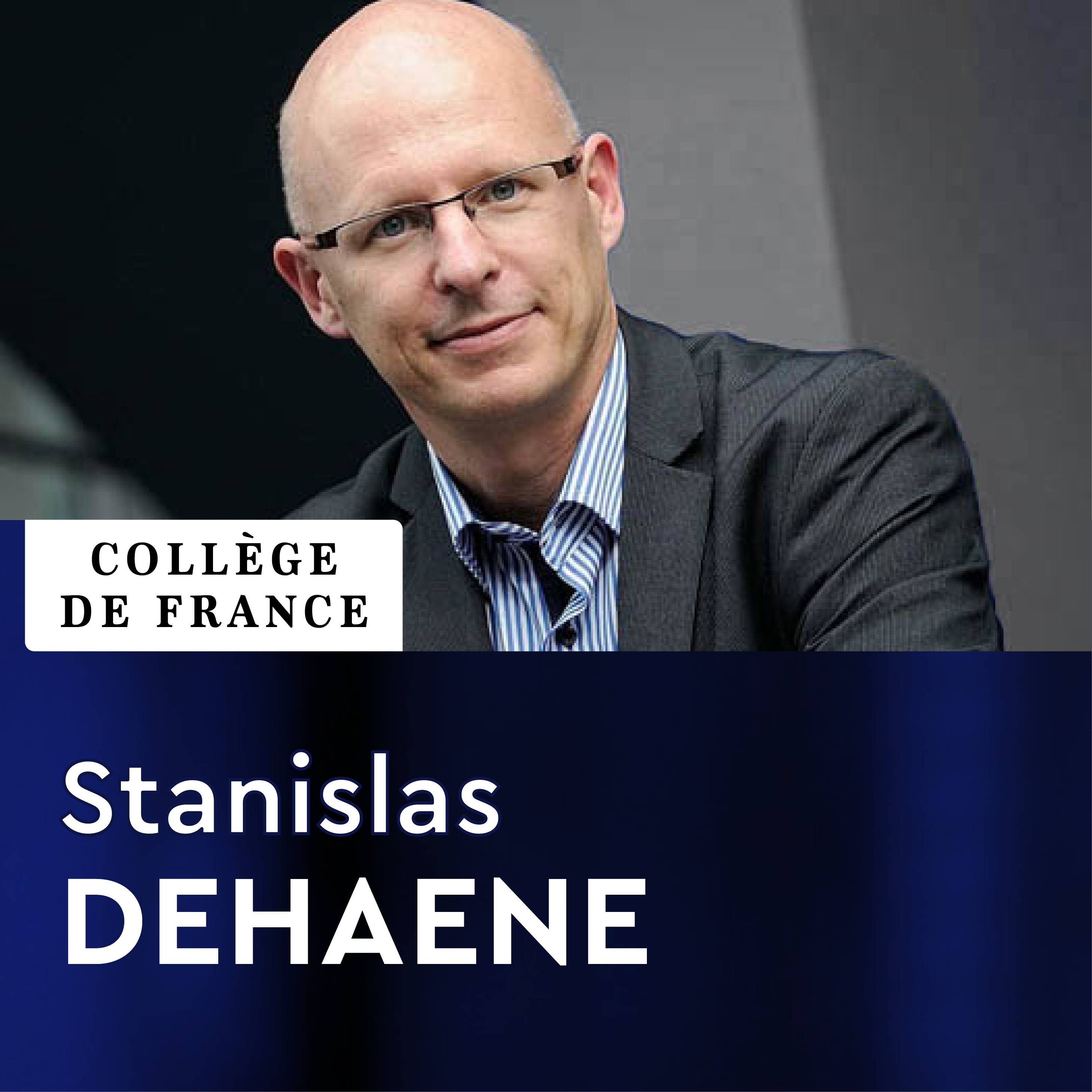
Psychologie cognitive expérimentale - Stanislas Dehaene
Collège de France
La mission de ce laboratoire est d'analyser les bases cérébrales des fonctions cognitives, chez l'homme normal et chez certains patients neurologiques, en développant et en exploitant les méthodes modernes de la neuro-imagerie conjointement à l'utilisation de paradigmes expérimentaux issus de la psychologie cognitive. Stanislas Dehaene est ancien élève de l'École normale supérieure et docteur en psychologie cognitive. En septembre 2005, il a été nommé professeur au Collège de France, sur la chaire nouvellement créée de Psychologie cognitive expérimentale, après avoir occupé pendant près de dix ans la fonction de directeur de recherche à l'Inserm. Ses recherches visent à élucider les bases cérébrales des opérations les plus fondamentales du cerveau humain : lecture, calcul, raisonnement, prise de conscience. Ses travaux ont été récompensés par plusieurs prix et subventions, dont le prix Louis D. de la Fondation de France (avec D. Le Bihan), le prix Jean-Louis Signoret de la Fondation Ipsen et la centennial fellowship de la fondation américaine McDonnell.Les nombres dans le cerveauStanislas Dehaene est l'expert reconnu des bases cérébrales des opérations mathématiques, domaine dont il a été le pionnier. Il a conçu de nouveaux tests psychologiques de calcul et de compréhension des nombres, et les a appliqués aux patients atteints de lésions cérébrales et souffrant de troubles du calcul. Son travail a conduit à la découverte que l'intuition des nombres fait appel à des circuits particuliers du cerveau, en particulier ceux du lobe pariétal. Stanislas Dehaene a utilisé les méthodes d'imagerie cérébrale afin d'analyser l'organisation anatomique de ces circuits, mais aussi leur décours temporel, démontrant notamment dans un article paru dans Science en 1999 que le calcul approximatif fait appel à des régions partiellement différentes de celles du calcul exact. En collaboration avec le neurologue Laurent Cohen, il a observé de nouvelles pathologies de ces régions, qui conduisent certains patients « acalculiques » à perdre toute intuition du nombre. Il a également montré des homologies frappantes entre les traitements des nombres chez l'homme et chez l'animal. Ainsi, les fondements de nos capacités arithmétiques trouvent leur origine dans l'évolution du cerveau.Les travaux de Stanislas Dehaene montrent que des pathologies de la région pariétale, d'origine traumatique ou génétique, peuvent exister chez l'enfant. Elles entraînent une « dyscalculie » – un trouble précoce du développement comparable à la dyslexie, mais affectant l'intuition du nombre. Le diagnostic, la compréhension et la rééducation de la dyscalculie, par le biais de logiciels de jeux éducatifs, constituent des objectifs majeurs du laboratoire. Stanislas Dehaene a résumé ses recherches sur le cerveau et les mathématiques dans un livre à destination du grand public : La Bosse des maths (Éditions Odile Jacob ; Prix Jean Rostand en 1997), dont une édition révisée a été publiée en 2010.
Episodes
Mentioned books

Oct 3, 2025 • 35min
Colloque - Floris de Lange : Uniquely Human Prediction?
Stanislas DehaeneChaire Psychologie cognitive expérimentaleAnnée 2025-2026Collège de FranceColloque : Seeing the Mind, Educating the BrainTheme: Human SingularityUniquely Human Prediction?Colloque - Floris de Lange : Uniquely Human Prediction?Floris de LangeRésuméThe brain is fundamentally a predictive organ that uses internal models to extrapolate future events from current inputs. While this predictive capacity exists across species, what may be uniquely human are the specific internal models we employ. Using AI tools to quantify predictability in naturalistic environments, we can examine prediction at multiple levels of abstraction. In my talk I will highlight recent work from the domain of language, music and visual perception, elucidating how uniquely human experiences and capabilities shape our predictive models of the world.
Oct 3, 2025 • 37min
Colloque - Florian Mormann : Single-Neuron Correlates of Perception and Memory in the Human Medial Temporal Lobe
Stanislas DehaeneChaire Psychologie cognitive expérimentaleAnnée 2025-2026Collège de FranceColloque : Seeing the Mind, Educating the BrainTheme: Neural Codes in Monkeys and HumansSingle-Neuron Correlates of Perception and Memory in the Human Medial Temporal LobeColloque - Florian Mormann : Single-Neuron Correlates of Perception and Memory in the Human Medial Temporal LobeFlorian Mormann
Oct 3, 2025 • 32min
Colloque - Arun SP : Do Monkeys See the Way We Do?
Stanislas DehaeneChaire Psychologie cognitive expérimentaleAnnée 2025-2026Collège de FranceColloque : Seeing the Mind, Educating the BrainTheme: Neural Codes in Monkeys and HumansDo Monkeys See the Way We Do?Colloque - Arun SP : Do Monkeys See the Way We Do?Arun SPRésuméMonkeys are widely used as model organisms for vision and cognition. While their anatomy and physiology have strong correspondences with humans, it is unclear whether they truly see the way we do. In most studies, monkeys are extensively trained on specific tasks, leaving us without a more general answer to this question, along with the nagging doubt that the extensive training might have altered their perception. So how do we then test whether monkeys see the way we do?
Oct 3, 2025 • 17min
Colloque - Lorenzo Ciccione : The Perception and Understanding of Patterns and Graphics
Stanislas DehaeneChaire Psychologie cognitive expérimentaleAnnée 2025-2026Collège de FranceColloque : Seeing the Mind, Educating the BrainTheme: Space, Time, and NumberThe Perception and Understanding of Patterns and GraphicsColloque - Lorenzo Ciccione : The Perception and Understanding of Patterns and GraphicsLorenzo CiccioneRésuméGraphics are a cultural product, meaning that they are a human invention with defined rules and syntax. In this respect, they are very similar to written words and numbers, probably the two most famous cultural inventions. However, unlike them, graphics have been invented much more recently and they became widespread only in the last two centuries. Furthermore, graphicacy—the ability to read and understand graphics—has received little attention from cognitive psychology. In this talk, I will present some findings about the human ability to intuitively extract statistics and mathematical relations from graphical representations. Specifically, I will show that: graphics' intuitions are available early on in development, independently from formal education, and correlate with statistical and mathematical knowledge; judging the trends of noisy graphical displays recycles brain areas usually devoted to the detection of objects' orientation (in agreement with the neuronal recycling hypothesis) and also activates the brain network for mathematics; both children and adults can extrapolate non-linear mathematical patterns, with the notable exception of quadratic and exponential functions.
Oct 3, 2025 • 17min
Colloque - Fosca Al Roumi : How Humans Compress Information in Memory: The Language of Thought Hypothesis
Stanislas DehaeneChaire Psychologie cognitive expérimentaleAnnée 2025-2026Collège de FranceColloque : Seeing the Mind, Educating the BrainTheme: Space, Time, and NumberHow Humans Compress Information in Memory: The Language of Thought Hypothesis Colloque - Fosca Al Roumi : How Humans Compress Information in Memory: The Language of Thought Hypothesis Fosca Al Roumi
Oct 3, 2025 • 34min
Colloque - Manuela Piazza : Space as the Fabric of Thought
Stanislas DehaeneChaire Psychologie cognitive expérimentaleAnnée 2025-2026Collège de FranceColloque : Seeing the Mind, Educating the BrainTheme: Space, Time, and NumberSpace as the Fabric of ThoughtColloque - Manuela Piazza : Space as the Fabric of ThoughtManuela Piazza
Oct 3, 2025 • 35min
Colloque - Edvard Moser : Network Coding in Grid Cells and Place Cells: From Space to Memory
Stanislas DehaeneChaire Psychologie cognitive expérimentaleAnnée 2025-2026Collège de FranceColloque : Seeing the Mind, Educating the BrainTheme: Space, Time, and NumberNetwork Coding in Grid Cells and Place Cells: From Space to MemoryColloque - Edvard Moser : Network Coding in Grid Cells and Place Cells: From Space to MemoryEdvard Moser
Oct 2, 2025 • 17min
Colloque - Claire Sergent : The Global Workspace Model of Consciousness: Then and Now
Stanislas DehaeneChaire Psychologie cognitive expérimentaleAnnée 2025-2026Collège de FranceColloque : Seeing the Mind, Educating the BrainTheme: Perception and ConsciousnessThe Global Workspace Model of Consciousness: Then and NowColloque - Claire Sergent : The Global Workspace Model of Consciousness: Then and NowClaire Sergent
Oct 2, 2025 • 44min
Colloque - Biyu Jade He : Neural Mechanisms of Conscious Visual Perception in Humans
Stanislas DehaeneChaire Psychologie cognitive expérimentaleAnnée 2025-2026Collège de FranceColloque : Seeing the Mind, Educating the BrainTheme: Perception and ConsciousnessNeural Mechanisms of Conscious Visual Perception in HumansColloque - Biyu Jade He : Neural Mechanisms of Conscious Visual Perception in HumansBiyu Jade HeRésuméIn this talk, I will discuss insights from our recent work probing the neural mechanisms underlying conscious visual perception in humans by leveraging multimodal neuroimaging and computational approaches. I will focus on the roles of slow cortical potentials and spontaneous ongoing brain activity as revealed by our recent empirical work. I will also discuss neural and computational mechanisms underpinning humans' remarkable one-shot learning capability in visual perception, as well as how lifelong prior knowledge influences conscious perception.
Oct 2, 2025 • 38min
Colloque - Lucia Melloni : Building a Theory of Consciousness, One Collaboration at a Time
Stanislas DehaeneChaire Psychologie cognitive expérimentaleAnnée 2025-2026Collège de FranceColloque : Seeing the Mind, Educating the BrainTheme: Perception and ConsciousnessBuilding a Theory of Consciousness, One Collaboration at a TimeColloque - Lucia Melloni : Building a Theory of Consciousness, One Collaboration at a TimeLucia MelloniRésuméWhat does it take to transform consciousness from a philosophical puzzle into a scientific theory? Few frameworks have shaped this quest as deeply as Stanislas Dehaene's Global Neuronal Workspace Theory (GNWT). By proposing that conscious access arises through large-scale broadcasting and ignition across fronto-parietal networks, GNWT provided both a conceptual framework and concrete, testable predictions

