

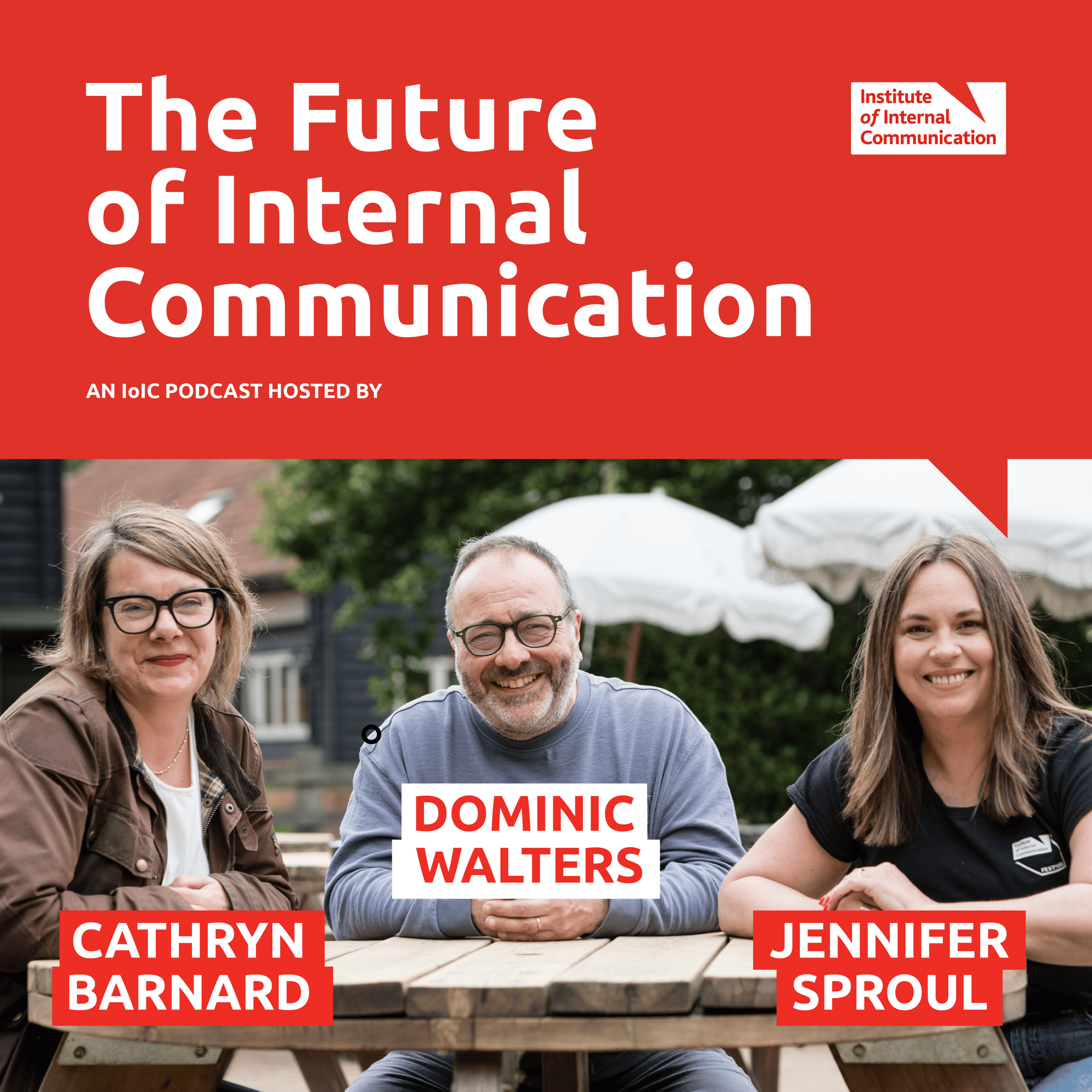
The Future of Internal Communication
Institute of Internal Communication
The Future of Internal Communication podcast is a series commissioned by The Institute of Internal Communication.
Organisations today face widespread and continuous disruption. The way communication takes place within and across teams, departments and business units is more critical than ever.
The podcast hosts subject matter experts from within and outside internal communication, each sharing their insights on the future of work and the role of communication as an essential driver of workplace trust, connection, culture, innovation, resilience and performance.
Hosts Jennifer Sproul, Dominic Walters and Cat Barnard explore opportunity for internal communicators. In increasingly digital, data driven, distributed and on-demand work landscapes, their conversations with thought-leaders examine the human side of work.
Organisations today face widespread and continuous disruption. The way communication takes place within and across teams, departments and business units is more critical than ever.
The podcast hosts subject matter experts from within and outside internal communication, each sharing their insights on the future of work and the role of communication as an essential driver of workplace trust, connection, culture, innovation, resilience and performance.
Hosts Jennifer Sproul, Dominic Walters and Cat Barnard explore opportunity for internal communicators. In increasingly digital, data driven, distributed and on-demand work landscapes, their conversations with thought-leaders examine the human side of work.
Episodes
Mentioned books

Mar 20, 2024 • 52min
Opportunities for internal communicators in the future of work with Janet Hitchen
The podcast explores aligning internal communication with organizational priorities, asking impactful questions, educating on the role of internal communication, developing business acumen. Janet Hitchen shares insights on strategic communication, transitioning from corporate to entrepreneurship, proactive communication approaches, collaboration for successful projects, building confidence in communication, and nurturing creativity in business practices.

Mar 6, 2024 • 1h 3min
Celebrating 75 years of IoIC
In this episode, Jen, Dominic, Cat are joined by Professor Michael Heller and Dr Joe Chick to discuss the institutional history of internal communication. They recap the progress of their research project and share their discoveries from archival research. They explore the concepts of diachronic and synchronic analysis and how the perspective on well-being has evolved over time. They also discuss the factors that have accelerated internal communication, including crises and the changing role of management. The conversation highlights the importance of continuity and change in internal communication and the strategic use of language, such as family metaphors. This conversation explores the history and future of internal communications (IC). The professionalisation of IC is an ongoing process, and the use of rhetorical history and organisational memory plays a significant role in shaping the field. The importance of heritage and history in IC is highlighted, with the International Association of Business Communicators (IABC) being one of the oldest IC organisations. The impact of new technologies, such as social media and AI, on IC is discussed, emphasising the shift from content creation to curation and co-creation. The conversation concludes with the importance of listening and learning from the past in order to reimagine the future of IC.
Takeaways
The institutional history of internal communication involves analysing the past and present to understand the evolution of the field.
Diachronic analysis focuses on studying a specific point in the past, while synchronic analysis examines a point in time across different periods.
The perspective on well-being has changed over time, with modern internal communication emphasizing employee well-being.
Crisis has played a significant role in shaping internal communication, with organisations responding to crises by developing new communication strategies.
Continuity and change are important in internal communication, with some aspects remaining constant while others evolve.
The strategic use of language, such as family metaphors, can shape internal communication practices and organisational culture. The professionalisation of internal communications is an ongoing process.
Rhetorical history and organizational memory play a significant role in shaping internal communications.
Heritage and history are important in internal communications, providing a sense of pride and gravitas.
New technologies, such as social media and AI, are changing the landscape of internal communications, shifting from content creation to curation and co-creation.
Listening and learning from the past are crucial in order to reimagine the future of internal communications.
About Professor Michael Heller, Newcastle Business School at Northumbria University
Michael Heller is a Professor of Business History at Newcastle Business School, Northumbria University. His research focuses on the history of large-scale organisations, work, corporate communication and society. He has published in a number of leading global academic journals such as Organisations Studies, British Journal of Management, European Journal of Marketing and Business History. He has been researching and publishing on internal communication for sixteen years.
https://historyofinternalcomms.org/
https://www.linkedin.com/in/professor-michael-heller-b94819a5/
About Dr. Joe Chick
Joe is a historian with an interest in long-term changes in social history from the medieval era to the present day. His research at Northumbria University is on the rise of large organisations since the late nineteenth century, focusing on the discourse and practice of employer communication with employees.
The themes of power relations and institutional change also appeared in his previous research into the transition from the medieval to the early modern era. His work looked at the power of the monasteries through their lordship over English towns, looking at town–abbey relations and institutional change with the sudden removal of these exceptionally powerful lords with Henry VIII’s dissolution of the monasteries. His first book Urban Society and Monastic Lordship in Reading, 1350-1600 was published with Boydell & Brewer in 2022.
https://historyofinternalcomms.org/
https://www.linkedin.com/in/joe-chick-36b6aa255/

Feb 21, 2024 • 37min
Exploring business sustainability with Diane Osgood
In this episode, guest Diane Osgood, discusses the topic of business sustainability and its importance. She defines business sustainability as the impact a company has on the environment and society through its modes of production and the impact of the products it makes. She also highlights the importance of managing the risks of climate and environmental impact on the company, its employees, and its customers. Diane emphasises the role of internal communication in helping employees understand the company's sustainability goals and progress, facilitating dialogue and action, and bridging generational perspectives. She recommends that internal communicators focus on educating employees about the company's sustainability challenges and progress.
Takeaways
Business sustainability encompasses the impact of a company's production processes and the nature of its products on the environment and society.
Internal communication plays a crucial role in helping employees understand the company's sustainability goals, progress, and the broader context of sustainability.
Effective internal communication can facilitate dialogue and action, bridge generational perspectives, and empower employees to contribute to sustainability efforts.
Educating employees about sustainability challenges and progress is essential for creating a shared understanding and fostering a sense of purpose and responsibility.
About Diane Osgood
Diane Osgood, US/France, is a pioneer in corporate sustainability and human rights. She has over 30 years of helping companies innovate and grow with purpose. She focuses on the power of consumers to influence brands and shape the economy. Diane served as a senior advisor to President Clinton for the Clinton Global Initiative and on the Vatican Arts and Technology Council.
Diane has run her boutique consulting business since 2019. Prior to that, she was a Director of Sustainability and Innovation for Richard Branson’s Virgin Group and VP of Strategy at Business for Social Responsibility (BSR). Her consulting clients include Meta, Virgin Hotels, Addison/Sia-Partners, Avnet, Waters, Pega Systems, DuPont, Monsanto, P&G, Aventis Pharma, and social enterprises. She was a senior advisor to President Clinton for the Clinton Global Initiative and served on the Vatican Arts and Technology Council.
She earned her Ph.D. in Environmental Economics and Development Studies at the London School of Economics. She’s a co-author and co-editor of the award-winning The Carbon Almanac (Penguin, 2022) and of the forthcoming Your Shopping Superpower. She contributes to Fast Company and GreenBiz.

Feb 7, 2024 • 39min
Exploring 2024 labour market and employment trends with Neil Carberry
In this episode, Neil Carberry, Chief Executive of the Recruitment and Employment Confederation, discusses the current state of the labour market and the challenges employers face in 2024. He emphasises the importance of effective internal communication in recruitment and retention, highlighting the need for human skills in the hiring process. Neil also discusses the impact of remote work and the importance of fair processes and negotiations in organisations. He emphasises the role of internal communicators in facilitating dialogue, establishing justice, and building a sense of belonging within the workforce. Overall, Neil emphasises the critical role of internal communication in navigating the complexities of the labour market and driving organisational success.
Takeaways
Labour market trends in 2024 include a drop in permanent hiring and increased reliance on temporary hiring due to economic uncertainty.
Improving hiring processes by working with specialist recruiters and focusing on quality applications can lead to better outcomes for employers and job seekers.
The role of internal communication is crucial in recruitment and retention, with a focus on building relationships, facilitating dialogue, and establishing justice.
Reskilling and upskilling are important in the current labour market, and organisations should provide clear pathways for career development and support employees in adapting to future changes.
Internal communicators play a strategic role in organisations by helping leaders listen better, establish belonging, and communicate effectively with employees.
About Neil Carberry
"Neil Carberry was appointed as Chief Executive of the Recruitment and Employment Confederation in June 2018 having been managing director at the Confederation of British Industry, leading the CBI’s work on the labour market, skills, energy and infrastructure. In 1999, Neil began his career in recruitment working for executive search firm Fraser Watson before doing a post-graduate degree in Human Resources at the London School of Economics and joining the CBI in 2004. He is a Chartered Fellow of the CIPD and a Fellow of the RSA. He is a member of the council of the conciliation service ACAS and a former member of the Low Pay Commission, which recommends UK minimum wages. A three-time nominee to the SIA staffing100 in Europe, he is also on the board of the World Employment Confederation, Total People and a primary academy trust in Oxfordshire. Neil is an RFU qualified rugby coach and is one of the 8000 co-owners who made Heart of Midlothian the UK’s biggest fan-owned football club.

Jan 24, 2024 • 51min
The importance of colleague experience in the future of work with Chris Carey and Christina Dolding
In this episode, hosts Cat Barnard, Jen Sproul and Dom Walters are joined by Chris Carey and Christina Dolding from Axiom Communications. The guests discuss the importance of colleague experience and its impact on attraction, retention, and business transformation. They emphasize the need for organisations to focus on the entire colleague journey, including pre-joining, onboarding, and post-honeymoon periods. The distinction between engagement and experience is highlighted, with experience being seen as more strategic and intentional. The role of internal communication in designing and improving colleague experience is emphasised, with a focus on listening, co-creation, and authenticity. The future of colleague experience is seen as more intentional and focused on managing life events. The conversation highlights the importance of listening and understanding in employee engagement. It emphasises the need for organisations to truly listen to their employees and take action based on their feedback. The discussion also explores the concept of designing the employee journey and the role of technology, HR processes, and leadership in shaping that journey. Training leaders and supporting line managers in communication are identified as crucial factors in delivering a positive employee experience. The conversation concludes with a focus on the potential benefits of investing time in employee engagement and the importance of considering the human journey in policy design.
Takeaways
Colleague experience is crucial for attraction, retention, and business transformation.
Organisations should focus on the entire colleague journey, including pre-joining, onboarding, and post-honeymoon periods.
Internal communication plays a vital role in designing and improving colleague experience.
Listening, co-creation, and authenticity are key elements of successful colleague experience.
The future of colleague experience will be more intentional and focused on managing life events. Truly listen to employees and take action based on their feedback.
Design the employee journey by considering technology, HR processes, and leadership.
Train leaders and support line managers in effective communication.
Invest time in employee engagement to gain time back and improve overall performance.
Consider the human journey when designing policies.
About Chris Carey
With more than 25 years in employee communication and engagement – the past 20 at the helm of Axiom after holding top corporate communication posts with several multinationals. As a consultant, I help organisations communicate with and engage their people, especially during times of change. I also devise and deliver communication skills training to help people become better communicators and am a seasoned facilitator of conferences and other live events. I’ve designed and delivered a wide range of employee engagement workshops for CEOs and frontline staff alike in organisations across sectors including pharmaceutical, manufacturing, retail, travel, banking and charities. When I’m on stage facilitating a big event, I like to use a high-energy, high-impact facilitation style to make the event live long in the memory. I’ll engage your audience and hold their attention – and then get them to identify and commit to pragmatic actions they can take when they get back to the office or factory floor.
https://www.linkedin.com/in/chriscareyaxiom/
About Christina Dolding
I have enjoyed over 30 years partnering with people and teams in the corporate world, focusing on both customer and employee experience. I have led and delivered transformation programmes which created outstanding, award winning colleague and customer centric journeys. I strongly believe delivering great, consistent and intentional colleague experiences is, without doubt, the route to delivering the highest possible level of customer experience. Over the years, I have designed and implemented a wide variety of innovative and creative end-to-end solutions that deliver remarkable results, whilst also achieving substantial cost benefits.
By translating the tools, techniques and training used extensively in the world of customer experience, I ensure the voices colleagues are heard and their diverse insights harnessed to positively impact the things that matter most to them and their stakeholders.
https://www.linkedin.com/in/christina-dolding-ccxp/

Jan 10, 2024 • 44min
Trend Spotting: Risks and Opportunities for Internal Communication in 2024 with Steve Wells
Steve Wells is a global futurist who helps organisations and their leaders improve their future change readiness through the delivery of horizon scanning executive education.
The co-editor and a contributing author to seven books on the emerging future, Steve is expertly placed to identify the trends most likely to present opportunity for internal communication in 2024.
In this episode, Cat, Jen, Dom and Steve chat about the shifting nature of work and the risks and opportunities for business in the year ahead.
Takeaways
Business leaders need to be aware of the interconnections between geopolitical frictions, cyber attacks, and elections.
Internal communicators play a crucial role in scenario planning and navigating uncertainty.
Embracing complexity and agility is essential in the face of rapid change.
Internal comms can become the new leadership function, driving understanding and collaboration.
About Steve Wells
Steve is a global futurist and founder of Informing Choices Ltd, a foresight business focused on helping organisations improve their future change readiness through delivering thought provoking speeches and presentations, executive education workshops, and horizon scanning studies.
He is also the co-editor and a contributing author to seven books on the emerging future.
LinkedIn: https://www.linkedin.com/in/steve-wells-futurist-speaker/

Dec 6, 2023 • 47min
BONUS EPISODE – A conversation with IoIC CEO Jen Sproul
In this episode, we turn the spotlight on IoIC CEO, Jennifer Sproul to hear her reflections on how the internal communication profession has changed since she took the helm in 2017. And where she feels the emergent opportunities lie.
Find out more about IoIC |
Website: https://www.ioic.org.uk/
LinkedIn: https://www.linkedin.com/company/institute-of-internal-communication
Twitter: https://twitter.com/IoICNews
Instagram: https://www.instagram.com/ioic_uk/
Facebook: https://en-gb.facebook.com/IoICupdates
Nov 15, 2023 • 45min
S8, E6: Embracing organisational agility in the future of work with Perry Timms
Perry Timms is the founder and CEO of People and Transformational HR. He was ranked HR’s Most Influential Thinker in 2022 by HR Magazine. An accomplished author and TEDx speaker, his 30+ year career focused on people, business change and performance means he now sits in the HR Most Influential Hall of Fame.
In this episode, he shares his observations about the changing nature of work and explores the business case for agility, both as an organisational practice and as a mindset.
More importantly, he sets out why internal communication has such a centre stage role to play as we navigate a very different future of work.
Show notes
Find out more about Perry: https://www.linkedin.com/in/perrytimms/
Find out more about PTHR: https://pthr.co.uk/
Watch the Barry-Wehmiller video Perry mentioned: https://www.youtube.com/watch?v=or6YoXfHWSE
Nov 1, 2023 • 39min
S8, E5: Navigating the political role ahead with Dr. Iain Wilton
Dr. Iain Wilton is a former ministerial special adviser who has held several senior public policy, corporate communications and government relations roles - in organisations including the BBC and the Royal Statistical Society.
In this episode, he shares why it’s important for organisations to stay abreast of political developments to minimise risk. We also find out which political risks pose the most threat to UK industry in the years ahead.
A key way for internal communicators to provide strategic value to their employers is to demonstrate awareness and understanding of the external factors driving change in the way we work today. We hope you’ll agree Iain provides huge food for thought and plenty for our senior executives to consider as they navigate the path ahead.
Oct 18, 2023 • 38min
S8, E4: How internal communication builds great organisational culture with Scott McInnes
Scott McInnes is the Managing Director of Inspiring Change, a consultancy that helps organisations build and maintain engaging and thriving work cultures. With a prior background in internal communication, he is expertly placed to share how and why the way we communicate at work is integral to culture.
In this episode, Scott shares his thoughts as to whether work culture is driven by the C-suite or whether it manifests from the ground up.
Scott, Jen, Dom and Cat also dissect the primary role internal communication has to play in nurturing positive working environments where people are inspired to give their best.

