

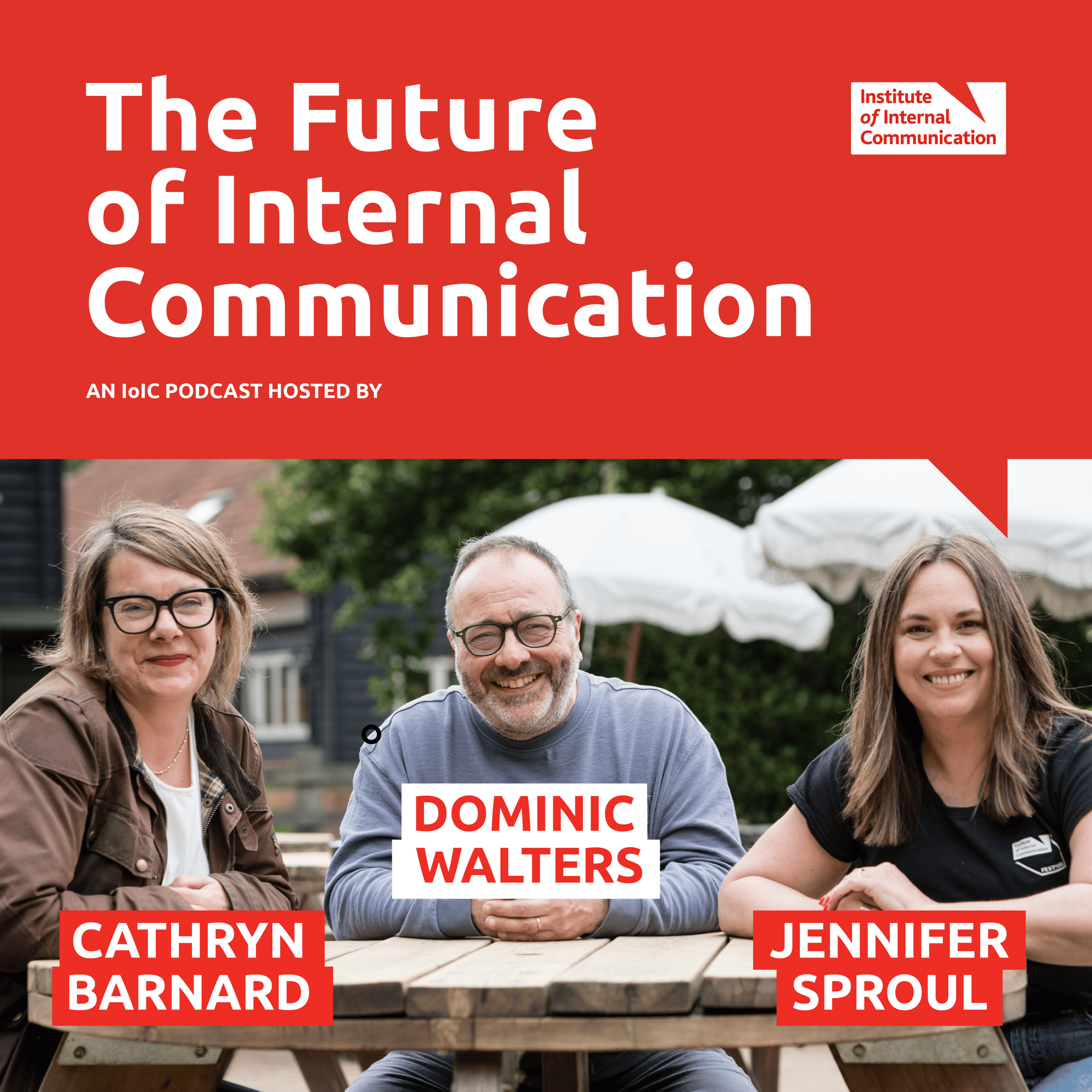
The Future of Internal Communication
Institute of Internal Communication
The Future of Internal Communication podcast is a series commissioned by The Institute of Internal Communication.
Organisations today face widespread and continuous disruption. The way communication takes place within and across teams, departments and business units is more critical than ever.
The podcast hosts subject matter experts from within and outside internal communication, each sharing their insights on the future of work and the role of communication as an essential driver of workplace trust, connection, culture, innovation, resilience and performance.
Hosts Jennifer Sproul, Dominic Walters and Cat Barnard explore opportunity for internal communicators. In increasingly digital, data driven, distributed and on-demand work landscapes, their conversations with thought-leaders examine the human side of work.
Organisations today face widespread and continuous disruption. The way communication takes place within and across teams, departments and business units is more critical than ever.
The podcast hosts subject matter experts from within and outside internal communication, each sharing their insights on the future of work and the role of communication as an essential driver of workplace trust, connection, culture, innovation, resilience and performance.
Hosts Jennifer Sproul, Dominic Walters and Cat Barnard explore opportunity for internal communicators. In increasingly digital, data driven, distributed and on-demand work landscapes, their conversations with thought-leaders examine the human side of work.
Episodes
Mentioned books

Dec 3, 2024 • 37min
How to build a movement with Deborah Hale MBE
Deborah Hale MBE has spent her career developing high profile global campaigns. She knows the importance of building brands, navigating complex stakeholders and making change happen by creating enhanced audience engagement.
As employers across the board struggle to resume pre-pandemic levels of organisational performance, Jen, Dom and Cat chat with Deborah to hear what she has learned about creating the conditions that build loyalty and goodwill across diverse audiences.
This conversation is a must-listen for any internal communicator looking to drive colleague engagement and imbue a sense of community within increasingly distributed workplaces.
Takeaways
Patience is essential in leadership and communication.
Successful campaigns require thorough planning and a clear framework.
Engagement is built through consistent and transparent communication.
Listening to stakeholders is crucial for effective leadership.
Pride in an organisation can be cultivated but not mandated.
Personal touches, like handwritten notes, can significantly impact morale.
Milestones should be celebrated to maintain momentum in campaigns.
Campaigns can lead to movements when they resonate with the public.
Cross-functional collaboration enhances the effectiveness of campaigns.
Change communication must reflect the realities of employees' experiences.
About Deborah Hale MBE
Deborah has a proven track record of developing high profile UK and global campaigns that achieve brand growth, awareness and audience engagement. In all her projects, her starting point is: “what is the change you want to see?”
After several years spent promoting the creative industries, she became Head of International Marketing for London, in charge of positioning the capital as a centre of excellence for inward investment, tourism, education and culture. This led to her role as Producer of the 2012 Olympic and Paralympic Torch Relays, in charge of what would become one of the UK’s largest public engagement campaigns. She was awarded an MBE in the 2013 New Year’s Honours List.
As an independent consultant, she has worked with numerous commercial and not for profit organisations such as the Design Council, Permian Global, BBC Children in Need, and the Global Goals campaign.
Find Deborah on LinkedIn: https://www.linkedin.com/in/deborah-hale-mbe-370bb7/

Nov 13, 2024 • 44min
Bringing sustainability data to life through storytelling with Debra Sobel
As the climate crisis worsens and social inequality escalates, legislation to monitor the sustainability efforts of organisations abounds.
But mandatory reporting is often undertaken by executives who don’t socialise their data in a way that helps internal stakeholders feel their employer is taking proactive steps to improve its impact.
In this episode, Jen, Dom and Cat chat with strategic communications consultant Debra Sobel to learn more about the vital role of internal communication in sustainability reporting.
Takeaways
Sustainability is shifting from aspiration to activation and transformation.
Companies must provide evidence for their sustainability claims to avoid greenwashing.
Internal communicators play a crucial role in translating sustainability strategies for employees.
Effective communication about sustainability requires digestible and engaging storytelling.
There is a need for consistency in language and alignment across leadership regarding sustainability.
Organisations must integrate sustainability into their overall communication strategy.
Data should be used to tell compelling stories about sustainability efforts.
Internal communicators should connect sustainability initiatives with organisational goals.
Leaders need tools and resources to effectively communicate sustainability strategies.
The return to growth narrative may conflict with sustainability goals. The reappointment of Trump may galvanise grassroots activism.
Younger generations feel they have little to lose, prompting activism.
Internal stakeholders must be included in sustainability discussions.
Sustainability should be integrated into business strategies, not treated separately.
The circular economy is essential for sustainable growth.
Internal communication must adapt to blurred organisational boundaries.
Communicators need to balance storytelling with data in sustainability efforts.
Sustainability communication requires cross-departmental collaboration.
Internal communicators should engage with sustainability teams proactively.
The future of internal communication hinges on sustainability integration.
About Debra Sobel – Strategic Communications Consultant
Debra is an experienced strategic communications strategist, with specialist knowledge in all things sustainability and purpose. Over 18 years in business she has partnered and consulted with national and multinational brands helping them navigate the purpose landscape, shape strategy and deliver clarity when it comes to stakeholder communications and embedding responsible business into culture. Debra is an ex-BBC prime TV producer / director who worked on programmes including Crimewatch, Watchdog and political and environmental documentaries.
LinkedIn: https://www.linkedin.com/in/debra-sobel-verity-london/

Oct 30, 2024 • 42min
Exploring techno-stress and digital overload with Elizabeth Marsh
The volume of digital tools and platforms available to improve how we work expands by the day. But how effectively are we, as users of those products, integrating them into our daily work habits? What provision is made by organisations to make sure their internal stakeholders are skilled to optimally use these tools? And what is the long-term impact on the users trying to keep up with increasingly digital workplaces?
In this episode, Jen, Dom and Cat chat with Elizabeth Marsh who researches the effect of all-digital on organisational health. A keynote speaker at the IoIC’s 2021 festival, Elizabeth specialises in digital upskilling and digital health.
This conversation explores the intersection between new workplace technology and the future-readiness of internal stakeholders to embrace increasingly AI-fuelled operating environments.
Takeaways
Techno stress is a psychological and physiological strain from technology use.
Organisations have a responsibility to provide effective digital tools.
The rapid pace of technology changes can lead to feelings of disempowerment.
Availability expectations contribute to increased techno stress.
Different age groups experience techno stress differently.
Good communication practices are essential for managing digital overload.
Internal communicators play a crucial role in fostering conversations about technology use.
Digital mindfulness can help individuals manage their technology interactions.
Organisations should prioritise employee wellbeing in digital transformations.
Asking questions about technology use is vital for understanding and improvement.
About Elizabeth Marsh
Elizabeth Marsh is an expert on workforce skills and wellbeing in digital contexts. She has over 20 years of experience in the digital workplace industry, working in range of organisations and roles - as a practitioner, consultant and researcher.
Her consulting and research span topics such as digital dexterity including AI readiness, protecting wellbeing in context of issues such as technostress and overload, and the role of digital workplace and communications professionals in mitigating them.
She supports organisations with digital skills audits and recommendations for raising digital dexterity and protecting wellbeing. In 2014 she co-authored 'The Digital Renaissance of Work' book and in 2018 released 'The Digital Workplace Skills Framework' report. Now in the latter stages of an ESRC 'Digital Society' PhD at the University of Nottingham, she has recently published to peer reviewed journals on the 'dark side' of technology and optimising digital worker well-being.
Find Elizabeth on LinkedIn: https://www.linkedin.com/in/elizabethmarsh/
Elizabeth’s website: https://digitalworkresearch.com/

Oct 16, 2024 • 45min
Exploring the social brain with Tracey Camilleri
Tracey Camilleri is the co-founder of the leadership and organisational development consultancy Thompson Harrison. In 2023, her book The Social Brain, co-authored with Samantha Rockey and Robin Dunbar was published to widespread acclaim.
In this episode we hear from Tracey as she shares what she’s learned about team dynamics and communicating within groups.
As organisations across the board become ever more digitally enabled, location-agnostic and asynchronous, Cat learns about how to embrace human connection and build community for enhanced organisational outcomes
Takeaways
The leader's role is to create a thriving environment.
Social interactions are essential for workplace efficiency.
Small groups foster better relationships and performance.
Communication is key to team coherence and success.
Organisations need to prioritise social strategies.
The health of small groups is crucial for innovation.
Internal communicators are vital to organisational success.
People's sense of belonging impacts their performance.
Leadership should focus on relational aspects of work.
Understanding team dynamics can enhance workplace culture.
Tracey Camilleri
Tracey Camilleri is the co-founder of Thompson Harrison, along with Sam Rockey and is an Associate Fellow at Oxford University’s Saïd Business School (OSBS). At OSBS, she has designed and directed the flagship Oxford Strategic Leadership Programme (2012-2022) as well as bespoke senior development programmes. She is known for her innovative design approach, her focus on the dynamics and practice of successful groups and what it means to lead healthy, thriving organisations in a world increasingly dominated by process and machines.
Earlier in her career she variously ran her own consulting company, WMC Communications, worked as an associate for the private investment bank, Allen and Company, as new business director for the publishing company, Marshall Cavendish, a teacher of English literature at St Paul’s Girls’ School, and as a research associate at Bain and Company. Her book, 'The Social Brain: The Psychology of Successful Groups’, written in partnership with Sam Rockey and evolutionary psychologist, Professor Robin Dunbar, was published by Penguin Random House in Spring 2023. Tracey has an MA from Oxford University.
Find Tracey on LinkedIn: https://www.linkedin.com/in/tracey-camilleri/
Tracey’s website: https://www.thompsonharrison.com/

Oct 2, 2024 • 40min
Mastering professional storytelling with Beatrice N. Kabutakapua
Beatrice Ngalula Kabutakapua is a business storytelling coach who uses the power of story to help organisations and their leaders improve their communication styles.
In a commercial world that is increasingly data-driven and preoccupied by measurement, how do we create emotional connection that sustains colleague engagement, builds trust and improves communication at work?
A two-time speaker at the IoIC festival, Beatrice chats with Jen, Dom and Cat and shares why storytelling is such a compelling communication technique, particularly in times of ongoing and profound change.
Takeaways
Storytelling is a powerful method of communication that engages and connects with employees.
Stories create an emotional connection and make messages more memorable and impactful.
Creating a storytelling culture in the workplace allows employees to feel safe to share their stories.
Storytelling is crucial in change and transformation communication, helping employees understand and care about the change.
Internal communicators should work on their own storytelling skills and use storytelling as a coaching tool to help leaders share their stories effectively.
About Beatrice Ngalula Kabutakapua
Beatrice Ngalula Kabutakapua is a professional storyteller, having worked as a journalist and documentary maker for a decade, she now supports international organisations as a business storytelling coach. Beatrice applies storytelling to engage, retain and develop internal audiences so that employees advance in their careers, are more productive, and lead with clarity of communication.
LinkedIn | https://www.linkedin.com/in/beatrice-ngalula-kabutakapua/

Sep 18, 2024 • 1h 2min
Helping People Change with Ellen Van Oosten
Ellen Van Oosten is Professor of Organization Behavior at Weatherhead School of Management, Case Western University in Cleveland, Ohio. She’s also the co-author of one of the best books we’ve read about human behaviour.
Helping People Change, written by Richard Boyatzis, Melvin Smith and Ellen Van Oosten was Henley Business School’s coaching book of the year in 2020. And we are unsurprised, because by taking a human-first approach to change, it turns most conventional thinking about organisational change management on its head.
In this episode, Jen, Dom and Cat chat with Ellen to hear what she’s learned about human behaviour over the course of her career. They discuss how organisations can better help their internal stakeholders not only shift behaviour for the long-term but also navigate the continuous change that marks the 2020s.
Takeaways
Continuous change is a prevalent and ongoing experience in the workplace, with many organisations undergoing restructuring and leadership changes.
Successful change requires individuals to have a sense of agency and to feel a personal connection to the desired future state.
Communication plays a crucial role in change management, particularly in articulating goals and objectives and fostering a shared understanding of how individuals can contribute to the organization's strategy.
The failure rate of change programmes remains high, indicating a need for a more empathetic and human-centered approach to change management.
Empathy and emotional intelligence are essential skills for leaders and communicators to cultivate in order to create supportive and engaging environments for change. Positive emotion is needed to thrive and flourish.
It's about dreams, not just goals.
Build resonant relationships through clarity, connection, and compassion.
About Ellen Van Oosten
Ellen B. Van Oosten, Ph.D. is Professor in the Department of Organizational Behavior and Faculty Director of Executive Education at the Case Weatherhead School of Management. She is also Director of the Coaching Research Lab, a scholar-practitioner collaboration to advance coaching research founded in 2014. Her research interests include coaching, leadership development, emotional intelligence and women’s leadership in STEM fields. She teaches in the MBA, Executive MBA and directs the Weatherhead Coach Certificate Program, the Leadership Institute for Women in STEM and Manufacturing Program and several company specific programs. She is also the author of numerous academic and practitioner articles and co-author of the award-winning book - Helping People Change: Coaching with Compassion for Lifelong Learning and Growth – with colleagues Richard Boyatzis, PhD and Melvin Smith, PhD. She has a BS in Electrical Engineering from the University of Dayton and a MBA and PhD from Case Western Reserve University.
Find Ellen on LinkedIn: https://www.linkedin.com/in/ellenbrooksvanoosten/
Ellen’s website: https://case.edu/weatherhead/about/faculty-and-staff-directory/ellen-van-oosten
HBR article: https://hbr.org/2019/09/coaching-for-change
5 Training Mistakes that Inhibit Lasting Change: http://tinyurl.com/y6qeh8uw .
How the best managers balance analytical and emotional intelligence - - https://hbr.org/2020/06/the-best-managers-balance-analytical-and-emotional-intelligence.
How to support the people you lead in times of uncertainty -https://greatergood.berkeley.edu/article/item/how_to_support_the_people_you_lead_in_times_of_uncertainty

Sep 4, 2024 • 45min
Designing workplaces for human connectivity with Peter Mandeno
Peter Mandeno is an expert in the science of human connection. His work goes beyond simply explaining why connections matter to show organisations how to improve connectivity outcomes by design – for employee engagement, wellbeing, creativity and performance.
As many countries in the Global North grapple with societal loneliness epidemics, in tandem organisations are encountering rising social friction at work. Yet strong bonds with work colleagues underpin successful collaboration, innovation and long-term business sustainability.
In this episode, Jen, Cat and Dom discuss what Peter discovered during his PhD research and why human connection is so invaluable. They also explore what organisations can do to improve engagement and wellbeing at work.
Takeaways
Organisations need to create the conditions for authentic and meaningful connections to happen naturally in the workplace.
Emotional, transactional, and intellectual connections are all valuable and contribute to engagement, well-being, and innovation.
Internal communicators can promote better connectivity by focusing on content, channel, and context.
Human connection should be seen as a strategic objective and given the necessary time, resources, and attention.
About Peter Mandeno
Peter Mandeno is an expert in the science of human connection. His work goes beyond simply explaining why connections matter to show organisations how to improve connectivity outcomes by design – for employee engagement, wellbeing, creativity and performance.
A native of New Zealand, Peter earned his PhD in Design Engineering from Imperial College London. His research built on two decades of global industry experience in communication, strategy and design. Peter has worked with organisations ranging from ABN AMRO and GSK to KPMG and Vodafone, helping them communicate more effectively and designing experiences that get diverse and distributed teams connecting more authentically.
Peter’s approach is practical, applicable and accessible. In addition to delivering inspirational keynotes and teaching masterclasses to teams of all sizes, Peter advises and consults globally on a range of human connectivity challenges from employee engagement and hybrid work strategies to talent retention and client relationships. Peter’s book – ‘Better Connected’ – is due to launch in 2025.
Find Peter on LinkedIn: https://www.linkedin.com/in/petermandeno
Peter’s website: https://betterconnected.world
HBR article: https://hbr.org/2013/01/facilitating-serendipity-with-peel-and-eat-shrimp

Aug 21, 2024 • 52min
Using communication to build trust with James Ball
James Ball is an award-winning journalist, broadcaster and author. He is a fellow of the think-tank Demos and the political editor of The New European. He is also the current chair of the UK committee of the Ethical Journalism Network.
Having been part of the Pulitzer prize-winning journalism team at the Guardian who covered the NSA leaks by Edward Snowden, it’s little surprise he’s developed more than a passing interest in the topics of trust and truth. Amongst other titles, in 2017 James published ‘Post-Truth: How Bullshit Conquered the World’.
The 2024 IC Index highlighted the crucial role of trust at work. With trust on a knife-edge in so many organisations now, we wanted to chat with someone who had researched into this vital issue.
Our conversation with James explores the critical role of trust and truth in healthy, well-functioning societies, and what happens when the people we ought to be able to trust don’t tell the truth.
Takeaways
Trust is a pressing issue in the workplace, especially as new ways of working continue to evolve.
The definition of trust is nebulous and difficult to quantify, but it generally refers to the belief in what someone says.
Facts and figures alone are not enough to change beliefs; trust is built through starting where people are and addressing their concerns.
Transparency and open communication are key in building trust and authenticity in journalism and internal communication. Regular and transparent communication is essential for building trust in organizations.
Balancing 'I don't know' with providing information is crucial for maintaining credibility.
AI can assist in communication but should not replace human interaction.
Effective communication involves building rapport, finding common ground, and challenging constructively.
Communication should be inclusive, honest, and open to empower individuals and foster trust.
About James Ball
James Ball
James Ball is an award winning journalist, broadcaster and author, fellow of the think-tank Demos, and the political editor of The New European.
He has worked as the global editor of TBIJ, a special correspondent at BuzzFeed UK and special projects editor at The Guardian, where he played a key role in the Pulitzer Prize-winning coverage of the NSA leaks by Edward Snowden, as well as the offshore leaks, HSBC Files, Reading the Riots and Keep it in the Ground projects.
At WikiLeaks he was closely involved in Cablegate – the publication of 250,000 classified US embassy cables in 2010 – as well as working on two documentaries based on the Iraq War Logs. James is a longstanding trustee for, and chair of the UK committee of, the Ethical Journalism Network.
James is the author of multiple books, including "Post-Truth and "The Tangled Web We Weave: Inside The Shadow System That Shapes the Internet”. His most recent book, “The Other Pandemic: How Qanon Contaminated The World” was published by Bloomsbury in July 2023.

Aug 14, 2024 • 46min
Communication is competititve advantage with Jennifer Sertl
Strategy consultant Jennifer Sertl is an internationally recognized influencer in social media and the president and founder of Agility3R, a leadership development company. In 2010, she co-wrote a book: Strategy, Leadership, and the Soul: Resilience, responsiveness and reflection for a global economy.
Ahead of its time, the book set out the new era of digitized, hyperconnected globalisation and explored what this meant for leaders, business strategy and communication.
In this illuminating conversation, Cat, Jen and Dom discuss the importance of authenticity in internal communication, not least in the age of generative AI. As we navigate continuous change and market ambiguity, Jennifer’s insights have lots to offer progressively-minded internal communicators.
Takeaways
Authentic leadership involves understanding one's essence and values.
Soulful communication is essential in the workplace.
AI cannot replace the need for trust and human connection.
Language and conversation have the power to shift perspectives and shape leadership.
Creating a safe space for leaders to practice and learn is crucial. Authentic leadership requires curiosity, vulnerability, and the ability to listen and learn.
Leaders need to trust themselves and create environments where others can trust themselves as well.
The traditional MBA model and hierarchical structures may not be sustainable in the changing landscape of work.
Internal communicators play a crucial role in understanding the business model, using language effectively, and humanising the audience.
Effective leadership communication is about building community, asking great questions, and being true to oneself.
About Jennifer Sertl
Strategy consultant Jennifer Sertl is an internationally recognized influencer in social media and the president and founder of Agility3R, a leadership development company. She is dedicated to strengthening strategic skills and helping leaders become more resilient, responsive, and reflective. Jennifer co-authored Strategy, Leadership, and the Soul and the Upstate Founders Playbook. Named one of the top 100 innovative thinkers by Hatch A Better World in 2013, she is also an alumni of Innotribe, SWIFT's innovation think tank. Currently, Jennifer serves as Director of Marketing for Circle Optics, Inc., creators of the only seamless 360 imaging system camera. She is also Chief Marketing Officer for Say Hii, an AI tool that increases productivity and wellbeing for market-leading organizations. Additionally, Jennifer is an Adjunct Professor at Rochester Institute of Technology, where she teaches Innovation.

Aug 7, 2024 • 47min
Exploring Storytelling in Communication
In 2022, Preeti Macwan embarked on a Master’s degree in Public Relations and Corporate Communication with Kingston University.
We are, of course, huge fans of anyone willing to invest in professional qualifications and so were keen to learn more about what Preeti studied and what her most compelling takeaways from the course were.
In this episode, Dom, Jen and Cat chat with Preeti to uncover what she learned about storytelling as a strategic communication tool and how her studies have shaped her thinking about the future of internal communication.
Takeaways
Training line managers is crucial for effective storytelling in organisations.
Honesty, authenticity, and vulnerability are key values in storytelling.
Recognising and celebrating successful storytellers within the organisation is important.
The desire for employees to return to the office challenges the narrative of remote work.
Transparency and authenticity are essential in organisational communication. Leaders need to be aware of their own style and adapt their communication to be authentic and relatable.
Education plays a crucial role in preparing professionals for the corporate world and internal communication.
Cultural differences can significantly impact leadership styles and the overall employee experience.
The future of internal communication involves finding a balance between technology and human storytelling.
Hybrid working offers a safety net and should be embraced to accommodate individual temperament and preferences.
About Preeti Macwan
Preeti Macwan has always been fascinated by human interaction, so studying communications felt like a natural course of action. She recently completed a master's degree in PR and Corporate Communications at Kingston University with a specific interest in internal and cross-cultural communications.
LinkedIn profile: linkedin.com/in/preeti-macwan-324311249

