

Hotel Bar Sessions
Leigh M. Johnson, Jennifer Kling, Bob Vallier
A podcast where the real philosophy happens.
Episodes
Mentioned books

Nov 3, 2023 • 1h 3min
Collegiality
The HBS hosts wonder if "collegiality" is a virtue... or just a cover for prejudice. Everyone who works with others has colleagues. In the academic world, the term "colleague" usually refers to the members of one’s own department, whether friend or foe. To describe someone as "collegial," however, is an entirely different matter."Collegiality" refers to those qualities that make someone a "good" colleague... though, especially in academia, the adjective "collegial" often takes on a more nuanced force, sometimes including whatever those qualities are that make one "likable" within a department. Often the characteristics of what makes someone collegial (or not) are vague, implied, or intentionally obscured... which frequently makes discussions of "collegiality" a sticking point in hiring, tenure, and promotion decisions. Most definitions of collegiality stipulate that the good colleague contributes positively to the work of their team, department, or company. However, there are negative aspects to this term and concept, as well: for example, women who speak frequently and powerfully at meetings are often deemed “uncollegial." Collegiality can come to mean something like “is one of us,” thus making those who are critical of "us" uncollegial. And when collegiality comes up in discussions of promotion or tenure, it often turns out to be an amorphous, vaguely defined term. With all these problems, it brings one to wonder: should the use of "collegiality" as a meaningful criterion for judgment be abandoned?Full episode notes at this link:https://hotelbarpodcast.com/podcast/episode-115-collegiality-------------------If you enjoy Hotel Bar Sessions podcast, please be sure to subscribe and submit a rating/review! Better yet, you can support this podcast by signing up to be one of our Patrons at patreon.com/hotebarsessions!Follow us on Twitter/X @hotelbarpodcast, on Facebook, on TikTok, and subscribe to our YouTube channel!
★ Support this podcast on Patreon ★
Oct 27, 2023 • 55min
Debt
The HBS hosts wonder why it is so hard for us to think of ourselves as "we, debtors"?Debt has an odd function within modern capitalist societies. On the one hand, the economy cannot function without debt; it provides the oil that eases the friction of production, circulation, and consumption. On the other hand, there is a lot of moral language surrounding debt. In many languages, the word for debt is related to or even the same as the word for guilt or sin. During the financial crisis of 2007-2008, it was not uncommon to hear reprobation for those who took out mortgages that they couldn’t afford. And there was a lot of beating up of people who “walked away” from their “obligations.” This same mixture of morality and economics is exposed by Marx in relation to both debt and to the moral value of saving money. Marx points out that the Friday payday, or even bi-weekly payday, is the first advance of credit in a capitalist economy. Labor works before they are paid, thereby lending their labor power, and the value it produces, to the capitalist. This form of debt is never seen as morally suspect, nor are the bankruptcies that capitalists like Donald Trump have gone through. A lower class, blue collar worker finds that they are no longer able to afford to pay back their debt, and that is somehow a “sin.” A billionaire walks away from their obligations and that is seen as “good business.” Why do we have this weird, dual relationship to debt? Is debt a moral obligation? Should we all walk away from our debts? Why does that seem more catastrophic than global climate change?!Full episode notes available at this link:https://hotelbarpodcast.com/podcast/episode-112-debt------------------- If you enjoy Hotel Bar Sessions podcast, please be sure to subscribe and submit a rating/review! Better yet, you can support this podcast by signing up to be one of our Patrons at patreon.com/hotebarsessions!Follow us on Twitter @hotelbarpodcast, on Facebook, on TikTok, and subscribe to our YouTube channel!
★ Support this podcast on Patreon ★
Oct 20, 2023 • 55min
Political Philosophy of Mind (with John Protevi)
The HBS hosts are joined by John Protevi to talk about case studies, COVID, and the political philosophy of mind.At first glance, a "political philosophy of mind" would seem to be an oxymoron of sorts. Minds, after all, are often considered to be the individual basis for decision and action, while political philosophy would demand that we think at least on some level in terms of collectivity if not relations. A political philosophy of mind demands, then, overcoming the binary of individual and collective, individual and society. The individual and collective is only one such challenge proposed by a political philosophy of mind. If we consider the mind to include not only cognitive dimensions and aspects, but also the affective basis of actions-- the feelings, moods, and emotions, that structure our responses-- then a political philosophy of mind also crosses the divide between mind and body.Such crossings are necessary to move beyond an economy and society that increasingly frames everything in terms of purely individual and rational decisions, as neoliberal calculations subsume our economic life, and even “you do you” guidelines replace public health. In this episode, we talk to John Protevi (Phyllis M. Taylor Professor of French Studies, Louisiana State University) about a political philosophy of mind, and why it might be necessary to think of the mind across the division of individual and society, mind and body.Full episode notes can be found at this link:https://hotelbarpodcast.com/podcast/episode-113-political-philosophy-of-mind-with-john-protevi -------------------If you enjoy Hotel Bar Sessions podcast, please be sure to subscribe and submit a rating/review! Better yet, you can support this podcast by signing up to be one of our Patrons at patreon.com/hotebarsessions!Follow us on Twitter @hotelbarpodcast, on Facebook, on TikTok, and subscribe to our YouTube channel!
★ Support this podcast on Patreon ★
Oct 13, 2023 • 58min
Fan Culture
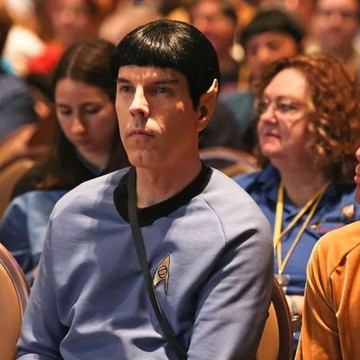
The HBS hosts chat about the symbiotic relationship between cultural products and their fandoms.For a long time, the image of the fan and fan culture was summed up by an infamous skit by William Shatner on SNL, in which he implores the trekkies to “get a life.” To be a fan was to be a passive stooge of the culture industry, one who mindlessly buys its products, and memorizes its trivia at the expense of their own creativity and life. Gradually this image began to change. The field of “Cultural Studies” demanded that we see fans as not just passive recipients of the culture industry, but active producers, who create their own interpretations, their own meaning, and their own activities with fan fiction, cosplay, and creativity, by poaching the commodities of the culture industry. Lately, however, the division between official product and consumption have broken down in a different way, as fan activity has become integral to marketing and maintenance of the value of intellectual property. Fans rabidly defend their favorite franchises online, harassing critics and anyone seen to deviate from canon. Suzanne Scott had dubbed this practice the convergence culture industry, it is fan activity not passivity that drives the industry. At the same time that fan culture and practices have changed in popular culture, the fan has moved beyond the confines of popular culture to become a general figure of political and cultural participation. The platform formerly known as twitter is dominated by Elon Musk fanboys who rush to defend his increasingly erratic actions. Therapists have had to adjust to the way in which Taylor Swift has become the dominant cultural force in the lives of young women. Last, but not least, the Trump rallies seem to be both fan service and rallies around the particular cult of personality of Trump. The fan has become a cultural, political, and economic force in our society. What has caused this transformation? What does it mean for us? What can be done about it?Full episode notes available at this link:https://hotelbarpodcast.com/podcast/episode-111-fan-culture-------------------If you enjoy Hotel Bar Sessions podcast, please be sure to subscribe and submit a rating/review! Better yet, you can support this podcast by signing up to be one of our Patrons at patreon.com/hotebarsessions!Follow us on Twitter @hotelbarpodcast, on Facebook, on TikTok, and subscribe to our YouTube channel!
★ Support this podcast on Patreon ★
Oct 6, 2023 • 60min
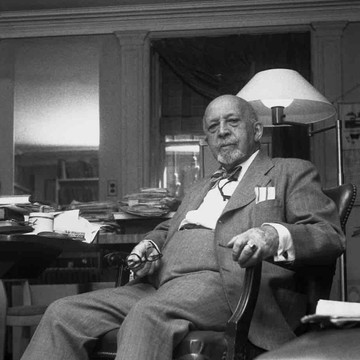
The Problem Spaces of Philosophy (with William Paris)
The HBS hosts are joined by Will Paris to talk about Du Bois, public philosophy, podcasting, and carving out "problem spaces." In The Souls of Black Folk, W.E.B. Du Bois famously asked the question “What is it like to be a problem?,” highlighting the stigmatizing and dehumanizing treatment of Blacks in the post-Reconstruction but Pre-Brown v. Board of Education United States. The purpose of his question was two-fold: on the one hand, Du Bois was urging his readers to consider the emotional and psychological toll on Black Americans living in a society where their very identity was reduced to a “problem” that others must grapple with; and on the other hand, by clearly articulating “what is it like to be a problem?” as a question, Du Bois was carving out a “problem space” of discourse, where the ugliness and urgency of anti-black racism was brought to the fore and itself demanded to be grappled with.We suspect that most people intuitively understand what a “problem” is— How do I find the length of the hypotenuse of a right triangle? Should I pay off my debts or invest in my retirement? When is the exact right time to quit Twitter?—and also that most people understand what a person qua “problem” is, whether they are made problematic by social conditions and systemic prejudices or whether they just don’t know how to act right. But what is a “problem space”? According to today’s guest, Will Paris (University of Toronto), it is NOT simply a location where problems occur or a problematic people show up, but rather a discursive space where ready-made answers are insufficient, critical thinking is necessary, complex societal issues can be made even more complicated, and actual problems are, although rarely “solved,” at least made intelligible.Full episode notes at this link:https://hotelbarpodcast.com/podcast/episode-111-the-problem-spaces-of-philosophy-with-william-paris -------------------If you enjoy Hotel Bar Sessions podcast, please be sure to subscribe and submit a rating/review! Better yet, you can support this podcast by signing up to be one of our Patrons at patreon.com/hotebarsessions!Follow us on Twitter/X @hotelbarpodcast, on Facebook, on TikTok, and subscribe to our YouTube channel!
★ Support this podcast on Patreon ★
Sep 29, 2023 • 1h 4min
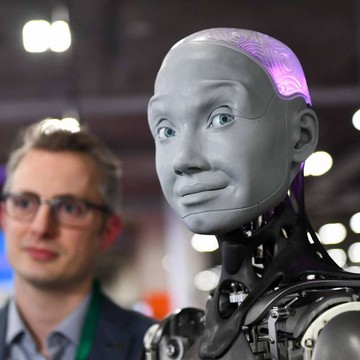
The Uncanny Valley
The HBS hosts discuss why humanlike robots are sooooo creepy.In 1970, a Japanese roboticist by the name of Masahiro Mori published a short essay in the journal Energy entitled “The Uncanny Valley," in which he attempted to explain humans' reactions to robots that looked and acted almost human. Mori hypothesized that when we encounter humanlike technological objects, our feelings of affinity toward them tend to increase as their verisimilitude increase. (To use a Star Wars example, think of the way we’re more positively drawn to C3PO than to R2D2.) However, the moment robots appear or behave in a too humanlike way, our attitude towards them immediately shifts to revulsion. (Think about the difference in your attitude toward C3PO and your attitude toward the King from the Burger King commercials.) Crossing that line between “humanlike” and “too humanlike,” Mori hypothesized, is like stepping off a precipice. Things just get creepier and creepier.In the 50 years since Mori first hypothesized the uncanny valley, as we all know, technology has advanced at light-speed. Improvements in robotics, computer generated imagery, augmented reality, and artificial intelligence technologies have made it increasingly difficult for us to readily perceive the difference between the human and the humanlike. All of this sparked renewed interest in Mori’s hypothesis: cognitive scientists and neuroscientists engaged in experimental “testing” of the uncanny valley. Psychoanalysts reopened their Freud, Jentsch, and Lacan books for reconsideration. (Philosophers did, too, but they added Schelling, Nietzsche, and Guy de Bord.) Philosophers of technology were born, as film and literary critics congratulated each other on hitting the lottery.Also important to note: Mori’s original essay states that his was an “incomplete” theory, and he very explicitly calls for readers to “build an accurate map of the uncanny valley.”So, today, we’re going to talk about the uncanny, the uncanny valley, whether or not our ability to distinguish between the human and the humanlike is fading, and if that matters.Prepare to be creeped out.Full episode notes available at this link:https://hotelbarpodcast.com/podcast/episode-110-the-uncanny-valley-------------------If you enjoy Hotel Bar Sessions podcast, please be sure to subscribe and submit a rating/review! Better yet, you can support this podcast by signing up to be one of our Patrons at patreon.com/hotebarsessions!Follow us on Twitter @hotelbarpodcast, on Facebook, on TikTok, and subscribe to our YouTube channel!
★ Support this podcast on Patreon ★
Sep 22, 2023 • 59min
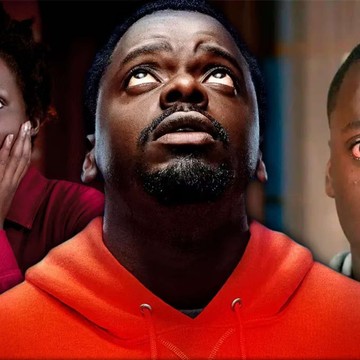
Jordan Peele's Horror (with Johanna Isaacson)
The HBS hosts discuss Jordan Peele's special brand of horror with the author of Stepford Daughters, Johanna Isaacson.For a long time, or at least it seemed, horror films were considered to be beneath serious scrutiny. The problematic politics of such films were all too apparent in the violence brought to bear on women’s bodies in countless slasher films. The racial politics were not much better; the cliche of the black character dying first exists for a reason. Gradually this changed, though, first with such groundbreaking critical studies such as Carol Glover’s Men, Women, and Chainsaws: Gender in the Modern Horror Film and Robin Wood’s “An Introduction to the American Horror film.”In the past few years, horror films themselves have changed as well. Most notably Jordan Peele has made three films dealing with our “social demons”: Get Out (2017), Us (2019), and Nope (2022). To talk with us about horror, the films of Jordan Peele, and how horror can be used to develop our critical understanding of capitalism, racism, and patriarchy, we have invited Johanna Isaacson author of Stepford Daughters: Weapons for Feminists in Contemporary Horror.Full episode notes available at this link:https://hotelbarpodcast.com/podcast/episode-109-jordan-peeles-horror-with-johanna-isaacson-------------------If you enjoy Hotel Bar Sessions podcast, please be sure to subscribe and submit a rating/review! Better yet, you can support this podcast by signing up to be one of our Patrons at patreon.com/hotebarsessions!Follow us on Twitter @hotelbarpodcast, on Facebook, on TikTok, and subscribe to our YouTube channel!
★ Support this podcast on Patreon ★
Sep 15, 2023 • 52min
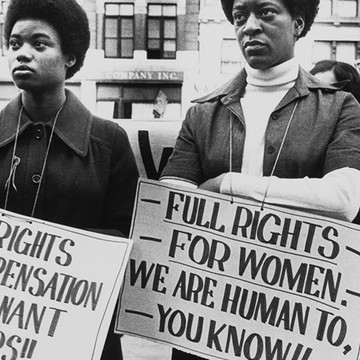
The Subversive Seventies (with Michael Hardt)
The HBS hosts ask Michael Hardt why we so quickly jump from the 60's to the 80's in our political imagination? Most histories of the present either overlook the seventies, jumping from the sixties of radical struggle to the eighties of Reagan/Thatcher and repression, or dismiss it as just the end point of the previous era struggles, the point where the sixties fell apart, collapsing into infighting, or went too far, devolving into violence. What do we overlook in not thinking about the seventies as a decade of struggle? Moreover, what does an examination of the history of that period offer for thinking about politics today? Joining us this week to talk about what we can learn from the seventies and his recently published book, The Subversive Seventies, is Michael Hardt.Full episode notes available at this link:https://hotelbarpodcast.com/podcast/episode-107-the-subversive-seventies-with-michael-hardt-------------------If you enjoy Hotel Bar Sessions podcast, please be sure to subscribe and submit a rating/review! Better yet, you can support this podcast by signing up to be one of our Patrons at patreon.com/hotebarsessions!Follow us on Twitter @hotelbarpodcast, on Facebook, on TikTok, and subscribe to our YouTube channel!
★ Support this podcast on Patreon ★

Sep 8, 2023 • 57min
Forgiveness
The HBS hosts wonder how a hard heart is melted and mended.In a world often colored by misunderstandings, hurtful actions, and lingering grudges, the concept of forgiveness emerges as a beacon of hope and healing. For some, its transformative power to mend relationships, free us from the shackles of resentment, and grant us the gift of emotional liberation make forgiveness a moral imperative. Forgiveness is not merely an internal journey; it's also a dynamic force that shapes societies and mends the fabric of communities torn apart by conflict and strife. But what does it mean to forgive? What does forgiveness do, and for whom? Does forgiveness require the forgetting of wrongs done? Is real forgiveness even possible?Full episode notes available at this link:https://hotelbarpodcast.com/podcast/episode-107-forgiveness -------------------If you enjoy Hotel Bar Sessions podcast, please be sure to subscribe and submit a rating/review! Better yet, you can support this podcast by signing up to be one of our Patrons at patreon.com/hotebarsessions!Follow us on Twitter @hotelbarpodcast, on Facebook, on TikTok, and subscribe to our YouTube channel!
★ Support this podcast on Patreon ★

Sep 1, 2023 • 60min
HBS Goes to the Movies: "Hands on a Hardbody" (1997)
The HBS hosts discuss a real human drama.Note to listeners: if you haven't already, you may want to watch “Hands on a Hardbody: The Documentary” (link to complete film on YouTube here) before listening!"Hands on a Hardbody: The Documentary" tells the story of an annual competition held from 1992 to 2005 in Longview, Texas, in which a local Nissan dealership selected 24 contestants by lottery for a chance to win a tantalizing symbol of freedom and mobility in many rural areas: a brand-new hardbody truck. All the contestants had to do to win it was to show up at 5am in the sweltering Texas summer heat, place a hand on the truck, and wait until theirs was the last hand left. They got a 5-minute break every hour and a 15-minute break every six hours, but the rest of the time they couldn’t lean, they couldn’t sleep, they couldn’t use the bathroom, and most importantly they couldn’t take their hand off the hardbody.They could only wrestle with the relentless passage of time… and all of the boredom, exhaustion, physical pain, and quite often delirium it brought with it. So they waited. And waited. And waited…sometimes more than 80 straight hours before there was only one hand left. That’s more three entire days and nights. As the clock ticks relentlessly on and we learn more about each contestant’s hunger for a chance at prosperity, what seemed like an absurd spectacle of willpower and perseverance becomes a deeper exploration of the human condition—the limits of mind and body, amity and enmity, suffering and compassion, ambition and ability— all as these 24 contestants confront the bittersweet realities of the American dream in the hopes of escaping the suffocating shackles of their circumstances. In the words of Benny Perkins, former winner of a hardbody, return contestant in the documentary “Hands on a Hardbody,” and arguably one of the most underrated philosophers of the 20th Century: “It’s a real human drama.”Full episode notes available at this link:https://hotelbarpodcast.com/podcast/episode-106-hbs-goes-to-the-movies-hands-on-a-hardbody-the-documentary-1997 -------------------If you enjoy Hotel Bar Sessions podcast, please be sure to subscribe and submit a rating/review! Better yet, you can support this podcast by signing up to be one of our Patrons at patreon.com/hotebarsessions!Follow us on Twitter @hotelbarpodcast, on Facebook, on TikTok, and subscribe to our YouTube channel!
★ Support this podcast on Patreon ★

