

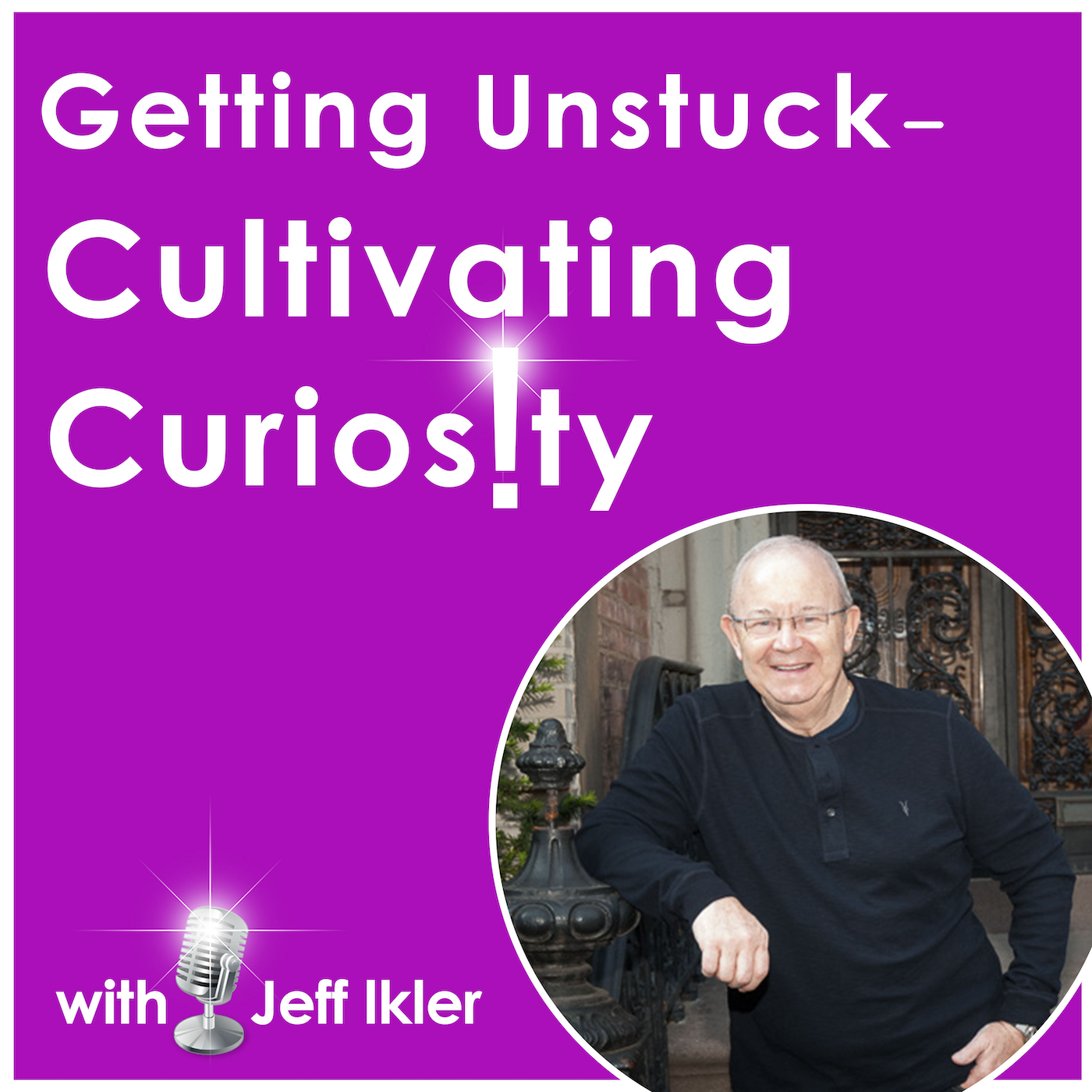
Getting Unstuck – Cultivating Curiosity
Jeff Ikler
Curiosity sits at the intersection of creativity, effective human interactions, problem-solving and purposeful change. Unfortunately, the pace of life — at home, work, and school — often sidetracks our natural curiosity. So, let's see the familiar from a different angle or something new as a possibility to consider.
Episodes
Mentioned books

Jan 24, 2023 • 50min
239: What is the Purpose of School?
Guest — Rhonda Broussard is an author, entrepreneur, and futurist. One Good Question: How Countries Prepare Youth to Lead is her first book. Broussard is an award-winning education entrepreneur and sought-after public speaker. She is the founder and CEO of Beloved Community, a national nonprofit committed to sustainable economic equity in schools, the workforce, and housing. She is a 28-year educator and researcher who founded and led a network of language immersion and international schools in the US. Broussard studied education in Cameroon, Martinique, metropolitan France, Finland, and New Zealand. Her essays have been featured in The Future of University, North American Edition; Building Bridges, One Leader at a Time; This I Believe, Personal Essays by the Women and Men of Eisenhower Fellowships; IB World magazine, and Forbes Magazine. Summary — In this episode, we touch on various reasons for our K-12 system of schooling. Is it to prepare students for a career, acquire knowledge and skills, or develop creative thinking and problem solver abilities? And what about student agency? How much voice and choice in determining what and how students want to learn should we allow? Key Discussions √ How allowing educators more time to wonder will pay dividends in terms of improved instruction. √ Why there is an inherent tension between giving educators time to wonder and the urgency to reform. √ What the role of schooling is. √ How the world of work and the expectations of a career have changed over time. √ How we can, on the one hand, respect and believe in greater student agency while reducing our tendency to limit it because it means a loss of our traditional authority. √ How global educators are grappling with the same question and coming up with different answers. Links / References For more information, visit rhondabroussard.com. IG: @RhondaBroussard_Author Twitter: @BroussardRhonda The Reluctant Creative by Dr. Caroline Brookfield Getting Unstuck Interview with Biology teacher, Nate Hassman Getting Unstuck Interview with Tennessee high school educators Getting Unstuck Interview with Michele Chen
Jan 17, 2023 • 1h 1min
238: Want to Increase Your Self Confidence?
Guest Dr. Nate Zinsser is an expert in the psychology of human performance who consults with individuals and organizations seeking a competitive edge. He has been at the forefront of applied sport psychology for over thirty years. From 1992 to 2022 Dr Zinsser directed a cutting-edge applied sport psychology program at the United States Military Academy's Center for Enhanced Performance. He is the author of The Confident Mind: A Battle-Tested Guide to Unshakable Performance. Summary Confidence is a state of mind achieved through training, choosing to focus on select experiences, and the ability to tell oneself a story based on a belief in a positive future. Key Discussions √ What are the Rosenthal or the Pygmalion effects, and how do they speak to performance? √ What is confidence? √ How does confidence apply to non-athlete and non-military leaders? √ What is the three-part process of becoming a confident leader? √ How does choice become a factor in building confidence? √ How important is it to read non-verbal communication? √ How do resilience and an "anti-fragile" mentality relate to confidence? √ Why do negative self-doubting thoughts keep popping into our heads? Links / References website The Confident Mind: A Battle-Tested Guide to Unshakable Performance Leading With Honor: Leadership Lessons from the Hanoi Hilton by Colonel Lee Ellis
Jan 10, 2023 • 40min
237: Cassoulet — Complex, Delicious, and a Metaphor for Life
Summary — Award-winning food and travel writer Sylvie Bigar found herself in 2008 "writing more about food than travel and had turned into a stroller-pushing Upper West Side Mama." Needing to "escape," as she admitted, "she decided to head to France to research cassoulet, that "slow-cooked carnivorous orgy of pork, lamb, duck, beans, and herbs stewed together in an earthenware tureen." A quick, fun story, she thought. "I couldn't have been more wrong," she discovered. Guest — Sylvie Bigar was born in Geneva, Switzerland, and lives in New York City. Her writing has appeared widely, including in The New York Times, Washington Post, Food & Wine, Forbes.com, Saveur, Bon Appetit, Edible, Departures, Travel & Leisure, and National Geographic Traveler. Sylvie co-authored chef Daniel Boulud's definitive Daniel: My French Cuisine, Living Art: Style Your Home with Flowers with floral artist and designer Olivier Giugni, and the recently published Cassoulet Confessions: Food. France, Family and the Stew That Saved My Soul. Takeaways √ Where, what, and when people eat gives you a sense of their culture. √ Cassoulet is a bean-based stew with duck confit, sausage, pork, vegetables, and various herbs. √ Sylvie's investigation of the complex story of cassoulet — its history, ingredients, method of cooking, and the region where it originated — became a metaphor for her investigation into her personal history. Links / ReferencesOnline socialwww.sbigar.com @sylviebigar Book Cassoulet Confessions: Food, France, Family and the Stew that Saved My Soul Articles Wall Street Journal New York Times "Front Burner" New York Post Food & Wine
Jan 3, 2023 • 47min
236: What's Your Recipe for Writing Success?
Guest Bill Whiteside is a sales and marketing executive turned software salesman turned writer of narrative non-fiction, specifically a forthcoming book about an incident in Winston Churchill's tenure as Britain's Prime Minister during World War II. Summary In this episode of "Getting Unstuck—Cultivating Curiosity," I talk with Bill about the process of writing, which he's detailed in a new book, Everybody Knows a Salesman Can't Write a Book. As Bill has written, "My book is for anyone who dreams of turning a creative idea into commercial reality, especially anyone who wonders how to manage the intellectual and the business challenges of writing a book while working a "traditional" job. Takeaways √ Bill's forthcoming book is a story about Winston Churchill and a deadly incident in the early days of World War II of which most people are not aware; a clash between the British and French who up to the time of the incident had been allies. √ The book is an intersection of "how to write," the content of the incident between Britain and France, and a memoir of Bill's life during a specific period. √ One of the key questions an aspiring writer has to ask themselves is "Do I have a deep enough passion for this topic to sustain me over a long period of time?" √ In addition to passion, to motivate your readers, it's important to have a sense that you can bring something different to your account of the story, especially with nonfiction. √ One of the challenges of writing is deciding what to leave in, what to leave out. √ There's always a reason not to do something. And most people find that reason and embrace that reason not to do something And it's the people who ignore that and say, I'm going to find the reasons to do something for the people who break through who are successful. Links/References Website: www.perfectlytruestory.com Sign up for Bill's monthly newsletter: https://www.perfectlytruestory.com/background-and-newsletter LinkedIn: https://www.linkedin.com/in/bill-whiteside-lancaster-pa/ Twitter: @PerfAdequate Email: bill.whiteside@perfectlytruestory.com
Dec 27, 2022 • 11min
235: Regret a Past Decision?
Summary Reflecting on past decisions, actions, and accomplishments can be a springboard to future action or a recurring regret for what we didn't do, impacting our ability to focus on the present. Takeaways √ Western society has slowly eliminated or reduced physical challenges to find food, build and take shelter, flee from predators, and avoid overly risky decisions. But that has resulted in us being more out of shape, overweight, anxious, burned out, materially focused, and generally more physically and mentally unhealthy than our predecessors. √ We attempt to increase our happiness or dampen our dispirited selves through acquiring material possessions, increased wealth, sugar and salt-laden ultra-processed foods, and alcohol and other drugs. √ Our view of death exacerbates our ability to focus productively on the present. References The Comfort Crisis
Dec 20, 2022 • 13min
234: The Exquisite Beauty of the Thing
Summary Debbie Danielpour, an award-winning screenwriter writer, and I examine how screenwriters and speakers use objects to grab their audiences' attention at a particular moment and for a particular reason. This is an abridged — and enhanced — version of episode 219. Takeaways √ Objects can be used by screenwriters or speakers to focus an audience's attention the way dialogue can't. √ Objects can be physical elements, a name, or something ethereal. √ Objects can play at least four roles in a film or communication. Referenced The paper in "Moneyball" The paper in "Charade"
Dec 13, 2022 • 11min
233: Answering the Other Powerful Question
Summary Like the powerful question organizations need to ask — "Why do we exist?" — "Why do I do what I do?" is a powerful question we should all ask ourselves periodically. Takeaways √ "Why does our organization exist?" is a powerful question that everyone in an organization should be able to answer uniformly. If they can't, the organization's purpose and people are likely out of alignment. √ Misalignment can have a significant impact on staff morale, productivity, and achieving desired results. √ Asking, "Why do I do what I do?" brings purpose setting down to the individual level. √ If the work we do and how we do it is not in alignment with our deepest values, we will find ourselves in a position of misalignment — and suffer the consequences. Referenced A Month in a Tuscan Villa Didn't Fix My Burnout City Slickers L.A. Confidential Interview with Brooke Erol Interview with Steve Miletto
Dec 6, 2022 • 35min
232: Explore Your 'One More'
Summary In this episode, my friend and fellow podcaster, Steve Miletto, and I discuss the "next big thing," the next chapter in our lives, the "one more" challenge we want to tackle. My guest Steve Miletto is the Executive Director of North Georgia Regional Educational Services Agency, which provides professional development services and support for 5 school systems in North Georgia. Steve is in his 36th year in public education in Georgia. He is also a professional leadership coach, a classroom teacher mentor and coach, a speaker on better instructional, leadership, and social media practices and the host of the very popular "Teaching Learning Leading K12" podcast. He is also a multiple award-winning teacher and principal. Takeaways √ "One more" is knowing that you have more in you to give to support your purpose. √ School leaders are wrestling with staff resignations and how to encourage staff to stay. √ When it comes to purpose, we tend to over-focus on the what and the how and under-focus on why we're doing what we're doing on behalf of those we serve. √ Don't look externally for purpose; look internally. √ To find purpose, "Ask: would I regret not doing "X" or stopping too soon doing what I'm doing? √ Feeling overwhelmed? Revisit your purpose. Ask yourself why you do what you do, and examine what you like doing. References / Links LinkedIn Podcast: Teaching Learning Leading K12 YouTube Channel @smiletto Instagram and Twitter @SRMiletto Pinterest Leadership from the Inside Out by Kevin Cashman L.A. Confidential - "Why did you want to become a cop?"
Nov 29, 2022 • 40min
231: Be True to Your Authentic Self
Summary Central to any focus on change are some looming questions: why change, how to change, and how to overcome obstacles. Looking broadly at change across many fields, what intrigues me about change is the engine that drives it, and that's curiosity. And curiosity is not just a point in time; it's a process: helping people to pause, reflect, ask questions, gain clarity and then change. My guest Andy Vargo is no stranger to change! If you ever feel awkward about yourself, then you can understand how Andy Vargo lived the first forty years of his life. Coming out of the closet at forty doesn't define him; pursuing his passion to help others does. Having changed everything about his life, Andy leads others as a motivational speaker and helps people live their fullest lives as a business and life-change coach. At night you can find him working stages around the northwest as a comedian, making light of his journey with the gift of laughter. Awkward is not only his brand, but his style as Andy encourages us all to 'Own Your Awkward' and be true to your genuine self. Takeaways √ "Owning your awkward" is being true to who you really are. √ When you recognize your awkwardness, it's time to change. √ "Authenticity" is not trying to fit in and put on a certain personality. √ Often the initial questions that clients come to coaching with are only scratching the surface. It's what's below the surface that's the real issue. √ Change is not about just having a goal; it's determining the results you want when you achieve the goal. √ The problem to a solution is often contained in the problem itself. √ Getting Unstuck is not an accident; it's a process. Referenced / Links Andy hosts the "Own Your Awkward" podcast, authored the Awkward Journal series, and Own Your Awkward Life Changes. He shares his thoughts and ideas in his blog and video series at awkwardcareer.com.
Nov 22, 2022 • 46min
230: Exploring the Roots of Creativity
Summary Research has shown that curiosity can make us happier, increase academic achievement, and increase our emotional intelligence. And of equal importance, as today's guest explains, curiosity is a divining rod in our search for creativity — a key ingredient of long-term business and personal success. My guest My guest in this episode is Dr. Caroline Brookfield, a veterinarian, stand-up comic, and passionate believer that we can courageously welcome creativity into our lives. She is the author of THE RELUCTANT CREATIVE: 5 Effortless Habits to Expand Your Comfort Zone. Takeaways √ Creativity is one of the top skills that people are going to need over the next 10-20 years to be effective problem solvers. √ People — especially children — learn how not to be creative, in part because we are pattern and routine driven. √ One of the killers of creativity is that we internalize how others react to our work. √ Daydreaming can generate both negative and positive results. √ D.A.N.C.E. D = Daydream A = Ambiguity N = Novelty C= Curiosity E= Edit later √ Mindfulness gives you space to be creative. √ Fear holds us back from experimentation. Resources / Links / References Free creative exercises from The Reluctant Creative Instagram and tik tok @artfulscience LinkedIn https://www.linkedin.com/in/caroline-brookfield/ Book thereluctantcreative.com Website carolinebrookfield.com

