

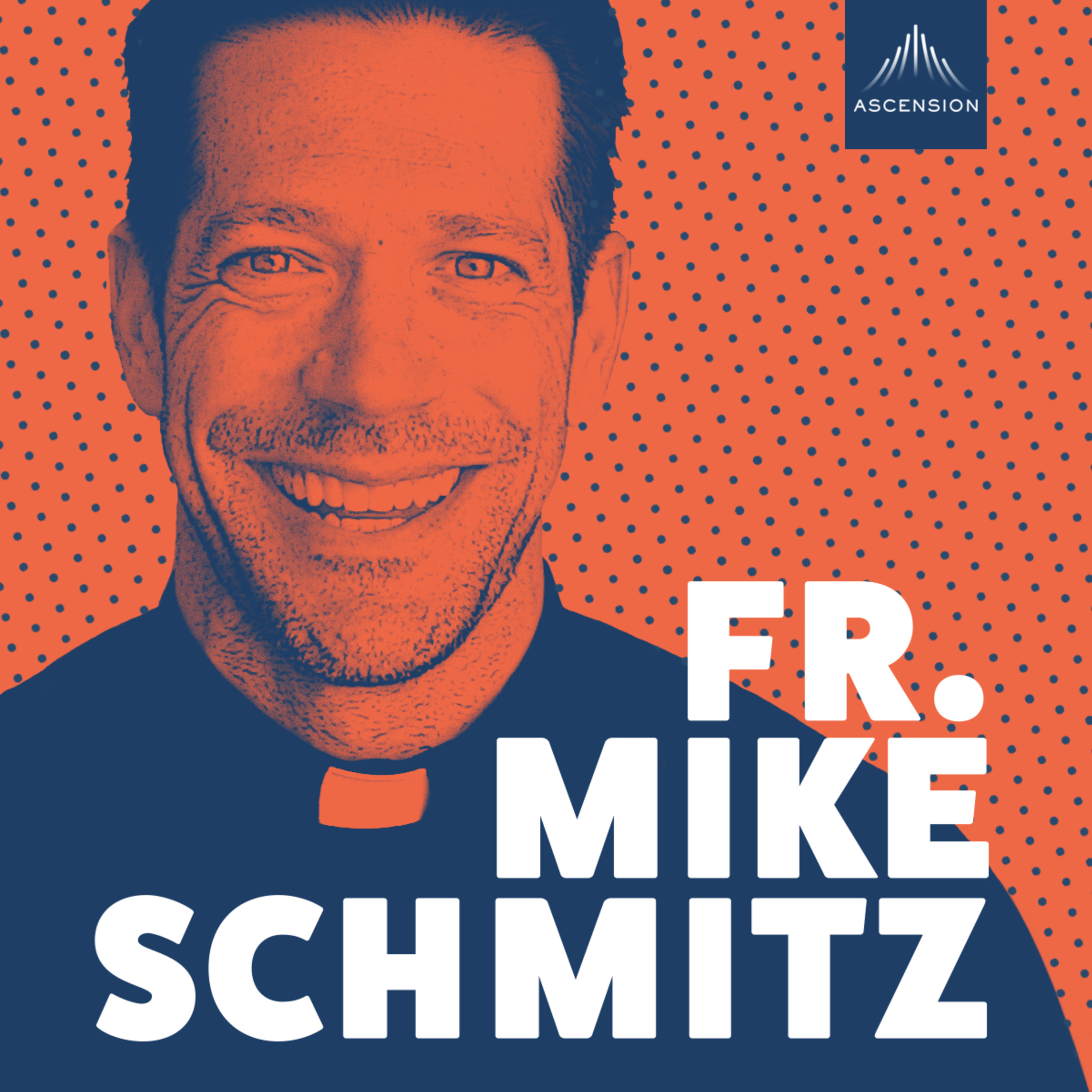
The Fr. Mike Schmitz Catholic Podcast
Ascension
Faith, pop culture, and headline reflections from Fr. Mike Schmitz.
Episodes
Mentioned books

Sep 3, 2020 • 8min
What It’s Really Like to Be a Catholic Speaker
Many people ask Fr. Mike, “How do you become a Catholic speaker?”
The quick answer is “Get baptized and start talking.” Of course this implies that you live out the promises of your baptism. When you do that, people will start asking you to give talks about the Faith.
At least that’s how it worked out for Fr. Mke. The caveat is that being a Catholic speaker is not all that it seems to be. The Faith is not going to spread throughout the world through someone on a stage with a microphone in hand. Christ will redeem the world through relationships, especially family and friendships.
The danger is in thinking that giving talks equals ministry. The Catholic teacher, director of religious education, and volunteer are in the messy relationships that make disciples of Christ one person at a time. We don’t want to become someone who is willing to travel a thousand miles to tell a thousand people about Christ, but isn’t willing to cross one street to tell one person about him.
Jesus first reached out to his twelve disciples and built strong relationships with them. Then people started coming to him. When you live an authentic Christian life founded upon a strong relationship with Christ and with others in Christ, people start noticing. You won’t have to aspire to be a Catholic speaker because those who are looking for a leader in the Faith will ask you to be one.Support The Fr. Mike Schmitz Catholic Podcast
Aug 27, 2020 • 7min
How to Get Real Friends
How many real friends do you have? Honestly, many people we call friends would probably better qualify as pals or buddies. The first step to getting real friends is to recognize how we are all made to be gifts of love. God is love and we were made in his image. We were also made for community, because God is a community of the Father, Son, and Holy Spirit.
Living out this love and community as God does requires availability and vulnerability.
By availability we mean “care-free timelessness”, as Catholic evangelist Matthew Kelly calls it.
By vulnerability we mean taking off the mask. This is the really hard part. As a missionary Fr. Mike knows once said, vulnerability is not just transparency. Transparency is letting someone look into the fish bowl. Vulnerability is inviting them into the fishbowl and letting them move things around.
How can we all learn to grow in love, community, availability, and vulnerability so we can become real friends to others and live as the image of God in the world?Support The Fr. Mike Schmitz Catholic Podcast
Aug 20, 2020 • 10min
If You’re Not Feeling Loved
If you’re not feeling loved by someone you love, take courage in the story of Leah in Genesis.
Jacob, Leah’s husband, did not love her. In fact, what’s even worse, he loved her sister, Rachel, instead. Leah named her first three sons out of her hope and desire for her husband to love her, thinking if she bore him sons he would love him. She named her first “Reuben” which means, “Look, a son,” saying, “Now my husband will love me.” She named her second son “Simeon” which means “listening” because she felt the Lord heard her prayer for Jacob to love her. She named her third son “Levi” which means “joined together” because she believed this time her husband will finally be joined to her.
By the time she had her fourth son, she named him Judah, which means “may God be praised.” She finally stopped trying to make Jacob love her, and instead she let go and let God take over. It’s no coincidence that Jesus would be born from the line of Judah.
Some people love people the way they know how to love, and the beloved just doesn’t notice. A father may love her daughter through acts of service rather than words of affirmation or quality time.
Others may simply not love you, but that does not mean you’re unlovable.
You’re chosen by God for a reason only you can know. Do not wait for someone else to give you the love that God the Father has already given you. Support The Fr. Mike Schmitz Catholic Podcast
Aug 13, 2020 • 8min
Freedom from the Fear of Death
Wearing masks, not wearing masks, and all the mixed emotions that have come with the coronavirus reveal that—as a society—we lack freedom from the fear of death.
Maybe you know someone who has died from the virus, or someone who lost their livelihood due to the lockdown. Many are wondering when they can safely go out again, or when they can they go back to Mass.
In fact, the coronavirus is revealing the fear of not just death, but also the fear of loss, uncertainty, and insecurity.
In these strange times, it’s encouraging to remember the one who conquered death. In Hebrews we read:
“Since therefore the children share in flesh and blood, he himself likewise partook of the same nature, that through death he might destroy him who has the power of death, that is, the devil, and deliver all those who through fear of death were subject to lifelong bondage” (Hebrews 2:14-15).
In a world without Jesus, death ought to be feared because it is a separation from life and everything good. But Christ has transformed life and death. This does not mean suffering and grief simply don’t matter, but in our suffering we have hope that death is not the end.
Living life is risky. About eight out of a thousand people die every year, COVID-19 aside (https://www.macrotrends.net/countries/WLD/world/death-rate). But the meaning of life is so much more than avoiding death. Frankly, some things are worse than death and some things are more important than our lives on earth. We are called to embrace the risks of life and live in hope … while still taking reasonable health precautions.Support The Fr. Mike Schmitz Catholic Podcast
Aug 6, 2020 • 10min
Believing in a God Who Allows Evil
It may sound foolish to believe in a God who allows evil, tragedy, suffering, and disasters. But God never promised to rid the world of these things. He promised us hope:
“and hope does not disappoint us, because God’s love has been poured into our hearts through the Holy Spirit who has been given to us” (Romans 5:5).
At some point we are going to experience heartbreak, loss, and suffering. Anyone who thought having faith in God would take away those things in life had the wrong idea of who God is.
Fr. Mike says he has never been disappointed in God, because he knows what promises God did make. God is faithful. He will never break his promises, but he never promised that you would not experience grief. He did promise that in the midst of the pain he will be there. In being there, he will help you to love the giver of peace more than the gift of peace.
Discipleship is a daily cross. God promised trouble, not peace. He encouraged us to take heart in the midst of that trouble, and that’s how we grow stronger and holier.
There will be floods and fire and sickness and tragedy. Turn to the one who promised he will be there with you through it all to help carry you through it. When we feel we have been let down by God the most, those are the times when trust in him means the most. Support The Fr. Mike Schmitz Catholic Podcast
Jul 30, 2020 • 8min
Why Are Some People So Annoying?
We all have pet peeves. We all get annoyed by things that really don’t matter much, whether it’s someone chewing with their mouth open, or someone whispering the Rosary in an Adoration chapel—which are two things that used to be pet peeves for Fr. Mike. But he learned a better way to deal with annoyances.
Why do we get so annoyed by such petty things? It’s because being annoyed is a choice.
Fr. Mike tells a quick story about prisoners of war in Vietnam. They were put in a really small cell where they were so close together they had to sleep touching each other. The prisoners came to an agreement that if they were annoyed by something another prisoner does, the one who is annoyed is the one at fault. This helped them rise about their situation.
There are four possible choices when you’re annoyed:
I can choose to be annoyed. This is not recommended.
I can actively choose to rise above the annoyance and grow in patience.
I can do something about it and let it move me to positive action.
Instead of saying that person annoys me, I can say that person sanctifies me.
Next time you get annoyed, try numbers two through four. Support The Fr. Mike Schmitz Catholic Podcast
Jul 23, 2020 • 7min
How Certain Is Your Faith?
Is your faith certain enough to stand up against the doubts and different ideas out there?
Fr. Mike shares insight about certainty from Dr. Montague Brown, professor of philosophy at St. Anselm College, New Hampshire. Dr. Brown says certainty is intellectual belief based off the evidence. It’s not blind belief. Someone with certainty is not going to change their mind without new objective evidence. Many times people change their mind not because of new evidence, but just because of new people in their lives. They’ve simply been exposed to new behavior. This happens to students in college quite often.
Christianity is evidential. It hinges upon an indisputable event, the life and death of Jesus.
If you’re from a small town, you may think the way you were raised is just part of your small town’s way of thinking, and that a well-known university in a big city must have a broader, more enlightened way of thinking. But really, the university is just as subject to its way of thinking as the small town is. The culture of a university is just as insulated as that of a small town.
Don’t get so caught up in the culture around you that you give in to new ideas without evidence—whether that culture is a university, a new workplace, new friends, new family, or a new city. Let your faith always be backed up by the evidence. Fr. Mike is certain in his belief that Christianity will then always come out on top.Support The Fr. Mike Schmitz Catholic Podcast
Jul 16, 2020 • 8min
Who You Are vs. Who You’re Called to Be
Fr. Mike recalls the speed math tests he took in second and third grade. He finished them in decent time, but his cousin—who was in the same class—finished them way faster. In fact, his cousin was the fastest in his class. For some reason this led Fr. Mike to believe he simply wasn’t good at math.
When it came to “speak and spell” though, Fr. Mike did really well. This led him to believe he was really good with words. He was acting under the common belief that someone is either good at something or bad at something.
In Carol S. Dweck’s book, Mindset, she speaks of fixed mindsets—like Fr. Mike had— and growth mindsets, which challenge us to grow.
Fr. Mike shares the findings of a study that observed two groups of children. The first group was given tests and were told “You’re really smart” when they finished them. The second group was told “You really worked hard on that.” When the tests got harder, the first group started giving up, but the latter group doubled down and rose to the challenge.
God works with us as if we were in the second group. He sees us for who we are, but approaches us as we could be. Confession is our opportunity to try harder next time. We are called to the struggle, because struggle is growth. The victory is not in never failing, but in getting back up and rising to the challenge.Support The Fr. Mike Schmitz Catholic Podcast
Jul 9, 2020 • 7min
How to Share the Gospel (and How Not To)
If you want to know how to share the gospel, it’s important to have the love and courage to not just give answers and corrections, but to ask questions. It is in asking questions from the heart that you convey true interest in the person’s soul, instead of just trying to convince the person you’re right.
Fr. Mike tells of a time when a student came to him saying he tries to evangelize, but just gets shut down. He tried to tell his good friend that he shouldn’t be over-drinking, and this just made his friend mad. Fr. Mike told this student, that’s not evangelization. That’s correction.
A good friend or pastor, depending on the relationship, may be in a position to offer correction to those they love. But evangelizing is a different conversation. Evangelization is introducing Christ to others.
That’s why Fr. Mike suggests asking questions when trying to introduce Christ to someone, because questions are a natural part of two people getting to know each other. If you are being Christ to someone, by asking them questions they are getting to know Christ just as much as you are getting to know them. Furthermore, asking genuine questions establishes a relationship and shows you are interested in where the person is coming from.
Also, it’s OK not to know the answers. Sometimes we get caught up in the concept communicated in St. Peter’s words:
“Always be prepared to make a defense to any one who calls you to account for the hope that is in you, yet do it with gentleness and reverence” (1 Peter 3:15).
There will be a time for that, but when that time comes the Holy Spirit will give you the words to say (Luke 12:12). Be content with just getting to know the person better first.
Also check out Ascension’s parish mission program, The 99: A New System for EvangelizationSupport The Fr. Mike Schmitz Catholic Podcast
Jul 2, 2020 • 9min
Striving vs. Abiding
In the spiritual life, it’s difficult to know whether striving to do God’s will or just abiding in him is better. But why can’t we do both?
Fr. Mike tells the story of a perpetually active student athlete. His inability to disengage in doing things and just abide in God was a problem, and he knew it.
Fr. Mike advised him, it’s not that abiding is right and striving is wrong. It’s important to do, but it’s important to also know what not to do in order to acquire the goal your living for.
There are many reasons why we choose to commit to activities, whether it’s for fear of missing out, liking being needed, needing to be liked. The list goes on. But if I find myself unable to rest, do I have a clear vision of what I really want out of life?
Being slightly engaged and not knowing what you’re striving for can be more exhausting than being fully engaged while knowing what you’re striving for.
It’s important to know when, where, and how I need rest, to know when to just abide in God, like Mary and not Martha (see Luke 10:38-42).
In any given hour, you can be called to strive like Martha in one moment and abide like Mary in the next; to do something one moment and just be in the next. The best thing is when you know you’re doing the right thing and you get to abide in God as well because you know you’re doing his will. Support The Fr. Mike Schmitz Catholic Podcast

