

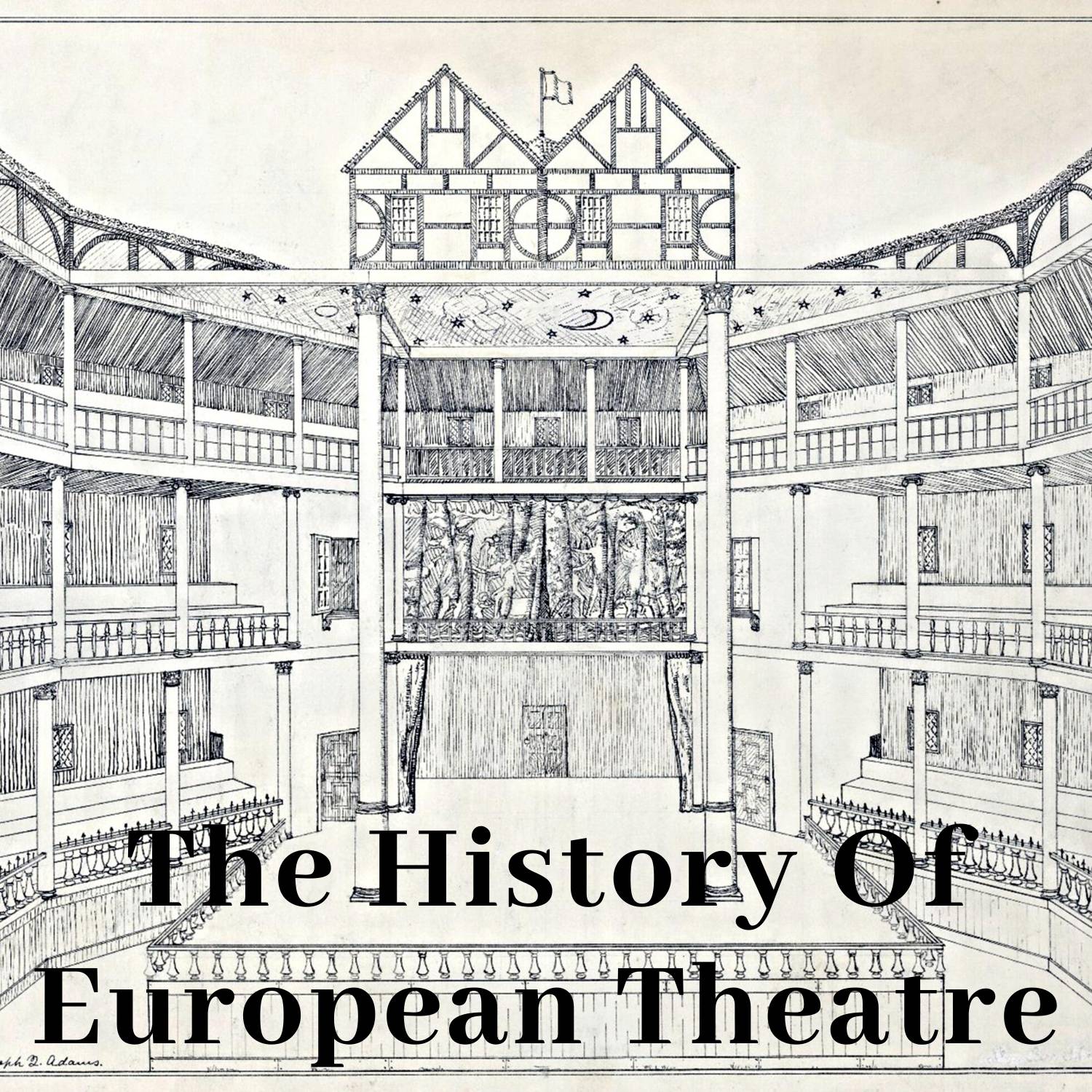
The History Of European Theatre
Philip Rowe
A podcast tracing the development of theatre from ancient Greece to the present day through the places and people who made theatre happen. More than just dates and lists of plays we'll learn about the social. political and historical context that fostered the creation of dramatic art.This podcast uses the following third-party services for analysis: Chartable - https://chartable.com/privacy Hosted on Acast. See acast.com/privacy for more information.
Episodes
Mentioned books

Jun 2, 2025 • 39min
Shakespeare in the Restoration: A Conversation with Stephen Watkins
Episode 171: For today’s guest episode it is a warm welcome to Stephen Watkins who is going to take us a little way forward in the timeline to the world of Restoration England where after fourteen years of closures theatres were again legally opened and where, as we shall hear, performance of Shakespeare plays formed a significant part of the repertoire, and this discussion does focus very much on Shakespeare in the Restoration, we will, of course, get to a look at the other playwrights and players of that period all in good time.Stephen Watkins is a writer and researcher working mainly on Shakespeare and Early Modern literature, with a particular focus on how writers and theatre makers recycle, adapt and remediate source texts to both register and resist historical and cultural change. He has published widely on Restoration adaptations of Shakespeare and the important figure of that time, William Davenant. His book ‘Shakespeare and the Restoration Repertory’, as part of the Cambridge University Press, ‘Elements in Shakespeare Performance’ series was published in February 2025. In it Stephen demonstrates how Davenant’s adaptations of Shakespeare were shaped as much by the transformed commercial and repertorial logics that came to govern the patent companies in the 1660s as they were by shifting aesthetic and political concerns in the period. Stephen has taught English at the Universities of Oxford, Nottingham, and Derby, and is currently based at the University of Greenwich.https://www.amazon.co.uk/Shakespeare-Restoration-Repertory-Elements-Performance/dp/1009324136/ref=sr_1_1?https://www.amazon.com/Shakespeare-Restoration-Repertory-Elements-Performance-ebook/dp/B0F29S1NJ1/ref=sr_1_1?Support the podcast at:www.thehistoryofeuropeantheatre.comwww.patreon.com/thoetpwww.ko-fi.com/thoetp Hosted on Acast. See acast.com/privacy for more information.
May 26, 2025 • 35min
The Merry Wives of Windsor: ‘Wives May be Merry and Yet Honest Too’
Episode 170: The dating of the playThe tradition of the queen Elizabeth commissionThe tradition of the connection to the Garter CeremonyThe Question of who played FalstaffA summary of the plotThe early publication history of the play in short quarto editionsThe sources for the playThe very specific location of the playThe character of FalstaffThe way the dominating prose of the play is used to define charactersThe change in Mistress Quickly and her use of languageThe stereotypical comedy of foreigners in Dr Caius and Parson EvansWas the play written for one audience, but then changed to fit another?The play as a city comedy and how Shakespeare subverts the genreThe influence of Queen Elizabeth’s position as a female ruler on the playThe later performance history of the playSupport the podcast at:www.thehistoryofeuropeantheatre.comwww.patreon.com/thoetpwww.ko-fi.com/thoetp Hosted on Acast. See acast.com/privacy for more information.
May 19, 2025 • 30min
Performing Medieval Theatre: A Conversation with Kyle Thomas
Episode 169A welcome return for Kyle Thomas to the podcast where we discussed Kyle’s work on preparing three of the York Cycle plays for performance this summer in Toronto. As you will hear Kyle is part of a team that are going to perform the fifty-play cycle on the 7th June 2025 in the grounds of the University of Toronto.Link to the York Cycle Plays performed at Toronto University in June 2025: https://www.yorkplays.caLink to Kyle’s projects:Ensemble Member: Stage Left TheatreReviewer for ChicagoOnStage.comChief Editor of ROMARD: Research on Medieval and Renaissance DramaFeatured Expert on Mysteries of the Abandoned: Hidden America (Discovery Channel)Lead Author of The Play About the Antichrist (Ludus de Antichristo): A Dramaturgical Analysis, Historical Commentary, and Latin Edition with a New English Verse TranslationLink to my blog post about the Valenciennes Illustration https://www.thehistoryofeuropeantheatre.com/blog/the-stage-set-from-valenciennes-1547/ Hosted on Acast. See acast.com/privacy for more information.
May 12, 2025 • 35min
Henry IV Part 2: ‘We Have Heard the Chimes at Midnight’
Episode 168:Although Shakespeare's completion of the events of Henry IV’s reign is very much a continuation of the story from part one it is a play with a very different vibe. The vigour of the battle scenes and the exuberance of prince Hal and Falstaff’s relationship are replaced in part two with a more sombre and elegiac tone. The effects of old age and the passing to time hang over the play and even at its ending, where the coronation of Henry V could have been treated as a big party full of hope, it is the final rejection of Falstaff that dominates as once again Shakespeare provides an ending that many would have found surprising.The dating of the playThe early publishing history of the playThe early performance history of the playShakespeare’s sources for the playA Synopsis of the plotHow the play functions without much dramatic actionWas the play a hurriedly written sequel?Foreshadowing and references to historyThe presence of the king and his illness in the playThe nature of the comedy in the playThe final split with FalstaffFalstaff the dangerous conmanThe Justices Shallow and SilenceMistress Quickly and the other comic charactersThe EpilogueSupport the podcast at:www.thehistoryofeuropeantheatre.comwww.patreon.com/thoetpwww.ko-fi.com/thoetp Hosted on Acast. See acast.com/privacy for more information.
May 5, 2025 • 51min
The Origins of Medieval Theatre: A Conversation with Kyle Thomas
Episode 167A conversation with Kyle Thomas where we discussed the long transition period between Roman theatre and medieval theatre. As you may remember from my episodes on the medieval theatre this is a very opaque period where details are few and far between. In my episodes in season three of the podcast I mostly followed the view that medieval theatre grew out of parts of the church liturgy that became dramatized as very simple, short plays. As you will hear in our conversation Kyle puts a more nuanced perspective on that and also speaks to the role of the education system of the time in that process.Links to Kyle’s projects:Ensemble Member: Stage Left TheatreReviewer for ChicagoOnStage.comChief Editor of ROMARD: Research on Medieval and Renaissance DramaFeatured Expert on Mysteries of the Abandoned: Hidden America (Discovery Channel)Lead Author of The Play About the Antichrist (Ludus de Antichristo): A Dramaturgical Analysis, Historical Commentary, and Latin Edition with a New English Verse TranslationSupport the podcast at:www.thehistoryofeuropeantheatre.comwww.patreon.com/thoetpwww.ko-fi.com/thoetp Hosted on Acast. See acast.com/privacy for more information.
Apr 28, 2025 • 34min
Henry IV Part 1: ‘Nothing Can Seem Foul to Those Who Win’
Episode 166:As with 'Richard II' 'Henry IV part 1' handles some complex English history as it examines the relationships between the King, his son and the powerful Percy family. After the deposition of Richard II Henry ruled for fourteen years until his death. Having ended 'Richard II' with Henry’s accession to the throne and Richard’s death in prison Shakespeare opens this play just a few years later, but with a vision of a tired king and a country dissatisfied with his rule. The setting for the playA brief synopsis of the playThe dating of the playThe early performance history of the playThe publication history of the playThe sources for the playThe balance of history and comedyThe historical accuracy of the playThe play as an examination of the father/son relationshipThe character of Hotspur as a medieval knightThe portrayal of Glendower as a mystic leaderThe role of the aristocratic ladiesPrince Hal as a new sort of leaderFalstaff, ruler of his own sort of court and a king of everymanThe historical figure of Sir John OldcastleThe later performance history of the playSupport the podcast at:www.thehistoryofeuropeantheatre.comwww.patreon.com/thoetpwww.ko-fi.com/thoetp Hosted on Acast. See acast.com/privacy for more information.
Apr 21, 2025 • 29min
Shakespeare’s Tutor: A Conversation with Darren Freebury-Jones
Episode 165In today’s guest episode it is a very welcome return to the podcast for Darren Freebury-Jones. Darren appeared previously to discuss his book ‘Shakespeare’s Borrowed Feathers’ and I asked him back on this occasion because his earlier book ‘Shakespeare’s Tutor: The Influence of Thomas Kyd’ is now published in a paperback edition by Manchester University Press, making it a much more accessible resource for any enthusiast of early modern theatre. In our conversation about the book Darren mentions a few points, like the detail of verse structure and characters like Robert Greene and Thomas Nashe that we discussed in more detail in our earlier encounter. If you would like to listen to that again it is still out there on the podcast feed as episode 126, that’s season six episode thirteen.Dr Darren Freebury-Jones is author of the monographs: Reading Robert Greene: Recovering Shakespeare’s Rival, Shakespeare’s Tutor: The Influence of Thomas Kyd, and Shakespeare’s Borrowed Feathers. He is also Associate Editor for the first critical edition of The Collected Works of Thomas Kyd since 1901. He has investigated the boundaries of John Marston’s dramatic corpus as part of the Oxford Marston project and is General Editor for The Collected Plays of Robert Greene, also published by Edinburgh University Press. His findings on the works of Shakespeare and his contemporaries have been discussed in national newspapers such as The Times, The Guardian, The Telegraph, The Observer, and The Independent as well as BBC Radio. His debut poetry collection, Rambling, was published by Broken Sleep Books in 2024. In 2023 he was elected a Fellow of the Royal Historical Society in recognition of his contributions to historical scholarship.Amazon UK link: https://www.amazon.co.uk/Shakespeares-Tutor-Influence-Thomas-Kyd/dp/1526182610/ref=tmm_pap_swatch_0Amazon US Link: https://www.amazon.com/Shakespeares-tutor-influence-Thomas-Kyd/dp/1526182610/ref=sr_1_1?Manchester Universty Press link: https://manchesteruniversitypress.co.uk/9781526182616/Support the podcast at:www.thehistoryofeuropeantheatre.comwww.patreon.com/thoetpwww.ko-fi.com/thoetp Hosted on Acast. See acast.com/privacy for more information.
Apr 14, 2025 • 35min
The Merchant of Venice: ‘The Quality of Mercy is not Strained’
Episode 164Fate, as in Romeo and Juliet, plays a large part in ‘The Merchant of Venice’, as do deep seated grudges, but these are more societal than familial. We are still in Italy, but no longer in close knit Verona, but mercantile and outward looking Venice. As Shakespeare wrote this play London was becoming orientated around increasing global trade and English trading ships were regularly making their way to Venice as a major trading hub, so perhaps it is no surprise that Venice, with its eyes on commerce and profit, was a suitably exotic setting for this tale of greed, love and a clash of cultures. The dating of the playThe printed history of the playThe sources of the play including earlier theatrical ‘Jew’ playsA brief outline of the plotThe different views of the character of Shylock – stereotype or sympatheticThe Jewish experience in Elizabethan LondonThe comic elements of the playThe character of AntonioPortia’s role in the playPortia’s ‘mercy’ speechThe performance history of the play Support the podcast at:www.thehistoryofeuropeantheatre.comwww.patreon.com/thoetpwww.ko-fi.com/thoetp Hosted on Acast. See acast.com/privacy for more information.
Apr 7, 2025 • 32min
A Statue in Verona: The Afterlife of Romeo and Juliet
Episode 163My background reading while preparing the episode on Romeo and Juliet took me to many stories about and thoughts on the afterlife of the play and its continuing influence on western culture, what follows is just a few stories and thoughts that illustrate that continuing influence.Verona and Juliet’s StatueJuliet’s tombCibber’s JulietFranco Zeffirelli’s film for the ‘love generation’West Side StorySupport the podcast at:www.thehistoryofeuropeantheatre.comwww.patreon.com/thoetpwww.ko-fi.com/thoetp Hosted on Acast. See acast.com/privacy for more information.
Mar 31, 2025 • 37min
Romeo and Juliet:‘These violent delights have violent ends.’
Episode 162In today’s episode I look at Shakespeare’s early tragedy and one of his enduringly popular plays ‘Romeo and Juliet’.The dating of the playThe early printings of the play in quarto editionsThe origins of the story and Shakespeare’s direct sourcesThe opening chorusViolence and the hand of fate underlying the actionThe opening brawl and the threat of violence to womenThe calming voice of women in the playRomeo as a Petrarchan heroJuliet as an innovative character who drives the plotRomeo and Juliet’s shared sonnetThe motivations of Friar Lawrence and Juliet’s nurseA brief performance history of the playSupport the podcast at:www.thehistoryofeuropeantheatre.comwww.patreon.com/thoetpwww.ko-fi.com/thoetp Hosted on Acast. See acast.com/privacy for more information.

