

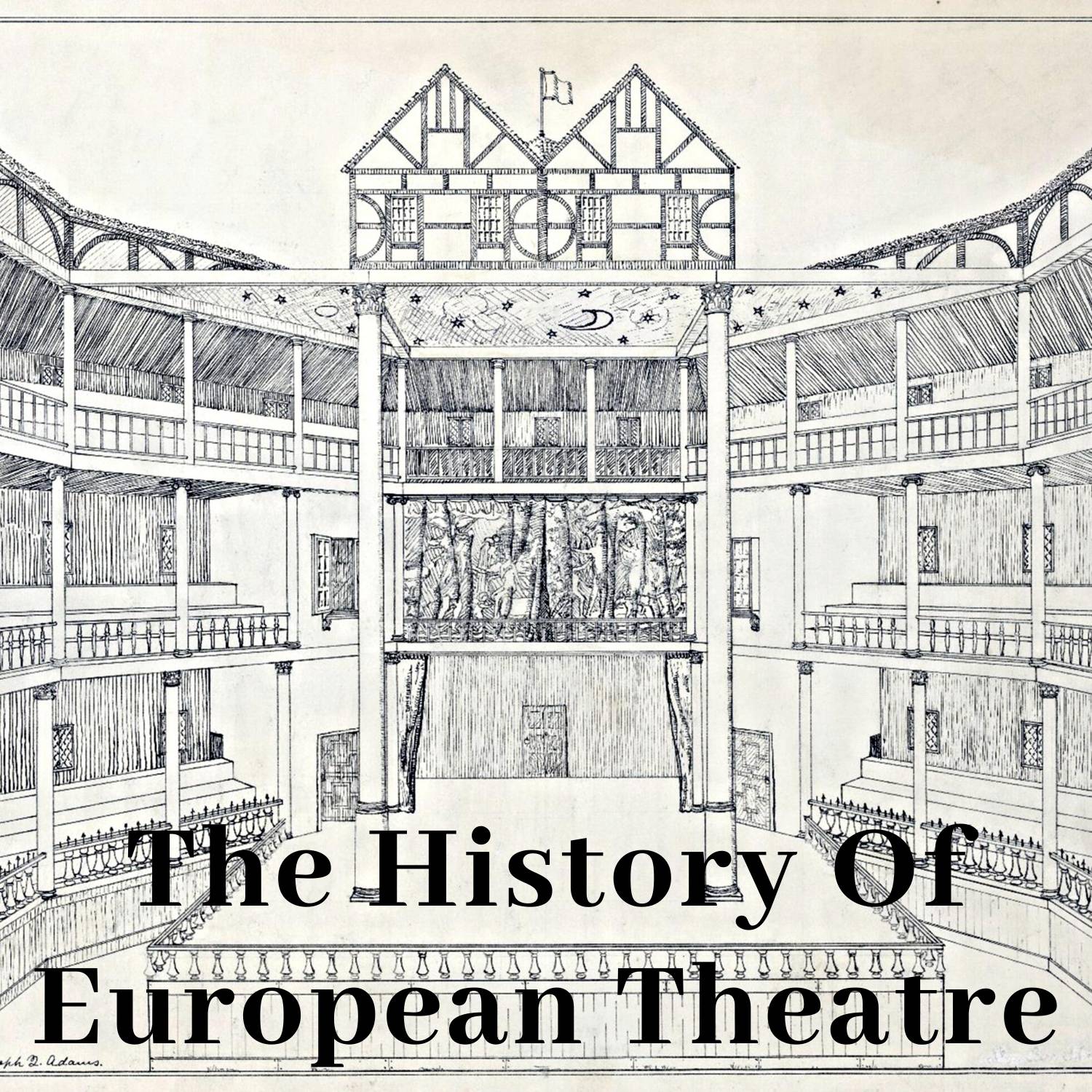
The History Of European Theatre
Philip Rowe
A podcast tracing the development of theatre from ancient Greece to the present day through the places and people who made theatre happen. More than just dates and lists of plays we'll learn about the social. political and historical context that fostered the creation of dramatic art.This podcast uses the following third-party services for analysis: Chartable - https://chartable.com/privacy Hosted on Acast. See acast.com/privacy for more information.
Episodes
Mentioned books

Oct 20, 2025 • 33min
Staging Julius Caesar: A Conversation with Ricky Dukes
Episode 191:For today’s guest episode it is a welcome return to Ricky Dukes, artistic director of Lazarus Theatre Company. Following on from our conversation about ‘Henry V’ Ricky and I went on to discuss ‘Julius Caesar’. Not surprisingly our conversation pulled out some alternative points to those I raised in my episode on the play, especially when it came to talking about aspects of staging the play and the impact of the female roles in the play, which I did not mention in any detail previously. So, please see these two episodes as complimenting each other, but as long as you are familiar with the play you don’t need to have listened to my episode first, or, for that matter, our earlier discussion of ‘Heny V’, to enjoy this one. Ricky Dukes is an award-winning Director, Practitioner and Teacher based in the West Midlands and London. In 2007 he founded Lazarus Theatre Company and is the company’s current Artistic Director for which he won Best Artistic Director in the 2012 Fringe Report Awards. His work is ensemble led with actor detail at its heart creating large scale visual, visceral, and vibrant theatrical experiences. Ricky has gone on to direct over 40 productions for Lazarus Theatre Company including: The Changeling, Hamlet, Doctor Faustus, Oscar Wilde’s Salomé, Macbeth, Marlowe’s Edward II, The Caucasian Chalk Circle, Tis Pity She’s A Whore, and Dido, Queen of Carthage. Ricky also runs workshops for actors under the ‘Lazarus Gym’ banner, and I have put links in the show notes to his activities so you can follow that up further if you wish.Check out Lazarus Theatre here: https://www.lazarustheatrecompany.co.ukSupport the podcast at:www.thehistoryofeuropeantheatre.comwww.patreon.com/thoetpwww.ko-fi.com/thoetp Hosted on Acast. See acast.com/privacy for more information.
Oct 13, 2025 • 35min
Julius Caesar: ‘It is the Bright Day That Brings Forth the Adder’
Episode 190:'Julius Caesar' has proved to be one of Shakespeare’s most malleable plays through the centuries as it’s political narrative has been applied to just about every period of history since it was first performed, either in the moment or retrospectively. In most people’s estimation it is one of Shakespeare’s truly great plays, but that does not mean that there is always a consensus of opinion over the details of the plot or the motivations of the main characters, but by now that is pretty much what we have come to expect from Shakespeare.The dating of the playThe early performance history of the playThe publication history of the playThe sources for the playA brief synopsis of the playWhy did Shakespeare choose to write about Roman history?The play as Ceasar’s tragedyThe play as the tragedy of BrutusAnthony as the playboy and political strategistThe role of words, letters and misunderstandings in the playThe death of Cinna the poetThe later performance history of the playSupport the podcast at:www.thehistoryofeuropeantheatre.comwww.patreon.com/thoetpwww.ko-fi.com/thoetp Hosted on Acast. See acast.com/privacy for more information.
Oct 6, 2025 • 40min
Neighbourly Relationships in Early Modern Drama: A Conversation in Dr Iman Sheeha
Episode 189:For today’s guest episode it is my pleasure to welcome Dr Iman Sheeha to the podcast. Her book ‘Neighbourly Relations in early modern drama has been published recently so it was a great opportunity to talk to her about her research after she had just completed a summer tour of conferences.Her work is a close examination of neighbourly relationships in early modern English drama, placing a select number of plays alongside other contemporary materials such as wills, pamphlets and sermons and other sources that give us a glimpse of the early modern lived life. The plays span the period between the 1550s and the 1620s, belong to different genres, were aimed at different audiences, and were written for different kinds of playhouses, which allows for conclusions to be drawn about the way genre shapes the treatment of neighbourly relationships, as well as revealing continuities and changes during the period.Iman Sheeha is a Senior Lecturer in Shakespeare and Early Modern Literature at Brunel University of London and co-General Editor of New Mermaids Classic Plays series. She has wide-ranging interests within the fields of Shakespeare and Early Modern Literature, including gender, race, devotional literature, service, and domesticity and she works with PhD candidates working on these and related topics.She is the author of two books: Household Servants in Early Modern Domestic Tragedy, and Neighbourly Relationships in Early Modern Drama. She has co-edited a special issue on liminal domestic spaces for Early Modern Literary Studies. Her research has appeared or is forthcoming in Shakespeare Survey, Early Theatre, The Journal of Early Modern Cultural Studies, Early Modern Literary Studies, and American Notes and Queries and she contributed a chapter to People and Piety: Devotional Writing in Print and Manuscript in Early Modern England (MUP, 2019).’ She has written the introduction for the Oxford World’s Classics edition of ‘The Tragedy of Master Arden of Faversham’ which is due to be published by Oxford University Press in April, 2026.Links to books by Iman Sheehahttps://www.routledge.com/Neighbourly-Relationships-in-Early-Modern-Drama-Staged-Communities/Sheeha/p/book/9781032896670https://www.routledge.com/Household-Servants-in-Early-Modern-Domestic-Tragedy/Sheeha/p/book/9780367503772Support the podcast at:www.thehistoryofeuropeantheatre.comwww.patreon.com/thoetpwww.ko-fi.com/thoetp Hosted on Acast. See acast.com/privacy for more information.
Sep 29, 2025 • 36min
As You Like It: ‘I Can Suck Melancholy Out of a Song as a Weasel Sucks Eggs’
Episode 188:Following on from the last episode before the run of summer guest conversations we take a sharp swerve from ‘Henry V’ to ‘As You Like It’. Although we cannot be quite sure about the chronology in which Shakespeare wrote his plays, or how much the writing of one crossed over with the writing of another, whatever the precise order it is pretty clear that Shakespeare could move freely between the History and Comedy genres and within those how he was always pushing at the edges of the forms and conventions of the theatre and playwrighting to see what could work on stage and with language. ‘As You Like It’ is no exception to that. The Dating of the playThe sources for the playThe possible first performance dateA brief synopsis of the playThe use of poetry and prose in the playThe play as part of the ‘Pastoral’ genreThe location of the play and influence of the forestThe character of JacquesThe character of RosalindThe character of TouchstoneThe ending, Hyman, and the masqueA summary of the performance history of the playThe epilogueSupport the podcast at:www.thehistoryofeuropeantheatre.comwww.patreon.com/thoetpwww.ko-fi.com/thoetp Hosted on Acast. See acast.com/privacy for more information.
Sep 22, 2025 • 35min
Who is King Henry?: A Conversation with Ricky Dukes
Episode 187:This episode is both an ending and a beginning. An ending because it is the last of the recent run of consecutive guest episodes – next time we will be returning to Shakespeare, Jonson and their plays – but it is also the first of what I hope will be a series of guest episodes attached to each of the very significant Shakespeare plays that are coming up soon. With the very well-known and arguably greatest of Shakespeare’s plays the task of providing some meaningful commentary is, I have found, very daunting, so I thought it would be a good idea to have another view on these plays to bring another perspective to them besides my own. I am also keen for those views to be born from the practical experience of producing the plays and understanding them from an actor’s perspective and therefore as a result of close exploration of the text. Ricky Dukes is an award-winning Director, Practitioner and Teacher based in the West Midlands and London. In 2007 he founded Lazarus Theatre Company and is the company’s current Artistic Director for which he won Best Artistic Director in the 2012 Fringe Report Awards. His work is ensemble led with actor detail at its heart creating large scale visual, visceral, and vibrant theatrical experiences. Ricky has gone on to direct over 40 productions for Lazarus Theatre Company including: The Changeling, Hamlet, Doctor Faustus, Oscar Wilde’s Salomé, Macbeth, Marlowe’s Edward II, The Caucasian Chalk Circle, Tis Pity She’s A Whore, and Dido, Queen of Carthage. Ricky also runs workshops for actors under the ‘Lazarus Gym’ banner, and I have put links in the show notes to his activities so you can follow that up further if you wish.The photos used on social media posts for this episode are from the 2015 production of 'Henry V' with Colette O'Rourke as the king at the Union Theatre. Photo credit: Adam Trigg.Check out Lazarus Theatre here: https://www.lazarustheatrecompany.co.ukSupport the podcast at:www.thehistoryofeuropeantheatre.comwww.patreon.com/thoetpwww.ko-fi.com/thoetp Hosted on Acast. See acast.com/privacy for more information.
Sep 15, 2025 • 27min
Robert Armin – Shakespeare’s Other Clown: A Conversation with Tim Fitzhigham
Episode 186:In this continuing series of guest episodes, it is a very welcome return to the podcast for Tim Fitzhigham. You may remember I spoke to Tim in episode 140 about his work at the Kings Lynn Guildhall where the Elizabethan period Stage had recently been uncovered and hit the headlines in the UK as a stage that Shakespeare and the Queen’s Men had actually played on as they toured the country. Since then the work has continued and through the summer of 2025 it has been possible for the public to view the timber floor, which was built in 1419. If you do get to Kings Lynns and want to see what is going on at the Guildhall and the theatre do have a look at the website that I have linked to in the show notes to check on what work is currently underway and how that might affect opening times.Tim Fitzhigham is the Borough Council of Kings Lynn and West Norfolk Creative Director appointed to oversee the revival of St George’s Guildhall. As well as leading this extensive project he is currently completing his PhD on Robert Armin, an actor in The King’s Men who originated many of the clown and fool roles in all but the earliest Shakespeare plays and was a well-known playwright and author in his own right.Link to King's Lynne Guildhall website: https://stgeorgesguildhall.com/ Hosted on Acast. See acast.com/privacy for more information.
Sep 7, 2025 • 47min
‘The Shakespeare Ladies Club’: A Conversation with Christine and Jonathan Hainsworth
Episode 185:For today’s guest episode it’s a warm welcome to the podcast for Christine and Jonathan Hainsworth, co-authors of the recently published book ‘The Shakespeare Ladies Club’.Their book explores the lives of four ladies who were crucial in ensuring the original work of Shakespeare was not forgotten in the 18th Century and beyond. In 1736, these three ladies of quality, two from the aristocracy and one a writer who ran a stationery shop, formed the ‘Shakespeare Ladies Club’. All three were so enraptured by the plays of William Shakespeare that they met to read and discuss his them and his genius. Not content with this, they used their power and influence to campaign for a statue of their literary idol to be placed in Westminster Abbey. They were successful in that endeavour, but their role in these achievements has never been properly recognised. Along with other scholars Christine and Johnathn’s book is part of the process of putting that right. It is a very entertaining and informative read that I thoroughly enjoyed as I hope you will our conversation with just a taster of some of the details Christine and Jonathan have revealed.Christine and Jonathan Hainsworth live in Adelaide, South Australia and have a passion for historical investigation and challenging the 'conventional wisdom' regarding famous historical subjects.Christine spent several decades working for the Australian government in social services. Her work on a program to re-connect lone parents with training, education and employment opportunities gave her a unique insight into family and societal challenges.Jonathan was educated in Britain and Australia and has over thirty years of experience as a high school teacher of Modern and Ancient History, and English Literature. He is a graduate of The University of Adelaide and the University of South Australia.Link to Christine and Jonathan's website: https://hainsworthwardagius.comLink to The Shakespeare Ladies Club on Amberley Publishing: https://www.amberley-books.comLink to The Shakespeare Ladies Club on Amazon UK: https://www.amazon.co.uk/Shakespeare-Ladies-Club-Forgotten-Rescued/dp/1398127442/ref=sr_1_1?Support the podcast at:www.thehistoryofeuropeantheatre.comwww.patreon.com/thoetpwww.ko-fi.com/thoetp Hosted on Acast. See acast.com/privacy for more information.
Sep 1, 2025 • 33min
‘A Trojan Woman’: A Conversation with Sara Farrington
Episode 184:Today’s episode is part of my summer run of guest episodes and feels very special as rather than talking about a long dead playwright I got to talk to a living one. Sara Farrington is a New York based playwright who has written an adaptation of ‘The Trojan Women’ by Euripides, called ‘A Trojan Woman’, which has had several productions in Europe and Nort America and Sara kindly agreed to come onto the podcast to discuss her interpretation of Euripides.Sara Farrington is a New York based Playwright and co-founder of Foxy Films Theatre. Her plays include: ‘Mickey & Sage’, ‘Leisure, Labor, Lust’, ‘A Trojan Woman’, ‘CasablancaBox’, which was nominated for two Drama Desk Awards and ‘The Rise & Fall of Miles & Milo’, which won the award for outstanding playwriting @ FringeNYC. She also works as a script supervisor and costume designer.Link to ‘A Trojan Woman’ published Edition: https://www.broadwayplaypublishing.com/the-plays/a-trojan-womanLink to Sara’s Substack ‘Theatre Is Hard’: https://substack.com/@theaterishardSara on Instagram: https://www.instagram.com/ladyfarrington/Link to Sara’s website: https://www.ladyfarrington.comSupport the podcast at:www.thehistoryofeuropeantheatre.comwww.patreon.com/thoetpwww.ko-fi.com/thoetp Hosted on Acast. See acast.com/privacy for more information.
Aug 25, 2025 • 39min
The Dream Factory: A Conversation With Daniel Swift
Episode 183:Today’s episode is the first of a short run of guest episodes to see us through the end of the English summer and first up is Daniel Swift, author of ‘The Dream Factory: London’s First Playhouse and the making of William Shakespeare’. Given that title I don’t think Daniel’s book needs any further introduction other than to say that I found it a fascinating read and I hope this episode gives. You a taster of Daniel’s work and the research he has undertaken.Daniel Swift is associate professor of English at Northeastern University, London, and has written books on Shakespeare, Ezra Pound, and the poetry of the Second World War and articles for The New York Times, The New Statesman and The Spectator.Links to'The Dream Factory':Yale University Press London: https://yalebooks.co.uk/book/9780300263541/the-dream-factory/Macmillan New York https://us.macmillan.com/books/9780374601270/thedreamfactory/Amazon UK:https://www.amazon.co.uk/Dream-Factory-Londons-Playhouse-Shakespeare/dp/0300263546/ref=sr_1_1?Amazon USA: https://www.amazon.com/Dream-Factory-Londons-Playhouse-Shakespeare/dp/0374601275/ref=sr_1_1?Support the podcast at:www.thehistoryofeuropeantheatre.comwww.patreon.com/thoetpwww.ko-fi.com/thoetp Hosted on Acast. See acast.com/privacy for more information.
Aug 18, 2025 • 37min
Henry V: ‘A Valiant Flea That Dare Eat His Breakfast on The Lip of a Lion’
Episode 182:Although it feels like a while since Shakespeare had produced a history play, we must remember that all the plays I have discussed so far were written and played in a very compressed timescale. If we take Henry 6th part 1 as being from 1591 then eight years and eighteen plays later, we get to Henry 5th.The sources for the playThe dating of the playThe printing history of the playThe early performance history of the playA brief synopsis of the playA play that works on several levelsThe central role of the ChorusThe multiple linguistic registers in the playThe conclusion of Henry’s character arcThe different aspects to Henry’s characterHenry’s meditations on the responsibilities of kingshipThe supporting characters – the soldiersPrincess Katerine and her English lessonThe demise of PistolThe later performance history of the playSupport the podcast at:www.thehistoryofeuropeantheatre.comwww.patreon.com/thoetpwww.ko-fi.com/thoetp Hosted on Acast. See acast.com/privacy for more information.

