

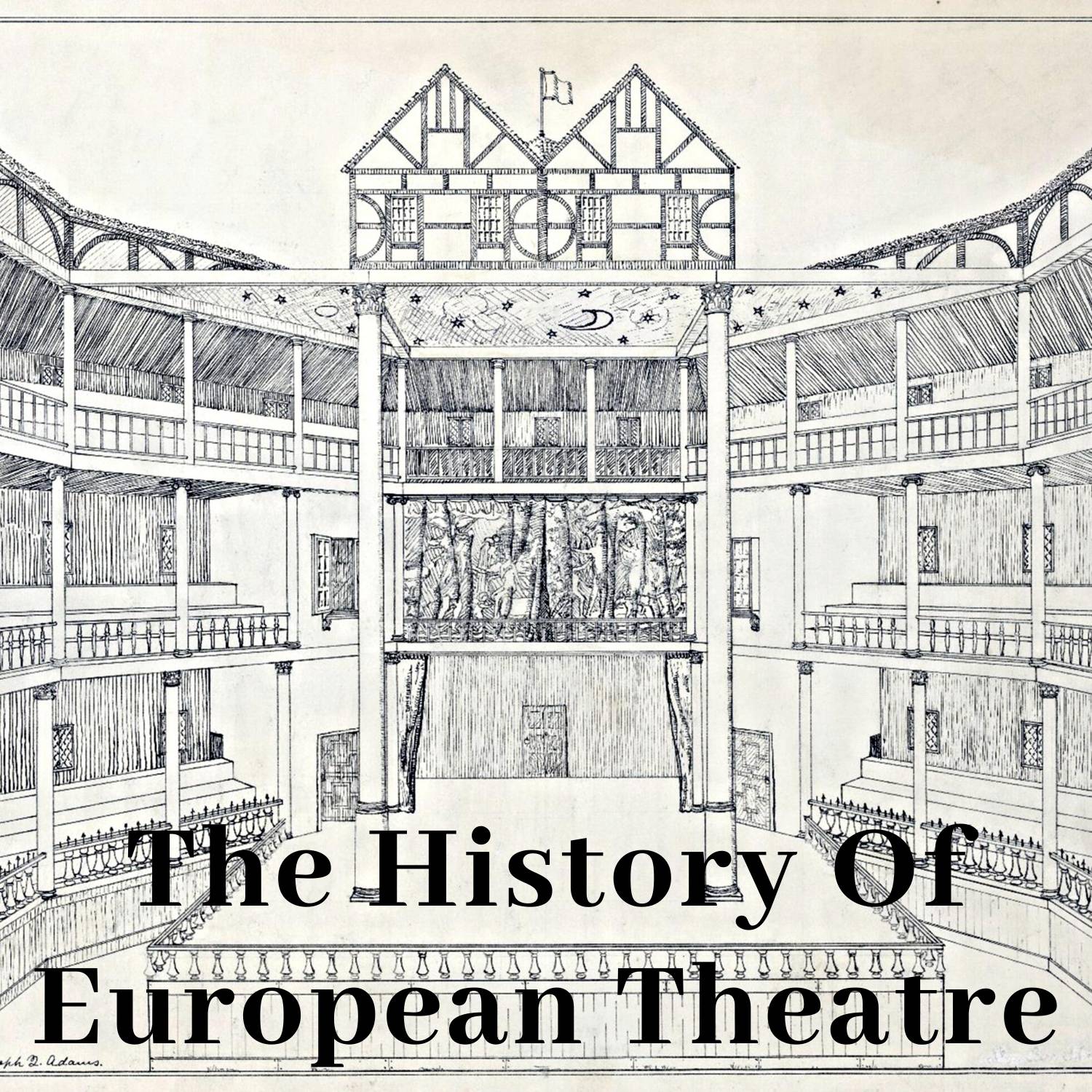
The History Of European Theatre
Philip Rowe
A podcast tracing the development of theatre from ancient Greece to the present day through the places and people who made theatre happen. More than just dates and lists of plays we'll learn about the social. political and historical context that fostered the creation of dramatic art.This podcast uses the following third-party services for analysis: Chartable - https://chartable.com/privacy Hosted on Acast. See acast.com/privacy for more information.
Episodes
Mentioned books

Oct 3, 2022 • 33min
European Renaissance Conclusions
Episode 86:A summary to conclude the season on European Renaissance Theatre focussing on four aspects of the theatre that I have covered in the last twenty-two episodes: The Italian RebirthThe Parisian TheatreTheatre in SpainThe Commedia Dell'arteSupport the podcast at:www.thehistoryofeuropeantheatre.comwww.ko-fi.com/thoetpwww.patreon.com/thoetpThis podcast uses the following third-party services for analysis: Chartable - https://chartable.com/privacy Hosted on Acast. See acast.com/privacy for more information.
Sep 19, 2022 • 27min
Bernini and Others: Sculpture, Architecture and Plays
Episode 85:We return to Italy, to the birthplace of the Renaissance, for one last visit in this theatrical age.The Bernini family and their history as sculptors and architects.The early life and career of the second-generation Bernini, Gian Lorenzo, and his place as a major sculptor and architect in Rome.His work as a scenic designer in the theatre and the impact of his special effects.Bernini as an all-round theatre practitioner and some examples of his work.Bernini as a playwright and the nature of his plays.The discovery of his one surviving play and the problems with the text.The plot of his one surviving play ‘The Impresario’.The Commedia Dell’arte elements in ‘The Impresario’ and how Bernini subverted them.Giovanni Burnacini and his son Ludovichi, who worked for the Vienna Opera houses and the Holy Roman Emperor. The use of multiple vanishing points in set designThe careers of three generations of the Galli-Bibienas in set design and architecture.Support the podcast at:www.thehistoryofeuropeantheatre.comwww.ko-fi.com/thoetpwww.patreon.com/thoetpThis podcast uses the following third-party services for analysis: Chartable - https://chartable.com/privacy Hosted on Acast. See acast.com/privacy for more information.
Sep 5, 2022 • 29min
Behind the Dikes: Renaissance Theatre in The Netherlands
Episode 84:Given the destruction of the thirty years war moving backwards and forwards across the Germanic and Flemish states of Europe between 1618 and 1648 it is a wonder that any art could flourish at all but in the Netherlands, there was something of an opposite effect.A word on the lack of examples from the Netherlands in this period and a reminder of the lasting influence of ‘Everyman’.The political and religious landscape that enables the Dutch Golden Age, a period of trade and expansion.The slow emergence of Dutch theatre from the medieval period.The Rhetoricians and their influence.The annual carnival and the drama competition.The life and work of Pieter HooftThe farces and comedies of G A BrenderoThe outline plot of ‘The Farce of the Cow’.Definitions of theatrical genres by publisher Cornelis van der PlasseFarce used to comment on the immigration of Germanic people into the Netherlands. The Moffenkluchten sub-genre.Influences from England and Southern EuropeThe life and work of Joost Van Der Vondel.Vondel’s historical play and celebration of the city of Amsterdam ‘Gysbreght van Aemstel’.Vondel’s religious semi-tragic plays, including ‘Jeptha, or the Promised Sacrifice’ and ‘Lucifer’The decline of the Rhetoricians.The Amsterdam Playhouse.Support the podcast at:www.thehistoryofeuropeantheatre.comwww.ko-fi.com/thoetpwww.patreon.com/thoetpThis podcast uses the following third-party services for analysis: Chartable - https://chartable.com/privacy Hosted on Acast. See acast.com/privacy for more information.
Aug 22, 2022 • 33min
Commedia Dell’arte: Players and Troupes
Episode 83:The Commedia Dell’arte tropes that operated in Italy and France were like many actors before them - travelling players operating if not exactly outside of society, then in their own niche within it. The framework that Commedia Dell’arte troupes operated in and how little had changed for the travelling player since Roman and Medieval times.The origins of the Gelosi Troupe via their first leader, Zan Ganassa and their second, long term director and main actor Flamminio Scala.The travels of the Gelosi through Italy and then to France for performances before King Henry 3rd, where they ran into some anti Italian feeling.The Gelosi travel to Venice and England.Francesco Andreini becomes leader of the Gelosi after a military career.His marriage to Isabella Canali.Their performance in Mantua and resulting problems.An attempt to create a Commedia ‘super-troupe’.The life of Isabella Andreini and her impact on Comedia Dell’arte playing madness and cross-gender roles.The popularity of the Gelosi with the French court, the death of Isabella on tour and the memorials penned to her.The disbandment of the Gelosi.The life of Vittoria Piisimi and her time with the Gelosi.The rivalry between Vittoria and Isabella.The Accesi troupe under the lead of Tristano Martinelli.The creation of Harlequin by Martinelli, maybe.Martinelli’s increasing power under the duke of Mantua.The popularity of the Commedia Dell’arte across Europe seen through the work of Martinelli and their time in Paris.Martinelli’s final years.The I Fedeli troupe formed by Giovanni Battista Andreini. The behaviour of the star performers.Flamminio Scala and ‘The Confident One’s’ troupe.The role of the more minor troupes.Support the podcast at:www.thehistoryofeuropeantheatre.comwww.ko-fi.com/thoetpwww.patreon.com/thoetpThis podcast uses the following third-party services for analysis: Chartable - https://chartable.com/privacy Hosted on Acast. See acast.com/privacy for more information.
Aug 8, 2022 • 34min
Commedia Dell’arte: A Selection of Scenarios
Episode 82:The characters of Commedia Dell’arte may have been used in every play over and over again until they became completely familiar, but the plays themselves were more varied that you might imagine.The first preserved Commedia Dell’arte scenario from 1568.How the play was created and the characters and players.A first-hand account of the play.A brief analysis of this history of the playThe play ‘Madness’ presented for a Medici wedding, performed by Isabella Andreinoi, of the Golosi troupe.A summary of the plot of ‘Madness’Why these two examples may not truly represent the formThe scenarios published as a collection by Flaminio Scala in 1611The form of the scenarios in the collectionThe continuing influence of Roman theatre on commedia Dell’arteThe reuse of classic stories in the scenarios, with a version of ‘The Menacmus Brothers’ as an example.How misunderstanding, intrigue and comic business remained at the heart of Commedia Dell’arte.‘The Mad Princess’, the only tragedy in the Scala collection.The later development of the three-in-one play where three tenuously linked plays were presented together, a comedy, a pastoral, and a tragedy.What the three-in-one play can tell us about the diversity within Commedia Dell’arte.Support the podcast at:www.thehistoryofeuropeantheatre.comwww.ko-fi.com/thoetpwww.patreon.com/thoetpThis podcast uses the following third-party services for analysis: Chartable - https://chartable.com/privacy Hosted on Acast. See acast.com/privacy for more information.
Jul 25, 2022 • 32min
Commedia Dell’arte: Characters and Masks
Episode 81:The development of common character types through the travelling troupes.The hierarchy of character, the troupe, and how that reflected society in general.The five main characters:PantaloneIl DottoreIl CapitanoPulchinelloHarlequinMinor characters:BrighellaPedrolinoColumbine and other female characters The young loversSupport the podcast at:www.thehistoryofeuropeantheatre.comwww.ko-fi.com/thoetpwww.patreon.com/thoetpThis podcast uses the following third-party services for analysis: Chartable - https://chartable.com/privacy Hosted on Acast. See acast.com/privacy for more information.
Jul 11, 2022 • 33min
Mountebanks, Charlatans, and the Origins of Commedia Dell’arte
Episode 80:The influence of Italian literary theatre can be seen in later works, but if there is one form that infiltrated the general consciousness of theatrical comedy on the continent it is the Commedia Dell’arte.A definition of what we mean by Commedia Dell’arte as it emerged in the Italian renaissance, and the difficulties with this.Professionalism, comedy, masks and the degree of improvisation, or not.Theories about the origins of the Commedia Dell’arte. From Roman mime and pantomime From non-religious medieval drama From religious medieval dramaThe impact of the system of troupe patronage in the development of the Commedia Dell’arte and how actors escaped from it.The continued low position of actors in society and their involvement with mountebanks and charlatans.The description of theatricals in Venice in 1608 by English traveller Thomas Coryat.Mountebanks and charlatans in Ben Johnson’s ‘Volpone’.The differences between Italian and English theatre as seen by Coryat.Why actors were associated with mountebanks and charlatans and the ongoing issues of professional begging.How the quack doctor character becomes part of Commedia Dell’arte.The earliest records of Commedia Dell’arte and Commedia Dell’arte troupes.‘A Song for Buffoons and Parasites’ as the earliest example of Commedia Dell’arte.The development of acting troupes from 1500 and then after 1550 when many new theatre buildings were constructed.The continuing prohibitions against playersSupport the podcast at:www.thehistoryofeuropeantheatre.comwww.ko-fi.com/thoetpwww.patreon.com/thoetpThis podcast uses the following third-party services for analysis: Chartable - https://chartable.com/privacy Hosted on Acast. See acast.com/privacy for more information.
Jun 27, 2022 • 34min
Keeping It Real: Italian Theatre In Perspective
Episode 79:As things moved on in the early renaissance art - painting and sculpture - led the way and theatre soon followed. Artists tried to inject more realism into their work, showing their subjects as they really were, or as close as they could get. The colours of clothes, skin tones, fruit, countryside scenery and, well, whatever the artist’s subject was, became more subtle and realistic as artists looked at the different impacts of viewpoint, light and light sources in paintings and strived to show the world as it really was. The discovery of an understanding of one thing in particular made those working in the theatre sit up and take note – perspective in art had arrived.Brunelleschi and the discovery of perspective painting.1414 and the rediscovery of Vitruvius and ‘De Architectura’.Leon Battista Alberti and the beginnings of theatrical perspective design .Pellegrino de San Daniele and his perspective scenery at Ferrara.Architect Sebastiano Serlio, his perspective designs and use of the raked stage and painted flats.The development of wing space as an integral part of theatre design.The problems with perspective scenery.Aristotle de San Gallo and his reintroduction of the ‘periaktoi’.The importance of the introduction of flats throughout theatres.Lighting methods in Italian renaissance theatre.The Teatro Olympico in Vicenza, designed by Andrea Palladio and completed by Vincenzo Scamozzi. This theatre was the panicle of perspective theatre design with seven arches at the back of the stage using perspective effect but had a short life.Advances in stage machinery by Nicola Sabbatini, known for his flying effects and his fondness for the ‘periaktoi’. To improve this feature he designed mechanical ways of rotating the periaktoi. Sabbatini’s wave form effect.Giacomo Torelli and his mechanical decice for moving flats on and off stage, the ‘chariot pole system’.Support the podcast at:www.thehistoryofeuropeantheatre.comwww.ko-fi.com/thoetpwww.patreon.com/thoetpThis podcast uses the following third-party services for analysis: Chartable - https://chartable.com/privacy Hosted on Acast. See acast.com/privacy for more information.
Jun 13, 2022 • 31min
Entertaining Madrid: The Corral del Principe
Episode 78:Records about the second corral in Madrid tell us a lot about the theatre. In this episode we go through the details of what the different parts of the theatre on the Calle del Principe were like.A short reminder of the history of the Corral in Spain as featured in episode 74.The location building of the Corral del Principe as a rival to the original Madrid playhouse, the Corral de la Cruz.The Facade wall on Calle del PrincipeThe doors in the facade and how they changedThe entrance and balcony for the ladiesThe entrance hallThe view from the patioThe lateral stands and benchesThe windows and balconies on the adjacent housesThe VIP rooms above the entranceThe StageThe tiring room and backstage accessBeneath the stageThe roof awningThe capacity at the corral del Principe and how it has been calculated.Rivalry between the Corral del Principe and the Corral de la CruzThe dispute over the balcony fees and the pulling down of the PrincipeThe Principe and the Cruz todaySupport the podcast at:www.thehistoryofeuropeantheatre.comwww.ko-fi.com/thoetpwww.patreon.com/thoetpThis podcast uses the following third-party services for analysis: Chartable - https://chartable.com/privacy Hosted on Acast. See acast.com/privacy for more information.
May 30, 2022 • 31min
Life Is a Dream: Pedro Calderon de la Barca
Episode 77:The life of Pedro Calderon de la Barca who took Lope de Vega’s crown as the greatest living Spanish playwright after Lope’s death in 1635His childhood, youthful brushes with the law, military service and early playwriting.His best regarded play ‘Life Is a Dream’ from 1632.A synopsis of the plot of ‘Life Is A Dream’An analysis of the main themes of the play and it’s relationship to cloak and dagger plays.Duty and honourThe philosophical aspects of the playThe question of reality and perceptionThe flaws and dissatisfactions in the play Calderon’s later career as a court poet and creator of auto sacramental and full length religious playsThe priesthood and deathSupport the podcast at:www.thehistoryofeuropeantheatre.comwww.ko-fi.com/thoetpwww.patreon.com/thoetpThis podcast uses the following third-party services for analysis: Chartable - https://chartable.com/privacy Hosted on Acast. See acast.com/privacy for more information.

